Introduction
Waterhemp is a troublesome weed in several crops in midwestern agriculture and has evolved resistance to herbicide groups with multiple mechanisms of action, including acetolactate synthase inhibitors, 5-enolpyruvylshikimate-3-phosphate synthase inhibitors, 4-hydroxyphenylpyruvate dioxygenase inhibitors, synthetic auxin inhibitors, photosystem II inhibitors, protoporphyrinogen oxidase inhibitors, and most recently, long-chain fatty-acid inhibitors (Cordes et al. Reference Cordes, Johnson, Scharf and Smeda2004; Heap Reference Heap2019; Hinz and Owen Reference Hinz and Owen1997; Horak and Peterson Reference Horak and Peterson1995; Steckel et al. Reference Steckel, Sprague and Hager2002). The percentage of sugarbeet growers in Minnesota and North Dakota reporting waterhemp as their most troublesome weed control problem increased from 11% in 2011 to 42% in 2018 (Lueck et al. Reference Lueck, Peters, Khan and Boetel2017; survey software by Turning Technologies, Youngstown, OH). Glyphosate-resistant waterhemp populations were greatest in southern and west-central Minnesota and in southeastern North Dakota in 2018, but incidences of waterhemp escapes are expanding north along the Red River in Minnesota and North Dakota.
Waterhemp emergence and persistence has been characterized by several researchers. Buhler and Hartzler (Reference Buhler and Hartzler2001) reported less waterhemp, as a percent of the original seedbank, emerged in years 1 and 2 compared with giant foxtail (Setaria faberi Herrm.) or velvetleaf (Abutilon theophrasti Medik.), but viability of waterhemp in year 4 was greater than giant foxtail or velvetleaf. Hartzler et al. (Reference Hartzler, Buhler and Stoltenberg1999) reported waterhemp emergence characteristics were different than those of giant foxtail and velvetleaf. Waterhemp emergence was 5 to 25 d later than velvetleaf emergence, and waterhemp’s emergence period was 8 to 13 d longer than that of giant foxtail. Werle et al. (Reference Werle, Sandell, Buhler, Hartzler and Lindquist2014) reported waterhemp and redroot pigweed (Amaranthus retroflexus L.) germinated later (10% emergence at 230 growing degree days [GDD]) and for an extended period (766 GDDs accumulated between 10% and 90% emergence) than common ragweed (Ambrosia artemisiifolia L.) and kochia [Bassia scoparia (L.) A.J. Scott] (10% emergence at 19 GDD and 108 GDDs accumulated between 10% and 90% emergence), two additional important weeds in sugarbeet production areas in Minnesota and eastern North Dakota. Waterhemp germinates and emerges in response to changes in temperature following rainfall (Franca Reference Franca2015) and can coexist at densities greater than 3,000 plants m−2 (TJP, personal observations). Dense weed populations, especially broadleaf populations not controlled early in the growing season, compete with sugarbeet for light, nutrients, and water and may cause up to 100% sugarbeet root yield loss (Schweizer and Dexter Reference Schweizer and Dexter1987; Soltani et al. Reference Soltani, Dille, Robinson, Sprague, Morishita, Lawrence, Kniss, Jha, Felix, Nurse and Sikkema2018). Thus, weed control recommendations in sugarbeet are structured to maintain a competitive advantage over weeds early in the growing season or during the first 8 wk after planting (Cioni and Maines Reference Cioni and Maines2010; Wicks and Wilson Reference Wicks and Wilson1983). Integrating soil residual herbicides into the weed management plan complements this strategy.
S-metolachlor (Dual Magnum®, Syngenta Crop Protection, Greensboro, NC) was registered for use PPI, PRE, or POST in sugarbeet in 2003. Significant sugarbeet injury was observed during the 2003 growing season in Minnesota and eastern North Dakota despite years of acceptable tolerance during development (Dexter and Luecke Reference Dexter and Luecke2004). Conditions favoring rapid seed imbibition but slow emergence such as cool soils and abundant rainfall seemed to contribute to increased sugarbeet loss of density. In Michigan, PRE application of S-metolachlor caused or tended to cause visual growth reduction and reduced leaf area greater than S-metolachlor applied POST at the 2- or 4-leaf sugarbeet stage (Bollman and Sprague Reference Bollman and Sprague2008). S-metolachlor PRE caused 23% visual growth reduction injury and 23% reduction in leaf area compared with the untreated control. However, sugarbeet fully recovered from early-season injury and recoverable sucrose yield was not affected by herbicide, except at a location receiving excessive rainfall within 7 d following PRE application (Bollman and Sprague Reference Bollman and Sprague2008). In response to sugarbeet injury, the label was modified for S-metolachlor POST application to sugarbeet at greater than two true-leaf growth stage (2 leaf) but not for PPI or PRE application (Anonymous 2015). However, S-metolachlor is registered PPI and PRE by a section 24(c) special local needs label for sugarbeet in Minnesota and North Dakota at 1.07 to 2.14 kg ha−1.
S-metolachlor applied PRE at rates to 1.4 kg ha−1 improved the overall consistency and duration of weed control compared with other herbicides applied in sugarbeet (Bollman and Sprague Reference Bollman and Sprague2007, Reference Bollman and Sprague2009) and in sweetpotato [Ipomoea batatas (L.) Lam.] (Meyers et al. Reference Meyers, Jennings, Schultheis and Monks2010). Peters et al. (Reference Peters, Lueck and Groen2017) reported waterhemp control increased from 80% to 92% when 0.54 kg ha−1S-metolachlor PRE preceded 1.40 kg ha−1S-metolachlor POST at the 2- to 4-leaf sugarbeet stage. Additionally, Peters et al. (Reference Peters, Lueck and Groen2017) reported even greater waterhemp control when 0.54 kg ha−1S-metolachlor PRE was followed by layered application of chloroacetamide herbicides, for example, S-metolachlor, acetochlor, or dimethenamid-P, at the 2- to 4-leaf and 6- to 8-leaf stages, compared with a single chloroacetamide herbicide application at the 2- to 4-leaf stage following PRE S-metolachlor. Despite these encouraging results, some Minnesota and North Dakota sugarbeet growers are hesitant to use S-metolachlor PRE, even at reduced rates, due to sugarbeet injury concerns.
Information about adsorption and desorption of soil residual herbicides contributes to understanding their environmental fate, biological activity, and persistence in the soil (Pusino et al. Reference Pusino, Liu and Gessa1992). Likewise, sugarbeet safety from soil-applied S-metolachlor is impacted by both physical and chemical properties of soil. Soil organic matter (OM) is the predominant adsorbent for S-metolachlor and soil texture to a lesser degree (Obrigawitch et al. Reference Obrigawitch, Hons, Abernathy and Gipson1981; Shaner et al. Reference Shaner, Brunk, Belles, Westra and Nissen2006; Westra et al. Reference Westra, Shaner, Barbarick and Khosla2015). According to Shaner et al. (Reference Shaner, Brunk, Belles, Westra and Nissen2006), the extent of S-metolachlor soil binding was highly correlated to soil organic matter (R2 = 0.98) in five soils ranging from 1.5% to 5.6% OM. Furthermore, S-metolachlor concentration in the soil solution reflected the degree of binding to soil. S-metolachlor concentration in soil solution in sandy loam soils was much greater than in a clay loam soil. Herbicide concentrations in soil solution decreased with time after treatment and varied by soil type. Finally, the authors hypothesized that S-metolachlor dissipation was due to a combination of microbial degradation and time-dependent binding of herbicide to soil.
S-metolachlor activity has been examined by several researchers in multiple crops. In sugarbeet, S-metolachlor absorption is primarily through roots and secondarily through hypocotyl (Bollman et al. Reference Bollman, Sprague and Penner2008). Moreover, the authors reported no differences in [14C] S-metolachlor across sugarbeet varieties (Bollman et al. Reference Bollman, Sprague and Penner2008). However, metabolism was more rapid in the more tolerant sugarbeet variety, and less [14C] S-metolachlor was translocated into the shoot of the more tolerant variety compared with the less tolerant varieties. Rapid metabolism reduces exposure time to the active herbicidal compound and results in greater crop safety (Bollman et al. Reference Bollman, Sprague and Penner2008; Rowe et al. Reference Rowe, Rossman and Penner1990).
Herbicides are a component in an integrated weed management strategy including nurse crops and inter-row cultivation in sugarbeet production in Minnesota and North Dakota (Peters et al. Reference Peters, Lueck and Carlson2019). Timely herbicide application is an important factor in sustainable weed management in many crops, including sugarbeet (O’Connell et al. Reference O’Connell, Harms and Allen1998). S-metolachlor applied PRE provides growers an opportunity to exploit crop system and crop selection as a way of managing glyphosate-resistant waterhemp without overreliance on tillage. S-metolachlor application flexibility allows for adaptation to local environmental, climatic, and agronomic needs. Furthermore, S-metolachlor can be used to enhance crop establishment and early-season crop competitiveness. Therefore, the objectives of this research were: (1) to evaluate sugarbeet tolerance to S-metolachlor applied PRE across environmental conditions and (2) to investigate how air temperature and soil water content interact with soil series and affect sugarbeet tolerance to S-metolachlor.
Materials and Methods
Field Experiments
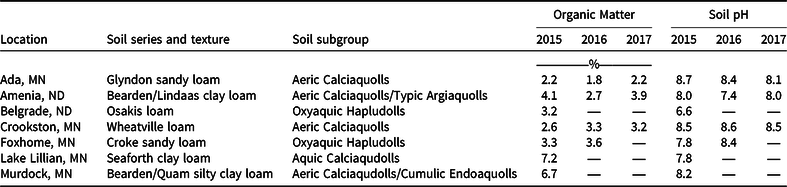
Field experiments were conducted in 2015, 2016, and 2017 at locations relevant to sugarbeet production in Minnesota and North Dakota. Location-year combinations herein referred to as an environment included a range in soil texture and OM content and provided a spectrum of environments to determine S-metolachlor effect on sugarbeet growth, development, and yield (Table 1). Soil was sampled from the surface to a depth of 15 cm and analyzed to measure OM, NO3-N, phosphorous, potassium, and pH. The experimental area was fertilized according to a soil test and prepared for sugarbeet planting with spring cultivation. Experimental treatments were arranged in a randomized complete block design and plot size was 3.3-m wide by 9.1-m long. Replications varied by year from 4 to 12.
Soil description across environments, 2015, 2016, and 2017.

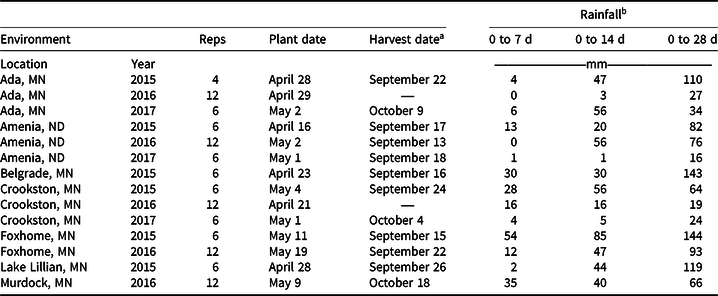
Crystal ‘981RR’ (ACH Seeds, Eden Prairie, MN) seed was treated with hymexazol (Tachigaren 70 WP, Mitsui Chemicals Agro, Tokyo, Japan) and penthiopyrad (Kabina ST, Mitsui Chemicals Agro, Tokyo, Japan) fungicide at 45 and 12 g, respectively, per 100,000 seeds. Seed was also treated with insecticide (Poncho Beta, Bayer Crop Science, Research Triangle Park, NC) containing active ingredients clothianidin and beta-cyfluthrin at 150 ml product per 100,000 seeds. Planting date ranged from April 16 to May 19 across environments (Table 2). Seed was planted in rows spaced 56 cm apart approximately 3-cm deep at approximately 152,000 seeds (±1,000) ha−1 or approximately 12-cm spacing between seeds along the row.
Plant and harvest date and cumulative rainfall 7, 14, and 28 d after planting, across environments, 2015, 2016, and 2017.

a Experiments at Ada 2016 and Crookston 2016 were terminated due to erratic sugarbeet emergence.
b Rainfall data collected using instrumentation managed by the North Dakota Agricultural Weather Network, Northwest Research and Outreach Center, Crookston, MN, and Community Collaborative Rain, Snow and Hail Network.
S-metolachlor was applied PRE at 0, 0.54, 1.08, 2.16, and 4.32 kg ai ha−1 immediately following sugarbeet planting using a bicycle wheel plot sprayer with a shielded boom to reduce particle drift and calibrated to deliver 159 L ha−1 through 8002XR nozzles (XR TeeJet® Flat Fan Spray Tips, TeeJet® Technologies, Glendale Heights, IL) spaced 51 cm apart and pressurized with CO2 at 207 kPa. Glyphosate (Roundup PowerMax®, Monsanto Company, St Louis, MO) was broadcast applied as needed to ensure the experiment remained weed-free. Fungicides were applied as needed to control rhizoctonia root rot (Rhizoctonia solani Kühn) and cercospora leaf spot (Cercospora beticola Sacc.). Rainfall was collected from nearby weather stations operated by North Dakota Agricultural Weather Networks, Community Collaborative Rain, Snow and Hail Network, and the University of Minnesota Experiment Station.
Sugarbeet tolerance to S-metolachlor was evaluated by counting sugarbeet plants in the middle two rows of each plot at the 2- to 4-leaf stage and again before harvest and by assessing sugarbeet stature reduction at the 2- to 4-leaf and 6- to 8-leaf stages. Evaluation was a visual estimate of injury ranging from 0% (no reduction in stature) to 100% (all plants completely eliminated) relative to the untreated control rows between individual plots. Evaluation ranged from 31 to 48 d after planting (DAP) and from 47 to 58 DAP for 2- to 4-leaf and 6- to 8-leaf sugarbeet, respectively, since the number of days to achieve the appropriate growth stage was dependent on environment. At harvest, sugarbeet was defoliated and harvested mechanically from the center two or three rows of each plot and weighed. A 10-kg sample was collected from each plot and analyzed for sucrose content and sugar loss to molasses by American Crystal Sugar Company (East Grand Forks, MN). Harvest date across environments ranged from September 15 to October 18 (Table 1). Root yield (kg ha−1), purity (%), and recoverable sucrose (kg ha−1) were calculated using Equations 1–3.
 $${\rm{Root}}\;{\rm{yield}}\;\left( {{\rm{kg}}/{\rm{ha}}} \right) = {\rm{ }}{{{\rm{Harvested}}\;{\rm{plot}}\;{\rm{weight}}\;\left( {{\rm{kg}}} \right)} \over {{\rm{Area}}\;{\rm{of}}\;{\rm{harvested}}\;{\rm{plot}}\;\left( {{\rm{ha}}} \right)}}$$
 $${\rm{Purity}}\;\left( \% \right) = {\rm{ }}{{\% \;{\rm{sucrose}}\;{\rm{content}}\; - \;\% \;{\rm{sugar}}\;{\rm{loss}}\;{\rm{to}}\;{\rm{molasses}}} \over {\% \;{\rm{sucrose}}\;{\rm{content}}}} \times \;100$$
 $${\rm{Recoverable}}\;{\rm{sucrose}}\;\left( {{\rm{kg}}/{\rm{ha}}} \right){\rm{ }}{\mkern 1mu} {\mkern 1mu} {\mkern 1mu} {\mkern 1mu} = {\rm{ }}\left( {{{\left[ {\left( {\% \;{\rm{purity}}/100} \right)\; \times \;\% \;{\rm{sucrose}}\;{\rm{content}}} \right]} \over {100}}} \right)\; \times \;{\rm{root}}\;{\rm{yield}}$$
Growth Chamber Experiments
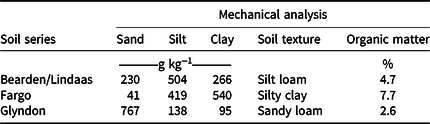
Field soils were selected based on OM and texture diversity for growth chamber experiments: Glyndon sandy loam (coarse-silty, mixed, superactive, frigid Aeric Calciaquolls); Fargo silty clay (fine, smectitic, frigid Typic Epiaquerts); and a homogenous mix of Bearden/Lindaas silt loam (fine-silty, mixed, superactive, frigid Aeric Calciaquodolls/fine, smectitic, frigid Typic Argiaquolls). Other characteristics of soils are found in Table 3. Soil was collected from the surface to 15-cm depth, screened through a 6-mm sieve, air-dried, and stored at 22 C until needed (approximately 2 to 4 mo). Field capacity (FC) was determined by weight for each soil type as described by Conklin and Lym (Reference Conklin and Lym2013) in a preliminary experiment. Four-hundred grams of soil was weighed and transferred into each 10 cm by 10 cm by 10 cm pot (Tessman Company, Fargo, ND). The pot base and sides were externally wrapped in aluminum foil to prevent water loss from leaching. Pots contained five equally spaced sugarbeet seeds of one experimental variety with less S-metolachlor tolerance based on preliminary screening. Sugarbeet were seeded using a standardized procedure, developed during preliminary experiments, to an accurate seeding depth of 2.5 cm. Soils were brought to respective field capacities before S-metolachlor application. The desired FC was maintained by weighing pots daily and adding water as needed.
Characteristics of soils from growth chamber experiments.

The experiment was a split-plot factorial treatment arrangement with six replications conducted over time. Temperature (14 or 21 C) was the whole-plot treatment; subplot treatments were S-metolachlor rate (0, 0.54, 1.08, 1.61, and 2.16 kg ai ha−1), soil series (Bearden/Lindaas silt loam, Fargo silty clay, and Glyndon sandy loam), and water content (75% or 100% FC). FC and air temperature values were derived from preliminary experiments and a review of the literature (Cassel and Nielsen Reference Cassel, Nielsen and Klute1986; Shaner Reference Shaner2014). S-metolachlor rates reflected field experiments.
S-metolachlor was sprayed over pots using a DeVries Generation III spray booth (Generation III, DeVries Manufacturing, Hollandale, MN) equipped with a TeeJet® 8001XR nozzle calibrated to deliver 100 L ha−1 spray solution at 276 kPa and 4.8 km h−1. After S-metolachlor application, all pots were transferred into a growth chamber set at 7 ± 2 C and 15-h photoperiod to deliver a light intensity of 700 µmol m−2 s−1 (GR36L, Percival Scientific, Perry, IA) for the first 7 d of the 21-d replication cycle to simulate cold and wet spring conditions conducive for S-metolachlor crop injury. All pots were transferred after 7 d into respective growth chambers set at either 14 ± 2 C (PT-80, Percival Scientific) or 21 ± 2 C (G-15, Environmental Growth Chambers, Chagrin Falls, OH) using a 15-h photoperiod that delivered a light intensity of 700 µmol m−2 s−1 for the remainder of the 21-d replication cycle.
Sugarbeet emergence was recorded daily, and density was tallied after a 21-d greenhouse run cycle. Sugarbeet number of days to emergence was recorded for each individual sugarbeet in each pot and averaged based on the total number of emerged sugarbeet plants in each pot. Sugarbeet growth was measured using total shoot fresh weight for each pot after the 21-d cycle.
Analysis
Field experiments were grouped by accumulated rainfall from planting through 14 d after S-metolachlor application. Rainfall greater than 40 mm within 7 d following S-metolachlor application increased sugarbeet injury (Bollman and Sprague Reference Bollman and Sprague2008). In these experiments, the interval to accumulate 40 mm of rainfall was increased from 7 to 14 d to account for differences in growing conditions in Minnesota and North Dakota compared with Michigan. Fourteen days is also S-metolachlor’s half-life (Cao et al. Reference Cao, Wang, Liu, Zhao and Han2008). Two of 14 environments were abandoned due to exceptionally dry conditions causing erratic sugarbeet emergence in 2016. Data were analyzed using the GLIMMIX procedure in SAS (v. 9.4, SAS Institute, Cary NC) to test for treatment effects and significant interactions. In field experiments, herbicide treatment and environment were considered fixed effects, while replicate was considered random effect with expected mean squares as recommend by Moore and Dixon (Reference Moore and Dixon2014). Type III statistics were used to test the fixed effects and least-squares means were separated using Fisher’s protected LSD at α = 0.05. Regression analysis was performed using SAS. Orthogonal contrasts were written to determine whether independent and dependent variables were best fit to linear, quadratic, or cubic regressions. In the greenhouse, run, temperature, S-metolachlor rate, soil series, and FC were considered fixed effects, while replicate was considered a random effect with expected mean squares as recommend by Moore and Dixon (Reference Moore and Dixon2014). Type III statistics were used to test the fixed effects and least-squares means were separated using Fisher’s protected LSD at α = 0.05. Data were analyzed using the gamma, Poisson, or gaussian (normal) distributions depending on data type, as count data often do not follow a normal distribution.
Results and Discussion
Field and Growth Chamber Experiments
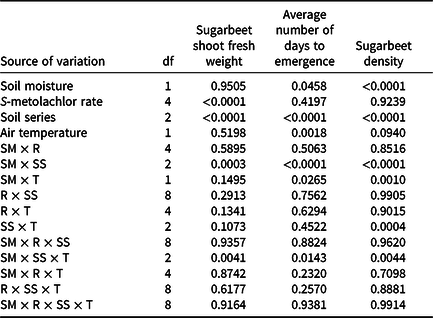
Sugarbeet planting dates ranged between April 16 and May 19 across environments, which is typical for sugarbeet production in eastern North Dakota and Minnesota (Giles and Cattanach Reference Giles and Cattanach2004; Smith Reference Smith2003) (Table 2). Air temperature and rainfall data were collected and recorded daily across environments using instrumentation nearest to the experiment (Table 2). Average air temperature was similar in the month of May in 2015 (13 C), 2016 (16 C), and 2017 (14 C) across environments. Soils representing a range in soil texture and OM across the sugarbeet-growing region were used for growth chamber experiments (Table 3). Sources of variation in growth chamber experiments were the main effects of S-metolachlor rate, soil series, air temperature, soil moisture, and interactions thereof (Table 4).
P-values for growth chamber experiments on sugarbeet response to S-metolachlor in relation to soil series, soil moisture, and air temperature with parameters including sugarbeet total shoot fresh weight per pot, days to emergence, and density.a

a Abbreviations: SM, soil moisture; R, S-metolachlor rate; SS, soil series; T, air temperature; df, degrees of freedom.
Air Temperature, Rainfall, and S-Metolachlor Rate
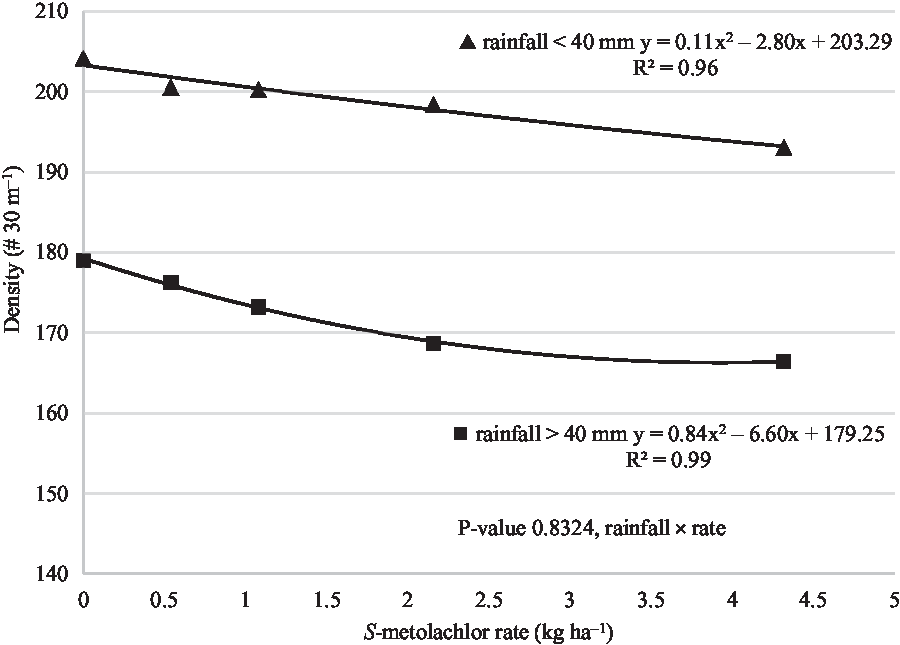
Sugarbeet density decreased as S-metolachlor rate increased in environments receiving less than 40-mm cumulative rainfall to 14 d after seeding (dry) and in environments receiving more than 40-mm cumulative rainfall to 14 d after seeding (wet) (Figure 1). Although density was greater in dry than wet environments, the shape and direction of the regression line indicates density responded the same to S-metolachlor rate in dry and wet environments (P = 0.8324, rainfall × rate). Density differences in response to environment were greater than density differences in response to S-metolachlor rate. Sugarbeet density in response to S-metolachlor rate was best explained by the quadratic equation.
Sugarbeet density (# 30 m−1, number of plants per 30-m row) in response to S-metolachlor rate (kg ha−1), grouped by environments with less than or greater than 40-mm cumulative rainfall through 14 d after planting in 2015, 2016, and 2017.

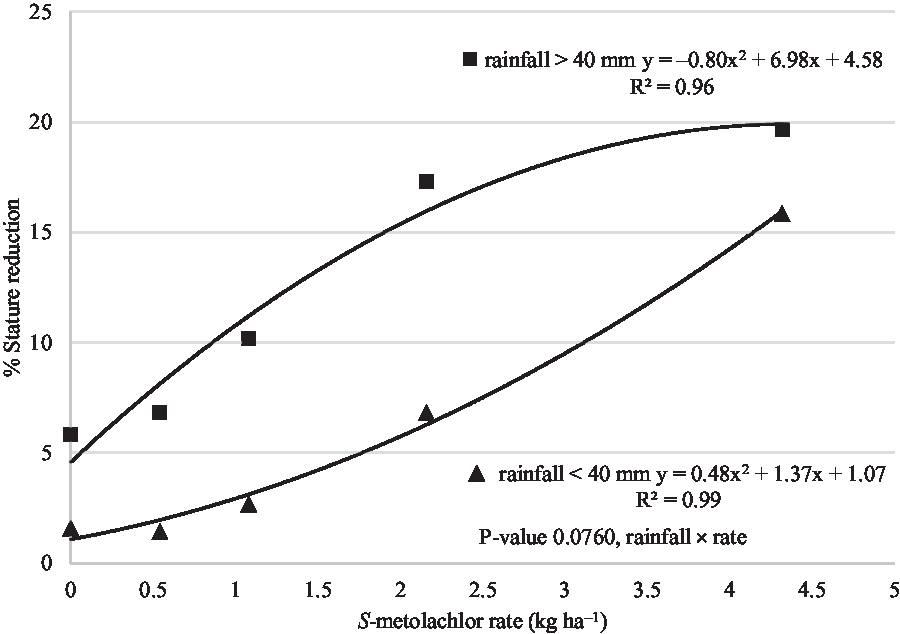
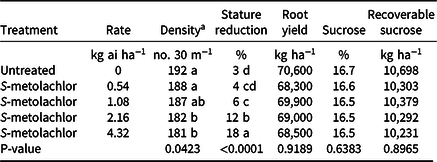
Sugarbeet injury, noted as visible reduction in stature between treated and untreated areas in the experimental unit, increased in response to S-metolachlor rate in dry and wet environments (Figure 2, P = 0.0760, rainfall × rate). Differences between environments were dependent on S-metolachlor rate. Moreover, differences in stature reduction in wet and dry environments following 0.54, 1.08, and 2.16 kg ha−1S-metolachlor were greater than differences in stature reduction in wet and dry environments following 4.32 kg ha−1S-metolachlor or in the untreated control. Finally, stature reduction in response to 4.32 kg ha−1S-metolachlor in dry environments was approximately the same as 2.16 kg ha−1S-metolachlor in wet environments. Sugarbeet stature reduction in response to S-metolachlor rate was best explained by the quadratic equation. That said, sugarbeet root yield (P = 0.9189), sucrose content (P = 0.6383), and recoverable sucrose (P = 0.8965) were not affected by S-metolachlor rate in either dry or wet environments (Table 5).
Sugarbeet stature reduction (%) in response to S-metolachlor rate (kg ha−1), grouped by environments with less than or greater than 40-mm cumulative rainfall through 14 d after planting in 2015, 2016, and 2017.

Sugarbeet density, stature reduction, root yield, sucrose content, and recoverable sucrose in response to application of S-metolachlor, averaged across environments receiving less than and greater than 40-mm cumulative rainfall through 14 d after application in 2015, 2016, and 2017.

a no. 30 m−1, number of plants per 30-m row. Means not sharing any letter are significantly different by t-test at the 5% level of significance.
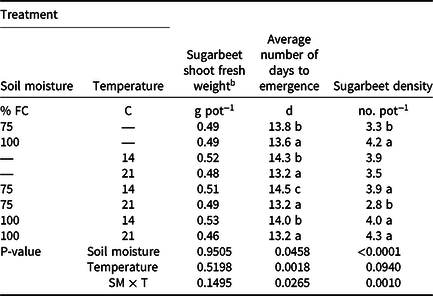
In the growth chamber, air temperature interacted with soil moisture and affected sugarbeet average number of days to emergence (P = 0.0265) and sugarbeet density (plant pot−1) (P = 0.0010) but did not affect sugarbeet shoot fresh weight (g pot−1) (P = 0.1495), averaged across S-metolachlor rate and soil series (Table 6). Average number of days to emergence (speed of emergence) and density (number pot−1) ranged from 13.2 to 14.5 d and from 4.3 to 2.8 sugarbeet (of 5 seeds planted pot−1), respectively, when averaged across soil series and S-metolachlor rate. Sugarbeet at 21 C and 75% or 100% FC emerged faster than sugarbeet at 14 C and 75% or 100% FC. At 14 C, sugarbeet emerged faster at 100% FC than 75% FC. However, sugarbeet density was more dependent on soil moisture than air temperature; total emergence at 14 and 21 C and 100% FC were the same, and sugarbeet density was greater than at 21 C and 75% FC.
Sugarbeet shoot fresh weight, average number of days to emergence, and density in response to soil moisture and air temperature averaged across S-metolachlor rate and soil series in a growth chamber.a

a Abbreviations: FC, field capacity; SM, soil moisture; T, temperature.
b Means not sharing any letter are significantly different by t-test at the 5% level of significance.
Sugarbeet production in Minnesota and eastern North Dakota is usually nonirrigated. Thus, air temperature and soil moisture content are random variables in agricultural fields, but controlled variables depending on soil-specific properties in growth chamber experiments to create treatments to investigate their contribution on sugarbeet emergence and growth following S-metolachlor application. Air temperature and soil moisture influenced overall sugarbeet density by different mechanisms following S-metolachlor application in these experiments. Air temperature affected sugarbeet speed of emergence (growth chamber), whereas soil moisture content affected overall emergence number (field and growth chamber). Speed of emergence is an important attribute in commercial sugarbeet fields, because sugarbeet are shallowly planted and soil moisture may be lost before fields have a complete sugarbeet stand. It is common in agricultural fields for the developing seedling to crack the seed coat but not emerge without enough moisture. Soil moisture content is a compromise between enough soil moisture to expedite emergence but not excessive moisture that may interact with S-metolachlor in soil solution and negatively affect sugarbeet density. Growth chamber results considering air temperature and soil moisture and resultant sugarbeet density are in agreement with results from Dexter and Luecke (2003), who reported environmental conditions contributing to rapid emergence and growth (such as warm moist soils) reduced risk of sugarbeet injury from S-metolachlor. However, air temperature and water content did not interact with S-metolachlor rate (three-way interaction) and affect sugarbeet emergence or sugarbeet shoot fresh weight in these growth chamber experiments (data not shown), and S-metolachlor rate did not adversely affect recoverable sucrose in dry or wet environments in field experiments.
Sugarbeet stature in response to S-metolachlor rate interacted with moisture and was reduced in field experiments (P = 0.0760) but shoot fresh weight (g pot−1) was unaffected by soil moisture or S-metolachlor rate in the growth chamber. Differences between field and growth chamber experiments might partially be explained by intensity and duration of rainfall and resultant soil moisture content and S-metolachlor in soil solution. In the field, rainfall often creates saturating conditions, including water ponding, which did not occur in the growth chamber as a result of the regimented daily watering schedule. However, a FC treatment greater than 100% (similar to ponding and creating an anerobic environment) likely would have increased sugarbeet injury. Additionally, timing of watering/rainfall are different between field and growth chamber experiments. In the growth chamber, S-metolachlor was immediately activated by watering to designated water content after seeding and maintained daily. Seed in field experiments is planted in soils that are well below 100% FC and rainfall may take soils to 100% FC (or greater than 100% FC in ponding scenarios). While the growth chamber experiments were designed to match field conditions, future growth chamber experiments may consider plant and the herbicide treatment application slowly brought to 75% or 100% FC after 24 or 48 h to better replicate what occurs in the field.
Rainfall, OM, Soil Series, and S-Metolachlor Rate
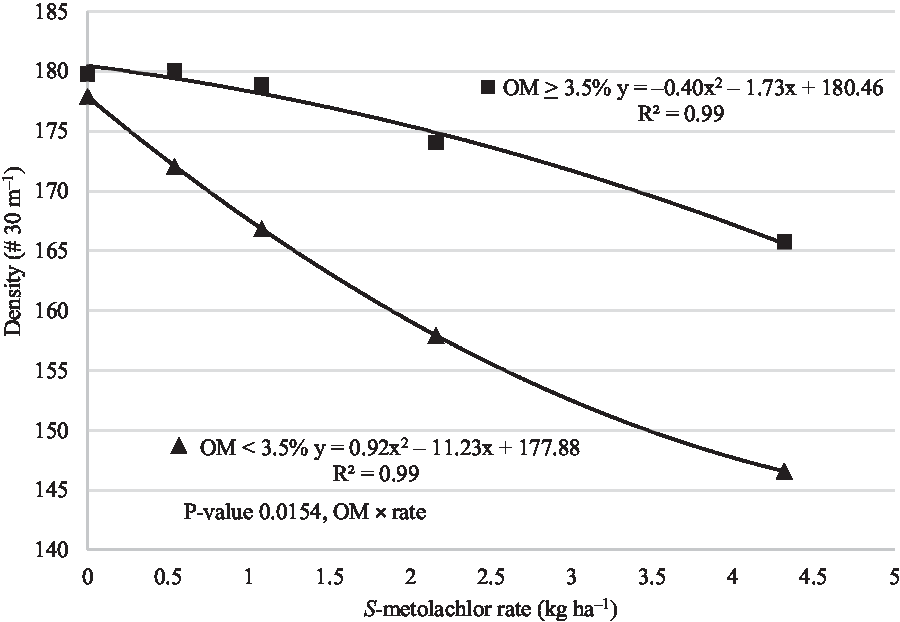
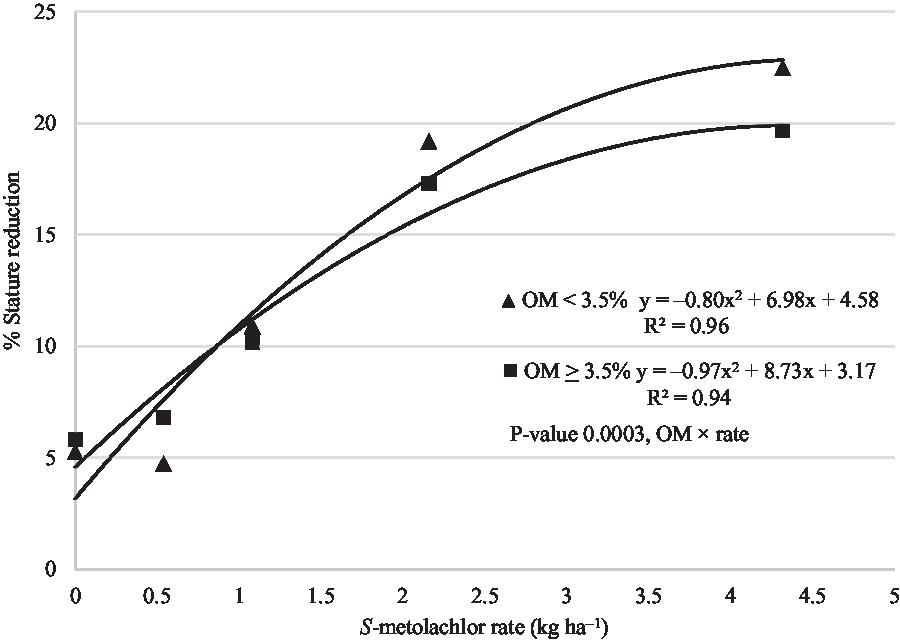
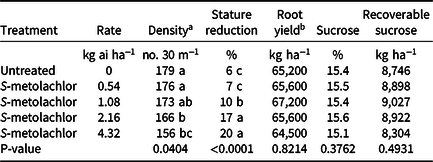
Sugarbeet density decreased and the magnitude of density differences between environments with less than 3.5% OM and greater than 3.5% OM in wet environments increased as S-metolachlor rate increased from 0.54 to 4.32 kg ha−1 (P = 0.0154, OM × rate) (Figure 3). Moreover, density following 4.32 kg ha−1S-metolachlor in environments with greater than 3.5% OM was similar to density following 1.08 kg ha−1S-metolachlor in environments with less than 3.5% OM, further demonstrating the role of OM as described by Shanner et al. (2006) in binding S-metolachlor. Sugarbeet density in response to S-metolachlor rate was best explained by the quadratic equation. Sugarbeet stature was reduced in response to S-metolachlor, but stature reduction interacted with OM and S-metolachlor rate (P = 0.0003, OM × rate) (Figure 4). Sugarbeet stature from S-metolachlor at rates to 1.08 kg ha−1 was reduced in 3.5% or greater OM soils compared with low-OM soil stature, presumably because stresses from waterlogged soils contributed to stresses caused by S-metolachlor. S-metolachlor was more readily available in soil solution in soils with less than 3.5% OM at rates greater than 1.08 kg ha−1, thus increasing sugarbeet injury compared with soils with greater than 3.5% OM. Sugarbeet stature reduction in response to S-metolachlor rate was best explained by the quadratic equation. Regardless, stand loss and/or stature reduction in response to S-metolachlor rate in low- or high-OM soils receiving greater than 40-mm cumulative rainfall up to 14 d after seeding did not affect root yield (P = 0.8214), sucrose content (P = 0.3762), and recoverable sucrose (P = 0.4931) in field experiments (Table 7).
Sugarbeet density (# 30 m−1, number of plants per 30-m row) in response to S-metolachlor rate (kg ha−1), averaged across environments with less than or greater than 3.5% organic matter (OM) content and greater than 40-mm cumulative rainfall through 14 d after application in 2015, 2016, and 2017.

Sugarbeet stature reduction (%) in response to S-metolachlor rate (kg ha−1), averaged across environments with less than or greater than 3.5% organic matter (OM) content and greater than 40-mm cumulative rainfall through 14 d after application in 2015, 2016, and 2017.

Sugarbeet density, stature reduction, root yield, sucrose content, and recoverable sucrose in response to S-metolachlor application, averaged across environments with less than and greater than 3.5% organic matter content and greater than 40-mm cumulative rainfall through 14 d after application in 2015, 2016, and 2017.

a no. 30 m−1, number of plants per 30-m row. Means not sharing any letter are significantly different by t-test at the 5% level of significance.
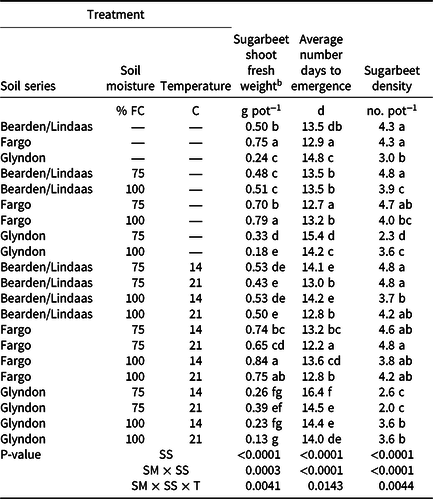
In the growth chamber, S-metolachlor applied to soils ranging in texture and OM content interacted with soil moisture and air temperature treatments (significant soil series × soil moisture × air temperature interaction) and affected sugarbeet average number of days to emergence (P = 0.0143), sugarbeet density (P = 0.0044), and sugarbeet shoot fresh weight (P = 0.0041) (Table 8). Sugarbeet emergence averaged across S-metolachlor rate ranged from 12.2 to 16.4 d. Sugarbeet emergence was fastest in the Fargo silty clay soil at 21 C and at 75% FC and was slowest in the Glyndon sandy loam soil at 14 C and 75% FC. The Fargo soil had the highest clay and OM content of the soils evaluated, and the Glyndon soil had the least. Soil series interacted with air temperature and soil water content and affected sugarbeet average number of days to emergence. At 14 C, sugarbeet emergence in the Fargo soil at 75% or 100% FC was the same, but days to emergence following S-metolachlor application was faster than emergence in the Bearden/Lindaas silt loam soil or Glyndon sandy loam soil. However, sugarbeet average number of days to emergence in Fargo soil following S-metolachlor application at 21 C and 100% FC was the same as emergence in the Bearden/Lindaas soil at 75% and 100% FC. At 21 C, speed of sugarbeet emergence in the Glyndon soil was less than emergence in the Bearden/Lindaas soil, but emergence was the same at 14 C and 100% FC.
Sugarbeet shoot fresh weight, number days to emergence, and density as influenced by soil series, soil moisture, and air temperature, averaged across S-metolachlor rate.a

a Abbreviations: FC, field capacity; SS, soil series; SM, soil moisture; T, temperature.
b Means not sharing any letter are significantly different by t-test at the 5% level of significance.
Sugarbeet density averaged across S-metolachlor rate ranged from 4.8 to 2.0 sugarbeet pot−1 depending on soil series, soil water content, and air temperature (Table 8). Density numerically was greatest in Bearden/Lindaas at 75% FC and 14 or 21 C and in Fargo soil at 75% FC and 21 C. Density was greater at 100% FC in the Glyndon soil at either 14 or 21 C than at 75% FC.
Sugarbeet shoot fresh weight, averaged across S-metolachlor rate, ranged from 0.84 to 0.13 g pot−1 and numerically was greatest in Fargo silty clay and least in Glyndon sandy loam (Table 8). Shoot fresh weight following S-metolachlor application was dependent on soil series, air temperature, and soil moisture. For example, sugarbeet in the Fargo soil at 100% FC had greater total shoot fresh weight than at 75% FC at 14 or 21 C. Sugarbeet shoot fresh weight was the same in Bearden/Lindaas soil at 75 and 100% FC and 14 and 21 C but was less than shoot fresh weight in the Fargo soil. There was no difference in sugarbeet shoot fresh weight with sugarbeet grown in Glyndon soils at 75% and 100% FC and 14 C; however, fresh weight at 100% FC was less than fresh weight at 75% FC at 21 C in the Glyndon soil following S-metolachlor application averaged across rates.
These data indicate sugarbeet density and stature development following S-metolachlor application were more dependent on attributes of soil series (soil texture and OM content) and characteristics of environment (rainfall and soil resultant water content and air temperature) than S-metolachlor rate. Sugarbeet density loss following S-metolachlor application was more pronounced in environments with less than 3.5% OM, in field experiments, or in pots with sandy loam soils in chamber experiments, because S-metolachlor was readily available for uptake by sugarbeet. In contrast, sugarbeet density was greater in soils with OM > 3.5%, in field experiments or in greenhouse pots with Fargo silty clay (7.7% OM) or Bearden/Lindaas silt loam (4.7% OM) soils, because S-metolachlor was bound and not available in the soil solution (Pusino et al. Reference Pusino, Liu and Gessa1992; Shaner et al. Reference Shaner, Brunk, Belles, Westra and Nissen2006). Other researchers have noted similar sugarbeet stand inconsistency following S-metolachlor application (Bollman and Sprague Reference Bollman and Sprague2008; Dexter and Luecke Reference Dexter and Luecke2004; Peters et al. Reference Peters, Lueck and Carlson2019). Previous research conducted by Peters et al. (Reference Peters, Lueck and Carlson2019) reported sugarbeet density reduction occurred in some, but not all environments following S-metolachlor PRE at 1.60 kg ha–1 or S-metolachlor PRE at 0.80 kg ha–1 plus ethofumesate at 1.68 kg ai ha–1 alone or followed by POST applications of dimethenamid-P at 0.95 kg ha–1. Sugarbeet injury was greatest in environments with less than 3.5% OM (2.6% OM actual), when air temperature was cooler than in environments with no injury, and when cumulative rainfall to 14 d after seeding equaled or was greater than 40 mm (58 mm actual).
Sugarbeet density or stature reduction did not reduce root yield or recoverable sucrose in these field experiments. Sugarbeet recovery from early-season stature reduction caused by soil-applied herbicide treatments has been reported by other researchers. Smith and Schweizer (Reference Smith and Schweizer1983) reported sugarbeet recovered from stature reduction caused by herbicides applied PRE and POST in spring and early summer, and yield was similar to that of weed-free, untreated checks. Likewise, Bollman and Sprague (Reference Bollman and Sprague2007) reported sugarbeet overcoming injury caused by PRE herbicides applied under different tillage regimes and closed canopy and producing recoverable sucrose the same as untreated control comparisons. Sugarbeet also compensates for stand loss. Khan and Hakk (Reference Khan and Hakk2016) reported no differences in sugarbeet root yield or recoverable sucrose at densities ranging from 100 to 200 sugarbeet plants per 30-m row at 56-cm spacing between rows corresponding to harvest populations ranging from 56,970 to 113,940 sugarbeet ha–1. However, individual sugarbeet mean root weight was dependent on plant density. Root mean weight averaged 1.22 kg per individual sugarbeet at 100 sugarbeet per 100-m row but averaged 0.84 kg per individual sugarbeet at 150 or 200 sugarbeet plant per 30-m row.
Air temperature and soil moisture content interacted with soil series and reduced sugarbeet density and stature following S-metolachlor application. Air temperature and soil moisture are usually difficult to manage in agricultural fields because they are random variables. Selecting fields with medium- and fine-textured soils with greater than 3.5% OM may buffer against sugarbeet density or stature reduction, especially injury from excessive rainfall during the first 14 d following S-metolachlor application PRE. Dexter and Luecke (Reference Dexter and Luecke2004) reported environmental conditions favoring rapid seed imbibition and slow emergence, such as wet and cool soils increased the risk of sugarbeet injury. The same authors also reported soil texture and OM content did not correlate well with sugarbeet injury (Dexter and Luecke Reference Dexter and Luecke2004). We believe timing and intensity of rainfall interacts with soil texture and OM, increasing soil available water in low-OM coarse-textured soils, thereby causing S-metolachlor to desorb from clay complexes and OM and become readily available for uptake by sugarbeet. Injury is more likely related to conditions creating more available herbicide in solution and less likely related to application rate. Environmental stressors such as low air and soil temperatures or saturated water content or conditions not conducive to maximizing photosynthesis reduce available energy for the developing sugarbeet to metabolize S-metolachlor, which increases risk of sugarbeet crop injury as the result of a biological trade-off. Other stressors such as soil-borne diseases, including Rhizoctonia spp. or Aphanomyces spp., may have a similar effect and exacerbate injury caused by S-metolachlor or other abiotic factors.
Sugarbeet injury from chloroacetamide herbicides is a collection of phenotypes based on severity, including within-row variation in plant color and foliage size. Visual chlorosis occurs in moderately injured sugarbeet, and density or stature reduction is the most severe injury response. Sugarbeet overcomes these phenotypes as it develops; plants with more leaf area have greater metabolic activity, dissipating the effects of herbicide and other stressors (Bollman et al. Reference Bollman, Sprague and Penner2008).
S-metolachlor was applied alone in these experiments, but producers will use S-metolachlor alone or in mixtures in a weed management system for controlling important weeds such as waterhemp in sugarbeet. These data conclude field selection contributes more to sugarbeet tolerance to S-metolachlor PRE than S-metolachlor rate.
Acknowledgments
The authors wish to thank the Sugarbeet Research and Education Board for funding this research and ACH Seeds and SesVanderhave for providing sugarbeet seed. The authors also acknowledge undergraduate assistants Allie Folkerts, Gunnar Hanson, and Zach Thoreson for contributions in the field. No conflicts of interest have been declared.