Introduction
It is well documented that cognitive impairment is a hallmark of schizophrenia (Heaton et al. Reference Heaton, Gladsjo, Palmer, Kuck, Marcotte and Jeste2001; Palmer et al. Reference Palmer, Dawes and Heaton2009) and a better predictor of global functioning than clinical symptomatology (Green, Reference Green1996; Green et al. Reference Green, Kern, Braff and Mintz2000). Disturbances in multiple neurocognitive domains have been reported in the first episode of schizophrenia (Bilder et al. Reference Bilder, Goldman, Robinson, Reiter, Bell, Bates, Pappadopulos, Willson, Alvir, Woerner, Geisler, Kane and Lieberman2000; Addington et al. Reference Addington, Saeedi and Addington2005; Mesholam-Gately et al. Reference Mesholam-Gately, Giuliano, Goff, Faraone and Seidman2009) as well as in the prodrome (Lencz et al. Reference Lencz, Smith, McLaughlin, Auther, Nakayama, Hovey and Cornblatt2006; Eastvold et al. Reference Eastvold, Heaton and Cadenhead2007; Jahshan et al. Reference Jahshan, Heaton, Golshan and Cadenhead2010; Seidman et al. Reference Seidman, Giuliano, Meyer, Addington, Cadenhead, Cannon, McGlashan, Perkins, Tsuang, Walker, Woods, Bearden, Christensen, Hawkins, Heaton, Keefe, Heinssen and Cornblatt2010). The prodrome is the period that precedes illness onset and is characterized by a marked deviation from a person's normal level of functioning (Yung & McGorry, Reference Yung and McGorry1996). An emerging view is that the commonly observed clinical and cognitive deficits of schizophrenia patients may arise, at least in part, by dysfunction in the coordination of neural activity at the earliest stages of sensory and cognitive information processing (Green & Nuechterlein, Reference Green and Nuechterlein1999; Light et al. Reference Light, Hsu, Hsieh, Meyer-Gomes, Sprock, Swerdlow and Braff2006; Javitt, Reference Javitt2009). Schizophrenia patients exhibit deficits in basic levels of sensory information processing (Turetsky et al. Reference Turetsky, Bilker, Siegel, Kohler and Gur2009; Leitman et al. Reference Leitman, Sehatpour, Higgins, Foxe, Silipo and Javitt2010), which are present early in the course of the illness and may even precede the emergence of psychotic symptoms (Cadenhead et al. Reference Cadenhead, Light, Shafer and Braff2005; Quednow et al. Reference Quednow, Frommann, Berning, Kuhn, Maier and Wagner2008). Event-related potentials (ERP) allow investigators to interrogate early sensory processes, including sensory discrimination and the orienting and subsequent reorienting of attention, which occur outside of an individual's awareness or conscious control (Callaway & Naghdi, Reference Callaway and Naghdi1982; Ford et al. Reference Ford, Roach, Miller, Duncan, Hoffman and Mathalon2010; Holig & Berti, Reference Holig and Berti2010; Rissling et al. Reference Rissling, Makeig, Braff and Light2010).
In a passive auditory oddball paradigm, a duration-deviant stimulus elicits a mismatch negativity (MMN) response that peaks 100–200 ms after the onset of a stimulus deviance (Naatanen et al. Reference Naatanen, Gaillard and Mantysalo1978). MMN can be elicited even when participants do not attend to the stimuli (Picton et al. Reference Picton, Alain, Otten, Ritter and Achim2000). Therefore, it is assumed to reflect an automatic, sensory-based deviance detection process, although some studies have shown that MMN can be attenuated by strongly focused attention to some other stimulus sequence (Woldorff et al. Reference Woldorff, Hackley and Hillyard1991, Reference Woldorff, Hillyard, Gallen, Hampson and Bloom1998).
Deficits in MMN generation using a variety of stimulation parameters (e.g. oddball stimuli that differ in pitch or duration) represent a remarkably robust finding in chronic schizophrenia (Shelley et al. Reference Shelley, Ward, Catts, Michie, Andrews and McConaghy1991; Javitt et al. Reference Javitt, Shelley and Ritter2000a; Mathalon et al. Reference Mathalon, Ford and Pfefferbaum2000; Light & Braff, Reference Light and Braff2005a, Reference Light and Braffb; Umbricht & Krljes, Reference Umbricht and Krljes2005; Kiang et al. Reference Kiang, Braff, Sprock and Light2009). Nevertheless, the extant literature on MMN in the early stages of the disease has yielded mixed results. Some studies have identified abnormalities (Javitt et al. Reference Javitt, Shelley, Silipo and Lieberman2000b; Devrim-Ucok et al. Reference Devrim-Ucok, Keskin-Ergen and Ucok2008; Hermens et al. Reference Hermens, Ward, Hodge, Kaur, Naismith and Hickie2010) whereas others have failed to detect any significant decrements in either duration or pitch MMN in patients with a psychotic illness duration of <3 years (Salisbury et al. Reference Salisbury, Shenton, Griggs, Bonner-Jackson and McCarley2002; Valkonen-Korhonen et al. Reference Valkonen-Korhonen, Purhonen, Tarkka, Sipila, Partanen, Karhu and Lehtonen2003; Umbricht et al. Reference Umbricht, Bates, Lieberman, Kane and Javitt2006). In a prospective study of first-hospitalized patients with schizophrenia (Salisbury et al. Reference Salisbury, Kuroki, Kasai, Shenton and McCarley2007), a strong relationship was found between the progressive reductions of MMN amplitude and left hemisphere Heschl gyrus gray matter volume. To date, only one study has assessed MMN in individuals in the prodromal phase of schizophrenia (Brockhaus-Dumke et al. Reference Brockhaus-Dumke, Tendolkar, Pukrop, Schultze-Lutter, Klosterkotter and Ruhrmann2005). Duration MMN amplitudes were slightly lower in at-risk patients compared with normal controls but this difference did not reach statistical significance. The clarification of the extent of MMN deficits in the prodrome contributes to the overall efforts to identify potential markers of vulnerability to schizophrenia and may offer insights into the underlying pathological processes leading to the development of the illness.
Recent studies have also demonstrated that MMN is highly associated with psychosocial functioning in schizophrenia patients (Light & Braff, Reference Light and Braff2005b; Kawakubo et al. Reference Kawakubo, Kamio, Nose, Iwanami, Nakagome, Fukuda, Kato, Rogers and Kasai2007; Wynn et al. Reference Wynn, Sugar, Horan, Kern and Green2010; Rasser et al. Reference Rasser, Schall, Todd, Michie, Ward, Johnston, Helmbold, Case, Soyland, Tooney and Thompson2011) as well as in healthy subjects (Light et al. Reference Light, Swerdlow and Braff2007). However, only two studies have examined this relationship in first-episode patients; one showed that larger duration MMN is associated with a better score on a quality of life measure (Hermens et al. Reference Hermens, Ward, Hodge, Kaur, Naismith and Hickie2010) while the other did not find a relationship between pitch MMN and social functioning (Salisbury et al. Reference Salisbury, Kuroki, Kasai, Shenton and McCarley2007). Given the observation that the at-risk patients who do not convert to psychosis still show at least some impairments in social functioning (Ballon et al. Reference Ballon, Kaur, Marks and Cadenhead2007), it is important to determine whether measures of early sensory processing are associated with the degree of functional disability in the early stage of illness.
The MMN ERP component is often followed by the P3a, a frontocentral positive wave peaking between 250 and 300 ms. The P3a component is assumed to reflect the covert orienting or shift in attention (Friedman et al. Reference Friedman, Cycowicz and Gaeta2001). Several studies have found that P3a amplitude in response to infrequent non-target or distracter stimuli is reduced in schizophrenia patients (Grillon et al. Reference Grillon, Courchesne, Ameli, Elmasian and Braff1990a, Reference Grillon, Courchesne, Ameli, Geyer and Braffb; Mathalon et al. Reference Mathalon, Ford and Pfefferbaum2000; Grzella et al. Reference Grzella, Muller, Oades, Bender, Schall, Zerbin, Wolstein and Sartory2001). Nonetheless, only one study has examined P3a in the early stages of the illness, finding impairment in first-episode psychosis patients (Valkonen-Korhonen et al. Reference Valkonen-Korhonen, Purhonen, Tarkka, Sipila, Partanen, Karhu and Lehtonen2003). To our knowledge, P3a has yet to be examined in subjects at risk for developing psychosis.
Automatic sensory discrimination and covert shifting of attention are important to our understanding of schizophrenia, as is the reorienting of attention or the automatic preparation for detecting subsequent stimulus changes (Naatanen et al. Reference Naatanen, Simpson and Loveless1982). This attentional reorienting may be reflected in an automatically elicited late negativity that follows the P3a, peaks at latencies between 400 and 600 ms, and is centered on frontocentral electrodes (Otten et al. Reference Otten, Alain and Picton2000; Schroger et al. Reference Schroger, Giard and Wolff2000). This component has been referred to as the ‘reorienting negativity (RON)’ (Schroger & Wolff Reference Schroger and Wolff1998). RON has been considered an automatically elicited response component during active auditory (Schroger et al. Reference Schroger, Giard and Wolff2000) and visual (Escera et al. Reference Escera, Alho, Winkler and Naatanen1998, Reference Escera, Yago and Alho2001) discrimination tasks (Escera & Corral, Reference Escera and Corral2007). To date, there are no published reports of RON in schizophrenia spectrum populations or in passive auditory paradigms.
The MMN, P3a and RON complex provides a serial, hierarchical neurophysiological index of the cascade of three main processes involved in involuntary attention control (automatic change detection, orienting of attention and reorienting of attention), following deviant stimuli (Berti et al. Reference Berti, Roeber and Schroger2004; Horvath et al. Reference Horvath, Winkler and Bendixen2008). When examined separately, those components may index discrete processes with dissociable underlying neural and genomic substrates as well as relationships to symptoms and functional outcome (Braff & Light, Reference Braff and Light2004; Light & Braff, Reference Light and Braff2005a; Light et al. Reference Light, Williams, Minow, Sprock, Rissling, Sharp, Swerdlow and Braff2010).
The primary aim of the present study was to cross-sectionally examine the MMN/P3a/RON response complex across different stages of schizophrenia by assessing the extent of MMN, P3a and RON amplitude reductions in (1) at-risk subjects, (2) recent-onset and (3) chronic schizophrenia patients relative to normal controls. We hypothesized that MMN, P3a and RON amplitudes would be significantly reduced in recent-onset and chronic patients relative to normal controls and that the amplitudes of the at-risk subjects would lie in between those of the normal controls and those of the recent-onset patients. The secondary hypothesis was that MMN, P3a and RON deficits would be associated with symptoms and social functioning impairment within the patient groups.
Method and materials
Subjects
At-risk subjects (n=26), recent-onset patients (n=31), chronic patients (n=33), and normal control subjects (n=28) were enrolled in the study. At-risk and recent-onset patients were selected from a pool of individuals who were participating in the Cognitive Assessment and Risk Evaluation program at UCSD and referred to the Schizophrenia Program laboratory for electroencephalography (EEG) testing. They were help-seeking and receiving treatment as usual (pharmacological or psychosocial) according to their presenting symptoms. Chronic patients were recruited from community residential facilities and via physician referral. Normal control subjects were recruited through newspaper advertisements and flyers posted at the UCSD medical center. Subjects aged >18 years were asked to give informed consent. Those aged <18 (n=12) provided assent and their guardian was asked to sign a consent form for study participation. All participants were tested on a passive auditory oddball paradigm and scheduled for a short clinical evaluation on the day (if possible), or within 1 month, of their EEG recording session.
The Structured Interview for Prodromal Symptoms (SIPS; Miller et al. Reference Miller, McGlashan, Rosen, Cadenhead, Cannon, Ventura, McFarlane, Perkins, Pearlson and Woods2003) was used to identify subjects at risk for psychosis and to measure the severity of prodromal symptoms. The majority of the at-risk subjects met criteria for at least one of the two most common prodromal syndromes (Seeber & Cadenhead, Reference Seeber and Cadenhead2005; Yung et al. Reference Yung, Yuen, McGorry, Phillips, Kelly, Dell'Olio, Francey, Cosgrave, Killackey, Stanford, Godfrey and Buckby2005) per the SIPS: ‘Attenuated Positive Symptom’ (new onset of subsyndromal psychotic symptoms) and ‘Genetic Risk and Deterioration’ (family history of schizophrenia in a first-degree relative or criteria for schizotypal personality disorder met in patient, associated with a decline in global functioning over the past year). The recent-onset and chronic patients had a DSM-IV diagnosis of schizophrenia and a mean duration of illness of 1.2±0.82 and 10.7±3.3 years respectively. Normal control subjects were not included if they had a history of mental illness or learning disability, cluster A personality disorder or prodromal symptoms, a family history of psychotic illness, or a history of taking psychotropic medications.
Axis I and Axis II diagnoses were assessed with the Structured Clinical Interview for DSM-IV Axis I Disorders (First et al. Reference First, Spitzer, Gibbon and Williams1995) and the Structured Interview for DSM-IV Personality Disorders (Pfohl et al. Reference Pfohl, Blum and Zimmerman1995), respectively. The Kiddie-Schedule for Affective Disorders and Schizophrenia (Chambers et al. Reference Chambers, Puig-Antich, Hirsch, Paez, Ambrosini, Tabrizi and Davies1985) was administered to patients aged <16 years (n=6). Subjects with a history of head injury, seizures, neurological disorder, or an IQ <80 were excluded from the study. Those who met DSM-IV criteria for lifetime substance abuse/dependence were included in the sample unless they endorsed having used substances during the month preceding neurophysiological testing or their urine toxicology test results were positive.
Clinical symptoms were evaluated using the Scales for the Assessment of Positive Symptoms (SAPS; Andreasen et al. Reference Andreasen, Endicott, Spitzer and Winokur1977) and Negative Symptoms (SANS; Andreasen, Reference Andreasen1984). Current level of functioning was assessed with the Modified Global Assessment of Functioning (GAF; Hall & Parks, Reference Hall and Parks1995). Family history of psychiatric illness was assessed, after receiving consent to contact a relative, using the Family History Research Diagnostic Criteria (Andreasen et al. Reference Andreasen, Endicott, Spitzer and Winokur1977). Six at-risk and three recent-onset patients had a first-degree relative with psychosis. Seven at-risk, 25 recent-onset and 31 chronic patients were on at least one atypical antipsychotic with or without other psychotropic medications at the time of testing. These at-risk subjects were prescribed antipsychotics for their attenuated positive symptoms or other mood problems that required treatment. Two of the 26 at-risk subjects transitioned to psychosis; one converted to psychotic mania and one to schizophrenia 25 days and 1 year after their ERP testing, respectively.
Neurophysiological testing
EEG recordings were acquired with a Neuroscan NuAmp system (Neuroscan, USA). EEG was recorded from the scalp using 34 electrodes attached to an electrode cap. The following 34 equidistant electrode positions were used: Fp1, Fp2, Fz, F3, F4, F7, F8, FC1, FC2, FC5, FC6, Cz, C3, C4, CP1, CP2, CP5, CP6, Pz, P3, P4, P7, P8, O1, O2, PO9, PO10, Iz, T1, T2, T7, T8, TP9, TP10. A reference electrode was placed at the nose tip, in addition to a ground electrode at Fpz. Four additional electrodes were placed above and below the left eye as well as at the outer canthi of both eyes in order to monitor blinks and eye movements. EEG was digitally referenced off-line to linked mastoids (TP9/TP10). All impedances were kept <4 kΩ. Signals were digitized at a rate of 1 kHz with system acquisition filter settings at 0.5–100 Hz. Subjects were presented with binaural tones (1 kHz 85 dB sound pressure level, with 1 ms rise/fall) with a fixed stimulus onset-to-onset asynchrony of 500 ms using a San Diego Instruments ERP-Lab system (San Diego Instruments, USA). Standard (90% probability; 50 ms duration) and deviant (10% probability; 100 ms duration) tones were presented in pseudorandom order using foam insert earphones. During EEG recording, subjects were instructed to watch a silent cartoon video. EEG acquisition was terminated when a minimum of 225 artifact-free deviant trials were collected. Data processing was performed offline using automated procedures. Continuous recordings were mathematically corrected for eye movement artifact employing standard procedures (Semlitsch et al. Reference Semlitsch, Anderer, Schuster and Presslich1986). Continuous data were divided into epochs relative to the onset of stimuli (−100 to 500 ms) and centered at the mean of the pre-stimulus baseline. Following blink correction, epochs containing >+50 μV in frontal recording sites were automatically rejected. MMN waveforms were generated by subtracting the ERP waveforms in response to standard tones from the waveforms elicited by the deviant tones. The resultant difference waves were low-pass filtered at 20 Hz (zerophase shift, 24 dB/octave roll-off) to remove any residual high-frequency artifact consistent with established methods (Light & Braff, Reference Light and Braff2005a, Reference Light and Braffb; Light et al. Reference Light, Swerdlow and Braff2007; Kiang et al. Reference Kiang, Braff, Sprock and Light2009). ERP component peaks were manually identified using butterfly plots, mean global field power, topographical inspection and comparison of individual frontocentral and mastoid electrodes. This allowed for the confirmation of polarity inversion at mastoid electrodes for MMN analyses. Search windows for peak MMN, P3a, and RON were 135–205, 250–350, and 350–500 ms, respectively. Mean amplitudes in the 25 ms surrounding the identified peaks were then automatically calculated for each electrode.
Statistical analyses
In order to investigate group differences in MMN, P3a and RON amplitudes, a repeated measures analysis of variance (ANOVA) with electrode site as the within-subject variable and diagnostic group as the between-subject variable was performed for each component. Greenhouse-Geisser adjustments were used for repeated measures ANOVAs that contained more than one degree of freedom. Significant group×electrode interactions were decomposed using a series of one-way ANOVAs to assess group effects at each of the frontocentral electrodes. Cohen's d was also calculated to further characterize group differences and minimize the reliance on p values for interpreting potential effects. Relationships between MMN, P3a, and RON amplitudes at frontocentral sites and GAF, SAPS, SANS, and SIPS ratings were investigated using Spearman rank correlations. Only significant correlations at contiguous electrodes were reported.
Results
Sample characteristics
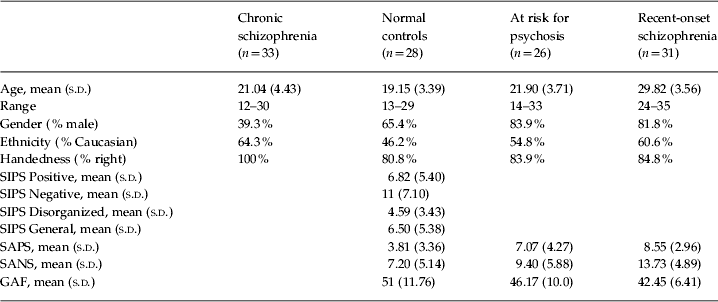
There were significant group differences in age (F 3,114=47.75, p<0.001) and education (F 3,113=3.76, p=0.01). As expected, the chronic schizophrenia group was significantly older than all the other groups (p<0.001) and had significantly fewer years of education than the normal control group (p=0.02). The at-risk group was also significantly younger than the recent-onset group (p=0.04). There were no significant group differences in ethnicity (χ2 12=15.37, p=0.22) and handedness (χ2 6=7.03, p=0.32) but there were significantly more males than females in the patient groups relative to the normal control group (χ2 3=17.34, p=0.001). As expected, there were significant differences in SAPS (F 2,81=11.38, p<0.001), SANS (F 2,80=10.53, p<0.001) and GAF (F 2,80=5.47, p=0.006) among the patient groups, with significantly less severe positive symptoms in the at-risk relative to the recent-onset (p=0.006) and chronic (p<0.001) groups. Similarly, the chronic group had significantly more severe negative symptoms (SANS) than the recent-onset (p=0.006) and at-risk (p<0.001) groups and more impairment in global functioning (GAF) than the at-risk group (p=0.004) (Table 1).
Demographic and clinical characteristics

SIPS, Structured Interview for Prodromal Symptoms; SAPS, Scale for the Assessment of Positive Symptoms; SANS, Scale for the Assessment of Negative Symptoms; GAF, Global Assessment of Functioning.
Given the significant group differences in age and results from our preliminary analyses showing that older age was associated with smaller MMN (r=0.36–0.57; Fp1, Fp2, F7, F8, Fz, F3, F4, FC2), P3a (r =−0.35 to −0.53; Fp2, F8, F4, C4) and RON (r=0.38–0.46; Fz, F3, F4, FC1, FC2, Cz) activity in the chronic group (p<0.05), we included age as a covariate in each of the subsequent analyses. However, age was not a significant covariate for any of the components (main effect of age: F=0.17–0.52, p>0.45; electrode×age interaction: F=0.70–1.99, p>0.10) and did not affect the results. Therefore, we decided to exclude it from further analyses. Moreover, in order to control for possible gender confounds, we repeated the analyses below after including gender as another between-subject variable. No significant main effects or interactions with gender were present.
Group differences in MMN amplitudes
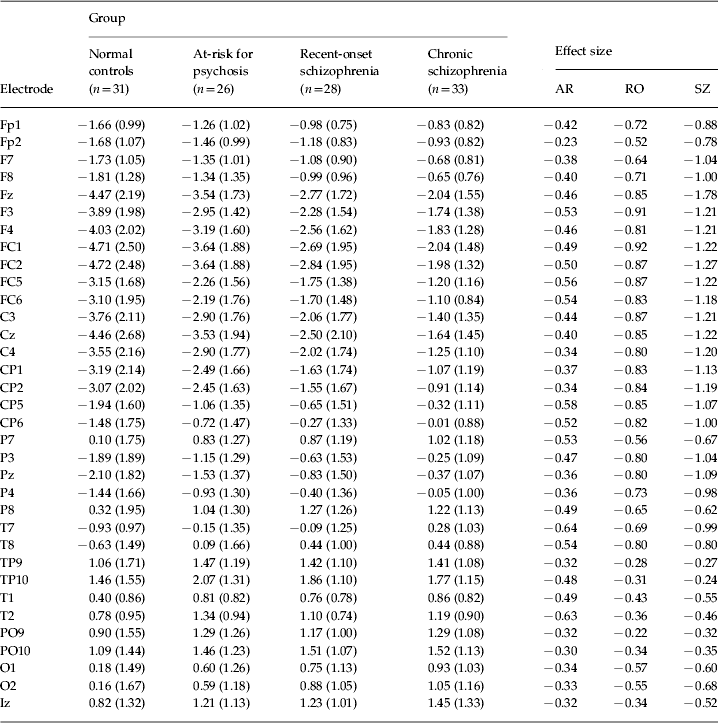
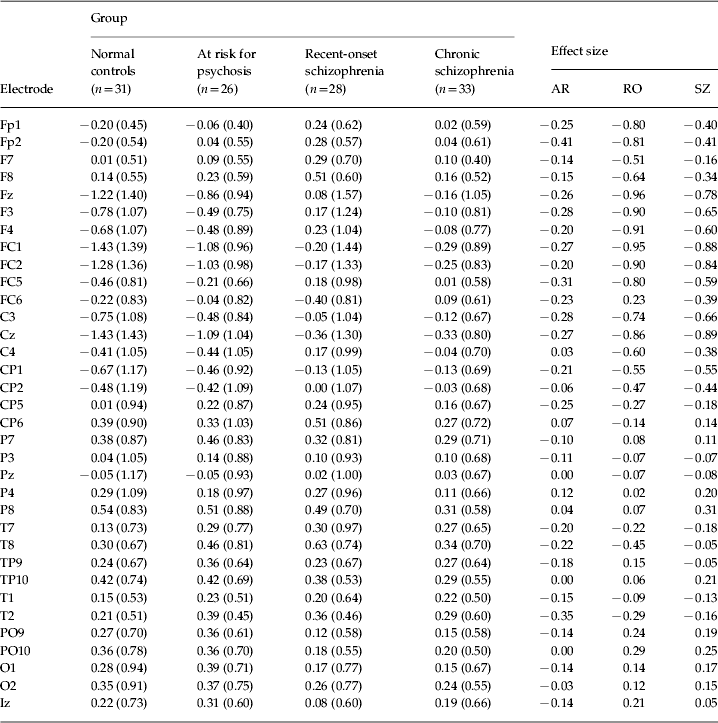
The repeated measures ANOVA revealed a significant effect of electrode (F 2.56,291.48=280.24, p<0.001) indicating a frontal maxima in the MMN amplitude distribution, with the expected polarity inversion of responses at temporo-parietal and other posterior electrodes. There was a significant group×electrode interaction (F 7.67,291.48=3.60, p=0.001), indicating the presence of deficits at frontocentral but not temporo-parietal sites. The follow-up ANOVA revealed significant group differences at p<0.01 at all frontocentral electrodes, with the largest effect size differences at FC1. Relative to the normal control group, the chronic (d=−0.78 to −1.78) and recent-onset (d=−0.52 to −0.92) groups had large effect-size MMN decrements at frontocentral recording sites (Fp1, F7, F8, Fz, F3, F4, FC1, FC2, FC5, FC6, C3, Cz, C4, CP1, CP2, CP5 and CP6; p<0.01). Similarly, the at-risk group had significant medium effect-size (d=−0.49 to −0.64) MMN reductions at F3, FC1, FC2, FC5, FC6, CP5 and CP6 (p<0.05) relative to the normal control group. There were no significant MMN amplitude differences between the at-risk and recent-onset groups. However, the at-risk group had significantly smaller MMN amplitudes at all frontocentral electrodes (p<0.01) relative to the chronic group. There were no significant group differences in peak MMN latency (F 3,114=2.29, p=0.08; mean=182.52, s.d.=20.0). Mean MMN amplitudes, standard deviations and effect sizes for each electrode site are presented in Table 2.
Descriptive statistics and effect sizes of MMN relative to normal controls

MMN, Mismatch negativity; AR, at-risk; RO, recent-onset schizophrenia; SZ, chronic schizophrenia.
Data are given as mean (s.d.) amplitude of event-related potential response. Effect sizes are calculated as Cohen's d.
Group differences in P3a amplitudes
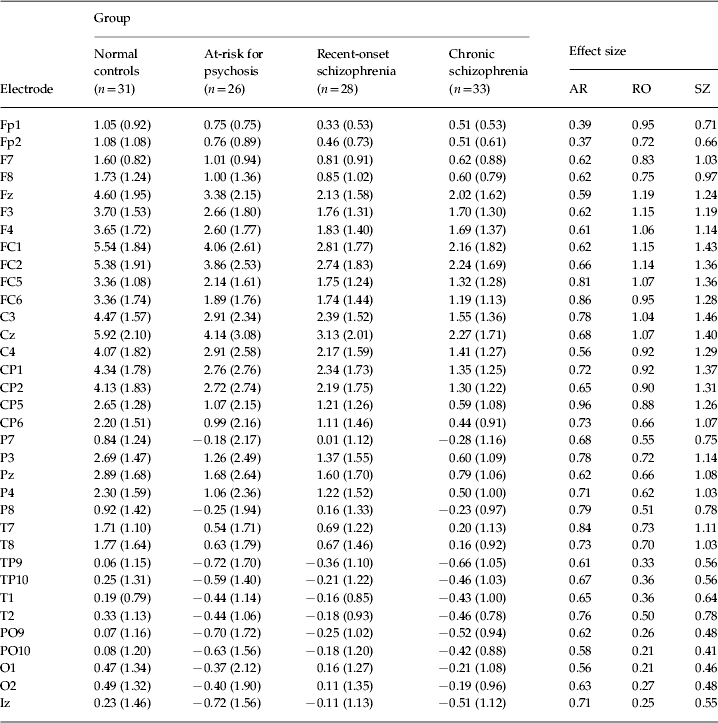
The repeated measures ANOVA revealed a significant effect of electrode (F 3.38,385.84=213.20, p<0.001) indicating that the P3a response was maximal at frontocentral electrodes, as well as a significant group×electrode interaction (F 10.15,385.84=6.33, p<0.001), indicating the presence of deficits at frontocentral but not temporo-parietal sites. The follow-up ANOVA revealed significant group differences at p<0.01 at all frontocentral electrodes, with the largest effect-size differences at FC1. Both the chronic (d=0.71–1.46) and recent-onset (d=0.66–1.19) patients had significant P3a deficits at p<0.01 at all frontocentral recording sites. The at-risk group had medium to large effect-size (d=0.56–0.96) reductions in P3a amplitudes relative to the normal control group, which were significant at FC1, FC2, FC5, FC6, C3, Cz, CP1, CP2, CP5 and CP6 (p<0.01) as well as F7, F8, Fz, F3, F4 and C4 (p<0.05). Moreover, there were significant P3a amplitude differences between the at-risk and recent-onset groups at Fp1, F3, Fz, FC1 and FC2 (p<0.05), as well as between the at-risk and chronic groups at Fz, FC1, FC2, C3, C4, CP1, CP2 (at p<0.01) and F3, F4, FC5 (at p<0.05). There were no significant group differences in peak P3a latency (F 3,114=0.99, p=0.40; mean=276.53, s.d.=26.33). Mean P3a amplitudes, standard deviations and effect sizes for each electrode site are presented in Table 3.
Descriptive statistics and effect sizes of P3a relative to normal controls

AR, At-risk; RO, recent-onset schizophrenia; SZ, chronic schizophrenia.
Data are given as mean (s.d.) amplitude of event-related potential response. Effect sizes are calculated as Cohen's d.
Group differences in RON amplitudes
The repeated measures ANOVA revealed a significant effect of electrode (F 3.21, 366.53=44.17, p<0.001), indicating a maximal RON response at frontocentral electrodes, as well as a significant group×electrode interaction (F 9.64,366.53=4.49, p<0.001), indicating the presence of deficits at frontocentral but not temporo-parietal sites. The follow-up ANOVA revealed significant group differences at p<0.01 only at Fz, F3, F4, FC1, FC2 and Cz. As with MMN and P3a, the largest effect-size differences were present at FC1. Both the chronic (d=−0.34 to −0.89) and recent-onset (d=−0.60 to −0.96) patients had significant RON reductions relative to the normal control subjects at Fz, F3, F4, FC1, FC2 and Cz (p<0.05). However, unlike the recent-onset and chronic patients, the at-risk subjects did not have significant RON deficits at any of the electrodes. The at-risk group had significantly larger RON amplitudes relative to both the recent-onset group (at Fz, F4, FC1, FC2; p<0.01 and Fp1, F3, FC6, Cz, C4; p<0.05) and the chronic group (at Fz, FC1, FC2 and Cz; p<0.05). There were no significant group differences in peak RON latency (F 3,114=0.57, p=0.64, mean=414.50, s.d.=47.22). Mean RON amplitudes, standard deviations and effect sizes for each electrode site are presented in Table 4.
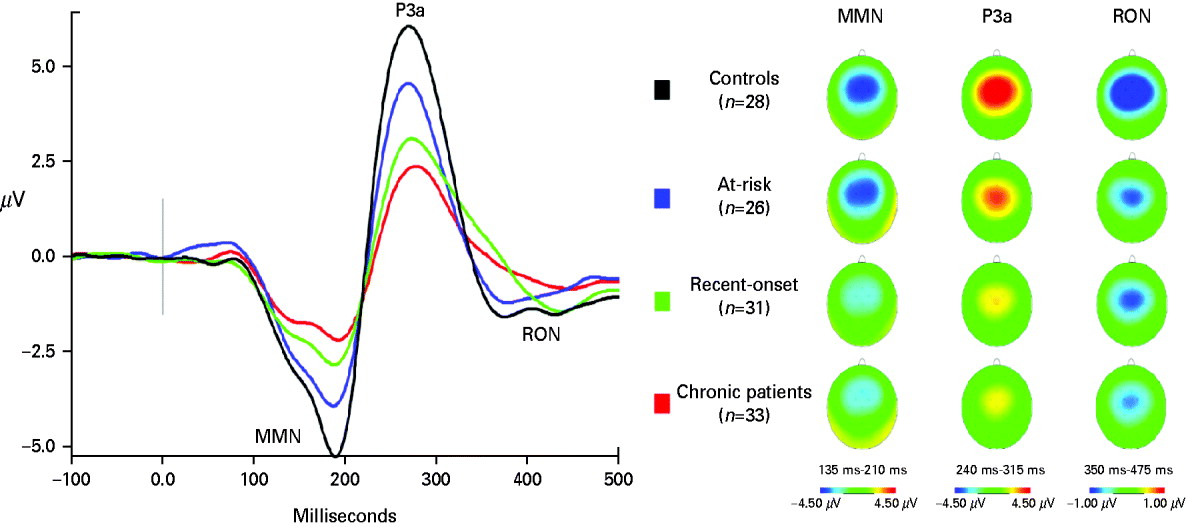
Fig. 1 shows the grand average waveforms with MMN, P3a, and RON amplitudes at FC1 for each of the groups. The at-risk group's mean MMN and P3a amplitudes were intermediate between those of the normal control group and the recent-onset group. As noted above, two of the at-risk subjects transitioned to psychosis during the study period. These subjects qualitatively appeared to have a more pronounced reduction in MMN and P3a amplitudes relative to the remaining at-risk subjects, although this small number precludes further analyses.
Grand average difference event-related potentials (ERPs), at electrode FC1, and their corresponding scalp distributions, formed by subtracting the ERP elicited by standard tones from the ERP elicited by deviant tones, for each group. MMN, mismatch negativity; RON, reorienting negativity.

Descriptive statistics and effect sizes of RON relative to normal controls

RON, Reorienting negativity; AR, at-risk; RO, recent-onset schizophrenia; SZ, chronic schizophrenia.
Data are given as mean (s.d.) amplitude of event-related potential response. Effect sizes are calculated as Cohen's d.
Relationships of MMN, P3a and RON with social functioning and clinical symptoms
Spearman rank correlation coefficients were generated in order to assess relationships between MMN, P3a and RON responses at frontocentral electrodes and social functioning as measured by the modified GAF scale ratings in the patient groups. There were significant correlations (p<0.05) between GAF and MMN (r s=−0.35 to −0.46; Fz, F3, F4, F7, F8, Fp1, Fp2, FC2, FC5, Cz, C4) at frontocentral electrodes only in the chronic patients. P3a and RON were not significantly associated with GAF in any of the patient groups.
We found no significant correlations between severity of positive or negative symptoms, as measured by the SAPS and SANS total scores, and MMN, P3a, and RON responses in the recent-onset and chronic patients. However, significant correlations (p<0.05) between SANS and RON (r s=0.46–0.52; Fp2, F4, F8), as well as between SIPS Negative and P3a at frontocentral electrodes (rs=−0.43 to −0.59; Fp1, Fp2, F8, Fz, F3, F4, FC6) were present in the at-risk group.
Discussion
To our knowledge, this is the first report to concurrently examine three ERP components (MMN, P3a, RON) of automatic, pre-attentive information processing across different stages of schizophrenia. In a between-groups design, results indicate that individuals identified as being at risk for psychosis have robust deficits in MMN and P3a, whereas patients early in the course of schizophrenia and chronic patients exhibit significant deficits in MMN, P3a and RON relative to normal controls. Although this is a cross-sectional study, the findings suggest that MMN and P3a abnormalities precede the onset of psychosis while RON deficits do not emerge until after the full manifestation of the illness. Cross-sectionally, it appears as though MMN and P3a deficits progressively increase with illness chronicity. The at-risk group also had MMN amplitudes that were intermediate between those of the normal control and recent-onset groups (although only significantly different from the normal control group's amplitudes). The at-risk group's P3a amplitudes at frontocentral electrodes were significantly different from both the normal control and recent-onset groups' amplitudes. The recent-onset group tended to show less severe MMN, P3a and RON deficits relative to the chronic group.
Our findings suggest that individuals at risk for developing a psychotic disorder as well as those with manifest schizophrenia have deficits in processing auditory stimuli or detecting changes in their acoustic environment, failing to notice stimuli that are salient to most people (Michie et al. Reference Michie, Innes-Brown, Todd and Jablensky2002). In other words, if someone has difficulty organizing sensory stimulation from their surrounding environment, they may also exhibit difficulty in mounting an appropriate response when necessary. It has been suggested that fundamental sensory processing abnormalities may result in inattentiveness and disorganization, causing significant disruption in everyday functioning (Braff & Light, Reference Braff and Light2004). Consistent with our previous results (Light & Braff, Reference Light and Braff2005a, Reference Light and Braffb), we found significant associations between psychosocial functioning and MMN in the chronic group. P3a and RON, in contrast, were not significantly associated with functional ratings in any of the patient groups.
Previous reports of the association between MMN and symptom severity have yielded inconsistent results, providing more support for an association with negative rather than positive symptoms in both chronic (Umbricht & Krljes, Reference Umbricht and Krljes2005) and first-episode (Oades et al. Reference Oades, Wild-Wall, Juran, Sachsse, Oknina and Ropcke2006; Umbricht et al. Reference Umbricht, Bates, Lieberman, Kane and Javitt2006) samples. We found no associations between MMN and negative symptoms in any the patient groups, which is consistent with previously reported findings in both first-episode (Salisbury et al. Reference Salisbury, Kuroki, Kasai, Shenton and McCarley2007) and chronic schizophrenia (Shelley et al. Reference Shelley, Ward, Catts, Michie, Andrews and McConaghy1991; Kasai et al. Reference Kasai, Okazawa, Nakagome, Hiramatsu, Hata, Fukuda, Honda, Miyauchi and Matsushita1999; Light & Braff, Reference Light and Braff2005b) patients. Nonetheless, there were significant correlations between both P3a and RON and negative symptoms in the at-risk group, suggesting that further study of the relationships and timing of the emergence of symptoms and neurophysiological abnormalities is warranted.
Certain limitations of our study require appropriate caveats, especially the fact that our samples are relatively modest and unbalanced on key demographic features. We did, however, attempt to control for these potential demographic confounds. Based on our extensive analyses, we believe that the group differences in age and gender did not markedly influence our results. The low conversion rate in our at-risk sample did not yield sufficient statistical power to employ a longitudinal design and assess the potential role of MMN/P3a/RON as predictors of conversion to psychosis. However, the inclusion of newly diagnosed and chronic schizophrenia groups alleviates this problem to some degree. Furthermore, it must be acknowledged that the influence of antipsychotic medications cannot be completely excluded since 27% of the at-risk, 81% of the recent-onset and 94% of the chronic patients were receiving antipsychotic medications at the time of testing. Independent samples t tests within the at-risk group revealed no significant differences (all d's <0.30) in MMN, P3a or RON amplitudes between patients who were taking one or more atypical antipsychotics (n=7) and those who were antipsychotic-free (n=19). Although it is hard to make any conclusions regarding treatment effects given our small sample size, there is evidence showing that MMN is uninfluenced by Olanzapine (Korostenskaja et al. Reference Korostenskaja, Dapsys, Siurkute, Maciulis, Ruksenas and Kahkonen2005), Risperidone (Umbricht et al. Reference Umbricht, Javitt, Novak, Bates, Pollack, Lieberman and Kane1999) or Clozapine (Umbricht et al. Reference Umbricht, Javitt, Novak, Bates, Pollack, Lieberman and Kane1998). Also, our patients show substantial deficits despite the possibility that Clozapine and other second-generation antipsychotics may exert some normalization of sensory ERP components (Light et al. Reference Light, Geyer, Clementz, Cadenhead and Braff2000; Horton et al. Reference Horton, Millar, Labelle and Knott2011).
Our results support the utility of examining RON in the context of MMN and P3a in studies of at-risk populations. MMN and P3a appear to be deficient before the onset of psychosis and RON deficits do not develop until later in the disease process. To date, the literature regarding the utility of the MMN to duration deviants as an endophenotype (Gottesman & Gould, Reference Gottesman and Gould2003) is inconclusive. Nonetheless, MMN and P3a may serve as possible markers of vulnerability to schizophrenia reflecting pre-morbid neuropathology. Longitudinal designs are needed to definitively determine whether the pre-attentive auditory processing abnormalities observed in the early course of schizophrenia are trait-related, worsen with illness progression, and usefully track the rate of change in subjects who convert to psychosis. It will be valuable to determine whether the size of the MMN/P3a amplitude can differentiate between subjects at various stages of the prodrome and identify those for whom psychosis is imminent. Additionally, it will be useful to ascertain whether measures derived from the MMN/P3a/RON complex can be used to predict medication adherence, academic or vocational functioning, and other instrumental activities of daily living in affected subjects (Banati & Hickie, Reference Banati and Hickie2009).
It remains an open question as to whether impairment in basic auditory sensory information processing improves sensitivity and predictive accuracy in conjunction with other known risk factors of conversion to psychosis (Cannon et al. Reference Cannon, Cadenhead, Cornblatt, Woods, Addington, Walker, Seidman, Perkins, Tsuang, McGlashan and Heinssen2008), including cannabis abuse (Kristensen & Cadenhead, Reference Kristensen and Cadenhead2007), severity of subsyndromal symptoms and decline in social functioning (Haroun et al. Reference Haroun, Dunn, Haroun and Cadenhead2006), working memory and processing speed (Jahshan et al. Reference Jahshan, Heaton, Golshan and Cadenhead2010). MMN, P3a, and RON may also serve as biomarkers of response to pharmacologic and nonpharmacologic interventions (Rissling & Light, Reference Rissling and Light2010; Rissling et al. Reference Rissling and Light2010).
Acknowledgments
This work was supported by grants from the Department of Veteran Affairs (VISN 22 Mental Illness Research, Education, and Clinical Center) and National Institute of Mental Health (MH079777; MH042228, and MH065571). The authors wish to thank Jason Nunag, Steven Reding, Kathleen Shafer, Marlena Pela, Joyce Sprock, and Richard Sharp for their assistance.
Declaration of Interest
None.