Introduction
Obsessive–compulsive disorder (OCD) is a severe and impairing illness. Cognitive-behavioral therapy (CBT) consisting of exposure and response prevention (EX/RP) is efficacious as monotherapy (Foa et al. Reference Foa, Liebowitz, Kozak, Davies, Campeas, Franklin, Huppert, Kjernisted, Rowan, Schmidt, Simpson and Tu2005) and as augmentation to medication (Simpson et al. Reference Simpson, Foa, Liebowitz, Roth Ledley, Huppert, Cahill, Vermes, Schmidt, Hembree, Franklin, Campeas, Hahn and Petkova2008). However, 13–42% of patients have a partial response and 29–41% have a poor response to treatment (Simpson et al. Reference Simpson, Huppert, Petkova, Foa and Liebowitz2006, Reference Simpson, Foa, Liebowitz, Roth Ledley, Huppert, Cahill, Vermes, Schmidt, Hembree, Franklin, Campeas, Hahn and Petkova2008). Identifying variables associated with a poorer response to EX/RP could guide the development of treatment strategies to modify these risk factors, thereby improving treatment response.
Little is known about what predicts EX/RP augmentation of serotonin reuptake inhibitor (SRI) therapy. As reviewed briefly below, most prior studies of outcome predictors of EX/RP have included patients both off and on medication, with few studies focusing on predictors of combination therapy. However, evaluating predictors of combination therapy (EX/RP plus SRIs) is important for several reasons. First, combination therapy has demonstrated a benefit over SRI monotherapy for OCD (Foa et al. Reference Foa, Liebowitz, Kozak, Davies, Campeas, Franklin, Huppert, Kjernisted, Rowan, Schmidt, Simpson and Tu2005; Tenneij et al. Reference Tenneij, van Megen, Denys and Westenberg2005). Second, many patients receiving EX/RP in real-world clinical settings are on SRIs (Blanco et al. Reference Blanco, Olfson, Stein, Simpson, Gameroff and Narrow2006). Therefore, identifying predictors of outcome to combination treatment is clinically relevant. Third, the impact of SRIs may attenuate the severity of certain EX/RP predictors such as depression (Hohagen et al. Reference Hohagen, Winkelmann, Rasche-Raeuchle, Hand, Koenig, Muenchau, Hiss, Geiger-Kabisch, Kaeppler, Schramm, Rey, Aldenhoff and Berger1998), such that differences may exist between predictors of combination therapy and EX/RP monotherapy.
Various clinical and demographic variables have been examined to determine whether they predict EX/RP outcome. These variables can be categorized into those related to OCD phenomenology, co-morbidity, demographics, and functioning. We first review findings from studies that examined patients receiving EX/RP monotherapy or, more commonly, mixed patients both on and off medication who were receiving EX/RP. Then we review the few studies that explicitly examined predictors of combination therapy.
Several variables associated with OCD phenomenology have been found to predict EX/RP outcome. In particular, severity of OCD symptoms predicted poor outcome in several studies (Keijsers et al. Reference Keijsers, Hoogduin and Schaap1994; de Haan et al. Reference de Haan, van Oppen, van Balkom, Spinhoven, Hoogduin and Van Dyck1997; Mataix-Cols et al. Reference Mataix-Cols, Marks, Greist, Kobak and Baer2002) but not all (Steketee & Shapiro, Reference Steketee and Shapiro1995). OCD characterized by compulsive hoarding predicted a poor outcome to EX/RP (Mataix-Cols et al. Reference Mataix-Cols, Marks, Greist, Kobak and Baer2002; Saxena et al. Reference Saxena, Maidment, Vapnik, Golden, Rishwain, Rosen, Tarlow and Bystritsky2002; Abramowitz et al. Reference Abramowitz, Franklin, Schwartz and Furr2003). Poor insight about obsessive fears adversely influenced treatment outcome in one small study (Foa et al. Reference Foa, Abramowitz, Franklin and Kozak1999), although larger studies showed no effect (Hoogduin & Duivenvoorden, Reference Hoogduin and Duivenvoorden1988; Lelliott et al. Reference Lelliott, Noshirvani, Basoglu, Marks and Monteiro1988). Age of onset did not predict treatment outcome (Steketee & Shapiro, Reference Steketee and Shapiro1995). Longer duration of illness predicted outcome in only one study (Keijsers et al. Reference Keijsers, Hoogduin and Schaap1994), with most studies (Steketee & Shapiro, Reference Steketee and Shapiro1995; Buchanan et al. Reference Buchanan, Meng and Marks1996) showing no impact.
Co-morbid Axis I and Axis II conditions have been hypothesized to affect EX/RP outcome. Reviewing 17 studies, Steketee et al. (Reference Steketee, Henninger, Pollard, Goodman, Rudorfer and Maser2000) concluded that the findings for co-morbid depression have been mixed. Several individual studies indicate that severe depression can lead to poor EX/RP outcome (Hohagen et al. Reference Hohagen, Winkelmann, Rasche-Raeuchle, Hand, Koenig, Muenchau, Hiss, Geiger-Kabisch, Kaeppler, Schramm, Rey, Aldenhoff and Berger1998; Abramowitz & Foa, Reference Abramowitz and Foa2000; Steketee et al. Reference Steketee, Chambless and Tran2001). By contrast, symptoms of anxiety were unrelated to treatment outcome in six studies (Steketee et al. Reference Steketee, Henninger, Pollard, Goodman, Rudorfer and Maser2000, Reference Steketee, Chambless and Tran2001). Only one study found severity of anxiety predicted EX/RP outcome (Foa et al. Reference Foa, Grayson, Steketee, Doppelt, Turner and Latimer1983a), although it has been suggested that certain specific anxiety disorders, for example post-traumatic stress disorder (PTSD), may influence outcome negatively (Gershuny et al. Reference Gershuny, Baer, Jenike, Minichiello and Wilhelm2002). One study found a trend for a greater number of co-morbid Axis I disorders to predict poor outcome (Steketee et al. Reference Steketee, Chambless and Tran2001). Finally, neither the number nor the severity of Axis II personality disorders has been associated with treatment outcome (de Haan et al. Reference de Haan, van Oppen, van Balkom, Spinhoven, Hoogduin and Van Dyck1997; Steketee et al. Reference Steketee, Chambless and Tran2001).
With regard to demographic variables, age and marital status were not related to EX/RP outcome (Foa et al. Reference Foa, Steketee, Grayson, Doppelt, Foa and Emmelkamp1983b; Hoogduin & Duivenvoorden, Reference Hoogduin and Duivenvoorden1988; Steketee & Shapiro, Reference Steketee and Shapiro1995). Female gender was unrelated to outcome in two studies (Foa et al. Reference Foa, Grayson, Steketee, Doppelt, Turner and Latimer1983a; Steketee et al. Reference Steketee, Chambless and Tran2001). Being employed was related to a better outcome in one study (Buchanan et al. Reference Buchanan, Meng and Marks1996). By contrast, global measures of social and occupational function have not predicted EX/RP outcome in the studies reviewed (Steketee & Shapiro, Reference Steketee and Shapiro1995; Buchanan et al. Reference Buchanan, Meng and Marks1996).
Only a few studies explicitly examined predictors of EX/RP when combined with medication. The severity of OCD symptoms and functional impairment both predicted a poorer outcome, and female gender predicted a better outcome in one naturalistic in-patient study of combination therapy (Stewart et al. Reference Stewart, Yen, Stack and Jenike2006). Having an Axis II disorder predicted a poorer treatment outcome in one small open trial (AuBuchon & Malatesta, Reference AuBuchon and Malatesta1994). Six studies of combination therapy reviewed demonstrated no impact of depression on treatment outcome (Steketee et al. Reference Steketee, Henninger, Pollard, Goodman, Rudorfer and Maser2000; Tolin et al. Reference Tolin, Maltby, Diefenbach, Hannan and Worhunsky2004; Stewart et al. Reference Stewart, Yen, Stack and Jenike2006). Consistent with this, severely depressed patients receiving combination therapy did significantly better than those receiving EX/RP alone (Hohagen et al. Reference Hohagen, Winkelmann, Rasche-Raeuchle, Hand, Koenig, Muenchau, Hiss, Geiger-Kabisch, Kaeppler, Schramm, Rey, Aldenhoff and Berger1998).
Only one study examined predictors of treatment response when EX/RP was used to augment SRI pharmacotherapy (Tolin et al. Reference Tolin, Maltby, Diefenbach, Hannan and Worhunsky2004). In this augmentation study, EX/RP was delivered after a therapeutic dose of an SRI had been received for a minimum of 2 months, and the dose was maintained throughout EX/RP. Augmentation of pharmacotherapy differs from other forms of combination therapy that initiate medication and EX/RP together and/or change the dose during EX/RP. This open trial found that insight was the only significant predictor of post-treatment severity. Consistent with medication trials for OCD (Denys et al. Reference Denys, Burger, van Megen, de Geus and Westenberg2003), this study also found that the number of prior SRI trials was significantly associated with outcome in the analyses of individual predictors, although not in the final regression model. The sample size (n=20) and open design of this study leave open the possibility that other significant predictors of outcome went undetected.
In summary, prior research identifies several variables associated with poor EX/RP outcome although the literature is unclear as to whether predictors differ when EX/RP is used in combination with SRI pharmacotherapy. This is because no randomized controlled trial of EX/RP plus medication has examined all of these variables in one sample. Moreover, some theoretically important variables have not been examined, such as subjective quality of life (QoL). QoL measures a subjective sense of well-being that is distinct from actual functioning (Endicott et al. Reference Endicott, Nee, Harrison and Blumenthal1993) and may promote treatment engagement (Jacobson et al. Reference Jacobson, Wu and Feinberg2003).
The current study overcomes these limitations by using data from a large randomized controlled trial of EX/RP augmentation of SRI pharmacotherapy (Simpson et al. Reference Simpson, Foa, Liebowitz, Roth Ledley, Huppert, Cahill, Vermes, Schmidt, Hembree, Franklin, Campeas, Hahn and Petkova2008) to examine whether the key variables reviewed above (i.e. those related to OCD phenomenology, co-morbidity and demographic data) were associated with EX/RP outcome. In doing so, we address an important gap in the OCD literature. In this trial, OCD patients who were still symptomatic despite receiving an adequate SRI trial were randomized to one of two forms of CBT, EX/RP or stress management training (SMT). SMT controlled for attention, time and other non-specific psychotherapy effects. The controlled study design enabled us to explore whether the variables act as moderators, differentially predicting outcome for one CBT treatment but not another (EX/RP or SMT), or as predictors, predicting a similar outcome for both forms of CBT.
Based on the literature reviewed above, we hypothesized that severity of OCD, prominent hoarding symptoms, Axis I co-morbidity, and the number of prior SRI trials would predict a poorer response to EX/RP. We also explored whether QoL at baseline was related to EX/RP outcome. Finally, we examined potential moderators of treatment type to understand whether certain variables differentially predict outcome to EX/RP or SMT.
Method
Overview of study design
Data for this study came from a randomized controlled trial described fully elsewhere (Simpson et al. Reference Simpson, Foa, Liebowitz, Roth Ledley, Huppert, Cahill, Vermes, Schmidt, Hembree, Franklin, Campeas, Hahn and Petkova2008). In brief, 108 adults with OCD participated; all were on a stable dose of an SRI for at least 12 weeks prior to entry. While continuing their SRI, they were randomized to EX/RP (n=54) or SMT (n=54), two different forms of CBT. EX/RP included two treatment-planning sessions and 15 exposure sessions. SMT included two introductory sessions and 15 sessions of stress management skills training. Sessions were twice weekly, for 90–120 min plus daily homework assignments. Sociodemographic features and treatment history were assessed at baseline. Clinical symptoms were assessed at baseline (week 0), mid-treatment (week 4), and at the end of treatment (week 8). Potential moderators and predictors were selected based on our review of the literature.
Participants
Participants were between the ages of 18 and 70 years, had a DSM-IV diagnosis of OCD for at least 1 year, and reported at least minimal improvement from an adequate SRI trial yet remained at least moderately ill [Yale–Brown Obsessive Compulsive Scale (YBOCS) score ⩾16]. Patients were excluded for mania, psychosis, prominent suicidal ideation, substance abuse or dependence in the past 6 months, an unstable medical condition, pregnancy or nursing, or prior CBT (⩾15 sessions of either EX/RP or SMT within 2 months) while receiving an adequate SRI trial based on doses recommended in the literature (detailed definition provided in Simpson et al. Reference Simpson, Foa, Liebowitz, Roth Ledley, Huppert, Cahill, Vermes, Schmidt, Hembree, Franklin, Campeas, Hahn and Petkova2008). Other co-morbid diagnoses were permitted if clearly secondary. Psychiatric diagnoses were confirmed by SCID-P (First et al. Reference First, Spitzer, Gibbon and Williams1996) and SCID-II (First et al. Reference First, Gibbon, Spitzer, Williams and Benjamin1997). Treatment history was confirmed by the clinician who prescribed the SRI and chart review. Patients were assessed as having a past SRI trial if they were prescribed and took SRI medication for any duration. Participants provided written informed consent prior to entry.
Assessments
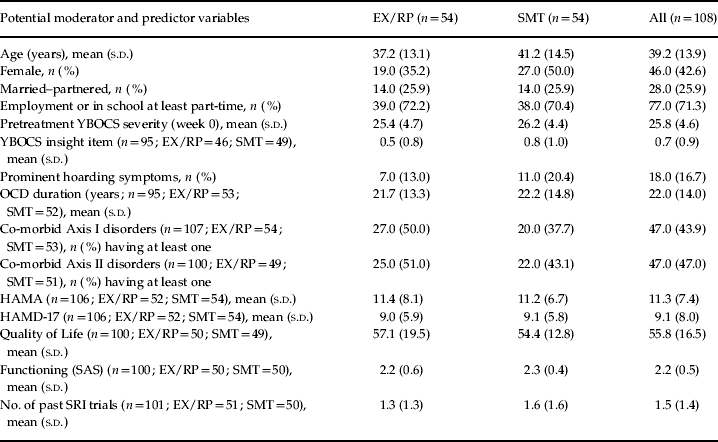
Independent evaluators blind to the CBT assignment conducted patient assessments. Symptom severity was evaluated using the YBOCS (Goodman et al. Reference Goodman, Price, Rasmussen, Mazure, Fleischmann, Hill, Heninger and Charney1989) for OCD (range 0–40 with higher scores representing greater severity), the 17-item Hamilton Depression Rating Scale (HAMD-17; Hamilton, Reference Hamilton1960) and the 14-item Hamilton Anxiety Rating Scale (HAMA-14; Hamilton, Reference Hamilton1959). Question 11 from the YBOCS assessed level of insight. Patients were identified as having prominent symptoms of hoarding if ‘hoarding’ was rated on the YBOCS checklist as one of their three most impairing symptoms. At each assessment, patients also completed self-report measures of QoL, using the Quality of Life Satisfaction Scale (QLESQ; Endicott et al. Reference Endicott, Nee, Harrison and Blumenthal1993), and of functioning, using the Social Adjustment Scale (SAS; Weissman & Bothwell, Reference Weissman and Bothwell1976). Table 1 describes the sample in terms of potential moderators and predictors of outcome.
Potential moderators and predictors of treatment outcome for 108 patientsFootnote a

EX/RP, Exposure and response prevention; HAMA, Hamilton Anxiety Rating Scale; HAMD-17, Hamilton Depression Rating Scale (17-item); OCD, obsessive–compulsive disorder; SAS, Social Adjustment Scale Self-Report; SMT, stress management training; SRI, serotonin reuptake inhibitor; YBOCS, Yale–Brown Obsessive Compulsive Scale; s.d., standard deviation.
a n=108 for full sample when not indicated otherwise.
Statistical methods
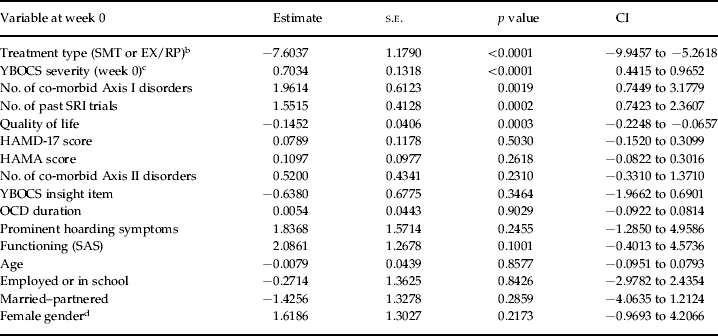
The sample is based on 108 participants at baseline; nine variables have missing data (n=95–107), as indicated in Table 1. Marital status and employment status were each collapsed into dichotomous variables. Fourteen participants dropped out before the post-treatment assessment (n=94 at post-treatment). Treatment of missing data is described below. Simple linear regression analyses were conducted for each main effect, adjusting for treatment type and pretreatment OCD severity to allow comparison with other studies.
Our primary analysis used multiple linear regression to predict post-treatment outcome; analyses included treatment type (EX/RP or SMT), pretreatment severity (YBOCS at week 0) and other covariate main effects and moderation effects. A final model was selected using the stepwise procedure (Burnham & Anderson, Reference Burnham and Anderson2002), which was modified to ensure that the main effect was retained when the corresponding interaction term was entered in the model. Starting with the base model consisting of all main effects, stepwise regression was conducted to test for interactions between treatment type (EX/RP or SMT) and each of 15 candidate moderator variables (see Table 1). Candidate interaction terms were entered one by one using the stepwise procedure with a significance level of 0.05; after each new interaction term was entered, backward elimination was conducted to eliminate interaction terms entered previously that were no longer significant. The procedure was repeated until no new interaction terms were eligible to be entered. Then, backward elimination was conducted on the main effect terms, under the following constraints: (1) the main effect term corresponding to each significant interaction term in the model was retained irrespective of statistical significance; and (2) treatment type and pretreatment YBOCS were retained in the model irrespective of their statistical significance. Treatment type was retained because it is the primary intervention of interest and is necessary to examine moderation effects; pretreatment severity was retained because it is the pretreatment version of the outcome measure. The final model was used to derive the subgroup treatment effect for each moderator variable. Hierarchical modeling was not used because we lacked adequate evidence to determine the a priori order of variables to enter, making the stepwise procedure preferable.
Item non-response (missing values among potential predictors) was addressed using multiple imputation (Little & Rubin, Reference Little and Rubin2002). Multiple imputation was applied to the nine variables having incomplete data (Table 1) using the other observed variables to impute the missing data. Missing data were replaced by random draws from a distribution of plausible values using SAS Proc MI (SAS Institute, 2007) to create five imputed data sets. Each imputed data set was analyzed separately. The findings from these analyses were then summarized using SAS Proc mianalyze to combine the uncertainty in the estimated regression parameters within and across the five imputed data sets (SAS Institute, 2007).
Case non-response (missing outcome data of 14 patients) was addressed using response propensity weighting (or non-response weighting) to mitigate the potential attrition bias; this procedure is more effective than a simple completer analysis. First, a logistic regression was used to predict response (YBOCS observed at week 8) versus non-response (drop-out). Second, the fitted logistic regression model was used to predict the response probability for each patient. Third, for each respondent with a week 8 YBOCS score, the reciprocal of the predicted response probability was taken as the response propensity weight, which is applied to each respondent in the primary analysis examining predictors of outcome. The resulting weights have a mean of 1.22, a standard deviation of 0.48, and a coefficient of variation of 0.39, with a range from 1.00 to 4.53.
Results
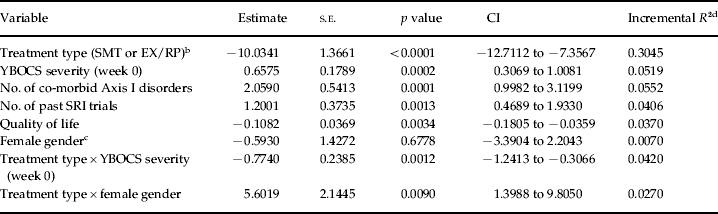
The results of the simple regression analyses for each variable are shown in Table 2; these were performed to allow comparisons with other studies and to demonstrate the stability of the findings in the final model. The results for the multiple regression model based on the stepwise procedure are shown in Table 3. The model included treatment type (EX/RP v. SMT), two moderators (pretreatment OCD severity and gender) and three predictors (number of Axis I disorders, number of SRI trials, and QoL) of treatment outcome (OCD severity at week 8).
Individual linear regression models: predictors of post-treatment YBOCS (week 8) adjusting for treatment type and pretreatment YBOCS severity (n=94)Footnote a

CI, Confidence interval; EX/RP, exposure and response prevention; HAMA, Hamilton Anxiety Rating Scale; HAMD-17, Hamilton Depression Rating Scale (17-item); OCD, obsessive–compulsive disorder; SAS, Social Adjustment Scale Self-Report; s.e., standard error; SMT, stress management training; SRI, serotonin reuptake inhibitor; YBOCS, Yale–Brown Obsessive Compulsive Scale.
a Using response propensity weights and multiple imputation.
b Controlling for week 0 YBOCS severity only; SMT was coded as 0.
c Controlling for treatment type only.
d Male was coded as 0.
Final regression model: moderators and predictors of post-treatment YBOCS (week 8) adjusting for treatment type and pretreatment YBOCS severity (n=94)Footnote a

CI, Confidence interval; EX/RP, exposure and response prevention; s.e., standard error; SMT, stress management training; SRI, serotonin reuptake inhibitor; YBOCS, Yale–Brown Obsessive Compulsive Scale.
a Using response propensity weights and multiple imputation.
b SMT was coded as 0.
c Male was coded as 0.
d Net incremental R 2 (i.e. the unique variance that variable contributes after accounting for all other variables in the final model) is presented for all variables except treatment type. For treatment type, the marginal incremental R 2 (i.e. the variance that variable contributes on its own) is presented because treatment type was controlled for in the analysis.
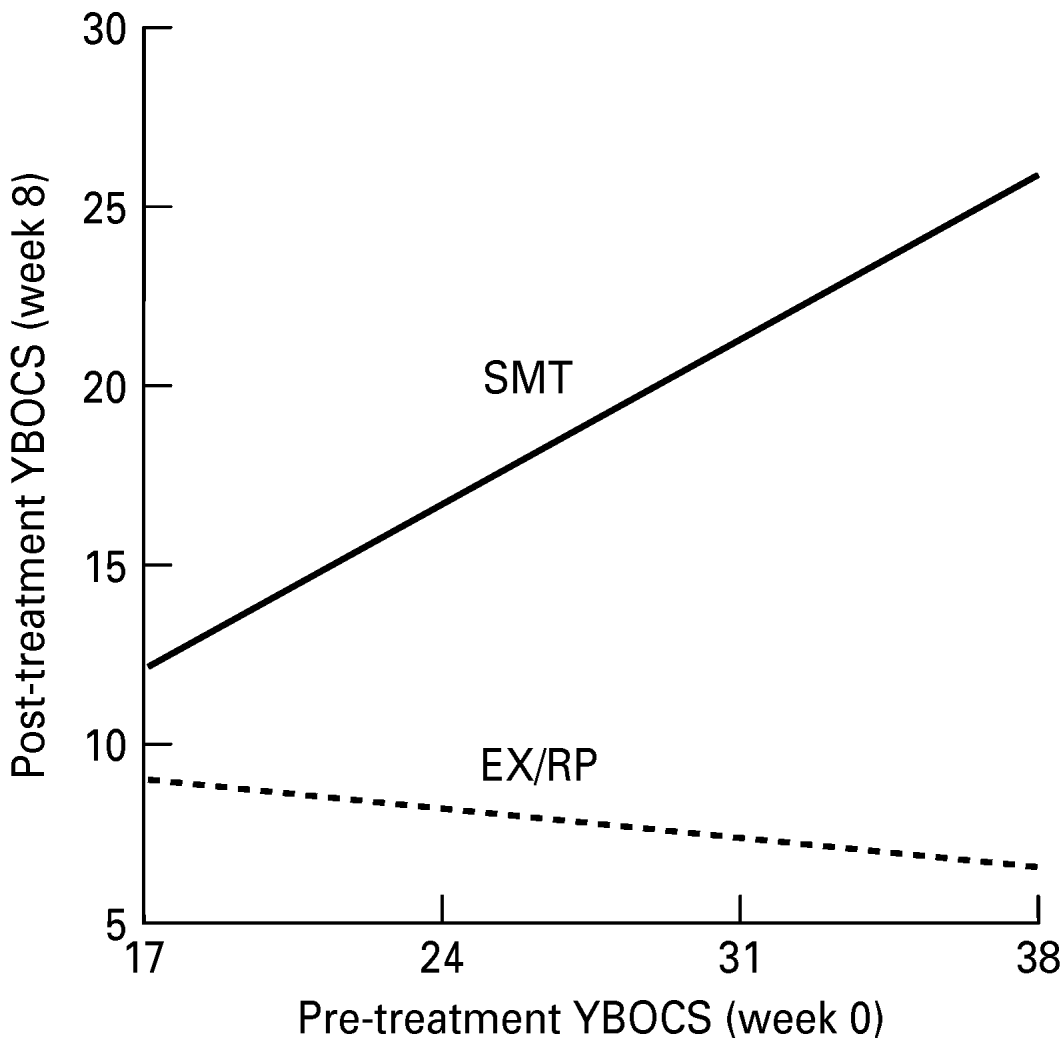
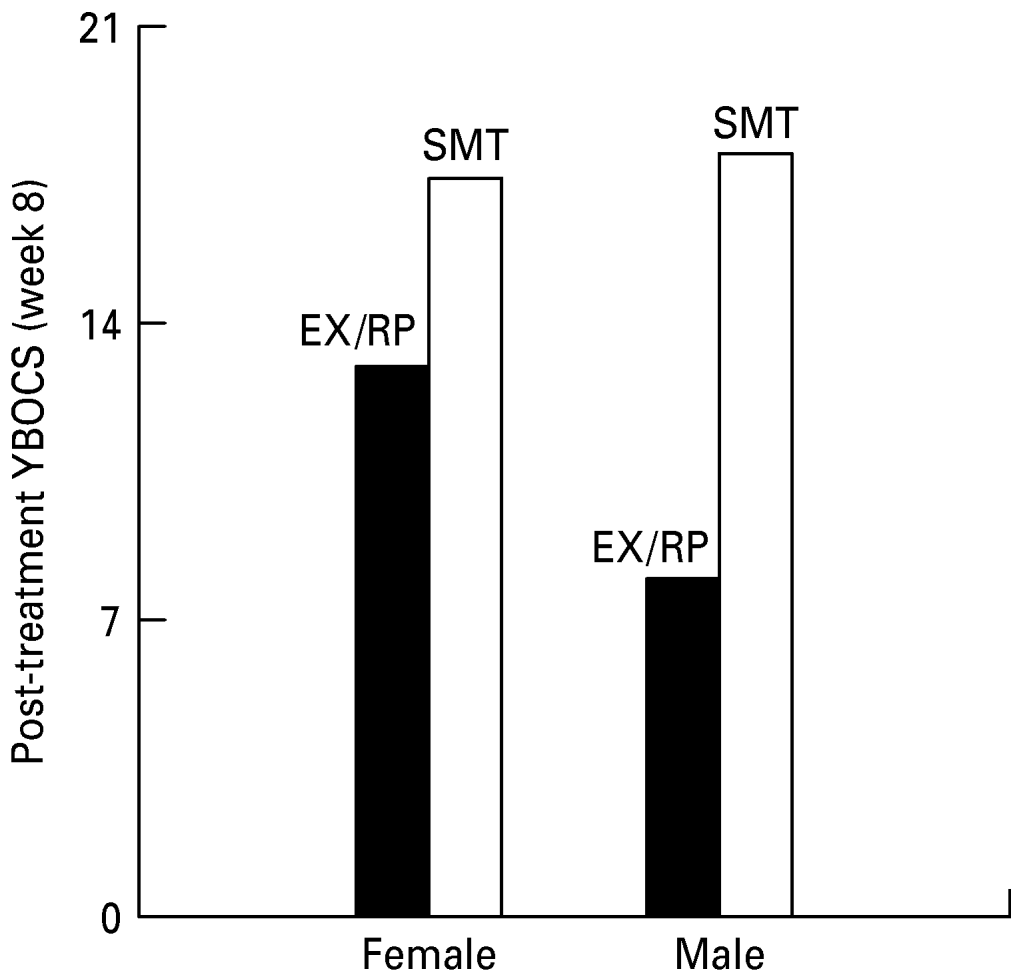
Pretreatment OCD severity moderated the relationship between treatment type and outcome (Fig. 1). Pretreatment OCD severity was unrelated to outcome among EX/RP patients [estimate=−0.1165, p=0.554, confidence interval (CI) −0.5019 to 0.2689], whereas pretreatment severity predicted a poorer outcome among SMT patients (estimate=0.6575, p<0.001, CI 0.3069 to 1.0081). Gender also moderated the relationship between treatment type and outcome (Fig. 2). Males and females receiving EX/RP both respectively had lower post-treatment YBOCS than males (10.03 point difference; p<0.001) and females (4.43 point difference; p=0.009) receiving SMT. However, the benefit of EX/RP over SMT was significantly larger for males than females (5.50 points difference; p=0.009).
Interaction between treatment type [exposure and response prevention (EX/RP) and stress management training (SMT)] and pretreatment Yale–Brown Obsessive Compulsive Scale (YBOCS) severity on post-treatment YBOCS at week 8. For EX/RP (n=48), pretreatment YBOCS did not predict post-treatment YBOCS (estimate=−0.1165, p=0.554). For SMT (n=46), pretreatment YBOCS significantly predicted post-treatment YBOCS (estimate=0.6575, p<0.001), with greater severity at pretreatment predicting greater severity at post-treatment.

Interaction between treatment type [exposure and response prevention (EX/RP) and stress management training (SMT)] and gender (male and female) on post-treatment Yale–Brown Obsessive Compulsive Scale (YBOCS) at week 8. Females benefit from EX/RP compared to SMT by 4.43 points on the YBOCS (p=0.009). Males benefit from EX/RP compared to SMT by 10.03 points on the YBOCS (p<0.001). The benefit of EX/RP over SMT is 5.50 YBOCS points more for males than females (p=0.009).

In addition to these moderators, the following variables significantly predicted poorer outcome in our final model: lower pretreatment QoL, having a greater number of co-morbid Axis I disorders, and having a greater number of lifetime SRI trials. Combining the contributions of the moderators (main effects and interactions) and predictors (main effects only) in the final model increased the proportion of variance explained from R 2=30.5% for treatment type alone to R 2=67.7% in the final model. Thus, a substantial portion of the variance (incremental R 2=37.2%) is attributable to these moderators and predictors. Moreover, the same model restricted to the EX/RP subgroup confirmed the same predictors of EX/RP outcome (gender, number of co-morbid conditions, number of past SRI trials, and QoL) as in the full model, and it also explained a large proportion of the variance (R 2=55.2%).
Secondary analysis comparing the imputed dataset with the completer dataset found no significant differences in regression coefficients. Moreover, the standard errors for imputed data are smaller than the standard errors for completer data, indicating that the imputation procedure was successful in recovering part of the missing information.
Contrary to expectation, prominent symptoms of hoarding did not predict outcome in the overall model. However, only seven of 54 EX/RP patients had prominent symptoms of hoarding. These seven experienced less YBOCS change on average from pre- to post-treatment compared to those without symptoms of hoarding [5.0 (s.d.=5.5) v. 10.4 (s.d.=6.7)].
Discussion
This is the first study to investigate moderators and predictors of treatment outcome using data from a large randomized controlled trial of CBT augmentation (EX/RP or SMT) of SRI pharmacotherapy in OCD. Significant moderators of treatment outcome included pretreatment OCD severity and gender. Significant predictors of poorer outcome included having more co-morbid Axis I disorders, more lifetime SRI trials, and lower QoL at baseline. Together, these moderators and predictors accounted for an additional 37.2% of the total variance in post-treatment OCD severity, a large and clinically important effect, beyond the 30.5% of the variance explained by treatment type alone.
The finding that pretreatment severity predicted post-treatment outcome among patients receiving SMT but not EX/RP is consistent with the only other study examining predictors of EX/RP augmentation (Tolin et al. Reference Tolin, Maltby, Diefenbach, Hannan and Worhunsky2004). This finding is also consistent with a review of EX/RP studies (of medicated and unmedicated patients) that found that pretreatment severity failed to predict outcome in four of six studies (Steketee & Shapiro, Reference Steketee and Shapiro1995); in two other studies pretreatment severity predicted EX/RP outcome but patients continued to improve with additional EX/RP treatment (Keijsers et al. Reference Keijsers, Hoogduin and Schaap1994; de Haan et al. Reference de Haan, van Oppen, van Balkom, Spinhoven, Hoogduin and Van Dyck1997). Thus, greater OCD severity alone should not prevent patients from benefiting from EX/RP, although patients with severe OCD may need additional sessions. Moreover, our data suggest that SRI therapy augmented with EX/RP may attenuate the impact of OCD severity on outcome. By contrast, pretreatment severity had a major impact on SMT outcome: patients with high severity before treatment were more likely to have high severity after treatment. This makes sense because SMT is not an efficacious treatment for OCD (Simpson et al. Reference Simpson, Foa, Liebowitz, Roth Ledley, Huppert, Cahill, Vermes, Schmidt, Hembree, Franklin, Campeas, Hahn and Petkova2008).
Gender also moderated the effect of treatment type on outcome, such that the benefit of EX/RP over SMT was larger for males than females although EX/RP was still superior to SMT for females. This finding contrasts with findings from one naturalistic in-patient study providing combination therapy that found that females had a better post-treatment outcome to EX/RP than males (Stewart et al. Reference Stewart, Yen, Stack and Jenike2006). Two studies that mixed medicated and unmedicated patients found no gender difference in EX/RP outcome (Foa et al. Reference Foa, Grayson, Steketee, Doppelt, Turner and Latimer1983a; Steketee et al. Reference Steketee, Chambless and Tran2001). It is not entirely clear what drove the relationship between gender and EX/RP outcome in our sample. It was not explained by other variables in the model or by post-hoc exploration of co-morbid disorders. However, we note that 26.3% of females receiving EX/RP had prominent hoarding symptoms compared with just 5.7% of males. This is noteworthy because those with hoarding symptoms experienced on average only half of the post-treatment YBOCS reduction achieved by those without hoarding symptoms. The fact that we had more females with prominent hoarding symptoms than males may in part explain the relationship between gender and EX/RP outcome in our sample. Future research should examine further the relationship between gender and outcome.
The number of co-morbid Axis I conditions that a patient had at baseline predicted poorer treatment outcome. Each additional Axis I disorder resulted in a 2.06-point increase in patients' post-treatment YBOCS score. The relationship between number of Axis I conditions and EX/RP outcome is consistent with one study that included both medicated and unmedicated children and adolescents (Storch et al. Reference Storch, Merlo, Larson, Geffken, Lehmkuhl, Jacob, Murphy and Goodman2008). Another study that included both medicated and unmedicated adults found a trend for the number of co-morbid conditions predicting EX/RP outcome (Steketee et al. Reference Steketee, Chambless and Tran2001). Although 44% of patients in our study had a co-morbid disorder, there were too few cases of individual disorders (e.g. major depressive disorder, n=4; PTSD, n=4) to examine whether any were driving this effect. However, our data indicate that neither severity of anxiety nor depression were responsible for the relationship between number of Axis I disorders and treatment outcome. Co-morbidity might result in poorer outcome for many different reasons including higher anxiety sensitivity, greater pessimism, lower distress tolerance, and lower motivation and adherence to treatment. If future research points towards these factors, interventions such as dialectical behavioral therapy for emotional regulation, motivational interviewing to improve adherence, and cognitive therapy for pessimism could all be valuable ways of targeting the relationship between co-morbidity and EX/RP outcome.
Little attention has been paid to the number of prior SRI trials as a predictor of post-treatment outcome to EX/RP. Our finding that the number of past SRI trials predicted poorer outcome is consistent with studies examining predictors of medication response (Denys et al. Reference Denys, Burger, van Megen, de Geus and Westenberg2003) and with one small open trial of EX/RP augmentation (Tolin et al. Reference Tolin, Maltby, Diefenbach, Hannan and Worhunsky2004), based on individual analyses of predictors. In our study, each additional past SRI trial resulted in a 1.20-point increase in patients' post-treatment YBOCS score. It is worth noting that the number of past SRI trials is not a substitute for patient's co-morbidity or OCD severity as both of these factors were controlled in the analysis. This finding may reflect a psychological cause, such that patients who perceive a lack of benefit from past medication trials could have less optimism about EX/RP, reducing the degree to which they engage in treatment. Psycho-education about the efficacy of EX/RP augmentation might benefit these patients. Alternatively, resistance to medications (as measured by proxy here as the number of prior SRI trials) could represent a neurobiological resistance to treatment because some evidence points to a shared neurobiological substrate of treatment response (Baxter et al. Reference Baxter, Schwartz, Bergman, Szuba, Guze, Mazziotta, Alazraki, Selin, Ferng, Munford and Phelps1992). Thus, resistance to medications may be associated with resistance to any treatment.
This is the first randomized trial to examine the relationship between pretreatment QoL and post-treatment EX/RP outcome. Higher QoL predicted a better treatment response whereas global measures of functioning did not. Every standard deviation decrease in QoL resulted in a 1.79-point increase in patients' post-treatment YBOCS score. Patients' mean QoL score at baseline (55.77, s.d.=16.52) was significantly lower on the QLESQ than that observed in healthy controls (78.91, s.d.=13.04) based on Huppert et al. (Reference Huppert, Simpson, Nissenson, Liebowitz and Foa2009). It might be that patients reporting higher QoL are more motivated to manage their OCD symptoms because they experience satisfaction from their lives in other domains. Future research should confirm this relationship between QoL and EX/RP outcome.
Several variables were not associated with treatment outcome. The number of Axis II disorders did not predict outcome, consistent with prior studies of EX/RP that included medicated and unmedicated patients (de Haan et al. Reference de Haan, van Oppen, van Balkom, Spinhoven, Hoogduin and Van Dyck1997; Steketee et al. Reference Steketee, Chambless and Tran2001) and another that focused on EX/RP augmentation of SRI pharmacotherapy (Tolin et al. Reference Tolin, Maltby, Diefenbach, Hannan and Worhunsky2004). It remains possible that only certain Axis II disorders, such as schizotypal and borderline personality disorders, are associated with poor outcome to EX/RP (Steketee et al. Reference Steketee, Henninger, Pollard, Goodman, Rudorfer and Maser2000), a question we could not explore because of the small number of patients with these disorders. Insight did not predict outcome, which is consistent with one study of combination therapy (Stewart et al. Reference Stewart, Yen, Stack and Jenike2006) and two EX/RP studies that included medicated and unmedicated patients (Hoogduin & Duivenvoorden, Reference Hoogduin and Duivenvoorden1988; Lelliott et al. Reference Lelliott, Noshirvani, Basoglu, Marks and Monteiro1988); insight did predict outcome in two smaller studies, one of EX/RP augmentation with medication (Tolin et al. Reference Tolin, Maltby, Diefenbach, Hannan and Worhunsky2004) and another of EX/RP monotherapy (Foa et al. Reference Foa, Abramowitz, Franklin and Kozak1999). Each study measured insight differently, making it difficult to interpret the findings. Insight may need to be very poor before it affects EX/RP outcome (Foa et al. Reference Foa, Abramowitz, Franklin and Kozak1999) because insight itself improves with treatment (Foa et al. Reference Foa, Abramowitz, Franklin and Kozak1999; Cottraux et al. Reference Cottraux, Note, Yao, Lafont, Note, Mollard, Bouvard, Sauteraud, Bourgeois and Dartigues2001). Few patients in our study had poor insight (i.e. mean insight=0.7, based on a scale of 0–4; no patient was rated as 4 and only 5% were rated as 3=poor insight).
Finally, the presence of prominent hoarding symptoms was not significantly related to outcome in our sample, in contrast to most prior studies (Black et al. Reference Black, Monahan, Gable, Blum, Clancy and Baker1998; Mataix-Cols et al. Reference Mataix-Cols, Marks, Greist, Kobak and Baer2002; Saxena et al. Reference Saxena, Maidment, Vapnik, Golden, Rishwain, Rosen, Tarlow and Bystritsky2002; Abramowitz et al. Reference Abramowitz, Franklin, Schwartz and Furr2003). However, only seven people who received EX/RP (6.5% of the total sample) reported the presence of prominent hoarding symptoms; thus, our result had a large confidence interval and cannot be considered definitive. Moreover, all seven also had other OCD symptoms, which may have resulted in declines in their OCD severity. Of note, these seven experienced much less reduction on average in their post-treatment YBOCS score than those without hoarding symptoms (5.0 v. 10.4). If these seven were representative, a larger group of patients with hoarding symptoms might well have replicated findings from other EX/RP studies.
Limitations
This study has several limitations. First, as in most predictor studies, the analyses were exploratory because patients were not randomized based on potential predictors of interest. Second, although one of the largest randomized samples of EX/RP outcome, it contained too few cases of specific Axis I and Axis II disorders of interest to examine their individual effects. Third, we were not able to address the impact of severe depression on EX/RP augmentation because patients were already receiving an SRI medication at study entry. Thus, few patients had severe depression (HAMD-17>24) at initial evaluation, and they were excluded from entering if they did.
Conclusions and clinical implications
In sum, significant moderators of a poorer outcome included gender (affecting EX/RP) and pretreatment severity (affecting SMT). Significant predictors of a poorer outcome (adjusting for treatment type and pretreatment severity) were more co-morbid Axis I conditions, past SRI trials and lower QoL at baseline. Our approach of examining a range of risk factors (versus searching for individual effects) begins to address an important gap in the OCD literature around predictors of combination therapy and EX/RP augmentation of pharmacotherapy in particular.
Findings for the EX/RP subgroup were consistent with the full model. The combined variance of female gender, more co-morbid conditions, more past SRI trials and lower QoL for EX/RP was large (R 2=55.2%). Yet the effect sizes for these individual factors were small to medium. This may explain the inconsistency between prior studies where the range of possible predictors examined was not as broad. Our results suggest that monitoring for a combination of risk factors is required to identify OCD patients at risk for poor EX/RP outcome. For example, patients with one co-morbid condition, one past SRI-trial, and the mean score on QoL (QLESQ) of 55.77 v. 78.91 for healthy controls (Huppert et al. Reference Huppert, Simpson, Nissenson, Liebowitz and Foa2009) had on average a post-treatment YBOCS score over 5 points higher (a clinically meaningful increase) than patients without these risk factors. Many patients in this study had several past SRI trials, co-morbid conditions and lower than average QoL, putting them at significant risk for poor EX/RP outcomes.
Future research will need to replicate these findings and should consider whether patients with multiple risk factors can benefit from a multi-modular intervention to target each risk factor impeding EX/RP outcome. Our data suggest that such an intervention should include evidence-based treatments targeting co-morbidity, interventions to enhance QoL, and psycho-education regarding the effectiveness of EX/RP for medication non-responders.
Acknowledgments
We thank the National Institute of Mental Health (NIMH) for funding [R01 MH45436 (M.R.L.), R01 MH45404 (E.B.F.), K23 MH01907 (H.B.S.)], the staff for their efforts during the clinical trial, and Dr Ning Zhao for expert data management.
Declaration of Interest
Dr Simpson is currently receiving medication at no cost from Janssen Pharmaceuticals for an NIMH-funded study that she is conducting; she is also receiving research support from Neuropharm Ltd to investigate novel treatments for OCD. Dr Simpson has served in the past as a scientific consultant for Pfizer Ltd. and for Jazz Pharmaceuticals. Dr Foa has received research support from Pfizer, Solvay, Eli Lilly, SmithKline Beecham, GlaxoSmithKline, Cephalon, Bristol-Myers Squibb, Forest, Ciba Geigy, Kali-Duphar, and the American Psychiatric Association. She has been a speaker for Pfizer, GlaxoSmithKline, Forest Pharmaceuticals, the American Psychiatric Association, and Jazz Pharmaceuticals. She has been a consultant for Acetelion Pharmaceuticals. She receives royalties from the sale of Stop Obsessing! and Mastery of Obsessive-Compulsive Disorder. Dr Liebowitz has received support for research (Lilly, Wyeth, GlaxoSmithKline, Avera, Novartis, Sanofi Aventis, Pfizer, AstraZeneca, Ono Pharmaceuticals, Forrest, Cephalon, UCB Pharmaceuticals), for consultation (Lilly, GlaxoSmithKline, Avera, AstraZeneca, Pherin, Boehringer Ingelheim, Abbott, Sanofi-Aventis, Wyeth, Forrest, Alexza), and for being a member of advisory boards (Sanofi-Aventis, AstraZeneca, Wyeth) and speakers bureaus (Wyeth, Forrest, Bristol–Myers Squibb, Solvay, Pfizer). He also has licensing agreements for a rating scale and/or electronic data capture device (GlaxoSmithKline, Pfizer, Avera, Lilly, Indevus, Clinphone, Servier) and holds intellectual property [copyright holder Liebowitz Social Anxiety Scale (LSAS)] and private company positions [Managing Director of the Medical Research Network (a private clinical trials site) and Chief Scientific Officer of ChiMatrix (an electronic data capture company)].