Introduction
Amyotrophic lateral sclerosis (ALS), traditionally seen as a motor neuron disease with spared extra-motor areas and cognitive functions, is now known to present with a broad range of cognitive impairments, including mild executive dysfunction, frontotemporal cognitive, and behavioral alterations as those observed in patients with frontotemporal dementia, as well as severe memory loss of the Alzheimer's dementia. The most consistently documented neuropsychological deficit in ALS patients is related to verbal and non-verbal fluency, executive planning, and attention (Abrahams et al., Reference Abrahams, Goldstein, Al-Chalabi, Pickering, Morris, Passingham and Leigh1997, Reference Abrahams, Leigh, Harvey, Vythelingum, Grise and Goldstein2000; Chari, Shaw, & Sahgal, Reference Chari, Shaw and Sahgal1996; Ludolph et al., Reference Ludolph, Langen, Regard, Herzog, Kemper, Kuwert and Feinendegen1992; Massman et al., Reference Massman, Sims, Cooke, Haverkamp, Appel and Appel1996; Moretti et al., Reference Moretti, Torre, Antonello, Carraro, Cazzato and Bava2002), generally described as executive dysfunction. Specifically, selective attention, widely evaluated with the Stroop test in both clinical and experimental settings (Lezak, Howieson, & Loring, Reference Lezak, Howieson and Loring2004; Spreen & Strauss, Reference Spreen and Strauss1998), has been found to be impaired in ALS patients in some (Abrahams et al., Reference Abrahams, Goldstein, Al-Chalabi, Pickering, Morris, Passingham and Leigh1997; Moretti et al., Reference Moretti, Torre, Antonello, Carraro, Cazzato and Bava2002), though not all (Evdokimidis et al., Reference Evdokimidis, Constantinidis, Gourtzelidis, Smyrnis, Zalonis, Zis and Papageorgiou2002; Ludolph et al., Reference Ludolph, Langen, Regard, Herzog, Kemper, Kuwert and Feinendegen1992; Ringholz et al., Reference Ringholz, Appel, Bradshaw, Cooke, Mosnik and Schulz2005), neuropsychological studies, and most of the neurophysiological studies (i.e., Pinkhardt et al., Reference Pinkhardt, Jürgens, Becker, Molle, Born, Ludolph and Schreiber2008; Vieregge, Wauschkuhn, Heberlein, Hagenah, & Verleger, Reference Vieregge, Wauschkuhn, Heberlein, Hagenah and Verleger1999).
Contrary to the relatively consistent previous cognitive impairments in ALS, however, there is variable evidence in support of memory deficits in this patient population. Despite the fact that many studies have failed to observe any significant differences on memory between ALS patients and healthy controls (i.e., Chari et al., Reference Chari, Shaw and Sahgal1996; Ludolph et al., Reference Ludolph, Langen, Regard, Herzog, Kemper, Kuwert and Feinendegen1992), memory functions have been found to be impaired (even in non-demented patients) in neuropsychological tests such as prose and picture recall, word list learning and free recall, and paired associate learning (Abrahams et al., Reference Abrahams, Leigh, Harvey, Vythelingum, Grise and Goldstein2000; Frank, Haas, Heinze, Stark, & Munte, Reference Frank, Haas, Heinze, Stark and Munte1997; Gallassi et al., Reference Gallassi, Montagna, Ciardulli, Lorusso, Mussuto and Stracciari1985; Hanagasi et al., Reference Hanagasi, Gurvit, Ermutlu, Kaptanoglu, Karamursel, Idrisoglu and Demiralp2002; Iwasaki, Kinoshita, Ikeda, Takamiya, & Shiojina, Reference Iwasaki, Kinoshita, Ikeda, Takamiya and Shiojima1990; Kato, Hayashi, & Yagishita, Reference Kato, Hayashi and Yagishita1993; Massman et al., Reference Massman, Sims, Cooke, Haverkamp, Appel and Appel1996; Okamoto, Hirai, Yamazaki, Sun, & Nakazato, Reference Okamoto, Hirai, Yamazaki, Sun and Nakazato1991; Strong et al., Reference Strong, Grace, Orange, Leeper, Menon and Aere1999). When memory is examined in ALS using the distinction between immediate and delayed recall, impairment on immediate recall seems to be more evident, with a highly variable delayed recall (Raaphorst, De Visser, Linssen, de Haan, & Schmand, Reference Raaphorst, De Visser, Linssen, de Haan and Schmand2009). Most neuropsychological studies support an encoding or retrieval deficit, mostly related to ALS frontal dysfunction (i.e., Mantovan et al., Reference Mantovan, Baggio, Dalla Barba, Smith, Pegoraro, Soraru’ and Angelini2003). Although memory functions may be affected by primary prefrontal dysfunction, temporal lobe abnormalities have been also noted in ALS patients, not only in demented but also in non-demented patients (i.e., Kew et al., Reference Kew, Goldstein, Leigh, Abrahams, Cosgrave, Passingham and Brooks1993; Okamoto et al., Reference Okamoto, Hirai, Yamazaki, Sun and Nakazato1991; Takeda, Uchihara, Mochizuki, Mizutani, & Iwata, Reference Takeda, Uchihara, Mochizuki, Mizutani and Iwata2007; Wightman et al., Reference Wightman, Anderson, Martin, Swash, Anderton, Neary and Leigh1992).
Despite the fact that unattended stimuli can emerge or be accessed at later stages, it is obvious that maximization of memory performance is related to selective attention to stimuli. Behavioral studies support that notion that attention influences the strength and content of memory (Chun & Turk-Browne, Reference Chun and Turk-Browne2007) and, whether the task is explicit or implicit, information that is to be learned must be selected. Selective attention, that is the capacity to highlight the important stimuli or ideas being dealt with while suppressing awareness of competing distractors (Lezak et al., Reference Lezak, Howieson and Loring2004), plays an important role in memory encoding, and once information is encoded, efficient retrieval is highly related to the selection between specific memories competing for recall (Chun, Golomb, & Turk-Browne, Reference Chun, Golomb and Turk-Browne2011). Brain damage, irrespective of the etiology, may affect one or more aspects of the regulation of information processing through the attention, and on the other hand, directly or indirectly impair one or more memory processes.
In view of the current status of knowledge regarding deficits of memory and selective attention in ALS, the goal of the present study is two-fold: (a) to investigate selective attention and verbal free recall in ALS patients; and (b) to identify the relative contribution of selective attention, encoding, consolidation, and retrieval efficiency to patients’ verbal free recall ability, given that when we are to recall something, thus retrieving it from memory and bringing it to the present, more than one of the processes of encoding, consolidation, and retrieval have to be intact to allow for efficient recall. A commonly used version of the classical Stroop test was used for the assessment of the selective attention, whereas verbal free recall was evaluated via short- (subsequently called immediate recall) and long-delay (subsequently called delayed recall) free recall using a commonly administered list-learning test. In the present study, we used the interference condition of the SNST as a measure of selective attention, since the Stroop test has been considered as a quite valid measure for the examination of the neuroanatomy of selective attention (i.e., Carter, Mintun, & Cohen, Reference Carter, Mintun and Cohen1995). Recently, item-specific deficit approach (ISDA) has been applied to list-learning tests to better identify encoding, consolidation, and retrieval difficulties in patients with acquired brain pathology (Wright & Schmitter-Edgecombe, Reference Wright and Schmitter-Edgecombe2011; Wright et al., Reference Wright, Woo, Schmitter-Edgecombe, Hinkin, Miller and Gooding2009). The ISDA is a relatively new psychometrically sound method that considers one's performance at the item (word) level and enables the “parcellation” of memory processes from list-learning tests commonly used in clinical practice, when experimental manipulations may not be feasible (Wright et al., Reference Wright, Woo, Schmitter-Edgecombe, Hinkin, Miller and Gooding2009). All of the three indices from the ISDA are deficit indices, thus providing information about the degree of impaired encoding, consolidation, and retrieval.
Given the variability of memory impairment, to a greater degree, and of selective attention, to a lesser degree, we cannot hypothesize that our ALS group will or will not reveal impaired selective attention and/or recall performance. Thus, in the absence of any expectations, both selective attention and immediate and delayed recall will be investigated in an exploratory way. Furthermore, we hypothesize that efficient selective attention will enhance the acquisition of new verbal information, especially under unstructured conditions, such as the list-learning test, and thus will contribute to the recall. Finally, based on the current ALS-related literature, if patients impaired recall ability is better described in terms of impaired encoding and retrieval deficits, then we expect to find that the encoding and retrieval deficit indices will significantly contribute and explain patients’ verbal free recall.
Methods
Participants
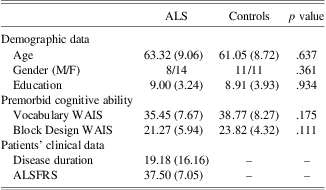
Twenty-two non-demented ALS patients were included in the present study. All patients underwent clinical assessment, including full neurological and electrophysiological examination, and diagnosed with sporadic ALS according to the modified El Escorial diagnostic criteria for ALS (Brooks et al., Reference Brooks, Miller and Swash2000). Patients (14 with peripheral-onset and 8 with bulbar onset disease) were subsequently referred for neuropsychological assessment as part of their routine clinical care. We also included a group of 22 unrelated healthy volunteer participants, as a control group, that did not differ to patients with respect to demographic characteristics and the premorbid cognitive level. The latter was evaluated by the Vocabulary and Block Design subtests of the Wechsler Adult Intelligence Scale (WAIS; Wechsler, Reference Wechsler1955). Inclusion criteria for the present study were the following: (a) absence of a history of other neurologic conditions affecting cognition (other than ALS for patients), (b) no serious psychiatric disease (e.g., major depression, schizophrenia), (c) no family history of ALS, (d) absence of psychoactive drugs or other medication that could affect mental status, (e) absence of severe motor deficits (upper extremities, dysarthria) that could interfere with neuropsychological performance, and (f) absence of dementia (Mini Mental State Examination > 25; preserved activities of daily living, social and personal conduct and insight based on patients’ and caregivers’ self-reports). Analysis of Vocabulary subtest performance and patients’ speech during discourse revealed no signs of semantic dementia or progressive nonfluent aphasia. Table 1 displays demographic characteristics for ALS and control group, as well as clinical characteristics for ALS group. Patients and healthy participants provided inform consent for the study, which was approved by the ethical committee of our institution.
Demographic and clinical characteristics of ALS patients and healthy controls
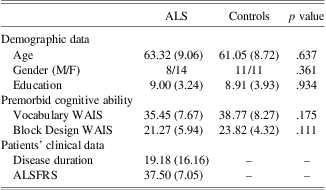
Note. Continuous variables are shown as mean (SD). Age and education are expressed in years, disease duration is expressed in months. Vocabulary and Block Design values are expressed as raw scores. ALS = amyotrophic lateral sclerosis; M/F = males/females; WAIS = Wechsler Adult Intelligence Scale; ALSFRS = Amyotrophic Lateral Sclerosis Functional Rating Scale (Cedarbaum & Stambler, Reference Cedarbaum and Stambler1997).
Neuropsychological Assessment
Selective attention and verbal free recall were assessed using the Stroop Neuropsychological Screening Test (SNST; Trenerry, Crosson, DeBoe, & Leber, Reference Trenerry, Crosson, DeBoe and Leber1989) and the Rey Auditory Verbal Learning Test (RAVLT; Rey, Reference Rey1964), as part of a comprehensive neuropsychological examination of multiple cognitive domains.
The score in SNST Color-Word condition (interference condition) was used as a measure of selective attention (maximum value = total number of correct items out of 112 items within 120 min). With regard to the RAVLT, a short delay recall of List A after the presentation of the distractor list B (maximum value = total number of list words) and a long delay free recall of List A after 30 min (maximum value = total number of list words), were used as measures of immediate and delayed free recall, respectively.
The ISDA was applied to the RAVLT, enabling the calculation of three extra indices, with higher index being indicative of greater memory difficulties (Wright et al., Reference Wright, Woo, Schmitter-Edgecombe, Hinkin, Miller and Gooding2009; Wright & Schmitter-Edgecombe, Reference Wright and Schmitter-Edgecombe2011). The encoding deficit index is calculated by counting the number of words across the list learning trials that are not recalled on more than half of the learning trials. Thus, in case of the five RAVLT trials, it is derived by counting the number of words that are recalled on two or fewer learning trials; the maximum value for encoding deficit index corresponds to the total number of list words (n = 15). The consolidation deficit index is derived by counting the individual words that are recalled during list learning but not recalled on subsequent delayed-recall trials (multiple recall trials are required). To control for different acquisition levels, an adjusted-consolidation deficit index is calculated by dividing the sum of the individual words recalled during the list learning that is the total number of words recalled at least once during learning (maximum value for words recalled at least once = total number of list words). On the other hand, the retrieval deficit index is calculated by summing the individual words that are recalled during list learning but inconsistently recalled across delayed recall trials (multiple recall trials are required as well). Similar to the consolidation deficit index, an adjusted-retrieval deficit index is calculated by dividing the sum of the individual words recalled during the list learning.
Statistical Analysis
Demographic characteristics between patients and healthy participants were analyzed using independent samples t test (age, years of education) and χ 2 test (gender distribution). Between-group analysis on SNST, RAVLT immediate and delayed free recall, and ISDA indices were performed using independent samples t test. Two hierarchical regression analyses were conducted to identify the contribution of selective attention and encoding, consolidation, and retrieval deficits to patients’ immediate and delayed recall on RAVLT. The SNST was entered into the model as block 1, followed by the ISDA encoding, consolidation, and retrieval indices (block 2, 3, and 4, respectively). The predictors were entered in such a way based on the assumption that selective attention is a prerequisite for adequate mental activity (Lezak et al., Reference Lezak, Howieson and Loring2004), and the hypothetical temporal relationship of encoding, consolidation, and retrieval. The threshold for statistical significance was set at p < .05. All analyses were conducted using the SPSS 17.0.
Results
Between-Group Differences on Selective Attention: SNST
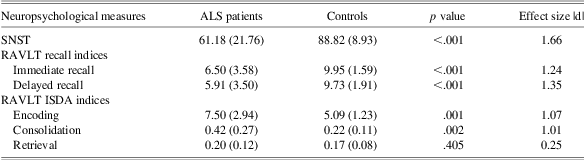
A significant difference was found for the SNST (Table 2), with patients performing significantly worse than healthy participants [t(27.88) = 5.51; p < .001]. To rule out a possible effect of information processing speed to the previous mentioned difference, univariate analysis of covariance was conducted using as a covariate the time needed to read the first column in the SNST Color task. Similar results were obtained, with the difference remaining statistical significant for the selective attention measure (p < .001).
ALS patients and healthy controls performance on SNST, RAVLT recall indices, and ISDA indices
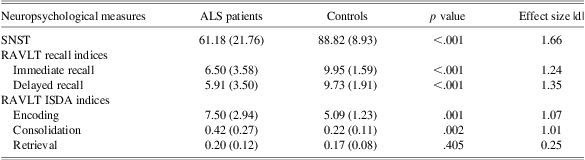
Note. Adjusted consolidation and retrieval indices were used, corresponding to consolidation and retrieval indices corrected for the total number of words gained (recalled at least once) across the five learning trials. Effect sizes (Cohen, Reference Cohen1988) were calculated for ALS and healthy controls; conventions for Cohen's d are as follow: small = 0.20; medium = 0.50; large = 0.80. ALS = amyotrophic lateral sclerosis; SNST = Stroop Neuropsychological Screening Test; RAVLT = Rey Auditory Verbal Learning Test; ISDA = Item-Specific Deficit Approach.
Between-Group Differences in List-Learning test: RAVLT Immediate and Delayed Free Recall and ISDA Encoding, Consolidation, and Retrieval Indices
Patients performed worse than healthy participants on RAVLT recall trials (Table 2). A significant difference was observed for both immediate and delayed recall, with patients recalling significantly fewer words than controls [immediate recall, t(28.95) = 4.13, p < .001; delayed recall, t(32.44) = 4.49, p < .001]. Furthermore, ALS patients evidenced significantly greater encoding [t(28.14) = −3.54; p = .001] and consolidation [t(27.65) = −3.35; p = .002] deficits compared to well-matched healthy participants. However, we did not find any significant differences between the two groups in the retrieval deficit index [t(35.76) = −0.84; p = .405]. Large effect sizes were observed for encoding and consolidation deficits.
Contribution of Selective Attention, Encoding, Consolidation, and Retrieval Deficits on Immediate and Delayed Recall in ALS Patients
Despite the fact that we did not find any significant between-group differences in retrieval index, we did include it in the regression analysis, considering the presence of small–medium effect size. Moreover, given the considerable variability within the ALS group (based on the SDs RAVLT measures), we used the adjusted consolidation and retrieval indices.
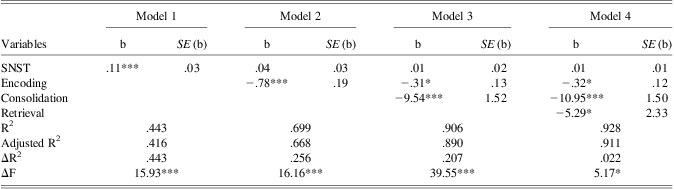
The SNST significantly predicted the RAVLT immediate recall (Model 1; F = 15.93; p = .001), accounting for 41.6% of the variance. The encoding index added significant predictive power to the model (Model 2; F = 22.08; p < .001; ΔR 2 = .256), with the new model accounting for 66.8% of the variance. The consolidation index added a significant predictive power to the model as well (Model 3; F = 57.77; p < .001; ΔR 2 = .207), with the new model accounting for 89% of the variance. Finally, the retrieval index added only a marginal predictive power to the model (Model 4; F = 54.66; p < .001; ΔR 2 = .022). When all variables were considered together (Model 4), they explained 91.1% of the variance of the RAVLT immediate recall (Table 3). Regression b coefficients refer to the expected mean difference in RAVLT immediate recall when each predictor increases by one unit. Negative effects were found in the case of encoding, consolidation, and retrieval. Therefore, the higher the encoding, consolidation, and retrieval deficits, the worse the mean RAVLT immediate recall performance that is expected.
Summary of hierarchical regression analysis to identify the contribution of SNST and ISDA encoding, consolidation, and retrieval indices on RAVLT immediate recall of ALS patients
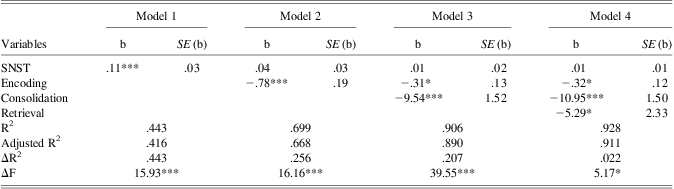
Note. Adjusted consolidation and retrieval indices were used, corresponding to consolidation and retrieval indices corrected for the total number of words gained (recalled at least once) across the five learning trials. ALS = amyotrophic lateral sclerosis; SNST = Stroop Neuropsychological Screening Test; ISDA = Item-Specific Deficit Approach; RAVLT = Rey Auditory Verbal Learning Test.
*p < .05.
**p < .01.
***p < .001.
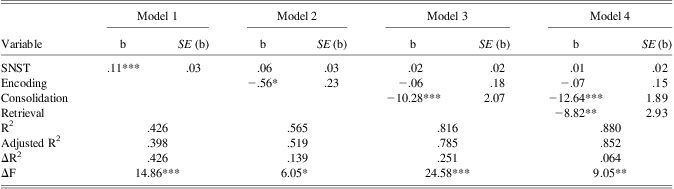
The SNST significantly predicted the RAVLT delayed recall (Model 1; F = 14.86; p = .001), accounting for 39.8% of the variance. The encoding index added significant predictive power to the model (Model 2; F = 12.33; p = .001; ΔR 2 = .139), with the new model accounting for 51.9% of the variance. The consolidation index added significant predictive power to the model (Model 3; F = 26.62; p < .001; ΔR 2 = .251), thus accounting for 78.5% of the variance. Finally, the retrieval index added significant predictive power to the model (Model 4; F = 31.15; p < .001; ΔR 2 = .064). When all variables were taken into consideration together (Model 4), they explained 85.2% of the variance of the RAVLT delayed recall (Table 4). Significant negative effects were found in the case of consolidation and retrieval. Thus, the higher the consolidation and retrieval deficits, the worse the mean RAVLT immediate recall performance that is expected.
Summary of hierarchical regression analysis to identify the contribution of SNST and ISDA encoding, consolidation, and retrieval indices on RAVLT delayed recall of ALS patients

Note. Adjusted consolidation and retrieval indices were used, corresponding to consolidation and retrieval indices corrected for the total number of words gained (recalled at least once) across the five learning trials. ALS = amyotrophic lateral sclerosis; SNST = Stroop Neuropsychological Screening Test; ISDA = Item-Specific Deficit Approach; RAVLT = Rey Auditory Verbal Learning Test.
*p < .05.
**p < .01.
***p < .001.
Discussion
Neuroanatomical Findings Underlying Cognitive Changes in ALS Patients
Findings for neuroanatomical studies in ALS patients indicate that degeneration may occur outside the motor cortex in both demented and non-demented patients (Agosta et al., Reference Agosta, Chio, Cosottini, De Stefano, Falini, Mascalchi and Filippi2010; Turner & Modo, Reference Turner and Modo2010; Wang, Melhem, Poptani, & Woo, Reference Wang, Melhem, Poptani and Woo2011). With regard to the motor involvement, corticospinal tract degeneration (mostly in the posterior limbs of the internal capsule, in the centrum semiovale and ventral brain stem) and brain atrophy in the motor cortex, remain the core findings of conventional neuroimaging techniques. On the other hand, advanced neuroimaging techniques have further supported the presence of extra-motor involvement, including the corpus callosum and cortical and subcortical regions of the prefrontal lobes, the temporal and limbic areas, the parietal regions, as well as specific white matter tracts, such as the uncinate fasciculus and the cingulate bundle. The pattern of degeneration can be heterogeneous and differences in the extent and localization of brain lesions may be related to the clinical picture of each patient. Extra-motor neuroanatomical findings underlie the behavioral and cognitive profile of ALS patients (Tsermentseli, Leigh, & Goldstein, Reference Tsermentseli, Leigh and Goldstein2012) and together with the motor involvement represent potential biomarkers not only for diagnosis but also for disease's progression (Turner, Kiernan, Leigh, & Talbot, Reference Turner, Kierman, Leigh and Talbot2009).
Group Differences in Selective Attention
In line with previous studies (Abrahams et al., Reference Abrahams, Goldstein, Al-Chalabi, Pickering, Morris, Passingham and Leigh1997; Frank et al., Reference Frank, Haas, Heinze, Stark and Munte1997; Moretti et al., Reference Moretti, Torre, Antonello, Carraro, Cazzato and Bava2002; Rusin et al., Reference Rusin, Ridzon, Kulist'ak, Keller, Bartos, Buncova and Matej2010), our patients showed deficient selective attention. However, other neuropsychological studies have failed to find significant differences in Stroop test when ALS compared to healthy participants (Evdokimidis et al., Reference Evdokimidis, Constantinidis, Gourtzelidis, Smyrnis, Zalonis, Zis and Papageorgiou2002; Ludolph et al., 1992; Ringholz et al., Reference Ringholz, Appel, Bradshaw, Cooke, Mosnik and Schulz2005). Stukovnik, Zidar, Podnar, and Repovs (Reference Stukovnik, Zidar, Podnar and Repovs2010) have recently suggested that ALS impaired performance in the Stroop test is mostly related to patients’ impaired motor production (speech output), since using Stroop indices adjusted for the color naming condition (congruent and incongruent), they did not find any significant difference between ALS patients and controls. However, the difference in our study remained significant even after controlling for the time needed to complete the color naming SNST condition. Thus, in our sample of 22 patients, any speech impairment cannot be accounted for the observed deficient selective attention.
Selective attention enables the identification and selection of information that is task-relevant (or sometimes subjectively meaningful) while ignoring information that is task-irrelevant (or sometimes subjectively meaningless). Functional magnetic resonance imaging (fMRI) studies using the Stroop paradigm in healthy population have supported two distinct mechanisms (Banich et al., Reference Banich, Milham, Atchley, Cohen, Webb, Wszalek and Magin2000). The one involves prefrontal regions and associated areas of the precuneus and seems to reflect the top–down executive mechanism for imposing an attentional set for task-relevant information. On the other hand, the second mechanism mostly involves posterior parietal regions and seems to reflect a mechanism that supports the detection of task-relevant Versus task-irrelevant information. These regions are affected early or in the course of the neurodegenerative process of ALS (Tsermentseli et al., Reference Tsermentseli, Leigh and Goldstein2012). Despite the fact that Stroop versions have been widely used to examine executive functions, mostly based on the assumption that the part of the suppression of an over-learned response in favor of an usual one, called inhibitory control, is supported by frontal structures, “from a clinical diagnostic point of view, there is no confirmation for the assumption that the Stroop test is a clear-cut ‘frontal-test’ (Russ, Lanfermann, & Zanella, Reference Russ, Lanfermann and Zanella1995) and only or primarily a measure of executive functions.” Although we used the interference condition of the SNST as a measure of selective attention, we cannot exclude that a constellation of cognitive processes, apart from selective attention, are engaged in Stroop performance.
Group Differences in List-Learning and Verbal Free Recall
Our findings highlight the presence of memory impairment in patients with ALS based on the measures of immediate and delayed recall, obtained from a commonly used list-learning test. Furthermore, according to the ISDA indices, our patients exhibit significantly great encoding and consolidation deficits but not retrieval impairment when compared to healthy participants. In the present study, we applied the ISDA method to better identify the efficient use of encoding, consolidation, and retrieval in a small group of ALS patients.
The ISDA indices are deficit indices, thus providing information about the degree of impairment. Encoding is calculated by counting the words that are recalled at least on half of the list learning trials. Thus, the higher the amount of words not “securely” gained (repeated/recalled) during the learning trials, the higher the encoding deficit. On the other hand, consolidation and retrieval deficit indices are calculated through multiple recall trials, based on the presence or absence of a consistent recall pattern of words across recall trials, while considering only the words that were repeated during the learning trials, irrespective of the level of acquisition. Thus, even if a word was recalled only once during the learning procedure, and probably not being “securely/deeply” encoded, it is assumed to be passed through the encoding system, and it is only for the words at least once repeated during the learning trials, that we can later consider them as poorly consolidated or retrieved. The approach of examining inconsistent recall of already encoded items seems to be analogous to the consistent and random long-term retrieval that has been used in other learning tests, such as the Buschke Selective Reminding Test (Buschke, Reference Buschke1973).
Attempts to fractionate memory dysfunction as encoding, consolidation, or retrieval failure, although difficult in clinical practice, may be extremely valuable, not only in specifying the dimensions on which memory impaired groups may vary but, more importantly, in identifying the way with which patients’ quality of life can be improved. The cognitive status of ALS patients over time may help clinicians. They can better design patients’ multidisciplinary care and their response according to their cognitive functions. One of our current attempts is to evaluate the severity of motor and cognitive impairment in relation to patients’ quality of life using objective neuropsychological tests and standardized questionnaires, since previous studies have supported a negative association between quality of life and self-reported everyday cognitive difficulties (Goldstein, Atkins, & Leigh, Reference Goldstein, Atkins and Leigh2002).
Briefly reviewing the literature, previous studies in ALS population have yielded inconsistent results using list-learning tests with either related (i.e., California Verbal Learning Test-CVLT) or unrelated (i.e., RAVLT) verbal material. Ringholz and colleagues (2005) categorized their patients into four groups according to the severity of cognitive impairments (intact, mild, moderate, and severe); mildly, moderately, and severely impaired patients presented with executive deficits, followed by memory dysfunction. Hanagasi and colleagues (2002) stated impaired long-delay recall in the CVLT but not short-delay or recognition, which along with the significant lower performance across the five trials of the test, was interpreted as registration and recall deficit. Massman and colleagues (1996) in their ALS patients with above average premorbid IQ, reported poor CVLT performance across the learning trials (corresponding to 22.1 percentile of performance) but relatively better recognition (corresponding to 38.2% of performance), yet recognition was still below the expected performance of above average premorbid IQ. Recognition deficits have been also observed using either list-learning tests or other procedures (Abrahams et al., Reference Abrahams, Goldstein, Al-Chalabi, Pickering, Morris, Passingham and Leigh1997; Hartikainen, Helkala, Soininen, & Riekkinen, Reference Hartikainen, Helkala, Soininen and Riekkinen1993). Using experimental techniques as well, Mantovan and colleagues (2003) showed (a) impaired recognition performance in a word-recognition test which was interpreted in the light of semantic encoding deficit or difficulties in effortful retrieval of remote information, and (b) impaired encoding and retrieval through an experimental encoding and post-encoding condition (Mantovan et al., Reference Mantovan, Baggio, Dalla Barba, Smith, Pegoraro, Soraru’ and Angelini2003). On the other hand, Kilani and colleagues (Reference Kilani, Micallef, Soubrouillard, Rey-Lardiller, Demattei, Dib and Blin2004) reported lower—yet not significant—delayed recall performance in the RAVLT in a small sample of patients. There are also studies that support superior free and recognition recall in non-demented ALS compared to healthy participants (Rippon et al., Reference Rippon, Scarmeas, Gordon, Murphy, Albert, Mitsumoto and Stern2006), even in the late stages of the disease (Lakerveld, Kotchoubey, & Kübler, Reference Lakerveld, Kotchoubey and Kübler2008). In line with the latter, Rottig and colleagues (Reference Rottig, Leplow, Eger, Ludolph, Graf and Zierz2006) did not manage to find any significant differences in short- and long-delay recall of CVLT, and reported positive correlations between disease's duration and memory performance. The above-mentioned findings highlight the absence of a consistent pattern of performance in memory tests, which is further supported in our study not only based on the high variation of immediate and delayed recall within ALS patients but also on the absence of significant between-group differences in the retrieval deficit index. However, given the small number of patients, we could not exclude a specific subgroup of patients with extremely poor performance and re-evaluate our findings.
The presence of deficient immediate and delayed recall, together with the encoding and consolidation deficits in our ALS group, is supportive of possible frontal and/or temporal dysfunction. In contrast to other studies, we did not find any retrieval deficits and retrieval between-group difference was characterized by small–medium effect size. From a neuroanatomical view, neuropsychological, structural, and functional neuroimaging studies indicate the existence of a relatively wide neuronal network underlying episodic memory, which is mainly characterized by the activation of the left prefrontal cortex during encoding, the right prefrontal cortex during retrieval and the so-called hemispheric encoding-retrieval asymmetry model (HERA) (Nyberg, Reference Nyberg2002), as well as the core role of hippocampal formation in consolidation and storage (Zola-Morgan & Squire, Reference Zola-Morgan and Squire1993). However, the involvement of other structures, such as the cingulate cortex, the temporo-parietal association cortex, and the cerebellum, has been also reported (Desgrandes, Baron, & Eustache, Reference Desgranges, Baron and Eustache1998). Prefrontal dysfunction has been considered as the primary cause of memory dysfunction in ALS, yet temporal lobe abnormalities are also present. The latter involve pathological changes related to neuronal degeneration mostly in the medial aspect of the temporal tip (Nakano, Reference Nakano1993; Wightman et al., Reference Wightman, Anderson, Martin, Swash, Anderton, Neary and Leigh1992), ubiquitin-positive inclusions in the entorhinal cortex and the granular cells of the dentate gyrus (Okamoto et al., Reference Okamoto, Hirai, Yamazaki, Sun and Nakazato1991; Wightman et al., Reference Wightman, Anderson, Martin, Swash, Anderton, Neary and Leigh1992), and focal depletion of pyramidal neurons in the pes hippocampi of demented ALS patients (Nakano, Reference Nakano1993), with similar findings being observed in non-demented patients as well (Nakano, Reference Nakano1993; Okamoto et al., Reference Okamoto, Hirai, Yamazaki, Sun and Nakazato1991). Recent reports have also observed that the perforant pathway (PP) is affected in ALS patients, which is suggestive of a relationship between PP lesions to memory impairments as seen in AD patients (Takeda et al., Reference Takeda, Uchihara, Mochizuki, Mizutani and Iwata2007). In the absence of neuroanatomical data and a large sample of patients, it could be meaningless to try to identify the neuroanatomical underpinnings of our patients’ deficient memory performance. However, based on the extra-motor and extra-frontal changes in ALS patients (Tsermentseli et al., 2012), we can support that our present findings should not be explained only through frontal-related dysfunction.
Selective Attention as a “Gatekeeper” to Memory and the Contribution of Encoding, Consolidation, and Retrieval to Free Recall
The act of remembering begins with the encoding phase of a stimulus/event and ends with the retrieval of it. However, if a patient fails to recall information, it is not known to what extent it was caused by encoding, consolidation/storage or retrieval, or some combination of these processes and mechanisms (Levy, Kuhl, & Wagner, Reference Levy, Kuhl and Wagner2010). By applying the ISDA method, we tried to distinguish encoding, consolidation, and retrieval processes and identify which of them are the most crucial for verbal free recall along with selective attention. Based on the findings from regression analyses, selective attention impairment, encoding, consolidation, and retrieval deficits significantly predict both immediate and delayed verbal free recall in our ALS group. An external measure of selective attention (SNST) plays a significant role in episodic memory, explaining almost half of the percentage of variance in both immediate and delayed free recall. Furthermore, among memory processes, it is the encoding followed by consolidation deficit that mostly account for the variance in immediate recall, whereas consolidation followed by encoding mostly account for delayed recall variance. In both cases, we found that the inclusion of retrieval in the total model accounted for less than 10%. The latter is consistent with our finding of the absence of significant difference between ALS patients and healthy participants and could suggest the high variation of memory performance within the ALS population.
The relationship between attention and memory is well-documented in the literature (i.e., Craik & Tulving, Reference Craik and Tulving1975; Vanderploeg, Schinka, & Retzlaff, Reference Vanderploeg, Schinka and Retzlaff1994). Selective attention can give task-relevant information higher priority in perception, decision, and response operations in face of distracting information. Specifically, attention during encoding strongly affects retrieval in both explicit and implicit memory, with explicit retrieval being more sensitive to changes in attentional load and selective attention during encoding, and implicit recall being minimally affected (i.e., MacDonald & MacLeod, Reference MacDonald and MacLeod1998; Mulligan, Reference Mulligan1998; Szymanski & MacLeod, Reference Szymanski and MacLeod1996). On the other hand, a strong relation has been indicated between encoding and levels of processing during encoding, with explicit retrieval being substantially improved with increasing depth of processing and attention during the encoding (i.e., Bentin, Moscovitch, & Nirhod, Reference Bentin, Moscovitch and Nirhod1998). However, deep processing is necessary but not a sufficient condition for later successful memory retrieval. Of interest, the information that is encoded into a memory representation is biased by selective attention, and this bias is mediated by cortical–hippocampal interactions (Uncapher & Rugg, Reference Uncapher and Rugg2009). To our knowledge, the present study is the first attempt to precisely explain ALS memory difficulties through impaired selective attention and/or inhibitory control, despite the fact that it was since 1985, that Iivanainen and colleagues noted that “another underlying possible mechanism is the increased inhibition or interference of memory traces due to interfering actions both in recall and other memorizing structures as seen in the subcortex and brain stem lesions” (Iivanainen et al., Reference Iivanainen, Laaksonen, Niemi, Farkkila, Bergstrom, Mattson and Cantell1985).
Limitations and Future Directions
Limitations of this study include the small sample size of patients that did not allow us to further compare subgroups of patients according to the severity of memory impairment or the site of onset or disease severity. In addition to including a larger sample size of patients, future studies should evaluate different levels of processing in verbal memory (deep vs. shallow) and use additional non-verbal memory tests to examine and generalize the effect of impaired selective attention and deficient encoding, consolidation, and/or retrieval across memory modalities. Furthermore, our ISDA and free recall indices were derived from the same neuropsychological test and may be dependent in each other. However, it is not uncommon to evaluate such contribution in clinical populations (Wright et al., Reference Wright, Woo, Schmitter-Edgecombe, Hinkin, Miller and Gooding2009; Wright & Schmitter-Edgecombe, Reference Wright and Schmitter-Edgecombe2011). Also, it is suggested to view the three memory processes as “dimensions (or sources of variance) that all contribute in every situation to the strength of a memory trace” (Bauer, Tobias, & Valenstein), such as this evaluated in verbal free recall. On the other hand, it would be of great interest to identify the contribution of selective attention and encoding, consolidation, and retrieval processes (as resulted from a list-learning test) to free recall of other episodic memory tests. If our findings are not solely affected by the interrelations between indices derived from the same neuropsychological test, then we will expect to find similar contribution to external episodic memory indices (e.g., immediate and delayed story free recall), but to a lesser extent. Finally, given the fact that the ISDA method enables the extraction of encoding, consolidation, and retrieval indices without applying complex experimental procedures, future research is needed to assess the validity of these indices in predicting any memory deterioration in the course of the disease, as well as in evaluating the relation between encoding, consolidation, and retrieval impairments and neuroanatomical changes, even subtle alterations detected with advanced neuroimaging techniques (Agosta et al., Reference Agosta, Chio, Cosottini, De Stefano, Falini, Mascalchi and Filippi2010; Tsermentseli et al., 2012).
Conclusions
Selective attention and memory processes were of main interest in the present study, since they support the ability to focus attention and maintain information processing in reaching a decision. Our findings suggest that non-demented ALS patients show variability with respect to verbal free recall and may present encoding and consolidation deficits, even in the absence of the “classical” retrieval difficulties. Impaired selective attention appears to account for a very large portion of the variance in ALS short- and long-delay free recall, and together with separate memory processes should be considered while interpreting ALS impaired memory.
Acknowledgments
The information in this manuscript and the manuscript itself has never been published either electronically or in print. There are no sources of financial support. We (author F.C.) gratefully acknowledge Professor Andrew C. Papanicolaou for his consistent encouragement and unconditional support. We wish to acknowledge Dr. Matthew J. Wright for his comments with regard to the application of Item-Specific Deficit Approach. We thank Dr. Silia Vitoratou and Dr. Giorgos Bakoyannis for reviewing the statistical analyses applied for the purpose of the present study. We also wish to acknowledge Dr. Roozbeh Rezaie for proofreading and editorial comments. Finally, we wish to thank the participants of the present study. There are no conflicts of interest.