Sed quis custodiet ipsos custodes . . .?Footnote 1
In the early 1860s the British Government of India in Calcutta received reports of disquiet in the Princely States of Rajputana and Central India. British Political Agents in these states reported a proliferation of thefts, burglaries and dacoities (gang crimes) within their territories, describing as their chief source certain Moghias, said to be ‘expert, troublesome, and constant robbers by hereditary profession’.Footnote 2 Over the course of the following two decades Moghias became the focus of a policing initiative, known first as the Gwalior Code and later as the Moghia Commission, in the Princely States of Rajputana and Central India.Footnote 3 An episode in a series of moves to criminalize communities in British India, from the subjugation of Bhils and Thugs in the early 1800s to the ‘reclamation’ of ‘criminal tribes’ in the late nineteenth and early twentieth centuries, the Moghia operations were the immediate precursor to the key stage in this process—the first Criminal Tribes Act of 1871.Footnote 4 Although criminal tribe legislation and related issues of policing and crime have attracted considerable attention from historians over the years, the Moghia operations, an important colonial innovation, have managed to pass under the radar so far. Much like the early nineteenth-century Bhil and Thuggee campaigns, the policing of Moghias was meant to be a temporary, special measure for managing a ‘crisis of crime’.Footnote 5 As will be seen, however, on the agenda was a much more systemic restructuring of native polity. The reported crisis did not agree with the evidence—neither were public disturbances on the rise nor were Moghias their most formidable perpetrators—betraying the fact that at stake was not really the momentary control and prevention of public disorder, but more systemically significant matters of the policing order. As an executive measure, the Moghia operations failed consistently for more than two decades. The record of their failure, nevertheless, bears lessons of substance.
Contrary to the general consensus in current historiography, which treats the policing of ‘criminal tribes’ in British India as largely a matter of controlling ‘innocent’, itinerant groups (peripatetic entertainers, traders, craftsmen, and the like),Footnote 6 the Moghia operations were dealing neither with ‘criminal’ nor with ‘innocent’ people, but with a group engaged in the business of ‘raiding and protection’,Footnote 7 through which policing had been traditionally conducted on the subcontinent.Footnote 8 Here protection and plunder were not thought of as mutually exclusive activities and it quite literally took a thief to catch a thief.Footnote 9 Such ‘plunder-policing’ assumed different forms: some groups extorted one-off protection fees from travellers and village communities; others had more established, ‘customary’ protection rights; and others yet served as watchmen (chaukīdārs) in villages or as nobles’ retainers. Whatever its form, local policing was essentially a racketeering trade: its agents themselves posed the threat from which they protected. Agents of such a trade owed their allegiances to their immediate patrons, and their protection services were conditional on patrons’ satisfaction of their side of the deal. They protected those who patronized them and plundered those who did not. As such, ‘plunder-policing’ constituted what Governor of Bombay Mountstuart Elphinstone called a ‘system of mutual security’,Footnote 10 which relied on personal, and often highly unstable, employment for protection of raiders, who were not subject to any overarching system of law and guarded no generalized public order. This class of raider-protectors was a crucial link in the local chain of political authority, where the dynamic configuration of power was subject to no central authority and, as such, offered colonial powers few steady handles for control. Although by the 1860s colonial government had a firm grip on most rulers of Princely States, as the events of 1857–1858 made plain, much of the inner workings of native polities remained beyond its grasp.
And the moment was ripe for change. The 1857–1858 Rebellion caused a major crisis of confidence among colonial authorities, who responded with a series of administrative changes meant to consolidate and extend the reach of its government on the subcontinent. Territories previously governed by the East India Company were placed under the direct control of the British Crown (through the newly established India Office) and steps were taken to bring Princely States under closer colonial supervision.Footnote 11 The establishment of a unified and centrally controlled police force across the subcontinent was on the forefront of the agenda. On British territories, the Indian Police Commission was established in 1860, the Indian Police Act passed in 1861 and the Criminal Procedure Code formulated in 1862. In the Princely States, over which British Government held few formal legal or administrative rights, the colonial police was to be implanted through more tacit means. On British and Princely territories alike, the establishment of the new police force had to reckon with and supplant the old. Just as during the 1820s–1830s ‘crisis of crime’,Footnote 12 the post-Rebellion ‘criminal tribe’ campaign was intrinsically bound up with the formulation of the colonial police, an institution pivotal to the establishment and extension of colonial governance on the subcontinent.
The principal player in the Moghia operations was the Thuggee and Dacoity (T&D) Department.Footnote 13 Since the 1830s, it had been established as the hub of expertise on ‘extraordinary crime’ and by the 1840s, with Thuggee pronounced dead, it shifted its focus to communities of ‘hereditary dacoits’. In the context of the effective post-Rebellion pacification of British India, the Department was anxious to redefine its relevance. As with the Thuggee witch-hunts, the Department proceeded to declare a crisis of ‘criminal tribes’, for which it, conveniently, had a solution. The Moghia campaign was the brainchild of the Department. First reports on Moghia depredations came from a T&D officer (and later the Department's head) E. R. C. Bradford; ‘evidence’ for Moghia criminality was largely extracted from the Department's archives; Superintendency over Moghia operations was mostly held by T&D officers; and the policing operations were spearheaded in Gwalior, where the mastermind of the Thuggee campaigns, William H. Sleeman, held the post of Political Resident in 1843–1849. The particular agenda of the Department coincided with the moment of colonial expansion, and the Princely States of Rajputana and Central India offered convenient playing fields for such experiments. The authority of rulers of the very fragmented and antagonistic Princely polities was perpetually, and particularly after 1857–1858, under the threat of insurrections, which were often carried out through the agency of robber-bands. Anxious both to get British help to curb the employment of such groups by their rivals and subordinates, as well as to prove their loyalties to the Crown, the Indian rulers initially supported the initiative.
A system of mutual (in)security
Before turning to the Moghia operations, here is a quick sketch of the political landscape in which they unfolded. Historically, responsibility for social control in South Asia was distributed along chains of patronage running all the way from heads of states to individual landholders and village communities. Rulers of states depended on their noblemen (jāgīrdārs), who in turn relied on their tenants (zamīndārs), who in their turn looked to their village communities to police their domains. Policing generally worked along the following lines. When a robbery took place, the village where it occurred was held responsible for identifying culprits, tracing them beyond the boundary of the village, and (failing to round up the thief) compensating the victims. In most villages, policing responsibilities were relegated, via the authority of a village headman, to one or more watchmen (chaukīdārs). Watchmen employed by landowners and village communities were the main source of intelligence, surveillance, protection, intimidation, and mediation; as such, they constituted, as one colonial police officer put it, ‘the real executive police of the country’.Footnote 14 Employed by landholders as robber-retainers, they provided information and plundered to raise funds for and intimidate the rivals of their patrons, and served as an auxiliary force in times of war and rebellion.Footnote 15Chaukīdārs and retainers ordinarily received a salary (chaukīdārī) and sometimes even land-grants (ināms) for their services, the rights (tānkas or haqs) to which occasionally even became hereditary.Footnote 16
The business of raiding and protection, in which most watchmen were involved, was an essential feature of pre- (and anti-) colonial politics in South Asia. Methodical plunder was deployed by Maratha and Rajput rulers, tribal chiefs, and various petty marauders as a way to extract revenue, rebel against superiors, intimidate rivals, conquer lands, and ultimately found new states.Footnote 17 Historically, every political level—from Mughal Emperors to Rajput and Maratha rulers, Bhil chiefs, and minor landholders—mobilized eclectic cohorts of robbers. Bands of marauders who roamed the countryside and joined one or another leader ranged from the 10,000-horse Pindari armies to a motley handful of thieves.Footnote 18 Although by the middle of the nineteenth century, the British had largely suppressed the large-scale raiding and mercenary operations of Thugs, Pindaris and hill chiefs, the employment of petty plunderers continued, as I have argued elsewhere, to no lesser extent, although perhaps on a smaller scale. A number of groups, many of them from the lowly itinerant, or ‘vagrant’, class, persisted to practice plunder as a more or less regular occupation.Footnote 19
With their professional expertise and connections, raider-protectors could be an effective police force. And a number of British observers indeed recognized the success of the chaukīdārī system. So, Foreign Office Secretary Thornton wrote that in the Gwalior estates of Nimach and Nimbahera the chaukīdārs proved useful as village watchmen, ‘protectors of roads and mails and in the local police’Footnote 20; a Political Agent in Gwalior likewise noted that the chaukīdārī ‘arrangement is still maintained, works well, and protects the villages’Footnote 21; and the Secretary of Foreign Department even thought that chaukīdārs possessed ‘a perfect system of intelligence’ and that they ‘kn[e]w everything that is going on in the country side’.Footnote 22 Raider-protectors enjoyed a measure of respect in local society. As ‘Thuggee’ Sleeman noted in his memoirs, Meenas, one of such groups, ‘who have the sagacity to avoid plundering near home, are always just as secure in our best regulated districts, as they are in the worst native states. . .they are always well received in the society around them’.Footnote 23
Moghias belonged to this legion of watchman-communities.Footnote 24 According to one ‘Report on the Moghias of Mewar’, ‘[e]ach eight or ten villages were [often] placed under a Moghia jemadar [headman], who was to be responsible for their protection and the good conduct of the Moghias employed [as watchmen] in them’. In the States of Kota, Jowra, Rutlam, Dewas, and Gwalior, Moghia chaukīdārs regularly received 3-4 bighas (5/8 of an acre) of rent-free land as well as a monthly salary; ‘as a vacancy occur[red] among the Moghia chowkidars, it [was] always filled up by the appointment of a Moghia, even though a boy of five or six years old may be the only one available. I saw a [Moghia] child’, wrote the Gwalior Political Agent, ‘who is in receipt of his Rs. 3 a month’.Footnote 25 The employment of plunderers for protection, however, was rarely a stable solution. If unsatisfied, watchmen could turn on their patrons or, if a better opportunity presented itself, join a rival and begin to carry out attacks on his behalf. Their masters also often dismissed them, sending them adrift to pillage the countryside. The following colonial account of the movement of Moghias across Rajputana gives a sense of the volatility of their employment in local political life:
[T]he common report ascribes the introduction of the Moghias in the country about Neemuch and Nimbahera to the Maharaja of Bheendir, a border noble of Meywar, who many years ago when preparing to oppose his suzerain the Maharana [of Mewar] sent for [Moghias] from Marwar and entertained as many as several thousands of the tribe. Matters were accommodated, but many of the Moghias instead of returning to Marwar settled down in Meywar. Be this as it may, the Moghias began some twenty years ago to appear in these districts, coming from Marwar in twos and threes. They were entertained as watchers of fields and in other petty offices. At that time the open country was harassed by the Meenas, who lived as a rule in the hilly portion towards Bheendir and Kanor of Meywar. The villages paid them chowkidari [watchman dues], but this was simply a purchase of exemption from plunder, the Meenas so paid residing at their homes and affording no protection. The Moghias, proving useful, were gradually employed as village watchmen. . .The Moghias were in consequence further employed for the protection of the roads and mails and in the local police. The excesses of the Meenas were thus put down, but it soon appeared that the country had only been freed from one evil to fall into a greater, and that the Moghias were professional robbers and dacoits of no mean order,. . .they became so formidable, that the very authorities who had introduced them had, as a measure of self-defense, to treat with them. [As] they were expelled, their wealth immediately purchased them shelter and protection elsewhere, and from their new residence they revenged themselves on the territory they had been driven from, either by robbing its people or bringing it into trouble by committing outrages in it. The authorities as their only resources had then to entertain fresh Moghias as watchmen. This secured the protection of their own territory, but sooner or later brought them into difficulties with others, the Moghias whenever opportunity offered robbing or committing excesses elsewhere. The history of the past is said to have been a succession of expulsions and fresh entertainments.Footnote 26
Employed as a mercenary force by a rebellious noble, Moghias were set adrift when they were no longer needed, at which point they found employment as watchmen in villages and on roads, replacing the Meenas who were, apparently, failing in this role. Soon, though, just like the Meenas, they too were accused of promiscuity. While the account describes their attacks as ‘vengeful’, in more likelihood such raids had more tactical significance. As Ajay Skaria and Marco Fattori have pointed out, raids constituted an institutionalized response aimed at (re)gaining assumed or established protection rights, rather than destructive, vengeful or ‘criminal’ acts.Footnote 27
The plunder-police were part of the encompassing, shifting and overlapping hierarchies of rule that were not subject to a single administrative, legal or executive authority. As a number of historians have already observed, local governance was predicated on the unstable and incomplete power of local rulers.Footnote 28 Norbert Peabody wrote that prior to British arrival in the Rajput kingdom of Kota,
Under jāgīrdārs there were lesser landholders who were responsible in revenue collection and battle to them, rather than to the Maharao directly. These ‘jāgīrdārs of jāgīrdārs’ would march under the banner of their immediate overlord (even when he was serving the Maharao), and in terms of land and service, at least, the large jāgīrs were miniature replications of the Maharao's realm.Footnote 29
Each domain was ruled by a ‘little king’, whose powers were limited to the immediate sphere of his social relations.Footnote 30 Domains subject to common jurisdiction, revenue collection and policing arrangements were fragmented and thus only under the rule of overlords of varying rank, ranging from rājās to jāgīrdārs, zamīndārs and ṭhākurs (village landholders). The power of each ‘little king’ relied on highly uncertain relations within and without his sphere of influence, and the extent of his power continually expanded and shrunk along with shifts in his alliances.Footnote 31 Each sphere of dominance was part of and within it contained more and less encompassing domains, each of which was a jurisdiction in its own right, not subject to a single sovereign ruler or an overarching set of abstract and general laws.
Dubious suspects
Bands of plunderers, who owed their allegiance to local landholders, posed a threat not only to the sovereignty of the British state, but also to the suzerainty of the native rulers, so that the initial prompt from the T&D officers to uproot Moghias was met with enthusiasm on both sides. A lowly community with few stable alliances offered a thread from which the power of landholders could be unravelled. Local authorities, who themselves often patronized a robber force of their own, were quick to accuse their neighbours and subordinates of harbouring bands of marauders; their accusations were readily picked up by British advocates of the campaign to construct evidence for their own case of the Moghia menace. Contrary to the Agents’ reports, available records suggest that neither crime was on the rise nor were Moghias its most numerous or significant perpetrators. Crime and police reports between the years 1861 and 1880 indicate no increase either in violent perpetrations or in minor misdemeanours. In fact, in the wake of the 1857 upheaval, and certainly by the early 1870s, violent crime in much of Rajputana and Central India appears to be on the decline.Footnote 32 Indeed, in a letter written in 1861, Rajputana Agent J. C. Brooke remarked that Moghias posed little threat and that ‘[t]he most noted dacoities in Malwa and the Deccan are committed by the Kot Pootle Meenas, though often ascribed to Mogheeas and Bheels’.Footnote 33 Almost a decade later he likewise wrote that
[The Moghias] are not numerous. [They are] not so important as the Bheels or Meenas, either in regard to numbers or character. The Mogheeas are a very miserable race; they are the gypsies of India, small, wizened, emaciated men, having sunken faces with sinister expression of countenances. The women are much finer than the men. A man of ordinary size is hardly ever seen amongst them, and young men look prematurely old. They drink inordinately, and eat carrion, snakes, rats &c. They are of filthy habits, and when an epidemic visits the neighbourhood where they live, they die off in great numbers, so that they are a rapidly diminishing race.Footnote 34
In January of 1868 another report recorded only 500 adult Moghia residents in Tonk, and by March 1869, this population appears to have dwindled to no more than 200 people.Footnote 35 The same year, the Superintendent of Moghia Operations, J. R. Fitzgerald, declared Moghias a non-threat and argued that their control was not necessary because they did not appear to be heavily involved in violent crime. A decade later, another officer observed that while touring the Pratapgarh district in south-eastern Rajputana he came across some Moghia families who ‘had been living there for some years, but who do not appear to have ever been troublesome’.Footnote 36 The same year, the Moghia population appeared to another Agent so insignificant so as to be ‘destined to die out’.Footnote 37 And the 1879 Moghia Report tallied a mere 1,039 Moghia families as resident in all of Rajputana and Central India.Footnote 38 The near total lack of ‘hard evidence’ in policing and administrative reports did no more to sustain allegations of Moghia criminality. A report submitted to the British government in 1876 as part of a request to continue funding the ‘reclamation’ of Moghias in Tonk, Mewar and Gwalior offered few specifics of their depredations, while describing the ‘criminal instincts’ of Moghias as a ‘bye-word, ‘repute’ or ‘common knowledge’.Footnote 39 The compiler of another report lamented that ‘[i]t is impossible to do more than speak generally [about Moghias], for if they attract attention at one place, they shift elsewhere’.Footnote 40
Despite the conspicuous lack of evidence for Moghia crimes, the T&D officers continued to insist on the necessity of policing the tribe, driving the centralizing juggernaut of British governance on the subcontinent. There were good reasons behind the initiative. With Thuggee declared dead, the T&D Department was struggling to justify its existence. Although from the 1840s Sleeman shifted his focus to the new ‘extraordinary crime’ of ‘hereditary dacoity’, publishing a tome on the subject in 1849,Footnote 41 the project lacked the coherence of the earlier Thug crusade. By the 1860s, the Department was nearly disbanded and new ventures were urgently needed to give it a new lease on life.Footnote 42 The Moghia ‘crisis’ provided a good case for the dacoit project. Most information on Moghia criminality received in Calcutta was not first-hand, but extracted from the T&D archives: so, the bulk of the 1879 Moghia Report replicated Sleeman's and other T&D agents’ writings on the ‘origin, manners, customs, and habits of the Moghias’, which, as its compiler claimed, ‘contain[ed] ample evidence extending over a term of years of the criminal habits of Moghias’.Footnote 43 By this time, Sleeman's reputation as the expert on ‘extraordinary crime’ had been firmly established, and his authority continued to be invoked to advance different imperial projects—including the Moghia operations—well into the early twentieth century.
The main source of Moghia ‘expertise’ was Sleeman's 1849 Report on Budhuk alias Bagree Decoits, which offered a methodology for the identification and classification of alleged communities of congenital criminals. In his Report, Sleeman introduced two key taxonomic techniques, which were widely used in the consequent compilation of lists of dacoits and criminal tribesmen, and which I will call the ‘alias thesis’ and the ‘regional name variation thesis’.Footnote 44 First, Sleeman wrote that Budhuks comprised a pan-Indian criminal cabal, which operated under a variety of aliases, including Bagri, Sansi, Bairagi, Gossein, Pardhi, Jogi, Bowri, and Moghia. These ‘aliases’ were of course names of different jātis (‘castes’), something that Sleeman knew well. He cautioned, however, that anyone claiming to belong to one of these jātis was in all likelihood a Budhuk in disguise. Thus, ‘Budhuk’ became an encompassing label that could be, and was, applied to an ever growing number of communities. Second, Sleeman wrote that ‘Budhuk’ was a region-specific name for a single ‘predatory fraternity’. Accordingly, some ‘Budhuks’ were in reality locally named segments of the pan-Indian criminal network.Footnote 45 Sleeman's taxonomic exercises gave British officers a way to decide whether one was a ‘genuine’ Gossein, Budhuk or Moghia, or a dacoit in disguise. The techniques became central to the later extension of special policing and penal provisions to a growing number of communities across the subcontinent.
Sleeman's taxonomy was first formally tested on Moghias, who, numbering in the hundreds in the initial stages of the operations in the early 1860s, seemed to grow to a much more formidable force by the end of the following decade, as more and more communities were labelled as Moghias. Whereas in 1865 Brooke referred to the ‘Bowrees’ and ‘Moghias’ as two distinct communities ‘who did not intermarry and held no feasts together’,Footnote 46 in a report submitted 12 years later, ‘Bowree’ appears as an ‘alias’ for the Moghias of Marwar.Footnote 47 In another 1877 report ‘Baorees’ are listed as a ‘Moghia sub-group’.Footnote 48 The report notes, however, that these ‘Moghia subgroups. . .did not intermarry or smoke [with the] other Moghias’, the ‘Kherari Moghias’ and ‘Kala Moghias’, suggesting that ‘Baorees’, ‘Kherari Moghias’ and ‘Kala Moghias’ did not in fact see themselves as members of one commensally connected jāti.Footnote 49 British reports, however, increasingly treated these different groups as members of a single caste. Sleeman's regional name variation thesis found new expression in the 1879 Report, the author of which wrote that, depending on the area, Moghias could be known as Bowris, Bagris or Budhuks.Footnote 50 Consequently, Bowris, Bagris and Budhuks, whose testimonies show that they did not consider themselves Moghias’ brethren, became subject to special policing measures as ‘Moghias known by region-specific names’.Footnote 51 As the ‘Moghia’ badge was applied to a growing number of communities, the population of ‘Moghias’ swelled. Given the apparent lack of people who actually referred to themselves as Moghias, such expansion of the Moghia category was essential to bolstering the aims of the campaign and to securing the financial and institutional support of the British government.
The Gwalior Code
The policing of Moghias formally began in 1861 in the Maratha State of Gwalior under the joint initiative of the British Council of Regency and the ruler of Gwalior, Maharaja Jayajirao Scindia. By that time, the alliance between the British government and the ruler of Gwalior had been firmly sealed. After the 1844 British defeat of the Marathas, Scindia's state of Gwalior came under the direct supervision of the British government. A Council of Regency was established as Gwalior's primary governmental body responsible for all major decisions made in the State, including the management of the army, the funding of railway projects and the elaborations of criminal law in the state. The special relationship with Scindia was confirmed in 1857, when he was overthrown in a rebellion led by the Queen of Jhansi and consequently restored by the British to the throne. Decorated with a long list of high imperial titles, Scindia was hailed a most ‘loyal Indian Prince’ and a ‘friend of the Empire’.Footnote 52 From the beginning and through most of the unsteady course of the Moghia operations, Scindia remained an ardent supporter of the Code, continually hoping to secure greater control over his nobles, from whom he feared insurrection.
In 1861, the government of Gwalior drew up the following 14 rules—the Gwalior Code—for the control of Moghias in the state:
I. The Soobah of the district to make enquiries and record information about every Moghia in each village.
II. Written security for the good behaviour of Moghias to be taken from the zamindar, dakildar and jagirdar of each village. The Moghias also to give bonds for good behaviour.
III. The arms, camels and horses of Moghias should be taken and sold through the person who gives security for them: the fund thus formed to be expended on those who wish to cultivate and require help at first.
IV. Village authorities to keep a watch on Moghias, and give notice to the police officials of the departure and return on certificate of each man; all responsibility resting with the village authorities.
V. Village authorities to prevent Moghias assembling.
VI. A Moghia on leave from his village to be handed over to the men in the village where he stays, and this man to be made responsible for his visitor.
VII. A Moghia going in a different direction to that for which he has a pass to be arrested.
VIII. No Moghia to be taken into service, but the village authorities who give security for him may appoint him chowkidar.
IX. If village authorities will not be responsible for their Moghia villagers, they should be distributed among tankadars [holders of protection rights] of the district in twos and threes; the tankadars being held responsible as in Rule IV.
X. The arrangements specified are to be for villages in which Moghias exist, but in future no more of the tribe are to be allowed to settle.
XI. If they are expelled for any crime, their expulsion should be effected through Political Officers.
XII. Approvers [or informers] are to be discouraged, and punished if found giving false evidence.
XIII. Any Moghia convicted should be punished and expelled from Malwa.
XIV. Village authorities not acting up to the terms of this Code to forfeit their Holdings.Footnote 53
Most of the rules concerned landholders and village officers, to whom the Code delegated the entire apparatus of patrol and administration. The political agenda of the Code is transparent: to bring not so much the Moghias, but the rank and file of local landholders under the centralized control of the state. In British India, reliance on local landholders for the control of disorderly groups was a long-tried and tested tactic. The first policing legislation under East India Company passed by the Governor of Bengal Warren Hastings (Article 35 of 1772) required zamīndārs and village authorities to police dacoits and thieves, to prevent traffic in stolen property and to assist the police in the apprehension of suspects.Footnote 54 Early nineteenth-century communal crime legislation (Regulation VI of 1810 and the 1830s–1840s Thuggee legislation) likewise held landlords responsible for policing operations and made their non-collaboration punishable by fines and imprisonment.Footnote 55 As we shall see, this was to change in the context of Criminal Tribe legislation and the Moghia campaign marked the turning point in this regard.
The key problem with the Gwalior Code was that it treated each jāgīr (estate) as a discrete and internally coherent jurisdiction, subject to the head authority of its jāgīrdār. Thus, rule II required common ‘security for the good behaviour of Moghias’ to be taken from the jāgīrdārs, zamīndārs and dakildars of each village. However, jāgīrdārs often had as little control over their subordinates as the heads of States over their jāgīrdārs. Relationships between estate holders and their subordinates were often antagonistic and both sides normally kept robber-retainers, whom they deployed against one another. This made obtaining common securities from different levels of the local power hierarchy virtually impossible, and after a decade and a half of the existence of the Gwalior Code, the Foreign Department Secretary despaired that the government almost never succeeded in acquiring the securities that it required. While accusing each other of harbouring Moghias, zamīndārs and jāgīrdārs refused to give security for Moghias on their own lands. Even those who were willing to comply with the rules often simply had no power to do anything about local marauding groups. The kings, nobles and minor landholders neither admitted impotence nor complied or directly refused cooperation. Meanwhile, few Moghias were being effectively patrolled, settled or expelled. Instead, the implementation of the Code resulted in a proliferation of abuses of the pass system: of arbitrary fines and incarcerations.Footnote 56 The Code gave the landholders a legitimate means to promote their own interests: to accost their rivals’ retainers while holding on to their own. Fifteen years after the Moghia Code was instituted in Gwalior, the Foreign Department Secretary lamented that it had no desired effect, being ‘too complicated and prolix’ for implementation.Footnote 57
The landholders failed, deliberately or not, in the task of policing the Moghias, leaving Scindia to complain that ‘nothing will ever come of the rules, if they are left in the hands of the squabbling landlords who obey no orders’.Footnote 58 The Central India Agent, H. D. Daly, likewise remarked that the Gwalior Code had no desired effect not only because it ‘appears chiefly to threaten zemindars, jagirdars and other village authorities if Moghias misbehave’, but also because local political realities were inconsistent with the assumptions of the Code:
the code cannot be enacted through zemindars as they have no grasp of law. They follow their own allegiances and have their own interests, so that a machinery of such a central character has no effect on them and their constituencies. What we need is a way to consolidate Scindia's territory. . .without such consolidation the rule of law and order is impossible.Footnote 59
The Central India Political Agent, A. C. Lyall, put his finger on the problem: the ‘absence of any one ruling authority’, he wrote, ‘is the great difficulty in Meywar. . . . The nobles are jagirdars whose estates are everywhere intermingled with the Khalsa [crown land] are quite independent and obey no orders’. He further noted that he did not trust that ‘the Durbars [crown courts] will ever effectively execute any such plans (uniform settling down system, etc); they are hampered by venal and untrustworthy subordinates to a degree unknown in British territory and by mutual jealousies’, creating an environment where ‘good governance was impossible’.Footnote 60 Indeed, local power-holders lived in a dynamic political world with its own set of conventional practices, institutions and rules, but that neither followed a supreme, overarching law nor prized a generalized, public order.
The Moghia Commission and the limits of power
Thus, after 17 years of continuous failures of the Gwalior Code under Scindia's supervision, the venture was taken up more directly by British authorities. In 1878, a new effort, entitled the Moghia Commission, was initiated by the Agents in Rajputana and Central India. And again the manpower and initiative came from the T&D Department.Footnote 61 This new stage of the operations assumed a different tone. Whereas the Gwalior Code aimed to integrate the local political players into the administrative hierarchy of the colonial state, the new Moghia Commission was to take the exercise out of local hands. The methods for the ‘control and reclamation’ of Moghias—and for the later criminal tribe legislation—were adopted directly from the T&D arsenal of civilizing tools. The establishment of agricultural and industrial settlements, on mass resettlement, the systems of roll-call and absentee passes, and the employment of approvers from the policed communities were all techniques developed by the Department in the course of their Thuggee campaign. At this stage of Moghia operations, the political motives of the mission became increasingly more obvious: the language of crime control gave way to the discourse of ‘good governance’ and ‘law and order’. Initial concern with Moghias all but disappeared from the discussion, the focus of which shifted to the establishment of a policing ‘machinery of central character’.
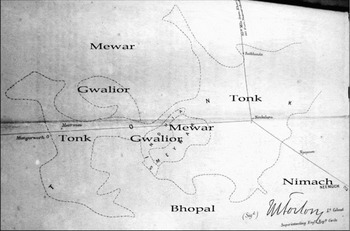
This new machinery was to be constructed in territorial rather than in social terms. At stake was the sealing of territorial boundaries, the porousness of which was singled out as the key obstacle to the implementation of Moghia operations. As most British officers saw them, Princely States were territorially contiguous jurisdictions stretching between borders clearly marked on colonial maps. In their eyes, the problem lay in the fact that the boundaries of Princely states were often precariously intertwined, the amoeboid local geography permitting bandits to easily pass from one state to the next and to successfully dodge the law. So, in 1870, the Rajputana Agent complained that the ‘convoluted configuration of borders’ between Mewar, Tonk and Gwalior (Map 2) was ‘the root and ground of the evil’ of Moghia depredations. ‘With such boundaries’, he wrote, ‘good government is impossible’. As a solution, he proposed the ‘rectification of boundaries’ by means of a series of territorial swaps between neighbouring states.Footnote 62 Keatinge's observations reflected a more general shift of the discussion's focus to territorial concerns. As the Foreign Department Secretary observed, by 1872 the question of Moghia patrol ‘has merged in the general question of re-arrangement of territory’.Footnote 63 And the discussion was fraught with disagreement.
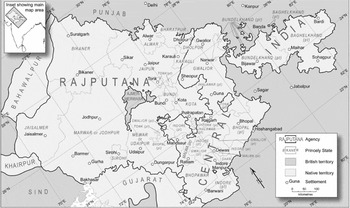
The Rajputana and Central Indian Princely States in 1860. Map drawn by the Cartographic Unit, Department of Geography, University of Cambridge.

The ‘convoluted configuration of borders’ between Mewar, Tonk and Gwalior from a letter by the Rajputana Agent Keatinge to the Foreign Department.Footnote 70

Contrary to the assumptions of British authorities and their maps, indigenous polities were not spatial, but essentially social entities, the uncertain boundaries of which lay at the limits of relational rather than territorial contiguities. No kingdom was under the exclusive rule of an absolute sovereign, but instead, as Nicholas Dirks points out, the ‘centralized government [coexisted] with peripheral, quasi autonomous foci of administration’.Footnote 64 Indeed, the territorial borders of Indian States were so porous as to be only very vaguely approximate to the parameters of indigenous rule.Footnote 65 Each Indian state was subject to continuous change caused by rifts within and shifts of alliance on its periphery. The integrity of local kingdoms was not based on territorial continuity. On the contrary, rulers often intentionally fragmented their jurisdictions so as to prevent alliances and conspiracies among neighbouring subjects. From the viewpoint of landholders, the political significance of land derived from particular sets of social ties rather than from the larger geopolitical entity of which it was part. Estates were valued not only for their size and the quality of their soil, but also significantly as social assets: as testimonies to ties both to the overlords by whom they were granted and to the community/family, to which the land belonged. At the risk of a slightly blunt generalization, one may say that polities were conceived of in social rather than in territorial terms.Footnote 66 Polities did not end at border posts, but graded off outwards into lesser degrees of relatedness. In the outlying ‘border’ regions, where allegiances were often switched, insurrection amongst aristocrats often stirred and most robber-retainers were employed. And British officials were right to observe that this is where most Moghias would have been employed. But the solution, as some of them indeed recognized, lay beyond the ironing out of borders. Land was certainly the terrain of much contest: it was owned, granted, revoked, conquered, inherited, but neither the system of land distribution nor the significance attached to land agreed with British geopolitics.
Not all colonial officials were oblivious to this. Central India Agent Daly, for instance, remarked that the native boundaries of rule were not well described with lines on a map and that the proposed ‘rectification of borders’ would be useless:
The interlacing of Native States [in Gwalior] is not exceptional, but has a general existence throughout Malwa, Neemuch is but a type of the whole. States do not estimate ancient holdings by mere revenue, and many of these, though of little pecuniary worth, are in their eyes, from family traditions, beyond price. . . . A revision of frontier, desirable as it is, would of itself do nothing to change the habits of these men, or even to bring them under control with the enmity and jealousy of action which subsists amongst the Native States. . .This question [of territorial consolidation] has little to do with boundaries—whatever may be done in the way of demarcation, the number of Chiefs and Thakoors will remain the same. . .[the Princely States] do. . .not and cannot have the cohesion that is assumed by law and order, and the rule of the Crown at large.Footnote 67
Daly's frustration lay in his grasp of local polities as dynamic, internally fragmented and fundamentally social terrains, and in the fact of what he understood to be the fundamental incompatibility of the two political orders, between which he was employed to negotiate and which he was meant to align. But Daly was a lone voice of dissent in the brutal engine of centralization. Other officers, whose lack of insight was compensated by enthusiasm, continued to advocate territorial consolidation. Rajputana Agent Keatinge, for instance, wrote that he is ‘hopeful that we will succeed in convincing the jagirdars in exchanging equal portions of their land, so as to find a more favourable order’.Footnote 68 In 1869, however, after two years of attempted negotiations of territorial exchange between Tonk and Gwalior, Keatinge had to report that ‘neither party was willing to give up territory’; consequent attempts at territorial swaps between Tonk and Gwalior, and later between Nimach, Tonk and Mewar, also failed.Footnote 69
If borders could not be ‘rectified’, little kingdoms were to be bound together by a set of rules that would cross the boundaries of the kingdoms. This was attempted through cross-border policing arrangements between Indian States, which by the late 1870s became central to the project. And again, the kings and lesser landholders used this to their advantage. The Tonk Amil of Nimbahera, for instance, wrote that Gwalior is full of the ‘Moghia menace’ and that ‘Meywar has a large number of Moghias in the districts enclosing Nimbahera, and it is from them that Nimbahera chiefly suffers’.Footnote 71 The Rajputana Agent, in turn, wrote that the ‘Meywar Durbar is apathetic in the matter. . .The Tonk authorities say, with truth, that they cannot be responsible for Moghia depredations in a small enclave like Nimbahera, surrounded by very unfriendly States; and of course the Rajpootana States lay a good deal of blame on Tonk and Gwalior’.Footnote 72 British Political Agents were just as keen as the darbārs to blame one another. In 1879 the Rajputana Agent claimed that ‘there can be no doubt that most of the robberies which have recently occurred may, with justice, be attributed to the bands of dacoits who infest the districts of Neembhaira under Tonk and Jawud Neemuch under Gwalior, whence they make raids into Meywar’.Footnote 73 In his turn, the Central India Agent wrote that ‘[t]here are many people of this [Moghia] tribe in the district under this [Mewar] Agency who have formed a formidable organization who, the authorities find, are able successfully to resist the constituted Police of their districts’.Footnote 74 While the Central India Agent pointed out ‘the apathy of Rajpootana State officials in tracing out the perpetrators of these attacks’, the Rajputana Agent blamed Central Indian authorities for failing to establish enough posts on roads and boundaries, and complained about the unwillingness of their troops to cooperate in cross-border policing.Footnote 75 Thus, attempts to establish reciprocal policing relations amongst the rulers of Princely States came to nothing. Again, the mission failed to bring under its aegis the fragmented local political terrain. The failures called for a new approach.Footnote 76 As Daly noted, ‘the hunting [of Moghias] from one State to another is the worst plan’ because landholders ‘by the score [are] as independent as the biggest chief within their own circle’.Footnote 77 Over the course of the mission, it became increasingly apparent that the darbārs had little power over, and increasingly little interest in, enforcing a general set of rules on territories designated as theirs by the cartographers.
As institutional, territorial and legal integrity had proven impossible, the Foreign Office attempted to create a new and socially abstracted bureaucracy for the mission. By this point, political ambitions were only very thinly veiled behind the rhetoric of crime control. Bradford, then head of the T&D Department, suggested that it would be useful to have the Princely States ‘under the guidance and control of a British Political Officer’ who can enforce ‘a machinery of somewhat international character which can act equally in all territories, and have similar jurisdiction in all’.Footnote 78 The establishment of a centrally appointed officer marked an important shift towards the extraction of policing functions from local political life. The Moghia Commission deliberately distanced its operations from local affairs: none of the Moghia Superintendents were appointed from the ranks of locally posted officers, so as to ensure the objectivity of their work.Footnote 79 But, as the Gwalior Code was replaced with the Moghia Commission and the operations taken entirely out of local hands, the kings who were not oblivious to their disempowerment by this process, refused to cooperate. Although the King of Mewar promised to undertake Moghia operations, no Moghias had in fact been registered in his jurisdiction.Footnote 80 In Jodhpur (western Rajputana) most Moghias relocated in 1878 to an agricultural settlement, almost immediately absconded, and within two years the settlement was entirely abandoned.Footnote 81 Even Scindia no longer agreed ‘to the adoption in his territory of the Moghia rules approved by Government’.Footnote 82 In 1879 only Rs. 350 of the monthly Rs. 1,150 salary of the Moghia Superintendent came from the Rajputana and Central Indian darbārs.Footnote 83 The remaining Rs. 800 were left to be paid by the British government. In 1879, Bradford, who continued to press on with the campaign, complained to the Foreign Office that
The Native States in India do not contribute as a rule anything like as much as they should for the maintenance of order in and about India; as a rule we are very chary of calling upon them to pay even for objects which obviously and immediately concern themselves. On one ground or another Government is generally saddled with the lion's share of the expense, and a little much-grudged help is got from the Durbars [emphasis added].Footnote 84
It was increasingly apparent to the Indian rulers that the concerns of the affair had little to do with establishing public peace on their calls. Calls for ‘objective rule’ served the particular interests of the T&D Department and the expansionist agenda of the colonial state. The British government, which wished to saddle the Princely States with the bulk of financial responsibility for the mission, failed to curb the ‘Moghia menace’. At the same time, it was plying the local political order with the British means of central control. The language of further negotiations makes plain the centralizing political aim of the Moghia mission. Take one letter, for instance:
I should be inclined [wrote the Foreign Office Secretary] in any case of this kind to act on a different principle, to insist politely on their paying whatever we might think proper, and thus take the opportunity of familiarizing them with the idea that they cannot contribute just as little as they please to objects which Government considers important [emphasis added].Footnote 85
Conclusion
By the early 1880s the rulers of Indian States were being ‘familiarized’ with the fact that behind the modest aims of the campaign—to control a handful of ruffians—much more profound, systemic changes of governance were at hand. This shift did not mean that the Indian rulers would wake up to be subjects of the British Government. Until India's independence, the reach of colonial control into Indian territories—vaguely termed ‘indirect rule’— remained highly varied. In the wake of 1857–1858, British authorities were anxious to establish better leverage over native jurisdictions. At the heart of this process lay the question of policing. Time and again at crucial moments of political unrest and expansion in British India, policing became the focal concern. Major struggles over political authority in British India (as much as in other parts of the world) revolved around the designation of criminals, constitution of criminal law, and formulation of policing practices. Innovations in criminal law served as key vehicles in the expansion of British control across—and the propagation of the colonial State as the regnant political form on—the subcontinent.Footnote 86 The establishment of a centrally controlled police force marks as much the European transition to modern statehood as the imperial production of modern states.Footnote 87 And it is no accident that the watershed decades in the establishment of colonial governance on the subcontinent—the 1770s, 1820s, 1860s, and 1930s—witnessed the most aggressive articulation of criminal law, penal procedure and policing practice. In British India the formulation of policing practice was carried out through periodic panics over ‘crises of crime’ and ‘criminal networks’, which required special measures of control. The Moghia campaign was but one episode in a series of such crises. The main advocate of the trope of extraordinary crime as a means to police reform was the T&D Department, which continued to be the key player in the ongoing ‘discovery’ of ‘criminal cabals’ and the larger policing of the subcontinent. And it is no coincidence that in 1904 the T&D Department became the Criminal Investigation Department—the key wing of colonial police.
In the discussion of Moghia operations the policing of criminals merged with increasing overtness into the much broader problem of political authority. Plunderer-policing groups like Moghias were an intrinsic element of the dynamic, fragmented and contentious structure of indigenous rule, which did not lend itself to the abstract and centralized apparatus of British governance. At stake in the Moghia project was the alignment of the parameters of local political order with those of the colonial state, an alignment which was basic to the extension of colonial control onto native territories. The diplomatic slippages that continually frustrated the negotiations of Moghia operations reveal some fundamental incompatibilities between the logics of British and Indian rule. The socially particular nature of local policing arrangements, and political structure at large, did not agree with the legal, territorial and bureaucratic abstractions of the colonial state. In the course of Moghia operations, British officials continually tried to smooth over these inconsistencies, which proved persistently resilient to change. The local fissured, turbulent and shifty political terrain could not be easily levelled with the bureaucratic ‘machinery of central character’ and ‘objective rule’ to become the landscape of ‘law and order’. The details of communications about the Moghia campaign reveal the fact that British officers understood as much. If local polities could not be brought in line with the colonial state, they were to be supplanted by it. The Moghia campaign marks the key shift from the colonial policy of incorporation to the policy of displacement. The shift from the locally administered Gwalior Code to the abstracted bureaucracy of the Moghia Commission signals this shift to the strategy of abstraction evident in the rest of formal Criminal Tribe legislation, which took the control of ‘criminal tribes’ out of local hands.Footnote 88
I have also argued that the Moghia campaign—just as the bulk of criminalizing projects before and after—mounted an assault not on the ‘innocent’ itinerant groups, but on the agents of indigenous police. Its operations aimed to dismantle the practice of raiding and protection, which was a key institution of indigenous politics. British governance assumed that raiding and protection were mutually exclusive activities—the first a crime against and the second the guardian of ‘law and order’. It was not nomadism that was criminalized, as historians have previously argued, but raiding that was transformed from a politically constitutive practice into a socially destructive ‘crime’. The ‘control and reclamation’ of Moghias is a story of a series of executive failures, which nevertheless paved the way for the formal Criminal Tribe legislation in British India. The failures of this project further expose the fact that the dynamic system of patronage-politics persisted well into the late nineteenth century and, as I have shown elsewhere, remains to a surprising degree alive and well today.Footnote 89