A review of existing studies shows that mother’s reporting of past childhood adversities (CAs) is an important marker for physical and mental difficulties for both the mothers and their children during the pre-and postpartum period. The retrospective reporting of a mother’s experience of past CAs has also been linked to higher use of health care services in this period (Grimstad & Schei, Reference Grimstad and Schei1999).
The estimated prevalence in women of childhood adversities, especially childhood abuse, has been investigated by various larger studies (Chartier, Walker, & Naimark, Reference Chartier, Walker and Naimark2007; Cougle, Timpano, Sachs-Ericsson, Keough, & Riccardi, Reference Cougle, Timpano, Sachs-Ericsson, Keough and Riccardi2010; Lizardi, Thompson, Keyes, & Hasin, Reference Lizardi, Thompson, Keyes and Hasin2010; May-Cahal & Cawson, Reference May-Chahal and Cawson2005; Pereda, Guilera, Forns, & Gómez-Benito, Reference Pereda, Guilera, Forns and Gómez-Benito2009; Walsh, MacMillan, & Jamieson, Reference Walsh, MacMillan and Jamieson2003). All the studies that have examined the interrelations between CAs concluded that they are highly prevalent, often co-occur, and are inter-correlated (Dong et al., Reference Dong, Anda, Felitti, Dube, Williamson, Thompson and Giles2004; Higgins & McCabe, Reference Higgins and McCabe2003; Kessler et al., Reference Kessler, McLaughlin, Green, Aguilar-Gaxiola, Alhamzawi, Alonso and Williams2010; Schilling, Aseltine, & Gore, Reference Schilling, Aseltine and Gore2008).
A full exploration of the interrelationships among multiple forms of CAs is critical to understanding of long-term effects of CAs and to predict reports of childhood abuse (Higgins & McCabe, Reference Higgins and McCabe2000). Different studies have found that certain types of reported CAs, related to maladaptive family function and parental loss or separation, are associated with a higher probability of retrospective reporting of childhood abuse. These types of CAs include parental mental illness (Chartier, Walker, & Naimark, Reference Chartier, Walker and Naimark2010; Walsh, MacMillan, & Jamieson, Reference Walsh, MacMillan and Jamieson2002), parental alcohol abuse (Berger, Reference Berger2005; Dube et al., Reference Dube, Anda, Felitti, Croft, Edwards and Giles2001), parental substance abuse (Walsh et al., Reference Walsh, MacMillan and Jamieson2003), parental death (Brown, Cohen, Johnson, & Salzinger, Reference Brown, Cohen, Johnson and Salzinger1998), and parental divorce (Afifi, Boman, Fleisher, & Sareen, Reference Afifi, Boman, Fleisher and Sareen2009; Brown et al., Reference Brown, Cohen, Johnson and Salzinger1998), among others. Other studies did not confirm these results for some types of CAs, such as parental divorce (Higgins & McCabe, Reference Higgins and McCabe2000) or parental mental illness (Peleikis, Mykletum, & Dahl, Reference Peleikis, Mykletun and Dahl2004).
The extant literature confirms that during the perinatal period, the retrospective reporting of a mother’s experience of past childhood abuse is associated with hormonal changes (Gonzalez, Jenkins, Steiner, & Fleming, Reference Gonzalez, Jenkins, Steiner and Fleming2009) and negative physical outcomes for the mother, increasing the probabilities of premature contractions and cervical insufficiency (Leeners, Stiller, Block, Gorres, & Rath, Reference Leeners, Stiller, Block, Gorres and Rath2010), pre-term delivery (Noll et al., Reference Noll, Schulkin, Trickett, Susman, Breech and Putnam2007), and pregnancy loss (Hillis et al., Reference Hillis, Anda, Dube, Felitti, Marchbanks and Marks2004). Women with a history of childhood abuse also have a greater risk for postpartum thyroid dysfunction (Plaza et al., Reference Plaza, Garcia-Esteve, Torres, Ascaso, Gelabert, Imaz and Martin-Santos2012). Likewise, the children of mothers who have been abused also show hormonal changes in the HPA axis (Brand et al., Reference Brand, Brennan, Newport, Smith, Weiss and Stowe2010), and they are at greater risk for low birth weight (Gavin, Hill, Hawkins, & Maas, Reference Gavin, Hill, Hawkins and Maas2011).
In addition to the physical consequences, childhood abuse is also a risk factor for negative mental outcomes in both the mother and her children. Specifically, childhood abuse has been associated with prenatal and postpartum depression (Dayan et al., Reference Dayan, Creveuil, Dreyfus, Herlicoviez, Baleyte and O’Keane2010; LaCoursiere, Hirst, & Barret-Connor, Reference LaCoursiere, Hirst and Barret-Connor2012; Plaza et al., Reference Plaza, Garcia-Esteve, Torres, Ascaso, Gelabert, Imaz and Martin-Santos2012; Rich-Edwards et al., Reference Rich-Edwards, James-Todd, Mohllajee, Kleinman, Burke, Gillman and Wright2011;), and prenatal and postpartum post-traumatic stress disorder (PTSD) (Lev-Wiesel, Daphna-Tekoah, & Hallak, Reference Lev-Wiesel, Daphna-Tekoah and Hallak2009; Seng, Sperlich, & Low, Reference Seng, Sperlich and Low2008; Seng, Low, Sperlich, Ronis, & Liberzon, Reference Seng, Low, Sperlich, Ronis and Liberzon2009). Furthermore, the presence of childhood abuse in the mother is a risk factor for abuse of her children (Berlin, Appleyard, & Dodge, Reference Berlin, Appleyard and Dodge2011), harsher parenting (Bailey, DeOliveira, Veitch Wolfe, Evans, & Hartwick, Reference Bailey, DeOliveira, Veitch Wolfe, Evans and Hartwick2012), greater internalized and externalized behavior problems (Dubowitz, Reference Dubowitz2001), and psychopathology in the children (Pawlby, Hay, Sharp, Waters, & Pariante, Reference Pawlby, Hay, Sharp, Waters and Pariante2011; Roberts, Lyall, Rich-Edwards, Ascherio, & Weisskopf, Reference Roberts, Lyall, Rich-Edwards, Ascherio and Weisskopf2013).
Despite these data, an assessment of such adversities is not performed routinely during pregnancy. In order to evaluate the utility of early screening and detection during this period, the aims of this study were: 1) To examine, during the perinatal period, the prevalence in women of three types of childhood abuse (physical, emotional and sexual), and the distribution of different characteristics of these abuses; 2) To examine whether a history of other types of childhood adversities, that are easily or usually collected in a general clinical interview (family mental illness, parental substance abuse, parental death, and parental separations), can be used as risk markers for the presence of childhood abuse.
Method
Participants
The study sample consisted of 303 postpartum Caucasian women over 18 years of age, all of whom gave birth in the same Obstetrics Unit and who were able to understand and answer clinical questionnaires. This sample was a subset of a total sample that participated in a larger prospective multicenter study on postpartum depression that took place between December 2004 and July 2005 in Spain (Sanjuan et al., Reference Sanjuan, Martin-Santos, Garcia-Esteve, Carot, Guillamat, Gutierrez-Zotes and de Frutos2008). The subset was composed of subjects from one center in the larger multicenter study, and was originally used for a study that examined the relationships between childhood abuse and postpartum thyroid status and depressive symptomatology in the postpartum period (Plaza et al., Reference Plaza, Garcia-Esteve, Torres, Ascaso, Gelabert, Imaz and Martin-Santos2012). This subset, which was also used for the present study, inherited the three exclusion criteria used by the larger prospective multicenter study: women under psychological and/or psychopharmacological treatment during pregnancy, women whose children died after birth, and illiteracy.
Fifty-three women (17.5%) were rejected on the basis of the exclusion criteria and a further 14 (4.61%) chose not to participate. The final sample therefore consisted of 237 women. The institutional review boards of the participating hospital approved the study, and all the women gave written informed consent. Participation consisted of an appointment in the Obstetric Unit at 24–48 hours postpartum in order to collect demographic variables and to complete the tests.
Measures
Childhood adversities (CAs), including maltreatments, were evaluated using the validated Spanish version (Plaza et al., Reference Plaza, Torres, Martín-Santos, Gelabert, Imaz, Navarro and García-Esteve2011) of the Early Trauma Inventory Self Report (ETI-SR, Bremner et al., Reference Bremner, Bolus and Mayer2007). This is a 56-item inventory that assesses the presence of childhood trauma before age 18. This inventory includes a physical subscale (9 items), an emotional subscale (7 items), and a sexual abuse subscale (15 items), as well a general trauma subscale (31 items). It also gathers data on frequency, age of trauma, the perpetrator, and other variables. The ETI-SR has been validated in many languages (German, French, Chinese, and Portuguese). The validated Spanish version shows a higher internal consistency for the total scale, with a Cronbach α coefficient of 0.79, whereas the Cronbach α coefficients of the physical, emotional and sexual subscales were 0.66, 0.70 and 0.58, respectively. In this Spanish validated version, the best cut-offs that maximize the sensitivity and specificity of the different subscales to determine the presence of physical, emotional, and sexual abuse were higher than 3, 4, and 2, respectively (Plaza et al., Reference Plaza, Torres, Martín-Santos, Gelabert, Imaz, Navarro and García-Esteve2011).
To collect information on CAs related to maladaptive family functioning and parental loss or separation, the following seven items of the ETI-SR general subscale were selected as dichotomous (yes/no) variables: family mental illness, parental alcohol abuse, parental drug abuse, parental death, parental divorce, parental separation, and not growing up with parents. Some of the selected items were fused and recoded into new ones, such that for the present study we considered two types of maladaptive family functioning (family mental illness and parental substance abuse, including alcohol) and two types of parental loss or separation (parental death and parental separations, including parental divorce and not growing up with parents). The recoded items were marked as “yes” if the participant answered “yes” to either of the dichotomous categories included in the combined variable.
Socio-demographic data (age, educational level, marital status, and financial status at the time of assessment) were also collected for a sample description. Only the educational level as an index of socioeconomic status was analyzed in relation to CAs.
Statistical Analysis
Data were recorded in the form of frequencies, specifically as percentages for category variables and as medians and quartiles for the quantitative variable. The prevalence of abuse was estimated using a 95% CI. The chi-square test was used to evaluate the association between each type of CAs and demographic variables, as well as between the different CAs themselves. Odds ratios and confidence intervals were calculated for the association between the three forms of childhood abuse: physical (CPA), emotional (CEA), and sexual abuse (CSA). Hierarchical binary logistic regressions were then applied, taking each type of abuse (physical, emotional, and sexual) as the dependent variable and demographic information (educational level) and CAs related to parental loss or separation and maladaptive family functioning as independent variables. The Hosmer-Lemeshow test was used to examine the internal validity of the regression models. The exponential regression coefficients were interpreted as odds ratios and 95% CI, with the level of significance being set at .05 for all analyses. Statistical analysis was performed using SPSS v.15.0.
Results
Characteristics of the Sample (n = 237)
The mean age (SD) of the women was 32.6 (4.56) years old (range: 19–46). Almost all of them were married (98%) and had completed either secondary (59%) or university education (40%). A majority of the women (65%) had a sufficient level of income, as defined by self-assessment, with only 4.2% being low earners.
Prevalence of CAs
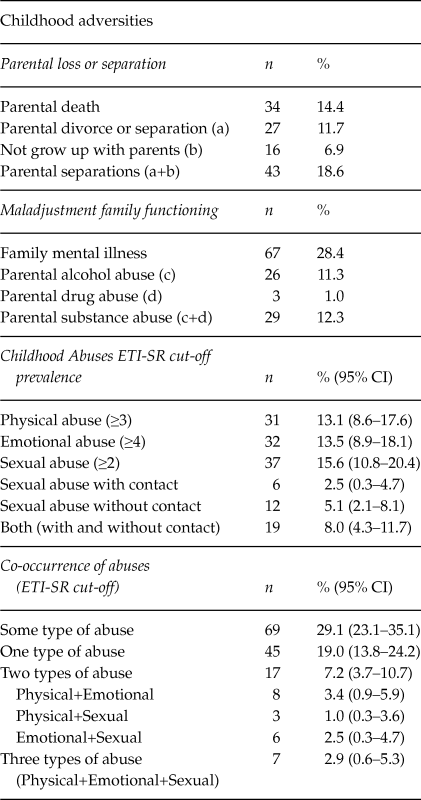
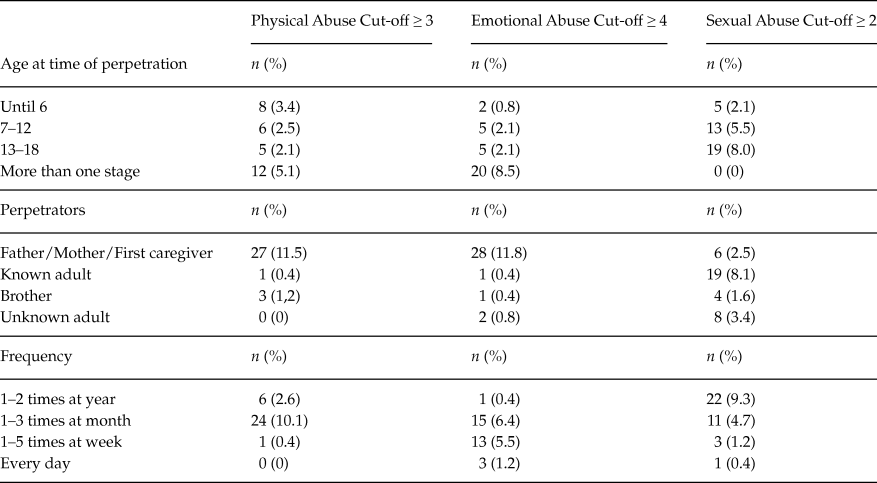
Table 1 shows the prevalence of CAs and co-occurring types of abuse. Table 2 shows the characteristics of each type of abuse in relation to age at the time of perpetration, the perpetrator, and frequency. Childhood abuse with contact was reported by 67.6% of the women who were sexually abused as a child, with penetration being involved in 1.3% of cases.
Prevalence of childhood adversities and co-occurrence between abuses

Note: N = 237.
Characteristics of childhood abuse

Note: N = 100.
Bivariate Analysis: Relationships between demographic characteristics and CAs
No CAs was related to educational level except the CPA that was significantly associated with a lower educational level (p < .032).
Bivariate Analysis: Relationships between CAs
The most significant association was that between CPA and CEA (OR: 10.4; 95% CI: 4.4–24.6), followed by the association between CSA and CEA (OR: 5.16; 95% CI: 2.26–11.7) and that between CPA and CSA (OR: 3.15; 95% CI: 1.34–7.42).
As regards the relationship between the different variables related to maladaptive family functioning and parental loss or separation in childhood, only the association between parental substance abuse and family mental disorder was significant (OR: 2.25; 95% CI: 0.928–5.360) The associations between parental substance abuse and parental separation (p < .188), parental substance abuse and parental death (p < .53), parental separation and parental death (p < .84), parental separation and parental mental illness (p < .58) and parental mental illness and parental death (p < .53) were not significant.
Logistic Regression
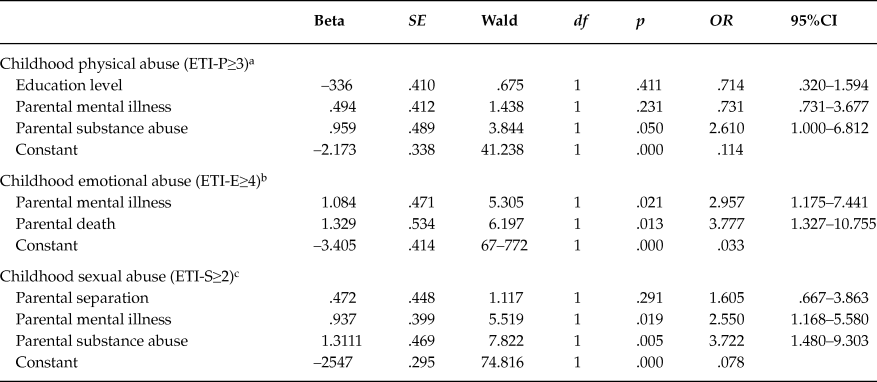
Table 3 shows the results of the three hierarchical binary logistic regressions with the three types of childhood abuse (physical, emotional, and sexual) as dependent variables. The order of entry of independent variables in each regression is also indicated. Current financial level and marital status were not considered.
Binary logistic regression. Childhood physical, emotional and sexual abuse as dependent variables

Note: a The independent variables for physical abuse were introduced in the following order: education level, parental mental illness and parental substance abuse.
b The independent variables for emotional abuse were introduced in the following order: parental mental illness and parental death.
c The independent variables for childhood sexual abuse were introduced in the following order: parental separation, parental mental illness and parental substance abuse.
Women who had experienced parental substance abuse had a two-fold greater risk of suffering CPA compared to women without such a history. Women who had experienced family mental illness in childhood or adolescence were two and three times more likely to suffer, respectively, CSA and CEA than were women without this background. Women who had experienced parental death in childhood or adolescence had a three-fold greater risk of suffering CEA compared to women without such a history.
Discussion
The results confirm that CAs are highly prevalent, often co-occur, and are strongly interrelated, with the strongest association being the one between CEA and CPA. CAs related to maladaptive family functioning were found to be a risk marker for the presence of all three types of abuse considered, especially CSA, while parental death was a risk marker for the presence of CEA.
Prevalence of CAs
Almost one third of the sample reported being abused before the age of 18, and one tenth of the women were exposed to more than one type of abuse (physical, sexual or emotional). The present study's estimates of exposure to each type of CAs are consistent with the prevalence rates reported in international representative surveys. For CSA, the reported prevalence of 15.6% is within the range of 10–20% reported for women in the majority of international studies (Cortés, Cantón, & Cantón-Cortés, Reference Cortés, Cantón and Cantón-Cortés2011; Finkelhor, Reference Finkelhor1994; Pereda et al., Reference Pereda, Guilera, Forns and Gómez-Benito2009; Stoltenborgh, van Ijzendoorn, Euser, & Bakermans-Kranenburg, Reference Stoltenborgh, van Ijzendoorn, Euser and Bakermans-Kranenburg2011). For CPA, the reported prevalence (13.10%) falls within the broader prevalence range reported for women (5–22%) in international studies (Cougle et al., Reference Cougle, Timpano, Sachs-Ericsson, Keough and Riccardi2010; Griffin & Amodeo, Reference Griffin and Amodeo2010; Thombs, Lewis, Barnstein, Medrano, & Hatch, Reference Thombs, Lewis, Bernstein, Medrano and Hatch2007). For CEA, the reported prevalence (13.5%) is similar to the 14.3% found by Scher, Forde, McQuaid, and Stein (Reference Scher, Forde, McQuaid and Stein2004) in a community sample, in women.
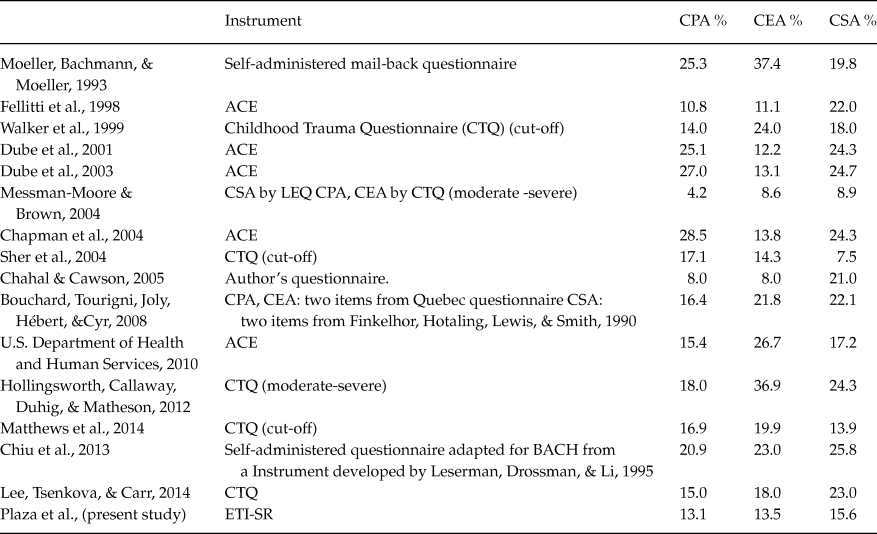
The reported prevalence of each type of abuse in the present study can also be compared to the varying prevalence rates reported in community population studies that, within a single study, report the prevalence of each of the three types of abuse in a non-clinical sample of women (Table 4). For CSA (13.9% and 17.2%) and CPA (16.9% and 15.4%), Matthews, Fang, Thurston, and Bromberger (Reference Matthews, Fang, Thurston and Bromberger2014) and the U.S. Department of Health and Human Services study (2010) showed prevalence rates similar to the present study. However, for CEA these studies showed lower rates (19% and 26.7%, respectively) than the present estimates. In contrast, for CEA (11.1% and 14.3%, respectively) and for CPA (10.8% and 17.1%, respectively) Fellitti et al. (Reference Fellitti, Anda, Nordenberg, Williamson, Spitz, Edwards and Marks1998) and Scher et al. (Reference Scher, Forde, McQuaid and Stein2004) found similar prevalence rates to ours, but for CSA, the first study reported a higher rate (7.5%), and the second a lower rate (22%) than in the present study. The differences observed could be due to the use of different instruments, or different socio-demographic characteristics. As we can see in Table 4, there is a wide range of reported prevalence in these studies. Even when using the same instrument and the same cut-off, as is the case for Mathews et al. (Reference Matthews, Fang, Thurston and Bromberger2014), Scher et al. (Reference Scher, Forde, McQuaid and Stein2004), and Walker et al. (Reference Walker, Gelfand, Katon, Koss, von Korff, Bernstein and Russo1999), the reported prevalence rates can still vary.
Prevalence of each type of abuse in studies of non-clinical samples of women, compared with the present study

ACE = Adverse Childhood Events; LEQ = Life Events Questionnaire (Long, 2002. Unpublished work. Oklahoma State University.). CTQ = Childhood Trauma Questionnaire (Bernstein et al., Reference Bernstein, Fink, Handelsman, Foote, Lovejoy, Wenzel and Ruggiero1994; Reference Bernstein, Stein, Newcomb, Walker, Pogge, Ahluvalia and Zule2003).
Childhood Abuse Characteristics
As regards the characteristics of abuse, the present study is consistent with previous research (Finkelhor et al., Reference Finkelhor, Hotaling, Lewis and Smith1990; Finkelhor, Ormrod, & Turner, Reference Finkelhor, Ormrod and Turner2005; Speizer, Goodwin, Whittle, Clyde, & Rogers, Reference Speizer, Goodwin, Whittle, Clyde and Rogers2008) in finding that CSA was most often perpetrated by a known adult, while the percentage of intra-familial sexual abuse was also similar to that reported (5.6%) by De Paúl, Milner, and Múgica (Reference De Paúl, Milner and Múgica1995). The age range of victims was likewise similar to previous reports (Cortés et al., Reference Cortés, Cantón and Cantón-Cortés2011). The percentage of CSA by penetration was consistent with that reported by Chen, Dunne, and Han (Reference Chen, Dunne and Han2004) and Oaksford and Frude (Reference Oaksford and Frude2001).
In contrast, CPA was most likely to be perpetrated by the primary caregiver, and it was the form of abuse most often perpetrated in the age range 0 to 6 years, this being consistent with previous findings (Griffin & Amodeo, Reference Griffin and Amodeo2010; May-Cahal & Cawson Reference May-Chahal and Cawson2005).
For CEA, the results are also consistent with the finding of Hovens et al. (Reference Hovens, Wiersma, Giltay, van Oppen, Spinhoven, Penninx and Zitman2010) that the primary caregiver was the most common perpetrator. CEA was the most common type of abuse in all age ranges, and had the highest reported rate of daily frequency compared with the other two types. These findings suggest that CEA is associated with greater chronicity.
Our results also reveal a high degree of overlap between adult reports of sexual, physical, and emotional abuse, as in other studies (Allen, Reference Allen2008; Higgins & McCabe Reference Higgins and McCabe2000). The rates of co-occurrence between types of abuse in the present study are similar to those reported for women by Scher et al. (Reference Scher, Forde, McQuaid and Stein2004). The strongest correlation was that between CEA and CPA, this being consistent with the findings of Higgins and McCabe (Reference Higgins and McCabe2000) and Scher et al. (Reference Scher, Forde, McQuaid and Stein2004).
The distinct characteristics of CSA compared to the other forms of abuse might be connected to unique effects on the development of the child/adolescent. In contrast to the findings for the other types of abuse, the primary caregiver was not the most common perpetrator of CSA. A further difference in relation to the other forms of abuse is that even if CSA only occurs on one occasion it is still considered to be sexual abuse.
Other CAs
The prevalence of parental death in the present study was similar to that reported for women in the general population (Speisman, Reference Speisman2006), and this similarity was also found for the prevalence of parental divorce (Lizardi et al., Reference Lizardi, Thompson, Keyes and Hasin2010), family mental illness (Dube et al., Reference Dube, Anda, Felitti, Croft, Edwards and Giles2001), and parental substance abuse (Walsh et al., Reference Walsh, MacMillan and Jamieson2003).
CAs as Risk Markers for Childhood Abuse
In the present study, the death of a parent before age 18 was one of the most important markers for having experienced CEA in women, being associated with a threefold increase in the odds of reporting. Although previous studies found that parental death was a risk marker for CSA (Brown et al., Reference Brown, Cohen, Johnson and Salzinger1998; Peleikis, Reference Peleikis, Mykletun and Dahl2004) there is, to our knowledge, no report about the association between parental death and CEA. Parental death can affect basic feelings of security and strengthen the attachment to the remaining parent, who is grieving and, possibly finding it hard to adjust to the new situation. As a result, his or her parenting skills may suffer. In this context it is worth noting that some studies have found single parenthood to be a risk factor for childhood abuse (Sedlak et al., Reference Sedlak, Mettenburg, Basena, Petta, McPherson, Greene and Li2010; Weitoft, Hjern, Haglund, & Rosén, Reference Weitoft, Hjern, Haglund and Rosén2003). In agreement with some authors (Chamberland, Fallon, Black, & Trocmé, Reference Chamberland, Fallon, Black and Trocmé2011; Higgins & McCabe Reference Higgins and McCabe2000) and, in contrast to the findings of others (Higgins & McCabe, Reference Higgins and McCabe2003; Mullen, Martin, Anderson, Romans, & Herbison, Reference Mullen, Martin, Anderson, Romans and Herbison1996), we found no significant association between CEA and separation/divorce/not growing up with parents.
In the present study the presence of family mental illness in childhood was associated with a twofold and threefold increase in the odds of reporting CSA and CEA, respectively. Research has previously highlighted the contribution of family mental illness or parental mental disorder to CSA (Chartier et al., Reference Chartier, Walker and Naimark2010; Walsh et al., Reference Walsh, MacMillan and Jamieson2002) and CEA (Hart & Glasser, 2011; Iwaniec, Larkin, & Higgins, Reference Iwaniec, Larkin and Higgins2006). As in the present study, Brown et al. (Reference Brown, Cohen, Johnson and Salzinger1998) did not find parental mental disorders to be a risk factor for CPA.
The present results show that the presence of parental substance abuse (including alcohol abuse) indicates a twofold and threefold increase in the odds of reporting CPA and CSA, respectively. This is consistent with previous findings (Berger, Reference Berger2005; Brown et al., Reference Brown, Cohen, Johnson and Salzinger1998; Walsh et al., Reference Walsh, MacMillan and Jamieson2003).
Implications for Practice
As several studies have argued, the most effective intervention programs are those carried out during the perinatal period (Gonzalez & McMillan, Reference Gonzalez and Macmillan2008). The high prevalence found in this study, combined with the significant risk of negative health outcomes, indicates that the perinatal assessment of CAs could have clinical benefits. The perinatal identification of women with an experience of childhood abuse, used as a basis for providing appropriate assistance, may therefore reduce the likelihood of physical and mental health problems, and as a result may mitigate the short- and long-term effects (both physical and mental) on their infants. As such it can help reduce the risk of intergenerational continuity of child abuse (Pears & Capaldi, Reference Pears and Capaldi2001).
Given the often-difficult implementation of a test battery in daily clinical practice, the results of the present study can help to identify women at risk. The presence of childhood family mental illness, parental substance abuse, or childhood parental death – questions that can be easily included in a general history – can serve as risk markers for a history of abuse, and can help to identify women who should be evaluated using a specific instrument to assess the presence of CAs.
As childhood trauma was assessed retrospectively, we cannot rule out the possibility of memory bias (Bremner, Reference Bremner2003), although recent studies do support the use of retrospective reports of childhood abuse (Hardt & Rutter, Reference Hardt and Rutter2004; Hardt, Vellaisamy, & Schoon, Reference Hardt, Vellaisamy and Schoon2010; Yancura & Aldwin, Reference Yancura and Aldwin2009). A further limitation is that the exclusion of women who were undergoing psychiatric and/or psychological treatment during pregnancy may have ruled out some potential participants who have suffered abuse in childhood, thereby leading to an underestimate of prevalence, but at the same time also providing an indication of the percentage of women that reported CAs in the postpartum period who are not identified by current clinical practice. Another limitation is that the present study is cross-sectional. Inferences regarding temporal relations cannot be made.
This study found a relatively high prevalence of childhood adversities, notably childhood abuse. The literature provides evidence for a link between the presence of CAs and significant negative outcomes for both mother and children. These results indicate the possibility to improve clinical outcomes, both physical and mental, via an assessment during the perinatal period. Screening for childhood family mental illness, parental substance abuse, or parental death – all identified risk factors for reporting childhood abuse – can be used in a general history to help to identify women that should be assessed specifically regarding abuse.