Significant outcomes
-
• Social anxiety, but not necessarily social anxiety disorder, is very prevalent in bipolar disorder, even in the remission period.
-
• Social anxiety is associated with self-stigmatisation and low self-esteem developed in the long term.
Limitations
-
• In this study, there is no control group enabling to compare the mean scores of social anxiety, sense of stigmatisation and self-esteem of bipolar patients.
-
• The study group is only constituted of bipolar patients without any comorbid diagnosis including social anxiety disorder. Bipolar patients with comorbid social anxiety disorder might present different associations in terms of social anxiety, sense of stigmatisation and self-esteem.
Introduction
Social anxiety can be seen in every phases of mood disorders both as a comorbid disorder and as a phenomenon. In bipolar disorder, social anxiety disorder is the most common comorbid disorder in the Systematic Treatment Enhancement Programme for Bipolar Disorder data (Reference Simon, Otto and Wisniewski1) and the third most common comorbid disorder in the Turkish comorbidity study in bipolar disorder (Reference Tamam and Ozpoyraz2). In an Italian study, where the comorbidity of social anxiety disorder in bipolar disorder is assessed, the prevalence is found to be 12.7% (Reference Pini, Maser and Dell'Osso3). As a phenomenon, social anxiety symptoms can also coexist in bipolar patients (Reference Graystone, Garner and Baldwin4).
There is an effort in understanding the occurrence of social anxiety in bipolar disorder. It is suggested that it is counterintuitive for the manic patients to have social anxiety; however, in the depressive phase, fears of public speaking or inferiority can be more acceptable (Reference Pini, Maser and Dell'Osso3). Himmelhoch upholds the central role of anaclisis and depressive inhibition in bipolar disorder, which during antidepressant therapy often overshoots in a hypomanic direction (Reference Himmelhoch5). It is suggested that patients with social anxiety disorder experiencing hypomanic switch while taking antidepressant treatment are considered in the bipolar spectrum (Reference Valença, Nardi and Nascimento6). But this does not fully explain the high comorbidity rate of social anxiety in bipolar disorder.
Stigmatisation of mental disorders is one of the prominent problems in the adaptation of psychiatric patients. It is reported that concerns about the stigma associated with mental illness reported by patients during an acute phase of bipolar illness predicted poorer social adjustment 7 months later with individuals outside the patient's family (Reference Perlick, Rosenheck and Clarkin7). In another study with mostly psychotic patients, it is shown that the stigma associated with mental illness harms the self-esteem of many people who have serious mental illnesses (Reference Link, Struening, Neese-Todd, Asmussen and Phelan8). Serretti et al. (Reference Serretti, Olgiati and Colombo9) suggest that in affective patients the genetic basis of self-esteem deficit has not been clarified; however, they point out that self-esteem is decreased because of a cognitive bias primarily involving self-attribution of positive characteristics. It can be predicted that stigmatisation may have a negative effect on the self-esteem of the bipolar patients.
In this study, it is aimed to show the association between bipolar disorder and social anxiety with the hypothesis that stigmatisation causes low self-esteem in remitted bipolar patients leading to social anxiety. This study does not aim to rate the diagnosis of comorbid social anxiety disorder in bipolar disorder, but it tries to explain the psychosocial aspects of the phenomenon of social anxiety in bipolar disorder.
Materials and methods
The study was carried out in Celal Bayar and Uludag University Hospitals, Mood Disorders Units, in Turkey.
Subjects
The inclusion criteria were being at the age of between 18 and 65, being in remission for at least 6 months, having a diagnosis of bipolar disorder according to DSM-IV, and demonstrating physical and cognitive ability sufficient to comply with study protocol. The exclusion criteria were having any psychiatrical, neurological or organical diagnosis other than bipolar disorder, having alcohol or any other substance misuse. In the Uludag group, 150 patients were screened for this study and 120 patients were eligible according to the inclusion and exclusion criteria. Two patients did not want to participate in this study because of their unwillingness to fill the scales. In the Celal Bayar group, 84 patients were screened for this study and 40 patients were eligible according to the inclusion and exclusion criteria. Two patients did not want to participate in this study because of their lack of time and six patients were unwilling to fill the study scales. Thus, 118 patients from the Uludag University Hospital and 32 patients from the Celal Bayar University Hospital constituted the study group. There was no statistically significant difference between the patients from each centre in terms of age, gender, education time, duration of illness and number of episodes. As a result, 150 remitted patients consecutively admitted to the units were included in this study. All patients completed the study instruments without any missing or wrong data. This study was approved by the Local Ethical Committee of Celal Bayar University (20.05.2009-134). All patients were asked to give their informed consent.
The asymptomatic state was confirmed by a 17-item Hamilton Depression Rating Scale (HAM-D) score less than 7 and a Young Mania Rating Scale (YMRS) score less than 4 at the time of the SCID-CV interview. All subjects had been asymptomatic for at least 6 months based on the clinician notes and the SCID-CV interview. Being in remission is also confirmed by not having any change in the treatment for the last 6 months. Additional clinical information (i.e. onset of illness, number of episodes and hospitalisations) was obtained from both clinical charts and direct patient interviews. The patients were assessed cross-sectionally.
Instruments
For assessing depressive symptoms, 17-item HAM-D with structured interview guide is used, and the reliability and validity study for the Turkish version was performed by Aydemir et al. (Reference Aydemir, Deveci and Icelli10). For assessing manic symptoms, the YMRS is used, and the reliability and validity study for the Turkish version was performed by Karadag et al. (Reference Karadag, Oral, Yalcin and Erten11).
For the assessment of social anxiety, Liebowitz Social Anxiety Scale (LSAS) was used. It measures anxiety and avoidance/withdrawal that appear in various social situations. It is composed of two subscales; the first subscale measures the level of anxiety that arises in social settings, and the second subscale measures the severity of avoidance/withdrawal behaviour. Subscale total score ranges from 0 to 72 and total scale score ranges between 0 and 144. Higher scores indicate greater severity of social anxiety and avoidance/withdrawal. The scale was developed by Liebowitz (Reference Liebowitz12); its validity and reliability were determined by Heimberg et al. (Reference Heimberg, Horner and Juster13), and the validity and reliability of the Turkish form were determined by Soykan et al. (Reference Soykan, Ozguven and Gencoz14).
For the assessment of self-esteem, Rosenberg Self-Esteem Scale (RSES) was used. It is a self-rated scale consisting of 63 items and 12 subscales. The items are 2- or 4-point Likert type. It is originally developed by Rosenberg (Reference Rosenberg15) and it is validated into Turkish by Cuhadaroglu (Reference Cuhadaroglu16). In this study, four of the subscales such as self-esteem, self-continuity, interpersonal trust and sensitivity to criticism were used.
For the assessment of stigmatisation, the sense of stigmatisation subscale of the Bipolar Disorder Functioning Questionnaire (BDFQ-Stigma) developed by the Mood Disorders Section of Psychiatric Association of Turkey was used. BDFQ was originally developed by Aydemir et al. (Reference Aydemir, Eren and Savas17). It is a 3-point Likert type self-rated scale. It has 11 subscales consisting of 52 items. The sense of stigmatisation subscale contains four items and the four items are ‘feeling inadequate or deficient because of the illness', ‘being humiliated or being seen as inadequate by others because of the illness', ‘difficulties in getting married because of the illness', and ‘difficulties in finding a job because of the illness'. Cronbach α coefficient of the sense of stigmatisation subscale was found to be 0.75 and item-total score correlation coefficients were between 0.40 and 0.59. In the confirmatory factor analysis, the sense of stigmatisation subscale had a goodness-of-fit index (GFI) of 0.49.
Statistical analysis
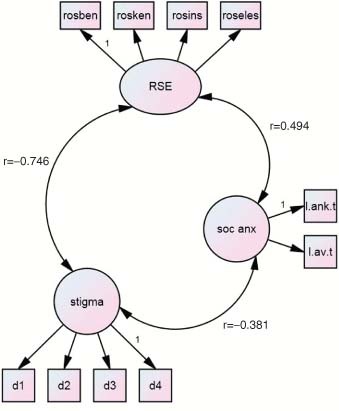
In the statistical analyses, beside demographic data, for the effect of demographic and clinical variables on stigmatisation and self-esteem, Pearson correlation test and Student's t-test and for the association between stigmatisation, sense of self-esteem and social anxiety, confirmatory path analysis were conducted. Path analysis is a statistical procedure allowing statistical determination of the relative importance of various variables within a theory-based model. Thus, a confirmatory path analysis allows verification of causal relationships between directly observable variables (Reference Hintermair18). Confirmatory path analysis was performed to test the sketched connection between stigmatisation, sense of self-esteem and social anxiety (Fig. 1). It provided the advantage to identify the best-fitting model between stigmatisation, sense of self-esteem and social anxiety. In the model, since these variables were hypothesised to interact between each other, the model was posited that all variables were correlated with each other. Goodness-of-fit statistics are reported for the model where GFI, confirmatory fit index (CFI) and root mean square error of approximation (RMSEA) are presented. The GFI and CFI values may range between 0 and 1 and should be greater than 0.90. The RMSEA is an absolute index of fit. RMSEA values under 0.05 indicate close fit with the data, values between 0.05 and 0.08 represent reasonable fit, values between 0.08 and 0.10 reflect poor fit, and values greater than 0.10 are unacceptable. All analyses were performed by using SPSS, version 10 and its affiliated software, AMOS.
Model for the interaction of social anxiety, sense of stigmatisation and self-esteem in remitted bipolar patients. Bidirectional arrows represent correlated variables, represented as correlation coefficients. RSE, self-esteem; rosben, RSES subscale of self-esteem; rosken, RSES subscale of self-continuity; rosins, RSES subscale of interpersonal trust; roseles, RSES subscale of sensitivity to criticism; stigma, sense of stigmatisation; d1, item 1 of sense of stigmatisation subscale of BDFQ; d2, item 2 of sense of stigmatisation subscale of BDFQ; d3, item 3 of sense of stigmatisation subscale of BDFQ; d4, item 4 of sense of stigmatisation subscale of BDFQ; socanx, social anxiety; l.ank.t, LSAS subscale of social anxiety; l.av.t, LSAS subscale of avoidance/withdrawal.

Results
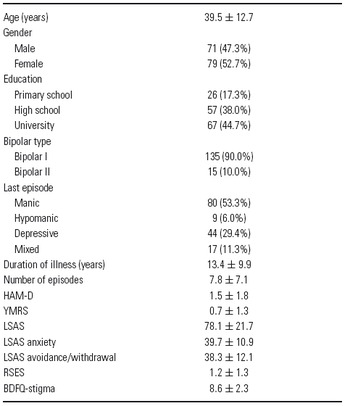
Table 1 shows demographic and clinical features of the bipolar patients. The mean age of the patients was 39.5 ± 12.7, and 52.7% (n = 79) were females. Ninety per cent (n = 135) of the patients had bipolar I disorder and taking the last episode into consideration, 53.3% (n = 80) experienced depressive episode and 29.3% (n = 44) experienced manic episode. The mean duration of the illness was 13.4 ± 9.9 years and the mean number of episodes was 7.8 ± 7.1. The mean HAM-D score was 1.5 ± 1.8 and the mean YMRS score was 0.7 ± 1.3. The mean LSAS anxiety subscale score was 39.7 ± 10.9 and the mean LSAS avoidance/withdrawal subscale score was 38.3 ± 12.1. The mean LSAS total score was calculated to be 78.1 ± 21.7. Demographic variables such as age, gender and education time and clinical features such as duration of illness and the number of episodes did not have statistically significant effect on stigmatisation and self-esteem.
Demographic and clinical features of the study group (n = 150)

The model in the explanation of social anxiety occurring in bipolar disorder includes the interaction between stigmatisation, sense of self-esteem and social anxiety. The final model produced adequate fit statistics for the occurrence social anxiety in bipolar disorder across the three variables. The model was subjected to confirmatory path analysis and the GFI was calculated to be 0.909, the CFI was found to be 0.902 and the RMSEA was 0.097. Self-esteem was negatively associated with stigmatisation (r = −0.746). Social anxiety was positively associated with self-esteem (r = 0.494) and was negatively associated with stigmatisation (r = −0.381).
Discussion
In bipolar disorder, social anxiety is a significant problem in remitted patients. In this study, social anxiety in remitted bipolar patients is found to be associated with low self-esteem and sense of stigmatisation. To our knowledge, this is the first study to explain the aspects of social anxiety symptoms in bipolar disorder.
Even though bipolar patients do not experience frequent episodes or are almost free of inter-episode symptoms despite some residual subsyndromal symptoms, being previously hospitalised, having to undergo drug treatment or laboratory analyses seem to weaken the sense of recovery of the patients (Reference Aydemir19). Stigmatisation is a serious problem that is experienced by 54.6% of the patients (Reference Morselli and Elgie20). After every mood episode, patients feel as useless or as a failure, or that they disappointed others. Low self-esteem is a remarkable consequence of recurrent episodes and stigmatisation (Reference Link, Struening, Neese-Todd, Asmussen and Phelan8). However, Camp et al. (Reference Camp, Ginlay and Lyons21) suggested that patients rejected society's unfavourable representations of mental illness, especially if these labels were perceived as carrying an unrealistic and negative stereotype.
When the relationship between self-esteem and stigmatisation is examined, the relationship may be bidirectional: those with lower self-esteem may be more aware of stigmatising beliefs, and those who believe that they have suffered because of such beliefs may also experience a lowering of self-esteem (Reference Hayward, Wong, Bright and Lam22). Furthermore, they suggest that there is a relationship between self-esteem and mood, while feelings of stigmatisation seem to be relatively independent of mood.
Beside self-stigmatisation, public attitudes towards mental illnesses are humiliating and discriminative mostly because of perceived likelihood of violence and they have a strong desire for social distance (Reference Link, Phelan, Bresnahan, Stueve and Pescosolido23). With the internalisation of these attitudes, patients expect rejection from community and they display avoidant behaviour in interpersonal relations to minimise disappointment (Reference Perlick, Rosenheck and Clarkin7). This seems to explain why patients feel anxiety in social situations, but not at the level of a diagnosis of social anxiety disorder.
In this study, it is shown that social anxiety symptoms in bipolar disorder are associated with sense of stigmatisation and low self-esteem. Hayward et al. (Reference Hayward, Wong, Bright and Lam22) stated in their study that their findings do not prove that being a member of a stigmatised group can be damaging to the sufferer's self-esteem. In this study, we tried to show the effect of stigmatisation and low self-esteem on the psychology of bipolar patients leading to social anxiety.
As a limitation, there is not a healthy control group. As self-stigmatisation is a subjective experience in the process of illness, it would be difficult to have a normal group. On the other hand, the relation between self-esteem and social anxiety is studied before (Reference Tanner, Stopa and De Houwer24). Even though the causal relation between sense of stigmatisation, low self-esteem and social anxiety can only be studied in an ill population, it would be favourable to compare the mean scores of the study scales of the patients with that of the normal controls.
Conclusion
In remitted bipolar patients, social anxiety seems to be associated with sense of stigmatisation and low self-esteem. To reduce social anxiety in remitted bipolar patients, all therapeutical and social interventions to improve self-esteem of the patients and to reduce concerns about stigma should be implemented.