Introduction
Biological control introductions are being considered against the soybean aphid, Aphis glycines Matsumura, an invasive species from Asia that is a destructive pest of soybeans in North America (Heimpel et al., Reference Heimpel, Ragsdale, Venette, Hopper, O'Neil, Rutledge and Wu2004; Ragsdale et al., Reference Ragsdale, Voegtlin and O'Neil2004; Wu et al., Reference Wu, Hopper, O'Neil, Voegtlin, Prokrym and Heimpel2004; Wyckhuys & Heimpel, Reference Wyckhuys and Heimpel2007; Wyckhuys et al., Reference Wyckhuys, Koch and Heimpel2007a,Reference Wyckhuys, Hopper, Wu, Straub, Gratton and Heimpelb). A strain of Binodoxys communis (Gahan) (Hymenoptera: Braconidae) that was collected from soybean aphid in China is one of the most promising natural enemies for release against A. glycines. This species appears to be very well adapted to A. glycines in laboratory studies and exhibits fairly high levels of host specificity (Wyckhuys et al., Reference Wyckhuys, Hopper, Wu, Straub, Gratton and Heimpel2007b; N. Desneux, personal communication).
The immature stages of insect parasitoids, such as B. communis, depend on their host for nutrients, and so adult female parasitoids must accurately assess the suitability of hosts for progeny development (e.g. Sequeira & Mackauer, Reference Sequeira and Mackauer1992a; Colinet et al., Reference Colinet, Salin, Boivin and Hance2005; Henry et al., Reference Henry, Gillespie and Roitberg2005). Many parasitoids preferentially attack certain sizes, ages or stages of a given host species (Mackauer, Reference Mackauer and Lowe1973; Hopper & King, Reference Hopper and King1984; Liu et al., Reference Liu, Morton and Hughes1984; Wang & Liu, Reference Wang and Liu2002; Lin & Ives, Reference Lin and Ives2003). These preferences influence developmental rate, survival and reproductive capacities of parasitoid offspring (Lewis & Redlinger, Reference Lewis and Redlinger1969; Nechols & Kikuchi, Reference Nechols and Kikuchi1985; Hopper, Reference Hopper1986; Sequeira & Mackauer, Reference Sequeira and Mackauer1993; Godfray, Reference Godfray1994; Lacoume et al., Reference Lacoume, Bressac and Chevrier2006). Host-stage preferences can also strongly influence host behaviour and population growth (Hopper & King, Reference Hopper and King1984; Murdoch et al., Reference Murdoch, Nisbet, Blythe, Gurney and Reeve1987; Murdoch et al., Reference Murdoch, Briggs and Nisbet2003; Lin & Ives, Reference Lin and Ives2003) and may affect parasitoid efficiency in biological control of aphids (Hågvar & Hofsvang, Reference Hågvar and Hofsvang1991).
All aphid parasitoids are endoparasitic koinobionts, meaning that eggs are laid within the host and the host continues developing after parasitism. Thus, the host stage used for oviposition generally precedes the host stage(s) used for larval development, complicating oviposition strategies (e.g. Kouamé & Mackauer, Reference Kouamé and Mackauer1991; Sequeira & Mackauer, Reference Sequeira and Mackauer1992b; Rivero, Reference Rivero2000; Li & Mills, Reference Li and Mills2004; Jenner & Kuhlmann, Reference Jenner and Kuhlmann2006). Koinobiosis also may decouple host stages that engage in defensive behaviour from those that support parasitoid development, in some cases allowing development on hosts that would otherwise be inaccessible (Liu et al., Reference Liu, Morton and Hughes1984; Gerling et al., Reference Gerling, Roitberg and Mackauer1990; Weisser, Reference Weisser1994, Reference Weisser1995; Chau & Mackauer, Reference Chau and Mackauer2000). For example, although large aphids contain more nutritional resources than small aphids, they also defend themselves more effectively than smaller ones (Gerling et al., Reference Gerling, Roitberg and Mackauer1990; Chau & Mackauer, Reference Chau and Mackauer1997; Losey & Denno, Reference Losey and Denno1998; Chau & Mackauer, Reference Chau and Mackauer2000).
Differences in host-stage use also have implications for parasitoid dispersal and establishment in novel environments. Most aphid species, including A. glycines, exhibit a polyphenism whereby individuals exhibit both winged (alate) and wingless (apterous) morphs (Dixon, Reference Dixon1998; Ragsdale et al., Reference Ragsdale, Voegtlin and O'Neil2004; Hodgson et al., Reference Hodgson, Venette, Abrahamson and Ragsdale2005). Alates generally leave their natal host plant and colonize new plants, eventually in different environments. Successful parasitism of winged or alatoid morphs could then lead to situations where parasitoid eggs or larvae are carried for considerable distances within their host (Kelly Reference Kelly1917; Hight et al., Reference Hight, Eikenbary, Miller and Starks1972; Rogers et al., Reference Rogers, Jackson, Eikenbary and Starks1972; Rauwald & Ives, Reference Rauwald and Ives2001). Such phenomena could be of great importance to establishment, spread and efficacy of potential biological control agents such as B. communis.
Here, we investigate B. communis parasitism of different developmental stages of the soybean aphid, A. glycines, under choice and no-choice settings. Parasitism differences are related to A. glycines defensive behaviour, B. communis handling costs and oviposition success on each of the A. glycines stages. We also assess parasitoid fitness on each of the A. glycines instars by measuring key life-history traits, such as development time, survival and sex ratio (e.g. Roitberg et al., Reference Roitberg, Boivin and Vet2001). This research increases basic knowledge of this host-parasitoid association and helps predict B. communis establishment, spread and biological control success upon release in North America.
Materials and methods
Study insects
We established a colony of A. glycines from individuals that were collected in 2003 from a soybean field in St Paul, Minnesota, USA. This colony has subsequently been maintained in the Minnesota Department of Agriculture/Minnesota Agricultural Experiment Station (MDA/MAES) Quarantine Facility in St Paul with periodic supplementation of aphids from the field. As aphid colonies were never started from one single aphid and no genetic characterization was done, no estimates are available of the number of clones of which the A. glycines colony consisted. The A. glycines colony was kept on soybean plants (cultivar M96-D133151), which were grown under greenhouse conditions (25±5°C, 60–80% RH and L16:D8).
A Chinese strain of Binodoxys communis was initiated with seven males and 33 females from collections of parasitized A. glycines by K. Hoelmer, K. Chen and W. Meikle made in several soybean fields in late August 2002 near Harbin (45°41′27″ N, 126°37′42″ E) and in Suihua County (45°36′28″ N, 126°57′49″ E) in the Chinese province of Heilongjiang. Voucher specimens of progeny from the material collected in China are stored frozen in molecular grade ethanol at the USDA-ARS Beneficial Insect Introduction Research Laboratory in Newark, Delaware, USA. We maintained B. communis in three subpopulations on A. glycines with a geometric mean of 66–68 adult parasitoids for each subpopulation for 26 generations. The parasitoid colony at the MDA/MAES Quarantine Facility was initiated from a total of 102 mummies in 2003, and has since been maintained on A. glycines. For experiments, we collected B. communis mummies from soybean plants and isolated these in clear gelatin capsules (size 0; Drum Point Pharmacy, Brick, NJ, USA). Adult female wasps were mated within 24 hr of emergence and kept in capsules with a droplet of mixed-flower honey prior to their use in experiments.
No-choice parasitism trials
In the first experiment, we determined B. communis fitness on each of the A. glycines developmental stages by measuring overall parasitism levels as well as a set of life-history traits. Hodgson et al. (Reference Hodgson, Venette, Abrahamson and Ragsdale2005) reported A. glycines to have a total of four different immature instars, and winged or wingless adult stages. Third and 4th instar nymphs of winged morphs possess wing-pads and are termed alatoid nymphs; of these two morphs, we included 4th instar alatoids in our experiment, yielding a total of seven A. glycines types to be tested.
We planted soybean plants in the greenhouse and used them at the V1 stage for our experiments. The V1 developmental stage is characterized by a fully developed first trifoliate leaf and expanded unifoliate leaves (McWilliams et al., Reference McWilliams, Berglund and Endres2004). In the laboratory, individually potted live plants were covered with a 0.5 l transparent PETE plastic cup (Solo Cup Company, Urbana, Illinois, USA) from which the bottom was removed. The top of the plastic cups was fitted with a fine nylon mesh, and the entire unit will be referred to as an ‘experiment cage’. We placed a total of 40 individuals of a given A. glycines stage onto each soybean plant using a fine brush. The different aphid stages were determined using an identification key developed by Hodgson et al. (Reference Hodgson, Venette, Abrahamson and Ragsdale2005). We allowed aphids to establish on plants for 1–2 hoursbefore the introduction of parasitoids.
Mated female B. communis were subsequently transferred to the cages and allowed to parasitize aphids for 4 h. The 4 h period ensured that high numbers of aphid offspring were not produced during the experiment, thereby likely distorting parasitism rates on each of the different aphid stages. Parasitoids were introduced into the cages between 12:00 and 14:00 and were removed after 4 h. The cages were maintained at 25°C, 75% RH and 16:8 L:D and checked on a daily basis for the presence of parasitoid mummies.
Mummies were counted upon formation, and the number of days until mummy formation was recorded. Mummies were subsequently placed singly in clear gelatin capsules (size 0) and the number of days until parasitoid emergence was recorded. The sex of emerged parasitoids was determined and sex ratio is expressed as the proportion of adults that were male. We report the parasitism rate as the number of mummies divided by the starting number of aphids (i.e. 40). Although this measure does not distinguish parasitoid acceptance of hosts from host physiological suitability for parasitoid development, it provides a useful assessment of the net effect of parasitoid choice and host suitability on overall parasitism success (Li & Mills, Reference Li and Mills2004; Colinet et al., Reference Colinet, Salin, Boivin and Hance2005). For each of the seven A. glycines developmental stages, we carried out a total of ten replicates.
To compare B. communis life history traits on the different A. glycines developmental stages, we used a Kruskal-Wallis test or One way analysis of variance (ANOVA) with Fisher's protected LSD as post-hoc analysis, according to the normality of the data set.
No-choice assay of host acceptance
A second experiment was done to quantify B. communis acceptance of each of the A. glycines developmental stages to determine the nature and extent of defensive behaviour of these stages. The behavioural arena consisted of a single leaflet that was removed from one of the fully expanded leaves of an uninfested V3–5 soybean plant and placed upside down within a 5.8 cm dia. Petri dish filled with moist sand. The leaflet had a diameter of >5 cm and commonly occupied the entire space within the Petri dish. The V3–5 soybean developmental stages are characterized by fully developed and expanded third-fifth trifoliate leaves (McWilliams et al., Reference McWilliams, Berglund and Endres2004). The Petri dish was then placed under a Leica GZ6E dissecting microscope. On this leaflet, we placed one individual of a given A. glycines stage and allowed it to settle for 5 min. Aphids were collected with a fine brush from A. glycines colonies on soybean plants of identical phenological stage and (visually) similar quality (Stadler et al., Reference Stadler, Weisser and Houston1994). Next, a one-day-old, mated B. communis female was gently introduced into a 1 cm dia.×0.65 cm high clear plastic dome. This dome was then placed over the individual aphid within the Petri dish. The observation was started when the parasitoid first encountered the aphid.
We observed both aphid and parasitoid behaviour until a successful oviposition occurred but not longer than 5 min. For B. communis, we recorded the time elapsed until oviposition, the number of encounters and the number of probing events. An encounter was defined as the parasitoid making contact with the aphid after having walked away from it for >5 s for re-encounters. All intervals were timed with a stopwatch to the nearest second. For the different A. glycines stages, we recorded defensive behaviour as ‘kick’, ‘rotate’, ‘walk away’ or ‘cornicle secretion’. Kicking was defined as the aphid raising its body and then contacting the parasitoid with one of its legs. Exposures were replicated 25 times for each aphid stage. For every observation, a different B. communis female was used.
For analysis, we computed the number of probing events and the number of encounters as frequencies over the allotted time (i.e. maximum of 5 min or until successful oviposition) (Desneux et al., Reference Desneux, Wajnberg, Fauverge, Privet and Kaiser2004). We compared these frequencies and the time until oviposition for the various aphid developmental stages using a non-parametric Kruskal-Wallis test. Next, pair-wise Mann-Whitney U tests were carried out following a Bonferroni correction for multiple comparisons. Proportional measures of attack and successful oviposition were compared between the different A. glycines stages using a Chi-square test. The same analysis was used to compare the proportion of aphids exhibiting defensive behaviours among the various stages.
Choice assay of host acceptance
A third experiment was done to determine whether B. communis prefers certain A. glycines stages over others and if such preference changes as a parasitoid forages within a patch of aphids of various stages. As in the previous assay, a soybean leaflet was placed upside down within a 5.8 cm dia. Petri dish filled with moist sand and placed under a dissecting microscope. On this leaflet (which will be referred to as the ‘patch’), we placed a total of five individuals of each of the seven different developmental stages of A. glycines, totaling 35 aphids. We allowed the aphids to establish for 5–10 min and then introduced one B. communis female. Upon introduction of the parasitoid, the Petri dish was covered with a plastic lid 5.1 cm in diameter and 1.3 cm in height.
We noted the sequence of aphids that were encountered and recorded parasitoid attack and oviposition on each aphid attacked. The observation was terminated when the parasitoid stayed outside the patch for longer than 1 min or when 30 min had elapsed. As B. communis did not appear to discriminate against previously-parasitized aphids (see Results), we did not replace parasitized aphids during the course of the observations or treat them differently in subsequent data analysis. However, for each replicate, we composed a new patch using only unparasitized aphids collected from the A. glycines colony. The exposure was replicated 25 times.
Procedures for statistical analysis of this experiment were modified from Weisser (Reference Weisser1994). Instar preference was measured using the formula of Manly (Reference Manly1974), whereby preference is scored as a deviation of the number of individuals of a given developmental stage selected for a particular behaviour (i.e. encounter, attack and oviposition) from the number of this stage eligible for the action (e.g. number present in the patch, number attacked, etc.). Let A i be the number of individuals of a given stage i eligible for a particular action by the parasitoid  , and let x i be the number of stage i that have been selected for this particular action and r i the number that have not been selected (so that x i+r i=A i). We considered the case in which an aphid already selected for an interaction is still eligible for this action (Weisser, Reference Weisser1994).
Then
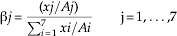
is Manly's Beta of the jth stage for this particular action (with a total of seven different stages being considered). If βj is greater than 1/7 for any given developmental stage j, then the parasitoid prefers this given stage for the action under consideration. If βj is less than 1/7 then the parasitoid avoids this interaction with stage j and, finally, if βj=1/7, then the parasitoids accept any eligible stage for the action under consideration. This formula is used to determine whether the different stages are encountered, attacked and parasitized in the same proportion as they are present within the patch. To determine whether B. communis preference changes with respect to the sequence of aphid attacks, we computed Manly's Beta values for different intervals over the course of the experiment (encounters 0–20, 20–40 and 40–60). We then compared these values between intervals for a select set of actions on each aphid stage (i.e. encounters, attacks or oviposition).
We compared Manly's Beta values for the different A. glycines stages using a Kruskal-Wallis test. For data that were normally distributed or could be successfully transformed, a One-way ANOVA was used, followed by Fisher's protected LSD as post-hoc analysis. All statistical analyses were executed using SPSS software (Landau & Everitt, Reference Landau and Everitt2004). For datasets that yielded non-significant differences, we performed a power analysis using GPower 3.0.4. (Faul et al., Reference Faul, Erdfelder, Lang and Buchner2007).
Results
No-choice parasitism trials
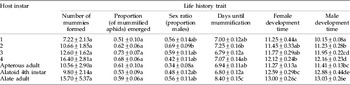
Binodoxys communis was able to successfully parasitize and develop on each of the seven stages of A. glycines. The number of mummies formed in each of the stages did not show any significant differences (table 1; ANOVA, F6,62=1.05, P=0.40). However, the achieved power of this analysis was 0.46. Emergence rates of B. communis on the different A. glycines stages also did not show significant differences (ANOVA, F6,60=0.91, P=0.50). The power of this analysis was also low, equalling 0.37. Among the 4th instar alatoid nymphs that developed into mummies, 54.01±0.08% (average±SE) had transformed into winged adults prior to mummification, and the B. communis mummies produced from these also possessed wings.
Life history traits of Binodoxys communis progeny emerging from the various developmental stages of its aphid host, Aphis glycines. Only one aphid stage was exposed to each adult female parasitoid in this experiment.

Mean±SE; values within the same column followed by identical letters are not significantly different (P>0.05, one-way ANOVA with Fisher's protected LSD).
The sex ratio of B. communis was highly male-biased on 2nd instar aphids, while female-biased on apterous A. glycines adults (table 1). Development time to mummification varied significantly with A. glycines stage (Kruskal-Wallis statistic=92.72, P<0.001) with mummification taking longest for alate adults. Time to emergence of both female and male B. communis also differed among A. glycines stages (Kruskal-Wallis statistic=40.41, P<0.001; KW statistic=64.27, P<0.001, respectively). In the various A. glycines stages, parasitoid development time gradually increased with aphid stage up until 4th instar. Parasitoids took longest to develop on alatoid nymphs and alate adults.
No-choice assays of host acceptance
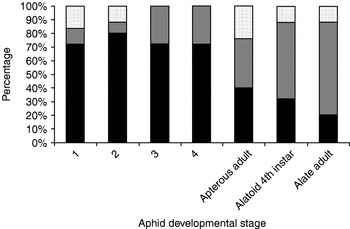
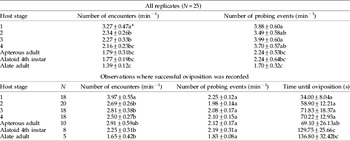
Although attack by B. communis females did not differ among the various A. glycines stages in no-choice assays (fig. 1; likelihood ratio χ2=1.23, P=0.97), parasitoid oviposition success did vary with stage (likelihood ratio χ2=15.65, P=0.02). Attacks on apterous adult, alate and alatoid nymphal stages were less likely to succeed than attacks on the apterous nymphal stages. Based on all replicates, we found B. communis to encounter 1st instars more frequently than other stages and alate adults less frequently than 2nd instars (table 2; Kruskal-Wallis statistic=16.26, P=0.01). Also, parasitoids probed immature A. glycines stages more frequently than alatoids and adults (Kruskal-Wallis statistic=18.284, P=0.006). First instar A. glycines were probed more frequently than other stages. The preferred location for oviposition was the aphid thorax, receiving 70.1% of successful ovipositions, compared to 17.5% for the head region and 12.4% for the abdomen. Aphid instars 1–4 received 72, 65, 72 and 66% of ovipositions in the thorax and 0, 5, 22 and 33% in the head region, respectively. Apterous adults, alatoids and alates received 80, 50 and 100% of oviposition in the thorax and 20, 50 and 0% in the head region, respectively.
Outcome of B. communis encounters with the various A. glycines developmental stages in a no-choice experiment. The graph represents the proportion of aphids (out of 25) of a given stage that were attacked or accepted for oviposition by B. communis ( , No attack;
 , Unsuccessful attack; ■, oviposition).

Acceptance behaviour of B. communis upon encounter with different A. glycines developmental stages in a no-choice experiment. Behavioural parameters are reported for all replicates (N=25) and for wasps that successfully oviposited in the aphids presented. Number of probing events and number of encounters are indicated as frequencies over the allotted time (i.e. 5 min or until successful oviposition). Parameters include the total number of probing events or encounters and the total time until oviposition.

Mean±SE; values within the same column followed by identical letters are not significantly different (P>0.05, Mann-Whitney U test).
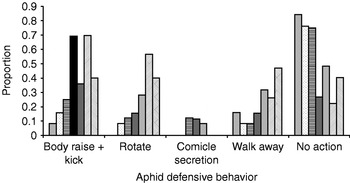
The various A. glycines stages differed in their defensive behaviour upon attack by B. communis (fig. 2). Many of the immature aphid stages did not exhibit any defensive behaviour, and the frequency of inaction varied among A. glycines stages (Chi-square χ2=16.348, P=0.012<0.05). Kicking was the most frequently recorded behaviour (seen in 38% of the aphids). The frequency of kicking or body rotation varied among aphid stages (Chi-square χ2=21.818, P=0.001; χ2=24.718, P<0.001, respectively). Some aphids exhibited more than one type of defensive behaviour, commonly combining kicking with body rotation.
Aphid defensive behaviours associated with B. communis attacking the various developmental stages of the soybean aphid, Aphis glycines, in a no-choice experiment. The proportion of aphids (out of 25) of a given instar exhibiting certain behaviours is indicated (, 1; , 2;  , 3; ■, 4;
 , Adult;
 , Alatoid;
 , Alate).

Choice assay of host acceptance
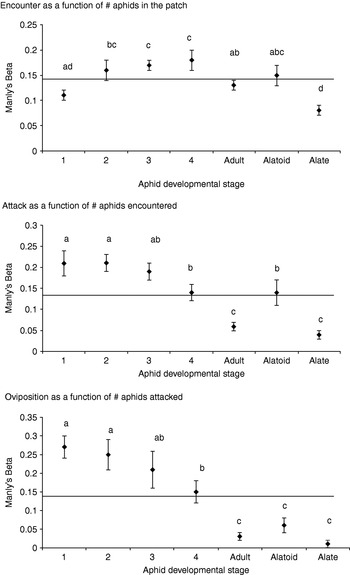
Parasitoid wasps stayed within the patch for 21.64±1.40 min and encountered 43.80±3.67 (average±SE) aphids, indicating that aphids were frequently encountered more than once. Binodoxys communis encountered the different A. glycines stages to varying extents (fig. 3; ANOVA F6,168=5.71, P<0.001). There were also significant differences in attack rates among stages that were encountered and in oviposition rates among stages that were attacked (fig. 3; ANOVA F6,168=9.76, P<0.001; Kruskal-Wallis χ2=74.61, P<0.001, respectively). Attack rates were highest for the young instars and lowest for alate and apterous adults, given their respective encounter rates. Lastly, 1st and 2nd instar A. glycines were also oviposited to highest extent, given their respective rates of attack.
Average (±SE) Manly's Beta values for B. communis behaviour in patches with a total of 35 A. glycines individuals, equally distributed among all seven different developmental stages. Within each figure, the line represent the baseline value (1/7) against which Manly's Beta values for each stage are compared. Different letters indicate significantly different Manly's Beta values for the subsequent aphid developmental stages (P>0.05, one-way ANOVA with Fisher's protected LSD post hoc analysis).

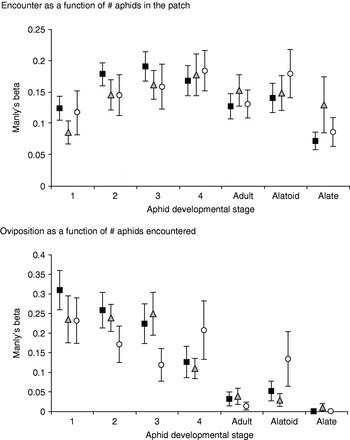
Parasitoids did not alter their preference for oviposition of certain aphid stages during the course of the experiment. Manly's Beta values for this action did not differ between the three intervals (Kruskal-Wallis statistic=1.88, P=0.39; Kruskal-Wallis statistic=1.60, P=0.45; Kruskal-Wallis statistic=3.95, P=0.14; Kruskal-Wallis statistic=0.53, P=0.77; Kruskal-Wallis statistic=0.30, P=0.86; Kruskal-Wallis statistic=1.98, P=0.37; Kruskal-Wallis statistic=1.86, P=0.39 for 1st, 2nd, 3rd, 4th instar, adult, alatoid and alate stages, respectively). Also, B. communis did not modify its preference for encounter or attack of any of the aphid stages over the allotted 30 min period (fig. 4).
Variation in B. communis preference for the different A. glycines developmental stages over the course of a 30 min choice experiment. Parasitoid preference for a given stage is represented as Manly's Beta values (±SE), which indicate whether the various stages are either encountered in the same proportion as they are present within the patch or oviposited in the same proportion as they are encountered. Values are computed for the following intervals: encounters 0–20 (■), 20–40 ( ) and 40–60 (○).

Discussion
Many parasitoids in the braconid subfamily, Aphidiinae, preferentially parasitize small or intermediate host instars (Liu et al., Reference Liu, Morton and Hughes1984; Sequeira & Mackauer, Reference Sequeira and Mackauer1987, Reference Sequeira and Mackauer1992a; Weisser, Reference Weisser1994; Mackauer et al., Reference Mackauer, Michaud and Völkl1996; Ives et al., Reference Ives, Schooler, Jagar, Knuteson, Grbic and Settle1999; Sharmila & Rajendra, Reference Sharmila and Rajendra1999; Chau & Mackauer, Reference Chau and Mackauer2000, Reference Chau and Mackauer2001; Perdikis et al., Reference Perdikis, Lykouressis, Garantonakis and Iatrou2004). Our research confirms this general pattern for B. communis, a parasitoid of the soybean aphid, A. glycines. No-choice assays showed a high proportion of successful attacks on all apterous nymphal A. glycines instars, while choice trials indicated lower encounter, attack and oviposition of apterous and alate adults, as well as alatoid nymphs. Nevertheless, parasitism trials with exposures over a longer time revealed similar B. communis parasitization of the various A. glycines stages. This disparity could hint at a lower suitability of young A. glycines instars for development of B. communis, as indicated below.
Parasitism of the various A. glycines stages possibly has major implications for fitness of B. communis offspring. Parasitism levels, mummy emergence and parasitoid sex ratio showed little differences among the various aphid stages. However, B. communis showed a higher rate of acceptance of young A. glycines instars compared to adults or alatoid nymphs. Thus, younger instars may have experienced greater mortality following parasitism (Rakhshani et al., Reference Rakhshani, Talebim, Kavallieratos and Fathipour2004; Colinet et al., Reference Colinet, Salin, Boivin and Hance2005). Alternative explanations are that super-parasitism levels of preferred younger instars is high or that host-stage preferences are not expressed in patches containing a single host stage, particularly for naïve parasitoids. Lastly, additional time of exposure (4 h) during parasitism trials could lead to higher parasitism rates of older stages despite short-term behavioural avoidance.
With the exception of the A. glycines apterous adult stage, development time of both B. communis sexes increased with aphid stage. Various relationships exist between parasitoid development time and host age at oviposition (Hopper, Reference Hopper1986; Colinet et al., Reference Colinet, Salin, Boivin and Hance2005), with positive associations being occasionally reported (Vinson, Reference Vinson1972; Lawrence et al., Reference Lawrence, Baranowski and Greany1976). Rapid parasitoid development in 1st instar A. glycines shows that these hosts provide minimum required nutrient levels for B. communis (Henry et al., Reference Henry, Gillespie and Roitberg2005) although parasitoids emerging from young hosts may be smaller. The gradual increase in development time on later A. glycines stages may reflect changes in nutritional value of the host, increased aphid resistance and competition of parasitoid larvae with the developing host embryos (Walker & Hoy, Reference Walker and Hoy2003; Colinet et al., Reference Colinet, Salin, Boivin and Hance2005) or increased time necessary for development of a larger parasitoid. No evidence was found of delayed parasitoid development in younger or smaller hosts, a common pattern in koinobiont parasitoids (Harvey, Reference Harvey2005). Younger A. glycines instars were much smaller than later developmental stages (Hodgson et al., Reference Hodgson, Venette, Abrahamson and Ragsdale2005; K. Wyckhuys, personal observation).
The interaction between B. communis and A. glycines is also mediated by host behaviour, particularly aphid defense. In no-choice assays, A. glycines exhibited a variety of defensive behaviours, all of which are commonly observed among aphid species (e.g. Gerling et al., Reference Gerling, Roitberg and Mackauer1990; Hågvar & Hofsvang, Reference Hågvar and Hofsvang1991; De Farias & Hopper, Reference De Farias and Hopper1999; Villagra et al., Reference Villagra, Ramirez and Niemeyer2002). In no-choice assays, B. communis did not refrain from attacking larger or older aphid stages or aphids that exhibited stronger defenses. This could reflect either a low response threshold of B. communis for oviposition (Mackauer et al., Reference Mackauer, Michaud and Völkl1996) or acceptance decisions resulting from its lack of previous experience (Henry et al., Reference Henry, Gillespie and Roitberg2005). Binodoxys communis females encountered and probed larger aphid stages at a lower frequency and with many probing attempts unsuccessful. Like other members of the genera Trioxys and Binodoxys, B. communis uses a pair of terminal abdominal prongs to grasp the host prior to oviposition (Völkl & Mackauer, Reference Völkl and Mackauer2000), and this grasping is thought to be more effective on smaller instars. Also, as older A. glycines stages were less frequently oviposited in and exhibited more body rotation and walking behaviours, thus these defensive behaviours may deter B. communis attack. However, 4th instar apterous A. glycines exhibited kicking behaviour as frequently as 4th instar alatoid nymphs; but the former were oviposited in as often as younger instar apterous nymphs, suggesting that this defense does not always work (see fig. 1).
In choice assays, B. communis females encountered alate morphs and 1st instars less often than other stages and morphs, while encountering 3rd and 4th instars at a higher rate than other stages and morphs. Although most parasitoids have poor ability to assess host suitability from a distance, they sometimes evaluate aphid shape, size or movement (Battaglia et al., Reference Battaglia, Pennacchio, Romano and Tranfaglia1995; Le Ralec et al., Reference Le Ralec, Curty and Wajnberg2005). Our results suggest that B. communis might employ aphid size as an initial criterion to determine host suitability, while increased movement of A. glycines alates may act as a release stimulus for attack.
Because B. communis successfully develops on all A. glycines developmental stages, field releases do not need to target specific phases of aphid infestation. Also, considering that young aphid instars are generally more abundant than older stages in field populations (Hughes, Reference Hughes1963; Chau & Mackauer, Reference Chau and Mackauer1997; Losey & Denno, Reference Losey and Denno1998), parasitoids are very likely to successfully establish irrespective of A. glycines colony composition. Parasitoid preference for younger stages can significantly affect host population growth (e.g. Lin & Ives, Reference Lin and Ives2003), while a sustained attack of older and larger A. glycines stages, along with its induction of costly defenses could reduce reproductive capacity of B. communis (Nelson & Rosenheim, Reference Nelson and Rosenheim2005).
Successful B. communis parasitism of A. glycines alatoid nymphs and alates and its increased development time on winged aphid hosts suggests the existence of a phoretic association. Such association was suggested by Hoelmer & Kirk (Reference Hoelmer and Kirk2005), who reported the presence of B. communis in association with A. glycines at early stages of their colonization of soybean fields in China and hypothesized parasitoid arrival as eggs carried within winged aphids (see also Liu et al., Reference Liu, Wu, Hopper and Zhao2004). Also, the finding that B. communis does not disrupt the development of wings of A. glycines alatoid nymphs (see Demmon et al., Reference Demmon, Nelson, Ryan, Ives and Snyder2004; Christiansen-Weniger & Hardie, Reference Christiansen-Weniger and Hardie2000) indicates that flight of parasitized aphids might be possible. Our findings can have implications for parasitoid establishment, dispersal capability and biological control success upon release in novel environments.
Acknowledgements
We thank Zeynep Sezen for helpful comments that improved the quality of the manuscript, and Jo Barta, Jon Malespy and Erika Commers for help with parasitoid and aphid colony maintenance. This work was funded in part by the multi-state USDA-RAMP project, in part by the North Central Soybean Research Council and in part by the Minnesota Agricultural Experiment Station.