

Close and meaningful personal relationships are essential for an optimal human life (Sbarra & Hazan, Reference Sbarra and Hazan2008). Within the realm of all interpersonal relationships, marriages are remarkably significant for individuals’ subjective, emotional and psychological happiness. Marital satisfaction is one of the most important determinative factors of overall healthy functioning (Greef, Reference Greef2000). Indeed, the marital relationship is the most sensitive personal relationship, which requires the concentrated efforts of both the partners to protect their common life goals and strive towards the attainment of high degrees of contentment and pleasure.
A Flourishing Marriage
A flourishing marriage is the highest quality of a marriage, which is indicative of a superior and qualified relationship reflected in the lives of the partners. The husband and wife share a reciprocal relationship and play a fundamental role in fulfilling each other's emotional, psychological and tangible needs (Berne, Steine, & Dusay, 1973). A marital relationship that is regarded as a flourishing relationship is characterised by optimal relationship functioning in which husbands and wives share in meaningful activities and a relationship that does not just seek happiness, but also aims to achieve goodness, wisdom, personal virtues, growth and positive self-expression (Fowers & Owenz, Reference Fowers and Owenz2010).
Communal Orientation as Predictor of Marital Flourishing
Current research has explored the determinants of flourishing within marital relationship, labelling these primarily as supportive, pleasing and satisfying bonds. However, little attention has been drawn to proving how personal relationships that are communal in nature may predict flourishing within marital relationship. Communal orientation is marked by a high degree of motivation to respond to other's need (Mills & Clark, Reference Mills, Clark, Harvey and Wenzel2001). Communal relationships are regarded as unique bonds that are characteristic of caring for the benefits and needs of the other partner, even if a specific benefit in return is not expected. Communally oriented people who are motivated to take care for others are likely to experience improved psychological functioning; they are emotionally available to their partners and they also enjoy helping others. They enjoy several interpersonal and intrapersonal traits such as high self-esteem, personal satisfaction, social bonds and feelings of empathy (Bonnie, Impett, Kogan, Webster, & Cheng, Reference Bonnie, Impett, Kogan, Webster and Cheng2013). People who are driven to behave communally toward their romantic partners feel more intrinsic pleasure when making sacrifices in the course of everyday life (Kogan et al., Reference Kogan, Impett, Oveis, Hui, Gordon and Keltner2010).
Nevertheless, while prevailing research in the relationship literature has identified possible shielding qualities of providing communal care, the potential personal rewards of having a communal orientation within a married relationship are yet to be investigated. Thus, based on the existing literature on the personal and interpersonal rewards of communal orientation, our investigation focused on levels of communal orientation exhibited by husbands and wives and the level of marital flourishing predicted by communal orientation. Furthermore, along with the predictive role of communal orientation in predicting psychological flourishing of husbands and wives, the mediating function of emotion expressivity could prove fundamental for understanding a flourishing marital relationship (Clark & Finkel, Reference Clark and Finkel2005).
Expression of Emotions as Mediator: A Brief Theoretical Review
Emotional expressivity is defined by Rauer and Volling (Reference Rauer and Volling2005) as verbal and non-verbal ways of expression that are displayed in an emotion-eliciting situation. The emotions felt and expressed serve as indicators of flourishing of individuals within a marital relationship. Planalp (Reference Planalp2003) regarded expression of emotions as an important element of intimate relationships that needs to be studied as a significant element affecting marital relationships.
As found by Miller, Caughling, and Huston (Reference Miller, Caughlin and Huston2003), married partners who express their emotions to each other may influence their behaviour toward each other. When a wife praises and appreciates her husband for something he did in relation to their marriage, it will reinforce the behaviour displayed by her husband and will cause him to show more encouraging behaviour in the future, thus enhancing their marital happiness. It would also positively improve her spouse's thoughts and perceptions regarding their marriage, and the importance that the spouses consequently ascribe to each other. Thus, the degree to which they express their emotions with each other will subsequently be enhanced (Gur-Aryeh, Reference Gur–Aryeh2010).
Earlier researches (e.g., Shapiro, Gottman, & Carrere, Reference Shapiro, Gottman and Carrere2000) on the marital relationship and expressivity of emotions in general specify a close association between expression of emotions and marital satisfaction. However, a few studies manifest incongruent findings (Lavee & Ben-Ari, Reference Lavee and Ben-Ari2004; Johnson et al., Reference Johnson, Cohan, Davila, Lawrence, Rogge, Karney and Bradbury2005). Evidence from a few relationship researches suggest that negative emotions can harm the relationship by reducing the person's coping capabilities and hampering one's cognitive and behavioural repertoire (Gottman & Levenson, Reference Gottman and Levenson1992; Tashiro, Reference Tashiro2005). However, Fardis (Reference Fardis2005) strongly advocates that negative emotional expressivity could be as beneficial as positive emotions within interpersonal relationships. Additionally, if an explanation of negativity is provided with the expression of negative emotions, then the relationship contentment will be higher as compared to when such explanations are not provided. This could be explained by the fact that married individuals might report differences in their level of relationship satisfaction within the marital relationship, conditioned on whether expressed emotions are negative or positive (Gur-Aryeh, Reference Gur–Aryeh2010) and on how the culture of the society and relationship type in question (communal or non-communal) affects the tendency for expression of diverse emotions (Ingoldsby, Horlacher, Schvaneveldt, & Matthews, Reference Ingoldsby, Horlacher, Schvaneveldt and Matthews2005).
Within communally oriented married relationships, expression of negative emotions and explanations for that negativity could act together to have an impact on relationship contentment (Tashiro, Reference Tashiro2005). Furthermore, individuals with communal orientations experience strong personal rewards from the positive emotions they feel when helping and responding towards the needs of their partners. Hence, attempts to understand expressing emotions in association with communal orientation can pave the way to explore psychological flourishing of husbands and wives. Therefore, the connection also seems logical that the marital relations that are characterised by feelings of communality and associated with emotion expressivity are not merely happy or satisfied; they may also be labelled as flourishing.
The Present Study
Irrespective of the fact that romantic relationships are a prototypical example of communal orientation (Clark, Fitness, & Brisette, Reference Clark, Fitness, Brisette, Brewer and Hewstone2004) and communally oriented people exhibit a variety of qualities that promote good relationships, little empirical work exists that has examined whether a dispositional tendency to care is indeed related to experiencing higher quality relationships across a variety of social bonds, such as with family, friends, and romantic partners. Likewise, little research has examined the emotions associated with the effect of communal orientation on a flourishing relationship among husbands and wives. Thus, in the current study, we investigated whether communally oriented people do indeed have more flourishing relationships within their marital bonds. We also aimed to test the unique contributions of the expression of emotions mediating the pathway between communal orientation and psychological flourishing among married individuals.
Of primary interest for the study, we hypothesised that a high strength of communal tendencies exhibited by each partner would be associated with a higher level of psychological flourishing within the marital relationship. We also speculated that the association between communal orientation and psychological flourishing among husbands and wives would be mediated by expression of emotions. We predicted that husbands and wives would exhibit differences in the exercise of communal orientation and psychological flourishing within their married relationship.
We utilised a number of scientific instruments to assess variables of the study (see Method section). However, due to the scarcity of a psychological instrument to assess flourishing at an interpersonal level, we designed a scale to assess the flourishing of married people, the Psychological Flourishing Scale (PFS). Current research operationalises a flourishing marriage as comprising all of the ingredients of a fully functioning relationship that is more than feelings of happiness and satisfaction, but also includes openness of expression, maturity of thoughts and emotions, sexual and emotional passion, long-term commitment, communication patterns, interactional styles during conflicts, personal virtues, self-growth, respect for individual differences, trustworthiness and forgiveness (Fahd & Hanif, Reference Fahd and Hanif2018).
Hence, this study examines the potential interaction effects between one's orientation to engage in communal relationships, mediation of emotion expressivity, and subsequent level of psychological flourishing among married individuals; and consequently, we aimed to explore new pathways through which marital relationships may promote an optimal level of functioning.
Objectives of the Study
The present study used a cross-sectional design incorporating conditions that aimed to: (1) analyse gender differences between husbands and wives regarding the use of communal orientation and psychological flourishing; (2) assess patterns of association of major study variables (i.e., communal orientation and psychological flourishing); (3) analyse the predictive role of communal orientation in predicting psychological flourishing of husbands and wives; and (4) analyse the mediating role of emotion expressivity buffering the relationship between communal orientation and psychological flourishing among married individuals.
Method
Sample of the Study
The sample consisted of 1,002 randomly selected married individuals (not necessarily couples) from urban areas of Pakistan. Participants were recruited in a series of two steps. First, one eligible participant was identified within each family unit. Participants were identified from Islamabad and Rawalpindi (Federal sector), Lahore and Gujranwala (Punjab), Bahawalpur and Rahim Yar Khan (Southern Punjab), and Muzafarabad (Kashmir). Second, 1,046 potential participants were contacted via telephone and through personal acquaintances. A total of 1,038 eligible participants were short-listed. Of these, 1,002 answered a booklet of questions concerning their relationships with their spouses, which took 20 minutes to complete. Individuals were included if they had been married for minimum of two years, had at least one child, and had acquired a minimum education of 10 years. Participants who were either separated or divorced were not included in the sample.
Respondents’ age range was between 20 and 80 years; 45.6% of the participants lived in an extended family and 45.6% lived in nuclear family. The participants were all Muslims and all were educated, with a minimum of 10 years and a maximum of 22 years’ formal education. With respect to their professions, the respondents were: housewives (22.1%), educationists (28.6%), entrepreneurs (11.2%), and job holders in private or government sectors (34.1%). Among the participants, 18.6% were in a committed marital relationship that they identified as ‘love marriages’ and 71.1% identified their marriages as ‘arranged’ (i.e., marriages were according to their parents’ will instead of their own).
Procedure
Collection of the data was completed in 4 months and 17 days. Participants were approached personally by the researcher. Each participant was briefed about the purpose, objectives and the rationale of the study, and was assured that the collected information would be kept confidential and would be utilised for research purposes only. Besides the written instructions printed at the beginning of each booklet, the respondents were also instructed verbally how to respond to various items in the booklet. The researcher personally collected all the questionnaires from the respondents. Each participant was given 24 hours to complete the questionnaire. The respondents’ participation was voluntary and they were not paid for it.
Measures of the Study
Communal Orientation Scale
Communal orientation of husbands and wives was measured by the Communal Orientation Scale (COS; Clark et al., Reference Clark, Quellette, Powell and Milberg1987). The 14-item scale evaluates an individual's inclination to be responsive and sharing with the partner and expects the same from the partner. The measure was translated into Urdu and adapted for the present research. Two subscales were formulated for the present research, named as communal orientation positive (COP) and communal orientation negative (CON). Each item of the scale was rated on 5-point scale where 1 = strongly disagree, 2 = disagree, 3 = neutral, 4 = agree and 5 = strongly agree. Scoring of the scale is done on continuous basis. Items 3, 4, 6, 9, 10, 12, and 13 measured the negative communal orientation and items 1, 2, 5, 7, 8, 11, 14 measured positive communal orientation. Reliability of the two subscales, measured with Cronbach's alpha reliability yielded satisfactory reliability (COP = . 71 and CON = .72) on the indigenous data of the present study.
Psychological Flourishing Scale
To determine the level of psychological flourishing of individuals within a marital relationship, an indigenously developed 39-item scale was used. The Psychological Flourishing Scale (PFS; Fahd & Hanif, Reference Fahd and Hanif2018) is a two-dimension measure used to evaluate the psychological flourishing of married individuals. The PFS has two subscales named as relationship dimension (α = .88) and individual dimension (α = .89) with 21 and 19 items respectively. Each item of the scale is scored on 5-point scale where 1 = strongly disagree, 2 = disagree, 3 = neutral, 4 = agree and 5 = strongly agree. All the responses are summed to obtain a total score. A high score depicts a high level of psychological flourishing of married individuals.
Emotion Expressivity Questionnaire
The Berkeley Emotion Expressivity Questionnaire (BEQ; Gross & John, Reference Gross and John1995) was adapted and translated into an Urdu version that was used to assess multiple facets of emotional expressivity, that is, expression of positive emotions, expression of negative emotions, and strength of impulse reactions. Each item of the scale is scored on 5-point scale where 1 = strongly agree, 2 = agree, 3 = neutral, 4 = disagree and 5 = strongly disagree. The BEQ yields a total score in addition to the three subscales for Impulse Strength (α = .74), Positive Expressivity, (α = .56) and Negative Expressivity (α = .64).
Hypotheses of the Study
A number of hypotheses were formulated in the present research to investigate the predictive role of communal orientation in predicting flourishing of husbands and wives and to check the significance of emotion expressivity as a mediator affecting the relationship between communal orientation and psychological flourishing. Furthermore, gender differences were also studied related to the study variables.
Hypothesis 1: Pakistani husbands and wives would show gender differences in the exercise of communal orientation and psychological flourishing within the marital relationship.
Hypothesis 2: Positive Communal Orientation would positively predict the Relationship dimension of Psychological Flourishing.
Hypothesis 3: Positive Communal Orientation would positively predict the Individual dimension of Psychological Flourishing.
Hypothesis 4: Negative Communal Orientation would negatively predict the Relationship dimension of Psychological Flourishing.
Hypothesis 5: Negative Communal Orientation would negatively predict the Individual dimension of Psychological Flourishing.
Hypothesis 6: Emotion expressivity mediates the relationship between communal orientation and psychological flourishing among married individuals.
Data Analysis
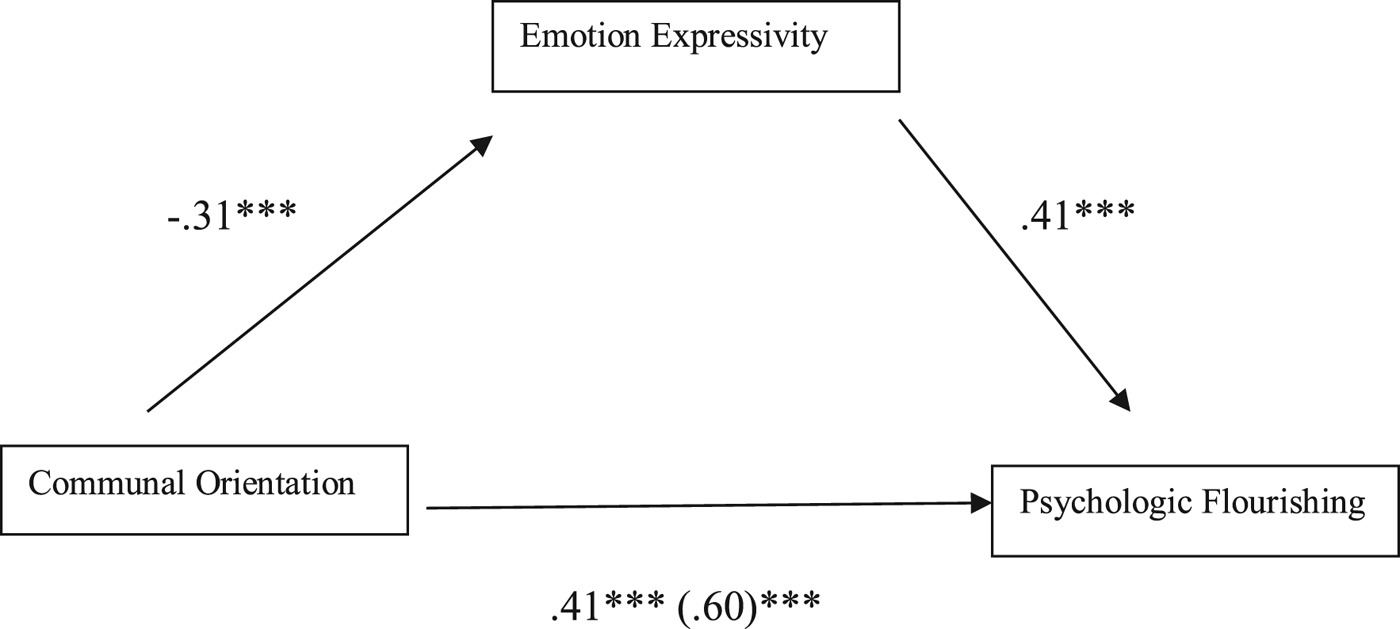
A huge database of 1,002 married individuals (56% wives and 43% husbands) was subjected to multiple statistical analyses in order to fulfill the objectives of the study. Missing values existing in the data set was dealt with a series mean method. A t test was computed to analyse the mean differences between husbands and wives regarding communal orientation and psychological flourishing (Table 1). Bivariate correlation statistics were computed to evaluate the patterns of association between communal orientation and psychological flourishing (Table 2). A linear regression was calculated to assess the predictive role of communal orientation in predicting psychological flourishing of husbands and wives (Tables 3, 4, 5, and 6). Lastly, mediation analysis was carried out to investigate the role of emotion expressivity as a mediator in the association between communal orientation and psychological flourishing (Figure 1). SPSS 22 was utilised to conduct a statistical analysis of the research data.
Mean Differences of Husbands and Wives on Communal Orientation and Psychological Flourishing, N = 1,002

Note: Mean differences and t test significance indicates that magnitude of negative communal orientation is higher among married males as compared to married females. On the other hand, married females appear to demonstrate high levels of both the dimensions of flourishing within the marital relationship.
Com (n) = communal negative ; Flou (rel) = flourishing relationship; Flou (ind) = flourishing individual.
UL = upper limit; LL = lower limit.
***p > .000.
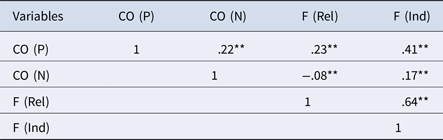
Correlations Between Communal Positive and Communal Negative Orientation and Dimensions of Psychological Flourishing

Note: CO (P) = Communal Positive Orientation; CO (N) = Communal Negative Orientation, F (Rel) = flourishing Relationship dimension; F (Ind) = flourishing Individual dimension.
***p < .005.
Linear Regression Analysis of Positive Communal Orientation as a Predictor of Marital Flourishing (Relationship Dimension), N = 1,002

Note: CO (P) = Communal Positive Orientation; R = Relationship dimension of flourishing.
***p < .001.
Linear Regression Analysis of Positive Communal Orientation as a Predictor of Marital Flourishing (Individual Dimension), N = 1,002

Note: CO (P) = Communal Positive Orientation.
***p < .001.
Linear Regression Analysis of Negative Communal Orientation as a Predictor of Marital Flourishing (Relationship Dimension), N = 1,002

Note: CO (N) = Communal Negative Orientation; R = Relationship dimension of flourishing.
***p < .001.
Linear Regression Analysis of Negative Communal Orientation as a Predictor of Marital Flourishing (Individual Dimension), N = 1,002

Note: CO (N) = Communal Negative Orientation.
***p < .001.
Mediation of emotion expressivity between the relation of communal orientation and psychological flourishing. Standardised regression coefficients for the relationship between communal orientation and psychological flourishing of married individuals significantly mediated by emotion expressivity. The standardised regression coefficient between communal orientation and marital relationship flourishing, controlling for multiple dimensions of emotion expressivity, is in parentheses.

Results
Discussion
According to the introduction of the present research, a number of studies have tried to expose the factors that could explain the variables underlying happy marriages (e.g., Cramer, Reference Cramer2000). Irrespective of the fact that several personality, relationship and intimacy ingredients have been highlighted, no research has explored the impact of communal orientation as a predictor of not merely a satisfied marital relationship, but a flourishing married relationship. Consequently, the present study explores the combined influence of communal and emotional factors in determining the flourishing of married population. According to the findings of the current study, husbands and wives’ psychological flourishing is influenced by positive and negative communal orientation. Moreover, the direct relationship between communal orientation and flourishing is buffered by the mediating role of emotion expressivity.
Significant Findings of Study
Major findings of the present empirical investigation are discussed below.
Relationship between communal orientation and psychological flourishing
Bivariate correlation statistics were computed to analyse patterns of relationship between the study variables. Findings illustrate that Positive Communal Orientation is significantly positively correlated with the Relationship dimension (r = .23**) and the Individual dimension (r = .41**) of psychological flourishing among husbands and wives. On the other hand, Negative Communal Orientation is negatively correlated with the Relationship dimension (−.08**) but positively correlated with the Individual dimension (.17**) of psychological flourishing.
The above findings add to the growing body of research that empirically states that flourishing of interpersonal relationships increases as Positive Communal Orientation increases. Similarly, the communal norm was seen as ideal and was linked to higher relationship satisfaction. Communal orientation also appears to play an important role in personal relationships and tends to instill a more altruistic and ‘giving’ attitude towards the partner (Clark, Lemay, Graham, Pataki, & Finkel, Reference Clark, Lemay, Graham, Pataki and Finkel2010).
Gender differences regarding communal orientation and psychological flourishing (Hypothesis 1)
T test statistics that tested the first hypothesis of the study indicated that the level of Negative Communal Orientation is higher among husbands compared to wives. On the other hand, wives are higher in flourishing (both the Relationship and Individual dimensions) compared to husbands within their marital relationship. The existing research shows the opposite trend and states that married male adults between 45 and 54 years were most likely to flourish as compared to married females (Keyes, Reference Keyes2002; Keyes & Simoes, Reference Keyes and Simoes2012). The current study's revelations hence reveal that married females are more flourishing and contribute more towards their relationship flourishing as compared to married males.
Positive Communal Orientation predicting the Relationship subscale of psychological flourishing among husbands and wives (Hypothesis 2)
The data from the study supported our second hypothesis, which stated that positive communal tendencies predict relationship flourishing among husbands and wives. As mentioned, the present study measures psychological flourishing of husbands and wives via an indigenous scale. The Relationship subscale of psychological flourishing includes compromise with the partner, mutual understanding with the spouse, respect, care and friendly relations, appreciation and communication patterns, maturity of attitude, capitalising on positive events and peaceful conflict resolution. As demonstrated by the current findings, the respondents who exhibit the tendencies of warmth, affection, social bonding and facilitating behaviour for others (Positive Communal Orientation) are also likely to experience relationship flourishing within their marital relationship. The current research findings are consistent with the evidence from the study of Bryan, Hammer, and Fisher (Reference Bryan, Hammer and Fisher2000), who believed that individuals with Positive Communal Orientation are inclined to give care to people, ranging from those within their close relationships to strangers, that subsequently improves their relationship satisfaction.
Positive Communal Orientation predicting the Individual subscale of psychological flourishing among husbands and wives (Hypothesis 3)
The third hypothesis of the study was also supported by the data from the current study, which illustrated that Positive Communal Orientation positively predicts the Individual subscale of psychological flourishing. The Individual dimension of flourishing within the marital relationship consists of a spouse's sense of humour, self-reliance, ability to sexually satisfy the partner, provision of personal space, level of self-esteem, emotional stability, submission to the spouse's will, financial independence, ability to forgive each other's mistakes, and respect for the individual differences of the partner within the married relationship. This findings of the study showed consistency with the current evidences (e.g., Thompson & DeHarpport, Reference Thompson and DeHarpport1998), which found that individuals who were high in communal orientation were more likely to allocate resources equally among each other, and that providing care for others is associated with greater self-efficacy and self-esteem (Crocker, Reference Crocker, Wayment, Bauer, Wayment and Bauer2008; Piferi & Lawler, Reference Piferi and Lawler2006). Drawing on these findings, we expect that communally oriented people who are inclined to facilitate their partners experience elevated positive emotions such as feeling happy and uplifted, and high self-esteem in their daily lives. The results of the present study therefore empirically supported the assumption that wives and husbands’ level of Positive Communal Orientation positively predicts the Individual dimension of psychological flourishing within a married relationship.
Negative Communal Orientation as a predictor of psychological flourishing within a marital relationship
Two hypotheses (Hypotheses 4 and 5) of the study contrived to investigate the prediction of Negative Communal Orientation as the predicting factor for psychological flourishing among married individuals. The fourth hypothesis gains support from the results of the current study and vividly demonstrates that Negative Communal Orientation negatively predicts the relationship dimension of psychological flourishing. The results of the present study show that married individuals who are high in Negative Communal Orientation would possibly have low levels of relationship flourishing within their married relationship. This particular finding is consistent with the research done by Bonnie et al. (Reference Bonnie, Impett, Kogan, Webster and Cheng2013).
People having high Negative Communal Orientation lack the tendency to show facilitating behaviours for others. They also appear to have a scarcity of affection and sense of social bonding within their intimate relationships. In other words, such husbands and wives do not like to compromise within their marital relationship; they seem to have lack of mutual understanding, friendly relations, appreciating behaviour and feelings of care for their spouse. It can hence be inferred that negative communal tendencies could possibly decrease the level of marital flourishing among husbands and wives.
The fourth hypothesis was unsuccessful in gaining support from the data of the present study. Findings of the present study illustrate that Negative Communal Orientation positively predicts the Individual dimension of psychological flourishing among husbands and wives. The findings therefore illustrate the fact that Negative Communal Orientation is not always linked with a low level of psychological flourishing within a marital bond. As found by the results of the current study, it appears that married individuals who maintain non-sociability, non-facilitating behaviours and a lack of warmth within their personal relations do not necessarily exhibit a low level of psychological flourishing within their married relationship.
Escalating the conceptual understanding of this indigenous finding, it could be interpreted that Pakistani husbands and wives may exhibit Negative Communal Orientation, but showing this lack of helping behaviour for the partner seems not to be linked with an individual's personality related to characteristics of flourishing, such as high self-esteem, good sense of humour, maturity of attitude, and emotional stability. In other words, such marriages may continue to flourish even if the partners are less responsive towards the needs of their spouses.
The fact related to this unusual finding that should be considered is that the phenomena of communal orientation (both positive as well as negative) has never been explored from the perspective of a married relationship. No empirical evidence has ever been documented that highlights the significance of communal orientation from the perspective of husbands and wives. Current scientific studies on communal orientation have merely highlighted the general approach of communally oriented people (Chen, Lee-Chai, & Bargh, Reference Chen, Lee-Chai and Bargh2001). Hence, the present study, which was designed to increase the understanding of communal processes within a married relationship, has extracted slightly different findings that do not match the existing relationship studies. Therefore, it could be interpreted that in the non-Western culture, the inclination of non-cooperative and non-facilitating behaviour may not necessarily decrease the married individual's flourishing within their married relationship.
Mediating role of emotion expressivity between the association of communal orientation and psychological flourishing (Hypothesis 6)
The current study also tested the mediation effects of emotion expressivity between communal orientation and psychological flourishing among married individuals. As Figure 1 shows, the standardised regression coefficient between communal orientation and emotion expressivity was statistically significant, as was the standardised regression coefficient between emotion expressivity and psychological flourishing. The standardised indirect effect was (−.31) (.41) = −0.13. Unstandardised indirect effects were computed for each of 5,000 bootstrapped samples at 95% confidence intervals. Values of Sobel z for normal theory was 6.04; p < .01. Thus, the indirect effect of emotion expressivity was statistically significant.
Our present findings and the existing theoretical position suggests the buffering effect of the expression of positive as well as negative emotions within a marital relationship. Furthermore, strength of impulse control also seems to affect the connection between communal orientation and psychological flourishing. Consequently, we join with the growing number of emotion researchers (Clark & Finkel, Reference Clark and Finkel2005; Keltner & Kring, Reference Keltner and Kring1998) who suggest that emotion in its expression dimension influences the link between communal tendencies and flourishing among husbands and wives. Correspondingly, several researches suggest a close connection between expression of emotions and happiness with the marital relationship (Halberstadt, Cassidy, Stifter, Parke, & Fox, Reference Halberstadt, Cassidy, Stifter, Parke and Fox1995; Geist & Gilbert, Reference Geist and Gilbert1996; Feeney, Reference Feeney2002; Carstensen, Gottman, & Levenson, Reference Carstensen, Gottman and Levenson1995).
The current results are, however, inconsistent with several studies that explored the role of emotion expressivity within marital relationships. For instance, Yediri and Hamarta (Reference Yediri and Hamarta2015) found no significant relationship between emotion expressivity and marital satisfaction among a non-Western (Turkish) population and stated that Turkish families prefer not to involve the expression of emotions in their marital relationships, which significantly affects their relationship satisfaction as well as personal qualities.
As tested by Lutz (Reference Lutz, Guinne and Hoalland1987), there exist several intercultural variations regarding expression of emotions within marital relationship. Likewise, Gross and John (Reference Gross and John1995) surveyed four diverse cultures, namely Asian, African-American, Caucasian and Spanish cultures, and concluded that Asians were the least determined to express their emotions. Ingoldsby (Reference Ingoldsby1980) also investigated the relation between emotional expression and couple satisfaction with a contrast of samples from America and Colombia, and his results showed a relationship between emotional expression and couple satisfaction within American samples, but zero correlations in the sample of Colombian respondents.
Henceforth, the findings of the current study also add to the present body of knowledge (Honeycutt & Cantrill, Reference Honeycutt and Cantrill2001; Kurdeck, Reference Kurdek1999) that emotions, in their expression module, significantly affect the interaction between communal orientation and flourishing of married individuals. Findings of the present study regarding emotion expressivity within married relationships are a step toward revealing the mediating effects of multiple emotions on marital flourishing; and within this association, the role of culture and type of relationship cannot be undermined.
Hence, the present empirical investigation renders multiple findings that serve to expand our understanding of romantic and interpersonal relations. The results of the present study also contribute to the growing body of research demonstrating the capacity for communally oriented individuals to experience relationship flourishing within their married relationship. It was found that when communal predispositions are influenced by emotional expressiveness, spouses can express their emotions freely, and consequently this may elicit flourishing within the relationship. It may simultaneously preclude that expressive as well as communal costs are known to enhance the ultimate happiness and flourishing of intimate relations.
Conclusion and Implications
As it pertains to the goals of this paper, it is important to note that individual differences in communal tendencies as well as a predisposition to express emotions appears to enhance psychological flourishing. This carries implications that go far beyond simply understanding the situational contexts in which emotions are being expressed. The current study is unique in its effort to explain romantic relationship flourishing as it occurs as a consequence of either partner's variations in their expression of multiple emotions, as well as their ability to be sensitive towards a partner's emotional and tangible needs. The current study was also notable for its findings from the indigenous data, as it demonstrates that expression of emotions serve important functions other than mere communication needs. Moreover, the research was significant for its design of psychological instruments to assess the optimal functioning of the individuals within the marital relationship.
Limitations of the Study
Finally, we acknowledge the limitations of this scientific work. Data from divorced and separated people were not used in this research. Moreover, comparing and contrasting various levels of flourishing should have been incorporated to gain a more detailed picture. Lastly, we have only examined three broad categories of emotions. Generalising our findings to other complex emotions and to observations of actual expression of emotion within romantic context awaits further research.
Ethical Standards
It is certified that all procedures performed in studies involving human participants were in accordance with the ethical standards of the institutional and national research committee formed by the National Institute of Psychology, Center of Excellence, Quaid-i-Azam University, Islamabad, Pakistan.
Informed Consent
Informed consent was obtained from all individual participants included in the study.
Funding Details
No grant or funding was utilised for the completion of research.
Conflict of Interest
None.