INTRODUCTION
Ensiling is widely employed as a forage conservation method in livestock farming. In order to produce well-fermented silages with minimal nutritional losses, careful management practices at all stages during the ensiling process are required (Weinberg & Ashbell Reference Weinberg and Ashbell2003). A uniform silage quality is necessary to ensure a high performance in ruminant livestock farming during the winter feeding period and in particular for year-round indoor feeding systems.
Extensive protein degradation occurs during wilting and ensiling altering the crude protein (CP) components in forage legumes compared with fresh herbage (Albrecht & Muck Reference Albrecht and Muck1991; Owens et al. Reference Owens, Albrecht, Muck and Duke1999b). The CP of fresh herbage usually consists of c. 0·10–0·25 non-protein nitrogen (NPN) compounds (Ohshima & McDonald Reference Ohshima and McDonald1978), whereas silage CP often contains more than 0·40 NPN (Owens et al. Reference Owens, Albrecht and Muck1999a; Seguin & Mustafa Reference Seguin and Mustafa2003). Immediately after cutting, plant enzymes hydrolyse the protein into free amino acids, amides and peptides leading to an increase in NPN compounds during the wilting process (Kemble & Macpherson Reference Kemble and Macpherson1954; Henderson et al. Reference Henderson, McDonald and Woolford1972). At the beginning of the fermentation phase, microbial enzymes such as the proteolytic clostridia initiate the degradation of amino acids to numerous compounds with ammonia-N as the most common end product (Ohshima & McDonald Reference Ohshima and McDonald1978; Seyfarth et al. Reference Seyfarth, Knabe and Weise1989). As a result of these processes, the nitrogen (N) compounds in silages are highly soluble so that the silage CP may be often poorly utilized by ruminants. Consequently, silage-based diets may be one cause for low N use efficiency by ruminants and excessive N losses to the environment (Givens & Rulquin Reference Givens and Rulquin2004).
Among forage legumes there are considerable differences in the extent of proteolysis during wilting and ensiling. In general, the CP of red clover silage contains less NPN compared with alfalfa, although both species have a similar CP content (Papadopoulos & McKersie Reference Papadopoulos and McKersie1983; Albrecht & Muck Reference Albrecht and Muck1991; Owens et al. Reference Owens, Albrecht and Muck1999a). Moreover, in comparison to alfalfa, feeding red clover silage to dairy cows results in improved N use efficiency, i.e. higher milk N/N intake and lower urinary N excretion (Broderick et al. Reference Broderick, Brito and Olmos Colmenero2007). All of these facts are often attributed to the polyphenol oxidase (PPO) activity in red clover, which has high PPO activities in its leaves (Jones et al. Reference Jones, Hatfield and Muck1995). PPOs are enzymes catalysing both hydroxylation of monophenols to o-diphenols and oxidation of o-diphenols to o-quinones in the presence of molecular oxygen (Matheis & Whitaker Reference Matheis and Whitaker1984). These PPO-generated quinones are powerful oxidants and strong electrophiles that undergo different reaction pathways, forming brown secondary products (Parveen et al. Reference Parveen, Threadgill, Moorby and Winters2010). The reaction of quinones with nucleophilic sites of forage proteins may limit post-harvest proteolysis (Sullivan & Hatfield Reference Sullivan and Hatfield2006; Lee et al. Reference Lee, Scott, Tweed, Minchin and Davies2008). Previous investigations have demonstrated that the release of free amino acids and ammonia-N is reduced in high PPO red clover silage compared with low PPO silage (Lee et al. Reference Lee, Scott, Tweed, Minchin and Davies2008; Winters et al. Reference Winters, Minchin, Michaelson-Yeates, Lee and Morris2008). It is supposed that the formation of protein–phenol complexes is responsible for reduced proteolysis in red clover silage (Winters et al. Reference Winters, Minchin, Michaelson-Yeates, Lee and Morris2008). However, all of these findings were from studies carried out under strictly controlled environmental conditions. Although in the past numerous ensiling experiments using field-grown red clover have been conducted, the PPO activity was not measured in these studies (Owens et al. Reference Owens, Albrecht and Muck1999a, Reference Owens, Albrecht, Muck and Dukeb; Grabber & Coblentz Reference Grabber and Coblentz2009). Field studies including both characterization of the proteolysis during wilting and ensiling of red clover and measuring the PPO activity have not been conducted. With regard to the improvement of the N use efficiency by ruminants, an elevated PPO activity in red clover is of special interest (Abberton & Marshall Reference Abberton and Marshall2005).
In this study it is hypothesized that (i) the higher the PPO activity in leaves of fresh red clover, the lower the extent of proteolysis during wilting and ensiling of red clover herbage, and (ii) differences occur in proteolysis among red clover cultivars. Therefore, the objective was to investigate whether varying PPO activities influence the CP quality characteristics of fresh, wilted and ensiled red clover herbage, involving three red clover cultivars and one white clover cultivar harvested in a four-cut management system over 2 consecutive years.
MATERIALS AND METHODS
Plant material and ensiling procedure
The plant material for the present laboratory ensiling experiment originated from a red clover field experiment established in June 2007 at Hohenlieth, northern Germany (54°24′N, 9°52′E, 19 m asl). The climate of the experimental site is characterized by an annual precipitation sum of 804 mm (1970–2009) and an average annual temperature of 8·9 °C (1980–2009). Soil texture is a sandy loam and the soil type is a brown soil.
The field experiment comprised the factors (i) species/cultivar and (ii) management system, with the factor species/cultivar nested within the management system. Twelve red clover cultivars from different geographical origins and one white clover cultivar as control were tested in pure stands. The factor management system included the levels (i) without mechanical stress and (ii) with mechanical stress. The management system without mechanical stress represented the most common cropping of pure clover stands, as practised in farming systems, whereas the plots with mechanical stress were rolled twice with a Cambridge roller c. 3 weeks before the planned cutting date. As previously observed, mechanical stress due to grazing and rolling may increase the specific PPO activity of red clover (Eickler et al. Reference Eickler, Gierus, Kleen and Taube2011). Each factor level combination was tested in three field replications, giving a total of 78 plots. Individual plot size was 7×1·5 m.
In the ensiling experiment, the characterization of the changes in CP quality during wilting and ensiling was conducted, which comprised the analysis of three different herbage conditions as follows: (i) fresh (immediately after cutting), (ii) wilted (prior to ensiling) and (iii) ensiled (90 days post-ensiling). For this purpose, from the total cultivars tested in the field experiment, three diploid red clover cultivars (Trifolium pratense L. cvars Milvus, Montana and Harmonie) and the tetraploid white clover (Trifolium repens L. cvar Vysocan) grown in both management systems were selected based on their previously measured contrasting specific PPO activity (Eickler et al. Reference Eickler, Gierus, Kleen and Taube2011).
The present study was conducted over two consecutive growing seasons (2008: first full harvest year; 2009: second full harvest year). In each year, four cuts with an interval of c. 6 weeks were carried out. The first cut was taken on 21 May 2008 and 18 May 2009. Pure clover stands were harvested with a forage plot harvester (Haldrup, Løgstør, Denmark). Samples for specific PPO analysis were collected in the plots just before cutting, separated into leaves and stems and stored immediately at −27 °C until analysis. For ensiling, herbage was chopped into 20–30 mm pieces using a laboratory forage chopper (Hege, Waldenburg, Germany) and then wilted, aiming to achieve a target dry matter (DM) of c. 400 g/kg. After wilting, herbage from each treatment was ensiled into 1·5 litre anaerobic glass jars with three replications, which were fully filled with an average of 800 g wilted herbage. All jars were stored for 90 days in a dark room at 25 °C.
Sampling and chemical analysis
At each cutting date, the phenological development stage of the red clover cultivars was characterized by the method of Fagerberg (Reference Fagerberg1988) and expressed as mean stage by count (MSC). Due to the lack of an appropriate classification system for white clover, its stage of maturity was not determined. The leaf weight ratio (LWR; leaf dry weight per plant dry weight) was determined by separating leaf and stem parts of fresh clover herbage dried at 58 °C. The specific PPO activity in fresh clover leaves was measured according to Escribano et al. (Reference Escribano, Cabanes, Chazarra and García-Carmona1997) with modifications described by Eickler et al. (Reference Eickler, Gierus, Kleen and Taube2011). Briefly, a sample of c. 8 g of frozen leaf material was milled and homogenized using liquid N2. For extraction, 6 ml extraction buffer containing 0·1 M sodium hydrogen phosphate buffer (pH 7·3) and proteinase inhibitors with a final concentration of 0·001 M was added to 1·5 g homogenized leaf material. The PPO activity was measured photometrically at 400 nm for 12 min using 2 mM caffeic acid as substrate. The reaction medium (pH 6·8) contained 0·05 M sodium hydrogen phosphate buffer and 0·69 mM sodium dodecyl sulfate. Protein content of the extracts was analysed by a Bradford protein assay (Bio-Rad, Munich, Germany) at 595 nm. Finally, the specific PPO activity was expressed in terms of the unit of enzyme (U) on a protein and DM basis (U/μg protein/g DM) and was defined as the amount of enzyme that produces an increase in absorbance of 0·001/min.
After cutting and wilting, a sample of herbage from each treatment was taken. At day 90 post-ensiling, silos were opened and total silage material of triplicate silos of each treatment was thoroughly mixed prior to sampling. Any silage material with apparent moulds or yeast was excluded from further analysis.
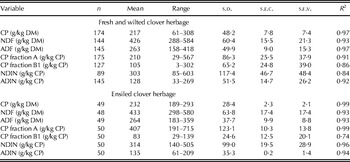
All herbage samples (fresh, wilted and ensiled) were dried for 48 h in a forced-air oven at 58 °C to determine DM content (Naumann & Bassler Reference Naumann and Bassler1997) and milled through a 1 mm screen (Cyclotec 1093 sample mill, Foss Tecator, Rellingen, Germany). The quality variables were estimated using near-infrared reflectance spectroscopy (NIRS). For this purpose, all dried and milled samples were scanned in duplicate with a NIR-Systems 5000 monochromator (Perstrop Analytical Inc., Silver Spring, MD, USA) over a wavelength range of 1100–2500 nm in 2 nm intervals. The software NIRS 2 (Infrasoft International®, ISI, Port Mathilda, PA, USA) was used for scanning, mathematical processing, calibration, validation and statistical analysis of the spectra data. Statistical characteristics of the NIRS calibration and validation for the quality variables of fresh, wilted and ensiled clover herbage are given in Table 1. The reference laboratory measurements of the selected samples were carried out using the following methods. The N content was measured according to the Dumas combustion method using an elemental analyser vario MAX CN (Elementar Analysensysteme GmbH, Hanau, Germany) and converted to CP by multiplying the N content in each herbage sample by 6·25. The CP fractions of the Cornell Net Carbohydrate and Protein System (Sniffen et al. Reference Sniffen, O'Connor, Van Soest, Fox and Russell1992) were analysed by the recommendations of Licitra et al. (Reference Licitra, Hernandez and Van Soest1996) with modifications as described below. This system classifies the CP into NPN (CP fraction A), true protein (CP fraction B) and unavailable protein for ruminants containing protein associated with lignin, tannin–protein complexes, and Maillard products (CP fraction C). CP fraction B is further divided into the three subfractions B1, B2 and B3 based on their decreasing rates of ruminal degradation. CP fraction A was measured by filtering the true protein with tungstic acid as precipitating agent through Whatman 541 filter paper. Afterwards, CP fraction A was calculated as the difference between total N and the N content of the residue after filtration. For determination of CP fraction B1, samples were filtered through Whatman 541 filter paper using borate-phosphate buffer. Additional samples in filter bags were sequentially analysed for neutral-detergent fibre without amylase or sodium sulphite and acid-detergent fibre by the method of Van Soest et al. (Reference Van Soest, Robertson and Lewis1991) using semi-automated equipment (ANKOM220 Fiber Analyzer, Macedon, NY, USA). Subsequently, the N content of the residues in the filter bags was measured to determine neutral-detergent insoluble nitrogen (NDIN) and acid-detergent insoluble nitrogen (ADIN). The difference between NDIN and ADIN gives CP fraction B3, whereas ADIN is classified as CP fraction C. CP fraction B2 was calculated by subtracting the sum of CP fractions A, B1, B3 and C from total N. Rumen-undegradable protein (RUP) was calculated as described by Sniffen et al. (Reference Sniffen, O'Connor, Van Soest, Fox and Russell1992). A ruminal passage rate constant of 0·035 /h and the generated CP fractions from the forages (fresh, wilted and ensiled) were used for calculation. Degradation rate constants were 1·50 /h for B1, 0·13 /h for B2 and 0·0175 /h for B3.
Statistical characteristics of the NIRS-calibration and -validation for the investigated quality variables of fresh, wilted and ensiled clover herbage

n, number of samples; s.d., standard deviation; s.e.c., standard error of calibration; s.e.v., standard error of validation; R 2, coefficient of determination of calibration; CP, crude protein; DM, dry matter; NDF, neutral-detergent fibre; ADF, acid-detergent fibre; NDIN, neutral-detergent insoluble nitrogen; ADIN, acid-detergent insoluble nitrogen.
The pH of all silage samples was determined in an aqueous silage extract (200 g fresh matter/litre). Ammonia-N was analysed by steam distillation using the Kjeldahl procedure (Naumann & Bassler Reference Naumann and Bassler1997). Silage DM content was corrected afterwards by a simplified equation of Weissbach & Strubelt (Reference Weissbach and Strubelt2008):
 $${\rm DMc}\,{\rm (g}/{\rm kg)} = 26{\cdot}2 + 0{\cdot}970\,{\rm DMn}$$
where DMc is the corrected DM content and DMn is the non-corrected DM content of the clover silages.
Finally, all silage quality variables were expressed in terms of the corrected DM content.
Statistical analysis
Data were subjected to an analysis of variance (ANOVA) based on a generalized mixed model using the software package SAS 9.1, where species/cultivar and management system were included as fixed factors. Cut, year and herbage condition were considered as repeated measurements. As the factor species/cultivar was nested within the management system with three replicate blocks, the error terms system×block and system×block×species/cultivar were random effects. The former was integrated in the ANOVA of LWR, silage pH, ammonia-N and specific PPO activity. The changes in CP quality characteristics from fresh over wilted to ensiled clover herbage were analysed with both error terms and the measured DM content of the clover herbages (fresh, wilted and ensiled) as a covariable. In the case of silage fermentation quality variables (pH and ammonia-N), the DM content measured at ensiling was included in the model as a covariable. With the exception of the specific PPO activity, all variables were analysed as weighted annual averages, which were calculated by the DM yield of each cut. Means with a significant F-value were compared using Student's t-test using pre-defined contrasts. To avoid random significances, probabilities were adjusted by the Bonferroni–Holm procedure (Holm Reference Holm1979) with P<0·05 as the significance level.
Separate regression analysis for each full harvest year was conducted with the analyst application in SAS. For this purpose, only the silage data were used and averaged over the field replications. Data of ensiled white clover herbage were not used for the regression analysis. Root-mean-square error (RMSE) and adjusted R 2 were given for each regression equation. The influence of LWR, MSC, degree of wilting and specific PPO activity on the determined protein quality characteristics of red clover silage were separately evaluated for each year using multiple regression analysis with forward selection. A variable was entered into the model when P<0·05. Data on specific PPO activity were related to LWR before regression analysis was carried out.
RESULTS
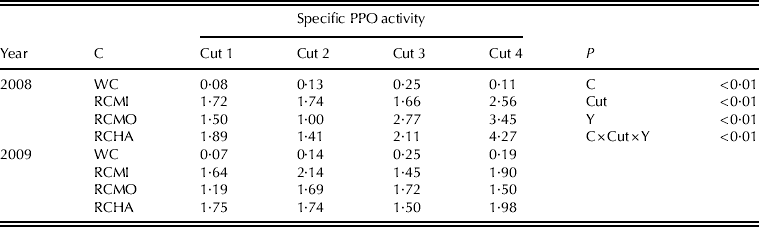
For the specific PPO activity in clover leaves an interaction year×cut×species/cultivar (P<0·01) was observed (Table 2). The lowest specific PPO activity was measured in the leaves of white clover, irrespective of cut and year. Differences among the red clover cultivars were only observed in the third and fourth cut of 2008. Cultivars Montana and Harmonie had the highest specific PPO activity in the third and fourth cut of 2008, respectively. The management system did not affect the specific PPO activity.
Specific PPO activity (unit/μg protein/g DM) in fresh clover leaves as influenced by cultivar (C), cut and year (Y) (s.e.m.=0·419)
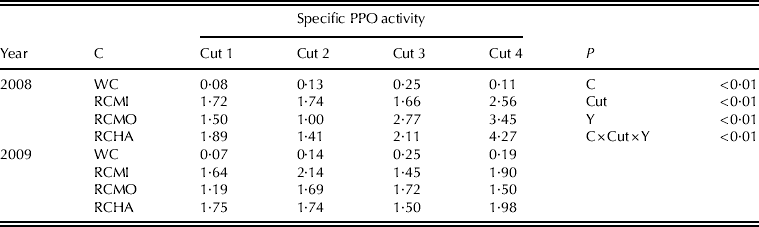
s.e.m., pooled standard error of the mean; P, probability; WC, white clover; RCMI, red clover cultivar Milvus; RCMO, red clover cultivar Montana; RCHA, red clover cultivar Harmonie.
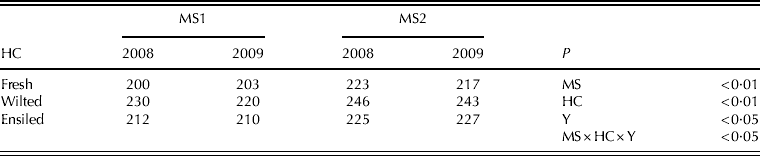
The CP content of fresh, wilted and ensiled clover herbage showed an interaction of management system×year×herbage condition (P<0·05), as indicated in Table 3. In the management system with mechanical stress, the CP content was higher than that in the system without mechanical stress, irrespective of herbage condition and year. In each case, the wilted herbage had the highest CP content. Irrespective of year, the CP content of ensiled red clover herbage was strongly positively correlated with the LWR (silage 2008: R 2=0·81, P<0·01; silage 2009: R 2=0·83, P<0·01). Moreover, the LWR of fresh clover herbage was highest under mechanical stress (main effect management system: P<0·01; LWR without mechanical stress: 0·37; LWR with mechanical stress: 0·41).
Effect of management system (MS), herbage condition (HC) and year (Y) on the CP content (g/kg DM) of clover herbage (s.e.m.=4·6)
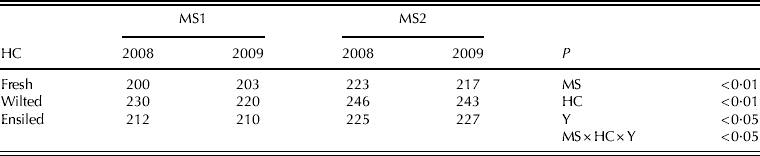
s.e.m., pooled standard error of the mean; P, probability; MS1, without mechanical stress; MS2, with mechanical stress.
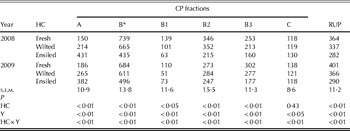
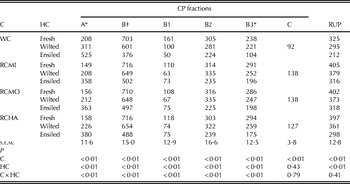
The analysis of covariance (ANCOVA) demonstrated a year×herbage condition interaction (P<0·01) for all CP fractions and the calculated RUP content (Table 4) as the most important two-way interaction. With the exception of CP fraction C and the calculated RUP content, the interaction species/cultivar×herbage condition was also significant (Table 5). In the case of CP fractions B2 and B3 a management system×year×herbage condition interaction was observed. Owing to a minor influence of the management system on the CP fractions, only the both two-way interactions will be described in the following.
Effect of herbage condition (HC) and year (Y) on the content of CP fractions (g/kg CP) and calculated RUP (g/kg CP) of clover herbage

* Sum of CP fractions B1, B2 and B3.
s.e.m., pooled standard error of the mean; P, probability; RUP, calculated rumen-undegradable protein.
Effect of cultivar (C) and herbage condition (HC) on the content of CP fractions (g/kg CP) and calculated RUP (g/kg CP) of clover herbage

* Differences between cultivars within herbage condition were absent when both MSC and DM content were used as covariable.
† Sum of CP fractions B1, B2 and B3.
s.e.m., pooled standard error of the mean; P, probability; WC, white clover; RCMI, red clover cultivar Milvus; RCMO, red clover cultivar Montana; RCHA, red clover cultivar Harmonie; RUP, calculated rumen-undegradable protein.
The content of CP fraction A increased during wilting and ensiling, irrespective of species, cultivar and year. The increase in CP fraction A from fresh to wilted herbage was +43% in both years. However, the increase from wilted to ensiled herbage (2008: +102%; 2009: +44%) and the content of CP fraction A in clover silage was lowest in the second full harvest year (Table 4). Concerning clover species, the increase of CP fraction A from fresh to ensiled herbage was +253% for white clover and +238% on average for the red clover cultivars, respectively. White clover had in all herbage conditions the highest content of CP fraction A. Silage made from the red clover cultivar Harmonie contained more CP fraction A in CP than either Milvus and Montana. However, using both MSC and DM content as covariable in the ANCOVA resulted in no differences in CP fraction A among the silages made from the three red clover cultivars (Table 5).
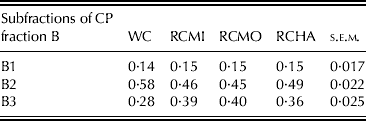
In comparison to CP fraction A, CP fraction B decreased from fresh over wilted to ensiled clover herbage. There was a strong negative correlation between CP fraction A and B of red clover silage (2008: R 2=0·94, P<0·01; 2009: R 2=0·95, P<0·01). The decrease of CP fraction B from fresh to wilted herbage was −10%, irrespective of year. However, the decrease from wilted to ensiled herbage (2008: −34%; 2009: −19%) differed between years. In 2009, the content of CP fraction B of clover silage was highest (Table 4). The lowest content of CP fraction B was observed for wilted and ensiled white clover herbage (Table 5). The decrease of CP fraction B during wilting and ensiling was higher for white clover (−46%) compared with the average of the red clover cultivars (−31%). With regard to the subfractions of CP fraction B, in the first full harvest year, the highest reduction was observed for CP fraction B1 (−55%), whereas in the second full harvest year this was true for CP fraction B3 (−42%), as shown in Table 4. A notable finding was that the proportion of CP fractions B1, B2 and B3 relative to the total amount of CP fraction B of ensiled clover herbage did not differ between years (Table 6). For white clover, among CP fractions B1, B2 and B3, CP fraction B1 had the largest decrease, followed by B3. In contrast, in case of red clover, all subfractions of CP fraction B decreased about equally with the lowest decrease for CP fraction B2 (Table 5). Considering all subfractions of CP fraction B, white clover silage had the same proportion of CP fraction B1, higher proportion of CP fraction B2 and lower proportion of CP fraction B3 compared with all red clover silages (Table 7). In general, the largest proportion of CP fraction B in clover silages consisted of CP fraction B2 when expressed on the basis of the total amount of CP fraction B. Considering the MSC of the red clover cultivars as a covariable in the ANCOVA in addition to the DM content revealed that the differences in CP fraction B3 among the red clover silages were absent (Table 5). For the red clover silages, there was a negative correlation between CP fraction A and B3 (2008: R 2=0·91, P<0·01; 2009: R 2=0·39, P<0·01).
Proportion of CP fractions B1, B2 and B3 relative to the total amount of CP fraction B as influenced by herbage condition and year

s.e.m., pooled standard error of the mean.
Proportion of CP fractions B1, B2 and B3 relative to the total amount of CP fraction B for ensiled clover herbage
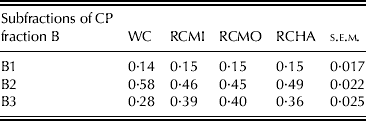
s.e.m., pooled standard error of the mean; WC, white clover; RCMI, red clover cultivar Milvus; RCMO, red clover cultivar Montana; RCHA, red clover cultivar Harmonie.
The content of CP fraction C did not vary among herbage conditions. In comparison to 2009, the silages made in 2008 contained more CP fraction C, whereas the content of CP fraction C in fresh clover herbage was highest in 2009 (Table 4). In all herbage conditions, the CP of white clover consisted of lower contents of CP fraction C compared with all red clover cultivars (Table 5).
The calculated RUP contents decreased during wilting and ensiling, regardless of year (Table 4), species and cultivar (Table 5). White clover had lower RUP contents in all herbage conditions compared with that of the three red clover cultivars (Table 5). In both years, the calculated RUP contents were negatively correlated with the content of CP fractions A and B2 and positively correlated with the content of CP fractions B1, B3 and C. A close and highly significant correlation was observed only in the case of CP fraction B3, irrespective of year (2008: R 2=0·90, P<0·01; 2009: R 2=0·92, P<0·01).
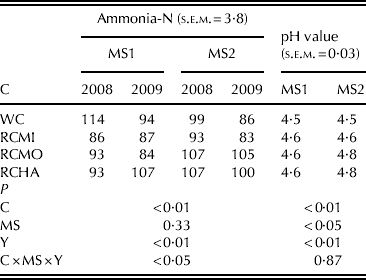
For ammonia-N, the ANCOVA showed an interaction of management system×year×species/cultivar, as indicated in Table 8. The contents of ammonia-N ranged from 83 to 114 g/kg total N. In both management systems, the ammonia-N levels of the white clover silages were higher in 2008 compared with 2009. With regard to red clover silages, differences between years were mostly absent. Only the ammonia-N content of the red clover cultivar Montana did not differ between years, independent of the management system.
Ammonia-N content (g/kg total N) and pH value of 90 days clover silage as influenced by cultivar (C), management system (MS) and year (Y)
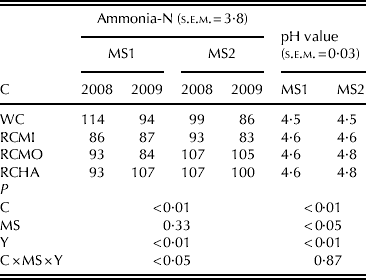
s.e.m, pooled standard error of the mean; P, probability; MS1, without mechanical stress; MS2, with mechanical stress; WC, white clover; RCMI, red clover cultivar Milvus; RCMO, red clover cultivar Montana; RCHA, red clover cultivar Harmonie.
An interaction of management system×species/cultivar (P<0·01) was observed for the final pH values of the clover silages. White clover silages in both management systems had the lowest pH values (Table 8). In general, the highest silage pH values were determined in 2008.
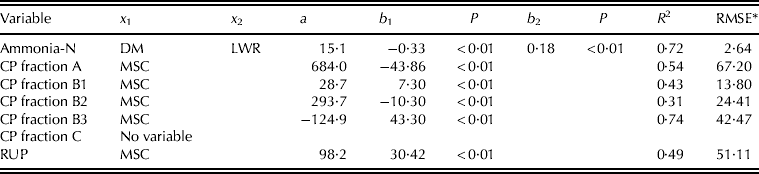
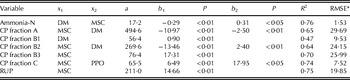
Multiple regression analysis revealed that the stage of maturity accounted for a high proportion of the variation in the contents of the CP fractions and the calculated RUP contents within both years, except for CP fraction C in 2008 and CP fraction B1 in 2009 (Tables 9 and 10). In both years, a moderate negative relationship between CP fraction A and the stage of maturity was identified for the red clover silages (2008: R 2=0·54, P<0·01; 2009: R 2=0·43, P<0·01). The stage of maturity alone explained the variation in CP fraction B3 and RUP within both years. The content of CP fraction B3 and RUP were highly positively correlated with the stage of maturity, irrespective of year (Tables 9 and 10). In 2008, degree of wilting and LWR accounted for 0·72 of the variation of ammonia-N, whereas in 2009 this was true for degree of wilting and stage of maturity. However, in both years, the degree of wilting was the main factor explaining the variation in ammonia-N content. In the present study, the DM content at ensiling ranged from 204 to 657 g/kg. There was a negative correlation between ammonia-N and degree of wilting (2008: R 2=0·58, P<0·01; 2009: R 2=0·73, P<0·01). The content of CP fraction A of ensiled red clover herbage also decreased with increasing DM content at ensiling (2008: R 2=0·29, P<0·01; 2009: R 2=0·43, P<0·01). However, in case of ammonia-N the relationship was closer. Including the specific PPO activity in the model only improved the prediction of CP fraction C in 2009 (Table 10). In 2009, CP fraction C was negatively correlated with the specific PPO activity (R 2=0·03), but the correlation was poor and not significant. Moreover, there was an increase of the content of ammonia-N (R 2=0·22, P<0·05) and CP fraction A (R 2=0·22, P<0·05) when the specific PPO activity increased in 2008. In contrast, a negative relationship was found for CP fraction B3 in both years (2008: R 2=0·32, P<0·01; 2009: R 2=0·24, P<0·01).
Multiple linear regressions (y=a+b 1x1+b 2x2) between leaf weight ratio (LWR), stage of maturity (MSC), degree of wilting (DM), specific PPO activity and protein quality variables of red clover silages in 2008
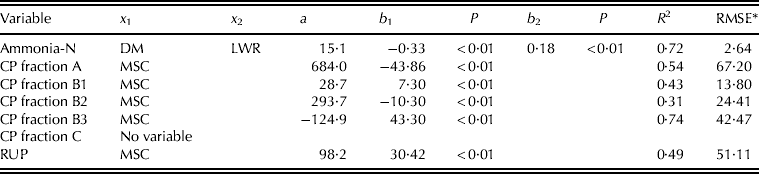
* Unit for ammonia-N is g/kg total N, for the remaining variables g/kg CP.
RUP, calculated rumen-undegradable protein; P, probability; R 2, coefficient of determination; RMSE, root-mean-square error.
Multiple linear regressions (y=a+b 1x1+b 2x2) between leaf weight ratio (LWR), stage of maturity (MSC), degree of wilting (DM), specific PPO activity and protein quality variables of red clover silages in 2009

* Unit for ammonia-N is g/kg total N, for the remaining variables g/kg CP.
PPO, polyphenol oxidase activity in relation to LWR; RUP, calculated rumen-undegradable protein; P, probability; R 2, coefficient of determination; RMSE, root-mean-square error.
DISCUSSION
The differences in CP content between the two management systems investigated in the present study are related to the LWR of fresh clover herbage. High LWR, as observed under mechanical stress, led obviously to higher CP levels. Higher CP contents in silages compared with fresh forages are generally a result of DM losses associated with respiration and silage fermentation (Albrecht & Muck Reference Albrecht and Muck1991; Owens et al. Reference Owens, Albrecht, Muck and Duke1999b). Since the CP content did not change during ensiling (Mustafa & Seguin Reference Mustafa and Seguin2003), the decrease in CP content from wilted to ensiled herbage in the present study cannot coherently be explained. The high CP content of wilted herbage is presumably attributed to a concentration of N compounds during wilting or a loss of DM as sugars, which is not reflected in the CP content of the respective silage.
The CP composition of forage crops is changed by wilting and ensiling (Seyfarth et al. Reference Seyfarth, Knabe and Weise1989). Although the management system affected the CP content of white and red clover herbage, it was of minor relevance for the changes in CP fractions from fresh to ensiled clover herbage. Consequently, the extent of protein degradation during wilting and ensiling was independent of the CP content in fresh clover herbage. The contents of CP fraction A in red clover silages in the present work were similar to those reported by Owens et al. (Reference Owens, Albrecht, Muck and Duke1999b). White clover silage had higher contents of CP fraction A than red clover, but the extent of proteolysis in white clover silage was lower compared with that of alfalfa silage (Papadopoulos & McKersie Reference Papadopoulos and McKersie1983; Owens et al. Reference Owens, Albrecht and Muck1999a, Reference Owens, Albrecht, Muck and Dukeb).
As a result of the activity of both plant and microbial enzymes (Ohshima & McDonald Reference Ohshima and McDonald1978), the content of CP fraction A increased from fresh over wilted to ensiled herbage, irrespective of clover species and cultivar. However, the proteolysis in the silo may be independent of the content of CP fraction A in wilted herbage so that the proteolysis is influenced by factors other than the wilting time, such as the substrate availability (Owens et al. Reference Owens, Albrecht and Muck1999a). The observations in the present work agree with this assumption. Furthermore, the increase in CP fraction A during wilting is apparently independent of the content of CP fraction A at harvesting as the content of CP fraction A of fresh clover herbage differed between years, but the extent of proteolysis during wilting was equal (Table 4). According to McKersie (Reference McKersie1985), the rate and endpoint of proteolysis in silage is largely dependent on the rate of pH decline and the proteolytic activity in the leaves of the ensiled forage legumes. Furthermore, the proteolytic activity of forage crops is not only species-dependent; cultivars within species also affect the proteolytic activity (Tremblay et al. Reference Tremblay, Bélanger, McRae and Michaud2001; Pichard et al. Reference Pichard, Tesser, Vives, Solari, Hott and Larraín2006). However, differences in the extent of proteolysis among the tested red clover cultivars were absent in the present study (Table 5).
The content of CP fraction A in red clover silage investigated in the present study decreased with advancing maturity. Similar results have been demonstrated for alfalfa (Kohn & Allen Reference Kohn and Allen1995) and pea silages (Cavallarin et al. Reference Cavallarin, Antoniazzi, Tabacco and Borreani2006). Therefore, the stage of maturity explains the variation in CP fraction A within years among the silages made from the red clover cultivars. The differences in the content of CP fraction A between years (Table 4) may be attributed to a higher carboxypeptidase activity in 2008. This enzyme is comparatively stable during ensiling and it loses its proteolytic activity very slowly post-ensiling (Guo et al. Reference Guo, Zhou, Yu and Zhang2007). Consequently, there was presumably a higher increase of free amino acid-N as a result of a higher carboxypeptidase activity in 2008 compared with 2009. The content of free amino acid-N accounts for a large part of the NPN compounds in silages and increases during ensiling even 35 days post-ensiling, as reported for alfalfa silage (Guo et al. Reference Guo, Zhou, Yu and Zhang2007). This was also reflected in the final pH values of the clover silages in the present study, as the products of the protein degradation have a buffering effect and thereby decelerate the pH decline (Voss Reference Voss1967), explaining the higher final silage pH values of the silages in the present study in 2008 compared with 2009.
Another important factor influencing the content of CP fraction A is the degree of wilting. In general, increasing DM contents prior to ensiling decrease the extent of proteolysis during ensiling (Papadopoulos & McKersie Reference Papadopoulos and McKersie1983; Jones et al. Reference Jones, Satter and Muck1992). Owing to different wilting conditions among cuts, the DM content at ensiling varied partly from the target DM of 400 g/kg in the present study. Therefore, a negative correlation between the content of CP fraction A and the degree of wilting was found for the red clover silages in both years.
As previously observed (Seguin & Mustafa Reference Seguin and Mustafa2003), most of the amount of CP fraction B in fresh herbage was converted into NPN compounds during wilting and ensiling. Thus, a large increase of CP fraction A during wilting and ensiling resulted in a corresponding decrease of CP fraction B (Table 4). However, there were substantial differences in the extent of decrease among the subfractions of CP fraction B between white and red clover (Table 5). The equal proportions of CP fraction B1, B2 and B3 relative to the total amount of CP fraction B of clover silages (red and white clover) in both years (Table 6) can explain the different decrease among the subfractions of CP fraction B between years. As a result, the breakdown of CP fraction B during ensiling of forage legumes followed certain pattern, independent of the proportion of CP fraction B in CP. Consequently, it is unlikely that the PPO plays a main role for the breakdown pattern of protein during wilting and ensiling.
In both years of the present study, changes in the content of CP fraction C during wilting and ensiling were absent (Table 4), contrary to what was observed in other studies (Merchen & Satter Reference Merchen and Satter1983; Seguin & Mustafa Reference Seguin and Mustafa2003). Differences in the content of CP fraction C between red and white clover may be related to the variation in specific PPO activity among clover species, as both the specific PPO activity (Table 2) and the content of CP fraction C in silages (Table 5) were lower for white clover than for red clover. However, multiple regression analysis revealed that the specific PPO activity was only relevant for the prediction of CP fraction C of red clover silage in 2009 (Table 10). As a consequence, the specific PPO activity alone did not explain the different level of CP fraction C between white and red clover, CP fractions are not sensitive enough to capture the influence of PPO, or a combination of both.
Besides CP fractions, the ammonia-N content in silages can be additionally considered to evaluate the extent of proteolysis in silages. The range of the ammonia-N contents in the present study (Table 8) is typical for legume silages with a DM content of c. 300–400 g/kg DM (Kung & Shaver Reference Kung and Shaver2001). In both years, increased degree of wilting resulted in a decrease of ammonia-N formation, as reported in previous studies (Merchen & Satter Reference Merchen and Satter1983; Verbič et al. Reference Verbič, Ørskov, Žgajnar, Chen and Žnidaršič-Pongrac1999).
High NPN contents in silages are unfavourable and often associated with low N use efficiency by ruminants (Givens & Rulquin Reference Givens and Rulquin2004). In the present study, CP fraction A was negatively correlated with RUP, regardless of management system and full harvest year. The lower RUP levels in silages (Tables 4 and 5) suggest that silage-based diets may have greater ruminal protein degradation than fresh forages, irrespective of the CP content. Since increasing amounts of rumen-degradable protein in diets of dairy cows declines the efficiency of conversion of feed N into milk N at low content of fast available carbohydrates, increasing the N losses via urine (Kalscheur et al. Reference Kalscheur, Baldwin, Glenn and Kohn2006), it is possible that the clover silages in the present study with a high content of CP fraction A may be inefficiently used if consumed by ruminants, particularly in case of the white clover silage. However, improved N utilization can be expected when red clover silage is fed to ruminants. One strategy for improving the N use efficiency of white clover silage by ruminants may be the feeding of white clover in mixtures with forb silage. Seng et al. (Reference Seng, Bonorden, Nissen, Isselstein and Abel2008) demonstrated that the CP of ensiled herbage mixtures consisting of perennial ryegrass, white clover and forbs, such as dandelion or ribwort comprises higher RUP levels compared with a mixture of perennial ryegrass and white clover.
The CP of red clover silage consists of higher contents of CP fraction B3 and lower contents of CP fraction A compared with other forage legumes (Grabber & Coblentz Reference Grabber and Coblentz2009). This is in accordance with the present observations between white and red clover silage (Tables 5 and 7). Grabber & Coblentz (Reference Grabber and Coblentz2009) supposed that the higher proportion of CP fraction B3 in red clover silage is caused by the action of PPO-generated o-quinones, but due to the lack of an appropriate measurement method, they did not quantify the o-diphenol substrates in red clover. However, the results of the multiple regression analysis (Tables 9 and 10) demonstrated that the specific PPO activity is not relevant for the variation of CP fractions A and B3 in red clover silages. In general, the CP quality characteristics (CP fractions A, B3 and ammonia-N) were inversely related to the specific PPO activity, as expected. These outcomes are contrary to previous findings (Lee et al. Reference Lee, Scott, Tweed, Minchin and Davies2008; Winters et al. Reference Winters, Minchin, Michaelson-Yeates, Lee and Morris2008). The main reason for the observed relationships between the CP quality variables and the specific PPO activity in the present study may be the low range of specific PPO activity (2008: 1·00–4·27 U/μg protein/g DM; 2009: 1·19–2·14 U/μg protein/g DM). Moreover, the PPO activity is influenced by the predominant environmental conditions (Eickler et al. Reference Eickler, Gierus, Kleen and Taube2011). Winters et al. (Reference Winters, Minchin, Michaelson-Yeates, Lee and Morris2008) determined in leaves of field-grown red clover about 10-fold higher PPO activity compared with red clover grown in a controlled environment. Furthermore, the beneficial effects of the PPO on the proteolysis were mostly demonstrated in controlled environment (Sullivan & Hatfield Reference Sullivan and Hatfield2006; Lee et al. Reference Lee, Scott, Tweed, Minchin and Davies2008; Winters et al. Reference Winters, Minchin, Michaelson-Yeates, Lee and Morris2008). Obviously, the results of proteolysis studies carried out under controlled environmental conditions are not easily transferable to field-grown red clover silages.
Overall, the present results point out that the changes in CP quality from fresh to ensiled herbage of different field-grown red clover cultivars are primarily related to other factors than the specific PPO activity in red clover leaves. However, an influence of the PPO in reducing the proteolysis during wilting and ensiling of red clover herbage cannot be completely excluded.
In conclusion, the herbage condition and thereby the course of the wilting and ensiling process has the greatest impacts on the final CP quality of clover silages. The extent of proteolysis in silages made from field-grown red clover is mainly influenced by the stage of maturity at harvesting and the degree of wilting at ensiling. In contrast, the variation in specific PPO activity seems to be of minor importance. As a result of these outcomes, genetic variability in proteolysis among the tested red clover cultivars was absent. Nevertheless, there is a need for further investigations to clearly evaluate the effects of PPO on proteolysis in red clover silages and the reasons for the high contents of CP fraction B3 in red clover compared with white clover. Therefore, a deeper insight into the composition of CP fraction B3 seems to be useful. Independent of this, in ruminant nutrition low contents of NPN compounds in silages as a result of low proteolysis during wilting and ensiling should be generally achieved to preserve the high CP quality level of fresh forage legumes. With regard to the protein utilization by ruminants, the silage CP composition of red clover is more favourable in comparison with white clover silage.
The authors gratefully acknowledge and thank the laboratory staff of ‘ISF Schaumann Forschung’ in Wahlstedt, Germany for the analysis of the silage samples. We are also indebted to the plant breeding company ‘Norddeutsche Pflanzenzucht’ namely Astrid Schirmer, and the Chamber of Agriculture Schleswig Holstein namely Stefan Lange for assistance during harvesting, wilting and ensiling. The authors also acknowledge Dr. Mario Hasler for statistical advice. This work was financially supported by the H. Wilhelm Schaumann Stiftung.