Introduction
The common two-banded sea bream, Diplodus vulgaris (Geoffroy Saint-Hilaire, 1817) (Teleostei: Sparidae) is a demersal species distributed in the Mediterranean Sea and along the eastern Atlantic coast from France to Senegal, including the Madeira, the Azores and Canary Islands (Bauchot and Hureau, Reference Bauchot, Hureau, Whitehead, Bauchot, Hureau, Nilsen and Tortonese1986). Adults are abundant in the sublittoral rocky bottoms down to 100 m depth, whereas the juveniles inhabit shallow coastal areas (Jardas, Reference Jardas1996; Correia et al., Reference Correia, Pipa, Gonçalves, Erzini and Hamer2011). In the Adriatic Sea, this species spawns in autumn during October and November (Dulčić and Kovačić, Reference Dulčić and Kovačić2020). After a short period spent in the water column, they settle (Loy et al., Reference Loy, Mariani, Bertelletti and Tunesi1998). The settlement occurs after 2–2.5 months of the larval planktonic stage and it is most intensive from November to February (Vigliola et al., Reference Vigliola, Harmelin-Vivien, Biagi, Galzin, Garcia-Rubies, Harmelin, Jouvenel, Le Direach-Boursier, Macpherson and Tunesi1998; Correia et al., Reference Correia, Pipa, Gonçalves, Erzini and Hamer2011; Altin et al., Reference Altin, Ozen, Ayyildiz and Ayaz2015).
Published information on food and feeding habits of the common two-banded sea bream is scarce and available information is mainly focused on adult populations (Sala and Ballesteros, Reference Sala and Ballesteros1997; Gonçalves and Erzini, Reference Gonçalves and Erzini1998; Pallaoro et al., Reference Pallaoro, Šantić and Jardas2006; Osman and Mahmoud, Reference Osman and Mahmoud2009). The diet of juvenile common two-banded sea bream was studied in the western Mediterranean (Rossechi, Reference Rossechi1987), Portuguese waters (Horta et al., Reference Horta, Costa and Cabral2004) and the North Aegean Sea (Altin et al., Reference Altin, Ozen, Ayyildiz and Ayaz2015). The only information on the diet of juvenile D. vulgaris in the Adriatic Sea is from Dobroslavić et al. (Reference Dobroslavić, Zlatović, Bartulović, Lučić and Glamuzina2013), who studied the diet overlap of juveniles in three sparid species, including D. vulgaris, in the southern part of the eastern Adriatic Sea.
Information on diet and feeding habits of juveniles is important not only to fulfil the existing gap in biological studies of this species in the Adriatic Sea, but also as an input for further studies on food webs and trophic levels necessary for understanding the overall ecosystem (Altin et al., Reference Altin, Ozen, Ayyildiz and Ayaz2015). Besides, presented data on food and feeding characteristics of the young two-banded sea bream provide useful information for juvenile production of this species in aquaculture. The aim of this study was not only to analyse the diet composition of the juvenile common two-banded sea bream in the central Adriatic Sea, but also to examine, for the first time, changes of diet and diet-related behaviour of juvenile D. vulgaris in relation to their size.
Materials and methods
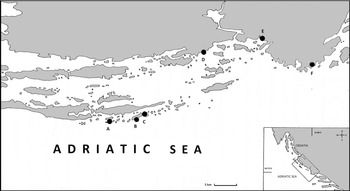
Samples of the juvenile common two-banded sea bream were collected from the central eastern Adriatic channel area, well known as a nursery area of D. vulgaris. The position of sampling stations was defined using random scheme with finally six sites being chosen, three of them on the coastal line and three around islands: Lavsa (43°45′11″N, 15°22′13″E), Studenjak (43°45′35″N, 15°22′47″E), Sovlja (43°45′56″N, 15°43′43″E), Žaborić (43°39′44″N, 15°56′44″E), Sićenica (43°30′06″N, 16°01′03″E) and Lojena (43°49′18″N, 15°15′01″E) (Figure 1). All sampling sites share similar biotic and abiotic characteristics (Pérès and Gamulin-Brida, Reference Pérès and Gamulin-Brida1973). A small beach seine specially designed for the collection of small individuals was used. The net was 50 m long and 30–170 cm high, with cod-end mesh size of 4 mm. Samples were collected during daylight hours. One sampling event per location occurred in the months listed in Table 1. The mean hauling duration was 45 min. Depths at the sampling sites ranged from 0 to 5 m. In shallow parts of the sampling stations the bottom was rocky with benthic algae while deeper parts were with sand muddy bottom and meadows of seagrass Posidonia oceanica and Cymodocea nodosa.
Study area and sampling bays of juvenile Diplodus vulgaris in the eastern central Adriatic Sea: (A) Lojena; (B) Studenjak; (C) Lavsa; (D) Sovlja; (E) Žaborić; (F) Sićenica.

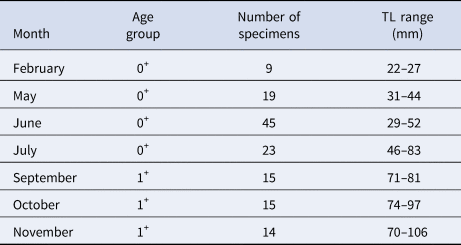
Month of samples, age group, number of catch specimens, TL range (mm) of juvenile Diplodus vulgaris

A total of 140 juveniles were collected from February to November in 2009. Immediately after capture, whole specimens were preserved in 4% formalin solution. In the laboratory, total length (TL) was measured to the nearest millimetre, and body weight to the nearest 0.01 g. Individual age of each analysed specimen was determined by reading sagitta otolith rings under a stereomicroscope at ten-fold magnification. Based on that, two age groups were defined, 0+ and 1+ (Table 1). In addition, stomachs were dissected and their contents were analysed. As the prey had been highly digested, it was determined to the level of taxonomy group. Inorganic matter and detritus were excluded from the analysis. Prey group abundance and blotted wet mass (±0.001 g) of each prey were recorded. In this study, the indices used were (Hyslop, Reference Hyslop1980):
-
Vacuity index (VI) = number of empty stomachs divided by total number of stomachs multiplied by 100;
-
Percentage frequency of occurrence (%F) = number of stomachs in which a food item was found divided by total number of non-empty stomachs multiplied by 100;
-
Percentage numerical composition (%N) = total number of a particular prey item in all non-empty stomachs divided by total number of food items in all stomachs multiplied by 100;
-
Percentage gravimetric composition (%W) = total wet mass of a particular prey item in all non-empty stomachs divided by total mass of stomach contents multiplied by 100.
The main food items were identified using the index of relative importance (IRI) of Pinkas et al. (Reference Pinkas, Oliphant and Iverson1971), as modified by Hacunda (Reference Hacunda1981):

The index was expressed as $\% {\rm IRI} = \left({{\rm IRI}/\sum {{\rm IRI}} } \right)\times 100$ .
Prey groups were sorted in the decreasing order according to IRI and then the cumulative %IRI was calculated.
The feeding breadth was calculated by the Shannon–Wiener diversity index H' (Krebs, Reference Krebs1989):

where pi is the proportion of a specific prey category for the n categories of the listed prey. In practice, for biological communities H' does not exceed 5.0 (Krebs, Reference Krebs1989).
To get a better insight into ontogenetic changes of feeding behaviour in juveniles and evaluate variations in food composition and feeding habits as a function of size, individuals were separated into three length classes: (I) 22–44 mm TL (n = 59), (II) 44–76 mm TL (n = 37) and (III) 76–106 mm TL (n = 36).
Proportional food overlap between length classes was calculated using Schoener's (Reference Schoener1970) dietary overlap index: Cxy = 1 − 0.5∑|Pxi − Pyi|, where Pxi and Pyi are the proportion of prey i (based on %IRI) found in the diet of groups x and y. This index ranges from 0 (no prey overlap) to 1 (all food items in equal proportions). Schoener's index values above 0.6 indicate significant overlap (Wallace, Reference Wallace1981).
Results
Diet composition
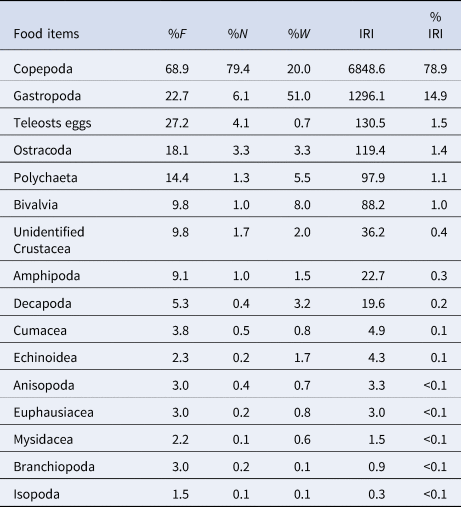
Frequency of occurrence, abundance, gravimetric composition and IRI values of prey organisms found in the stomachs are shown in Table 2. Food items identified in stomachs belonged to 16 different prey groups: Copepoda, Gastropoda, Teleost eggs, Ostracoda, Polychaeta, Bivalvia, unidentified Crustacea, Amphipoda, Decapoda, Cumacea, Echinoidea, Anisopoda, Euphausiacea, Mysidacea, Branchiopoda and Isopoda. Planktonic copepod crustaceans occurred in 68.9% of stomachs that contained food, and represented 79.4% of total prey number and 20.0% of the total prey weight. Gastropods occurred in 22.7% of the stomach examined and represented 6.1% by number and 51% by weight of the total prey. Planktonic copepod crustaceans were the most important prey group ingested, constituting 78.9% of the total IRI, followed by gastropods (%IRI = 14.9). Other prey groups had much lower %IRI (<2%) and were thus of less importance.
Diet composition from 132 non-empty stomachs of juvenile D. vulgaris (%F, frequency of occurrence; %N, percentage numerical composition; %W, percentage gravimetric composition; IRI, index of relative importance; %IRI, percentage index of relative importance)

Of the total number of stomachs examined (n = 140), eight were empty (VI = 5.7%). The Shannon–Wiener diversity index (H') of prey groups in the total sample was 0.97.
Food in relation to fish size
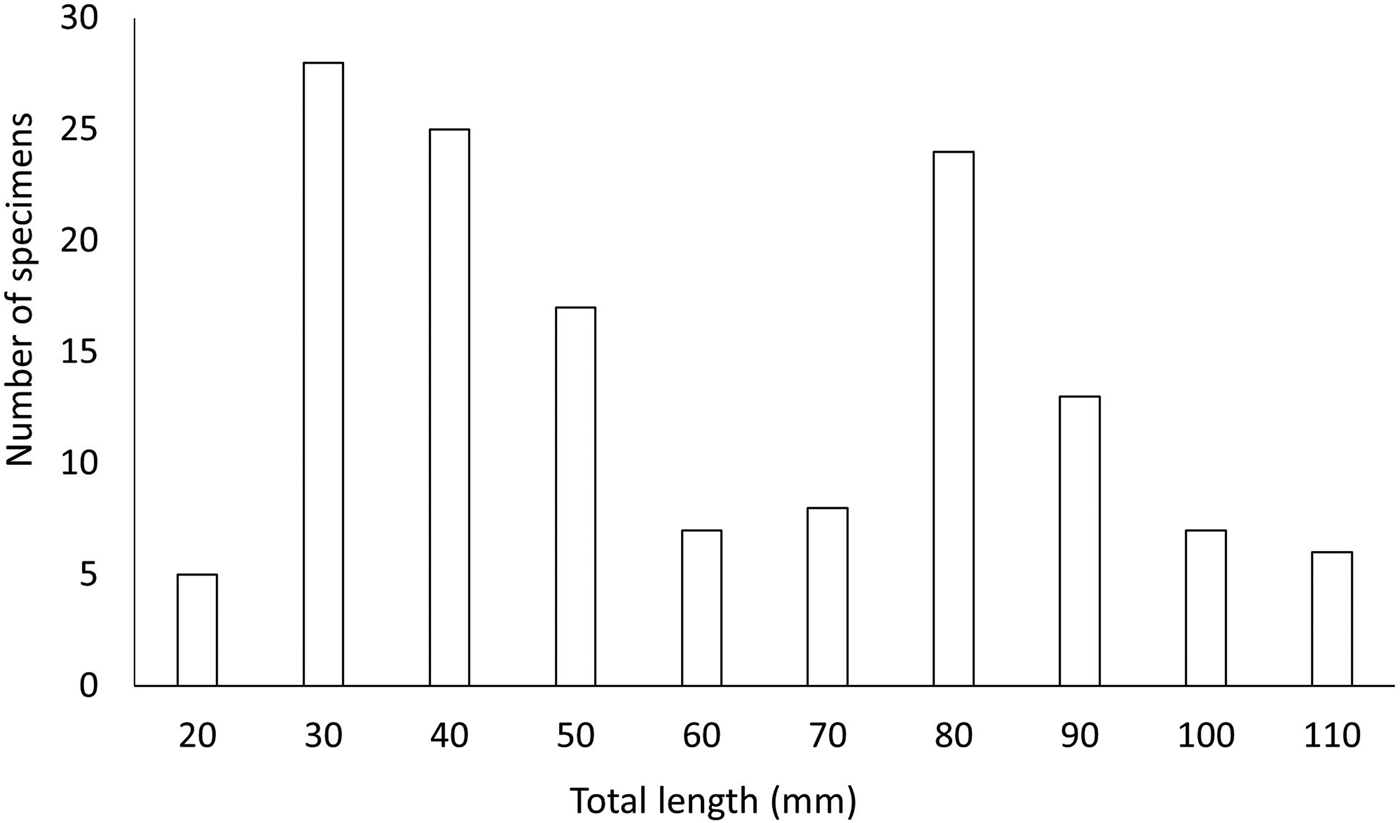
The TL of the examined fish ranged from 22 to 106 mm (Figure 2).
Length-frequency distribution of sampled juvenile D. vulgaris from the eastern central Adriatic Sea (n = 140).

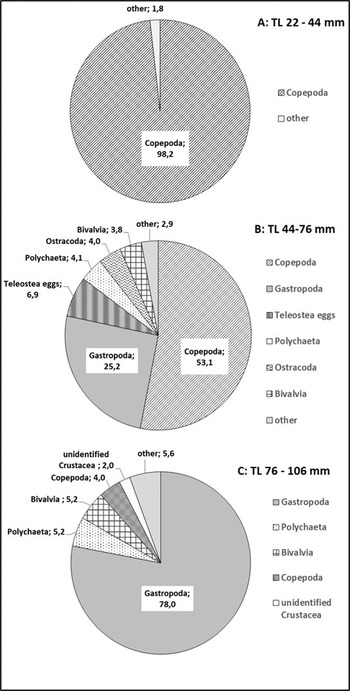
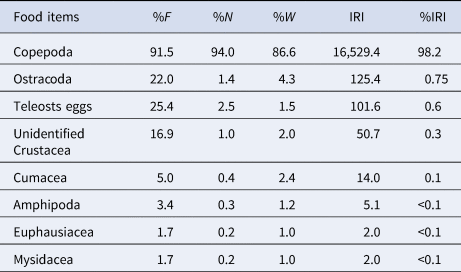
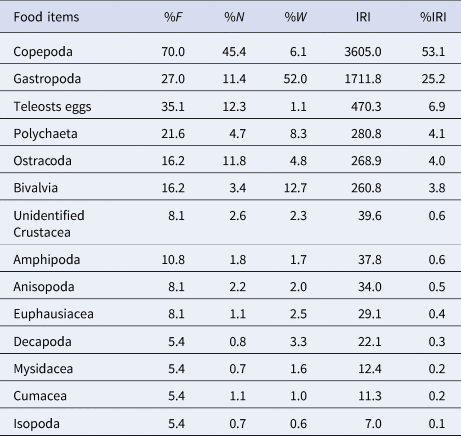
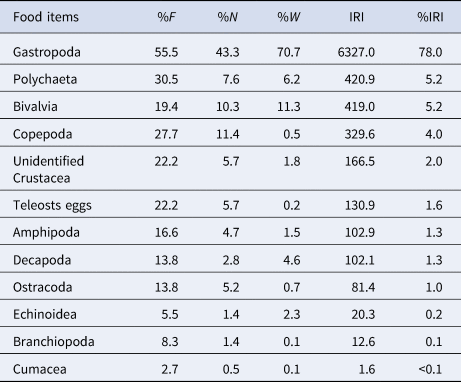
The %IRI changed depending on the size of juveniles (Figure 3). In the first length class copepods dominated the diet (%IRI = 98.2), whereas other prey groups were of minor importance, and all together accounted for only 1.8% of food found in stomachs (Table 3, Figure 3A). In the second length class (up to 76 mm) planktonic copepods were the most important prey (%IRI = 53.1) followed by gastropods (%IRI = 25.2). Other categories of prey, including eggs of Teleosts, Polychaeta, Ostracoda, Bivalvia and other food groups, had much lower %IRI in this length class when compared to the first length class (Table 4, Figure 3B). In the third group, with the largest analysed juveniles, importance of copepods decreased significantly (%IRI = 4.0). In the stomachs of these specimens (over 76 mm TL), gastropods markedly dominated (%IRI = 78) and were followed by polychaetes (%IRI = 5.2) and bivalves (%IRI = 5.2). All other groups, primarily crustaceans, accounted for 5.6% (Table 5; Figure 3C). Teleost eggs and ostracods showed the highest value in the second length class (Table 4). Planktonic euphausiids and mysids were found only in stomachs of fish with TL up to 76 mm while unidentified crustaceans, Amphipoda and Cumacea were present in small quantities in stomachs of juveniles of all length classes.
Composition of juvenile D. vulgaris diet for three length classes: (A) I – 22–44 mm TL, (B) II – 44–76 mm TL, (C) III – 78–106 mm TL, based on %IRI values for major prey groups. Group ‘others’ includes prey groups with very small %IRI (<2%) in each length class.

Diet composition of juvenile D. vulgaris in length class 22–44 mm LT (59 non-empty stomachs) (%F, frequency of occurrence; %N, percentage numerical composition; %W, percentage gravimetric composition; IRI, index of relative importance; %IRI, percentage index of relative importance)

Diet composition of juvenile D. vulgaris in length class 44–76 mm LT (37 non-empty stomachs) (%F, frequency of occurrence; %N, percentage numerical composition; %W, percentage gravimetric composition; IRI, index of relative importance; %IRI, percentage index of relative importance)

Diet composition of juvenile D. vulgaris in length class 76–106 mm LT (36 non-empty stomachs) (%F, frequency of occurrence; %N, percentage numerical composition; %W, percentage gravimetric composition; IRI, index of relative importance; %IRI, percentage index of relative importance)

Schoener's overlap index indicated differences in diets between the largest fish (>76 mm TL) and both smaller size groups of up to the 76 mm in TL. On the contrary, high values of overlapping (0.77) were found for the two first size groups of fish, 22–44 and 44–76 mm TL, where the diet was dominated by planktonic copepod crustaceans (Table 6).
Proportional food overlap coefficients (Schoener's index) of the diet between length classes of juvenile D. vulgaris

Discussion
The composition of food suggests that juvenile common two-banded sea bream inhabiting eastern part of the central Adriatic Sea is a carnivorous species with the dominance of zooplanktonic organisms in the diet. Planktonic copepod crustaceans were the most abundant prey constituting 78.9% of the total IRI and thus can be considered as the primary food source (Rosecchi and Nouaze, Reference Rosecchi and Nouazè1987). Based on the total IRI, gastropods were the second most important prey while other prey groups were of less importance. The low value of Shannon–Wiener index (H' = 0.97) indicates the low diversity of food and proves that only few prey groups are relevant for juvenile D. vulgaris diet.
Similarly, in previous studies copepods were dominant prey found in stomachs of juvenile D. vulgaris sampled in the south Adriatic (Dobroslavić et al., Reference Dobroslavić, Zlatović, Bartulović, Lučić and Glamuzina2013) and in the North Aegean seas (Altin et al., Reference Altin, Ozen, Ayyildiz and Ayaz2015). Moreover, copepods are an important prey for juvenile stages of many Adriatic fishes such as Oblada melanura (Pallaoro et al., Reference Pallaoro, Šantić and Jardas2004), Chromis chromis (Dulčić, Reference Dulčić2007), Trachurus trachurus and Trachurus mediterraneus (Šantić et al., Reference Šantić, Rađa and Pallaoro2013), Sarpa salpa and Boops boops (Dobroslavić et al., Reference Dobroslavić, Zlatović, Bartulović, Lučić and Glamuzina2013). In contrast, in the Mediterranean French waters small teleosts and decapods were the most frequent prey in the juvenile D. vulgaris diet (Rossechi, Reference Rossechi1987). Juvenile individuals of D. vulgaris sampled in Portuguese waters fed on amphipods, mysids and algae (Horta et al., Reference Horta, Costa and Cabral2004). Generally, variations in prey consumption may be related to the geographical and environmental characteristics as well as to the presence and availability of food resources in the different areas.
The diet of juvenile D. vulgaris corresponds well with the distribution patterns and abundance of copepods in the Adriatic Sea. These small-sized epiplanktonic crustaceans in very large number inhabit surface sea layers, and are especially abundant in the offshore and inshore waters of the Adriatic Sea during the spring, summer and autumn (Gamulin, Reference Gamulin1979; Regner, Reference Regner1985, Reference Regner1991) which corresponds, for the most part, with the time of D. vulgaris sampling in this study.
Feeding intensity is positively related to the degree and index of fullness, and negatively related to the percentage of empty stomachs (Bowman and Bowman, Reference Bowman and Bowman1980). The low values of the VI (5.7%) indicate that the feeding intensity of juvenile D. vulgaris is very high. Similarly, in the eastern central Adriatic Sea, low values of VI were reported for juveniles of O. melanura (Pallaoro et al., Reference Pallaoro, Šantić and Jardas2004), C. chromis (Dulčić, Reference Dulčić2007), T. mediterraneus and T. trachurus (Šantić et al., Reference Šantić, Rađa and Pallaoro2013). The VI of juvenile D. vulgaris is much lower than that in adults (%VI = 18.4; Pallaoro et al., Reference Pallaoro, Šantić and Jardas2006) and this is in an agreement with the general assumption that in all species high feeding intensity is more pronounced in smaller individuals with the highest growth rates. This high feeding frequency in small individuals is also related to the fact that small prey in stomachs of juveniles is digested faster than the larger items represented in the diet of large fish (Chapman et al., Reference Chapman, Mackay and Wilkinson1988), i.e. feeding intensity and frequency are directly correlated with meal size and digestion time (Grove and Crawford, Reference Grove and Crawford1980).
Fish size was an important factor affecting the diet of juveniles D. vulgaris. A size-related diet changes were observed during stomach content analyses and were therefore presented in three separate length classes. The stomach content analyses clearly indicated changes in prey selection with increasing body length. A prominent shift in the feeding habits was recorded from the second to third length class (~76 mm TL, Schoener's overlap index = 0.41), with the decrease in predation on planktonic copepods and an increase of benthic, larger-sized, prey such as gastropods, polychaetes and bivalves. So, the juvenile two-banded sea bream, not only changed the categories and size of the prey, but also the feeding behaviour and habitat by switching gradually from feeding in the water column with small pelagic crustaceans to feeding on the sea bottom in search of larger benthic prey. Trophic shift of juvenile D. vulgaris can also be explained in terms of fish morphology. Width and height of the mouth are linearly related to fish size and increased body and mouth size permit the capture of a broader range of prey size and prey type (Ross, Reference Ross1978). Besides, development and differentiation of teeth is very important, especially molars, with increasing size. Onofri (Reference Onofri1986) relates the type of food in D. vulgaris with the characteristics of their denture adapted for grinding of hard animal shells. The development of the tooth thus also explains a high proportion of animals with hard exoskeletons, such as larger Crustacea, Gastropoda and Bivalvia, in the diet of larger juveniles. The trophic shift also required important shape changes, mostly related to their swimming capacity and different feeding behaviour (Loy et al., Reference Loy, Mariani, Bertelletti and Tunesi1998). Results in the present study confirm this feeding behaviour; larger-sized juveniles of D. vulgaris (>44 mm TL) gradually change their prey types when compared to the smallest individuals. Increased prey size with increasing fish size optimizes the energy input for growth (Stoner and Livingston, Reference Stoner and Livingston1984). This is especially evident in the largest fraction of the analysed juveniles (TL over 76 mm) where planktonic copepods are only a small fraction of the prey (%IRI = 4.0) and, on the contrary, benthic groups, primarily gastropods become the most important food (%IRI = 78.0). It was previously found that in the Adriatic Sea adult individuals of D. vulgaris feed on various prey items including mostly benthic organisms such as echinoids, decapods, gastropods and bivalves (Pallaoro et al., Reference Pallaoro, Šantić and Jardas2006), and the same has been confirmed for adult D. vulgaris in the Mediterranean Sea (Sala and Ballesteros, Reference Sala and Ballesteros1997; Gonçalves and Erzini, Reference Gonçalves and Erzini1998).
Conclusions
Small juveniles of D. vulgaris (ca. 20–50 mm TL) feed upon planktonic crustaceans, almost exclusively copepods. After a short period spent in the water column, they descend and start searching for prey in benthos (ca. 50–80 mm), at first only occasionally and still mainly feeding on copepods. Larger juveniles, towards the end of the first year of their life (0+) and especially during the second year of their life (1+), switch to food and feeding habits very similar to their adults, i.e. they feed on larger prey and mainly consume benthic organisms such as gastropods, bivalves and polychaetes.
Acknowledgements
We want to express special gratitude to our dear colleagues, the late Armin Pallaoro and Miro Kraljević, for their contribution to this study.
Author's contribution
SKŠ: formulating the research question, designing and caring out the study, analysing the data, interpreting the findings and writing the article (drafting, reviewing and editing), final approval of version to be published. MŠ: analysing the data, interpreting the findings and writing the article (drafting, reviewing and editing), final approval of version to be published.
Financial support
This research received no specific grant from any funding agency, commercial or not-for-profit sectors.
Data
The data that support the findings of this study are available from the corresponding author, SKŠ, upon reasonable request.