1 Introduction
Clicks are non-pulmonic sounds and relatively rare among the sounds of the world's languages. Their occurrence in phoneme inventories is geographically limited to the African continent (Ladefoged & Maddieson Reference Ladefoged and Maddieson1996, Güldenmann & Stoneking Reference Güldemann and Stoneking2008, Miller et al. Reference Miller, Brugman, Sands, Namaseb, Exter and Collins2009). In African languages, clicks serve as the smallest contrastive unit and have a linguistic function. In Zulu, for example, [ìsìːŋǀéː] ‘kind of spear’ and [ìsìː ǃŋéː] ‘rump’ are contrastive (see Ladefoged Reference Ladefoged2006).
Clicks in other languages are to a large extent overlooked since they do not have a phonemic status and they are acoustically less salient than African clicks. Non-African clicks will be considered in this study. One of the main features of clicks is the occurrence of negative intraoral pressure. The first aim of this exploratory study is to use a data-driven approach to evaluate the occurrence of negative intraoral pressure in human speech production in order to provide a better understanding where clicks could potentially occur. A second aim is then to relate these findings to the presence or absence of weak clicks in the acoustic signal and discuss the possible underlying articulatory behaviour.
1.1 The occurrence of weak clicks in non-African languages and their properties
The most often reported clicks in non-African languages such as English (Ohala Reference Ohala1995), German (Simpson Reference Simpson2007), Korean (Silverman & Jun Reference Silverman and Jun1993), and French (Marchal Reference Marchal1987) are the ones that occur in sequences of two successive stops. In the case of two adjacent stops, two closures in the vocal tract (most likely bilabial, alveolar, velar, and glottal) may be realized with some temporal overlap (Fuchs, Koenig & Winkler Reference Fuchs, Koenig and Winkler2007). If the volume of air between the two closures is increased, it results in negative intraoral pressure. When the closure is released, it is possible for a ‘weak click’ to be produced. We will use ‘weak clicks’ to refer to epiphenomenal clicks in contrast with the African clicks.
Ohala (Reference Ohala1995) was able to show a small negative pressure excursion between /m/ and /n/ with a pressure sensor located just behind the lips during an utterance of ‘da[mn]ation’ of his own speech. He also mentioned that although negative pressure is theoretically possible in both front–back or back–front stop sequences, clicks may only be audible in the former case, since the back stop can already be anticipated during the production of the front stop (large degree of temporal overlap) leading to a double occlusion. Less temporal overlap, no double occlusion and therefore fewer clicks are expected in the opposite direction, since the anticipation of a front stop during the production of a back stop is less likely without hiding the first consonant (Chitoran, Goldstein & Byrd Reference Chitoran, Goldstein, Byrd, Gussenhoven and Warner2002, see also Rochet-Capellan & Schwartz Reference Rochet-Capellan and Schwartz2007 for a phenomenon called the Labial-Coronal Effect, which discusses the greater stability of front–back consonant articulations in comparison to back–front consonant articulation).
Simpson (Reference Simpson2007) conducted an analysis of both canonical stop releases and epiphenomenal releases (weak clicks) for stop clusters using acoustic data. In combination with previous aerodynamic and articulatory studies, he speculated on their potential production mechanisms. In particular, he discusses three: (i) pulmonic, (ii) non-pulmonic egressive, and (iii) non-pulmonic ingressive. These releases were found in alveolar–velar, bilabial–velar, alveolar–glottal stop sequences. He found that all three types of release were possible for the same environment across different speakers. He characterized the canonical pulmonic release as having a long duration (50–100 ms), while non-pulmonic releases were short (10–15 ms). According to Simpson (Reference Simpson2007) egressive non-pulmonic bursts were characterized by energy over a broad spectrum, and ingressive non-pulmonic bursts showed energy concentrated at lower frequencies (<4000 Hz). The non-pulmonic bursts were assumed to have been produced by a velaric airstream mechanism in which there were two simultaneous closures, and speaker-specific articulatory motion during this period produced either cavity expansion for pressure decrease or cavity compression for pressure increase.
Silverman & Jun (Reference Silverman and Jun1993) measured pressure and airflow during the production of Korean /pk/ and /kp/ sequences with different combinations of front and back vowel context. Pressure was measured in the oral cavity with a sensor mounted on the flow mask and pharyngeally with a nasally inserted pressure sensor. Regarding the production of negative pressure, consonant order did not matter. The presence of negative pressure was entirely dependent on vowel order. Using the case of identical vowel context before and after, they found that back–front vowel sequences produced a higher oral pressure, and front–back vowel sequences produced a marked rarefaction in oral pressure: /ipku/ and /ikpu/ showed negative intraoral pressure, but not /upki/ or /ukpi/. They suggest that the tongue motion for vowel production produced the observed pressure changes. They hypothesized that a back–front vowel sequence produced a pressure increase due to tongue motion that compressed the cavity resulting from dual closure, while a front–back vowel sequence produced a pressure decrease due to tongue motion that enlarged the cavity (negative pressure).
1.2 The function of clicks in non-African languages
To our knowledge, three different classes of clicks in non-African languages have been discussed in the literature: those with a paralinguistic function, those with a communicative function, and those produced inadvertently epiphenomenally. Various authors report that clicks serve a paralinguistic function (Gil Reference Gil, Dryer and Haspelmath2011, Wright Reference Wright2011) and their phonetic properties can reflect several emotional states such as annoyance, disapproval, sympathy, etc. With very few exceptions, these findings have not been grounded in empirical data (e.g. Ward Reference Ward2006). Hence, further investigations, in particular perception studies, are necessary to derive reliable conclusions on the paralinguistic function of clicks.
A communicative function of clicks in human interaction has been addressed by the studies of Wright (Reference Wright2007, Reference Wright2011). Wright carried out a comprehensive study of clicks in talk-in-interaction based on corpora of 18 hours of telephone interactions. Clicks were realized by 20 speakers. Out of this dataset Wright selected 86 ‘New Sequence Indexing’ clicks, clicks that follow a disjunctive change in conversation. The infrequent occurrence of clicks in this large database speaks for the rarity of these sounds (about 4.7 per hour) in non-click languages. Out of the 86 clicks, 53 (62%) were simultaneously produced with the onset of inhalation and 33 (38%) without inhalation. Wright concludes that clicks have ‘an orderly, sequential distribution which can be mapped onto the interactional structure of English conversation’ (Wright Reference Wright2007: 1072).
Clicks as an epiphenomenon of speech preparation have been described by Scobbie, Schaeffler & Mennen (Reference Scobbie, Schaeffler and Mennen2011). They studied speech preparation in reading tasks in German and English. The authors mention that potential differences in speech preparation among the languages may reflect language-specific articulatory setting as they occur in pauses between speech intervals (Gick et al. Reference Gick, Wilson, Koch and Cook2004). Their results show that the most frequent pattern (about 60% of the cases) before reading a sentence is a click that is followed by inhalation noise. They note that it was not possible to determine whether sounds were pulmonic or non-pulmonic, and there was a great deal of variation in the acoustic signal.
Furthermore, most frequently, clicks are reported as an epiphenomenon in successive consonant sequences as described in the section above. Although they are considered a by-product of articulatory timing and overlap, Ohala (Reference Ohala1995) argues that, for instance, for the specific case of /m/ followed by /n/, an epiphenomenal click can give the listener the impression of an epenthetic stop insertion and may have led to sound change in various languages. Thus, even an epiphenomenon can become linguistically relevant over time, provided listeners can hear it.
In order to shed light on one of the defining properties of clicks, negative intraoral pressure, we carried out a combined acoustic and intraoral pressure study, recording fifteen German subjects. The subjects were recorded under both spontaneous speech (monologue) and read speech conditions, and all instances of negative pressure were identified.
2 Method
2.1 Experimental set-up
A pressure transducer (Endevco 8507C-2, San Juan Capistrano, CA) was inserted in a small plastic tube that was glued on silk (see Figure 1a), and the silk was affixed by means of surgical glue (epiglu®) to the end of the hard palate (see Figure 1b). The pressure transducer was about 12 mm in length and 2 mm in diameter. It senses the pressure difference between the pressure in the intraoral cavity and the outside atmosphere via a thin tube.
(a) Position of the pressure transducer ar the subject's hard palate. (b) Pressure transducer and plastic pipe glued on silk.

This methodology has been successfully tested on a number of subjects (Fuchs & Koenig Reference Fuchs and Koenig2009, Koenig, Fuchs & Lucero Reference Koenig, Fuchs and Lucero2011) and permits an assessment of intraoral pressure for stops when the closure is produced anterior to the sensor's placement. It is straightforward to sense intraoral pressure for bilabial or alveolar stops. For velars, however, the closure location may individually differ and can be anterior to, at, or posterior to, the pressure transducer. In the first case, pressure can be sensed, whereas in the latter two cases the measures will not be reliable. Putting the pressure transducer even more posterior was not an option, since this decreases the subject's comfort and increases the sensitivity to react with a gag reflex. Moreover, a more posterior location of the sensor decreases the likelihood of getting intraoral pressure rarefaction in consonant sequences. In consonant sequences the transducer needs to be located between two closures, e.g. between an alveolar and a velar closure. The exact location of these closures in running speech is unknown and may even be individually different. Since the pressure transducer may not always be placed at the right location, we may miss cases where negative pressure occurs. Thus, we expect more cases of negative pressure than we actually observed in our data.
Intraoral pressure data were simultaneously recorded with acoustic signals by means of a super cardioid condenser microphone (Sennheiser HKH50 P48) using a six channel voltage data acquisition system (DATaREc® 4DIC6B/DIC6L). The sampling rate of all data was set to 22050 Hz.
Before the recording session started, the pressure transducer was calibrated using PCQuirer. To do so, the pressure signal was recorded while changing the water column in 2 cm steps. Such a procedure allows pre-processing intraoral pressure data in Pa and comparing them among subjects. The calibration was carried out before each recording session and turned out to be very stable even across several days of data collection. During the recording session participants sat in front of a music stand where they could read the respective target words during the reading task.
2.2 Speakers and speech material
Participants of the study were fifteen native speakers of German. They were all female students aged 21–33 years with no known history of speech, language or hearing impairment. All participants spoke Standard German and grew up either in the Berlin and Brandenburg area or Northern Germany. All subjects provided informed consent and were paid for their participation in the study. One speaker was removed from further analysis. No intraoral pressure data could be recorded, since the subject showed a strong gag reflex when trying to apply the pressure transducer.
The recording session consisted of the following tasks:
• spontaneous speech (monologue)
• reading a short text
• tongue twisters
• reading a word list of target words
• reading target words embedded in a sentence
The order of the tasks was kept constant to avoid an influence of the read speech material on the choice of words in the spontaneous speech. Subjects always started with a spontaneous speech task by answering one or more of the following questions for about two minutes:
• What did you have for breakfast?
• What is your neighbourhood like?
• How do you like Berlin?
• What do you like to do on vacation?
• What do you do in your free time?
Note that the experimenter did not interact with the subject and therefore this speech material should be considered as a monologue. The spontaneous speech task was then followed by a short reading passage (see Appendix A), which was written by us for the purpose of comparing the production of certain monosyllabic words (with voiced and voiceless stops in onset and coda position) in a text and a word list. Following that task, subjects were instructed to read two very common German tongue twisters twice (once at normal and once at fast speed). These tongue twisters involve alveolar–velar stop combinations (see Appendix B) that can trigger negative pressure (e.g. Fuchs et al. Reference Fuchs, Koenig and Winkler2007). The subjects self-selected the respective speed of production. The following two tasks (reading target words in a word list and in sentences) will not be further considered here.
2.3 Data pre-processing
The raw data were first converted from .edt format to Matlab. For labelling negative pressure we further converted all acoustic and intraoral pressure data to a .wav format and labelled segments containing negative intraoral pressure using Praat (version 5.1.18, Boersma & Weenink Reference Boersma and Weenink2008). In the corresponding textgrids the respective speech material was added for the intervals where negative intraoral pressure was found.
Intraoral pressure data were multiplied by a factor that was calculated on the basis of the pressure calibration procedure. The raw intraoral pressure data were additionally smoothed using the filtfilt function in Matlab to minimize time delays. A lowpass filter was used with passband edge = 40 Hz, stopband edge = 100 Hz, and stopband attenuation = 50 dB. This processing eliminated the high-frequency oscillation associated with phonation and yielded minimal distortion around the regions of rapid pressure changes associated with obstruent closure and release.
In order to define negative pressure, a zero line was defined on the basis of the smoothed intraoral pressure signal at stable (flat) vowel portions surrounding the time interval of interest. By ‘flat vowel portions’ we refer to those vowels which do not involve lip protrusion, since lip protrusion increases the vocal tract length and can lead to baseline drifts within the vowel. Moreover, baseline drifts may generally be found over the course of the experiment. For the purpose of identifying negative pressure events, the determination was made on the basis of a local baseline. Figure 2 provides a general overview of selected events. We did not constrain our labelling with respect to a certain time window, since clicks can involve very rapid movements (Scharf et al. Reference Scharf, Hertrich, Roux and Dogil1995). However, pressure variations that are shorter than vocal fold oscillations have not been taken into account. Furthermore, we did not consider pressure variations that differ approximately 20 Pa from zero.
Examples for labelling negative pressure (speaker 14) in spontaneous speech: (a) negative pressure in /m#g/ at the word boundary between [ɪm] and [gʁyːn] im Grünen ‘in nature’, (b) during inhalation, (c) in /m#k/ at the boundary between [ʊntɐneːm] and [kan] in unternehmen kann ‘undertake something’, (d) during inhalation and swallowing (pressure data are always clipped and are above /below ±2000 Pa), and (e) in the palatal fricative during [ɪҫ] ich ‘I’.
Examples for VC-sequences (first column: /il/ in [famiːljə] Familie ‘family’), and single C (second column: velar voiceless stop in [okeː] okay ‘okay’, and third column: voiceless palatal fricative in [ɪҫ] ich ‘I’).
3 Results
We first provide a general overview of contexts where negative intraoral pressure was found. Since our results are to a large extent congruent with results on weak clicks reported in the literature, i.e. negative pressure occurring in inter-speech intervals (Scobbie et al. Reference Scobbie, Schaeffler and Mennen2011, Wright Reference Wright2011), in consonant sequences (Ohala Reference Ohala1995, Marchal Reference Marchal1987, Simpson Reference Simpson2007, Fuchs et al. Reference Fuchs, Koenig and Winkler2007), in vowel–consonant sequences (Silverman & Jun Reference Silverman and Jun1993), we grouped our findings accordingly:
• inter-speech intervals (breathing or silent pauses)
• consonant sequences (CC)
• sequences consisting of a vowel and a nasal, lateral or glide (CV or VC)
• single consonants
• single vowels
Furthermore, single vowels and consonants have been added, although the former group is only marginal. For the latter we found instances of negative pressure that appeared within velar stops and palatal fricatives.
In the spontaneous speech task negative pressure occurs most frequently in inter-speech intervals, accounting for 65% of all instances of negative pressure (n = 259). This is followed by consonant sequences, 15% (n = 58), single consonants, 14% (n = 57), vowel–consonant combinations, 5% (n = 21), and single vowels, 1% (n = 2). Comparable distributions were found for the reading task (72% for inter-speech intervals, 14% single consonants, 12% consonant sequences, and 2% vowel–consonant sequences), but absolute numbers were lower (in total n = 179), since there was significantly less speaking time in the reading task than in the spontaneous speech task.
In the next sections we will concentrate on the negative pressure occurring during the inter-speech intervals and during consonant sequences. Although the percentage for instances of negative pressure in single consonants is also quite large, this group consists of the voiceless palatal fricative and the voiced and voiceless velar stops only. In the former case, e.g. in ich [ɪҫ] ‘I’, a small negative pressure was often found over the whole fricative interval. We interpret this as being due to the sensor's location within the constriction (palatal channel), where a high egressive air flow and a negative pressure should be expected. In the latter case (/g, k/), e.g. in [okeː] ‘okay’, the pressure signal varies often from one item to the next and no general pattern emerged. This may be due to the contact of the tongue with the sensor or related to the sensor's placement anterior or posterior to the velar closure. We cannot separate methodological issues related to the pressure sensor from potential theoretical implications of these findings.
Theoretically, it is possible that forward looping patterns (Mooshammer, Hoole & Kühnert Reference Mooshammer, Hoole and Kühnert1995, Perrier et al. Reference Perrier, Payan, Zandipour and Perkell2003, Brunner, Fuchs & Perrier Reference Brunner, Fuchs and Perrier2011) found in particular vowel contexts could enlarge the oral cavity and may lead to a small pressure rarefaction. For example, in /aka/, the tongue moves toward the palate, forms a closure and slides forward along the palate. That would also be in agreement with the results of Silverman & Jun (Reference Silverman and Jun1993), who demonstrated the impact of front versus back vowel contexts on the occurrence of negative pressure.
Cases with vowel–consonant sequences or single vowels also occurred, but they are much less frequent and will not be considered further. They correspond to pulmonic sounds. A few examples from the database are given in Figure 3.
3.1 Pressure rarefaction in inter-speech intervals
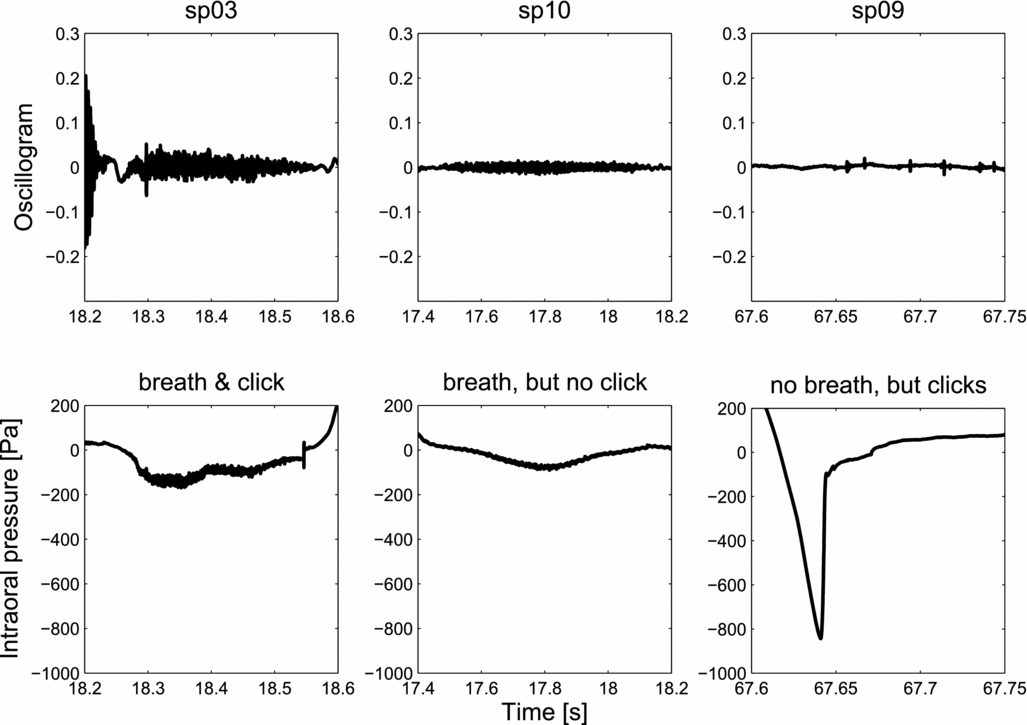
The most consistent finding in our dataset is the occurrence of negative intraoral pressure during inter-speech intervals (pauses) of all kinds (n = 259 for spontaneous speech and n = 129 for reading). In a further analysis, we classified the data in silent pauses, non-breathing pauses with weak clicks, non-breathing pauses with swallows, non-breathing pauses with swallows and weak clicks, breathing pauses with no clicks, and breathing pauses with clicks. Figure 4 provides some examples.
Examples for intraoral pressure rarefaction during inhalation in running speech. Upper tracks depict oscillograms and lower tracks display the respective intraoral pressure. First column corresponds to a breathing pause with a weak click in the beginning, second column to a breath pause with no click and third column to a pause without breathing noise, but some small clicks.
Weak clicks were defined as spikes in the acoustic signal which were larger in amplitude than the surrounding context. Breathing pauses were determined on the basis of breathing noise in the acoustic signal. Swallowing was defined on the basis of an auditory impression and additionally on the extreme negative pressure values (pressure data were clipped and were above ±2000 Pa, since the tongue touches the pressure sensor) over a longer time window. Our results provide evidence that nearly half of all pauses were breathing pauses with weak clicks (46%), followed by breathing pauses without clicks (32%), and pauses with no audible breath but a click (19%). All other cases were marginal (1–2%). In read speech the proportions look slightly different. Negative pressure occurs in only 40% of breathing pauses with clicks, in 54% of the breathing pauses without clicks, in 5% of the non-breathing pauses with a click and in 1% of the silent pauses.
A result which we did not expect, but which became evident during data analysis, was that the occurrence of the acoustic spikes in the inter-speech intervals was in most cases (55%) temporally aligned with the pressure minimum. In 25% of the cases, no alignment was found and in 20% of the cases, the pressure data are clipped, so that we cannot analyse alignment reliably. The most frequent pattern, however, is the one showing alignment between the location of the click and the pressure minimum. Such a pattern is not speaker-specific, but occurs in all subjects. Examples are shown in Figure 5.
Examples for negative intraoral pressure during inhalation in running speech. Upper tracks depict oscillograms with arrows marking the duration of the breathing noise and lower tracks display the respective intraoral pressure with vertical arrows showing the alignment of the pressure minimum with the click. The data from speaker 04 in column 3 is exceptional, since the click occurs late in the breathing noise.
3.2 Pressure rarefaction in consonant sequences
As has been reported previously (Marchal Reference Marchal1987, Silverman & Jun Reference Silverman and Jun1993, Ohala Reference Ohala1995, Fuchs et al. Reference Fuchs, Koenig and Winkler2007, Simpson Reference Simpson2007), negative pressure may occur in successive consonant sequences with two closures that overlap in time. In this section, we will describe occurrences of negative intraoral pressure with respect to front–back and back–front articulations and also discuss where clicks can be observed in the acoustic signal. In the spontaneous speech data we found negative pressure in eight cases with back–front place of articulation, 36 cases with front–back articulation, and three cases where the place of articulation of the two consonants was the same, but differed in nasality. In the reading passage we observed only six cases with negative pressure in front–back articulations, but 16 in back–front articulation. In the tongue twisters, we found 46 cases with negative pressure in front–back articulations (/t#k/) but the speech material was selected for that purpose. In the following paragraphs we explain the front–back and back–front articulations in more detail.
3.2.1 Front–back consonant sequences
The articulatory mechanism underlying front–back double occlusions is shown in Figure 6, taken from Fuchs et al. (Reference Fuchs, Koenig and Winkler2007). It shows tongue–palate contact patterns for a /t#k/ sequence. The temporal order of the two successive stop productions is: first, alveolar closure is made; second, velar closure is made in addition to the alveolar closure; third, alveolar closure is released while velar closure is still present; and finally, velar release is made. The alveolar release is thus non-pulmonic, since the air comes from the small air pocket between the two closures.
Evidence for double occlusion in electropalatographic data taken from Fuchs et al. (Reference Fuchs, Koenig and Winkler2007: 451), temporal changes in rows from top to bottom, black dots correspond to tongue palate contacts, y-axis: from posterior (0) to anterior (8). Arrow in the first row shows alveolar closure, in the second row alveolar and velar closure, in the third row alveolar release and velar closure, and in the fourth row velar release.
In the spontaneous speech dataset many instances of word-final nasal alveolar or bilabial stops were followed by a word-initial velar release. Such cases have also been described acoustically for German in Simpson (Reference Simpson2007). Figure 7 provides four examples from different speakers. These examples differ in the amount of negative pressure and whether a click was realized (only present in the last two columns, but not in the first two).
Examples for intraoral pressure rarefaction in nasal–velar consonant sequences in running speech (from left to right: /n#k/ as in [ɪnkalshɔʁst] in Karlshorst ‘in Karlshorst’, /m#k/ as in [nəmkla n] ne[m k]leinen Balkon ‘a small balcony’, /m#k/ as in [amkanaːl] am Kanal ‘at the canal’ and /n#g/ as in [gɛstɐngəmaхt] gester[n g]emacht ‘made yesterday’. Upper tracks depict oscillograms and lower tracks display the respective intraoral pressure (raw data with oscillations and superimposed filtered data without oscillations). The arrows at the pressure minimum point to the spike in the acoustic signal. Sp# in different columns is the speaker number.
Figure 8 presents examples of /t#k/ from the tongue twister task. It provides evidence that the /t/ release is very short (spike) and non-pulmonic in nature (see sp03). This acoustic release is reduced due to the velar closure. In sp11, the alveolar release is not present in the acoustics, but we assume that the articulatory gesture was realized, because intraoral pressure increased.
Examples for intraoral pressure rarefaction in /t#k/ sequences produced in the tongue twisters. Upper tracks depict oscillograms and lower tracks display the respective intraoral pressure (raw data with oscillations and superimposed filtered data without oscillations). The arrow at the pressure minimum points to the spike in the acoustic signal.
3.2.2 Back–front consonant sequences
In our corpus we found negative pressure in five sequences of /n#m/ in read speech and in one case in spontaneous speech (see Figure 9 for examples).
Examples for intraoral pressure rarefaction in nasal and nasalized sequences (first column [leːgŋ mʊstə] legen mußte ‘had to lay’, second till fifth column [jeːdnmɔɐgŋ] jeden Morgen ‘every morning’. Upper tracks depict oscillograms and lower tracks display the respective intraoral pressure (raw data with oscillations and superimposed filtered data without oscillations). Columns correspond to speakers and conditions.
This negative pressure is the result of an increase in the size of the oral cavity when the nasalized stop is released into the bilabial nasal stop. The negative pressure presumably results from an increase in the size of the oral cavity caused by tongue motion during the alveolar release. In the acoustic signal, no spikes were present, since the back closure is released while the front closure is present. These results confirm Ohala's suggestion (Ohala Reference Ohala1995) that back–front sequences may also show pressure rarefaction, but with no obvious audible consequences. Furthermore, it is interesting to note that although the nasal passage is always connected to the oral cavity and to atmospheric pressure, an increase in the size of the oral cavity still produces a negative pressure.
In the spontaneous speech data we found only 11 clicks out of 58 cases showing negative pressure, i.e. there were many more cases of negative pressure than clicks. In the reading and the tongue twister data, 28 clicks were realized out of 69 instances with negative pressure. Since we did not control the distance from the mouth to the microphone in this study, we cannot draw any conclusions, but we hypothesize that the occurrence and prominence of clicks in the acoustics is related to the amount of negative pressure in the oral cavity.
4 Discussion
4.1 Clicks in inter-speech intervals
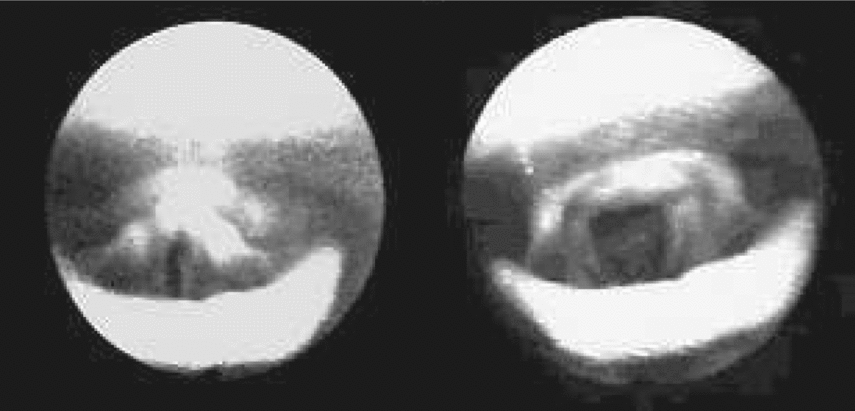
It was also found, in agreement with Wright (Reference Wright2007, Reference Wright2011) and Scobbie et al. (Reference Scobbie, Schaeffler and Mennen2011), that clicks occur frequently in connection with breath, and they appear at the beginning of the breathing noise in the acoustic signal. Wright (Reference Wright2011) points to the communicative function of such clicks, signalling a new sequence in the discourse. She also argues that these clicks are not a consequence of breathing since not all breaths include clicks, and not all clicks occur with inhalation. However, our own results and the work by Scobbie and colleagues also show clicks in inter-speech intervals in tasks others than discourse. Most of the clicks occurring in breathing noise in our study show an alignment with the negative pressure and occur at the pressure minimum. We interpret these findings as being due to the coordination between glottal opening and inhalation. For the short and deep inhalation phase before starting to speak, an open glottis is required and the glottis moves from a constricted position in speech to a wide open glottis in breathing (see Figure 10, data are taken from our own transillumination recordings, see Fuchs Reference Fuchs2005 for further details).
Glottal opening in a word initial voiceless aspirated /t/ (left) and during inhalation (right).
We suggest that the spike in the acoustic signals reflects the release of the glottal constriction at the end of speech and the beginning of inhalation. Moreover, breathing serves not only a biological function, but is fundamentally linked to speech production. For instance, inhalation depth has been shown to vary as a function of utterance length, with deeper inhalation before longer utterances (e.g. Whalen & Kinsella-Shaw Reference Whalen and Kinsella-Shaw1997, Fuchs et al. Reference Fuchs, Petrone, Krivokapić and Hoole2013) and also with respect to the degree of sentence embedding (with deeper inhalation for main clauses in comparison to embedded clauses, Rochet-Capellan & Fuchs Reference Rochet-Capellan and Fuchs2013). Therefore, it seems plausible to assume that the coordination between glottal opening and inhalation may vary slightly depending on the upcoming utterance length and the degree of sentence embedding and may have consequences for the prominence of clicks in the acoustics. It is also likely that there is no clear distinction between the epiphenomenal and the communicative function of clicks in these inter-speech intervals, similar to what Ohala (Reference Ohala1995) proposed for epenthetic stop insertions in /mn/. These insertions were originally based on coarticulatory processes and became linguistically relevant and led to sound change. However, further work is needed to test such a hypothesis.
4.2 Clicks in consonant sequences
Negative pressure occurred frequently in consonant sequences differing in place of articulation. This result holds true for front–back as well as back–front sequences. In front–back sequences, we interpret the negative pressure with respect to the double occlusion which is the consequence of a temporal overlap of the two closures (see also Chitoran et al. Reference Chitoran, Goldstein, Byrd, Gussenhoven and Warner2002). The closure of the back consonant can be anticipated during the production of the front stop. In the back–front sequences, such temporal overlap is less likely, since a front closure cannot be anticipated during the production of a back closure without disturbing it. However, when both stops are realized with different articulators, like with the lips and the tongue as it occurs in /n#m/ sequences, negative pressure can also be produced. It is probably the result of the tongue tip being released while the lips are closed for the bilabial stop. This increases the cavity downstream of the closure. Although negative pressure is realized, either clicks do not frequently occur or the small spikes may be hidden by vocal fold oscillations.
4.3 Limitations of this work
This is an exploratory study using pressure and acoustic data to shed light on the production of clicks in different speech tasks. On the basis of our results we assume that the prominence of the click in the acoustics, if it occurs, is correlated with negative pressure. However, since we did not control for the mouth-to-microphone distance, we cannot further test this assumption. Furthermore, we have investigated spontaneous speech in monologues and read speech, and the results provide evidence for relatively frequent occurrences of negative intraoral pressure in both. A statistical comparison of the two tasks is not reasonable, because different speech material was used. Future work should additionally study free conversation to investigate the communicative function of clicks and possibly differentiate them from epiphenomenal clicks that are realized in inter-speech intervals. Another interesting aspect may be to study individual differences in the frequency of click occurrences. We have not provided any details about speaker effect, since the occurrence of negative intraoral pressure depends on the location of the pressure sensor in the oral cavity. For instance, the cavity between two double occlusions is often very small and the exact placement of the sensor unpredictable. In some speakers we may have placed the sensor at the right location, while in other speakers, the sensor may have been placed slightly outside this cavity, and then no negative pressure would have been found. In this respect, it is unknown whether differences among speakers are due to methodological issues.
5 Conclusion
Negative pressure in the oral cavity is a feature of clicks. Given our data, however, we conclude that it is not an exclusive property of these sounds. Negative pressure can be present with no associated click in the acoustic signal. This may be somewhat surprising since speech production is mainly realized on egressive air flow. Our data provide evidence that negative pressure occurs relatively frequently in speech production, in particular in pauses (between speech intervals) and in consonant sequences. Negative pressure in pauses occurs frequently with clicks (but not exclusively) which are aligned with the pressure minimum. We conclude that these aligned clicks are epiphenomenal and reflect the interaction of the respiratory and the laryngeal systems. In consonant sequences, clicks may be present more often with front–back consonant order than the reverse, but in both cases negative pressure can be found.
Acknowledgements
This work was supported by a grant from the BMBF (01UG0711) and by a grant by the NSF award number 1052819. Additionally, we thank two anonymous reviewers for their comments, our subjects and Jörg Dreyer for technical support. This work is dedicated to Dieter Fuchs.
Appendix A. Speech material for the reading task
Der Tag war wundervoll. Lena begann ihn mit einem Lied auf den Lippen und nahm ein Bad. Jeden Morgen machte sie diesen Putz und der Duft nach Parfüm und dem neusten Taft breitete sich im Badezimmer aus. Danach frühstückte sie warme Brötchen und räumte den Tisch ab. Plötzlich klingelte ihr Telefon. Eine tiefe Bassstimme meldete sich und redete wirres Zeug durcheinander. Ein junger Bub wäre da. Er wolle Dart lernen und Lena solle ihre Sachen packen, mit dem Bus vorbeikommen und mitspielen. Lena denkt, der Mann am Telefon ist wahrscheinlich besoffen und legt den Hörer einfach auf. Sie genießt weiter ihren Tag und schaut aus dem Fenster. Auf dem Dach zwitschern die Vögel. Es klingt wie ein Tusch. Sie kündigen den beginnenden Frühling an. Tief einatmen und das Sonnenlicht einfangen. Das tut so gut.
[deː taːkvaːvʊndɐfɔlleːnabəgan Ɂiːnmɪt Ɂanəmliːt Ɂːa
 fdeːnlɪpən Ɂʊntnaːm Ɂanbaːtjeːdənmɔgənmaxtə ziː diːzənpʊ
 Ɂʊntdeːdʊftnaxpafyːm Ɂʊntdeːmnɔ
 stəntaftbʁatətə zɪç Ɂɪmbaːdəɪmɐ Ɂasdanaːxfʁyːʃtʏktə ziː vamə bʁøːtçən Ɂʊnt ʁɔmtə deːntɪʃ Ɂapplœlɪç klɪŋəltə Ɂiːtelɛfoːn Ɂanə tiːfə basʃtɪmə mɛldətə zɪç Ɂʊnt ʁeːdətə vɪʁəsɔkdʊçɁanandɐ Ɂanjʊŋɐ buːpvɛːʁə daː Ɂeːvɔlə daʁtlɛnən Ɂʊntleːnazɔlə Ɂiːʁə zaxənpakənmɪtdeːmbʊsfoːbakɔmən Ɂʊntmɪtʃpiːlənleːnadɛŋktdeːman Ɂamtelɛfoːn Ɂɪstvaːʃanlɪç bəzɔfən Ɂʊntleːktdeːnhøːʁɐ Ɂanfax Ɂːafziː gəniːstvatɐ Ɂiːʁəntaːk Ɂʊnt ʃat Ɂːasdeːmfɛnstɐ Ɂafdeːmdaxvɪ
 ɐndiː føːgəl Ɂɛsklɪŋtviː Ɂantʊʃ ziː kʏndɪgəndeːnbəgɪnəndənfʁyːlɪŋ Ɂantiːf Ɂanaːtmən Ɂʊntdaszɔnənlɪçt Ɂanfaŋəndastuːtzoː guːt]
‘The day was wonderful. Lena started it with a song on her lips and took a bath. She did the same thing every morning and the smell of perfume and the new hair spray filled the bathroom. Then she ate a breakfast of warm rolls and cleared the table. Suddenly her telephone rang. A deep bass voice came on the line and began talking confused nonsense. A young boy was there. He wanted to learn how to play darts, and Lena should pack her things, catch the bus and come to play. Lena thinks the man on the telephone is probably drunk, and hangs up on him. She continues to enjoy her day and looks out the window. Birds are singing on the roof. It sounds like a flourish. They are announcing the beginning of spring. Take a deep breath and catch the sun light. Life is good.’
Appendix B. Tongue twisters
Alveolar–velar combinations are marked in bold for visualization purposes. Bold marking did not appear on the text printed for the subjects.