Introduction
The development of resistance by parasites to the widely used benzimidazole group of anthelmintics has prompted investigations into alternative drug formulations, non-chemical control strategies and other means of increasing the activity of existing drugs. An understanding of the metabolism of parasites, mechanisms of action and pharmacokinetic behaviour of anthelmintics may expand the opportunities for improving chemotherapeutic efficacy of existing drugs. Manipulation of the pharmacokinetic behaviour of an anthelmintic to extend its systemic availability may increase its efficacy and, thereby, provide useful benefits at less cost than the development of new classes of chemotherapeutic agents (Hennessy et al., Reference Hennessy, Lacey, Prichard and Steel1985). An alternative, which is considered in the present paper, is the inhibition of benzimidazole metabolism.
Albendazole (ABZ; methyl [5-(propylthio)-1H-benzimidazol-2yl] carbamate), a member of the benzimidazole group of anthelmintics, is highly effective at different dose rates against all stages of gastrointestinal nematodes, including lungworms, and against cestodes and adult liver flukes in cattle, sheep and goats (Theodorides et al., Reference Theodorides, Gyurik, Kingsbury and Parish1976). Because of its aliphatic side-chain, ABZ is more quickly metabolized in the liver following absorption than are other sulphide benzimidazoles (Hennessy et al., Reference Hennessy, Steel, Lacey, Eagleson and Prichard1989), and its two metabolites, albendazole sulphoxide (ABZ-SO) and albendazole sulphone (ABZ-SO2) appear, and are eliminated, more quickly from the vascular compartment (Sanyal, Reference Sanyal1997, Reference Sanyal1998). Studies have demonstrated that a major mechanism of elimination of benzimidazoles involves hydroxylation and the subsequent sulphate conjugation with excretion of conjugates in bile (Hennessy et al., Reference Hennessy, Lacey, Prichard and Steel1985). As the sulphoxide metabolite is the anthelmintically active moiety, inhibition of sulphonation and hydroxylation can therefore increase the plasma concentration of, and prolong the parasite exposure to, the pharmacologically active moieties. The involvement of hepatic microsomal cytochrome P450 has been demonstrated in the sulphonation and hydroxylation of the sulphoxide metabolite (Murray et al., Reference Murray, Hudson and Yassa1992). In the present study we report the effect of piperonyl butoxide (PBT), an inhibitor of cytochrome P450 (Franklin, Reference Franklin1977), on the pharmacokinetic and anthelmintic efficacy of albendazole in goats.
Materials and methods
Experimental design
Goats maintained in the Goat Unit, College of Veterinary Science and Animal Husbandry, Anjora, Durg, were used for the study without disturbing normal husbandry practices. They were maintained exclusively on grazing during the day with the provision of night shelter. No supplementary concentrated food was made available to them. Thirty female goats aged 2–3 years and weighing 12.3–26.0 kg were selected, based on their subclinical nematode infection status as revealed by regular quantitative faecal examination, and they were divided randomly into three groups of ten animals each. Goats were parasitized naturally (mixed species of gastrointestinal nematodes, having at least 150 eggs per gram of faeces). It was verified that the selected animals had not been treated in the previous 8–12 weeks. The first group of goats was given an oral administration of ABZ (Albacril 2.5% w/v, Cattle Remedies India Ltd, Pune, Maharashtra, India) at 7.5 mg kg-1 body weight, and the second group both ABZ and PBT (Sigma–Aldrich GmbH, Munich, Germany), at 7.5 and 63.0 mg kg-1 body weight, respectively. Goats of the third group served as untreated controls.
Collection and analysis of blood samples
Whole blood was collected from treated goats, selected randomly, by jugular venipuncture in heparinized vials (Vacutainer, Becton Dickinson Inc., California, USA) at 0, 4, 8, 12, 18, 24, 30, 36, 48, 72 and 96 h post-dosing. Plasma was separated immediately and stored at − 4°C until its analysis by high performance liquid chromatography (HPLC). Faecal samples were collected individually, directly from the rectum, into collection containers from all animals before treatment and on day 10 post-treatment.
Pure external standards (ABZ-SO and ABZ-SO2) were supplied by Smith Kline Beecham India Ltd., Bangalore, India. A pure internal standard (ethyl oxfendazole; ETH-OFZ) was supplied by Dr D.R. Hennessy, CSIRO McMaster Laboratory, Sydney, Australia. Solid-phase extraction of plasma (Hennessy et al., Reference Hennessy, Lacey, Prichard and Steel1985) was done using a C18 Sep-pak cartridge (Waters Associates, Millford, Massachusetts, USA). Plasma (1 ml) was spiked with 0.5 μg of the internal standard ETH-OFZ and applied to a Sep-pak cartridge that had been preconditioned with 10 ml HPLC-grade methanol and 5 ml Sep-pak buffer. Following elution with 10 ml HPLC-grade water and 0.5 ml 40% methanol, metabolites were collected in 2.5 ml methanol and evaporated under nitrogen gas to approximately 300 μl before HPLC analysis.
The reverse-phase HPLC (Flexar; PerkinElmer, Singapore; consisting of a Flexar HPLC pump, UV-Vis detector set at 292 nm, Solvent Manager and a C18 column), was run in isocratic mode using 33% acetonitrile in 0.025 mol l− 1 sodium acetate as the mobile phase (Sanyal, Reference Sanyal1997), with a flow rate of 2 ml min− 1. Identification of metabolites in plasma was done by comparison with retention times of the reference standards. The absolute recovery rate was 97%, the precision of the extraction procedure and chromatography being evaluated by processing, as replicates on different days, pooled plasma aliquots containing known amounts of ABZ-SO and ABZ-SO2.
Stock solutions of ABZ-SO, ABZ-SO2 and ETH-OFZ were prepared in dimethyl sulphoxide (DMSO) at a concentration of 1000 μg ml− 1. Working solutions of 0.125, 0.25, 0.5 and 1.0 μg per 5 ml (external standard) were prepared in DMSO from stock solutions. Blank plasma (1 ml) spiked with the external standards at five different concentrations of 0, 0.125, 0.25, 0.5 and 1.0 μg ml− 1 and 0.5 μg of the internal standard ETH-OFZ was added to each vial. The spiked plasma was extracted by solid-phase extraction and dried down to 300 μl under nitrogen gas. Then 20 μl was injected into the column to enable calibration curves to be prepared for the two components. The concentrations of each component in plasma extracts were determined by comparing the detector response for each component with the corresponding peak in the standard mixture. Least squares regression analysis was used to determine the slope, intercept and correlation coefficient for each compound in the concentration range tested. The limit of detection was 0.02 μg ml− 1.
Data analysis
The maximum concentration (Cmax), time to Cmax (Tmax), area under the concentration–time curve (AUC), distribution half-life (t1/2α), elimination half-life (t1/2β), volume of distribution (VD) and other parameters for ABZ-SO and ABZ-SO2 were determined using the non-linear modelling program PHARMKIT, which fitted concentrations versus time profiles to a first-order input and output, two-compartment model (Sanyal, Reference Sanyal1994). The plasma levels of ABZ metabolites and kinetic data were subjected to analysis of variance using GraphPad Prism 4 software (Version 4.02, GraphPad Software Inc., 2004, New York, USA).
Faecal egg count reduction test and egg hatch assay
The faecal egg count reduction test (FECRT) was conducted according to the World Association for the Advancement of Veterinary Parasitology (WAAVP) guidelines for detection of anthelmintic resistance (Coles et al., Reference Coles, Bauer, Borgsteede, Geerts, Klei, Taylor and Waller1992, Reference Coles, Jackson, Pomroy, Prichard, von Samson-Himmelstjerna, Silvestre, Taylor and Vercruysse2006). Faecal egg counts (FEC) were performed by a modified McMaster method (detection limit 100) using a modified McMaster slide (Skerman & Hillard, Reference Skerman and Hillard1966). Data were analysed for faecal egg count reduction (%FECR) using the RESO calculator (Martin & Wursthorn, Reference Martin and Wursthorn1991). Resistance to anthelmintic was considered if: (1) the faecal egg count reduction (FECR) was < 95%; and (2) the lower 95% confidence limit was < 90%. If one of these two criteria was met, resistance was suspected. About 75–100 g of pooled faecal material from each group was coprocultured and infective larvae were identified (Skerman & Hillard, Reference Skerman and Hillard1966).
The in vitro egg hatch assay (EHA) was performed on five replicates of eggs separated from pooled faeces collected on day 0, using pure thiabendazole (TBZ; Sigma, St. Louis, Missouri, USA) in a twofold dilution series of 0.0625 and 1.0 μg TBZ ml− 1 (Coles et al., Reference Coles, Bauer, Borgsteede, Geerts, Klei, Taylor and Waller1992, Reference Coles, Jackson, Pomroy, Prichard, von Samson-Himmelstjerna, Silvestre, Taylor and Vercruysse2006). Eggs (n= 100) per well, along with varying concentrations of TBZ, were incubated in 24-multiwell plates for 24 h at 28°C in a BOD incubator, followed by addition of a drop of Lugol's iodine to each well. The numbers of unhatched eggs and larvae (L1) were counted to determine the proportion of eggs hatched. Data were analysed by Probit Analysis to obtain ED50 values for egg hatch. An ED50 value in excess of 0.1 μg TBZ ml− 1 was considered to indicate the emergence of benzimidazole resistance.
Results
Using the described chromatographic conditions, ABZ-SO, ABZ-SO2 and ETH-OFZ were well resolved without interference from indigenous compounds and with retention times of 1.84 ± 0.09, 2.86 ± 0.08 and 3.98 ± 0.05 min, respectively.
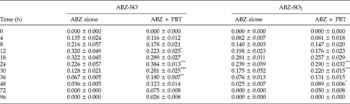
Plasma ABZ-SO metabolite, the anthelmintically active moiety, reached its maximum concentrations of 0.322 μg ml− 1 and 0.384 μg ml− 1 at 18 h and 24 h after administration ABZ alone and co-administration of ABZ and PBT, respectively (table 1). The anthelmintically inactive moiety ABZ-SO2 reached its maximum concentrations of 0.281 μg ml− 1 and 0.290 μg ml− 1 at 18 h and 24 h post-administration of ABZ alone and ABZ and PBT co-administration, respectively. Statistically increased ABZ-SO levels at 24, 30 (P < 0.001) and 36 h (P < 0.01), and at 24, 30 and 48 h (P < 0.05) for ABZ-SO2, were observed following administration of ABZ and PBT (table 1).
Comparative plasma levels (mean ± SEM) of albendazole sulphoxide (ABZ-SO) and albendazole sulphone (ABZ-SO2) in goats following a single oral administration of albendazole (ABZ) alone or co-administration of ABZ and piperonyl butoxide (PBT).

Levels of significance: *P < 0.05; **P < 0.01; ***P < 0.001.
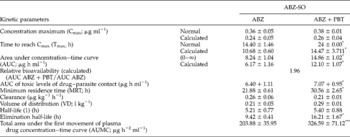
No significance difference (P > 0.05) in values of Cmax (normal and calculated) for ABZ-SO could be observed between groups of goats. However, values of Tmax (normal), Tmax (calculated), AUC (0-∞), AUC (calculated), minimum residence time (MRT), elimination half-life (t1/2β) and total area under the first movement of plasma drug concentration–time curve (AUMC) of ABZ-SO were significantly higher (P < 0.05) in goats following the single oral co-administration of ABZ and PBT (table 2).
Comparative pharmacokinetic values (mean ± SEM) of albendazole sulphoxide (ABZ-SO) in goats following a single oral administration of albendazole alone or co-administration of albendazole (ABZ) and piperonyl butoxide (PBT).

Levels of significance: *P < 0.05; ***P < 0.001.
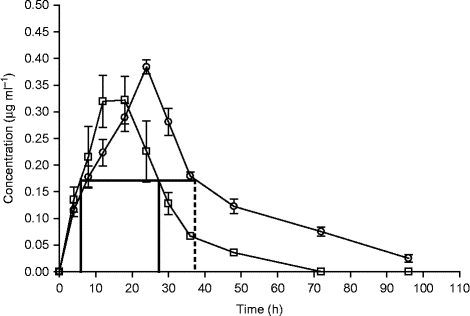
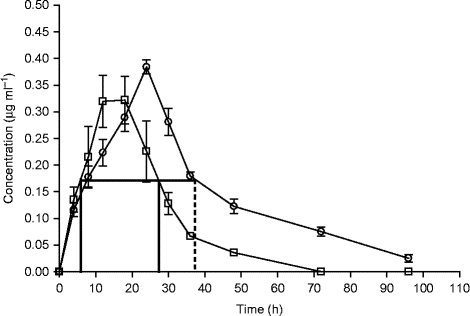
The midpoint for the pharmacologically active metabolite ABZ-SO in the circulatory compartment was about 0.17 μg ml− 1 and the period of exposure to this concentration was about 22 (6 h to 28 h) and 42 h (6 h to 38 h) in goats receiving ABZ alone and a combination of ABZ and PBT, respectively (fig. 1). The time of exposure of parasites to the toxic concentration of the anthelmintic metabolite was significantly prolonged in goats receiving the combination of ABZ and PBT.
Estimated drug–parasite contact of albendazole sulphoxide (ABZ-SO) in goats, following a single oral administration of albendazole alone (open squares) at 7.5 mg kg− 1 body weight or albendazole and piperonyl butoxide (open circles) at 7.5 and 63.0 mg kg− 1 body weight.
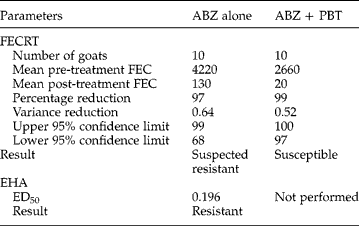
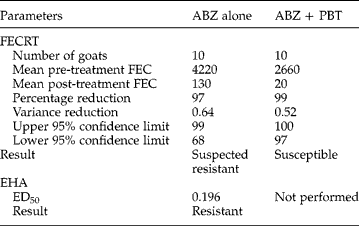
The FECR and lower 95% confidence limit for the group treated with ABZ alone were 97% and 68%, while for co-administration of ABZ and PBT the values were 99% and 97%, respectively (table 3). Mean anthelmintic pre-treatment and post-treatment faecal egg counts were 2210 and 3120, respectively in the control group of ten goats. The nematodes exhibiting resistance were Haemonchus spp. (95%) and Oesophagostomum spp. (5%). The ED50 for egg hatch was 0.196 (table 3), indicating resistance to benzimidazole.
In vivo faecal egg count reduction test (FECRT) and egg hatch assay (EHA) to monitor the status of anthelmintic resistance in gastrointestinal nematodes in five groups of goats receiving treatment with albendazole (ABZ) alone and co-administration of ABZ and piperonyl butoxide (PBT) compared to untreated controls.
Discussion
The absence of albendazole in jugular plasma indicated that the drug was removed beyond detectable limit from the portal blood by the liver. Albendazole was metabolized to the sulphoxide and sulphone metabolites by liver microsomal oxidation (Lanusse et al., Reference Lanusse, Nare and Prichard1993; Sanyal, Reference Sanyal1997) in a similar manner to other sulphide benzimidazoles (Sanyal, Reference Sanyal1994, Reference Sanyal1995). The process of sulphoxidation of ABZ appeared to be rapid, as evidenced by the rapid appearance of the sulphoxide metabolite in the peripheral circulation of goats, compared to that of sulphide benzimidazoles (Sanyal, Reference Sanyal1994, Reference Sanyal1995). Hennessy et al. (Reference Hennessy, Steel, Lacey, Eagleson and Prichard1989) attributed this to the presence of an aliphatic side-chain in albendazole compared to an aromatic side-chain in fenbendazole. Like other sulphide benzimidazoles, the sulphoxide metabolite is the component with potent nematocidal activity (Hennessy et al., Reference Hennessy, Steel, Lacey, Eagleson and Prichard1989). ABZ metabolites could be completely extracted from plasma without pre-treatment with organic solvent, which suggests that they bind less avidly with plasma proteins. The rapid metabolism and excretion of aliphatic-substituted benzimidazoles such as ABZ (Gyurik et al., Reference Gyurik, Chow, Zaber, Brunner, Miller, Villani, Petka and Parish1981) could possibly be explained by the appearance of substantially higher plasma concentrations of two metabolites of ABZ with less protracted concentration–time curves compared to aromatic-substituted benzimidazoles such as fenbendazole, when similar administration routes were employed (Sanyal, Reference Sanyal1993, Reference Sanyal1994). Comparatively higher plasma concentrations of ABZ-SO2 in goats compared to sheep might be due to less extensive urinary excretion of ABZ-SO prior to further oxidation in goats, while in sheep ABZ-SO constitutes the major urinary metabolite, due to its rapid and extensive urinary excretion before further oxidation to the sulphone metabolite (Gyurik et al., Reference Gyurik, Chow, Zaber, Brunner, Miller, Villani, Petka and Parish1981). The efficacy and spectrum of activity of benzimidazole compounds are mainly determined by the time for which parasites are exposed to a toxic concentration (Prichard et al., Reference Prichard, Hennessy and Steel1978). Hennessy (Reference Hennessy1994) proposed that the concentration of a metabolite of a benzimidazole compound, in the appropriate compartment, that is midway between zero and the maximum concentration achieved after administering a therapeutic dose may be regarded as the minimum toxic level for the parasite, and that, for optimum results, this concentration should be maintained for as long as possible.
Hepatic microsomal cytochrome P450 and flavin monoxygenase enzyme systems are reportedly involved in sulphoxidation, sulphonation and hydroxylation of benzimidazole anthelmintics (Murray et al., Reference Murray, Hudson and Yassa1992). There is evidence from in vitro inhibition studies that the sulphoxidation of benzimidazoles involves both the flavin monoxygenase and cytochrome P450 enzyme systems, whereas only cytochrome P450 is implicated in the sulphonation and hydroxylation reactions (Benchaoui & McKeller, Reference Benchaoui and McKellar1996). The latter authors also studied the interaction between fenbendazole and PBT to determine its pharmacokinetic and pharmacodynamic implications in sheep and goats, at PBT dose rates of 0, 15, 31, 63, 125 and 250 mg kg− 1 body weight. They observed significantly increased Cmax, AUC and MRT of fenbendazole and fenbendazole sulphoxide when fenbendazole was co-administered with PBT at a dose rate equal to or higher than 31 mg kg− 1 body weight, with a highly significant reduction of worm egg output in sheep infected with benzimidazole-resistant Teladorsagia circumcincta and Haemonchus contortus. Hence, PBT was used at a dose rate of 63 mg kg− 1 body weight in the present study. While studying plasma achiral and chiral pharmacokinetic behaviour of intravenous oxfendazole (OFZ) co-administered with PBT in sheep, Sánchez et al. (Reference Sánchez, Small, Jones and McKellar2002) observed that PBT co-administration was associated with an inhibition of OFZ biotransformation, as evidenced by the significantly higher plasma concentrations of OFZ and fenbendazole, and this could have important implications in terms of anti-parasite therapy against benzimidazole-resistant parasite strains. While evaluating the effects of PBT, a metabolic inhibitor, on the plasma availability and enantiomeric behaviour of OFZ given orally to horses, and to compare the clinical efficacy of OFZ given either alone or co-administered with PBT in naturally parasitized horses, Bruni et al. (Reference Bruni, Fuse, Moreno, Saumell, Álvarez, Fiel, McKellar and Lanusse2005) observed that the use of PBT as a metabolic inhibitor may be useful to enhance OFZ activity against mature and migrating larvae of different parasite species in horses.
The present study revealed significantly higher AUC (which reflects the amount of drug available for absorption), Tmax and t1/2β of ABZ-SO, and Cmax and AUC of ABZ-SO2, suggesting a higher anthelmintic uptake, in goats dosed with combination of ABZ and PBT, which was adequately translated into increased drug–parasite contact. In conclusion, the co-administration of PBT with ABZ significantly affects the pharmacokinetic disposition of ABZ, which would possibly result in potentiation of anthelmintic activity. However, the cost of the drug combination and host toxicity could be limiting factors for exploitation in veterinary practice despite the widespread problem of benzimidazole resistance in small ruminants.
Acknowledgements
The Dean, College of Veterinary Science and Animal Husbandry, Anjora, Durg is thankfully acknowledged for the facilities provided.
Conflict of interest
None.
Ethical standards
The experimentation on goats was approved by the Institutional Ethics Committee, College of Veterinary Science and Animal Husbandry, Chhattisgarh Kamdhenu Vishwavidyalaya, Anjora, Durg, India.