


Introduction
It has been argued that in advanced socially democratic nations young adulthood represents a transitional developmental stage involving an extended period of personal exploration (Grant & Potenza, Reference Grant and Potenza2010). Similarly, Arnett (Reference Arnett2000) posits that in advanced capitalist societies this developmental period represents a new stage of human development that he refers to as ‘emerging adulthood’, which typically takes place between the ages of 18–29 years. Emerging adulthood is characterized by a growing capacity for interpersonal intimacy, autonomy, and the emergence of a coherent personal identity and sense of self. Increased mental health difficulties often mark this stage of emergent adulthood, as young adults face the challenges involved in negotiating key developmental tasks. Prevalence rates of anxiety and depression have been shown to rise rapidly during this developmental period (e.g. Grant & Potenza, Reference Grant and Potenza2010). The on-going development of effective therapies is needed to address the mental health issues of this unique population.
The number of young adults attending higher educational institutes (HEIs) in the UK has steadily risen over the past 10–15 years, as have concerns about the mental health and well-being of students in higher education (e.g. AUCC, 1999; Royal College of Psychiatrists, 2003). Approximately one in four young adults will have experienced a clinically significant depressive episode by the age of 24 years (Zarate, Reference Zarate, Grant and Potenza2010). Further, Perlick and colleagues (Reference Perlick, Hofstein, Michael, Grant and Potenza2010) contend that the rate of serious mental health problems is highest among young adults aged 18–25 years. Early onset depression in late adolescence or young adulthood is associated with more severe, persistent and recurrent forms of disability often leading to lifelong, role impairments in social, interpersonal, occupational and educational spheres (Zarate, Reference Zarate, Grant and Potenza2010). For many young adults in the UK, higher education presents several significant stressors such as the emotional demands associated with the transition and relocation from home to university, financial pressures, continuous assessment and examinations, a highly competitive job market.
In the UK, university counselling services typically function as the primary-care mental health service for most students seeking psychological help (Royal College of Psychiatrists, 2003). Yet, the evidence base for the effectiveness of counselling is somewhat mixed (NICE, 2010). Arguably, the provision of a range of therapies within HEIs would be useful in referring students to the most suitable forms of therapy to address complex student mental health issues. Randomized clinical trials and meta-analyses have consistently demonstrated that cognitive behaviour therapy (CBT) is an effective, evidence-based intervention for the treatment of common mental health problems such as anxiety and depression (Williams & Garland, Reference Williams and Garland2002). CBT may have particular clinical benefit for students in HEIs who suffer anxiety and depression, yet this assumption awaits investigation.
CBT is underpinned by a number of core theoretical, philosophical and clinical assumptions concerning the task, procedure and process of therapy (Blackburn & Twaddle, Reference Blackburn and Twaddle1996). In brief these include (i) the centrality of cognitive formulation, (ii) an emphasis on the phenomenological experiences of the patient, (iii) guided discovery underpinning the therapeutic conversation between patient and therapist, (iv) collaboration, structure, focus and an emphasis upon homework, (v) work which is time limited and problem orientated, (vi) active patient involvement essential to therapeutic success and, (vii) a commitment on the patient's part to undertake key tasks such as behavioural work is emphasized. NICE recommend that CBT is a clinically effective and cost-effective intervention for patients who present with common mental health problems such as anxiety and depression (NICE, 2004a , b , 2010). Yet, CBT has rarely been offered as a therapeutic treatment in HEIs in the UK.
Our primary aim, therefore, was to investigate whether a brief course of CBT is effective in reducing young adult patients’ depressive and anxious symptomatology. McGinn & Sanderson (Reference McGinn and Sanderson2001) argue that the focus of CBT on key tasks, as well as procedural and process-related material, facilitates opportunities for clinicians to work briefly. In sum, CBT emphasizes focused assessment, collaboration, transparency, measurable and achievable goals, structured sessions, regular reviews and draws upon empirically supported interventions (McGinn & Sanderson, Reference McGinn and Sanderson2001).
Historically, there has been an absence of CBT offered to student populations in HEIs in the UK. Here, we predicted that all young adult patients at a HEI, NHS Student Health Centre (SHC) would report a reduction in anxious and depressive symptoms over the course of brief CBT.
Method
Participants and setting
The sample comprised patients referred for CBT at a NHS SHC at a UK university in England. Referrals to the SHC were received from three sources: (a) general practitioner (GP) referrals from the medical practice attached to the university, (b) university counselling service, and (c) university mental health advisory service and student support services. Each referral to the SHC (current students registered at the university) was initially assessed by a senior clinical psychologist to establish the patient's primary presenting problem and diagnosis based on DSM-IV criteria (APA, 1994), major risk issues and focus of work. Exclusion criteria included: (i) no longer registered at the university as a student, (ii) currently engaged in therapy with another clinician from another service, (iii) diagnosed with a personality disorder, (iv) deemed more appropriate to refer to another NHS service (e.g. secondary-care Community Mental Health Team) or other type of therapy. Forty-eight participants presenting with depression and/or anxiety as their primary interfering problem as assessed by a clinical psychologist participated in the study. Participants also met the criteria for short-term CBT based on established indicators, such as ability to access automatic thoughts, ability to form a collaborative, therapeutic relationship, and the ability to take personal responsibility for change (Segal et al. Reference Segal, Swallow, Bizzini and Rouget1996).
Forty-eight participants who met the relevant criteria, met with one of three trainee clinical psychologists on adult mental health placements (final year of training) at the SHC or a senior clinical psychologist with advanced training in CBT (BABCP accredited; MSc in Advanced Cognitive Therapy Studies, Oxford Cognitive Therapy Centre, University of Oxford). Prior to the CBT sessions, an initial formulation was undertaken to identify the nature, duration and severity of the referred patients’ problem(s) and key predisposing, precipitating, perpetuating and protective factors (Blackburn & Twaddle, Reference Blackburn and Twaddle1996), as well as identifying initial therapy goals.
Measures
Global Anxiety Disorder-7 Scale (GAD-7; Spitzer et al. Reference Spitzer, Kroenke, Williams and Lowe2006). The GAD-7 is a widely used and well validated measure used in clinical practice to assess self-reported generalized anxiety. Seven items are rated from 0 to 3 in graded symptom severity. A threshold score of 8 is considered the optimum sensitivity and specificity cut-off for the detection of anxiety disorders (Kroenke et al. Reference Kroenke, Spitzer, Williams, Monahan and Lowe2007).
Patient Health Questionnaire-9 (PHQ-9; Kroenke et al. Reference Kroenke, Spitzer and Williams2001). The PHQ-9 is a well validated and widely used measure in clinical practice to assess self-reported depression. Nine items are rated from 0 to 3 in graded symptom severity. A score of 10 is the threshold for identifying cases that meet clinical severity criteria (Richards & Suckling, Reference Richards and Suckling2008).
Procedure
Three trainee clinical psychologists on adult mental health placement at the SHC each met with 6–7 patients for weekly CBT. The trainees had received some training in CBT on their doctoral training programme in clinical psychology prior to their specialist placement. In addition, the trainee clinical psychologists received weekly individual supervision on placement from the senior clinical psychologist at the SHC. Supervision focused on therapy task, procedure and process of the therapeutic work. Trainees also video-recorded weekly sessions and utilized the Cognitive Therapy Scale – Revised (CTS-R; Blackburn et al. Reference Blackburn, James, Milne, Baker, Standart, Garland and Reichelt2001) with one of the patients they were seeing. Patient consent was given. In addition, trainees were observed by their clinical supervisor undertaking designated assessments and trainees also observed their supervisor undertaking assessments. In order to enhance and augment the learning cycle and experience while on placement, trainees had the opportunity to sit in on on-going therapy sessions (with patient consent) with their supervisor.
In order that (i) trainee learning was maximized, (ii) the requirements of clinical psychology doctoral training were met, and (iii) the quality of the psychology service offered at the SHC was not affected, patients were allocated to clinicians based on a range of criteria. For example, a key aim in allocating patients to trainees was to ensure that trainees were provided with a sufficient number of appropriately complex cases with which to work. The allocation sought to ensure that trainees were able to work in their respective zone of proximal development in order that their core skills, competencies and knowledge could be further developed and best enhanced (Vygotsky, Reference Vygotsky1978).
Patients met weekly with a trainee clinical psychologist or senior clinician for CBT sessions. Over the course of therapy, patients completed the GAD-7 and PHQ-9 at the beginning of each weekly session. This prospective audit study was conducted in accordance with BPS ethical guidelines and had approval from the NHS, SHC service at the university. All data were anonymous and confidential.
Results
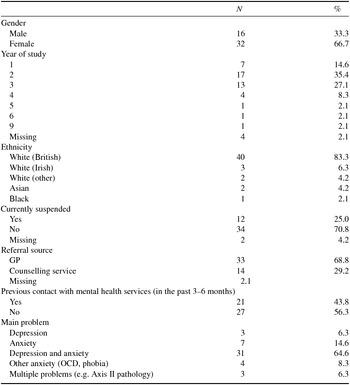
On average, patients attended approximately eight sessions of CBT (range 2–16). The number of sessions attended did not differ between trainees (mean = 8.6) and the clinical psychologist (mean = 8.0, t 46 = 0.65, p = 0.52). The mean age of the sample was 24.52 years (s.d. = 6.90). The majority of patients were women, had been referred by their GP, and just over half reported no recent contact with mental health services (see Table 1). One-quarter of patients had suspended their studies. Patients’ primary problem was determined by clinical judgement, following the initial screening assessment. Most patients were defined as presenting with a primary problem of mixed anxiety and depression.
Student patient demographics

Depression symptoms
Multi-level modelling (MLM) analyses were conducted in MLwiN version 2.10 (http://www.bristol.ac.uk/cmm/software/mlwin/). Predictors of interest were tested for significance using Δχ2 to compare nested models, as this method tends to have greater statistical power than the Wald test (Hox, Reference Hox2002). Parameters were estimated using full iterative generalized least squares (IGLS) estimation. Restricted iterative generalized least squares (RIGLS) estimation was used in cases where only the random component was compared between models (Hox, Reference Hox2002). In total, there were 363 observations available for analysis. Examination of residuals suggested the assumptions of normality and linearity were met.
The overall mean score for depression was 11.09. The variance partition coefficient (VPC; or intra-class correlation) was 0.48, indicating that 48% of the total variance in depression scores was attributable to differences between patients. Therefore, multi-level analysis with random intercepts was indicated. Session was specified as the level 1 variable, and patient as the level 2 (grouping) variable.
The baseline (covariates only) model included a random intercept, and controlled for various factors likely to affect psychological well-being but not of primary focus to the present study. Type of diagnosis was controlled for by the inclusion of five dummy-coded variables. In addition to this, gender, whether the patient was currently suspended from class, and whether they had previously presented for treatment in the past 3 months were included as covariates. The baseline model was as follows:
PHQ ij = β0j + β1 Depression diagnosis j + β2 Anxiety diagnosis j + β3 Mixed Anxiety-Depression diagnosis j + β4 Anxiety (other) diagnosis j + β5 Multiple Problems/Personality diagnosis j + β6 Sought Treatment in Past 3 Months j + β7 Currently Suspended j + β8 Gender j + β9 Total Length of Treatment j + eij ,
 \begin{equation*}
{\rm \beta }_{{\rm 0}j} \;= \;\beta _{\rm 0} \;+ \;u_{{\rm 0}j} .
\end{equation*}
Adding the time/session number variable significantly improved model fit, indicating that depression scores significantly decreased over the course of treatment [coefficient (s.e.) = −0.771 (0.07), Δχ2(1) = 101.00, p < 0.001]. To control for the possible effects of therapist training, therapist qualification and time×qualification terms were added to the model as additional controls. Therapist qualification did not improve prediction of average depression scores, [coefficient = −0.11 (1.73), Δχ2(1) = 0.02, p = 0.89]. However, there was a significant time × therapist interaction [coefficient = −0.40 (0.15), Δχ2(1) = 7.37, p = 0.007]. While the clinical psychologist's patients tended to present with non-significantly higher depression scores (mean = 15.46, s.d. = 5.32), relative to trainee clinical psychologists’ patients (mean = 14.50, s.d. = 6.67, t 46 = 0.55, p = 0.59), they showed significantly steeper improvement over the course of therapy. Even after controlling for these effects, there was still a significant decrease in depression over the course of treatment [coefficient = −0.63 (0.09), Δχ2(1) = 48.99, p < 0.001].
Anxiety symptoms
The overall mean score for anxiety was 9.25. The VPC was 0.47, indicating that 47% of the total variance was attributable to differences between patients. Therefore, multi-level analysis with random intercepts was indicated. Session was specified as the level 1 variable, and patient as the level 2 (grouping) variable. The baseline model included a random intercept and included the same predictors as the depression model.
Adding the time/session number variable significantly improved model fit, indicating that patient anxiety significantly decreased over the course of treatment [coefficient = −0.70 (0.06), Δχ2(1) = 110.03, p < 0.001]. Adding therapist qualification did not improve the fit of the model [coefficient = 2.22 (1.56), Δχ2(1) = 2.36, p = 0.13]. Again, this effect was qualified by a significant time×therapist interaction [coefficient = −0.51 (0.13), Δχ2(1) = 16.19, p < 0.001]. This revealed that, as with depression, while the clinical psychologist's patients tended to present with non-significantly higher anxiety (mean = 14.29, s.d. = 4.69), relative to trainee clinical psychologists’ patients (mean = 11.83, s.d. = 5.93, t 46 = 1.58, p = 0.12), they showed significantly steeper improvement over the course of therapy. Even after controlling for these effects, there was still a significant decrease in anxiety over the course of treatment [coefficient = −0.52 (0.07), Δχ2(1) = 47.31, p < 0.001].
Discussion
The present study evaluated the effectiveness of CBT in treating anxiety and depression in a university student population. Results support the effectiveness of CBT when delivered in a higher education setting.
Student patients receiving CBT reported significant reductions in anxiety and depression over the course of treatment. These results are consistent with the findings of large-scale RCTs and the status of CBT as an empirically supported treatment (Williams & Garland, Reference Williams and Garland2002). The present study found significant reductions in self-reported anxiety and depression over the course of treatment even after controlling for the type of primary problem, overall length of treatment, gender, and whether assistance for mental health problems had recently been sought. These findings add to the evidence for CBT by suggesting it may be an effective treatment in ‘real-world’ higher education settings.
The effectiveness of CBT remained even after controlling for differences in therapist qualifications. Student patients receiving CBT from a clinical psychologist with advanced training in CBT showed faster improvement than those receiving treatment from supervised doctoral clinical psychology trainees on specialist placement. They showed almost twice the rate of improvement over time compared to those seen by trainees. This was despite there being no difference in the overall number of sessions attended by those seeing the expert clinical psychologist compared to the trainee clinical psychologist. Controlling for differences in therapist qualifications reduced the effect size of CBT somewhat, but it still remained highly significant.
The present study benefited from several strengths: (1) the use of MLM to analyse session-by-session change while controlling for biases that may result from between-patient differences at baseline and differences in the length of treatment offered; (2) the exclusive use of an empirically supported treatment for anxiety and depression as implemented in a ‘real-world’ setting. However, there were some methodological limitations which deserve comment. For the aforementioned reasons, it was not appropriate to randomly assign patients to psychologists of different qualifications in the context of the present study. There was only one clinical psychologist employed at the SHC, therefore, causal effects of clinical psychology training on treatment outcomes cannot be drawn from this pilot study, and should be interpreted with caution. Last, it was not feasible to account for variance attributable to inter-therapist differences in CBT administration. The low number of trainees involved in the study would have raised concerns about anonymity and comparisons of trainee ‘performance’, adversely impacting the learning environment.
In summary, this study investigated the effectiveness of ‘real-world’ CBT for anxiety and depression in a higher education setting in the UK. Results support the effectiveness of CBT for treating mild/moderate symptoms in university students. Consistent with recommended practice, there was also some support for the triaging of student patients presenting with more severe symptoms to supervising psychologists with advanced training in CBT in order to facilitate a speedy treatment response.
Summary of main points
-
• Brief courses in CBT are effective in treating anxiety and depression in student patients.
-
• The effectiveness and efficacy of CBT was maintained even after controlling for differences in psychologists’ clinical qualifications and experience.
-
• Patients who present with more severe symptoms may benefit from triaging to a psychologist experienced in the use of CBT.
Acknowledgements
M.J.G. is supported by a National Health and Medical Research Council of Australia Early Career Fellowship (APP1036365).
Declaration of Interest
None.
-
(1) University counselling clinics typically function as primary-care mental health services for students, yet CBT is not commonly offered and its effectiveness in this context has not been established.
-
(2) CBT delivered by trainee or fully qualified psychologists significantly reduces anxiety and depressive symptoms in a ‘real-world’ university clinic setting.
-
(3) Further research is required to determine if student patients with more severe presentations achieve faster symptom reduction with a fully qualified psychologist compared to a trainee.



Comments
No Comments have been published for this article.