

I. Introduction
Classification matters in winemaking. As an experiential good, a wine's classification is of heightened importance. “Great wines don't come from just anywhere,” notes The Wine Bible author Karen MacNeil (Reference MacNeil2001, 7). In wine classification, producers and consumers value a wine's terroir—a rather ambiguous concept related to the geographic location of a wine's grapes. Even without a commonly accepted definition, extensive literature discusses terroir and its effect on the quality and price of wines and vineyards (e.g., Ashenfelter and Storchmann, Reference Ashenfelter and Storchmann2010; Cross, Plantinga, and Stavins, Reference Cross, Plantinga and Stavins2011; Gergaud and Ginsburgh, Reference Gergaud and Ginsburgh2010). It is well established that terroir can have a demonstrable effect on a wine's worth, but there is no consensus on whether terroir matters as a fundamental reality or solely economically due to the perceived reputation of a particular area. Nevertheless, the prices at which winemakers can sell their wines vary depending on the wines’ geographic origins (Gokcekus and Finnegan, Reference Gokcekus and Finnegan2013; Landon and Smith, Reference Landon and Smith1997; Lecocq and Visser, Reference Lecocq and Visser2006).”
The French Champagne Appellation d'Origine Contrôlée (AOC) is an excellent example of regional reputation capitalization. For winemakers within the Champagne AOC, grapes are worth more than a million euros per hectare; grapes outside Champagne's boundaries bring a mere €5,000 per hectare (BBC News, 2008). Understandably, vineyards clamber to gain entry into the prestigious Champagne AOC. While winemakers in France struggle to become a part of established AOCs, U.S. winemakers in Oregon are pursuing the development of new, distinct American Viticultural Areas (AVAs) within those already established and recognized.Footnote 1
In this study, we argue that the establishment of sub-AVAs in the Willamette Valley was part of a dynamic process, an act of reclassification by “better” wineries to distinguish themselves from “lesser” wineries and ultimately collect higher regional reputation premiums. À la Douglas (Reference Douglas1986, 108), the people make new kinds of institutions, the new institutions make new labels, and the new labels make new kinds of people. Accordingly, we put forward the following hypothesis: Establishing sub-AVAs was economically beneficial for the wineries included in these new classifications. By differentiating themselves, well-established wineries with good reputations among wine critics and consumers were able to collect higher regional reputation premiums.
II. Motivation for Reclassification: Model, Data, and Analyses
According to Zeruvabel (Reference Zeruvabel1996, 421), we experience the world we live in as “discrete chunks.” Zeruvabel describes lumping as “the mental process of grouping ‘similar’ things in distinct clusters” and splitting as “separating ‘different’ clusters from one another,” and he argues that these diametrically opposite cognitive acts complement each other. Using cognitive processes, we categorize things around us—which is the main act of classification. Classification is particularly important in the wine industry, as consumers use reputation, which is often regionally based, as a proxy for quality, which can only be determined upon consumption (Bicknell and MacDonald, Reference Bicknell and MacDonald2012). Although the research of Johnson and Bruwer (Reference Johnson and Bruwer2007) suggests that the creation of sub-AVAs is diluting the brand power of wine regions, we hypothesize that the creation of sub-AVAs by wineries with already established reputations allows those wineries to separate from others that may be coasting on the reputations of the better wineries. Zhao (Reference Zhao2005, 187) argues that classifications “often result in differentiations in social standing among actors (or objects),” a motivation that we believe incited the development of sub-AVAs in Willamette. Thus, we expect our analysis to demonstrate i) that regional reputation premiums have increased with the creation of sub-AVAs and ii) that the price-quality ratio gap between sub-AVAs and the rest of Willamette has widened.
A. Data
Our initial dataset was drawn from Wine Spectator’s list of all Oregon wines rated from 1984, the year the Willamette Valley AVA was established, through 2008 and had 4,317 unique wine entries. For each wine, we recorded Wine Spectator’s list price. We made several deletions to this dataset: i) Wines were removed if their wineries were not physically situated in Oregon; ii) because we were only concerned with wineries within the Willamette Valley AVA or one of its sub-AVAs, we deleted wines produced by Oregon wineries from other AVAs; iii) we also excluded wineries that bottled from several AVAs, because these wineries lacked obvious affiliation with any particular AVAs; iv) we removed all wines by wineries that were no longer operational; v) for each winery, we collected information about two measures of size: acreage and cases produced per year; and vi) because most of the wines rated by Wine Spectator are pinot noirs, and because Willamette is known as a pinot noir region, we conducted our analyses on 2,211 pinot noirs.
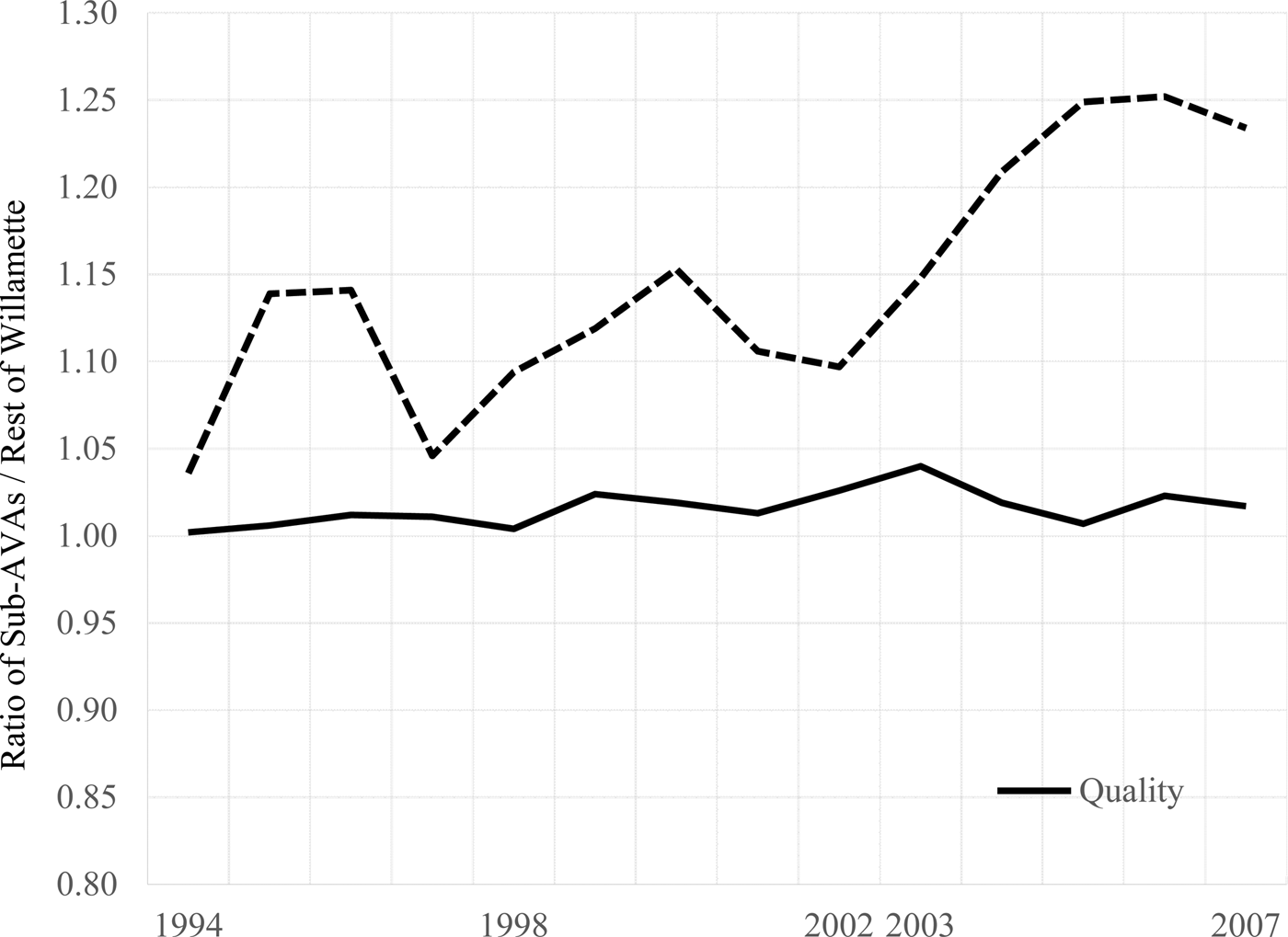
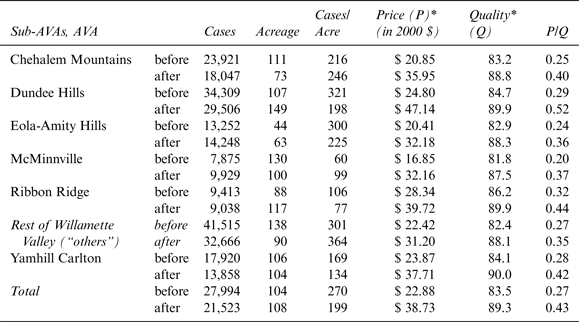
As Table 1 indicates, prior to reclassification, for those Willamette Valley AVA wineries that were not included in any of the new sub-AVAs, designated here as “others,” the average price was $22.42; the quality was 82.4 points; and the price-quality ratio was 0.27. Three of the now sub-AVA regions—Chehalem Mountains, Eola-Amity Hills, and McMinnville—had lower price-quality ratios than the rest of Willamette (0.25, 0.24, and 0.20, respectively). Ribbon Ridge had the highest price-quality ratio, at 0.32. The price-quality ratio range was relatively narrow, between 0.20 and 0.32. After reclassification, prices, quality, and, most importantly, price-quality ratios of Willamette pinot noirs all increased: i) for “others,” the average price was $31.20; quality was 88.1 points; and the price-quality ratio was 0.35; ii) each of the sub-AVAs had an equal or higher price-quality ratio than the rest of Willamette; and, moreover, iii) the price-quality ratio range widened, becoming 0.35 to 0.52. Figure (1) presents the annual quality ratings and price-quality ratios in sub-AVAs and in “others.”
Quality and Price/Quality over Time: Sub-AVAs versus “Others”

Production, Price, and Quality, “Before” and “After”

* Price in constant 2000 U.S. dollars; Quality = points assigned by Wine Spectator; “before” average = arithmetic average from 1984 until 1999; “after” average = arithmetic average from 2006 until 2008. Source: Authors’ calculations.
B. A Simple Before-After Analysis
We set the following model and estimated the coefficients to quantify the sub-AVA-reputation premium before (1996–2000) and after (2006–2008) the creation of the sub-AVAs:
 $$\eqalign{{\rm Price}/{\rm Qualit}{\rm y}_{{\rm it}} & = a + b_1{\rm CHE}\hbox{-} {\rm MN}{\rm T}_{{\rm it}} + b_2{\rm DUN}\hbox{-} {\rm HIL}{\rm L}_{{\rm it}} + b_3{\rm EOL}\hbox{-} {\rm AM}{\rm I}_{{\rm it}} \cr & \quad+ b_4{\rm McMI}{\rm N}_{{\rm it}} + b_5{\rm RIB} \hbox{-} {\rm RI}{\rm D}_{{\rm it}} + b_6{\rm YAM} \hbox{-} {\rm CA}{\rm R}_{{\rm it } + }e_{{\rm it}}.} $$
In this regression equation, Price/Qualityit is the price-quality ratio of wine i at time t; i = 1, 2, … , 2,211; t = 1984, 1985, … , 2008; CHE-MNT, DUN-HILL, EOL-AMI, McMIN, RIB-RID, and YAM-CAR are regional dummies assigned the value of 1 for a winery's geographic location (Chehalem Mountains, Dundee Hills, Eola-Amity Hills, McMinnville, Ribbon Ridge, and Yamhill Carlton District, respectively), and 0 otherwise; and e it is a well-behaving random error term.
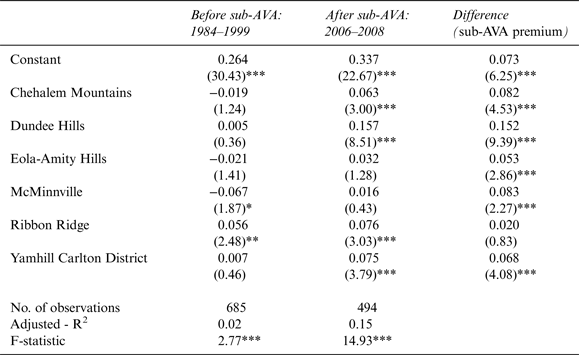
Table 2 summarizes the robust regression results for the “before” and “after” periods in column (2) and column (3). According to the estimation results presented in column (4), i) after reclassification, the price-quality ratio for all portions of Willamette (sub-AVAs and the greater AVA) increased; and, most importantly, ii) the gap between sub-AVAs and “others” widened.
Regression Results for Price-Quality Ratio as a Function of the Regional (Sub-AVA) Reputation, “Before” and “After” Sub-AVA's Creation

Robust t-values in parentheses; significance levels (two-tailed) 1% (***), 5% (**), and 10% (*).
The price-quality ratio increase was significant for four of the sub-AVAs at a 1% statistical significance level or better. Although the results for two of the six sub-AVAs, Eola-Amity Hills and McMinnville, were not statistically significant, their price-quality ratios also increased.
To better demonstrate the sub-AVA creation effect on price-quality ratios, we calculated the “before” and “after” prices for a bottle of wine with a rating of 90 points by Wine Spectator from each of the sub-AVAs and from the rest of the Willamette Valley AVA (“others”). For instance, the unofficial (at that time) sub-regions of Willamette—namely, Chehalem Mountains, Eola-Amity Hills, and McMinnville—actually collected smaller premiums for a 90-point wine than the rest of Willamette (by $1.71, $1.89, and $6.03, respectively). Dundee Hills and Ribbon Ridge collected larger premiums by $4.23 and $5.04, respectively. Following the reclassification, each of the sub-AVAs earned significantly higher premiums than those procured by the rest of Willamette, ranging between $1.44 (McMinnville) and $14.13 (Dundee Hills).
C. An Augmented Model
To account for the effects of various factors, we model a wine's price-quality ratio as follows:
 $$\eqalign{{\rm Price}/{\rm Quality}_{{\rm it}} & = a + b_1 {\rm CHE} \hbox{-} {\rm MNT}_{{\rm it}} + b_2 {\rm DUN} \hbox{-}{\rm HILL}_{{\rm it}} + b_3 {\rm EOL} \hbox{-}{\rm AMI}_{{\rm it}} \cr &\quad + b_4 {\rm McMIN}_{{\rm it}} + b_5 {\rm RIB}\hbox{-}{\rm RID}_{{\rm it}} + b_6 {\rm YAM} \hbox{-} {\rm CAR}_{{\rm it} } \cr &\quad+ c_1 {\rm CHE} \hbox{-} {\rm MNT} \hbox{-} {\rm SUB}_{{\rm it}} + c_2 {\rm DUN} \hbox{-} {\rm HILL} \hbox{-} {\rm SUB}_{{\rm it}} \cr & \quad+ c_3 {\rm EOL} \hbox{-} {\rm AMI} \hbox{-} {\rm SUB}_{{\rm it}} + c_4 {\rm McMIN} \hbox{-} {\rm SUB}_{{\rm it}} + c_5 {\rm RIB} \hbox{-} {\rm RID} \hbox{-} {\rm SUB}_{{\rm it}} \cr & \quad+ c_6 {\rm YAM} \hbox{-} {\rm CAR} \hbox{-} {\rm SUB}_{{\rm it}} + c_7 {\rm WILLIAMETTE} \hbox{-} {\rm AVA}_{{\rm it}} \cr &\quad + d_1 {\rm AGE}_{{\rm it}} + d_2 {\rm SIZE}_{{\rm it}} + d_3 {\rm YIELD}_{{\rm it}} \cr &\quad+ d_4 {\rm SINGLE} \hbox{-} {\rm VINEYARD}_{{\rm it}} + v_{{\rm it}.}} $$
In this model, CHE-MNT, DUN-HILL, EOL-AMI, McMIN, RIB-RID, and YAM-CAR are regional dummies (the area within the Willamette Valley other than these six regions is the default region); CHE-MNT-SUB, DUN-HILL-SUB, EOL-AMI-SUB, McMIN-SUB, RIB-RID-SUB, YAM-CAR-SUB, and WILLIAMETTE-AVA are the official AVA or sub-AVA designation dummies; AGE is how many years prior the winery was established at the time of a wine's evaluation; SIZE is the acreage of the vineyard (in 1,000 acreages); YIELD is the number of cases divided by the SIZE; SINGLE-VINEYARD is a dummy variable taking the value of 1 for single vineyard wines and 0 otherwise;Footnote 2 and v it is a well-behaving random error term. Thus, it is correct to say that for a wine x belonging to the Chehalem Mountains region, CHE-MNTi = 1 (and 0 otherwise), and CHE-MNT-SUBi = 1 in the after period (and 0 in the before period).
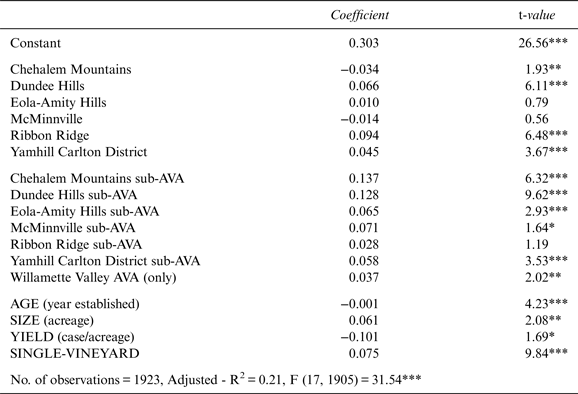
According to the estimation results, summarized in Table 3, all four factors had significant effects on the price-quality ratio: While SIZE had a positive effect—the larger the vineyard, the bigger the price-quality ratio—YIELD had a negative effect. The older wineries had lower price-quality ratios, and the single vineyard premium was statistically significant.
Robust Regression Results for Price-quality Ratio as a Function of the Geography, Sub-AVA Reputation, and Other Factors

Robust t-values in parentheses; significance levels (two-tailed) 1% (***), 5% (**), and 10% (*)
Dundee Hills, Ribbon Ridge, and Yamhill-Carlton District were the three regions at a 1% statistical significance level for the regional effect on the price-quality ratio. Moreover, similar to the estimation results in Table 2, the estimation results in Table 3 indicate that i) after reclassification, the price-quality ratio for all portions of Willamette (sub-AVAs and the greater AVA) increased; and ii) the gap between the sub-AVAs and “others” widened. (The only exception was the Yamhill-Carlton District sub-AVA.) The price-quality ratio increase for four of the sub-AVAs—Chehalem Mountains, Dundee Hills, Eola-Amity Hills, and Yamhill-Carlton District—was significant at a 1% statistical significance level or better.
D. A Treatment Effect Model
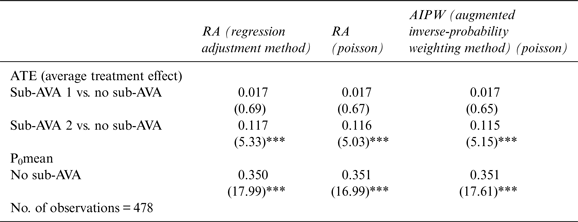
Considering the other factors’ effects along with regions and official reclassifications gives similar results as in the previous section, but with some slight variations. To consolidate these differences and better quantify the sub-AVA premiums, in our observational (nonexperimental) data, we assume that SIZE and AGE affect treatment assignment (i.e., officially creating own sub-AVA) and that in addition to SIZE and AGE, YIELD and SINGLE-VINEYARD affect treatment-specific outcome (i.e., price-quality ratio). Specifically, we think that bigger and older wineries in regions with above-average price-quality ratios (i.e., Dundee Hills, Ribbon Ridge, and Yamhill-Carlton District) would be interested in reclassification to further differentiate themselves from the rest of the AVA. Accordingly, we separate these three regions from the other three regions that established their own sub-AVAs (Chehalem Mountains, Eola-Amity Hills, and McMinnville). In a sense, we model the sub-AVA creation as multivalued treatments: Treatment 1—”others,” or those that officially become sub-AVAs without above-average price-quality ratios (Chehalem Mountains, Eola-Amity Hills, or McMinnville); and Treatment 2—those that officially become sub-AVAs with above-average price-quality ratios (Dundee Hills, Ribbon Ridge, and Yamhill-Carlton District).
The results in Table 4 indicate that although Treatment 1 had no statistically significant effect, Treatment 2 caused the price-quality ratio to increase by 0.12 points over the 0.35 rating of “others” with no official sub-AVA designation. This effect was statistically significant at a 1% statistical significance level or better. To demonstrate with an example, after Treatment 2, a bottle of wine with a rating of 90 points by the Wine Spectator earned a price premium of $10.80.
Multivalued Treatment-Effects Estimation Results

z-values in parentheses; significance levels (two-tailed) 1% (***)
III. Concluding Remarks
Following the creation of sub-AVAs, the price-quality ratio for all areas of Willamette increased. Those wineries that had already carried a better-quality reputation than the rest in Willamette were able to substantially increase the premiums they collected for their reputations; for instance, Dundee Hills was able to collect $12.69 more on a “90-point” wine than it could before being officially classified as its own sub-AVA. From an economic standpoint, reclassification has seemingly been successful for those “better” wineries included in the new sub-AVAs. Of course, due to data limitations, we have only captured an initial impact, and we look forward to evidence that the creation of these sub-AVAs will have an enduring impact. Moreover, to check the robustness of our findings, it would be helpful to rerun the same analyses i) by using data from Wine Advocate, Wine Enthusiast, Steve Tanzer, and Allen Meadows (the Burghound) rather than data from Wine Spectator; and ii) for different AVAs with a similar sub-AVA creation experience. Additionally, it is possible that consumers may treat all wines within a certain range as indistinguishable; this possibility is beyond the scope of this paper, but we do acknowledge the difficulty of interpreting wine ratings.