Introduction
The increasing worldwide incidence of overweight and obesity in children and adolescentsReference Kelly, Barlow and Rao 1 has been paralleled by an increase in mental health disorders.Reference Olfson, Blanco, Wang, Laje and Correll 2 For example, a recent report from Sweden showed that the proportion of young people with negative mental affectivity rose from 9 to 30% of women and 4–14% of men, from 1988–1989 to 2004–2005, respectively.Reference Lager, Berlin, Heimerson and Danielsson 3 Additionally, a large proportion of young adults aged 20 and over in the United States are obese (34.6%) and 7.2% have current depression.Reference Pratt and Brody 4 Rates of obesity of young adults (18–25 years) in developing countries are increasing at a higher rate than in developed countries.Reference Poobalan and Aucott 5 Cohort studies in Australia show rates of overweight and obesity increasing most rapidly in early childhood, particularly in socially disadvantaged communities,Reference Wake, Hardy, Canterford, Sawyer and Carlin 6 consistent with international trends. 7
Several meta-analyses have shown significant positive associations between obesity and depression or anxiety in the general population.Reference de Wit, Luppino and van Straten 8 , Reference Gariepy, Nitka and Schmitz 9 In a US study more than one-third of adults with depression symptoms were obese.Reference Pratt and Brody 4 Obesity also often co-exists with depression in children and adolescents.Reference Mühlig, Antel, Föcker and Hebebrand 10 , Reference Louise, Warrington and McCaskie 11 A meta-analysis of longitudinal studies in adolescents and adults, showed that after controlling for potential confounders, depressed people were at significantly higher risk for developing obesity compared with non-depressed people.Reference Blaine 12
The nature of the depression-obesity association is likely to be complex, with possible common underlying familial and environmental influences.Reference Williams, Mesidor, Winters, Dubbert and Wyatt 13 Models of life-course, socio-economic factors and cardiovascular outcomes suggest a possible association between childhood socio-economic status (SES) and adult obesity in middle and higher income countries.Reference Hemmingsson 14 , Reference Pollitt, Rose and Kaufman 15 However, in many developing countries the transition to young adult obesity accompanies upward social and economic mobility with exposure to a more obesogenic environment and corresponding changes in lifestyle.Reference Poobalan and Aucott 5 Several types of antidepressant medications also predispose to weight gain and obesity,Reference Virk, Schwartz, Jindal, Nihalani and Jones 16 although few population-based studies account for this.Reference Hasler, Pine and Kleinbaum 17 In middle- and upper-income societies SES of the family is a strong influence associated with both negative effectReference Miech, Caspi, Moffitt, Wright and Silva 18 and obesity in children and adults.Reference Loucks, Magnusson and Cook 19 – Reference Brunner, Chandola and Marmot 23
Smoking in pregnancy is of particular interest in heralding the link between obesity and depression in offspring. Maternal smoking in pregnancy is associated with social disadvantage,Reference Smedberg, Lupattelli, Mårdby, Øverland and Nordeng 24 , Reference Chivers, Parker, Bulsara, Beilin and Hands 25 lower birth weight infantsReference Suzuki, Tanaka and Kondo 26 – Reference Savitz, Dole, Terry, Zhou and Thorp 28 and obesity later in life.Reference Oken, Levitan and Gillman 29 – Reference Cupul-Uicab, Skjaerven and Haug 31 However, it is unclear whether the effect on prenatal smoking on obesity is due to maternal programming in pregnancyReference Lee, Abrahamowiez and Leonard 32 , Reference Ladd-Acosta, Shu and Lee 33 or to the confounding effects of social and familial factors.Reference Brion, Victora and Matijasevich 34 , Reference Mund, Louwen, Klingelhoefer and Gerber 35
In addition to the relation with offspring obesity, maternal smoking in pregnancy has been independently associated with childhood behavioural problems.Reference Roza, Verhulst and Jaddoe 36 – Reference Menezes, Murray and László 39 However, the relationship between maternal prenatal smoking and offspring depression is less consistent.Reference Dolan, Geels and Vink 40 , Reference Lavigne, Hopkins and Gouze 41 Associations reported between maternal smoking in pregnancy and offspring mental healthReference Chivers, Parker, Bulsara, Beilin and Hands 25 , Reference Brion, Victora and Matijasevich 34 , Reference Robinson, McLean and Oddy 42 might also reflect the influence of SES, as mothers who smoke in pregnancy are younger,Reference Rogers 43 and less educated than their non-smoking counterparts.Reference Pickett, Wood and Adamson 44 , Reference Jaakkola, Jaakkola, Gissler and Jaakkola 45 We have previously reported an association between adiposity and depression/anxiety symptoms in 14-year olds in the Western Australian Pregnancy Cohort (Raine) Study.Reference Louise, Warrington and McCaskie 11
The present study examined Raine participants at age 20 years and aimed to identify pregnancy and early life factors, and offspring behaviours that may predispose to any association between adiposity and depressive tendencies. We hypothesized that maternal smoking in pregnancy and related social factors might identify those showing a predisposition to both depression and adiposity in early adult life.
Method
Study population
The Raine Study is a prospective longitudinal pregnancy study of 2868 live births from pregnant women enrolled at 18 weeks of gestation.Reference Newnham, Evans, Michael, Stanley and Landau 46 In brief, 2900 pregnant women were recruited through the antenatal clinic at King Edward Memorial Hospital in Perth or surrounding private practices between 1989 and 1991. The potential for introducing bias by using a tertiary referral centre sample was minimized by enrolling women who booked before 18 weeks of gestation, which excluded those referred with complications. In total, 90% of eligible women agreed to participate in the study and written informed consent to participate was obtained at enrollment. The study has ethics approval from the Human Research Ethics Committees at King Edward Memorial Hospital, Princess Margaret Hospital for Children and The University of Western Australia. This analysis uses data from the 20-year follow-up of the offspring, conducted from 2010 to 2012 and analyzed in 2015 to 2016. Informed written consent was obtained from the participants.
Anthropometry
Weight was recorded with a Wedderburn Chair Scale (nearest 100 g) after fasting and wearing minimal clothing. Height was measured without shoes using a Holtain Stadiometer, Holtain Ltd, Crosswell, UK (nearest 0.1 cm). BMI was categorized as normal/underweight (<25 kg/m2), overweight (25–29.9 kg/m2) or obese (⩾30 kg/m2).
DASS depression-score
The Depression, Anxiety, Stress Scale (DASS-21) is the short form of the DASS-42, a combination of three self-report scales and comprising 21 questions. Seven questions in each category measure the negative emotional states, respectively, of depression, anxiety and stress.Reference Lovibond and Lovibond 47 The DASS-21 scores were multiplied by 2 as per scoring instructions allowing comparison with DASS-42 normative data.Reference Lovibond and Lovibond 47 DASS-21 highly correlates to other validated measures of depression and anxiety, indicating a high convergent validity.Reference Lovibond and Lovibond 47 , Reference Henry and Crawford 48 Depression symptoms experienced over the past week, were scored on a four-point severity/frequency scale (did not apply to me at all=0, applied to me to some degree, or some of the time=1, applied to me to a considerable degree, or a good part of the time=2, applied to me very much, or most of the time=3). The seven symptoms were ‘I could not seem to experience any positive feeling at all’, ‘I felt that I had nothing to look forward to’, ‘I felt I was not worth much as a person’, ‘I felt down-hearted and blue’, ‘I was unable to become enthusiastic about anything’, ‘I felt that life was meaningless’, and ‘I found it difficult to work up the initiative to do things’. Additionally, participants were asked if they had ever been diagnosed with depression by a health professional asking, ‘Do you have now, or have you had in the past, any of the following health professional diagnosed medical conditions or health problems?’.
Maternal psychosocial covariates
Pre-pregnancy BMI of the participants’ mothers was calculated from self-reported weight before pregnancy and height measured at 18 weeks’ gestation. If women could not answer this question, their weight was used to estimate pre-pregnancy weight. Self-report of weight by women of reproductive age has been found to be valid with 84% of women correctly classified into the correct BMI categories.Reference Brunner Huber 49 Maternal self-reported data for weekly alcohol intake and smoking during pregnancy were dichotomized as ‘yes/no’ response.Reference Bhat, Robinson, Burrows and Mori 50 Mothers with post-school higher education were ranked as having a tertiary education. Annual family income during pregnancy was dichotomized as low-income status <$24,000 Australian-Dollars (AUD), in accordance with the poverty line during 1989–1991. Breast-feeding data from questionnaires completed by mothers was assessed as the age breast-feeding stopped and the introduction of milk other than breastmilk was introduced.Reference Brennan-Jones, Eikelboom and Jacques 51 At 18-weeks gestation mothers were asked whether they had experienced any of 10 life-stress events since becoming pregnant.Reference Bhat, Robinson, Burrows and Mori 50 Family functioning at adolescent age of 14 used the General Functioning Scale from the McMaster Family Assessment Device.Reference Epstein, Baldwin and Bishop 52
Offspring psychosocial covariates
Birth weight of the participants was obtained from hospital records. Self-reported measures of current smoking and current alcohol consumption at 20 years were dichotomized as ‘yes/no’. Information about use of hormonal contraceptives (HC) in females was based on self-reported current use of the oral contraceptive (OC) pill, implant, injection or any intrauterine HC device. The short form of the International Physical Activity Questionnaire was used to derive a measure of metabolic equivalents, a unit of resting metabolic rate.Reference Jurakić, Pedišić and Andrijašević 53
Statistical analyses
Analyses were performed using STATA 12 (StataCorp, College Station, TX, USA). Summary estimates for continuous and categorical variables were calculated as means/proportions with 95% confidence intervals (CIs). Significant differences between participants v. non-participants, maternal prenatal smokers v. non-smokers, and high v. low family-income during pregnancy were determined using χ2/Z tests. Ordinary least square models regressed the BMI outcome on DASS Depression-score and depression scores on medical practitioner diagnosed depression. The linearity of the relation was assessed examining scatterplot overlaid with locally weighted regression smoother. Univariate analyses involved variables of clinical and biological relevance for BMI and depression-score outcomes.Reference Friedman and Brownell 54 Offspring covariates in these univariate analyses included gender, gestational age at delivery (weeks), birth weight, breast-feeding (⩾4 months), current alcohol drinking, current smoking and physical activity (hours/week). Maternal covariates included age, history of hypertension in pregnancy, pre-pregnancy BMI, smoking, alcohol consumption and life-stress score during pregnancy, post-school higher education and low family-income during pregnancy. Variables potentially associated (P<0.10) with BMI in univariate analyses were included in the multivariable regression model. A backward elimination regression identified the final set of significant (P<0.05) covariates. Covariates with the largest P-value>0.05 were excluded first and at each step the model was examined for evidence of the excluded covariate’s importance from the change in regression coefficient and model variance. The two-way interaction between depression-score and maternal prenatal smoking or family income at pregnancy was introduced separately to the penultimate multivariable model to test whether maternal smoking or family-income modified the depression and BMI relationship. Analyses investigated the effect modification by gender. All regression models used ‘within family cluster’ adjustment to correct for correlation between a small number of siblings.
Results
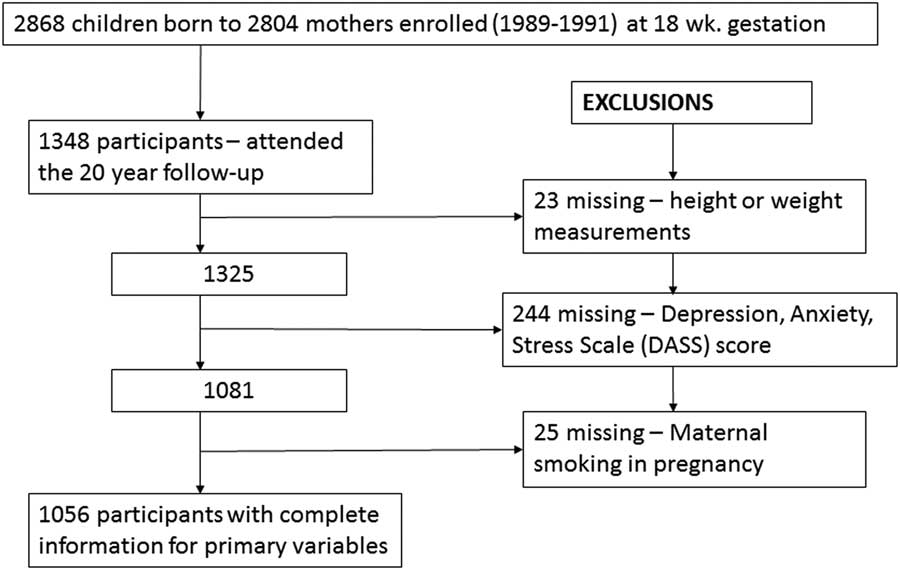
At 20 years of age, 1348 participants attended the follow-up (Fig. 1). Complete data on primary variables of interest BMI, DASS Depression-score, maternal smoking in pregnancy and gender were available for 1056 participants and their mothers. A comparison of study participants (n=1056) with those that did not participate in the 20-year follow-up (n=1743) shows more mothers of those that did not participate smoked during the first trimester of pregnancy (31.4 v. 19.5%, P<0.001), were less likely to have a tertiary education (43.4 v. 56.6%, P<0.001) or to consume alcohol during pregnancy (42.9 v. 49.9%, P<0.001), were younger (26.8 v. 29.0 yrs, P<0.001), and were more likely to have a low family-income at the time of pregnancy (49.6 v. 34.4%, P<0.001) (online Supplementary Table S1). These findings are indicative of some retention bias for families more likely to be well educated, health conscious and having a relatively higher income.
Flow diagram of the Western Australian Raine Study participants attending the 20-year follow-up.

Young adult offspring that did not complete the DASS Depression-score questionnaire (n=244) were more likely to have mothers with a low family income at the time of pregnancy (43.2 v. 34.3%; P=0.012) and were more likely to be males (70.1 v. 47.7%; P<0.001).
Maternal and offspring cohort characteristics
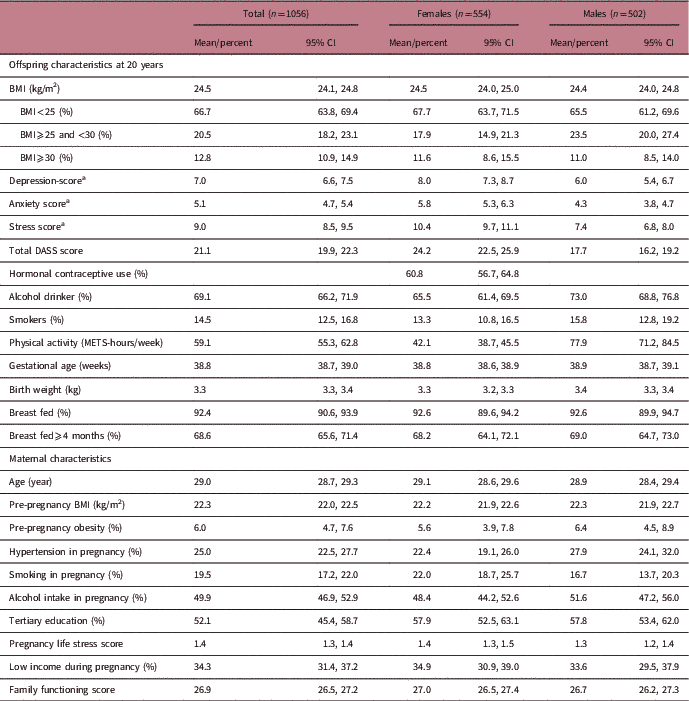
Table 1 shows the characteristics of offspring according to gender. Males had lower average depression, anxiety and stress scores, and a higher level of physical activity compared with females. The proportion of HC use by females was 60.8%. Depression diagnosed by a medical practitioner was reported in 16.1% of young adult participants. In these participants, depression scores were 8.25 units (95% CI: 7.10, 9.41, P<0.001) higher compared with the scores of participants not clinically diagnosed with depression. None of the participants used antidepressants at age 20.
Participant characteristics by gender

METS, metabolic equivalents.
a Score range for each depression, anxiety, stress scale is from 0 to 42.
Univariate and multivariable-adjusted BMI regression
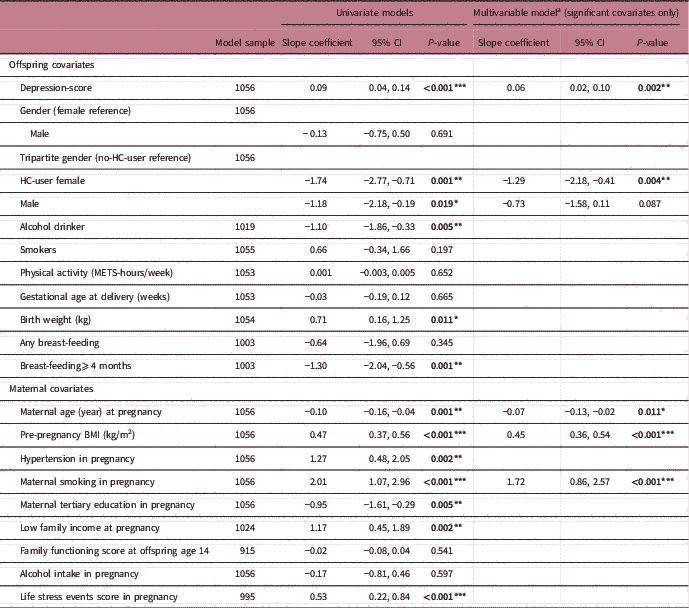
In univariate analysis, DASS Depression-score associated positively with offspring BMI (0.09; 95% CI: 0.04, 0.14, P<0.001) (Table 2). Covariates that significantly associated positively with offspring BMI were birth weight, high life-stress score during pregnancy, higher maternal pre-pregnancy BMI, history of maternal hypertension in pregnancy, maternal smoking in pregnancy, and low family income at the time of pregnancy. Offspring BMI was significantly inversely associated with breast-feeding ⩾4 months, drinking alcohol at age 20, higher maternal age, and maternal tertiary education in pregnancy (Table 2). In a multivariable model, the depression-score and BMI association remained significant after adjusting for gender and HC use in females, maternal pre-pregnancy BMI, maternal age, and maternal prenatal smoking (Table 2). Adjustment attenuated the magnitude of the depression score effect on BMI (0.06; 95% CI: 0.02, 0.10, P=0.002). This equated to 0.5 kg/m2 increase in BMI for every 1 s.d. (8 units) increase in depression score.
Univariate and multivariable-adjusted body mass index (BMI) regression

HC, hormonal contraceptives; METS, metabolic equivalents.
Boldface indicates statistical significance (*P<0.05, **P<0.01, ***P<0.001).
a Model constant for multivariable model (coefficient=16.59; 95% CI 14.05, 19.13; P<0.001)
Effect of maternal prenatal smoking on the association between depression scores and BMI
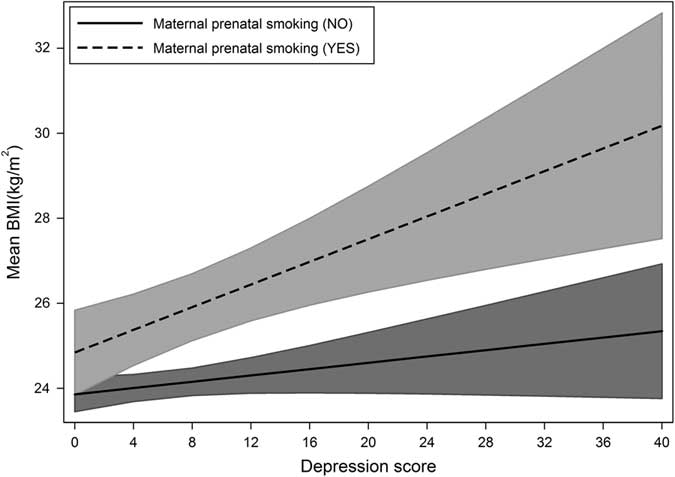
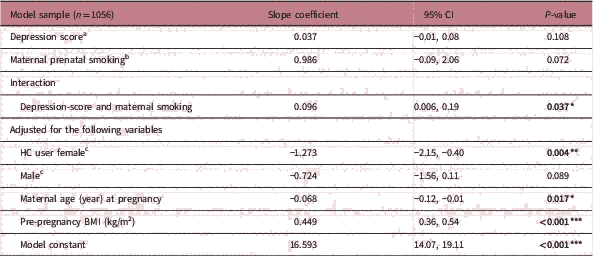
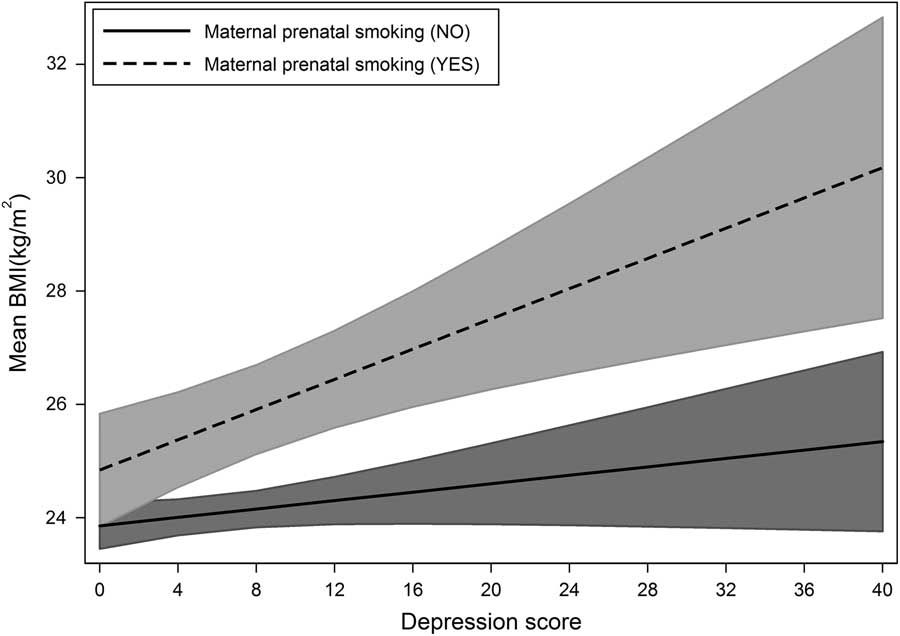
Gender was not identified as an effect modifier. The final multivariable regression model showed a significant interaction between maternal prenatal smoking and depression-score (interaction coefficient=0.096; 95% CI: 0.006, 0.19, P=0.037), indicating the relationship between depression scores and BMI differed according to the maternal prenatal smoking status (Table 3 and Fig. 2). A positive association between BMI and depression score in offspring of maternal prenatal smokers (0.133; 95% CI: 0.05, 0.21, P=0.001) was independent of gender and HC use in females, maternal age and pre-pregnancy BMI. It equated to 1.1 kg/m2 increase in BMI for every 1 s.d. (8 units) increase in depression-score. There was no significant association between BMI and depression-score in offspring of mothers that did not smoke in pregnancy (0.037; 95% CI: −0.01, 0.08, P=0.108) (Table 3 and Fig. 2).
Predicted offspring body mass index (BMI) according to the depression-score at age 20, by maternal smoking in pregnancy.
Multivariable adjusted body mass index (BMI) regression

HC, hormonal contraceptives; METS, metabolic equivalents.
Boldface indicates statistical significance (*P<00.05, **P<00.01, ***P<00.001)
a Depression-score coefficient in offspring of maternal prenatal non-smokers. Depression-score coefficient in offspring of maternal prenatal smokers=(0.037+0.096)=0.133; 95% CI: 0.05, 0.21; P=0.001 (independent of gender, female HC use, maternal age and pre-pregnancy BMI)
b Difference in BMI between offspring of maternal prenatal smoker v. non-smoker (during pregnancy) for those with depression-score=0
c Female not using hormonal contraceptive is the reference
Effect of low family-income on the association between depression scores and BMI
To determine whether the influence of maternal smoking in pregnancy on the association between depression scores and BMI is a reflection of SES, we examined the relationship in relation to low family income during pregnancy. Online Supplementary Table S2 provides a comparison of the characteristics according to maternal prenatal smoking and family income status. Compared to maternal prenatal non-smokers, maternal smokers were significantly younger (26.9 v. 29.5 years, P<0.001), had a lower family income (50.0 v. 30.6%, P<0.001), less tertiary education (34.5 v. 62.0%, P<0.001) and higher pregnancy life-stress scores (1.6 v. 1.3, P<0.001). The offspring of mothers that smoked in pregnancy had a significantly higher BMI (26.1 v. 24.1 kg/m2, P<0.001) and were more likely to be obese than offspring of mothers that did not smoke in pregnancy (20.4 v. 10.9%, P<0.001). Similar differences were observed comparing high v. low family-income during pregnancy (online Supplementary Table S2).
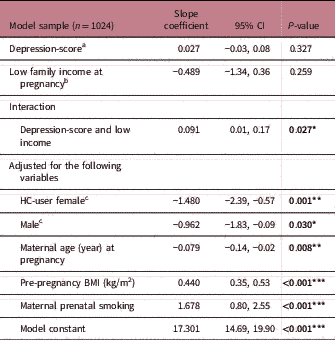
The multivariable regression model showed similar results to those identified using maternal prenatal smoking (Table 4). A significant interaction between low family income at pregnancy and depression-score (interaction coefficient=0.091; 95% CI: 0.01, 0.17, P=0.027) indicated a positive association between BMI and depression-score among offspring of mothers with a low family income during pregnancy (0.118; 95% CI: 0.06, 0.18, P<0.001), but no association in those with a high maternal family income (0.027; 95% CI: −0.03, 0.08, P=0.327). This relationship was independent of gender and HC use in females, maternal age, pre-pregnancy BMI and maternal prenatal smoking.
Multivariable adjusted body mass index (BMI) regression substituting family income at pregnancy for maternal prenatal smoking

HC, hormonal contraceptives; BMI, body mass index.
Boldface indicates statistical significance (*P<00.05, **P<00.01, ***P<00.001).
a Depression-score coefficient in offspring of high family income category depression coefficient in offspring of low family income category=(0.027+0.091)=0.118; 95% CI: 0.06, 0.18; P=<0.001 (independent of gender, female HC-use, maternal age and pre-pregnancy BMI).
b Difference in BMI between offspring from low family income v. high family income for those with depression score=0.
c Female not using hormonal contraceptive is the reference.
Discussion
This study has shown that the relationship between depression scores and BMI of 20 year olds was modified by maternal prenatal smoking and low family income at pregnancy, independent of gender, maternal age, maternal pre-pregnancy BMI, and a range of other potential maternal and offspring confounders. The results showed a positive association between BMI and depression-score in offspring of mothers that smoked during pregnancy, but not in the offspring of maternal prenatal non-smokers.
Several studies have shown cigarette smoking in pregnancy is positively associated with offspring behavioural disorders.Reference Moylan, Gustavson and Øverland 37 – Reference Menezes, Murray and László 39 , Reference Cornelius, Goldschmidt and Day 55 However, the association of maternal prenatal smoking with offspring internalizing behaviours, such as depression, is not clear. In the Avon Longitudinal Study of Parents and Children, the above association was not significant once adjusted for covariates such as SES, parental psychopathology and alcohol consumption.Reference Brion, Victora and Matijasevich 34 Similarly, in the Generation R study, the association between maternal smoking in pregnancy and childhood internalizing behaviours was eliminated after adjustment for confounders such as parental educational level, family income, national origin, parental psychopathology and child gender.Reference Roza, Verhulst and Jaddoe 36 Maternal prenatal smoking has shared variance with other family psychosocial covariates of young offspringReference Robinson, McLean and Oddy 42 and in the present study was correlated significantly with lower family income and maternal education status (r=0.3 and r=0.4, respectively). Indeed, maternal smoking and maternal BMI are thought to be partly responsible for the intergenerational transmission of social inequalities in offspring BMI.Reference Koupil and Toivanen 56 , Reference Fergusson, Woodward and Horwood 57
Our analytic models show independent effects of maternal smoking and family income in pregnancy on the association between BMI and Depression scores in the 20-year-old offspring. However, we cannot differentiate between possible effects of smoking on in utero programming from psychosocial factors in smoking families which were not measured or were underestimated. An in utero effect of maternal prenatal smoking on offspring behavioural outcomes is plausible given the evidence that tobacco exposure during fetal life alters the epigenome,Reference Ivorra, Fraga and Bayón 58 , Reference Taylor, Carslake and de Mola 59 even in the absence of fetal growth restriction. Infants exposed to in utero tobacco smoke have significantly elevated adrenocorticotropin hormone levels suggesting cigarette smoking may promote in utero ‘programming’ of the fetal hypothalamic–pituitary–adrenal axis.Reference McDonald, Walker and Perkins 60 Nicotine exposure during pregnancy prompts DNA methylation that could predispose the offspring to childhood obesity through altered neurobehavioral impulse control systems and food satiation levels,Reference Toschke, Koletzko, Slikker, Hermann and von Kries 61 , Reference von Kries, Toschke, Koletzko and Slikker 62 and altered dietary fat intake preferences.Reference Lee, Abrahamowiez and Leonard 32 , Reference Ladd-Acosta, Shu and Lee 33
There has been a decrease in the proportion of mothers smoking during pregnancy, however the decline is more evident among highly educated women and less pronounced in younger and less educated women.Reference Rogers 43 A low maternal education and a lower household income have been shown to contribute to the incidence of depression and development of obesity in adolescents, while the onset and persistence of depression among obese individuals varies according to SES as determined by income or educational level.Reference Williams, Mesidor, Winters, Dubbert and Wyatt 13 Although both prenatal smoking and low family income showed significant independent effects, we are unable to determine whether the smoking influence was either a marker of a broader adverse psychosocial environment or operating through fetal programming, or a combination of both factors. Importantly the findings point to those young adults who can be identified from maternal smoking in pregnancy and at birth as being destined to be at high risk of an association between adiposity and depression.
There is some evidence that genetic factors may also play a role in the interaction between lifestyle, obesity and depressionReference Palacios, Pazos and Hoyer 63 but this has yet to be substantiated in large population studies. Although gender differences in the association between adiposity and depression have been suggestedReference de Wit, Luppino and van Straten 8 , Reference Louise, Warrington and McCaskie 11 , Reference Korczak, Lipman, Morrison, Duku and Szatmari 64 , Reference Marmorstein, Iacono and Legrand 65 we found no evidence for this in the 20 year olds in our cohort.
Strengths of our study include the large sample size and accounting for a wide range of potential maternal and offspring confounders. A potential limitation of the study is that there was significant attrition from the original population cohort which included more high-risk pregnancies and low-income families as they were recruited predominantly from public hospitals. However, the cohort now has a greater retention of socially advantaged families which would tend to underestimate the observed influences. In terms of generalizability of our findings, the proportion of mothers smoking in pregnancy was similar to that reported in various developed countries.Reference Roza, Verhulst and Jaddoe 36 Considering the DASS depression scores used in the study are dimensional, interpretability of clinical depression severity would need to be undertaken with caution.Reference Lovibond and Lovibond 47 However, some validity of the use of the depression scores in our population was that the DASS Depression-score was substantially higher in those who reported at some time having been diagnosed with depression by a medical practitioner. Notably none of the participants in our study was taking antidepressant medications which have been associated with weight gain and obesity.Reference Virk, Schwartz, Jindal, Nihalani and Jones 16
In conclusion associations between depression and BMI were only seen among offspring of mothers who smoked during pregnancy or those with low income, and these effects were independent of offspring gender, maternal age, pre-pregnancy BMI and other lifestyle covariates such as current offspring smoking and alcohol drinking. Whilst these associations will require replication in other populations including of different ethnicity, they are potentially important in the context of a widening socio-economic divideReference Chung, Backholer and Wong 66 , Reference Frederick, Snellman and Putnam 67 and epidemic of worldwide levels of adiposity,Reference Kelly, Barlow and Rao 1 , Reference Ogden, Carroll and Lawman 68 with the likelihood of an accompanying increase in the levels of affective disorders such as depression. Identifying families in pregnancy whose offspring may be most at risk of the co-association of adiposity and depressive symptoms could be a valuable public health priority.
Supplementary materials
To view supplementary material for this article, please visit https://doi.org/10.1017/S2040174418000533
Acknowledgements
The authors thank the Raine Study participants and their families and the Raine Study management team for cohort co-ordination and data collection. Core funding of the Raine Study is provided by the University of Western Australia, the Telethon Kids Institute, the Raine Medical Research Foundation, the Faculty of Medicine, Dentistry and Health Science (UWA), the Women’s and Infants’ Research Foundation, Curtin University and Edith Cowan University. S.K.B., L.J.B., M.R. and T.A.M. conceived the study. S.K.B. and S.B. performed statistical analysis. S.K.B. wrote the manuscript. All of the authors contributed to the interpretation of the results, critical revision of the manuscript and approved the final manuscript.
Financial Support
This research received no specific grant from any funding agency, commercial or not-for-profit sectors.
Conflicts of Interest
None.
Ethical Standards
The study has ethics approval from the Human Research Ethics Committees at King Edward Memorial Hospital, Princess Margaret Hospital for Children and The University of Western Australia.