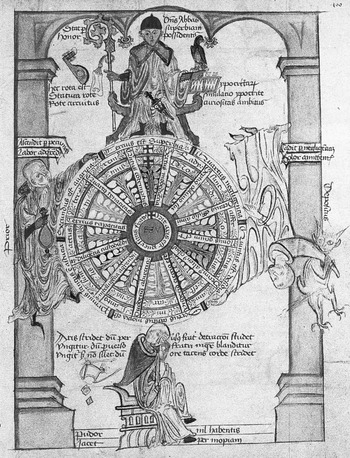
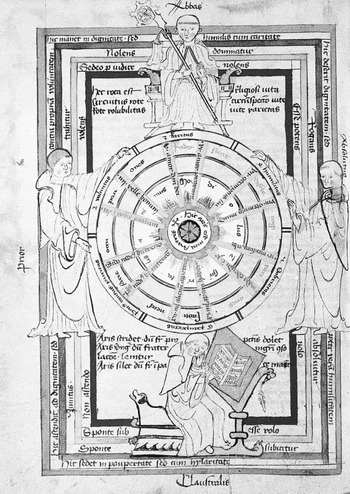
Inthe middle of the fifteenth century, the Benedictine monks of Melk in Austria copied Hugh of Fouilloy's On the Wheel of True Religion, a moral treatise that contrasted well-disciplined and dissolute religious life.Footnote 1 Two large images accompany the text. Atop an image depicting a dissolute cloister (Figure 1), an abbot reigns in pride and “curiosity.” He wears a red habit, a red tunic adorned with buttons at the wrists, a red beret, and red boots with golden spurs. A luxuriously adorned dagger hangs on a golden belt. The abbot also holds a falcon in his left hand, and nearby are a backgammon board and a lyre. To the left, a prior aspires to the abbot's glory. He wears fashionable long-toed boots and a red tunic adorned with buttons. He also clutches a blue bag, presumably filled with the cash that is said to fund his ascent “through simony.” To the right of the image, a deposed abbot, pulled down by a demon who clutches his habit, laments his fall from grace “through negligence.” A cloistered monk sleeps below with a pair of dice nearby. Atop the contrasting image of disciplined monks (Figure 2), a humbly clothed and properly tonsured abbot holds his office “in dignity, but humbly and with charity.” The abbot's successor, the prior, ascends reluctantly. His predecessor resigns his office out of true humility. A cloistered monk sits quietly below, reading diligently and embracing willingly his life of poverty and obedience.
Figure 1:Clergy consumed by sin and vice. Source: Hill Museum and Manuscript Library.
Figure 2:A contrasting image of discipline and virtue. Source: Hill Museum and Manuscript Library.
At Melk these sharp dichotomies between dissolution and strict observance had their origins in a reform movement that began a generation before, in 1418. Its leader was Nicholas Seyringer, a former canon of Olomouc in Moravia and a student of Henry of Langenstein at Vienna.Footnote 2 In 1403, Seyringer turned away from his promising academic career to embrace reformed Benedictine life at Subiaco in Italy. By 1418, Habsburg Duke Albert V of Austria arranged for Seyringer to return to Melk. There he and his followers established a new way of life rooted in the ideal of discipline and community set forth in the images noted above. One of its key inspirations was the thirty-third chapter of the Rule of Benedict, in which the founder of Western monasticism condemned what he called the “vice” of ownership. Benedict wrote:
This vice especially is to be cut out of the monastery by the roots. Let no one presume to give or receive anything without the Abbot's leave, or to have anything as his own—anything whatever, whether book or tablets or pen or whatever it may be—since they are not permitted to have even their bodies or wills at their own disposal; but for all their necessities let them look to the Father of the monastery.Footnote 3
Reformers at Melk and elsewhere now recovered and applied these principles anew. They sought to uproot all of the cash and comfort, pomp and privilege of their era, and to bind both abbot and community back to what they imagined to be the common life of Christian antiquity—the modest food and drink of the common table, the stern simplicity of a common dormitory, and so on.
Seyringer's experiment at Melk was only one of the most visible inflections of a much broader reform of the orders. Now known as the Observant Movement, it was well underway across the orders and across Europe by 1400. A reform of the Augustinian canons began at Raudnitz in Bohemia in the 1330s. In Italy, Paolucci Trinci began a reform of the Franciscans in the 1360s; Raymond of Capua, a reform of the Dominicans in the 1380s. After 1400, a reform of the Augustinian canons began to spread from Windesheim in the Netherlands. In France in the same years, Franciscan reform took root at Mirabeau and Corbie. Reformed Benedictine congregations spread from Kastl in the Palatinate, Melk in Austria, St. Matthias in Trier, and Bursfeld in Lower Saxony. By century's end, the reformed orders produced some of the most remarkable religious figures of the era: the Benedictine abbot Johannes Rode; the reformed canon Thomas à Kempis, author of the Imitation of Christ; the crusading Franciscan John of Capistrano; the fiery Dominican prophet and preacher Savonarola; even the young Martin Luther himself, who was an Observant Augustinian friar before becoming a reformer of another stripe.
Study of institutional religious life and its reform has long mirrored our wider models of the fourteenth and fifteenth centuries. Fifty years ago, Huizinga's autumnal light cast its long shadows over the closing lines of the Benedictine David Knowles' survey of religious life in England. By 1300, Knowles wrote, the age of the great monks and friars had passed. Only the “heavy weight of the social and economic fabric of the world” remained, awaiting renewal through repentance.Footnote 4 By the 1980s, scholars then began to craft more empirically grounded models of “crisis”—Malthusian models of demographic crisis, Marxist models of feudal crisis, and arguments for a general “crisis of the age.”Footnote 5 In the same years, Heiko Obermann, Steven Ozment, Francis Oakley, and others began to trace a longer history of reform, both backward from the sixteenth century and forward from the thirteenth.Footnote 6
Just as these conversations were coming fully into print, Kaspar Elm called for new research that would ground the history of religious decline and renewal in the larger models. Famine and plague, war and schism, economic and demographic contraction, as “more or less uncontested” causes of decline, provided key contexts for evaluating a range of phenomena—a compromised observance of poverty; the declining size and number of the orders' foundations; and challenges of recruitment and fiscal solvency. Elm argued that Observant reform in a similar way reflected a range of wider changes: the growing power of secular princes and city councils; the energies and ideas of conciliar reform; and the cultural currents of humanism and the Modern Devotion.Footnote 7 More recently, Bernd Hamm has argued that a general “crisis mentality” inspired the Observant reformers' return to rules, to discipline, and to Christ-centered piety. Their movement hence provides one of the best examples of the broad cultural process Hamm has called “normative centering.”Footnote 8
Scholars have nevertheless begun to note the limits and interpretive costs of these larger models. As Howard Kaminsky and others have argued, models of “crisis”—a rubric invoked so loosely and frequently as to deprive it of much of its explanatory force—are in many ways only another iteration of a “dialectic of lateness” inherited ultimately from Petrarch and the humanists.Footnote 9 Arguments for a general “crisis mentality,” for example, fail to account for the perspectives of those many who did not express angst, disorientation, fear, and so on. A reconsideration of the evidence has also begun to strain models of demographic and agrarian crisis to the breaking point and to stress the survival of a social order of lords and subjects from the thirteenth century well into the early modern era. In analogous ways, scholars are now aware of the limits of many of our approaches to reform.Footnote 10 Many fine studies have traced crucial continuities between the medieval and Reformation eras. But a preoccupation with the drama, the questions, and the categories of the sixteenth century still tends to distort or simplify the religious history of the fourteenth and fifteenth centuries generally and the history of reform in particular. Several studies—Caroline Walker Bynum's Wonderful Blood, for example, and John Van Engen's work on the fifteenth-century church and the Modern Devotion—have hence begun to embrace the full range of interpretive complexity to be found in a thicket of fifteenth-century texts, images, and archives.Footnote 11
This essay puts the history of Observant reform at the center of these efforts to rethink the intersection of religion and reform in the fifteenth century. It does so through a close reading of what might be called reform's “cultural mechanics.” It first considers the arguments surrounding one of reform's core principles, the observance of religious community, as revealed in the work of the leading Melk reformer, Johannes Wischler. A close reading of Wischler's commentaries on the Rule of Benedict reveals a reforming ideology that cut so deeply against the grain of a well-established religious “common sense” of custom and estate that it had to be shaped and deployed against an array of serious counterarguments. The essay then turns from principle to practice to explore a similar complexity. To return religious life to their vision of its origins, reformers had to engage in a process of inquest and deposition, through which they sought to undermine the authority of local superiors who stood in their way. In practice as much as in principle, Observant reform was thus something other than a straightforward reaction to crisis or decline. It was the product of contest, strategy, and process; and it was shaped by crucial ambiguities, contingencies, and possibilities that reward more careful consideration.
Models of Community
Among the early Observant leaders at Melk was Johannes Wischler, a former parish priest trained in philosophy, theology, and canon law at Heidelberg, who professed in the early days of his community's reform.Footnote 12 Wischler was soon prior, and in that position he emerged as a prolific author whose works—most still buried in manuscripts we are only beginning to explore—brought deep learning and wide-ranging experience to bear on reform of the orders.Footnote 13 Among the most challenging of those works are two to be considered here, Wischler's extended commentaries on the thirty-third chapter of the Rule of Benedict. Footnote 14 Each is a baroque tour de force of argument and counterargument, subtle distinction and intricate citation from Roman and canon law, all of it intended to engage one of the most tangled and explosive issues of his day: the tensions among authority, the corporate wealth of the church, and the Christian ideal of common life.
Those tensions are perhaps best known to medieval historians as part of a distinctly Franciscan story: the stern insistence of Francis of Assisi on absolute poverty and the inevitable compromises that followed the growth of the order; the conceptual and legal puzzle of corporate ownership (dominium, proprietas) and individual use; the tension between poverty and obedience that culminated in the condemnations of John XXII; and the emergence of Observant reform in response to “conventual” decline.Footnote 15 Yet to frame Wischler and his reforming thought too strongly within the Franciscan story is ultimately misleading. To do so neglects too much of Wischler's particular setting and circumstance and blunts the original force of his arguments. To capture these, it is better to begin with what might be called the religious and cultural “common sense” of his contemporaries, a common sense that had long sustained the patterns of authority and community his reform movement sought to challenge.
At the heart of that “common sense” was the authority of good custom.Footnote 16 From the Roman jurists and Isidore down to Gratian's Decretum and beyond, custom had remained a central ordering principle in medieval society. The legal tradition defined it as any longstanding habit that had taken root among a given group, a “use” that over time could be “taken as written law.”Footnote 17 Most presumed much more than they recorded about its normative presence, but custom was encountered at every turn and perhaps nowhere more palpably than in the life of the cloister—in daily routines of prayer; in the celebrations of the festivals of the saints; and in the donations of patrons and parents.Footnote 18 It was also powerfully embodied in the presence of the household superior, whose will, especially in internal matters of household administration and discipline, remained law.Footnote 19 Toward 1300, good custom and the authority of superiors, in turn, came to govern a series of quiet but crucial shifts that allowed the rank and file of the religious orders an ever greater degree of freedom and financial independence. Among the oldest Benedictine communities, at places like Fulda and Cluny, household officers had for centuries managed complex bundles of estates with virtual independence, often in ways almost indistinguishable from those of secular lords.Footnote 20 After 1250, however, many more came to enjoy personal incomes of their own. Cash payments to supplement or to replace household provision in kind were common (a notable parallel is the provision of cash as part of a servant's livery in a secular household), as were cash payments for masses and other spiritual services.Footnote 21 In the most entrepreneurial arrangements, individual monks, nuns, canons, and friars became virtually independent players in their local real estate and capital markets.Footnote 22 In a range of charters, statutes, and other texts of practice, as well as the decretals and the commentaries of the schools, the same set of assumptions appears again and again to sanction these arrangements: religious superiors used their authority and their discretion, in good faith and in harmony with good custom, to allow the individual religious to meet his or her needs, as circumstance demanded.
Monks, nuns, canons, and friars who lived in accordance with good custom also shared with their contemporaries a set of assumptions about their “estate” (status). The concept eludes or confuses modern dichotomies of “public” and “private,” individual and corporate ownership, and material and spiritual culture. Fourteenth- and fifteenth-century elites held properties, rights, jurisdictions, powers, and so on by privilege; and they embodied their particular bundles of goods, rights, and privileges, all at once, as their personal or corporate possessions, as extensions of their person, community, or family, and as a representation to the wider world of a divinely ordained and legally established social hierarchy.Footnote 23 Moreover, it was culturally imperative that “estate” in all of these senses be embodied and shown forth materially through what modern people recognize as an appropriate “style” and “standard of living.” From the tenth century at the latest, European elites had fulfilled that imperative in retinues of followers, in fine clothing and abundant food and drink, in the giving and receiving of gifts, all according to their place and rank and condition. In one sense religious had of course renounced the pomp of worldly splendor through their vows. But they too belonged both to the clerical estate and to what became known as the “estate of monks,” or more broadly the “estate of perfection.” And in every locale, monks, too, embodied their estate in ways that blended public and private, material and the spiritual, sacred and social.
Scattered testimonies from the religious themselves help elucidate how these principles must have shaped notions of religious community toward 1400. Dominican friars, whose houses provided them with only the essentials of food and clothing, argued that good custom had granted mass stipends and other secure personal incomes to fund a range of pastoral and professional responsibilities.Footnote 24 Augustinian canons in Austria argued that there was no difference between customary household provision of food and clothing and the prelate's licensed provision of money to buy such things.Footnote 25 Moreover, they argued—and an elite community of nuns in Münster later echoed the same sentimentFootnote 26—that cash incomes were an efficient way to do business. All recognized the dangers of cash and freedom for those professed to individual poverty, and the orders had to legislate continually against the inevitable waste, fraud, and excess. But the consensus remained that the provision of cash and the freedom to use it were worth the moral risk. The Franciscan William Woodford, responding to Wyclif's attacks on clerical dominion, put the matter boldly.Footnote 27 If what Wyclif said were true, what of the bishop's feasts and his magnificent horses? What of the sumptuous palaces and churchly splendor of bishops and the religious alike, their crowds of servants, their great halls and chambers and treasures, all of which secular lords also enjoyed? Surely to renounce all of that was not only too harsh, but also repugnant to natural reason. For Woodford it was simply part of the natural order that priests and monks, just as much as their noble peers beyond the clerical ranks, represent themselves with the outward magnificence that marked their place in society. The same imperative led Pope Benedict XIII to grant a Franciscan, the son of the count of Foix, an annual revenue of 1,000 francs, so as to sustain the friar in a manner appropriate to his family's “estate.”Footnote 28
A Franciscan with a thousand-franc income granted by a pope seems to indicate that something has gone very wrong in the life of the church and its friars. But it is crucial to accept fully the deeply rooted conceptual and cultural framework of custom and estate that had long sanctioned these kinds of arrangements, and countless more modest ones, in religious houses across Europe. And it is crucial to take seriously in turn how the men and women of the religious orders, whatever the severity of the challenges before them, presumed and drew from that framework to redeem their circumstance and to assert their place and their patterns of life within the established order.
And yet for Johannes Wischler at Melk, and for many others in the Holy Roman Empire after 1400, most of the “common sense” propositions that defended propertied religious life as part of the established order had somehow become infuriatingly untenable. In part the discontents reflected ancient problems—monasteries that excluded from their membership those who did not share their noble blood, prelates and monks who ignored all of the reforming legislation meant to curb the excesses of their elite communities.Footnote 29 In other ways they reflected more recent changes, above all the era's new horizons of comfort and consumption and the orders' battle to regulate the excesses—friars who “accessorized” their habits with fashionably cut sleeves and belts, monks who feasted in intimate and tastefully adorned apartments.Footnote 30 But perhaps most immediately for Wischler and his contemporaries, reform of religious life captured in microcosm all of the frustrations of the effort to reform the church “in head and members.” At the Council of Constance, amid broader discussions about the fiscal affairs of the church, the lordly excess of prelates, the moral failures of the clergy, and so on, publicists both across and beyond the ranks of the orders launched a pamphlet war against what they called the “vice of property” in the cloister.Footnote 31 In part it was a recovery of all of the old laws and rules, the long tradition of treatises on virtues and vices, the long tradition of “estates satire” denouncing greed and gluttony among the clergy. But reformers now sharpened the old cultural weapons anew with striking sentiments all their own: propertied monks, so one of the most popular treatises claimed, were worse than thieves, whores, or even murderers, children of hell who took their mortal sin and broken vows with them to the grave.Footnote 32
At Melk, Wischler knew and cited all of these pamphlets; in fact, they are often circulated side by side with his works in the Melk manuscripts. But Wischler recognized that the rhetoric of reform alone was insufficient to convince others that their common sense had betrayed them. For all of the lordly prelates and salaried monks, safe in their ancient foundations, who flaunted their status and neglected their pastoral duties, most still embraced the inherited patterns of life in the name of common sense, the authority of superiors, custom, and clerical dominion. In his commentary on the thirty-third chapter of Benedict's Rule, Wischler therefore chose to confront head-on the issues the rhetoric of the publicists had left unsolved.
To that end, Wischler grounded his approach in a key distinction between what he called the “truth of essence” and the “truth of justice.” Whatever the conceptual and legal subtleties that made their way of life lawful and laudable (the “truth of essence”), in Wischler's view propertied monks and their superiors had “usurped” the goods of their communities in unjust ways, and so had broken their vow to live sine proprio and committed mortal sin. Others had crafted similar constructions: Wyclif and his followers, notably, had used an analogous model to argue that clerical dominion as a whole was unjust and mortally sinful. Wischler now made his own case, independently, in a way that focused on the dominion and wealth of the cloister, rather than of the clergy or the church generally.
True to his training, Wischler advanced his arguments through a schoolman's many distinctions, citations, and counterarguments. But, thankfully, he adorned his intricate weave with vivid and revealing examples, all of them doubtless drawn from common experience. To illustrate what he meant by unjust usurpation, he noted several particular cases: a monk who was dutifully assigned an administrative office, but who then violently seized the revenues he was to oversee; a monk who gave away community property as if it were his own; a monk who refused to be removed from an individual apartment or a house, or who refused to yield a book that he had borrowed from the library.Footnote 33 In all of these external acts, as well as in countless inward dispositions of conscience, at issue was not merely a technical distinction between ownership, use, and possession, but also the unjust seizure of goods that were intended to be common to all. Not all giving and receiving, Wischler was careful to point out, rose to the level of mortally sinful injustice. A range of particular acts—giving or receiving a book, a candle, a portion of food, and so on—might be without sin, as long as they were done with permission and in humility. But the majority of abbots and monks gave and received in ways that were sinful indeed, as he saw it, not least because they so closely mirrored the customs of secular lords. Wischler complained of “modern abbots,” for example, who dispensed bread, wine, meat, and money, not only to their own monks, but also to “outsiders.” The monks in turn hoarded the provision as their own or gave it to parents, relatives, and friends.Footnote 34 Here was an echo of the modes and sensibilities of custom and estate, of giving and receiving as markers of charity and elite status both within and beyond the cloister. But something led Wischler, a keen schoolman, stern pastor, and mature convert to religious life, to dismiss it all impatiently, as so much fraud and waste.
Taxing Wischler's patience even more were the injustices of usurpation he discerned among his order's lordly abbots. Again his vivid examples, drawn from daily experience, help capture the moment and the issues more than any of the legal and scholastic subtleties. He had heard the story of an abbot whose niece was in need of a handsome dowry. The abbot had “allowed” some thirty pounds from his community's funds be given to himself as “alms.” He then gave the money away to the girl.Footnote 35 Other “modern abbots,” their communities laden with anniversary masses, took in wandering monks or recruited monks from other communities in order to meet the demand. Another story concerned those prelates who resigned their offices and who customarily enjoyed an endowed pension in retirement. They enjoyed as their own all of the revenues assigned to them, “and no one says to them ‘why do you do this?’”Footnote 36 Wischler here clothed their unassailability, cleverly and revealingly, in a stock phrase canonists had long used to reflect on the absolute power of the pope.Footnote 37 The allusion could not have been lost on Wischler's readers, many of whom would have been familiar with both the citation and the larger issues of clerical lordship it entailed. But in the end Wischler brought all of the theoretical reflections back to an indictment of those “perverse abbots of our time,” as he called them in another work, and of the grinding social injustice they inflicted or allowed. Their very words were a witness to their lust for gain, since they openly called everything their own: “my village, my carriage, my vassal, my slave, my men, my house, my horse, my money.”Footnote 38 They lived “gloriously, or more truly, I should say, disgracefully” with their great households and retinues, and they dined with princes at tables thick with gold and silver vessels. The unrepentant pomp of these prelates, as he saw it, went hand in hand with their piteous neglect of ordinary monks, compelled by circumstance to work for a wage, to beg for assistance from their parents, kin, and friends, or to suffer in miserable indigence. Wischler himself had known a monk who, though he lived in a corporately wealthy community, had been left to fend for himself. The monk soon fell ill, and even his own brothers refused to come to his aid. He was soon forced to flee his community altogether and to live among the laity.
Wischler's vivid laments were grounded in wider circumstances. Too many abbots, his fellow Benedictines complained in the same years, held forth at grand feast tables “like secular lords” and allowed all manner of “curious and irreligious gestures” amid the festivities.Footnote 39 Too many demanded to be addressed as “Glorious Lord,” “Your Gloriousness,” and the like, and rode horses adorned with splendidly decorated saddles. All of this ignored the laws of the church, as one Tegernsee scribe scribbled in the margins of his manuscript, and “made knights out of monks.” The bad example of the prelates corrupted the rank and file, whose purses and bags—recall the one in the clutches of the ambitious prior depicted at the beginning of this essay—held their coins, spices, and other valuables. And yet, for all of the laments, the foundational principles held fast. Abbots and other prelates held forth as they did, not as victims of some kind of crisis, but by virtue of the authority of custom and in a manner appropriate to their estate as spiritual lords. Whatever the occasional scandal or injustice, superiors remained lords of their communities and their properties, and they retained the authority and the discretion to allow individuals, in the name of the community, to enjoy all of the incomes, mass stipends, and so on that good custom allowed. Wischler thus had to argue at greater length about the nature of corporate ownership in the church and in reformed monastic communities in particular. To that end, he authored a second commentary on the thirty-third chapter of the Rule of Benedict.
Again Wischler advanced his arguments with an array of distinctions whose intricacy and subtlety defy easy summary. But at the heart of the work was a struggle to locate ownership (dominium) somewhere other than at the heart of monastic life. To do so cut against the long tradition, noted above, that had made clerics lords and ministers of the property of the church and that had allowed religious houses and orders to be corporate owners of the goods their individual members enjoyed. Wischler therefore had first to confront the obvious counterarguments grounded in the old models: individual monks might use the goods of their corporations, so his scholastic interlocutor argued, but no individual monk could claim to be a sole proprietor of any part of the community. All were hence insulated from any violation of chapter thirty-three of the Rule.Footnote 40 Wischler's interlocutor then illustrated the model with a compelling analogy of ten men who pulled a ship. No one man was sufficient for the task, but all accomplished it easily together.Footnote 41 In a similar way, so no single monk owned any part of a monastic community, though all shared in the life of the corporation as a whole. Again it is important to accept the full resonance of these kinds of arguments. In an age of many mature theories of community, of corporations and the common good, propertied monks could articulate theories of their own, again in ways that presumed their full participation in a “modern” clerical estate.
Against arguments like these Wischler advanced his own, all of them grounded in a striking counterclaim: neither abbots nor their corporations, to say nothing of the individual religious, could claim any dominion or ownership (dominium). Abbots and their communities retained only the rights of possession and use.Footnote 42 True dominium belonged to God alone. That proposition eventually inspired a lively exchange over how and where to locate the “shared” dominium that Wischler's opponents advocated. Another round of careful distinctions, claims, and counterclaims soon yielded to a teacher's charming puzzle: could corporate ownership theoretically devolve to a single monk? Suppose that Socrates and Plato were monks, Wischler asked, and that Plato left the monastery, making Socrates the sole monk left. Where did Plato's share of the community's ownership remain? If not with him, then with whom? If it departed with Plato when he died, where did it go? If it departed with Plato to another monastery, how was it taken up into the corporate wealth of the second community? And what if Socrates should then receive another monk, Cicero, into his hapless little community? Whence did Cicero receive Plato's share of the corporation's ownership? The entire model, if reduced to a single monk, resulted in an ownership that was neither common (because the monk was alone) nor individual (because it was still somehow shared)—“which seems,” Wischler concluded, “to be absurd.”Footnote 43
Yet Wischler himself was still left with the conceptual problem of what then happened to the ownership of the money and goods that so many patrons donated to so many religious communities. Wischler's response may have left more than one of his opponents sputtering, but he himself seems to have found it convincing enough: upon their donation, ownership of incomes and goods offered to monasteries (somehow) simply vanished. Patrons simply “deserted” their claims to ownership, leaving them not to any earthly corporation or any prelate, but to God alone. When abbots and other administrators (who merely used or possessed the goods) then transferred the property back to those outside the ranks of the monks themselves, earthly dominion was then (somehow) acquired anew.Footnote 44
In the closing portion of his commentary Wischler confronted a more practical challenge: how to balance trust in the abbot's authority and discretion with his pastoral responsibility to provide for his monks? On the one hand, the monks themselves could not claim any of the community's goods, its food or clothing or money as their own. And yet justice seemed to demand that they have some right to the sustenance and provision owed to them by a good pastor, as their Rule prescribed. The scholastic intricacies that followed centered on an array of distinctions.Footnote 45 But again the discussion often gave way to revealing analogies. Wischler noted the communal ownership of a city granary, or of a common fishery, whose administrators had the right of use to provide for the community in the name of all.Footnote 46 Another revealing analogy turned to the typical parish, whose churches and goods the common parishioner had the right to use for divine services and other needs. Should a rapacious lord somehow seize the granary or turn the parish church into a fortress (the parallel to a rapacious abbot seems obvious), citizens and parishioners then had to demand the rights of use that the lord had unjustly taken from them.Footnote 47
In one sense, Wischler's commentary reflected a set of tensions between spirit and institution that were as old as the story of Francis of Assisi, indeed far older still. In that setting it is tempting to read Wischler's work as yet another reforming reaction to an obvious religious and institutional crisis, grounded in a transparent reading of Benedict's Rule and all of its ideals. To do so is not entirely wrong, but there is much more interpretive possibility to be explored in taking Wischler's opponents seriously and in taking seriously how his reforming position had to be forged in tension and competition with its competing models. Read in that way, Wischler's commentary suggests that at the heart of what has been read as a dialectic of “crisis” and reform was a richly unpredictable collision of historical forces—the ideal and practice of inherited custom, and transformations of material culture; and claims and counterclaims about authority, ownership, and community. A similarly unpredictable dynamic shaped the Melk monks' attempts to establish their vision of reformed community in practice.
Reform of Community in Practice
Writing to a colleague about an upcoming visitation to the abbey of Seitenstetten in Austria, the Melk reformer Peter of Rosenheim offered a terse bit of advice: be cautious in dealing with the abbot, Peter warned, since without his cooperation “you'll accomplish nothing, and all of your work will be in vain.”Footnote 48 Peter's insight captured a lesson hard-won from years of reforming practice. Whatever the rhetoric, whatever the tangled theoretical discussions, only local abbots and abbesses sympathetic to the reformers' aims could ensure any lasting success. Superiors who actively opposed the reformers, even those only suspicious of their agenda, could bring every effort to ruin. Peter himself knew the lesson firsthand from his experience at Melk, where Albert V and his advisers had helped install Nicholas Seyringer in 1418. Peter and other Melk reformers had then led further visitations, most notably in the duchy of Austria (1418–1419), in the diocese of Freising (1424–1426), and the archdiocese of Salzburg (1451–1452).Footnote 49 From these visitations emerged a consistent process that was soon broadly applied.Footnote 50 After a reception and an opening sermon on reform's core ideals—Apostolic community was a favorite—visitors subjected both local superiors and their rank and file to a round of interrogations, under oath, regarding matters of proper observance. The commission then drew up a formal visitation charter outlining all that they hoped would be changed in practice. They also expelled, imprisoned, or otherwise punished those who obstinately refused reform, and they often left behind a handful of “devout men,” zealots whose task was to train others in the finer points of reformed observance. A range of issues was at stake in these many visitations, but at the heart of each, as Peter of Rosenheim's remark suggests, was a contest to discern whether local superiors would use their authority and discretion to secure lasting results.
Another text authored by Johannes Wischler provides a sense of the particular ways visitors engaged that contest in practice. Around 1429, the archbishop of Salzburg assigned Wischler to visit the Austrian abbey of Lambach. Wischler drew up a brief text in preparation for the encounter, one that focused intensely on all of the tensions of authority and community that animated his intricate commentaries on the Rule of Benedict.Footnote 51 In those texts, he vividly denounced the “perverse abbots of our time,” who so pompously lorded it over others and who so scandalously neglected to provide materially and spiritually for their own households. Wischler now confronted the issue locally at Lambach, where he subjected a powerful abbot to a series of pointed and personal demands. The abbot's habit and his bedding were to be in no way significantly different from the other monks, for example. He was to enjoy no meat unless he were ill, even if he were in the company of “eminent” guests, and he was to abstain from hunting and from having hunting dogs in his household. Turning to the wider community, Wischler demanded that “immediately and above all” the abbot was to force his monks to surrender all of their money, their individual cells and apartments, their clothes, and their books. The abbot in turn was to gather all in common and to ensure that the household thereafter had but one cellarer and one vestiary to feed and clothe the entire community. A set of questions followed, each centered on discerning whether the abbot was truly committed to providing for his monks sufficiently in food and clothing and for all of their other needs. Wischler then provided a meticulously detailed description of that provision—including a demand that the monks reshape their excessively (fashionably?) pleated and wide habits.
Wischler's insistence on the austerities of reformed community is, with centuries of hindsight, unsurprising. But it becomes more vivid in the context of what remained, deep into the fifteenth century, reform's precarious cultural position. As Wischler and other visitors confronted each local circumstance anew, as they asked their questions and sorted through the answers, they had to work through a complex calculus whose equations demanded quick resolution from partial evidence. They had to evaluate the temporal and spiritual circumstance of the household and to discern the competence and reputation of an abbot or abbess and his or her willingness to cooperate in reform. They then had to pass judgment in a way that balanced a superior's discretion with universal principles. And they did all of this, it should be noted, against often deeply entrenched local interests and long-held customs. The visitors were all too easily perceived as meddlesome outsiders, and against them many communities marshaled the aid of kinsfolk and allies to resist visitation fiercely, even violently. The power of local lords and the reverence for good custom were so great, the aging visitator Martin of Leibitz remembered, that only the privileges of the dukes of Austria and Bavaria-Munich had allowed his visitation commission even to enter many communities, to say nothing of bringing about any lasting reform.Footnote 52 Martin's reforming colleagues in other orders recalled similar experiences—of resentment, harassment and persecution, exile and imprisonment, even attempted murder.Footnote 53 It is unknown whether the abbot of Lambach or any in his community resisted Wischler and his visitors so sharply. But it is easy to imagine resentment at an outsider's insistence on such a meticulous commitment to pastoral responsibility and communal sensibility.
A second text, recorded soon after Wischler's interrogation of the abbot of Lambach, captures the precariousness and uncertainty of reform from a different angle. In 1433, Abbot Johannes of Maulbronn attempted to reform the nunnery of Rechentshofen in Swabia.Footnote 54 Melk monks and many others then circulated the record of that visitation widely in coming decades, presumably because the text captured something of the drama and the dilemmas they encountered in their own visitations.Footnote 55 To Abbot Johannes it was clear to “all whose reason is not depraved” that the women of Rechentshofen had to be returned to strict observance of the laws that governed their estate and, above all, to the observance of strict enclosure and the common life. The women and their family members who were present at the confrontation responded, indignantly, with all of the corrosive counterarguments: that long-held and approved custom, and the abbess' authority, sanctioned their way of life; that to enclose the women, to deprive them of their incomes and restrict their freedom, would be an insult to their honor and a shame to their families. Did the women not confess their sins regularly and submit to the authority of their abbess? How then was it not an insult to call them—as indeed Johannes of Maulbronn had in his opening remarks—no better than thieves and whores? It was a pitiless God indeed, they protested, who would not save the souls of such noble women, however sinful. Otherwise, why should the visitors not uproot their monasteries like so many communities of heretics?Footnote 56
Caught in the middle of all the argument and uncertainty were women like Sisters Margareta and Katharina.Footnote 57 Margareta protested that she had entered the community as a little girl, and she knew nothing other than her obligation to live as all the other “honest and noble” women—who had never been strictly enclosed and who had never resigned their incomes and other goods. Had Margareta known what would be required of her, she certainly would have stayed in the world. Sister Katharina's case taxed the visitors' discretion more still.Footnote 58 She wanted to submit fully to the way of life the reformers proposed—indeed, she testified that she had once tried to be transferred to a reformed community, only to be refused because the impoverished household did not have the resources to sustain her. Katharina had then tried to resign her incomes to her abbess, asking in return that she be provided only food, drink, and other necessities. The abbess had promptly refused, sharply accusing Katharina of “singularity”—that prideful, excessive holiness that numbered among the worst of monastic sins. Was it not licit, then, for her to remain at Rechentshofen and to maintain her customary way of life without mortal sin? Abbot Johannes responded that she was to continue to ask her abbess, in all humility and devotion, to accept the resignation of her incomes and to provide only for her necessities. Should her repeated appeals fail, Katharina could then live with her incomes in good conscience, as long as she was inwardly contemptuous of them and ever willing to share them in common.
The two texts noted here not only capture something of the all-too-human circumstances—the resentment and resistance, the hard cases, the uncertainty and genuine confusion—that confronted so many who found themselves involved in a reforming visitation. They also suggest what must have been one of the reforming visitors' most difficult challenges: what to do with local superiors who were ultimately unable or unwilling to use their power to sustain reform. On the one hand, no superior could be simply thrown out of office without cause. On the other hand, both church law and circumstance provided room for a range of strategies that could help visitors replace superiors unsuited to reform's agendas with those who were.
On the eve of the reform at Melk, Nicholas of Dinkelsbühl, one of Albert V's closest advisers and also the duke's representative at the Council of Constance, had already shown the way. In his Reformationis Methodus, Nicholas proposed several ways to make way for an abbot who could establish reformed Benedictine life in Austria.Footnote 59 One of the more “soft and amicable” options, and the one most preferable to Nicholas, was to find an abbot willing to renounce his office in return for lifelong provision (this was the option that soon allowed Seyringer to become abbot at Melk, with famous results). Subsequent proposals were more aggressively manipulative. Upon the death of the abbot of a given community, Nicholas suggested, Duke Albert and his allies might intervene to delay the election or confirmation of all candidates but their own. More aggressively still, they might lie in wait for an abbot whose administrative failure or notorious character opened the way for him to be deposed or suspended.Footnote 60
In a later reforming handbook, the Irish Benedictines in Vienna echoed Nicholas's preference for flexibility and negotiation. Not every prelate, the monks advised, would be found scandalously negligent or hostile to reform. They therefore allowed superiors to be publicly “chastened” for their faults and excesses, but to remain in office.Footnote 61 Moreover, even if an abbot were found to be so scandalous, wasteful, or negligent that there was clearly no hope for reform, or if he were simply judged too old to be able to lead a reformed household, the reformers suggested he was first to be invited to renounce his office willingly and offered the incentive of lifelong provision as a consolation.Footnote 62 If the abbot agreed to resign, the handbook suggested, he was to be handled gently. No one would presume to recite any of his particular misdeeds or faults openly, and he was to be told of the favor he would find not only with God, but also with the prince and the bishop. A formula for renunciation followed, stressing the abbot's free consent and the absence in the negotiations of even a hint of simony.Footnote 63
Where persuasion and negotiation failed, later reformers turned to Nicholas's more aggressive strategies. One reforming handbook made some of the most striking suggestions. Faced with an abbot who refused to resign, visitors might freely entertain all manner of public accusations against him—from laity, servants, neighbors, or “whoever else” they might find.Footnote 64 The text then suggested that visitors throw in the abbot's face (obiciatur) not only his own negligence, but also the sins of all under his command. Here was a shrewd manipulation of the moral politics of the moment. In the wake of visitation and interrogation, few would be without some fault; and in principle the abbot was to be held responsible for all the failings of his flock.Footnote 65 To create such a volatile circumstance, as all recognized, could be dangerous. The Melk handbooks advised visitors to guard the monastery carefully, to anticipate violence and rebellion, and to be prepared to have the deposed abbot seized and thrown into prison. A formula for deposition then followed, emphasizing how the abbot's manifest vice and negligence merited deposition.Footnote 66
Testimony alone, however, was insufficient for a solid conviction. Visitors had somehow to fit all of the information their inquest had produced into established precedents. To that end, one reformer—most likely Johannes Schlitpacher—compiled a brief and practical synthesis of those precedents, organized under the rubrics of specific cases.Footnote 67 A unique collection of categories and precedents, this artfully arranged legal florilegium shows one reformer sharpening the textual and legal weapons he needed to depose a religious superior. The first case that justified deposition was the most fully developed. It concerned an abbot found to be a “waster” (dilapidator). The precedents were many, including a decretal of Honorius III that had empowered visitors to denounce all nonexempt abbots deemed to be “wasters” to the bishops, who were to depose them.Footnote 68 The Melk compilation also cited canon eight of the Fourth Lateran Council, the famous Qualiter et quando. In that text, Innocent III summarized and clarified from his own precedents how best to investigate and prosecute clerics suspected of crimes.Footnote 69 Taken up into Gregory IX's Decretals, the canon became foundational for a range of procedures in church courts. In the Melk compilation, the text helped reformers prosecute abbots in the name of administrative waste, which had been one of the many “grave excesses” that for Innocent III had justified clerical inquisition. Another precedent, from a text of Gratian, suggested that even an abbot who was only suspected of wasteful administration might be removed from office.Footnote 70 Subsequent cases and their precedents concerned abbots who were unchaste or otherwise morally scandalous; manifestly ignorant or incompetent, especially in matters of pastoral care; or grossly negligent in correcting abuses. The compilation ended with a notable survey of more extreme cases—heresy, simony, and homicide.
The compiler of the precedents then brought his textual creature to life through an aggressive reading of the last lines of Innocent's Lateran decree establishing inquisitions for the crimes of clerics. At the end of that decree, the pope noted, with rather uncharacteristic brevity and imprecision, that the rules for due process he outlined need not apply to regular clergy. The Melk compiler now exploited that generality. “Since many prelates are guilty of these things,” he concluded, prosecutions against them could advance without due process.Footnote 71
The text examined here survives from a handbook from the 1450s. Trace evidence suggests, however, that its very same categories and precedents had been deployed a generation before. In early October 1427, the visitation commission sponsored by the bishop of Freising and Duke William of Bavaria-Munich began its work at the Benedictine community of Ebersberg.Footnote 72 In the presence of Duke William, the vicar-general of Freising Johannes Grünwalder, several nobles, as well as a crowd of soldiers and church officials, the commission interrogated Ebersberg's ten members. The proceedings quickly turned to focus on the reputation of the abbot, Simon Kastner, who had allied his fortunes with William's cousin and rival, Duke Henry the Rich of Bavaria-Landshut. The visitors recorded a range of accusations against the abbot, including one of simony leveled by his own monks. They then deposed him and cast him into prison. Notably, the list of crimes of which Abbot Simon was convicted was strikingly consistent with the categories and precedents visible in the later Melk compilation. Abbot Kastner was declared a “waster” (dilapidator) and a perjurer. He was also found guilty of simony and concubinage, declared incompetent in administration, and denounced as a “proprietor.” The list hence suggests how the visitors may have tried to fit all of the testimony into categories they knew could make a solid case for deposition of an abbot who had run afoul of the reformers and the duke who supported their visitation. In fact, there was perhaps too much manipulation of the circumstance and the testimony. Abbot Simon was soon set free, and he quickly accused the reformers of unjust deposition and seizure of his incomes. He then launched a vigorous countersuit that occupied all parties in multiple appeals. After the death of Martin V in 1431, Simon won back his position, ruling again at Ebersberg until his death in 1442.
Conclusion
Recent scholarship has framed the study of church, religion, and society in the fourteenth and fifteenth centuries in more focused and interpretively expansive ways. Grand narratives of crisis and (Pre-) Reformation have given way to a better appreciation of a range of multivalent links between sacred and social, spiritual and material; of the nature and reach of clerical power; of women's lives and roles; the learning of the schools in relation to society; and more. Within this new interpretive landscape, religio as contemporaries understood it in its most precise sense—professed life in an ancient monastic household, convent, or friary—provides another field of inquiry for exploring that wider complexity. The sharp moral dichotomies that reforming monks at Melk crafted in their images and in their rhetoric seem at first to confirm the older cyclical models of crisis and reform. But closer consideration suggests how hard the Melk reformers had to work to contest the conceptual and cultural foundations of custom and estate and abbatial authority and community that had so long sustained propertied religious life. In ways consonant with wider cultural forces—the debates over justice and authority unleashed at the councils; the writing and thinking of the lawyers and devout theologians of the region's new universities; even something of the “communalism” of the village and the parish—reformers advanced a vision of religious community that was, in both principle and in practice, the product of argument and counterargument, strategy and process. The particulars of that process have too long escaped analysis, but their consideration here suggests their fruitfulness for new approaches to religious reform, for questions of religion and authority, and for the ongoing effort to rethink the nature of the fourteenth and fifteenth centuries.





 You have Access
Inthe middle of the fifteenth century, the Benedictine monks of Melk in Austria copied Hugh of Fouilloy's On the Wheel of True Religion, a moral treatise that contrasted well-disciplined and dissolute religious life.Footnote 1 Two large images accompany the text. Atop an image depicting a dissolute cloister (Figure 1), an abbot reigns in pride and “curiosity.” He wears a red habit, a red tunic adorned with buttons at the wrists, a red beret, and red boots with golden spurs. A luxuriously adorned dagger hangs on a golden belt. The abbot also holds a falcon in his left hand, and nearby are a backgammon board and a lyre. To the left, a prior aspires to the abbot's glory. He wears fashionable long-toed boots and a red tunic adorned with buttons. He also clutches a blue bag, presumably filled with the cash that is said to fund his ascent “through simony.” To the right of the image, a deposed abbot, pulled down by a demon who clutches his habit, laments his fall from grace “through negligence.” A cloistered monk sleeps below with a pair of dice nearby. Atop the contrasting image of disciplined monks (Figure 2), a humbly clothed and properly tonsured abbot holds his office “in dignity, but humbly and with charity.” The abbot's successor, the prior, ascends reluctantly. His predecessor resigns his office out of true humility. A cloistered monk sits quietly below, reading diligently and embracing willingly his life of poverty and obedience.
Clergy consumed by sin and vice. Source: Hill Museum and Manuscript Library.
A contrasting image of discipline and virtue. Source: Hill Museum and Manuscript Library.
At Melk these sharp dichotomies between dissolution and strict observance had their origins in a reform movement that began a generation before, in 1418. Its leader was Nicholas Seyringer, a former canon of Olomouc in Moravia and a student of Henry of Langenstein at Vienna.Footnote 2 In 1403, Seyringer turned away from his promising academic career to embrace reformed Benedictine life at Subiaco in Italy. By 1418, Habsburg Duke Albert V of Austria arranged for Seyringer to return to Melk. There he and his followers established a new way of life rooted in the ideal of discipline and community set forth in the images noted above. One of its key inspirations was the thirty-third chapter of the Rule of Benedict, in which the founder of Western monasticism condemned what he called the “vice” of ownership. Benedict wrote:
This vice especially is to be cut out of the monastery by the roots. Let no one presume to give or receive anything without the Abbot's leave, or to have anything as his own—anything whatever, whether book or tablets or pen or whatever it may be—since they are not permitted to have even their bodies or wills at their own disposal; but for all their necessities let them look to the Father of the monastery.Footnote 3
Reformers at Melk and elsewhere now recovered and applied these principles anew. They sought to uproot all of the cash and comfort, pomp and privilege of their era, and to bind both abbot and community back to what they imagined to be the common life of Christian antiquity—the modest food and drink of the common table, the stern simplicity of a common dormitory, and so on.
Seyringer's experiment at Melk was only one of the most visible inflections of a much broader reform of the orders. Now known as the Observant Movement, it was well underway across the orders and across Europe by 1400. A reform of the Augustinian canons began at Raudnitz in Bohemia in the 1330s. In Italy, Paolucci Trinci began a reform of the Franciscans in the 1360s; Raymond of Capua, a reform of the Dominicans in the 1380s. After 1400, a reform of the Augustinian canons began to spread from Windesheim in the Netherlands. In France in the same years, Franciscan reform took root at Mirabeau and Corbie. Reformed Benedictine congregations spread from Kastl in the Palatinate, Melk in Austria, St. Matthias in Trier, and Bursfeld in Lower Saxony. By century's end, the reformed orders produced some of the most remarkable religious figures of the era: the Benedictine abbot Johannes Rode; the reformed canon Thomas à Kempis, author of the Imitation of Christ; the crusading Franciscan John of Capistrano; the fiery Dominican prophet and preacher Savonarola; even the young Martin Luther himself, who was an Observant Augustinian friar before becoming a reformer of another stripe.
Study of institutional religious life and its reform has long mirrored our wider models of the fourteenth and fifteenth centuries. Fifty years ago, Huizinga's autumnal light cast its long shadows over the closing lines of the Benedictine David Knowles' survey of religious life in England. By 1300, Knowles wrote, the age of the great monks and friars had passed. Only the “heavy weight of the social and economic fabric of the world” remained, awaiting renewal through repentance.Footnote 4 By the 1980s, scholars then began to craft more empirically grounded models of “crisis”—Malthusian models of demographic crisis, Marxist models of feudal crisis, and arguments for a general “crisis of the age.”Footnote 5 In the same years, Heiko Obermann, Steven Ozment, Francis Oakley, and others began to trace a longer history of reform, both backward from the sixteenth century and forward from the thirteenth.Footnote 6
Just as these conversations were coming fully into print, Kaspar Elm called for new research that would ground the history of religious decline and renewal in the larger models. Famine and plague, war and schism, economic and demographic contraction, as “more or less uncontested” causes of decline, provided key contexts for evaluating a range of phenomena—a compromised observance of poverty; the declining size and number of the orders' foundations; and challenges of recruitment and fiscal solvency. Elm argued that Observant reform in a similar way reflected a range of wider changes: the growing power of secular princes and city councils; the energies and ideas of conciliar reform; and the cultural currents of humanism and the Modern Devotion.Footnote 7 More recently, Bernd Hamm has argued that a general “crisis mentality” inspired the Observant reformers' return to rules, to discipline, and to Christ-centered piety. Their movement hence provides one of the best examples of the broad cultural process Hamm has called “normative centering.”Footnote 8
Scholars have nevertheless begun to note the limits and interpretive costs of these larger models. As Howard Kaminsky and others have argued, models of “crisis”—a rubric invoked so loosely and frequently as to deprive it of much of its explanatory force—are in many ways only another iteration of a “dialectic of lateness” inherited ultimately from Petrarch and the humanists.Footnote 9 Arguments for a general “crisis mentality,” for example, fail to account for the perspectives of those many who did not express angst, disorientation, fear, and so on. A reconsideration of the evidence has also begun to strain models of demographic and agrarian crisis to the breaking point and to stress the survival of a social order of lords and subjects from the thirteenth century well into the early modern era. In analogous ways, scholars are now aware of the limits of many of our approaches to reform.Footnote 10 Many fine studies have traced crucial continuities between the medieval and Reformation eras. But a preoccupation with the drama, the questions, and the categories of the sixteenth century still tends to distort or simplify the religious history of the fourteenth and fifteenth centuries generally and the history of reform in particular. Several studies—Caroline Walker Bynum's Wonderful Blood, for example, and John Van Engen's work on the fifteenth-century church and the Modern Devotion—have hence begun to embrace the full range of interpretive complexity to be found in a thicket of fifteenth-century texts, images, and archives.Footnote 11
This essay puts the history of Observant reform at the center of these efforts to rethink the intersection of religion and reform in the fifteenth century. It does so through a close reading of what might be called reform's “cultural mechanics.” It first considers the arguments surrounding one of reform's core principles, the observance of religious community, as revealed in the work of the leading Melk reformer, Johannes Wischler. A close reading of Wischler's commentaries on the Rule of Benedict reveals a reforming ideology that cut so deeply against the grain of a well-established religious “common sense” of custom and estate that it had to be shaped and deployed against an array of serious counterarguments. The essay then turns from principle to practice to explore a similar complexity. To return religious life to their vision of its origins, reformers had to engage in a process of inquest and deposition, through which they sought to undermine the authority of local superiors who stood in their way. In practice as much as in principle, Observant reform was thus something other than a straightforward reaction to crisis or decline. It was the product of contest, strategy, and process; and it was shaped by crucial ambiguities, contingencies, and possibilities that reward more careful consideration.
Models of Community
Among the early Observant leaders at Melk was Johannes Wischler, a former parish priest trained in philosophy, theology, and canon law at Heidelberg, who professed in the early days of his community's reform.Footnote 12 Wischler was soon prior, and in that position he emerged as a prolific author whose works—most still buried in manuscripts we are only beginning to explore—brought deep learning and wide-ranging experience to bear on reform of the orders.Footnote 13 Among the most challenging of those works are two to be considered here, Wischler's extended commentaries on the thirty-third chapter of the Rule of Benedict. Footnote 14 Each is a baroque tour de force of argument and counterargument, subtle distinction and intricate citation from Roman and canon law, all of it intended to engage one of the most tangled and explosive issues of his day: the tensions among authority, the corporate wealth of the church, and the Christian ideal of common life.
Those tensions are perhaps best known to medieval historians as part of a distinctly Franciscan story: the stern insistence of Francis of Assisi on absolute poverty and the inevitable compromises that followed the growth of the order; the conceptual and legal puzzle of corporate ownership (dominium, proprietas) and individual use; the tension between poverty and obedience that culminated in the condemnations of John XXII; and the emergence of Observant reform in response to “conventual” decline.Footnote 15 Yet to frame Wischler and his reforming thought too strongly within the Franciscan story is ultimately misleading. To do so neglects too much of Wischler's particular setting and circumstance and blunts the original force of his arguments. To capture these, it is better to begin with what might be called the religious and cultural “common sense” of his contemporaries, a common sense that had long sustained the patterns of authority and community his reform movement sought to challenge.
At the heart of that “common sense” was the authority of good custom.Footnote 16 From the Roman jurists and Isidore down to Gratian's Decretum and beyond, custom had remained a central ordering principle in medieval society. The legal tradition defined it as any longstanding habit that had taken root among a given group, a “use” that over time could be “taken as written law.”Footnote 17 Most presumed much more than they recorded about its normative presence, but custom was encountered at every turn and perhaps nowhere more palpably than in the life of the cloister—in daily routines of prayer; in the celebrations of the festivals of the saints; and in the donations of patrons and parents.Footnote 18 It was also powerfully embodied in the presence of the household superior, whose will, especially in internal matters of household administration and discipline, remained law.Footnote 19 Toward 1300, good custom and the authority of superiors, in turn, came to govern a series of quiet but crucial shifts that allowed the rank and file of the religious orders an ever greater degree of freedom and financial independence. Among the oldest Benedictine communities, at places like Fulda and Cluny, household officers had for centuries managed complex bundles of estates with virtual independence, often in ways almost indistinguishable from those of secular lords.Footnote 20 After 1250, however, many more came to enjoy personal incomes of their own. Cash payments to supplement or to replace household provision in kind were common (a notable parallel is the provision of cash as part of a servant's livery in a secular household), as were cash payments for masses and other spiritual services.Footnote 21 In the most entrepreneurial arrangements, individual monks, nuns, canons, and friars became virtually independent players in their local real estate and capital markets.Footnote 22 In a range of charters, statutes, and other texts of practice, as well as the decretals and the commentaries of the schools, the same set of assumptions appears again and again to sanction these arrangements: religious superiors used their authority and their discretion, in good faith and in harmony with good custom, to allow the individual religious to meet his or her needs, as circumstance demanded.
Monks, nuns, canons, and friars who lived in accordance with good custom also shared with their contemporaries a set of assumptions about their “estate” (status). The concept eludes or confuses modern dichotomies of “public” and “private,” individual and corporate ownership, and material and spiritual culture. Fourteenth- and fifteenth-century elites held properties, rights, jurisdictions, powers, and so on by privilege; and they embodied their particular bundles of goods, rights, and privileges, all at once, as their personal or corporate possessions, as extensions of their person, community, or family, and as a representation to the wider world of a divinely ordained and legally established social hierarchy.Footnote 23 Moreover, it was culturally imperative that “estate” in all of these senses be embodied and shown forth materially through what modern people recognize as an appropriate “style” and “standard of living.” From the tenth century at the latest, European elites had fulfilled that imperative in retinues of followers, in fine clothing and abundant food and drink, in the giving and receiving of gifts, all according to their place and rank and condition. In one sense religious had of course renounced the pomp of worldly splendor through their vows. But they too belonged both to the clerical estate and to what became known as the “estate of monks,” or more broadly the “estate of perfection.” And in every locale, monks, too, embodied their estate in ways that blended public and private, material and the spiritual, sacred and social.
Scattered testimonies from the religious themselves help elucidate how these principles must have shaped notions of religious community toward 1400. Dominican friars, whose houses provided them with only the essentials of food and clothing, argued that good custom had granted mass stipends and other secure personal incomes to fund a range of pastoral and professional responsibilities.Footnote 24 Augustinian canons in Austria argued that there was no difference between customary household provision of food and clothing and the prelate's licensed provision of money to buy such things.Footnote 25 Moreover, they argued—and an elite community of nuns in Münster later echoed the same sentimentFootnote 26—that cash incomes were an efficient way to do business. All recognized the dangers of cash and freedom for those professed to individual poverty, and the orders had to legislate continually against the inevitable waste, fraud, and excess. But the consensus remained that the provision of cash and the freedom to use it were worth the moral risk. The Franciscan William Woodford, responding to Wyclif's attacks on clerical dominion, put the matter boldly.Footnote 27 If what Wyclif said were true, what of the bishop's feasts and his magnificent horses? What of the sumptuous palaces and churchly splendor of bishops and the religious alike, their crowds of servants, their great halls and chambers and treasures, all of which secular lords also enjoyed? Surely to renounce all of that was not only too harsh, but also repugnant to natural reason. For Woodford it was simply part of the natural order that priests and monks, just as much as their noble peers beyond the clerical ranks, represent themselves with the outward magnificence that marked their place in society. The same imperative led Pope Benedict XIII to grant a Franciscan, the son of the count of Foix, an annual revenue of 1,000 francs, so as to sustain the friar in a manner appropriate to his family's “estate.”Footnote 28
A Franciscan with a thousand-franc income granted by a pope seems to indicate that something has gone very wrong in the life of the church and its friars. But it is crucial to accept fully the deeply rooted conceptual and cultural framework of custom and estate that had long sanctioned these kinds of arrangements, and countless more modest ones, in religious houses across Europe. And it is crucial to take seriously in turn how the men and women of the religious orders, whatever the severity of the challenges before them, presumed and drew from that framework to redeem their circumstance and to assert their place and their patterns of life within the established order.
And yet for Johannes Wischler at Melk, and for many others in the Holy Roman Empire after 1400, most of the “common sense” propositions that defended propertied religious life as part of the established order had somehow become infuriatingly untenable. In part the discontents reflected ancient problems—monasteries that excluded from their membership those who did not share their noble blood, prelates and monks who ignored all of the reforming legislation meant to curb the excesses of their elite communities.Footnote 29 In other ways they reflected more recent changes, above all the era's new horizons of comfort and consumption and the orders' battle to regulate the excesses—friars who “accessorized” their habits with fashionably cut sleeves and belts, monks who feasted in intimate and tastefully adorned apartments.Footnote 30 But perhaps most immediately for Wischler and his contemporaries, reform of religious life captured in microcosm all of the frustrations of the effort to reform the church “in head and members.” At the Council of Constance, amid broader discussions about the fiscal affairs of the church, the lordly excess of prelates, the moral failures of the clergy, and so on, publicists both across and beyond the ranks of the orders launched a pamphlet war against what they called the “vice of property” in the cloister.Footnote 31 In part it was a recovery of all of the old laws and rules, the long tradition of treatises on virtues and vices, the long tradition of “estates satire” denouncing greed and gluttony among the clergy. But reformers now sharpened the old cultural weapons anew with striking sentiments all their own: propertied monks, so one of the most popular treatises claimed, were worse than thieves, whores, or even murderers, children of hell who took their mortal sin and broken vows with them to the grave.Footnote 32
At Melk, Wischler knew and cited all of these pamphlets; in fact, they are often circulated side by side with his works in the Melk manuscripts. But Wischler recognized that the rhetoric of reform alone was insufficient to convince others that their common sense had betrayed them. For all of the lordly prelates and salaried monks, safe in their ancient foundations, who flaunted their status and neglected their pastoral duties, most still embraced the inherited patterns of life in the name of common sense, the authority of superiors, custom, and clerical dominion. In his commentary on the thirty-third chapter of Benedict's Rule, Wischler therefore chose to confront head-on the issues the rhetoric of the publicists had left unsolved.
To that end, Wischler grounded his approach in a key distinction between what he called the “truth of essence” and the “truth of justice.” Whatever the conceptual and legal subtleties that made their way of life lawful and laudable (the “truth of essence”), in Wischler's view propertied monks and their superiors had “usurped” the goods of their communities in unjust ways, and so had broken their vow to live sine proprio and committed mortal sin. Others had crafted similar constructions: Wyclif and his followers, notably, had used an analogous model to argue that clerical dominion as a whole was unjust and mortally sinful. Wischler now made his own case, independently, in a way that focused on the dominion and wealth of the cloister, rather than of the clergy or the church generally.
True to his training, Wischler advanced his arguments through a schoolman's many distinctions, citations, and counterarguments. But, thankfully, he adorned his intricate weave with vivid and revealing examples, all of them doubtless drawn from common experience. To illustrate what he meant by unjust usurpation, he noted several particular cases: a monk who was dutifully assigned an administrative office, but who then violently seized the revenues he was to oversee; a monk who gave away community property as if it were his own; a monk who refused to be removed from an individual apartment or a house, or who refused to yield a book that he had borrowed from the library.Footnote 33 In all of these external acts, as well as in countless inward dispositions of conscience, at issue was not merely a technical distinction between ownership, use, and possession, but also the unjust seizure of goods that were intended to be common to all. Not all giving and receiving, Wischler was careful to point out, rose to the level of mortally sinful injustice. A range of particular acts—giving or receiving a book, a candle, a portion of food, and so on—might be without sin, as long as they were done with permission and in humility. But the majority of abbots and monks gave and received in ways that were sinful indeed, as he saw it, not least because they so closely mirrored the customs of secular lords. Wischler complained of “modern abbots,” for example, who dispensed bread, wine, meat, and money, not only to their own monks, but also to “outsiders.” The monks in turn hoarded the provision as their own or gave it to parents, relatives, and friends.Footnote 34 Here was an echo of the modes and sensibilities of custom and estate, of giving and receiving as markers of charity and elite status both within and beyond the cloister. But something led Wischler, a keen schoolman, stern pastor, and mature convert to religious life, to dismiss it all impatiently, as so much fraud and waste.
Taxing Wischler's patience even more were the injustices of usurpation he discerned among his order's lordly abbots. Again his vivid examples, drawn from daily experience, help capture the moment and the issues more than any of the legal and scholastic subtleties. He had heard the story of an abbot whose niece was in need of a handsome dowry. The abbot had “allowed” some thirty pounds from his community's funds be given to himself as “alms.” He then gave the money away to the girl.Footnote 35 Other “modern abbots,” their communities laden with anniversary masses, took in wandering monks or recruited monks from other communities in order to meet the demand. Another story concerned those prelates who resigned their offices and who customarily enjoyed an endowed pension in retirement. They enjoyed as their own all of the revenues assigned to them, “and no one says to them ‘why do you do this?’”Footnote 36 Wischler here clothed their unassailability, cleverly and revealingly, in a stock phrase canonists had long used to reflect on the absolute power of the pope.Footnote 37 The allusion could not have been lost on Wischler's readers, many of whom would have been familiar with both the citation and the larger issues of clerical lordship it entailed. But in the end Wischler brought all of the theoretical reflections back to an indictment of those “perverse abbots of our time,” as he called them in another work, and of the grinding social injustice they inflicted or allowed. Their very words were a witness to their lust for gain, since they openly called everything their own: “my village, my carriage, my vassal, my slave, my men, my house, my horse, my money.”Footnote 38 They lived “gloriously, or more truly, I should say, disgracefully” with their great households and retinues, and they dined with princes at tables thick with gold and silver vessels. The unrepentant pomp of these prelates, as he saw it, went hand in hand with their piteous neglect of ordinary monks, compelled by circumstance to work for a wage, to beg for assistance from their parents, kin, and friends, or to suffer in miserable indigence. Wischler himself had known a monk who, though he lived in a corporately wealthy community, had been left to fend for himself. The monk soon fell ill, and even his own brothers refused to come to his aid. He was soon forced to flee his community altogether and to live among the laity.
Wischler's vivid laments were grounded in wider circumstances. Too many abbots, his fellow Benedictines complained in the same years, held forth at grand feast tables “like secular lords” and allowed all manner of “curious and irreligious gestures” amid the festivities.Footnote 39 Too many demanded to be addressed as “Glorious Lord,” “Your Gloriousness,” and the like, and rode horses adorned with splendidly decorated saddles. All of this ignored the laws of the church, as one Tegernsee scribe scribbled in the margins of his manuscript, and “made knights out of monks.” The bad example of the prelates corrupted the rank and file, whose purses and bags—recall the one in the clutches of the ambitious prior depicted at the beginning of this essay—held their coins, spices, and other valuables. And yet, for all of the laments, the foundational principles held fast. Abbots and other prelates held forth as they did, not as victims of some kind of crisis, but by virtue of the authority of custom and in a manner appropriate to their estate as spiritual lords. Whatever the occasional scandal or injustice, superiors remained lords of their communities and their properties, and they retained the authority and the discretion to allow individuals, in the name of the community, to enjoy all of the incomes, mass stipends, and so on that good custom allowed. Wischler thus had to argue at greater length about the nature of corporate ownership in the church and in reformed monastic communities in particular. To that end, he authored a second commentary on the thirty-third chapter of the Rule of Benedict.
Again Wischler advanced his arguments with an array of distinctions whose intricacy and subtlety defy easy summary. But at the heart of the work was a struggle to locate ownership (dominium) somewhere other than at the heart of monastic life. To do so cut against the long tradition, noted above, that had made clerics lords and ministers of the property of the church and that had allowed religious houses and orders to be corporate owners of the goods their individual members enjoyed. Wischler therefore had first to confront the obvious counterarguments grounded in the old models: individual monks might use the goods of their corporations, so his scholastic interlocutor argued, but no individual monk could claim to be a sole proprietor of any part of the community. All were hence insulated from any violation of chapter thirty-three of the Rule.Footnote 40 Wischler's interlocutor then illustrated the model with a compelling analogy of ten men who pulled a ship. No one man was sufficient for the task, but all accomplished it easily together.Footnote 41 In a similar way, so no single monk owned any part of a monastic community, though all shared in the life of the corporation as a whole. Again it is important to accept the full resonance of these kinds of arguments. In an age of many mature theories of community, of corporations and the common good, propertied monks could articulate theories of their own, again in ways that presumed their full participation in a “modern” clerical estate.
Against arguments like these Wischler advanced his own, all of them grounded in a striking counterclaim: neither abbots nor their corporations, to say nothing of the individual religious, could claim any dominion or ownership (dominium). Abbots and their communities retained only the rights of possession and use.Footnote 42 True dominium belonged to God alone. That proposition eventually inspired a lively exchange over how and where to locate the “shared” dominium that Wischler's opponents advocated. Another round of careful distinctions, claims, and counterclaims soon yielded to a teacher's charming puzzle: could corporate ownership theoretically devolve to a single monk? Suppose that Socrates and Plato were monks, Wischler asked, and that Plato left the monastery, making Socrates the sole monk left. Where did Plato's share of the community's ownership remain? If not with him, then with whom? If it departed with Plato when he died, where did it go? If it departed with Plato to another monastery, how was it taken up into the corporate wealth of the second community? And what if Socrates should then receive another monk, Cicero, into his hapless little community? Whence did Cicero receive Plato's share of the corporation's ownership? The entire model, if reduced to a single monk, resulted in an ownership that was neither common (because the monk was alone) nor individual (because it was still somehow shared)—“which seems,” Wischler concluded, “to be absurd.”Footnote 43
Yet Wischler himself was still left with the conceptual problem of what then happened to the ownership of the money and goods that so many patrons donated to so many religious communities. Wischler's response may have left more than one of his opponents sputtering, but he himself seems to have found it convincing enough: upon their donation, ownership of incomes and goods offered to monasteries (somehow) simply vanished. Patrons simply “deserted” their claims to ownership, leaving them not to any earthly corporation or any prelate, but to God alone. When abbots and other administrators (who merely used or possessed the goods) then transferred the property back to those outside the ranks of the monks themselves, earthly dominion was then (somehow) acquired anew.Footnote 44
In the closing portion of his commentary Wischler confronted a more practical challenge: how to balance trust in the abbot's authority and discretion with his pastoral responsibility to provide for his monks? On the one hand, the monks themselves could not claim any of the community's goods, its food or clothing or money as their own. And yet justice seemed to demand that they have some right to the sustenance and provision owed to them by a good pastor, as their Rule prescribed. The scholastic intricacies that followed centered on an array of distinctions.Footnote 45 But again the discussion often gave way to revealing analogies. Wischler noted the communal ownership of a city granary, or of a common fishery, whose administrators had the right of use to provide for the community in the name of all.Footnote 46 Another revealing analogy turned to the typical parish, whose churches and goods the common parishioner had the right to use for divine services and other needs. Should a rapacious lord somehow seize the granary or turn the parish church into a fortress (the parallel to a rapacious abbot seems obvious), citizens and parishioners then had to demand the rights of use that the lord had unjustly taken from them.Footnote 47
In one sense, Wischler's commentary reflected a set of tensions between spirit and institution that were as old as the story of Francis of Assisi, indeed far older still. In that setting it is tempting to read Wischler's work as yet another reforming reaction to an obvious religious and institutional crisis, grounded in a transparent reading of Benedict's Rule and all of its ideals. To do so is not entirely wrong, but there is much more interpretive possibility to be explored in taking Wischler's opponents seriously and in taking seriously how his reforming position had to be forged in tension and competition with its competing models. Read in that way, Wischler's commentary suggests that at the heart of what has been read as a dialectic of “crisis” and reform was a richly unpredictable collision of historical forces—the ideal and practice of inherited custom, and transformations of material culture; and claims and counterclaims about authority, ownership, and community. A similarly unpredictable dynamic shaped the Melk monks' attempts to establish their vision of reformed community in practice.
Reform of Community in Practice
Writing to a colleague about an upcoming visitation to the abbey of Seitenstetten in Austria, the Melk reformer Peter of Rosenheim offered a terse bit of advice: be cautious in dealing with the abbot, Peter warned, since without his cooperation “you'll accomplish nothing, and all of your work will be in vain.”Footnote 48 Peter's insight captured a lesson hard-won from years of reforming practice. Whatever the rhetoric, whatever the tangled theoretical discussions, only local abbots and abbesses sympathetic to the reformers' aims could ensure any lasting success. Superiors who actively opposed the reformers, even those only suspicious of their agenda, could bring every effort to ruin. Peter himself knew the lesson firsthand from his experience at Melk, where Albert V and his advisers had helped install Nicholas Seyringer in 1418. Peter and other Melk reformers had then led further visitations, most notably in the duchy of Austria (1418–1419), in the diocese of Freising (1424–1426), and the archdiocese of Salzburg (1451–1452).Footnote 49 From these visitations emerged a consistent process that was soon broadly applied.Footnote 50 After a reception and an opening sermon on reform's core ideals—Apostolic community was a favorite—visitors subjected both local superiors and their rank and file to a round of interrogations, under oath, regarding matters of proper observance. The commission then drew up a formal visitation charter outlining all that they hoped would be changed in practice. They also expelled, imprisoned, or otherwise punished those who obstinately refused reform, and they often left behind a handful of “devout men,” zealots whose task was to train others in the finer points of reformed observance. A range of issues was at stake in these many visitations, but at the heart of each, as Peter of Rosenheim's remark suggests, was a contest to discern whether local superiors would use their authority and discretion to secure lasting results.
Another text authored by Johannes Wischler provides a sense of the particular ways visitors engaged that contest in practice. Around 1429, the archbishop of Salzburg assigned Wischler to visit the Austrian abbey of Lambach. Wischler drew up a brief text in preparation for the encounter, one that focused intensely on all of the tensions of authority and community that animated his intricate commentaries on the Rule of Benedict.Footnote 51 In those texts, he vividly denounced the “perverse abbots of our time,” who so pompously lorded it over others and who so scandalously neglected to provide materially and spiritually for their own households. Wischler now confronted the issue locally at Lambach, where he subjected a powerful abbot to a series of pointed and personal demands. The abbot's habit and his bedding were to be in no way significantly different from the other monks, for example. He was to enjoy no meat unless he were ill, even if he were in the company of “eminent” guests, and he was to abstain from hunting and from having hunting dogs in his household. Turning to the wider community, Wischler demanded that “immediately and above all” the abbot was to force his monks to surrender all of their money, their individual cells and apartments, their clothes, and their books. The abbot in turn was to gather all in common and to ensure that the household thereafter had but one cellarer and one vestiary to feed and clothe the entire community. A set of questions followed, each centered on discerning whether the abbot was truly committed to providing for his monks sufficiently in food and clothing and for all of their other needs. Wischler then provided a meticulously detailed description of that provision—including a demand that the monks reshape their excessively (fashionably?) pleated and wide habits.
Wischler's insistence on the austerities of reformed community is, with centuries of hindsight, unsurprising. But it becomes more vivid in the context of what remained, deep into the fifteenth century, reform's precarious cultural position. As Wischler and other visitors confronted each local circumstance anew, as they asked their questions and sorted through the answers, they had to work through a complex calculus whose equations demanded quick resolution from partial evidence. They had to evaluate the temporal and spiritual circumstance of the household and to discern the competence and reputation of an abbot or abbess and his or her willingness to cooperate in reform. They then had to pass judgment in a way that balanced a superior's discretion with universal principles. And they did all of this, it should be noted, against often deeply entrenched local interests and long-held customs. The visitors were all too easily perceived as meddlesome outsiders, and against them many communities marshaled the aid of kinsfolk and allies to resist visitation fiercely, even violently. The power of local lords and the reverence for good custom were so great, the aging visitator Martin of Leibitz remembered, that only the privileges of the dukes of Austria and Bavaria-Munich had allowed his visitation commission even to enter many communities, to say nothing of bringing about any lasting reform.Footnote 52 Martin's reforming colleagues in other orders recalled similar experiences—of resentment, harassment and persecution, exile and imprisonment, even attempted murder.Footnote 53 It is unknown whether the abbot of Lambach or any in his community resisted Wischler and his visitors so sharply. But it is easy to imagine resentment at an outsider's insistence on such a meticulous commitment to pastoral responsibility and communal sensibility.
A second text, recorded soon after Wischler's interrogation of the abbot of Lambach, captures the precariousness and uncertainty of reform from a different angle. In 1433, Abbot Johannes of Maulbronn attempted to reform the nunnery of Rechentshofen in Swabia.Footnote 54 Melk monks and many others then circulated the record of that visitation widely in coming decades, presumably because the text captured something of the drama and the dilemmas they encountered in their own visitations.Footnote 55 To Abbot Johannes it was clear to “all whose reason is not depraved” that the women of Rechentshofen had to be returned to strict observance of the laws that governed their estate and, above all, to the observance of strict enclosure and the common life. The women and their family members who were present at the confrontation responded, indignantly, with all of the corrosive counterarguments: that long-held and approved custom, and the abbess' authority, sanctioned their way of life; that to enclose the women, to deprive them of their incomes and restrict their freedom, would be an insult to their honor and a shame to their families. Did the women not confess their sins regularly and submit to the authority of their abbess? How then was it not an insult to call them—as indeed Johannes of Maulbronn had in his opening remarks—no better than thieves and whores? It was a pitiless God indeed, they protested, who would not save the souls of such noble women, however sinful. Otherwise, why should the visitors not uproot their monasteries like so many communities of heretics?Footnote 56
Caught in the middle of all the argument and uncertainty were women like Sisters Margareta and Katharina.Footnote 57 Margareta protested that she had entered the community as a little girl, and she knew nothing other than her obligation to live as all the other “honest and noble” women—who had never been strictly enclosed and who had never resigned their incomes and other goods. Had Margareta known what would be required of her, she certainly would have stayed in the world. Sister Katharina's case taxed the visitors' discretion more still.Footnote 58 She wanted to submit fully to the way of life the reformers proposed—indeed, she testified that she had once tried to be transferred to a reformed community, only to be refused because the impoverished household did not have the resources to sustain her. Katharina had then tried to resign her incomes to her abbess, asking in return that she be provided only food, drink, and other necessities. The abbess had promptly refused, sharply accusing Katharina of “singularity”—that prideful, excessive holiness that numbered among the worst of monastic sins. Was it not licit, then, for her to remain at Rechentshofen and to maintain her customary way of life without mortal sin? Abbot Johannes responded that she was to continue to ask her abbess, in all humility and devotion, to accept the resignation of her incomes and to provide only for her necessities. Should her repeated appeals fail, Katharina could then live with her incomes in good conscience, as long as she was inwardly contemptuous of them and ever willing to share them in common.
The two texts noted here not only capture something of the all-too-human circumstances—the resentment and resistance, the hard cases, the uncertainty and genuine confusion—that confronted so many who found themselves involved in a reforming visitation. They also suggest what must have been one of the reforming visitors' most difficult challenges: what to do with local superiors who were ultimately unable or unwilling to use their power to sustain reform. On the one hand, no superior could be simply thrown out of office without cause. On the other hand, both church law and circumstance provided room for a range of strategies that could help visitors replace superiors unsuited to reform's agendas with those who were.
On the eve of the reform at Melk, Nicholas of Dinkelsbühl, one of Albert V's closest advisers and also the duke's representative at the Council of Constance, had already shown the way. In his Reformationis Methodus, Nicholas proposed several ways to make way for an abbot who could establish reformed Benedictine life in Austria.Footnote 59 One of the more “soft and amicable” options, and the one most preferable to Nicholas, was to find an abbot willing to renounce his office in return for lifelong provision (this was the option that soon allowed Seyringer to become abbot at Melk, with famous results). Subsequent proposals were more aggressively manipulative. Upon the death of the abbot of a given community, Nicholas suggested, Duke Albert and his allies might intervene to delay the election or confirmation of all candidates but their own. More aggressively still, they might lie in wait for an abbot whose administrative failure or notorious character opened the way for him to be deposed or suspended.Footnote 60
In a later reforming handbook, the Irish Benedictines in Vienna echoed Nicholas's preference for flexibility and negotiation. Not every prelate, the monks advised, would be found scandalously negligent or hostile to reform. They therefore allowed superiors to be publicly “chastened” for their faults and excesses, but to remain in office.Footnote 61 Moreover, even if an abbot were found to be so scandalous, wasteful, or negligent that there was clearly no hope for reform, or if he were simply judged too old to be able to lead a reformed household, the reformers suggested he was first to be invited to renounce his office willingly and offered the incentive of lifelong provision as a consolation.Footnote 62 If the abbot agreed to resign, the handbook suggested, he was to be handled gently. No one would presume to recite any of his particular misdeeds or faults openly, and he was to be told of the favor he would find not only with God, but also with the prince and the bishop. A formula for renunciation followed, stressing the abbot's free consent and the absence in the negotiations of even a hint of simony.Footnote 63
Where persuasion and negotiation failed, later reformers turned to Nicholas's more aggressive strategies. One reforming handbook made some of the most striking suggestions. Faced with an abbot who refused to resign, visitors might freely entertain all manner of public accusations against him—from laity, servants, neighbors, or “whoever else” they might find.Footnote 64 The text then suggested that visitors throw in the abbot's face (obiciatur) not only his own negligence, but also the sins of all under his command. Here was a shrewd manipulation of the moral politics of the moment. In the wake of visitation and interrogation, few would be without some fault; and in principle the abbot was to be held responsible for all the failings of his flock.Footnote 65 To create such a volatile circumstance, as all recognized, could be dangerous. The Melk handbooks advised visitors to guard the monastery carefully, to anticipate violence and rebellion, and to be prepared to have the deposed abbot seized and thrown into prison. A formula for deposition then followed, emphasizing how the abbot's manifest vice and negligence merited deposition.Footnote 66
Testimony alone, however, was insufficient for a solid conviction. Visitors had somehow to fit all of the information their inquest had produced into established precedents. To that end, one reformer—most likely Johannes Schlitpacher—compiled a brief and practical synthesis of those precedents, organized under the rubrics of specific cases.Footnote 67 A unique collection of categories and precedents, this artfully arranged legal florilegium shows one reformer sharpening the textual and legal weapons he needed to depose a religious superior. The first case that justified deposition was the most fully developed. It concerned an abbot found to be a “waster” (dilapidator). The precedents were many, including a decretal of Honorius III that had empowered visitors to denounce all nonexempt abbots deemed to be “wasters” to the bishops, who were to depose them.Footnote 68 The Melk compilation also cited canon eight of the Fourth Lateran Council, the famous Qualiter et quando. In that text, Innocent III summarized and clarified from his own precedents how best to investigate and prosecute clerics suspected of crimes.Footnote 69 Taken up into Gregory IX's Decretals, the canon became foundational for a range of procedures in church courts. In the Melk compilation, the text helped reformers prosecute abbots in the name of administrative waste, which had been one of the many “grave excesses” that for Innocent III had justified clerical inquisition. Another precedent, from a text of Gratian, suggested that even an abbot who was only suspected of wasteful administration might be removed from office.Footnote 70 Subsequent cases and their precedents concerned abbots who were unchaste or otherwise morally scandalous; manifestly ignorant or incompetent, especially in matters of pastoral care; or grossly negligent in correcting abuses. The compilation ended with a notable survey of more extreme cases—heresy, simony, and homicide.
The compiler of the precedents then brought his textual creature to life through an aggressive reading of the last lines of Innocent's Lateran decree establishing inquisitions for the crimes of clerics. At the end of that decree, the pope noted, with rather uncharacteristic brevity and imprecision, that the rules for due process he outlined need not apply to regular clergy. The Melk compiler now exploited that generality. “Since many prelates are guilty of these things,” he concluded, prosecutions against them could advance without due process.Footnote 71
The text examined here survives from a handbook from the 1450s. Trace evidence suggests, however, that its very same categories and precedents had been deployed a generation before. In early October 1427, the visitation commission sponsored by the bishop of Freising and Duke William of Bavaria-Munich began its work at the Benedictine community of Ebersberg.Footnote 72 In the presence of Duke William, the vicar-general of Freising Johannes Grünwalder, several nobles, as well as a crowd of soldiers and church officials, the commission interrogated Ebersberg's ten members. The proceedings quickly turned to focus on the reputation of the abbot, Simon Kastner, who had allied his fortunes with William's cousin and rival, Duke Henry the Rich of Bavaria-Landshut. The visitors recorded a range of accusations against the abbot, including one of simony leveled by his own monks. They then deposed him and cast him into prison. Notably, the list of crimes of which Abbot Simon was convicted was strikingly consistent with the categories and precedents visible in the later Melk compilation. Abbot Kastner was declared a “waster” (dilapidator) and a perjurer. He was also found guilty of simony and concubinage, declared incompetent in administration, and denounced as a “proprietor.” The list hence suggests how the visitors may have tried to fit all of the testimony into categories they knew could make a solid case for deposition of an abbot who had run afoul of the reformers and the duke who supported their visitation. In fact, there was perhaps too much manipulation of the circumstance and the testimony. Abbot Simon was soon set free, and he quickly accused the reformers of unjust deposition and seizure of his incomes. He then launched a vigorous countersuit that occupied all parties in multiple appeals. After the death of Martin V in 1431, Simon won back his position, ruling again at Ebersberg until his death in 1442.
Conclusion
Recent scholarship has framed the study of church, religion, and society in the fourteenth and fifteenth centuries in more focused and interpretively expansive ways. Grand narratives of crisis and (Pre-) Reformation have given way to a better appreciation of a range of multivalent links between sacred and social, spiritual and material; of the nature and reach of clerical power; of women's lives and roles; the learning of the schools in relation to society; and more. Within this new interpretive landscape, religio as contemporaries understood it in its most precise sense—professed life in an ancient monastic household, convent, or friary—provides another field of inquiry for exploring that wider complexity. The sharp moral dichotomies that reforming monks at Melk crafted in their images and in their rhetoric seem at first to confirm the older cyclical models of crisis and reform. But closer consideration suggests how hard the Melk reformers had to work to contest the conceptual and cultural foundations of custom and estate and abbatial authority and community that had so long sustained propertied religious life. In ways consonant with wider cultural forces—the debates over justice and authority unleashed at the councils; the writing and thinking of the lawyers and devout theologians of the region's new universities; even something of the “communalism” of the village and the parish—reformers advanced a vision of religious community that was, in both principle and in practice, the product of argument and counterargument, strategy and process. The particulars of that process have too long escaped analysis, but their consideration here suggests their fruitfulness for new approaches to religious reform, for questions of religion and authority, and for the ongoing effort to rethink the nature of the fourteenth and fifteenth centuries.