Introduction
The relationship between violence and schizophrenia has been researched extensively. The public persistently entertains the stereotype that people suffering from schizophrenia are dangerous and unpredictable (Angermeyer & Matschinger, Reference Angermeyer and Matschinger2004), and numerous studies have examined the violent behaviour of schizophrenia patients (Eronen et al. Reference Eronen, Angermeyer and Schulze1998; Hiday, Reference Hiday2006). There is, however, another and largely neglected side to this topic: people with schizophrenia are themselves at greater risk of becoming victims of violent crime than the general population (Hiday et al. Reference Hiday, Swartz, Swanson, Borum and Wagner1999; Brekke et al. Reference Brekke, Prindle, Bae and Long2001; Silver et al. Reference Silver, Arseneault, Langley, Caspi and Moffitt2005). Although previous studies used different inclusion criteria for diagnosis, concurrent disorders and the living situation of participants, several factors are consistently associated with victimhood in patients. The two largest studies, comprising samples of 670 schizophrenia patients in the UK (Walsh et al. Reference Walsh, Moran, Scott, McKenzie, Burns, Creed, Tyrer, Murray and Fahy2003) and 708 patients in Finland (Honkonen et al. Reference Honkonen, Henriksson, Koivisto, Stengard and Salokangas2004), found victim status was predicted by substance or alcohol misuse, a history of homelessness, and being the perpetrator of past assaults. Other reported associations have included more severe clinical symptoms (Brekke et al. Reference Brekke, Prindle, Bae and Long2001; Walsh et al. Reference Walsh, Moran, Scott, McKenzie, Burns, Creed, Tyrer, Murray and Fahy2003), a concurrent personality disorder (Walsh et al. Reference Walsh, Moran, Scott, McKenzie, Burns, Creed, Tyrer, Murray and Fahy2003), a lack of meaningful daily activities (Fitzgerald et al. Reference Fitzgerald, de Castella, Filia, Filia, Benitez and Kulkarni2005), involvement in conflictual social relationships (Silver et al. Reference Silver, Arseneault, Langley, Caspi and Moffitt2005), and a poor financial situation (Honkonen et al. Reference Honkonen, Henriksson, Koivisto, Stengard and Salokangas2004).
Most of these factors are attributes of the victims themselves, in particular their clinical state and conduct. However, in the current paper, we are interested in the way environment shapes both the risk of victimhood and the perception of danger. We investigated this by distinguishing urban and rural areas of residence. Urban living is associated with both a greater risk of crime (Castalano, Reference Castalano2006) and a higher incidence of schizophrenia (Krabbendam & van Os, Reference Krabbendam and van Os2005). We relate our findings to the concept of social capital, which offers a framework for understanding adverse effects of urban living and is of increasing interest in psychiatric research (McKenzie et al. Reference McKenzie, Whitley and Weich2002).
The incidence of criminal victimization appears to vary between countries and areas of residence: in an urban sample from Los Angeles, Brekke et al. (Reference Brekke, Prindle, Bae and Long2001) found 34% of schizophrenia patients had been the victim of a violent crime during a 3-year follow-up period, whereas this was true of only 5.6% in an urban–rural sample from Finland (Honkonen et al. Reference Honkonen, Henriksson, Koivisto, Stengard and Salokangas2004). In a qualitative study of the impact of mental illness on work and private life in London, more than two-thirds of patients suffering from psychotic illness talked about either verbal or physical harassment (Dinos et al. Reference Dinos, Stevens, Serfaty, Weich and King2004). Two studies have so far examined urban–rural differences in crime directed at people with schizophrenia, although they yield inconclusive results. Honkonen et al. (Reference Honkonen, Henriksson, Koivisto, Stengard and Salokangas2004) found no urban–rural difference in violent victimhood in schizophrenia patients in Finland, whereas Hiday et al. (Reference Hiday, Swartz, Swanson, Borum and Wagner1999) reported that those living in urban areas in North America suffered more crime. Neither study addressed urban/rural variation in the patients' subjective feelings of safety.
We have used data from the European Schizophrenia Cohort (EuroSC), a 2-year follow-up study set in nine centres in France, the UK and Germany, to test the hypothesis that the personal experience of crime would be increased and feelings of security reduced for patients living in more urban areas.
Method
A detailed description of the EuroSC has been published earlier (Bebbington et al. Reference Bebbington, Angermeyer, Azorin, Brugha, Kilian, Johnson, Toumi and Kornfeld2005). In brief, it is a naturalistic follow-up of a cohort of people suffering from schizophrenia for a period of 2 years, conducted in Islington and Leicestershire (UK), in Lille, Lyon and Marseille (France), and in Hemer, Heilbronn, Altenburg and Leipzig (Germany).
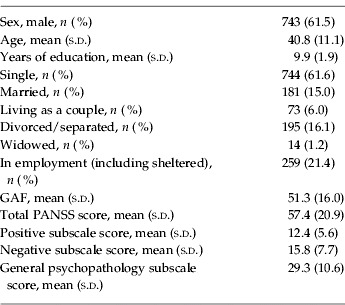
Patients were eligible for the study if they were aged between 18 and 64 years at the time of enrolment in the study, had a diagnosis of schizophrenia according to DSM-IV and had given signed informed consent. Primary and secondary diagnoses were based on the Schedules for Clinical Assessment in Neuropsychiatry (SCAN) interview (Wing et al. Reference Wing, Babor, Brugha, Burke, Cooper, Giel, Jablenski, Regier and Sartorius1990). Patients were excluded from the study if they had been hospitalized for the 12 months prior to the initial interview, were currently homeless, or were planning to move during the study period in a way that made it impossible to perform the follow-up visits. The sample comprised 1208 patients, 302 from the UK, 287 from France, and 619 from Germany. Most were long-term patients (time since first contact with psychiatric services: mean 14.4 years, s.d.=10.1), and almost all had been admitted to a psychiatric ward at least once (94.5%). Details of the sample are given in Table 1. Five interviews were sought with each participant: at initial assessment and every 6 months for the subsequent 2 years. A total of 1024 participants took part at the second interview, 962 at the third, 861 at the fourth, and 810 at the final interview. All available data (including those from participants who did not complete all interviews) were included in our analyses.
Sample characteristics at baseline (n=1208)

GAF, Global Assessment of Functioning; PANSS, Positive and Negative Syndrome Scale; s.d., standard deviation.
Instruments
Of the extensive battery of instruments used in the EuroSC, only those relevant to the present study are presented.
Dependent variables
Victim status and subjective feelings of safety were established from items in the Lehman Quality of Life interview (Lehman, Reference Lehman1983). During this structured interview, respondents were asked whether, in the past 6 months, they had been the victim of ‘any violent crimes such as assault, rape, mugging, or robbery’, and ‘any non-violent crimes such as burglary, theft of your property or money, or being cheated’. Information was thus gathered for a period of 2.5 years. The subjective appraisal of personal safety was assessed with three questions. Respondents had to state how they felt about how safe they were on the streets of their neighbourhood, how safe they were in their homes, and how protected they felt against being robbed or attacked. Answers were recorded on a seven-point Likert scale anchored with 1=‘terrible’ and 7=‘delighted’. As answers to the three questions correlated highly (α at t1–t5=0.79–0.84) and principal component analysis revealed a single factor loading on all three items, we combined them into a single measure of subjective safety by calculating the mean answer score. The subjective safety scale generated in this way has been used and characterized previously (Lehman, Reference Lehman1983) with similar internal consistency (α=0.76).
Independent variables
Interviewers classified participants' community of residence based on the respondents' postal address as rural (<10 000 inhabitants), small urban (10 000–100 000 inhabitants) and large urban (>100 000 inhabitants). Using this assessment (instead of classifying the whole of each study centre), we could take account of the possibility that people from rural areas might receive out-patient treatment from a centre located in a larger city.
Two other items from the Lehman Quality of Life interview were used. We assessed whether participants were themselves perpetrators of criminal assaults by asking them how many times they had been arrested for offences during the past 6 months. With regard to their financial situation, we asked participants whether they generally had enough money during the past 6 months to cover five requisites: food, clothing, housing, travelling around the city, and social activities. We calculated the mean value of all five items, converting it to a score between 0 and 1. Information from the SCAN interview allowed the construction of a dichotomous variable denoting abuse of alcohol or illegal substances during the year prior to the study. This information was elicited only at the initial interview; hence, no variation in drinking or substance use patterns during the follow-up period could be assessed.
Symptoms were assessed with the Positive and Negative Syndrome Scale (PANSS; Kay, Reference Kay1991). This scale comprises 30 items, each rated as a seven-point scale of severity. There are detailed instructions for conducting the clinical interview on which the ratings are based, and a glossary of individual items (Kay et al. Reference Kay, Fiszbein and Opler1987). Seven items provide an overall positive syndrome score, seven a negative syndrome score, and 16 a general measure of psychopathology. Inter-rater reliability has been reported as good (Norman et al. Reference Norman, Malla, Cortese and Diaz1996). For the purpose of analysis, values in all three dimensions were divided by the number of respective items, resulting in final scores from 1 to 7. Other variables elicited were employment (including sheltered employment) and years of education.
Statistical analysis
Objective violent and non-violent victimhood and estimates of subjective safety were entered as dependent variables into regression analyses. In addition to the type of residential area, we included country of residence and patient characteristics known to predict victimhood as independent variables in order to control their effects. For subjective safety, we used a between-effect error component regression model for unbalanced panel data. This model estimates the influence of interpersonal differences in independent variables measured at several time-points on a dependent variable measured at the equivalent time-points. Thus, because very few respondents moved between urban and rural areas of residence during the study period, the model's focus is on differences between persons (between effects). Error component regression models calculate generalized least square regression coefficients. For the dichotomous variables indicating violent and non-violent victimhood, we computed population-averaged logistic regression models for panel data that calculate odds ratios. Relative to cross-sectional data, the repeated measurement enhances the reliability and the statistical power of the models tested. Calculations were carried out using stata version 9.2 (Stata Corporation, College Station, TX, USA).
Results
One in 10 respondents reported at least one violent assault during the 2.5-year study period, and one in five at least one example of non-violent victimhood (Table 2). Victim status was more frequent in large urban areas than in rural areas, with small urban areas yielding rates similar to larger areas for violent crimes, and to rural communities for non-violent crimes.
Patients reporting victimhood by a violent or non-violent crime during the 2.5-year study period, broken down by residential area

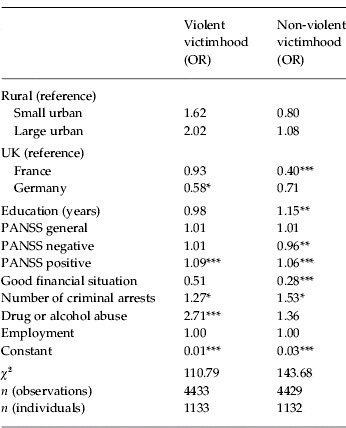
Table 3 shows the results of the logistic regression analysis for violent and non-violent victim status. Although odds ratios for violent victimhood were increased in small and large urban areas compared to rural areas, the differences were not significant. There was no difference between residential areas for non-violent victimhood. Violent victimhood was less likely in Germany than in the UK, and was associated with higher PANSS positive scores. An increase in a PANSS positive score of 1 point led to a 9% increase in the probability of violent victimhood and of 6% in non-violent experiences. Those participants who had themselves been arrested were more likely to have been a victim of violent assaults. The strongest predictor of violent victimhood was drug or alcohol abuse during the year prior to the study. Thus some behaviours of the participants were associated with the violent behaviour of others towards them. Non-violent victimhood was predicted by different variables: it was less likely in France than in the UK and more frequently reported by the better-educated patients. Positive symptoms were associated with non-violent victimhood, negative symptoms inversely so. This sort of victim status was much less frequent in those living in good financial circumstances. Again, patients who had themselves been arrested were more likely to be the victims of non-violent crime.
Violent and non-violent victimhood regressed on residential area, country of residence and patient characteristics. Logistic regression model, odds ratios (ORs)

PANSS, Positive and Negative Syndrome Scale.
* p<0.05, ** p<0.01, *** p<0.001.
The negative ratings on the seven-point scale for subjective safety suggest that 12.7% of patients were unsatisfied with their safety at home, 22.0% felt unsafe on the streets, and 22.7% felt they had insufficient protection against being robbed or attacked. Mean values at baseline for the combined subjective safety scale were similar for residents in small and large urban areas (small urban, 4.8, s.d.=1.4; large urban, 4.9, s.d.=1.3), but higher in rural communities (5.3, s.d.=1.2).
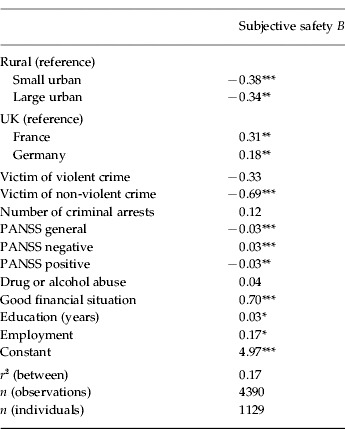
Table 4 reports the regression model for subjective feeling of safety. In this linear model, coefficients represent the predicted differences in answer scores compared to the reference category, adjusting for all other variables. The constant represents the predicted score for the reference category. Thus, living in non-rural areas reduced subjective safety by between 0.34 and 0.38 points on the seven-point scale. French and, to a lesser extent, German patients reported a greater subjective sense of safety than those living in the UK. While the experience of non-violent crime was one of the strongest predictors of subjective safety, reducing subjective safety by 0.69 points, it is incapable of explaining its impairment in urban settings. The respondents’ financial situation was also important: good financial standing increased perceived safety by 0.7 points. An increase of 1 point on the PANSS general and positive scales was associated with a small but statistically significant impairment in subjective safety by 0.03 points. Negative symptoms, by contrast, predicted the appraisal of slightly better safety. Higher education and employment were also associated with marginally better subjective safety. The value of the constant shows that overall perception of safety was in the favourable half of the seven-point scale.
Subjective safety regressed on residential area, country of residence, violent and non-violent victimhood and patient characteristics. Between-effects error component regression analysis, standardized regression coefficients (B)

PANSS, Positive and Negative Syndrome Scale.
* p<0.05, ** p<0.01, *** p<0.001.
Discussion
Criminal victimization
Drawing on a large international sample of schizophrenia patients who were examined on five occasions over a 2-year period, our study was unable to demonstrate significant urban/rural differences in criminal victimization. Although odds ratios for violent victimhood did increase somewhat with city size, this was not significant in our logistic regression model. The sole evidence of social factors shaping the criminal risk of schizophrenia patients was the protective influence of a good financial situation on non-violent crimes.
Our results corroborate individual attributes of criminal victims identified in previous studies, namely drug or alcohol abuse (Hiday et al. Reference Hiday, Swartz, Swanson, Borum and Wagner1999; Brekke et al. Reference Brekke, Prindle, Bae and Long2001; Walsh et al. Reference Walsh, Moran, Scott, McKenzie, Burns, Creed, Tyrer, Murray and Fahy2003; Honkonen et al. Reference Honkonen, Henriksson, Koivisto, Stengard and Salokangas2004) and being the perpetrator of a crime (Walsh et al. Reference Walsh, Moran, Scott, McKenzie, Burns, Creed, Tyrer, Murray and Fahy2003; Honkonen et al. Reference Honkonen, Henriksson, Koivisto, Stengard and Salokangas2004; Fitzgerald et al. Reference Fitzgerald, de Castella, Filia, Filia, Benitez and Kulkarni2005). Higher education made reporting of non-violent crimes more likely; although surprising at first glance, this was also found by Hiday et al. (Reference Hiday, Swartz, Swanson, Borum and Wagner1999). She attributed it to an increased readiness in better-educated persons to define certain incidents as crimes.
We also found that the level of positive psychotic symptoms was associated with the experience of violent and non-violent crime. This might arise because the more disturbed patients were more vulnerable to crime, but also because the experience of being a victim leads to a traumatic enhancement of positive symptoms. A third possibility would be over-reporting of criminal incidents due to paranoid delusions.
The overall prevalence of violent and non-violent victimhood during the 2.5-year period covered by our interviews places our sample from the UK, France and Germany between the very low rates reported from Finland (Honkonen et al. Reference Honkonen, Henriksson, Koivisto, Stengard and Salokangas2004) and the high rates found in urban Los Angeles (Brekke et al. Reference Brekke, Prindle, Bae and Long2001) during a similar time period. The national differences evident from our data must be interpreted with caution, as our samples were representative not of the countries but of the specific study sites.
Perception of personal safety
In marked contrast to objective criminal victimhood, the subjective sense of safety was clearly impaired in the urban environments in our study. Hence, although urban living was not significantly associated with objective security threats, patients feel more threatened. As the reported associations are adjusted for actual victimhood experience, it becomes clear that subjective safety arises less from an absence of crime than from a complex appraisal of one's situation. In this context, it is of interest that the impact of personal experience on the sense of safety arises more from non-violent than violent victimization. The patients' unfavourable appraisal of their security in urban areas is likely to trigger stress and anxiety, and contribute adversely to the course of the illness. The concept of social capital offers a theoretical framework for this by incorporating shared beliefs about the local personal environment that exert a tonic effect on a general sense of well-being (McKenzie et al. Reference McKenzie, Whitley and Weich2002). Colletta & Cullen (Reference Colletta and Cullen2000) have distinguished between structural and cognitive elements of social capital. A collective sense of safety is clearly related to one of the theoretical strands supporting the idea of social capital (Lochner et al. Reference Lochner, Kawachi and Kennedy1999), that of trust and reciprocity, which is essentially part of the cognitive element of social capital. Attitudes towards the aspects of the environment that influence personal safety may have a specific bearing on the modulation of beliefs that maintain negative schemas in psychosis (Fowler et al. Reference Fowler, Freeman, Smith, Kuipers, Bebbington, Bashforth, Coker, Gracie, Dunn and Garety2006; Smith et al. Reference Smith, Fowler, Freeman, Bebbington, Bashforth, Garety, Dunn and Kuipers2006).
The sense of safety was associated with the positive and general PANSS subscores, and, inversely, with negative symptoms. This might mean that a reduced sense of safety is merely symptomatic, but it could equally be part of appraisal processes that shape the symptoms themselves (Birchwood, Reference Birchwood2003; Lobban et al. Reference Lobban, Barrowclough and Jones2004; Fialko et al. Reference Fialko, Freeman, Bebbington, Kuipers, Garety, Dunn and Fowler2006; Watson et al. Reference Watson, Garety, Weinman, Dunn, Bebbington, Fowler, Freeman and Kuipers2006). There is increasing evidence from the life event and trauma literature that situations implying danger, threat and a disrupted sense of security are associated with an increment in positive symptoms (Hardy et al. Reference Hardy, Fowler, Freeman, Smith, Steel, Evans, Garety, Kuipers, Bebbington and Dunn2005; Raune et al. Reference Raune, Bebbington, Dunn and Kuipers2006). Moreover, appraisals of danger may lead to safety behaviours that themselves increase the chronicity of delusional ideas (Morrison, Reference Morrison2001; Freeman et al. Reference Freeman, Garety, Kuipers, Fowler, Bebbington and Dunn2007).
The substantial influence of the respondents' financial situation on subjective safety merits discussion. The items we used to elicit financial means measured not wealth, but the ability to afford basics such as food, clothing and housing, as well as transport and some social activities. This corresponds to a situation close to poverty. The impact of insufficient financial means on subjective safety may indicate that structural inequalities increase stress and anxiety in schizophrenia patients, ultimately leading to a worse prognosis (Kelly, Reference Kelly2005; Salize, Reference Salize2006). However, it is also possible that poverty is acting as a proxy for more general aspects of a deprived environment. Moreover, poverty is a variable at the individual level, but may also operate at a social level. In areas where one's neighbours are also poor, this may impinge on beliefs contributing to the sense of social capital. If it is the poverty of the individual that shapes a reduced sense of safety, additional resources might improve things. However, if individual poverty contributes to a sense of general deprivation, it may merely form a small portion of the influences on a perception of lowered capital, and the amelioration of individual poverty might then not improve the sense of safety.
Limitations
Some limitations of our study need consideration. First, the specific hypotheses addressed in our analysis arose ex post facto. Although the EuroSC was designed to address quality of life in schizophrenia patients, the study was not specifically arranged to elicit victimhood experiences. Hence we did not complement the questions of the Lehman inventory with a more detailed account of the individual's victimization experience, and under-reporting of criminal incidents may thus have affected our analysis. In general, accounts of patients with serious mental illness about previous victimization have been found reliable (Goodman et al. Reference Goodman, Thompson, Weinfurt, Corl, Acker, Mueser and Rosenberg1999), and because official records of criminal incidents such as police reports are known to underestimate the amount of crime and victimhood (Hiday et al. Reference Hiday, Swartz, Swanson, Borum and Wagner1999), self-reports appear to be a better option.
We also lacked data differentiating victimhood further than into violent and non-violent incidents. More detailed information about the nature of the crimes occurring particularly frequently in this group would be helpful. Thus, Silver et al. (Reference Silver, Arseneault, Langley, Caspi and Moffitt2005) in their examination of a birth cohort in New Zealand found that people with schizophrenic symptoms were more likely to experience threatened and completed physical assault, but were less likely to suffer from sexual assaults than those with no psychiatric illness.
The focus of our study is the possible determinants of criminal victimization and subjective safety within a population of people with schizophrenia. As our data did not include a group of healthy controls, a comparison of the victimhood rates found with those of the general population is not possible.
Finally, our analyses were not concerned with changes over time, and thus did not formally allow conclusions about causality. This is because almost no variance occurred in the respondents' area of residence during the study period, and our analyses therefore focused on differences between persons rather than on intra-personal changes.
Conclusion
Violent and non-violent victimhood in patients with schizophrenia occurred frequently during the 2.5-year period covered by our interviews. A relationship between victim status and residential area was not confirmed, but subjective safety was clearly worse in towns and cities than in rural areas. Overall, objective safety and subjective safety of schizophrenia patients are related to different factors.
Acknowledgements
This study was funded by an unrestricted research grant from Lundbeck A/S and a grant from the German Federal Ministry of Education and Research in the framework of the Research Association Public Health Saxony (grant no. 01EG9732/7).
Declaration of Interest
M. C. A., P. E. B., J.- M. A. and T. B. received indirect support (in honoraria and travel funds) from Lundbeck A/S to participate in project managing meetings.