Romantic relationships are an important and integral part of human life: they foster deep and meaningful fulfillment of an individual's desire for a sense of belonging (Baumeister & Leary, Reference Baumeister and Leary1995). However, not all romantic relationships act as a source of deep connection (Tan, Agnew, VanderDrift, & Harvey, Reference Tan, Agnew, VanderDrift and Harvey2015). In such cases, many individuals may become involved in more than one romantic relationship over the course of their lifetime, as they strive to satisfy their need to belong (Baumeister & Leary, Reference Baumeister and Leary1995). How do individuals who have been involved in more than one relationship evaluate their current relationship in light of past ones? Relationship research often considers the formation of new relationships as completely removed from past relationships (Rodriguez, Øverup, Wickham, Knee, & Amspoker, Reference Rodriguez, Øverup, Wickham, Knee and Amspoker2016; cf. Kelley & Thibaut, Reference Kelley and Thibaut1978; Rusbult, Reference Rusbult1980). However, Spielmann, Joel, MacDonald, and Kogan (Reference Spielmann, Joel, MacDonald and Kogan2013) showed that an individual's memory of their former partner may play a role in their evaluation of relationship alternatives and, in turn, relationship quality (e.g., satisfaction). Therefore, exploration of the impact of past relationships on current ones could have important implications for how people think about and evaluate their own relationships.
Existing literature on social comparisons in relationships has focused on comparing one's relationship with other people's relationships (e.g., Broemer & Diehl, Reference Broemer and Diehl2003; Buunk, Reference Buunk2006; Morry & Sucharyna, Reference Morry and Sucharyna2016; Smith LeBeau & Buckingham, Reference Smith LeBeau and Buckingham2008) or comparing oneself with one's partner (e.g., Derrick & Murray, Reference Derrick and Murray2007; Pinkus, Lockwood, Schimmack, & Fournier, Reference Pinkus, Lockwood, Schimmack and Fournier2008; Thai & Lockwood, Reference Thai and Lockwood2015; Thai, Lockwood, Pinkus, & Chen, Reference Thai, Lockwood, Pinkus and Chen2016). However, there is limited research pertaining to relationship social comparisons in terms of individuals comparing partners across their own different relationships. As an individual navigates their romantic relationship, they may come across information pertaining to their current partner's previous romantic partner, and they may also be exposed to information regarding their own ex-partner and that person's current romantic partner. This information may include verbal stories about the particular person, photographs or their online profiles, and the sources of such information may be direct (e.g., the current or former partner) or indirect (e.g., common friends or acquaintances, social media). This access to information about a current partner's ex-partner or an ex-partner's current partner may allow individuals to evaluate them over a range of potential domains (e.g., physical attractiveness, personality, lifestyle, success). For many individuals, especially those who are in satisfying romantic relationships, information regarding a current partner's ex-partner and an ex-partner's current partner may have minimal impact upon them, as they are able to recognise that these relationships are in the past; instead, they focus on their own current relationship. However, individuals who are typically insecure in their relationship and sensitive to relationship threat may be especially likely to use the information as a standard of comparison for relationship evaluations. These characteristics are typical of individuals high in attachment anxiety.
Attachment Theory in Romantic Relationships
The ways in which adult attachment styles have been conceptualised and measured by researchers have evolved across time (Fraley, Reference Fraley2019). Hazan and Shaver's (Reference Hazan and Shaver1987) early research on adult attachment suggested that individuals belong to one of three categories of attachment: secure, avoidant, or anxious-ambivalent. Building from this theory, Bartholomew and Horowitz (Reference Bartholomew and Horowitz1991) introduced a different, four-category model based on the combination of individuals’ representational models of themselves and others. The pattern of the valence of both of these respective models determined the category of attachment style to which individuals belonged: secure (positive models of self and other), preoccupied (negative model of self and positive model of other), dismissing (positive model of self and negative model of other), or fearful (negative models of self and other; Bartholomew & Horowitz, Reference Bartholomew and Horowitz1991). The latter two categories are also known as dismissing-avoidant and fearful-avoidant.
Although categorical conceptualisations of adult attachment became widely accepted and implemented, the limitations of these models also became apparent (Fraley, Reference Fraley2019). For example, some research highlighted the unreliable nature of the classifications, the implication that attachment styles are mutually exclusive, and the conceptual disregard for within-category variability (Gillath, Karantzas, & Fraley, Reference Gillath, Karantzas and Fraley2016). As researchers began to accumulate evidence that attachment style does not fit a taxonomic model and that instead individuals differ in attachment security on a continuous scale (Fraley & Waller, Reference Fraley, Waller, Simpson and Rholes1998), the consensus after over 30 years of research on adult attachment is that individual differences in attachment patterns are best conceptualised and measured using dimensional models of attachment style (Fraley, Reference Fraley2019; Gillath et al., Reference Gillath, Karantzas and Fraley2016). The two dimensions are attachment avoidance and attachment anxiety (see Fraley, Reference Fraley2019, and Gillath et al., Reference Gillath, Karantzas and Fraley2016, for reviews).
Initial experiences of close relationships often shape individual differences in attachment avoidance and anxiety (Gillath et al., Reference Gillath, Karantzas and Fraley2016). The avoidance dimension highlights the extent to which people are at ease with intimacy and one's capacity to depend on intimate others (Stanton & Campbell, Reference Stanton and Campbell2015). Individuals who score high on attachment avoidance tend to be less devoted in their romantic relationships and wish to stay emotionally autonomous from their partners (Dandurand, Bouaziz, & Lafontaine, Reference Dandurand, Bouaziz and Lafontaine2013). The anxiety dimension evaluates the degree to which individuals are concerned with being abandoned or rejected by their romantic partners (Murray & Hazelwood, Reference Murray and Hazelwood2011). Individuals who score high on attachment anxiety tend to be less secure in their relationships; they crave affection from their partner while simultaneously being sceptical of their partner's love (Dandurand et al., Reference Dandurand, Bouaziz and Lafontaine2013). As noted above, individuals vary on these dimensions; broadly speaking, those who are high in either one are classified as insecurely attached, and those who are low on both dimensions are deemed securely attached (Gillath et al., Reference Gillath, Karantzas and Fraley2016; Mikulincer & Shaver, Reference Mikulincer and Shaver2007).
The present research focuses on the interplay of personal and relationship factors that are driven by the anxiety dimension of attachment style. The avoidance dimension is not being considered due to the emotional distance individuals high in attachment avoidance exhibit in relationships (Dandurand et al., Reference Dandurand, Bouaziz and Lafontaine2013). There is no reason to expect avoidantly attached individuals to use other relationships as a standard of comparison for current relationships, or to have amplified sensitivity toward potential relationship threats (Moreira, Reference Moreira2011).
Attachment Anxiety and Relationship Quality
Considerable research has demonstrated that high levels of attachment anxiety in one or both romantic partners can undermine relationship quality (Overall, Girme, Lemay, & Hammond, Reference Overall, Girme, Lemay and Hammond2014). Individuals high in attachment anxiety harbour ingrained fears of rejection and abandonment by their partners, promoting feelings of uncertainty and doubts about the relationship (Overall et al., Reference Overall, Girme, Lemay and Hammond2014). As a result of this fear, the attachment systems of anxiously attached individuals become hyperactivated, characterised by enduring proximity-seeking behaviours toward their partner in order to achieve their desired sense of acceptance (Moreira, Reference Moreira2011). For example, anxiously attached individuals bring up their relationship more frequently in regular conversations with their partner, persistently seek affirmation of their partner's affection, and only tend to feel reassured about their relationship when their partner expresses explicit positive regard toward them (Overall et al., Reference Overall, Girme, Lemay and Hammond2014).
Simpson (Reference Simpson1990) proposed that despite their longing for steady, supportive relationships, the uncertainty that individuals high in attachment anxiety face concerning the stability of their relationships incites a sense of ambivalence toward both their relationships and their partners. Accordingly, individuals with high levels of attachment anxiety often identify as being in steady but dissatisfying dating relationships (Campbell, Simpson, Boldry, & Kashy, Reference Campbell, Simpson, Boldry and Kashy2005). The dissatisfaction experienced by these anxiously attached dating individuals extends to lower levels of marital satisfaction and sexual satisfaction in studies with anxiously attached married individuals (Butzer & Campbell, Reference Butzer and Campbell2008). In sum, individuals with higher levels of attachment anxiety experience relationship uncertainty and dissatisfaction more intensely than individuals with lower levels of attachment anxiety. Such experiences of uncertainty are inherently associated with the notion of social comparison (Smith LeBeau & Buckingham, Reference Smith LeBeau and Buckingham2008).
Attachment Anxiety and Social Comparisons
There is limited literature about individual differences in social comparison tendencies based on adult attachment orientation. In his original article, Festinger (Reference Festinger1954) outlined that uncertainty is a prerequisite to making social comparisons in general; it is under circumstances of doubt about one's abilities and opinions that the motivation for comparing to others arises. Additionally, individuals who experience uncertainty about the self are particularly interested in social comparison (Wayment & Taylor, Reference Wayment and Taylor1995). As individuals with high levels of attachment anxiety hold less positive and more uncertain evaluations of the self compared to individuals with low levels of attachment anxiety (Stanton & Campbell, Reference Stanton and Campbell2015), it follows that anxiously attached individuals may find social comparison particularly appealing.
It is useful to consider the role of attachment anxiety when examining the nature of two forms of social comparisons that may exist in romantic relationships: personal social comparisons (i.e., comparisons of oneself to another person on a particular evaluative dimension) and relationship social comparisons (i.e., comparisons of one's relationship to another's on a particular evaluative dimension). When considering personal social comparisons, individuals with a negative perception are often inclined to make more upward comparisons (i.e., self is inferior to others), and those with a positive self-perception tend to make more downward comparisons (i.e., self is superior to others) (Gibbons & Buunk, Reference Gibbons and Buunk1999). These comparisons often serve to maintain self-perceptions (Wheeler & Miyake, Reference Wheeler and Miyake1992). Correspondingly, individuals with low self-esteem and more prominent feelings of jealousy tend to make more upward comparisons and fewer downward comparisons (Morry & Sucharyna, Reference Morry and Sucharyna2016). As individuals with high levels of attachment anxiety often have low self-esteem and demonstrate sensitivity toward potential signs of rejection (Stanton & Campbell, Reference Stanton and Campbell2015), it is expected that these individuals will show a similar proclivity toward making upward comparisons with individuals who are viewed as a potential threat to the relationship.
Further, because anxiously attached individuals demonstrate hypervigilance toward relationship threats (Stanton & Campbell, Reference Stanton and Campbell2015), if the target of comparison is viewed as a potential threat to the relationship, then experiences of doubt may motivate anxiously attached individuals to make more comparisons to such a target. Such feelings of uncertainty might elicit not only more frequent personal comparisons but also more frequent relationship comparisons. For example, if an individual is unsure of how much time should be spent with their partner, they may look to others’ relationships as a reference point for evaluation (Morry & Sucharyna, Reference Morry and Sucharyna2016). Building from the idea that uncertainty is associated with frequency of social comparisons in general (Butzer & Kuiper, Reference Butzer and Kuiper2006), Smith LeBeau and Buckingham (Reference Smith LeBeau and Buckingham2008) examined relationship social comparison frequencies in the context of relationship insecurity. They found that the frequency of relationship social comparisons was positively correlated with relationship insecurity, attachment anxiety and low self-esteem, and negatively correlated with relationship satisfaction. Given previous associations between uncertainty and attachment anxiety, it is expected that individuals with higher levels of attachment anxiety will make more frequent relationship social comparisons than individuals with lower levels of attachment anxiety.
Attachment Anxiety and Comparisons Across Relationships
To date, the existing literature on social comparisons in relationships has not focused on comparing partners across their own different relationships (e.g., comparing themselves to their partner's ex-partner, comparing themselves to their ex-partner's current partner), perhaps due to limited access to information about these individuals. However, with the advent of social media, the availability of information about others has become increasingly accessible, facilitating online surveillance of potential relationship threats (Tokunaga, Reference Tokunaga2016).
Why might such individuals be inclined to make comparisons across romantic relationships? Although Festinger (Reference Festinger1954) originally suggested that social comparison is a passive process, and Gilbert, Geisler, and Morris (Reference Gilbert, Giesler and Morris1995) posited that social comparisons occur automatically, other research suggests that some social comparisons arise through a motivated process in which individuals have the capacity to select a target of comparison (Major, Testa, & Bylsma, Reference Major, Testa, Bylsma, Suls and Wills1991; Wood, Reference Wood1989). In this context, individuals may choose a particular relationship target when they want to feel better about their self/relationship (i.e., a downward comparison target) or when they want to get ideas about how to be better/have better relationships (i.e., an upward comparison target; Buunk, Collins, Taylor, VanYperen, & Dakof, Reference Buunk, Collins, Taylor, VanYperen and Dakof1990). Accordingly, social comparisons can serve beyond a means of self-evaluation or relationship evaluations by also functioning as a means of self-enhancement and self-improvement (Wood, Reference Wood1989). Individuals have a range of potential targets for personal and relationship comparisons to select from, whether it is a stranger, a friend or a celebrity (Morry & Sucharyna, Reference Morry and Sucharyna2016). For individuals who are motivated to select a target for the purposes of evaluation, it is expected that they may look to their current partner's ex-partner or ex-partner's current partner above friends’ and/or celebrities’ relationships due to the personal relevance of these particular comparison targets (Morry & Sucharyna, Reference Morry and Sucharyna2016). Given that these targets share a (former or current) partner with the individual or their partner, individuals may perceive parallels in their relationship experience and view the targets as a suitable source of comparison.
Comparisons to a current partner's ex-partner
How might individuals acquire information on which to make a comparison to their current partner's ex-partner? One source may be the current partner themselves, via processes of self-disclosure. Self-disclosure refers to the sharing of personal details between partners and is vital to the development and continuation of romantic relationships (Sprecher & Hendrick, Reference Sprecher and Hendrick2004). One aspect of self-disclosure in romantic relationships is divulging information about previous romantic relationships (Cann & Baucom, Reference Cann and Baucom2004). This information provides context for evaluating the relationship (and the self) when an individual is exposed to information pertaining to their current partner's ex-partner. This information exchange can be biased because it is transmitted through only the current partner's perspective (Cann & Baucom, Reference Cann and Baucom2004). Exposure to this (potentially biased) information generates opportunities for individuals to make social comparisons about their current relationship with their partner's past relationship, or about themselves with their current partner's ex-partner.
In general, ex-partners are likely to be regarded as being a minimal threat to the relationship; by exhibiting qualities that class them as a more suitable companion, current partners have (arguably) prevailed over ex-partners in order to establish the present relationship (Cann & Baucom, Reference Cann and Baucom2004). Despite this notion, relationship insecurities related to former romantic partners continue to persist in current partners (Cann & Baucom, Reference Cann and Baucom2004). One reason insecurities persevere may be due to the tendency for individuals high in attachment anxiety to have a lower threshold for perceiving signals of relationship risk, mistaking otherwise ambiguous cues as threats to their relationship (Rodriguez, DiBello, Øverup, & Neighbors, Reference Rodriguez, DiBello, Øverup and Neighbors2015). Additionally, high levels of attachment anxiety are associated with increased rumination about threat-related concerns, leading these individuals to interpret information in a way that serves to confirm negative expectations from attachment figures (i.e., romantic partners) and subsequently catastrophise the relationship's future (Campbell et al., Reference Campbell, Simpson, Boldry and Kashy2005). As a result, individuals high in attachment anxiety may view their current partner's ex-partner as a threat to their own relationship. Subsequently, they may be more inclined to compare themselves and their relationship to their current partner's ex and the relationship that they shared, with the intention to justify or quell anxieties stemming from perceived relationship threat.
Comparisons to an ex-partner's current partner
From a more exploratory angle, there is some evidence to suggest that anxiously attached individuals may feel inclined to compare themselves to their ex-partner's current partner. Relationships research often depicts new relationships as independent of, and unaltered by, past relationships (Rodriguez et al., Reference Rodriguez, Øverup, Wickham, Knee and Amspoker2016; cf. Kelley & Thibaut, Reference Kelley and Thibaut1978; Rusbult, Reference Rusbult1980). In contrast, emerging literature suggests that feelings for current and ex-partners may mutually influence one another (Spielmann et al., Reference Spielmann, Joel, MacDonald and Kogan2013). For example, acquiring a new partner may help accelerate the process of getting over an ex-partner (Spielmann et al., Reference Spielmann, Joel, MacDonald and Kogan2013). Stage models of relationship development and conclusion often posit that the final stage of relationship termination is the dissolution of communication between ex-partners (Rodriguez et al., Reference Rodriguez, Øverup, Wickham, Knee and Amspoker2016). However, contact between ex-partners may continue to occur through either direct or indirect (e.g., electronic surveillance/monitoring) interaction, and joint investments (e.g., children, pets) may also permit continued contact (LeFebvre, Blackburn, & Brody, Reference LeFebvre, Blackburn and Brody2015). Communication between ex-partners may persist even when one or both individuals enter a new romantic relationship, whereby it is expected that there is some degree of disclosure about respective new partners between ex-partners (Rodriguez et al., Reference Rodriguez, Øverup, Wickham, Knee and Amspoker2016). Accordingly, in addition to the information individuals may have access to about their current partner's ex-partner, they may also have access to information about their ex-partner's current partner.
Might some individuals be more inclined to seek out information about their ex-partner's current partner? People who have a negative self-perception and are fearful of rejection may feel particularly threatened by individuals who have an intimate relationship with their past partners. These qualities are typical of individuals with high levels of attachment anxiety (Overall et al., Reference Overall, Girme, Lemay and Hammond2014). For these individuals, forming positive perceptions of their ex-partner's current partner may serve to reinforce personal insecurities, as they may be inclined to believe that should their current relationship end, their current partner will similarly be able to acquire a more desirable alternative partner. Although individuals high in attachment anxiety exhibit poorer emotional adjustment post-relationship dissolution, greater preoccupation with an ex-partner and greater idealisation of ex-partners (Davis, Shaver, & Vernon, Reference Davis, Shaver and Vernon2003), there is limited research investigating anxiously attached individuals’ evaluations of ex-partners’ current partner or current relationship after having entered a new romantic relationship.
The Current Study
The current study aims to explore whether the nature of personal social comparisons and the frequency of relationship social comparisons to an individual's current partner's ex-partner (CPE) or ex-partner's current partner (ECP) is associated with adult attachment style, particularly focusing on the dimension of attachment anxiety. The current study is the first to investigate personal and relationship social comparisons to one's CPE or ECP. Due to the exploratory nature of the current study, it is not expected that there will be CPE versus ECP differences in any of the associations.
Hypotheses
It was hypothesised that in comparison to participants who are relatively low in attachment anxiety, participants who are relatively high in attachment anxiety would: (1) make more upward or lateral personal social comparisons to their CPE/ECP over a range of interpersonal qualities (i.e., have a less positive rating of self compared to target on characteristics such as being kind and patient), (2) make more frequent relationship social comparisons to general others’ relationships, and (3) make more frequent relationship social comparisons to their current partner's past relationship/ex-partner's current relationship.
In addition to the primary hypotheses, and consistent with previous research (Derrick & Murray, Reference Derrick and Murray2007; Mikulincer, Shaver, & Pereg, Reference Mikulincer, Shaver and Pereg2003; Overall et al., Reference Overall, Girme, Lemay and Hammond2014; Stanton & Campbell, Reference Stanton and Campbell2015), it was hypothesised that in comparison to participants who are relatively low in attachment anxiety, participants who are relatively high in attachment anxiety would (4) be more uncertain about their relationship and (5) be less satisfied with their relationship.
Method
Participants
Individuals who identified as being in a romantic relationship (n = 113 first-year students; n = 172 community members) participated in this online study. Undergraduate students received course credit for their participation and community participants were given the opportunity to enter a lottery draw to win one of four $50 gift cards for their participation in the study. Participants were excluded for being in a casual relationship (n = 18), being outliers on the relationship length variable (n = 5), or for failing both attention check questions (n = 3). The final sample included 259 participants (214 female) whose ages ranged from 18 to 57 (M = 23.10, SD = 5.84). Participants’ ethnic background was mostly European (59%), and the majority of participants identified as heterosexual (85%). Most participants were currently in an exclusive dating relationship (66%), and the mean relationship length was 41.07 months (SD = 40.13, range: 1–216 months).
Measures and Procedure
This research was approved by the University of Sydney Human Research Ethics Committee (Project no. 2017/259). Undergraduate students were recruited via the university's research participation system (SONA), and community participants were recruited via snowball sampling through social media networks. Participants completed all measures online using Qualtrics survey software (https://www.qualtrics.com/au/research-core/survey-software/).
Sociodemographic questions
These questions were administered to gather personal demographic information (e.g., age, sex, sexual orientation, ethnicity, level of education, personal annual income) and relationship demographic information (e.g., relationship status, relationship length). Additionally, participants completed a single-item baseline measure of relationship satisfaction (‘How satisfied are you with your relationship right now?’) using a 7-point scale with anchors of 1 (very dissatisfied) and 7 (very satisfied).
Attachment orientation
Attachment orientation was measured with the Attachment Style Questionnaire — Short Form (ASQ–SF; Alexander, Feeney, Hohaus, & Noller, Reference Alexander, Feeney, Hohaus and Noller2001; Karantzas, Feeney, & Wilkinson, Reference Karantzas, Feeney and Wilkinson2010), a 29-item measure of global adult attachment, with 16 items on the avoidance dimension (e.g., ‘I find it difficult to depend on others’; Cronbach's α = .858) and 13 items on the anxiety dimension (e.g., ‘I worry that others won't care about me as much as I care about them’; Cronbach's α = .871) on a 6-point Likert-type scale with anchors of 1 (strongly disagree) and 6 (strongly agree). The ASQ–SF was selected because it focuses on general attachment tendencies as opposed to being a reflection of security in an individual's current relationship (a common criticism of other adult attachment scales such as the frequently used Experiences in Close Relationships Scale — Revised [Fraley, Waller, & Brennan, Reference Fraley, Waller and Brennan2000]).
Relationship uncertainty
Attridge, Berscheid, and Sprecher's (Reference Attridge, Berscheid and Sprecher1998) measure of relationship insecurity was administered to determine the degree of uncertainty participants experience in their current romantic relationship (e.g., ‘I often wonder how much my partner really cares for me’; Cronbach's α = .870). The 15 items were rated on a 6-point Likert-type scale with anchors of 1 (strongly disagree) and 6 (strongly agree).
Relationship satisfaction (RS)
Participants completed a four-item measure of relationship satisfaction (Murray, Homes, & Griffin, Reference Murray, Holmes and Griffin1996b; e.g., ‘I am extremely satisfied with my current romantic relationship’). Participants responded on a 9-point scale with anchors of 1 (not at all true) and 9 (completely true; Cronbach's α = .895.).
Comparison target allocation questions
Participants were asked about their own romantic relationship history and their current partner's romantic relationship history in order to be allocated an appropriate target of comparison for the remaining measures. Participants were asked whether they and their current partner had been in a previous romantic relationship (of a minimum duration of six months) prior to their current relationship. If participants indicated that they and/or their partner had been in a previous relationship, subsequent questions were administered to ascertain participants’ awareness of CPE/ECP. Based on responses to these questions, 81 participants were allocated to the CPE target condition and 26 participants were allocated to the ECP target condition. Participants who met criteria to be allocated to both CPE and ECP conditions were randomly allocated to one of the two conditions. Participants were assigned to the control group (n = 152) for any of the following reasons: both participants and their partner were in their first relationship, participants were unaware of their CPE's identity, participants were unaware of their ex-partner's relationship status, or participants were unaware of their ECP's identity.
Personal social comparisons
All participants completed three variations of Murray, Holmes, and Griffin's (Reference Murray, Holmes and Griffin1996a) Interpersonal Qualities Scale (IQS) to measure perceptions of self, partner, and partner's perception of self (i.e., perceived regard),Footnote 1 respectively. Participants allocated to either the CPE or ECP comparison targets were additionally administered a modified version of the IQS about that target (‘Please indicate how characteristic each of the following traits you believe is characteristic of CPE [ECP]’). These measures were presented in randomised order. Participants rated how characteristic 22 interpersonal attributes (e.g., patient, distant, emotional) and social-exchange commodities (e.g., intelligent, physically attractive) were of each individual on a 9-point scale with anchors of 1 (not at all characteristic) and 9 (completely characteristic). After reverse-coding negative items, means were calculated such that higher numbers indicate more positive evaluations (Cronbach's α-self = .785; Cronbach's α-CPE = .868; Cronbach's α-ECP = .847). A series of difference scores were created to index social comparison; specifically, CPE–IQS and ECP–IQS were each subtracted from Self–IQS. Positive difference scores indicate downward comparisons (i.e., self is rated more positively than target) and negative difference scores indicate upward comparisons (i.e., self is rated less positively than target). These difference scores enabled a covert measure of participants’ social comparison with other individuals in order to minimise reactivity and demand characteristics associated with more explicit measures of social comparison (e.g., ‘How attractive are you compared to your current partner's ex?’).
Relationship social comparisons
All participants completed Smith LeBeau and Buckingham's (Reference Smith LeBeau and Buckingham2008) 24-item Relationship Social Comparison Scale (RSCS), which is a measure of relationship social comparison tendencies (e.g., ‘I compare the things that my partner does for me to what other people's partners do for them’) with ratings on a 5- point scale with anchors of 1 (never) and 5 (always). The scale showed high internal consistency (Cronbach's α = .947). Additionally, participants who were allocated a comparison target received an additional modified version (21 items) of the RSCS focusing on the target of comparison (e.g., ‘I compare how happy I am in my relationship to how happy my partner was with his/her ex in their relationship’ [CPE; Cronbach's α = .944]; ‘I compare the things that my partner does for me to the things my ex does for their current partner’ [ECP; Cronbach's α = .954]). The RSCS and Target RSCS measures assess frequency of comparisons, but not comparison direction (e.g., upward, downward).
Descriptive items
The present study is the first to introduce one's CPE/ECP as potential targets of social comparison. Accordingly, four items were included for those participants allocated a comparison target in order to capture descriptive information about how participants knew about these individuals. Items assessed methods (from a list of options) and frequency (1 = never; 5 = always) of accessing information about CPE/ECP. Participants also rated how often they think about CPE/ECP (1 = never; 5 = always) and how this makes them feel (-3 = much worse about myself than usual; +3 = much better about myself than usual).
Attention checks and suspicion probe
Participants completed two attention check questions that were embedded within two measures. Specifically, they were asked, ‘What is the current month? Respond with “May” regardless of what the current month is’ and ‘For this question, please select “slightly disagree”’. Finally, a series of questions were administered to gauge whether participants were aware the true aims of the study. No participants were identified as being suspicious of the true aims.
Results
Data Analysis Strategy
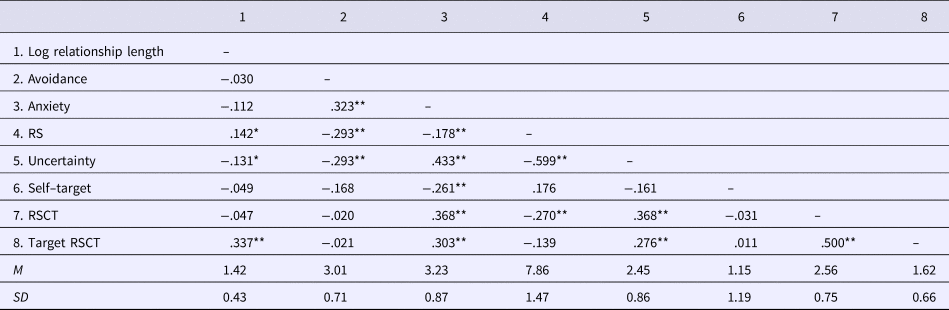
Multiple regression was employed to model attachment anxiety as the primary predictor variable and the target of comparison (CPE, ECP, control) as a moderator variable. Consistent with the attachment style literature, avoidance was included in all analyses to model the effects of anxiety over and above those of avoidance (Overall et al., Reference Overall, Girme, Lemay and Hammond2014). Relationship length and age were significantly correlated (r = .674, p < .01), and there were significant differences between samples for these two variables. Relationship length was also positively correlated with relationship satisfaction and negatively correlated with uncertainty and target relationship social comparison tendencies (see Table 1): the longer the duration of the relationship, the more satisfied and less uncertain individuals were in these relationships, and the less likely they were to make comparisons to relationships involving the target. These findings suggest that the longer an individual has been in a relationship, the less likely they are to feel threatened by the comparison targets. For these reasons, and consistent with past research, the present research controlled for relationship length in all analyses (Overall et al., Reference Overall, Girme, Lemay and Hammond2014). Specifically, the log-transformed relationship length variable was included in all analyses to account for non-normality of the original variable.
Correlations and Descriptive Statistics of Key Variables

Note: RS = relationship satisfaction; RSCT = relationship social comparison tendencies.
*p < .05 (2-tailed) **p < .01 (2-tailed)
Multiple regression analyses involving target of comparison included two dummycoded variables for the target of comparison predictor (CPE, in which CPE = 1, all else = 0; ECP, in which ECP = 1, all else = 0), and continuous variables for attachment orientation. For analyses involving dependent variables pertaining to specific comparison targets (i.e., Hypotheses 1 and 3), the target of comparison moderator simplifies to a CPE versus ECP dummy-coded variable only (because participants in the no-comparison control group were not included in the analyses). Descriptive statistics and intercorrelations among the variables can be found in Table 1.
Multiple Regression Analyses
In all of the analyses, target of comparison was never a significant moderator. Therefore, there were no differences on the basis of the allocated target of comparison.
Personal social comparisons predicted from attachment anxiety (H1)
Participants’ self-IQS ratings (M = 6.46, SD = 0.78) were not correlated with their target IQS ratings (M = 5.26, SD = 1.04; r = .173, p = .073). The regression model accounted for 12% of variance in discrepancies between self and target of comparison IQS ratings, F(5, 101) = 2.74, p = .023. Attachment anxiety was the only significant predictor, such that participants with higher levels of attachment anxiety reported lower discrepancy scores (b = −0.39, t = −2.73, SE = 0.14, p = .008). The mean self–target discrepancy score was positive (see Table 1); on the basis of how the discrepancy scores were operationalised, this finding indicates that overall ratings of self were higher than overall ratings of the allocated target of comparison (i.e., downward comparison). However, the finding that attachment anxiety is a negative predictor of these discrepancy scores indicates that individuals relatively high in attachment anxiety were less likely to rate themselves as superior to the allocated target of comparison (i.e., they made lateral or upward comparisons instead) compared to those relatively low in attachment anxiety.
General relationship social comparisons predicted from attachment anxiety (H2)
The model accounted for 15.7% of variance in frequency of relationship social comparisons, F(7, 248) = 6.61, p < .001. Over and above the effects of attachment avoidance (b = −0.16, t = −2.36, SE = 0.07, p = .019), attachment anxiety was a significant predictor of relationship social comparisons (b = 0.39, t = 5.45, SE = 0.07, p < .001): Higher attachment anxiety predicted more frequent comparisons to other people's relationships, as hypothesised.
Specific relationship social comparisons predicted from attachment anxiety (H3)
The model predicting frequency of social comparisons to the target's relationship from attachment anxiety accounted for 19.5% of variance, F(5, 98) = 4.74, p < .001. Consistent with the hypothesis and over and above the effects of the log of relationship length (b = −0.44, t = −3.19, SE = 0.14, p = .002), participants with higher attachment anxiety reported more frequent relationship social comparisons to their CPE/ECP (b = 0.21, t = 2.71, SE = 0.08, p = .008).
Relationship uncertainty predicted from attachment anxiety (H4)
The model predicting relationship uncertainty from attachment anxiety accounted for 22.2% of variance, F(7, 251) = 10.22, p < .001. Consistent with the hypothesis and over and above the effects of attachment avoidance (b = 0.21, t = 2.94, SE = 0.07, p = .004), attachment anxiety was a significant predictor of relationship uncertainty, with higher attachment anxiety predicting more uncertainty (b = 0.33, t = 4.16, SE = 0.08, p < .001).
Relationship satisfaction predicted from attachment anxiety (H5)
The model accounted for 11.2% of variance in relationship satisfaction, F (7, 254) = 4.43, p < .001. Inconsistent with the hypothesis, this variance was entirely accounted for by the control variables of attachment avoidance (b = −0.41, t = −3.50, SE = 0.12, p < .001) and the log of relationship length (b = 0.35, t = 1.97, SE = 0.18, p = .050).
Descriptive Information about CPE/ECP
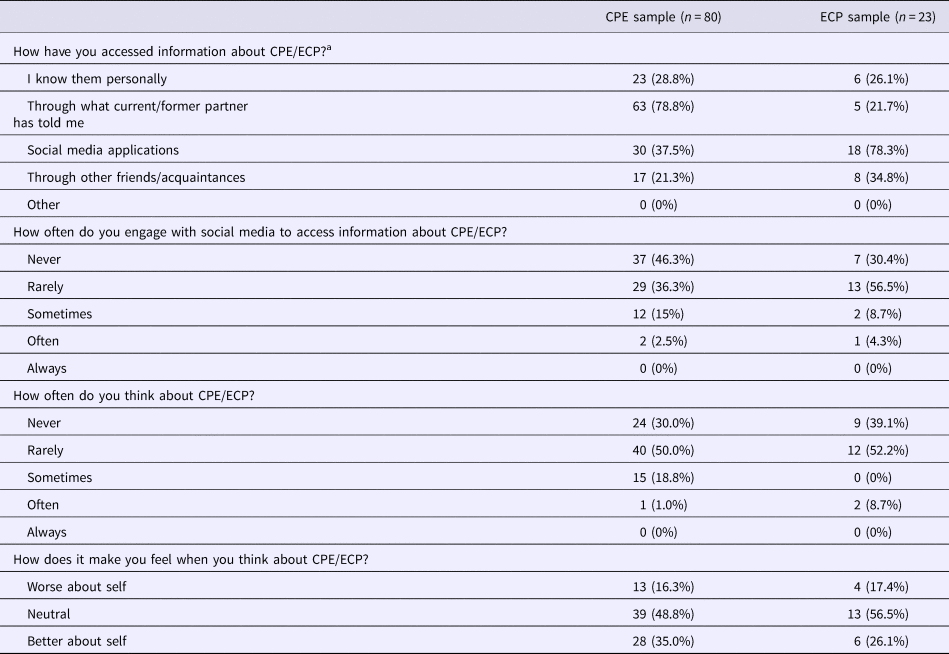
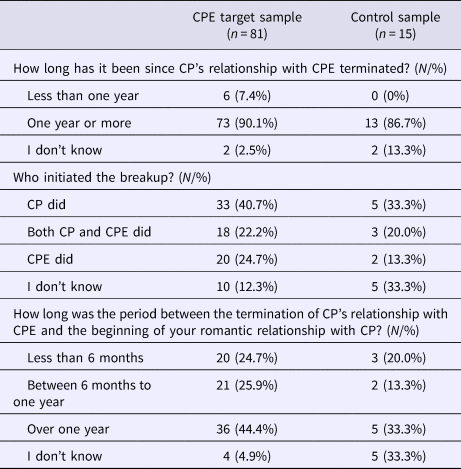
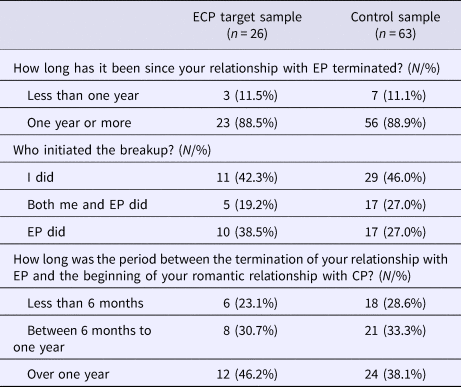
Participants most frequently accessed information about their CPE/ECP through what their current/former partner had told them (66.0%) and through social media applications (46.6%). Most participants reported ‘rarely’ thinking about their CPE/ECP (50.5%) and feeling ‘neutral’ when they do (50.5%). Descriptive statistics of the responses to these items can be found in Table 2, and further context about relationship dissolution can be found in Tables 3 (CPE) and 4 (ECP).
Response Frequencies for Descriptive Items by Sample

Note: aMultiple answers allowed for this item, therefore percentages do not total to 100.
Past Relationship Dissolution Descriptive Statistics — CPE

Note: CP = current partner; CPE = current partner's ex-partner. In the actual study, CP and CPE were replaced with the self-reported initials of this individual. Questions were administered prior to allocation to condition; control sample refers to participants who ultimately were allocated no target as result of their answers to allocation questions.
Past Relationship Dissolution Descriptive Statistics – ECP

Note: CP = current partner; EP = ex-partner. In the actual study, CP and EP were replaced with the self-reported initials of this individual. Questions were administered prior to allocation to condition; control sample refers to participants who ultimately were allocated no target as result of their answers to allocation questions.
Discussion
The current study aimed to explore whether the nature and frequency of personal and relationship social comparisons to an individual's current partner's ex-partner (CPE) or ex-partner's current partner (ECP) were associated with adult attachment style, particularly focusing on the anxiety dimension. The results of the present study mostly support the hypotheses proposed. Consistent with Hypothesis 1, the current study found that over a range of interpersonal qualities, individuals with higher levels of attachment anxiety evaluated themselves less positively than their CPE/ECP compared to those with lower levels of attachment anxiety. Interestingly, the study revealed that the average participant made downward comparisons (i.e., self is superior to others) to their CPE/ECP. Anxiously attached individuals’ ratings, however, were less superior to their CPE/ECP when compared to their low anxiety counterparts. These findings suggest that anxiously attached individuals may be making lateral (i.e., self is the same as others) or upward comparisons (i.e., self is inferior to others) to their CPE/ECP. Specifically, anxiously attached individuals show proclivities toward making upward comparisons to others, as they tend to have a negative model of self and a positive model of others (Gillath et al., Reference Gillath, Karantzas and Fraley2016; Mikulincer et al., Reference Mikulincer, Shaver and Pereg2003). These internal working models may manifest in the context of comparisons to one's CPE/ECP insofar as they bias anxiously attached individuals to view their positively regarded CPE/ECP as a reference point for evaluation, serving to reinforce negative (or less positive) self-perceptions. It is important to note that the consequences of upward comparisons are not always detrimental (Buunk et al., Reference Buunk, Collins, Taylor, VanYperen and Dakof1990). For example, an upward comparison may provide a source of optimism about the potential to improve the self (Major et al., Reference Major, Testa, Bylsma, Suls and Wills1991). However, research suggests that low self-esteem (which is correlated with attachment anxiety; Gillath et al., Reference Gillath, Karantzas and Fraley2016) may bias individuals to focus on the more negative aspect of upward comparisons (Taylor, Buunk, & Aspinwall, Reference Taylor, Buunk and Aspinwall1990). This focus on the negative interpretation of upward comparisons is consistent with anxiously attached individuals’ tendency to seek information that confirms their negative self-views (Gillath et al., Reference Gillath, Karantzas and Fraley2016).
The current study suggested that individuals with higher levels of attachment anxiety report more frequent relationship social comparisons both to general others’ relationships (Hypothesis 2), as well as to their current partner's past relationship or ex-partner's current relationship (Hypothesis 3). Consistent with previous literature that highlights the positive association between uncertainty and frequency of social comparisons (Butzer & Kuiper, Reference Butzer and Kuiper2006), feelings of relationship uncertainty common in anxiously attached individuals may propel these individuals to evaluate how their own relationship fares relative to others’ relationships (Smith LeBeau & Buckingham, Reference Smith LeBeau and Buckingham2008). For individuals who are motivated to make more relationship social comparisons, looking to their own, or their partner's, former relationship may be more appealing than looking to that of their friends or others, due to the personal relevance of these targets (Morry & Sucharyna, Reference Morry and Sucharyna2016). It is worth noting that the direction of these comparisons (e.g., upward, downward) is not clear because the relationship comparison measures did not assess comparison direction. Thus, these more frequent comparisons on the part of anxiously attached individuals could be to relationships that are evaluated as better, worse, or the same as one's current relationship. Further, in the context of the overall sample, the average frequencies of relationship social comparisons were low, with values roughly corresponding to the labels ‘somewhat’ (general others’ relationships) and ‘rarely’ (target relationships; see Table 1).
The present research is the first to highlight that individuals make social comparisons to their CPE/ECP about themselves and their romantic relationships. This finding begs the question: Why might people be interested in these particular individuals? For some individuals, making comparisons to their CPE/ECP may function as self-enhancement, in which they make downward comparisons to these targets in order to feel better about themselves and their relationship (Wood, Reference Wood1989). This notion was reflected in the current study, as, on average, participants were viewing themselves as superior to their CPE/ECP. However, for individuals who are uncertain in their relationships, these specific targets may serve as a potential threat to their relationship. Particularly, Major et al. (Reference Major, Testa, Bylsma, Suls and Wills1991) claim that comparisons may be most threatening when the target person is similar and the dimension being evaluated is important. An individual's CPE/ECP can be viewed as similar to the individual insofar as they share experiences with the same romantic partner, and important, as the dimensions of comparison (interpersonal qualities and relationship evaluations) are related to the self. Therefore, as one's CPE/ECP can be perceived as self-relevant, it follows that individuals may find these targets to be particularly threatening.
Feelings of threat in relation to one's CPE/ECP may be amplified in individuals with high levels of attachment anxiety. The current study demonstrated that disclosure by a current or former partner was a routine source through which individuals acquired information about their CPE/ECP. Individuals with higher levels of attachment anxiety tend to have a low threshold for perception of relationship threats (Stanton & Campbell, Reference Stanton and Campbell2015), and as such, may view communication about past or current partners as a potential threat to themselves and their current relationship. For anxiously attached individuals receiving information about their CPE from their partner, this may be particularly threatening to their relationship, as communication about these individuals may be interpreted as an indication of their partner's sustained investment and interest in the former partner. This may serve to set off a cycle of comparison between the self and the CPE or their partner's past relationship.
However, it is important to recognise that the nature and frequency of this disclosure by current or former partners may have an impact on the extent to which individuals feel inclined to draw comparisons to their CPE/ECP. For example, if current partners deliberately disclose negative and infrequent information about their former partner, this may quell fears of the CPE's potential as a relationship threat. However, if one's current partner still views the ex-partner positively, they may disclose information that presents the CPE in a positive manner, encouraging anxiously attached individuals’ hypervigilance toward these individuals. Similarly, receiving positive information from one's ex-partner about their current partner may heighten negative self-perceptions and promote uncertainty in one's current relationship. The current study cannot provide insight into these disclosures because the only measure related to them was one collected for descriptive purposes to ascertain how participants accessed information about the targets (‘through what current/former partner has told me’). Future research should endeavour to gain a more comprehensive understanding of the nature and frequency of self-disclosures from current partners (about CPE) and former partners (about ECP) through the use of a dyadic design involving communications between the participant and the current (or former) partner.
Supporting Hypothesis 4, the current study provides evidence to suggest that individuals with higher levels of attachment anxiety experience more relationship uncertainty than those with lower levels of attachment anxiety. This finding is consistent with previous literature that suggests that anxiously attached individuals harbour chronic relationship doubts with regard to their partner's love and acceptance (Overall et al., Reference Overall, Girme, Lemay and Hammond2014). Anxiously attached individuals often report feelings of ambivalence toward their romantic partner or relationship, whereby they yearn for stable, satisfying relationships; however, this desire is undermined by their enduring experiences of relationship uncertainty (Stanton & Campbell, Reference Stanton and Campbell2015). This notion may be evidenced in the current study, as Hypothesis 5 was not supported: there was no association between attachment anxiety and relationship satisfaction. This finding contradicts previous research that suggests anxiously attached individuals experience relationship dissatisfaction (Campbell et al., Reference Campbell, Simpson, Boldry and Kashy2005). However, it may serve to support the idea that experiences of relationship uncertainty catalyse indifference to one's romantic relationship, such that attached individuals may feel neither particularly satisfied nor dissatisfied in their relationship (Simpson, Reference Simpson1990).
In the present study, the mean for relationship satisfaction was relatively high (see Table 1). This may suggest that individuals high in attachment anxiety evaluate their relationship satisfaction on different criteria than they use to evaluate their uncertainty in their relationship. There are a few other potential reasons for this high satisfaction rating. First, because the current study was advertised as requiring participants to be in current romantic relationships, self-selection might have prompted people in satisfying relationships to participate; or, alternatively, it may have been unappealing for people in less satisfying relationships. Second, it is likely that individuals in very low-quality relationships might have already exited their problematic relationship (Loving, Reference Loving2006). Anxiously attached individuals in the current study may be on par with their secure counterparts in the domain of relationship satisfaction.
Although attachment avoidance was not a key focus, it was controlled for in the current study. It is worth noting that the current study's results are consistent with previous work about the attachment avoidance construct (i.e., avoidantly attached individuals made fewer social comparisons than secure individuals and reported less relationship satisfaction and less relationship certainty).
Limitations and Future Directions
The current study may be restricted by potential design and methodological limitations. This research relied solely on self-report measures, resulting in potential social desirability biases. Moreover, comparison target allocations were not randomly allocated and there was no true control condition. As the present study was testing hypotheses contingent on comparisons to one's CPE/ECP occurring in the first place, it was necessary to allocate participants to condition based on their experiences (i.e., to determine whether they actually had a CPE or ECP instead of being allocated completely at random). Therefore, future research should aim to implement random allocation and a true control group through employing experimental designs (e.g., by providing vignettes) in order to allow for causal inferences. In addition, researchers could conduct diary studies or ecological momentary assessments in order to capture the frequency of these types of comparisons as well as their impact with greater precision.
Another limitation of the current study may be its recruitment strategy, in which the only criterion for participation was to be in a current romantic relationship. As a substantial proportion of the overall sample was not allocated a target of comparison (i.e., they were allocated to the control condition), future research may consider employing a more direct approach to recruiting a sample in which participants and their exclusive romantic partners have both had previous romantic relationships. Such a strategy would be useful for increasing the likelihood that each participant has a CPE and/or ECP to refer to. However, implementing a less restrictive recruitment strategy allowed for gaining an understanding of how many people had a CPE/ECP from a pool of people who were in current relationships. It is noteworthy that the majority (83%) of the sample identified as female. Gender differences were not expected in the current study because, according to Gillath et al. (Reference Gillath, Karantzas and Fraley2016), there is often a large degree of inconsistency with differences in attachment as a function of gender, and, when present, gender differences are often negligible. However, future research may aim to explore gender differences in attachment style and comparison processes in romantic relationships with targeted recruitment across genders.
Additionally, the present study asked participants to refer to their partner's or their own most recent relationship that lasted for a minimum duration of six months. Reference to the most recent relationship was necessary in order to attempt to standardise the time-lag aspect of the comparisons and, subsequently, reduce potential confounds. However, it is important to note that participants may have been in multiple relationships and therefore have experiences with various CPEs and ECPs over the course of their life, with some CPEs or ECPs potentially having more of an impact on individuals than others. Furthermore, in the present study there was no way to identify how the impact of the CPE/ECP on the individual changed over the course of their current relationship. For example, an individual may have been particularly sensitive to information about their CPE/ECP earlier in their relationship; however, as time has progressed, they are no longer concerned with this individual. As the mean relationship length in the current study was nearly 3.5 years, future research may aim to investigate social comparison processes to one's CPE or ECP in the early stages of a subsequent romantic relationship. Moreover, contextual factors such as which partner terminated the past relationship, how long ago the most recent past relationship was, and the length of the past relationship may have an impact on how an individual perceives their CPE/ECP. These notions should be taken into consideration for future research.
Furthermore, the current study did not directly assess whether participants viewed their CPE/ECP as a threat due to reactivity concerns. Future research should assess whether these targets are threatening, perhaps by using implicit measures. Finally, participants were provided with a comparison target rather than selecting one on their own. Although exposing participants to these targets may mirror the way that individuals come to know about them in real life (e.g., when a partner conveys information about a CPE), it will be important for future research to assess responses to comparisons in which participants freely choose their comparison target (e.g., a motivated choice).
Summary and Conclusion
The current study extended what is known about social comparisons in romantic relationships by examining the nature of these comparisons across an individual's own, or their partner's, past romantic relationships. Additionally, the current study focused on individual differences in these social comparison tendencies as a function of attachment anxiety and aimed to replicate previous research about relationship processes in anxiously-attached individuals.
Overall, the sample was high in relationship satisfaction; however, anxiously attached participants still reported significant relationship uncertainty. The specific relationship concerns outlined in the uncertainty scale are likely to be a central constituent of attachment anxiety; indeed, the two variables are moderately correlated (see Table 1). The present study also offers robust evidence that attachment anxiety is positively associated with social comparison tendencies. When thinking about other people's relationships or specific targets (i.e., CPE or ECP), anxiously attached participants reported more frequent social comparisons relative to less anxiously attached participants. Additionally, anxiously attached participants viewed themselves less positively than their CPE/ECP compared to their less anxiously attached counterparts. These findings are consistent with the notion that the negative model of self that underpins the anxiety dimension of adult attachment biases individuals to make less flattering social comparisons to individuals on the periphery of their current relationship.
These findings suggest that although anxiously attached individuals may demonstrate some secure tendencies within the dyad (i.e., high relationship satisfaction), this may not be enough to surmount feelings of uncertainty within and outside of the dyadic context. These novel findings serve to challenge previous research that conceptualises current romantic relationships as largely independent from previous ones. The present research establishes the need for further research to explore social comparisons across romantic relationships and the individual differences that compel these comparisons. In a counselling context, findings from the current study may be useful for mitigating relationship conflict stemming from a former partner. By highlighting the biases at play in the anxiously attached individual to both the individual and their partner (e.g., perceptions of relationship threats from comparisons to CPE; understanding the rationale behind this perception of relationship threat), this research might assuage relationship uncertainties. This may be particularly beneficial, as previous research suggests that some of the feelings of uncertainty ingrained in anxiously attached individuals may be alleviated by their partner's responsiveness (e.g., exaggerating affection, conveying commitment) to their doubts and reassurance-seeking behaviours (Arriaga, Kumashiro, Simpson, & Overall, Reference Arriaga, Kumashiro, Simpson and Overall2018).