Proton pump inhibitors are among the most widely prescribed and used agents worldwide. Reference Gawron, Feinglass and Pandolfino1 International gastroenterology guidelines promote proton pump inhibitors as the best treatment of gastroesophageal reflux disease and peptic ulcer disease. Reference Barkun, Bardou, Kuipers and Sung2 Nevertheless, an increasing number of reports associate long-term (>2–3 months) proton pump inhibitor use with a variety of serious adverse effects, like severe hypomagnesemia and cardiac arrhythmia. Reference Wilhelm, Rjater and Kale-Pradhan3 The mechanism of hypomagnesemia due to using proton pump inhibitors remains unknown. It has been suggested that proton pump inhibitors may interfere with the absorption of magnesium by blocking the active transport of magnesium across the intestinal wall or causing extreme loss into the intestinal lumen. Reference Cundy and Mackay4,Reference William, Nelson, Hayman, Mukamal and Danziger5 Hypomagnesemia is often accompanied by other electrolyte abnormalities, such as hypocalcaemia and hypokalaemia. The cardiac effects of hypomagnesemia may include conduction disturbances and ventricular arrhythmias associated with QT prolongation, including ventricular fibrillation and ventricular tachycardia. However, some studies have shown that the majority of long-term users of proton pump inhibitors do not develop hypomagnesemia, and those with hypomagnesemia are often asymptomatic. Reference Chrysant6 Clinicians should also consider that patients taking additional drugs that can cause hypomagnesemia may be at an increased risk for electrolyte abnormality. Reference Corsonello and Lattanzio7 The Food and Drug Administration issued an advisory indicating that clinicians need to be watchful for this serious adverse effect of proton pump inhibitors, check the magnesium levels before initiation of treatment, and monitor the levels after treatment. Reference Cundy and Mackay4
Ventricular repolarisation is a complex electrical phase that represents a crucial stage in electrical cardiac activity. Reference Monitillo, Leone, Rizzo, Passantino and Iacoviello8 At the clinical level, simple corrected QT (QTc) measurements from electrocardiogram recordings are not sufficient to measure ventricular repolarisation. Reference Varró and Baczkó9 The Tp-e (Tpeak-Tend) interval is a marker of transmural dispersion of polarisation in electrocardiogram. Tp-e intervals and Tp-e/QT ratios are useful and non-invasive parameters in explaining the development of arrhythmias based on repolarisation abnormalities and drug-induced proarrhythmic adverse effects. Recent studies also have shown that the Tp-e interval is affected by heart rate and body weight, so the Tp-e/QT ratio is considered to be a more precise index for the evaluation of ventricular repolarisation. Increased values of these measurements may be risk factors for ventricular arrhythmia and sudden cardiac death.
Previously, ventricular repolarisation parameters have been studied in different disease groups in childhood; however, there are no studies in dyspeptic children in the literature. In this study, we aimed to evaluate the variability of ventricular repolarisation parameters on electrocardiogram before and after proton pump inhibitor treatment in children with dyspepsia.
Materials and methods
Study population
This prospective study was conducted at a single centre between January and December, 2020. Participants in the study included 69 patients attending a paediatric gastroenterology, hepatology, and nutrition outpatient clinic who had dyspeptic symptoms, including burning stomach pain, bloating, nausea, and heartburn for at least 3 months and who had not received any medical treatment in the last 2 weeks. The patients who had a chronic disease, rhythm disturbances, prominent U waves, or negative T waves on the electrocardiogram (on DII and V5 lead) or electrolyte disorders were excluded from the study.
Data collection
The patients’ age, gender, anthropometric measurements, such as weight, height, body mass index, and their standard deviation scores, were recorded. Weight was measured using a digital scale, and height was measured using a stadiometer. Body mass index was calculated as weight in kilograms divided by height in metres squared. The standard deviation scores were calculated according to the Turkish children growth charts to assess the weight, height, and body mass index values across different age and gender groups. Reference Neyzi, Bundak and Gökçay10
Evaluation of ventricular repolarisation
Twelve-lead electrocardiograms were recorded before treatment and at the 1st month follow-up visit after treatment at a paper speed of 25 mm/s in a supine position after resting. Electrocardiogram recordings were scanned and transferred to a personal computer to increase the accuracy of the measurements. In Adobe Photoshop software, the ×400 zoom process (with a digital magnifier) was performed, and an electronic caliper calibrated to the shooting standard was used during the measurements.
The QT interval was measured from the beginning of the QRS complex to the end of the downslope of the T wave. In the DII lead, 10 consecutive beats in the period of minimal RR variation were used for QT measurement. The electrocardiogram measurements were made by two different physicians (paediatric gastroenterologist and paediatric cardiologist) to reduce measurement errors. A data record was created by taking the average of three consecutive measurements. The measurement difference between the observers was less than 5%.
The QTc value was calculated using the Bazett formula, dividing the QT by the square root in seconds of the previous RR interval of each beat. QTc was considered prolonged when >440 ms, in accordance with the criteria commonly used in the literature. The minimum and maximum values of QT and QTc calculated over 10 beats were entered into the data recording area. The QTc dispersion (QTcd) was calculated using the formula QTc maximum–QTc minimum.
Tp-e time was calculated with the tangent method as the time from Tp, the peak of the T wave at its maximum amplitude, to Te, the point where the line drawn on the downslope of the T wave meets the isoelectric line. Tp-e dispersion was calculated with the formula Tp-e maximum–Tp-e minimum.
Laboratory tests
The laboratory biochemical parameters such as blood urea nitrogen, creatinine, sodium, potassium, magnesium, phosphor, calcium, and chloride levels were assessed at the time of the initial visit (before treatment) and the 1st month follow-up visit.
Treatment selection
Proton pump inhibitors were started by a specialist of paediatric gastroenterology at a dose appropriate for the age and weight of the patients. Lansoprazole (15 mg for patients under 30 kg, 30 mg for patients ≥30 kg), omeprazole (5 mg for patients 5–10 kg, 10 mg for patients 10–20 kg, 20 mg for patients ≥20 kg), and esomeprazole (10–20 mg for patients aged 1–12 years, 20–40 mg for patients aged >12 years) were preferred as proton pump inhibitors. Drug selection was made randomly from the preparations approved by the Ministry of Health for the paediatric age group in our country.
Statistical analysis
The distribution of the data was calculated using the Kolmogorov–Smirnov test of normality. Ventricular repolarisation parameter values between the initial visit and the 1st month follow-up was performed using Wilcoxon signed rank test for the data that was not normally distributed and the paired sample t-test for the data that was normally distributed. Intra- and inter-observer variabilities for QT, QTc, QT dispersion, and Tp-e interval measurements in all patients were estimated using the Bland and Altman method. The level of significance was accepted as p < 0.05. Data were analysed using the IBM SPSS 22.0 (IBM Corp., Armonk, NY).
Ethical approval
The study was approved by the Ethical Committee of the Medical School, Cumhuriyet University (2021-04/04). Written informed consent was signed by parents or caregivers. The study was conducted in accordance with the Declaration of Helsinki guidelines.
Results
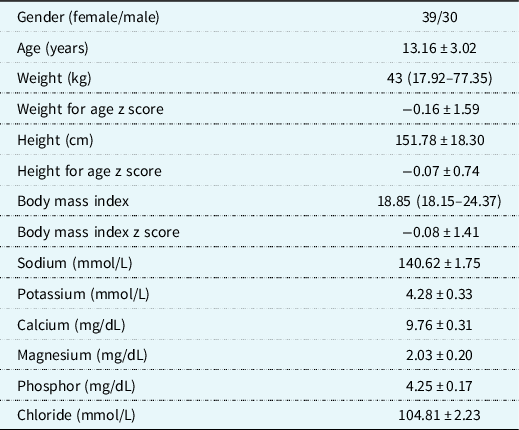
Thirty-nine of the patients included in the study were girls, 30 were boys, and the mean age was 13.16 ± 3.02 years. The weight, height, and body mass index standard deviation scores were –0.16 ± 1.59, –0.07 ± 0.74, and –0.08 ± 1.41, respectively. Electrolyte levels of the patients before treatment were within the normal range (Table 1).
Demographic, anthropometric and laboratory characteristics of the patients

Values for variables with normal distribution shown as mean ± standard deviation. Values for variables that do not show normal distribution the median is shown as the minimum and maximum.
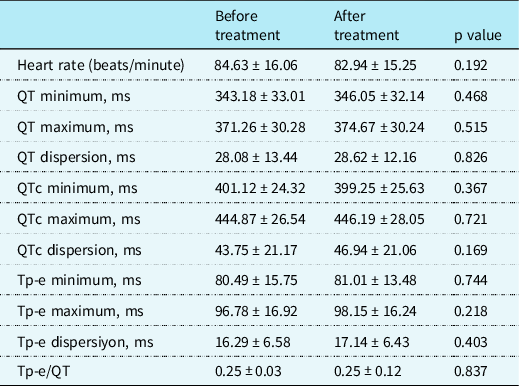
The comparison of electrocardiogram parameters before and after treatment is presented in Table 2. No statistically significant difference was found in the QT, QTc, QTd, QTcd, or Tp-e values, or the Tp-e/QT ratio of the patients before and after treatment. There was also no statistically significant difference in electrocardiogram parameters at the 1st month follow-up visit between our groups using different proton pump inhibitors. Electrolyte levels measured at the 1st month control of proton pump inhibitor treatment were found to be within the normal range, similar to the initial values. There was no statistically significant difference between male and female genders in terms of electrocardiogram parameters before and after treatment.
The comparison of electrocardiographic parameters before and after treatment

ms: millisecond. Values for variables with normal distribution shown as mean ± standard deviation. Values for variables that do not show normal distribution the median is shown as the minimum and maximum.
Discussion
Many drugs needed in practice, even those used for antiarrhythmic purposes, have the potential to cause drug-related arrhythmias. Drug-induced QT-interval prolongation is a complex condition related not only to the characteristics or dose of a particular drug but also to various factors such as drug-drug interactions, age, gender, presence and severity of underlying heart disease, and genetic predisposition.
Studies have reported that drug-induced long-QT syndrome is seen 70–90% more frequently in women than in men, so the risk of Torsades de Pointes in women is increased compared to men. Reference Vlachos, Georgopoulos, Efremidis, Sideris and Letsas11–Reference Mitten, Maron and Zipes13 The mechanism of the increased prevalence of drug-induced long-QT syndrome among women is still unclear. Differences in cellular electrical properties, genetic structure, as well as sex hormones are accepted hypotheses. Additionally, age over 60 years was found to be a risk factor for drug-induced long-QT syndrome and Torsades de Pointes. Reference Vlachos, Georgopoulos, Efremidis, Sideris and Letsas11 In our study, no statistically significant difference was found in any of the ventricular repolarisation parameters for the male or female gender after the proton pump inhibitor treatment was started. These results can be explained by the low mean age of our study population. While recruiting our study sample, we considered the absence of comorbid conditions, such as known structural heart disease, kidney disease, liver disease, electrocardiogram abnormality (such as atrioventricular block, sinus bradycardia), and the absence of factors such as additional drug use in order not to affect the results of our study. Cytochrome p-450 polymorphism, subclinical congenital long-QT syndrome, and ion channel polymorphism, which determine the pharmacokinetics of proton pump inhibitor drugs, are among the factors that may affect our results.
Magnesium is the most abundant ion in the cell after potassium and calcium. It is a cofactor in more than 300 enzyme systems in the human body, and it has an important role in the transport of potassium and calcium through the membranes. Reference Chrysant6 Therefore, it plays a protective role against cardiac arrhythmias. The chronic use of proton pump inhibitors to cause hypomagnesemia was first reported in 2006. In systematic reviews and meta-analyses published in the following years, it was concluded that people with chronic proton pump inhibitor use have a 40–80% increased risk of hypomagnesemia. Reference Park, Kim, Roh, Kim and Lee14,Reference Cheungpasitporn, Thongprayoon and Kittanamongkolchai15 Although some argue that proton pump inhibitors are not associated with hypomagnesemia Reference Chowhry, Shah and Kemper16 , research on their potentially fatal side effects has become increasingly prominent in the adult population. Reference Famularo, Gasbarrone and Minisola17 Lazzerini et al Reference Lazzerini, Bertolozzi and Finizola18 retrospectively reviewed 48 adult patients who developed Torsades de Pointes. They found that 58% of the patients had a history of using proton pump inhibitors for more than 2 weeks, and hypomagnesemia was detected in 40%. Proton pump inhibitor-associated hypomagnesemia was considered to be the most significant risk factor for the development of Torsades de Pointes.
It is accepted that the use of a proton pump inhibitor for more than 2 weeks (in most cases, longer than 1 year) contributes to the development of hypomagnesemia. It is not dose-dependent, and it can occur with different proton pump inhibitor groups (pantoprazole, lansoprazole, omeprazole, esomeprazole), which is a class effect.
The mechanism of the development of hypomagnesemia is still unclear. Both gastrointestinal and renal losses may be responsible through the transient receptor potential melastatin 6/7 (TRPM6/7) dysfunction in both the gut and distal convoluted tubule due to a single nucleotide polymorphism. Reference Famularo, Gasbarrone and Minisola17 Accordingly, recent data suggest that carriers of the transient receptor potential cation channel subfamily M member 6/TRPM6 polymorphism are at increased risk. The development of hypomagnesemia due to proton pump inhibitor use in genetically predisposed patients is defined as the clustering factor, which prolongs the QTc duration and creates a potential for ventricular arrhythmia. Reference Hess, de Baaij and Broekman19 Although research focuses on the potential for cardiac arrhythmia as a result of the effects of proton pump inhibitors on electrolyte levels, the direct molecular effect of proton pump inhibitors may also play a role in the development of arrhythmia. In the absence of hypomagnesemia, Torsades de Pointes cases with a direct inhibitory effect on the Human Ether-a-go-go-Related Gene/ hERG potassium channel and related IKr/ the rapid delayed rectifier channels have been reported after the use of lansoprazole alone or in combination with ceftriaxone. Reference Lazzerini, Bertolozzi and Finizola18,Reference Lorberbaum, Sampson and Chang20 These reports suggest that we should consider that proton pump inhibitor use may cause lethal side effects, even though electrolyte disturbances are not detected.
When we completed our study, the duration of proton pump inhibitor use in our patients was 1 month, and no electrolyte disturbances were found at the follow-up visit. The QTc max duration increased at 1 month compared to baseline, but this difference was not statistically significant. There was no statistically significant difference in electrocardiogram parameters at the 1st month follow-up visit between our groups using different proton pump inhibitors. In the literature, we could not find any study investigating the effects of different groups of proton pump inhibitors on ventricular repolarisation parameters.
In this study, we compared the ventricular repolarisation parameters on the electrocardiogram of children with dyspepsia before and after proton pump inhibitors treatment. Our study is the first study to evaluate ventricular repolarisation parameters before and after proton pump inhibitor treatment in children with dyspepsia. We did not find any repolarisation abnormalities occurred after treatment.
The QTc value was calculated using the Bazett formula. A prolonged QTc interval is a manifestation of a complex interplay between genetic and environmental factors, and it is a risk factor for life-threatening dysrhythmias and sudden death. Reference Van Der Bijl, Heradien, Doubell and Brink21 The Tp-e interval corresponds to the transmural distribution of repolarisation in the ventricular myocardium, where the epicardium is fully repolarised, but the repolarisation process continues in M cells in the subendocardium and is vulnerable to early after depolarisation. The action potential in M cells is longer compared to other cells in the myocardium. Repolarisation is completed first in epicardial cells. Where appropriate, the critical early after depolarisation initiates the re-entry circuit and continues until it converts to ventricular tachycardia or ventricular fibrillation. An abnormally prolonged Tp-e interval on the electrocardiogram is a risk factor for ventricular arrhythmic mortality and all-cause mortality, independent of age, sex, QRS duration, or corrected QT interval. Reference Ramírez, van Duijvenboden and Young22 Similarly, it has been reported that Tp-e can be used as a predictor of sudden cardiac death in patients with normal or unmeasurable QTc intervals. Reference Panikkath, Reinier and Uy-Evanado23 Bılge et al Reference Bılge, Tezel, Acar, Cüce, Karadaş and Taşar24 found that Tp-e and the Tp-e/QTc and Tp-e/QT ratios were higher in patients with acute ischaemic stroke compared to a control group. Their results suggest that these markers may contribute to lowering the mortality and morbidity rates of acute ischaemic stroke patients. Ucar et al Reference Ucar, Ozturk and Yılmaztepe25 found that Tp-e, Tp-e/QT, and Tp-e/QTc were significantly higher in the acute myocarditis group compared to the control group. Based on these results, they suggest that the increased frequency of ventricular arrhythmias can be explained by the increased ventricular repolarisation parameters in patients with acute myocarditis. Küçük et al Reference Küçük, Karadeniz, Ozdemir and Meşe26 found that the heart rate, Tp-e, Tp-e dispersion, and the Tp-e/QT and Tp-e/QTc ratios were statistically higher in patients with Down syndrome without congenital heart disease compared to the control group. In a study including children with subclinical hypothyroidism, maximal QT, QTd, QTcd, Tp-e, Tp-e/QT ratio, and Tp-e/QTc ratio were higher compared to the control group. Reference Akın, Unal, Yıldırım, Türe, Balık and Haspolat27 These different results may be related to our small sample size. In our study, we found no statistically significant difference in the QT, QTc, QTd, QTcd, and Tp-e values or the Tp-e/QT ratio of the patients before and after treatment. The Tp-e/QT, Tp-e/QTc ratio, and Tp-e dispersion are considered a more precise index for evaluating ventricular repolarisation due to the effect of heart rate and body weight on the Tp-e interval. We did not find statistically significant changes in the ventricular repolarisation parameters in children with dyspepsia before and after proton pump inhibitor treatment. We did not observe ventricular arrhythmia in our patients during follow-up. Electrocardiographic pathologies may be observed in the long-term follow-up. Although none of the patients had ventricular arrhythmia during follow-up, the patients were not prospectively followed long-term for ventricular arrhythmia. A Holter recording would be preferred to observe the incidence of ventricular arrhythmias in these patients.
In conclusion, we did not find a statistically significant change in ventricular repolarisation parameters. Nevertheless, these patients may have an increased risk of developing ventricular arrhythmias. Therefore, caution should be exercised when using drugs that prolong the QT period, and follow-up with serial electrocardiograms should be planned.
Limitations
While our study yielded novel and significant findings, it was limited by the lack of long-term follow-up of the patients. The second limitation of the study was the small sample size. In a multicentre study with a larger sample size and longer follow-up period, significant results might be found in ventricular repolarisation parameters. Additionally, Holter electrocardiogram could not be performed on all patients, which was another limitation of our study.
Acknowledgements
None.
Financial support
This research received no specific grant from any funding agency, commercial or not-for-profit sectors.
Conflicts of interest
None.
Ethical standards
Study approval was obtained from the ethics committee of Cumhuriyet University (2021-04/04).