A mass casualty incident (MCI) is defined as an event that generates more patients at one time than locally available resources can manage using routine procedures. MCIs require exceptional emergency arrangements and additional or extraordinary assistance. MCIs can also be defined as events resulting in a number of victims great enough to disrupt the normal course of emergency and health care services. 1
MCIs commonly occur worldwide. It has been suggested that, on average, a disaster takes place every day somewhere in the world.Reference Culley 2 Wherever and whenever it happens, an MCI constitutes the ultimate test of any medical system, and hospitals in particular. Health care systems must rapidly convert from routine activity to one ready to absorb quickly a large number of casualties, sort them by the severity and nature of their injuries, set priorities, and allocate resources to achieve the greatest survival and clinical benefits for the injured.
In a hospital, an MCI immediately affects the entire operation. Routine work is interrupted, because the immediate need is to treat the wounded and be prepared for the possible arrival of additional casualties. This event is an enormous challenge for any hospital. All of its resources need to be coordinated so that they are directed most effectively for the benefit of victims; to do so requires precise knowledge of the hospital's existing resources, their availability, and their location, so that decisions about their use are as informed as possible. It is also necessary to coordinate the event with other agencies outside the hospital such as the emergency medical services (EMS), police forces, adjacent hospitals, civil and military emergency systems, and other authorities responsible for the management of MCIs at the regional and national levels. All of these activities must be accomplished in a state of ambiguity, urgency, and, at times, confusion.
As part of their preparedness, hospitals develop detailed protocols for standard operating procedures (SOPs), listing the procedures and their sequence of operation in the event of an MCI. Hospitals usually have SOPs for conventional MCIs, radiation MCIs, toxicological MCIs, or a combination of these, and for natural disaster scenarios such as earthquakes and epidemics.
Principles of Management of an MCI at the Hospital Level
The first task in the case of an MCI is to obtain updated information from the field about the location, nature, and type of event (conventional or otherwise) and about the number of injured expected to arrive at the hospital and their characteristics (age and type and severity of injuries). If circumstances justify it, the management team declares an MCI.
After an MCI is declared, the appropriate SOP is activated, and the MCI management team (IMT) operates in accordance with it. Concurrently, the IMT collects information about hospital resources: the number of patients in the emergency department and in the wards, available beds in the intensive care units, and the status of the operating rooms. Moreover, the staff receives information about vital resources in the hospital, such as the number of units of available blood and blood products and respirators.
For the proper management of MCIs, it is essential that IMT work procedures are implemented precisely and strictly, that reliable and relevant information flows to the IMT in a timely manner, and that information is processed adequately so that the IMT can draw valid conclusions from it.Reference Admi, Eilon, Hyams and Utitz 3
The Rambam Health Care Campus, Its Strategic Position and Preparedness for Mass Casualty and Emergency Situations
The Rambam Health Care Campus (RHCC) is a 1000-bed academic medical center complex. It is the largest such center and the only tertiary-care medical facility in northern Israel. RHCC covers all of the major medical and surgical disciplines, and is the only level 1 trauma center in the region. It has a busy emergency department, with a high annual admission rate; a large surgical workload; and an active ambulatory service. As the level 1 trauma center for all of northern Israel, RHCC treats nearly 4000 trauma patients annually. A trauma registry and the International School for Trauma have developed into an internationally recognized educational resource for RHCC. The center routinely conducts organizational and therapeutic protocols and is part of the Israeli National Trauma Registry.
RHCC has played an active role in almost all of the numerous regional conflicts in the past 70 years. It has been part of the national preparedness program for more than 25 years, and it is continually preparing and practicing for possible emergency scenarios. Emergency drills are supervised by the Ministry of Health through its Division for Emergency Conditions, Department of Hospital Preparedness for National Emergencies, which provides guidelines and a national perspective. Preparedness planning at RHCC has focused on the ability to handle mass casualties in times of both peace and war, and on meeting the challenges of possible conventional and unconventional scenarios.Reference Bar-El, Michaelson, Hyames, Skorecki, Reisner and Beyar 4 The national preparedness program also involves collaboration with the various bodies that deal with emergencies, such as the Israel Defense Forces and the evacuation and transportation system of Magen David Adom (Israel's national emergency medical, disaster, ambulance, and blood bank service, and a member of the International Federation of Red Cross and Red Crescent Societies since 2006).
The challenges of these scenarios led us to search for a better way of managing MCIs. We assumed that a computerized portal that incorporates the major clinical and administrative information systems of the hospital will enable us to obtain a more comprehensive perception of the situation and thus assist in the decision-making process.
Methods
The Current RHCC Information Systems
RHCC routinely operates several administrative and clinical information systems, some of which play an important role during emergencies.
The Prometheus Clinical System
This electronic health record system was developed by our department of information technology. The comprehensive system covers all aspects of clinical charting in the hospital, making it possible to automate the management of medical records, generate clinical reports, order tests, prescribe medication, and share information among all involved parties at the hospital. The software serves all departments and units of the hospital, including the emergency services.
To date, Prometheus has served the medical staff by computerizing and networking all information created in the hospital. The system has helped create comprehensive online medical records for every patient and enabled sharing patient information among all professionals and health care workers. Prometheus also enabled the RHCC department of emergency and urgent care medicine to become the first such unit in Israel to initiate a paper-free work process.
Administrative Patient Management System
The administrative patient management system is one of the core systems at the hospital. It is based on an SAP platform and serves as the admission, transfer, and discharge system of the hospital, handling all administrative-medical aspects: admissions, tracking of medical services provided, discharge, and billing. The system also includes a scheduling module.
The system contains a dedicated module developed specifically for emergencies. It has a dedicated screen for admitting casualties, with the fundamental change of admitting patients by casualty number rather than by regular identification number. The system also includes dedicated fields for emergency situations, such as casualty state (ie, light, medium, severe, critical, anxiety) and intermediate stations (ie, operating room, imaging suite). Emergency admission is characterized by short intake time (ie, a minimum number of fields) and the option to complete the form at a later stage. By contrast, regular admission takes longer and contains many mandatory fields.
Online Business Intelligence System
The online business intelligence system is a decision support system (Insight Online) that is used daily at the hospital. It uses information derived from the core hospital systems regarding the status of the hospital and its departments at any given time. The system helps hospital management make decisions aimed at streamlining operations and identifying and releasing bottlenecks in real time.
Adam System
The information technology division of RHCC developed Adam, a national computerized web-based program to identify and allocate casualties in MCIs, for the use of the Emergency Department of the Ministry of Health. Adam operates within the information centers of all the hospitals in Israel, at the National Institute of Forensic Medicine, and it is connected to local emergency authorities and public information centers nationwide.
The system integrates data regarding casualties from the various intake systems at the hospitals into a central database. It also allows photographs of the victims to be saved, primarily for a later identification process of unknown victims. The main goal of the system is to facilitate communication and share data among the information centers of all the hospitals and to ease and shorten the process of establishing connection between victims and their relatives.
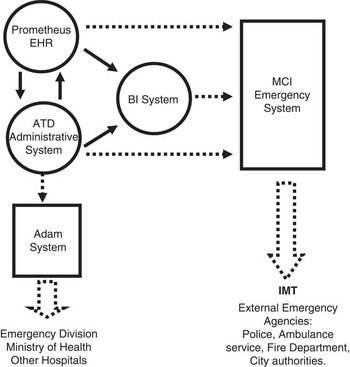
None of these systems was designed or intended to serve alone as a computerized platform for the management of various types of MCIs in all of their aspects or to produce reports and databases that can help the IMT manage MCIs. Therefore, RHCC management decided to establish a new system to manage all types of MCI scenarios (Figure 1).
Description of Data and Information Flow Among Systems.

The basic assumptions underlying the project were as follows:
-
1. Emergency situations require a deviation from routine procedures and a significant adjustment of hospital activity to specific emergency characteristics.
-
2. Successful and quick transition from routine to emergency operation and management of emergency situations requires that accurate and continuously updated information of the current state be presented to hospital management so that it can make better informed decisions. Unlike during routine operation, emergency situations necessitate timely and continuous information be obtained for several critical resources (eg, blood units in the blood bank, operating rooms, intensive care beds, and respirators).
-
3. Several emergency scenarios are possible (eg, MCI, mega MCI, toxicological event, radiation event), each with its unique protocol, checklists, and procedures. The new information system must help manage each event on its own terms and help transitioning between the events if necessary.
For the transition from routine to emergency operation, management and control of the hospital are transferred to the IMT. Several subordinate management teams operate in conjunction with the IMT: rear-area headquarters (ie, military headquarters responsible for the state's inhabited areas in the event of an emergency), logistics headquarters, and personnel headquarters. The system supports the management of the activities of each of the subordinate management teams and of all their components, both in communication between the teams and in transition between types of events.
The Emergency System and Its Use
On receiving notification of an MCI, the IMT assembles and the emergency system is activated in accordance with the reported MCI characteristics (conventional, toxicological, radiation, or a combination thereof). The system lists the officials who are supposed to be called to the IMT (eg, during a radiation incident, a radiation expert joins the IMT). It also lists the preliminary tasks that must be carried out such as reports and updates.
In addition to posting the list of tasks that require execution, the system can perform tasks on its own, both by manual operation (eg, typing notifications) or automatically, such as broadcasting prerecorded messages over the public address system, or sending summary reports to officials within the hospital or outside it at predetermined intervals, sending short mobile phone messages or e-mail messages to a specified list of recipients.
With the arrival of the casualties at the hospital, the system acquires data from other hospital systems (medical center patient management system, Prometheus, and business intelligence) and presents them in a way that allows a quick overview of the number of casualties, their condition, and their position. The system also presents data from Adam, which is activated during the initial steps of the MCI.
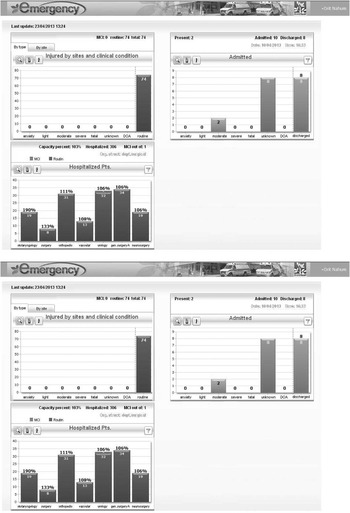
Data about the injured are displayed through a graphic interface, with casualty figures broken down by state and by their location at various sites within the hospital (admission and triage site, emergency department, imaging suite, and other temporary or permanent departments and units). The system integrates into a unified view the data of previously hospitalized patients who are not involved in the emergency situation, distinguishing graphically between them and the casualties of the incident. Thus, the IMT receives a complete up-to-date picture of the status of each department and treatment site within the hospital. The system also allows presentation of the data by various criteria such as location and clinical status, permits drilling down to the level of the individual patient, and displays complete demographic and clinical data (Figure 2).
Examples of System's Screens Showing Transmitted Hospital Data.

The emergency system is also linked to the hospital address book of medical, nursing, and administrative staff, so that it is possible to mobilize staff quickly, if necessary. Furthermore, the system controls and directs the security and monitoring cameras placed at strategic locations in the hospital, providing valuable visual information.
The system allows automated event logging (log book), through both manual data entry and automatic documentation after the system executes the tasks. It is also possible to retrieve from the system documents relevant for the event, such as protocols, memos, and clinical guidelines.
The system is updated continuously, and it reports the status of vital resources within the hospital: the number of operating rooms available at any moment, available intensive care beds, respirators, and blood bank products. The system is programmed to warn in case of impending shortages in each of these resources. Finally, the system is used to deliver messages between the IMT and subordinate management teams (logistics and nursing).
If the nature and type of the event changes during the incident, for example, an event defined initially as a conventional MCI becomes a radiation incident, the system supports the transition from one type of event to another in real time, consolidating and/or removing tasks originating in different scenarios.
When the event terminates, the system posts a checklist of tasks to be carried out according to the procedure for closing an event. The event log and other data automatically saved in the system make it possible to conduct thorough debriefing and investigations based on an abundance of real-life data to help the staff learn from the event.
Results and Discussion
While the system requirements were derived from real cases of MCI's during previous decades, the system has not been used yet in real situations. In a large nation-wide conventional MCI exercise conducted in January 2012, the system was activated and it worked flawlessly. Many visiting officials who witnessed the exercise were impressed positively by its performance and efficacy. Following the exercise, the emergency and disaster management division of the Israeli Ministry of Health decided to equip all trauma centers in the country with the system.
Further developments will include dedicated modules for the subordinate management teams (nursing services, logistics) to allow the IMT to transfer monitoring tasks to them, and dedicated screens for back-office operations. The overall aim is to achieve easy flow of relevant information to all persons involved in managing the MCI.
Conclusions
The emergency system designed and developed by the RHCC division of information, computerization, and communications is a comprehensive software package that greatly facilitates the management of an MCI. Its major advantages is its ability to collect pertinent data from existing clinical and administrative systems at the hospital, incorporate and analyze the data, and present them to the IMT in a clear, graphic, and useful format that can serve as a basis for informed decision making.
Several decision-support systems for MCI management, triage, or victim identification have been recently proposed.Reference Nelson 5 – Reference Adler, Krusmann, Greiner–Mai, Donner, Chaves and Via Estrem 7 To the best of our knowledge, ours is the only system designed specifically for the in-hospital management of MCIs.
Following future drills and real MCIs, it will be necessary to refine, adjust, and improve the system. The fact that the system was planned and developed by the local information technology staff has great advantages because it allows rapid and optimal adjustment of the system to the structure and capabilities of the hospital.
Circles and solid arrows indicate regularly used information technology (IT) systems and data flow; squares and dotted- line arrows indicate IT systems and data transfer during mass casualty incidents.
Abbreviations: ATD, admittance, transfer, discharge; BI, business intelligence; EHR, electronic health record; IMT, incidence management team; MCI, mass casualty incidence; MOH, Ministry of Health.