Introduction
The majority of foliose lichens are attached to their substratum by root-like attachment organs on the lower surface, the so-called rhizines, composed of conglutinated, prosoplectenchymatous hyphae (Hannemann Reference Hannemann1973). Hannemann (Reference Hannemann1973) distinguished 15 different types of appendage-organs, among those rhizines and hapters. She restricted rhizines to compact, elongated hyphal strands on the lower surface of the thallus, whereas short, not elongated organs are called hapters (Hannemann Reference Hannemann1973; Kondratyuk & Poelt Reference Kondratyuk and Poelt1997).
Parmeliaceae is the largest family of lichen-forming ascomycetes, including c. 79 genera, with 2726 species currently accepted (Crespo et al. Reference Crespo, Kauff, Divakar, Amo, Arguello, Blanco, Cubas, del Prado, Elix and Esslinger2010; Thell et al. Reference Thell, Crespo, Divakar, Kärnefelt, Leavitt, Lumbsch and Seaward2012). Within the family, the genus Hypogymnia belongs to the hypogymnioid clade (Crespo et al. Reference Crespo, Lumbsch, Mattsson, Blanco, Divakar, Articus, Wiklund, Bawingan and Wedin2007) together with the genera Arctoparmelia, Brodoa, and Pseudevernia, based on the analysis of molecular systematics. The genus Hypogymnia is characterized in Parmeliaceae by swollen lobes, a hollow medulla, perforations in the lower surface, and the absence of rhizines (Elix Reference Elix1993). Numerous recent lichen floras describe Hypogymnia as lacking rhizines (Elix & James Reference Elix and James1982; Galloway Reference Galloway1985; Brodo et al. Reference Brodo, Sharnoff and Sharnoff2001; Nash et al. Reference Nash, Ryan, Gries and Bungartz2002; Smith et al. Reference Smith, Aptroot, Coppins, Fletcher, Gilbert, James and Wolseley2009; Wirth et al. Reference Wirth, Hauck and Schultz2013). While most genera in Parmeliaceae are rhizinate, Brodoa and Pseudevernia also lack rhizines and have a hollow or loose medulla, whereas Arctoparmelia, which has previously been included in the distantly related genus Xanthoparmelia (Hale Reference Hale1986), possesses rhizines. Arctoparmelia, however, agrees with other genera in the hypogymnioid clade in having a loosely compact medulla (Divakar & Upreti Reference Divakar and Upreti2005).
Currently, c. 90 species of Hypogymnia are known (Thell et al. Reference Thell, Crespo, Divakar, Kärnefelt, Leavitt, Lumbsch and Seaward2012) and they are considered to be erhizinate (Bitter Reference Bitter1901; Elix Reference Elix1979). However, Lindau (Reference Lindau1895) has already reported on the rare occurrence of rhizines (“Rhizoiden”) in Hypogymnia physodes (L.) Nyl. in a comparative study on attachment of lichens to their substratum, and Beltman (Reference Beltman1978) reported hapters in a number of Hypogymnia spp.
During our taxonomic studies on the genus Hypogymnia, we observed appendage-organs in a few species. Consequently, we studied a larger number of samples (828 specimens), including 64 type specimens, representing 72 currently accepted species in order to better understand how common rhizines are in Hypogymnia and to compare their morphology with rhizines found in the related genus Arctoparmelia.
Materials and Methods
Materials
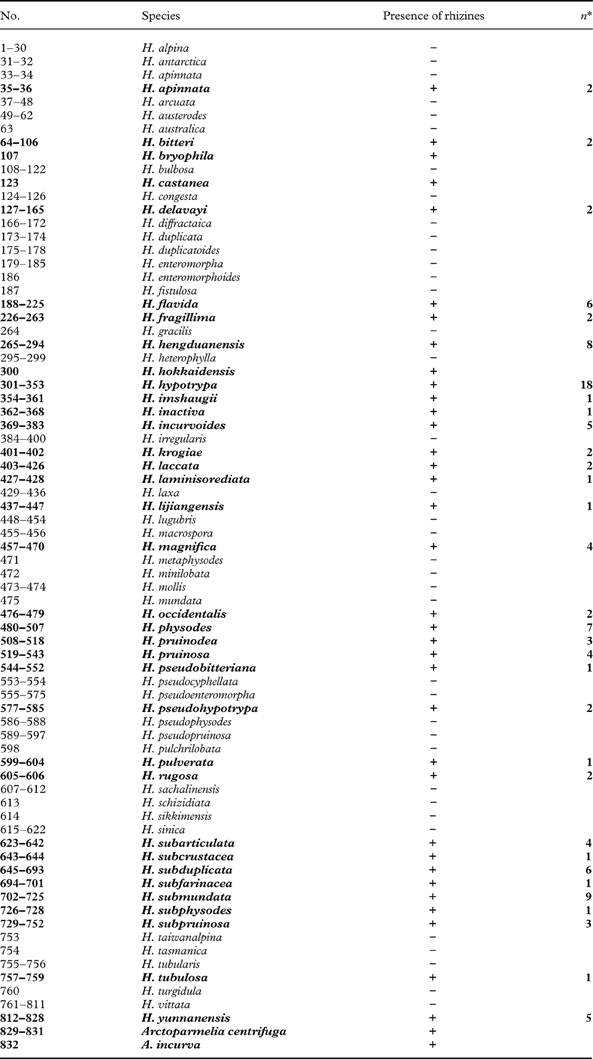
Sixty-four type specimens of Hypogymnia spp. and 764 non-type specimens of Hypogymnia, mostly including species occurring in China, have been studied. Four samples of Arctoparmelia were examined for comparison. The voucher information of specimens examined is listed in Table 1.
Voucher specimens of Hypogymnia and Arctoparmelia species studied.
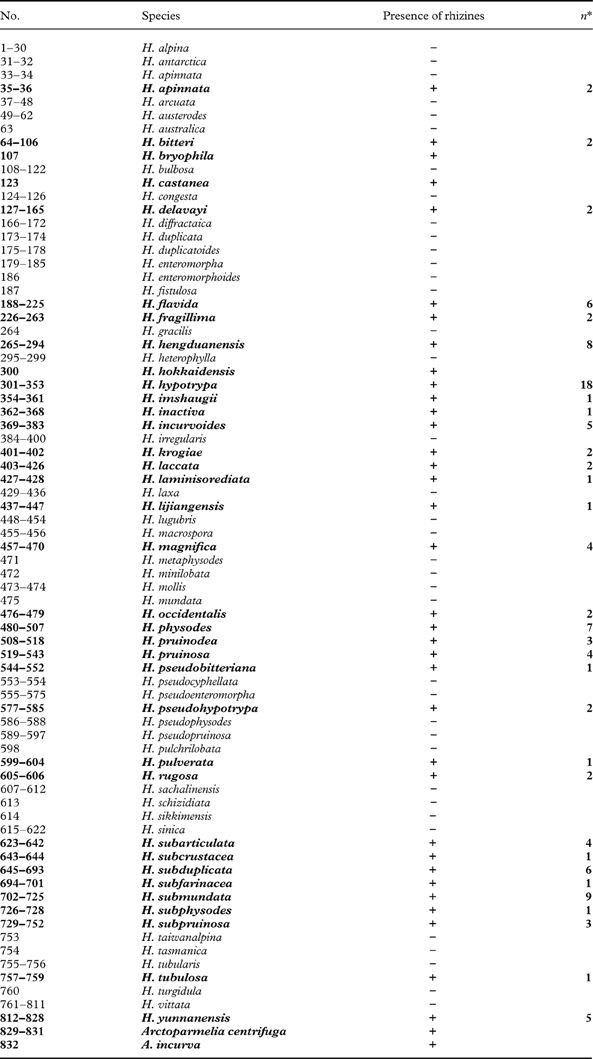
Boldface indicates the species with rhizines; * number of specimens with rhizines.
Morphological studies
The morphology and anatomy of rhizines was studied using a dissecting microscope (Leica M125) and compound microscope (ZEISS AX10 Lab.A1). Scanning electron microscopy (FEI, Quanta 200) was used for studying the fine structure of rhizines.
Results and Discussion
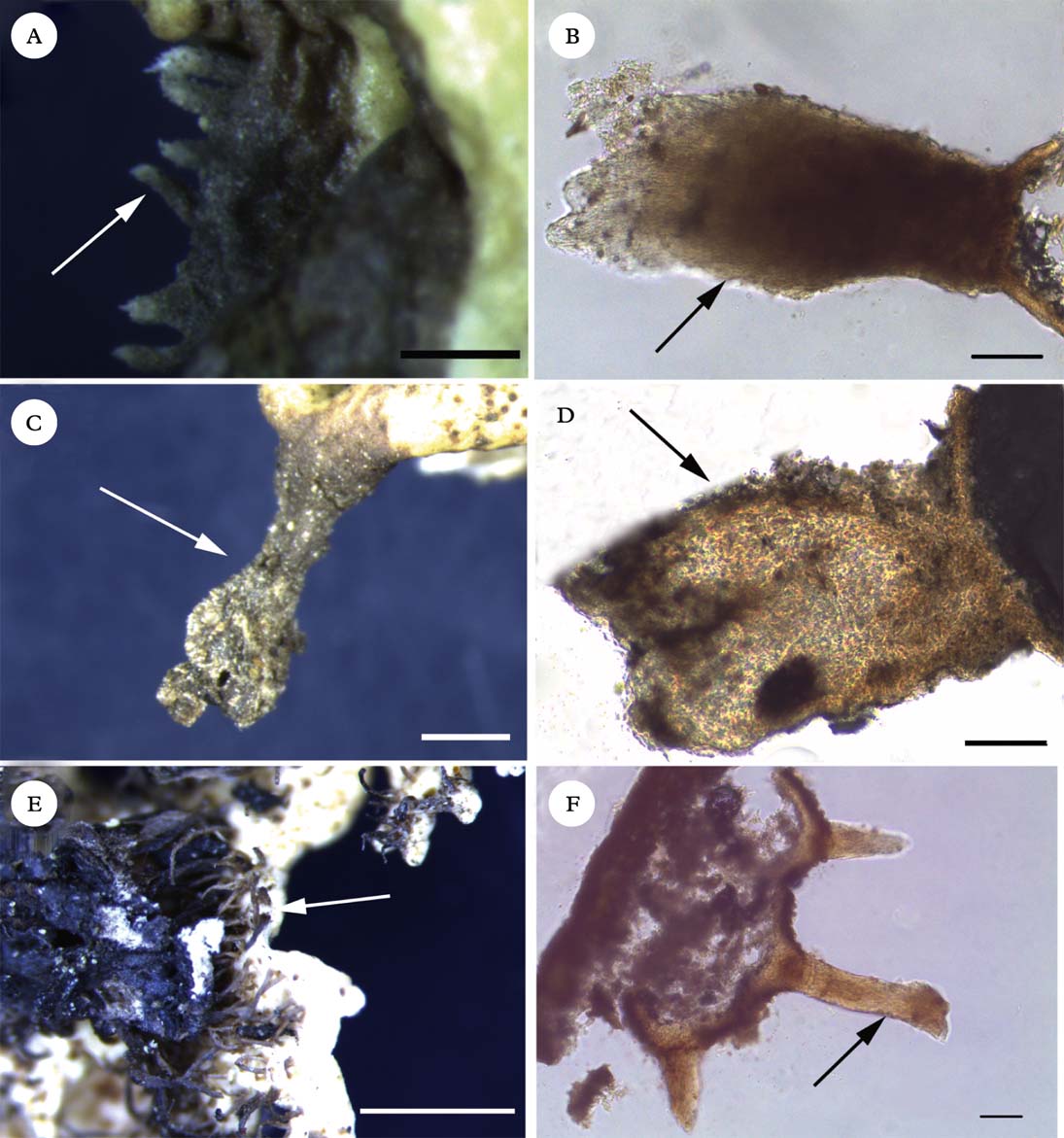
We found appendage-organs occasionally occurred on the lower thallus surface in 35 Hypogymnia species (Table 1). Rhizines, when present, were always few in number and sparsely distributed over the lower surface. The morphology of appendage-organs is shown in Figure 1. Two types of appendage-organs were found: slender rhizines (Fig. 1A) with fine and tapering tips, which were found in H. krogiae Ohlsson and H. subfarinacea X. L. Wei & J. C. Wei; a second type (Fig. 1C) represents hapters, which are thick with broken tips, sometimes anastomosing. The latter type of hapter is the most common in Hypogymnia spp. Both types of appendage-organs are dark brown to black and usually concolorous with the lower surface. Rarely, pale appendage-organs with whitish tips were found (Fig. 1A). The hapters are short and usually less than 0·5 mm long. However, H. pruinoidea X. L. Wei & J. C. Wei has hapters up to 1·5 mm long (Fig. 1C).
Appendix-organs under dissecting and compound microscope. A & B, rhizines. Hypogymnia krogiae (holotype, MSC); B, H. krogiae (holotype, MSC); C–F, hapters. H. pruinoidea (paratype, HMAS-L085010); D, H. pruinoidea (paratype, HMAS-L085010); E, Arctoparmelia centrifuga (HMAS-L004439); F, A. centrifuga (HMAS-L004439). Arrows pointing at rhizines. Scales: A=200 μm; B=50 μm; C=500 μm; D=100 μm; E=1 mm; F=5 μm. In colour online.
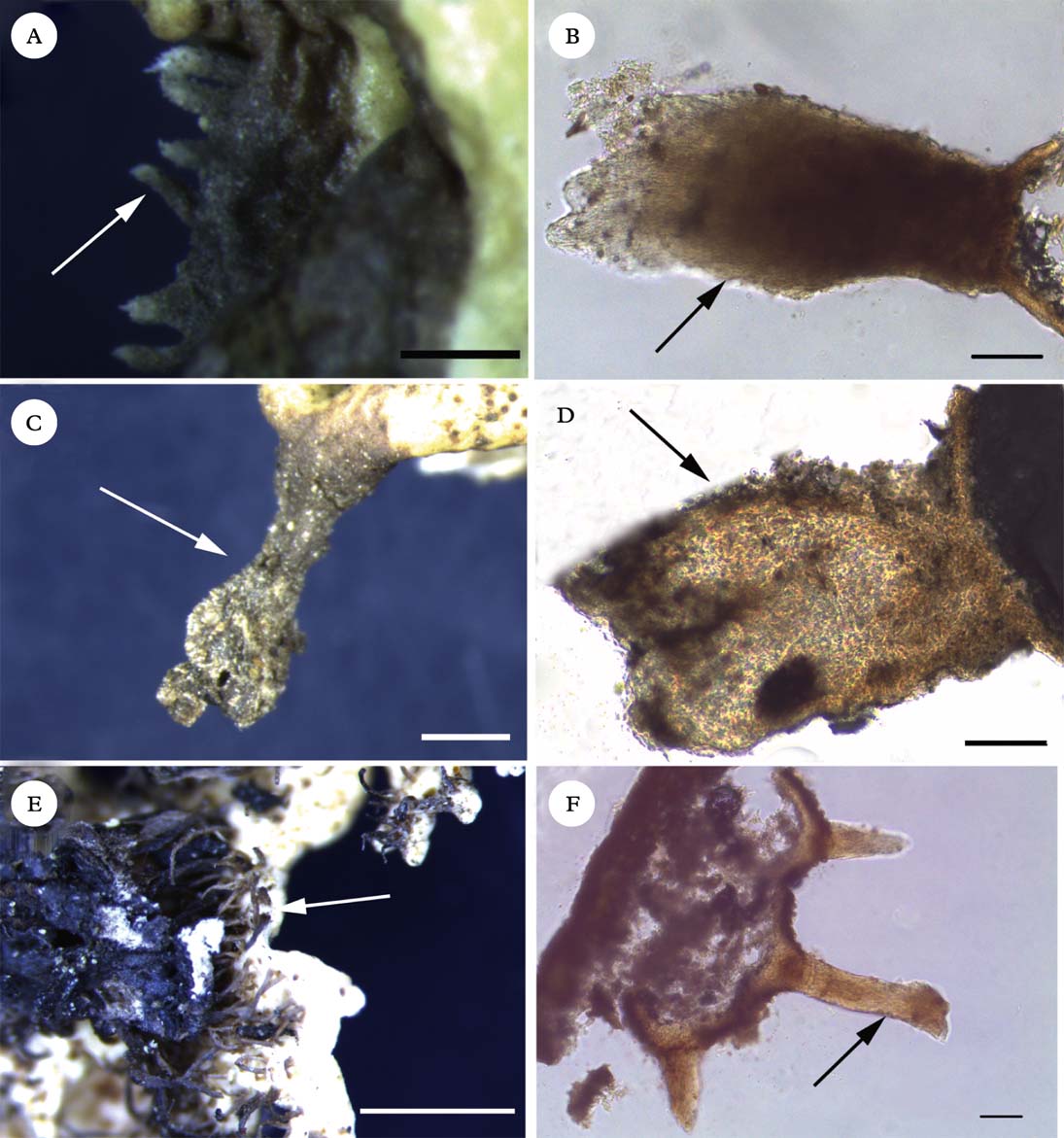
Rhizines in the Arctoparmelia spp. studied were similar in morphology to those found in Hypogymnia in being usually dark brown with tapering tips and sometimes anastomosing, and 0·5–1·0 mm long (Fig. 1E).
Longitudinal sections of rhizines showed that the lower cortex is continuous, composed of a hyphal strand (Fig. 1B, D & F). The anatomy of rhizines in Hypogymnia and Arctoparmelia was similar.
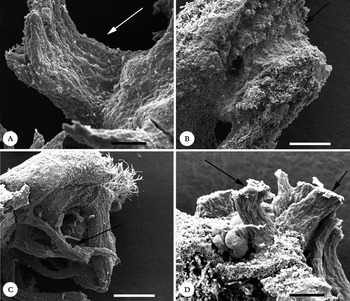
SEM studies of rhizines (Fig. 2) showed that they were continuous with the lower cortex, and composed of hyphal strands. There was no difference between the rhizines in the Hypogymnia and Arctoparmelia species examined.
Appendix-organs under SEM. A, C & D, rhizines; A, Hypogymnia krogiae (holotype, MSC); C, Arctoparmelia centrifuga (HMAS-L004439), ×200; D, rhizines in A. incurva (HMAS-L128720), ×500. B, hapters in H. pruinoidea (paratype, HMAS-L085010), ×200. Arrows pointing at rhizines. Scales: A & D=50 µm; B & C=150 µm.

Rhizines are attachment organs, consisting of clustered hyphae, developing from the lower cortex (Büdel & Scheidegger Reference Büdel, Scheidegger and Nash2008). Hannemann (Reference Hannemann1973) restricted the term rhizines to compact, elongated hyphal strands on the lower surface of the thallus and accepted 14 additional types of appendage-organ. Although some of these types are clearly distinct, such as an umbilicus, differences between others are less clear. Their distinction was mainly based on morphology and function, and the development of the structure was not taken into account (Beltman Reference Beltman1978). Moreover, there is a danger that such terms take on a life of their own (i.e. similar structures that represent a continuum that was divided for convenience are seen as fundamentally different). This is especially true for lichenized fungi, which lack true tissues and are known to have enormous regenerative abilities (Honegger Reference Honegger1993, Reference Honegger1996; Ott et al. Reference Ott, Treiber and Jahns1993; Jahns & Ott Reference Jahns, Ott and Hawksworth1994; Honegger et al. Reference Honegger, Conconi and Kutasi1996). Despite these reservations, we have followed here the restricted use of the term rhizines and use hapters for the non-elongated appendage-organs (Hannemann Reference Hannemann1973; Kondratyuk & Poelt Reference Kondratyuk and Poelt1997). In Hypogymnia, we demonstrated that rhizines are occasionally present but have been previously largely overlooked, probably because they are concolorous with the lower cortex and when present are sparsely distributed over the surface. We found appendage-organs in 35 species, including true rhizines in two species, but in those they were present in only a few specimens and when present, they were always rare. Hence, the taxonomic significance of rhizines within Hypogymnia is not clear. In Parmeliaceae, most genera have rhizines (Elix Reference Elix1993). Parmeliaceae is a strongly supported monophyletic group and six well-supported main clades can be distinguished within the family (Crespo et al. Reference Crespo, Lumbsch, Mattsson, Blanco, Divakar, Articus, Wiklund, Bawingan and Wedin2007), one of which being the hypogymnioid clade. The majority of hypogymnioid taxa are believed to lack rhizines. However, with the discovery of a widespread presence of rhizines in Hypogymnia the placement of the rhizinate genus Arctoparmelia in this clade is less unusual and demonstrates that careful morphological studies can help to better understand and revise our knowledge of morphological traits in lichenized fungi.
This project was supported by the National Natural Science Foundation of China (31200018) and the Main Direction Program of Knowledge Innovation of the Chinese Academy of Sciences (KSCX2-EW-Z-9). The authors sincerely thank the curators of ASU, BM, CANB, FH, H, KUN, LE, MSC, NSW, OSC, TUR, US, and W who kindly sent us specimens on loan for examination. Bruce McCune and Walter Obermayer kindly sent us Hypogymnia specimens. Ms. H. Deng provided assistance during the studies in HMAS-L.