Introduction
Sexually active young women are exposed to complications related to unintended pregnancy, unsafe abortion, rapid repeat pregnancies and pregnancy-related morbidity, in addition to health risks shared with their male peers (Chandra-Mouli et al., Reference Chandra-Mouli, McCarraher, Phillips, Williamson and Hainsworth2014). Young women in low-resource countries globally, including Ghana, are more vulnerable to these risks due to social and economic inequalities associated with pregnancy and childcare (Mirembe et al., Reference Mirembe, Karanja, Hassan and Faúndes2010; Shah & Ahman, Reference Shah and Ahman2010; Sundaram et al., Reference Sundaram, Juarez, Bankole and Singh2012; Biney & Atiglo, Reference Biney and Atiglo2017). In most Ghanaian societies, childbirth is only acceptable within marriage (GSS et al., 2015) and non-marital pregnancy is stigmatized (Agyei et al., Reference Agyei, Biritwum, Ashitey and Hill2000; Cockrill & Nack, Reference Cockrill and Nack2013; Payne et al., Reference Payne, Debbink, Steele, Buck, Martin, Hassinger and Harris2013; Biney & Atiglo, Reference Biney and Atiglo2017). Nonetheless, the disparity between early sexual debut and delayed marriage indicates prevalence of premarital sexual activity and, with it, the attendant risks of unintended pregnancies among unmarried but sexually active young women (GSS et al., 2015). In spite of this, only a few studies have acknowledged and measured the need for contraception among unmarried young women in Ghana, for whom obtaining and appropriately using contraception are not without challenges (Chandra-Mouli et al., Reference Chandra-Mouli, McCarraher, Phillips, Williamson and Hainsworth2014).
A key theme correlated with women’s contraceptive behaviour is their previous pregnancy outcomes (Padmadas et al., Reference Padmadas, Lyons-Amos and Thapa2014). Pregnancy experience and outcomes constitute transitional life events which may potentially alter young women’s cognition and behaviour related to sex and pregnancy. This study was based on the proposition that their experience of the consequences of risky sexual behaviour will have a relational effect, and upon self-evaluation, motivate young women to engage in subsequent safe sexual behaviour. While prior studies have focused on the health impacts of sexual behaviour (Vasilenko et al., Reference Vasilenko, Lefkowitz and Welsh2014), the behavioural outcomes of the consequences of previous sexual behaviour have not been much researched. Studies on post-abortion and postpartum sexual abstinence and contraception uptake are scant, much less among unmarried young women. Available studies have compared timing of postpartum and post-abortion uptake and discontinuation of contraception among married women (Wilson et al., Reference Wilson, Fowler and Koo2013; Padmadas et al., Reference Padmadas, Lyons-Amos and Thapa2014) but these factors have not been investigated in the sub-Saharan African context. In addition, secondary abstinence is a strategy used by sexually experienced young women to delay pregnancy (Loewenson et al., Reference Loewenson, Ireland and Resnick2004; Atiglo & Biney, Reference Atiglo and Biney2018); however, few studies have examined this pregnancy prevention behaviour among young women (Alhassan & Dodoo, Reference Alhassan and Dodoo2020).
Again, fertility levels have declined but rapid postpartum conception and repeat abortions continue to pose significant health risks in low- and middle-income countries (Hindin et al., Reference Hindin, McGough and Adanu2014). Multiple pregnancies and/or abortions are detrimental to the health of women, and in the case of the former, the well-being of the child (Shah et al., Reference Shah, Santhya and Cleland2015; Maravilla et al., Reference Maravilla, Betts, Abajobir, Couto e Cruz and Alati2016). Also, among all women, those aged 15–24 are least likely to initiate contraceptive use after an abortion or birth and even if they do they are most likely to discontinue use soonest (Padmadas et al., Reference Padmadas, Lyons-Amos and Thapa2014). Post-abortion and postpartum contraception is important to prevent unintended pregnancy and repeat abortion (Tripney et al., Reference Tripney, Kwan and Bird2013; Padmadas et al., Reference Padmadas, Lyons-Amos and Thapa2014). However, it is rare to find a single study employing population-based data to compare the effects of abortions (spontaneous or induced), childbirth and years since sexual debut on contraceptive behaviour and sexual abstinence among unmarried young women. The aim of the present study was to assess the relationship between previous pregnancy experience and outcome and contraceptive behaviour among unmarried 15- to 24-year-old women in Ghana.
Furthermore, despite the importance of the years since sexual debut (coitarche) for understanding young women’s contraceptive behaviour, it has rarely been considered by researchers, who have focused mainly on age at first sex as an indicator of sexual risk (Zaba et al., Reference Zaba, Pisani, Slaymaker and Boerma2004; Magnusson et al., Reference Magnusson, Masho and Lapane2012). Meanwhile, evidence among young people in the US indicates that, regardless of age at sexual debut, the rates of ever-use and efficacy of using contraceptives increase with years since sexual debut (Mosher et al., Reference Mosher, Jones and Abma2015; Cwiak et al., Reference Cwiak, Howard, Hsieh, Ricciotti and Sucato2016). This suggests that young people who have recently initiated sex may still be learning to use contraceptives, especially in a setting where contraceptive prevalence is low. In the present study among young women in Ghana, the effect of years since sexual debut on contraceptive behaviour was also investigated among groups of young women with varying pregnancy outcomes.
Methods
Data
This cross-sectional study employed the women’s dataset from the nationally representative 2014 Ghana Demographic and Health Survey (GDHS), which collected data on reproductive health behaviours, socioeconomic and demographic characteristics and child health care practices among women aged 15–49 (GSS et al., 2015). The survey data collection protocol was approved for ethical considerations, including confidentiality and informed consent procedures, by the Ghana Health Service Ethics Review Committee and the ICF International Institutional Review Board (GSS et al., 2015).
Sampling procedures of eligible women for the survey involved a multistage sampling design, details of which are available from the 2014 GDHS report (GSS et al., 2015). The study used data from 1118 sexually experienced, fecund and non-pregnant unmarried women aged 15–24 who wanted to postpone pregnancy for at least 2 years. Women who were not exposed to the risk of pregnancy because they had never had sex (1211), were infecund (33), amenorrhoeic (254) or already pregnant (196) were excluded from the study. Women who desired a child within 2 years of the survey (189) and those currently married (326) were also excluded.
Variables
Dependent variable
The dependent variable was ‘contraceptive behaviour at the time of the survey’. There were three categories of contraceptive behaviour based on sexual activity and contraceptive use. ‘Sexual activity’ was measured by intercourse within 4 weeks preceding the survey; ‘contraceptive use’ was limited to modern methods only (see Hubacher and Trussell (Reference Hubacher and Trussell2015) for choice of categorization of modern methods). Thus, women were categorized into three groups by contraceptive behaviour: ‘non-users of modern contraception’ (sexually active women who wanted to delay childbirth [2 or more years] or were unsure about their fertility intentions but were not using a modern contraceptive method); ‘abstinent’ (women who were sexually inactive for 4 or more weeks prior to the survey); and ‘users of modern contraception’ (women using modern contraceptives).
The duration of 4 or more weeks was selected to represent secondary abstinence as it is the typical definition of period of sexual abstinence (GSS et al., 2015) and also because studies use this to determine those not sexually active (Wilson et al., Reference Wilson, Fowler and Koo2013; Machiyama & Cleland, Reference Machiyama and Cleland2014; Atiglo & Codjoe, Reference Atiglo and Codjoe2019). Also, the minimum of 4 weeks allows for a better comparison with women’s current contraceptive use.
Independent variables
Pregnancy experience and outcome were indicated by two main factors: parity and abortion. Thus, there were three categories of women by pregnancy outcome: ‘nulligravid’ (never pregnant), ‘post-abortion’ (whether induced or spontaneous) and ‘postpartum’. Postpartum women who had ever had an abortion were classified based on their most recent experience. Explicit data on induced abortions are rare (Shah et al., Reference Shah, Santhya and Cleland2015) but following the examples of other studies using the DHS (Padmadas et al., Reference Padmadas, Lyons-Amos and Thapa2014; Banerjee et al., Reference Banerjee, Gulati, Andersen, Acre, Warvadekar and Navin2015) and knowledge of under-reporting of abortion in Ghana and other contexts (Rossier, Reference Rossier2003; Awusabo-Asare et al., Reference Awusabo-Asare, Abane and Kumi-Kyereme2004; Biney & Atiglo, Reference Biney and Atiglo2017) all pregnancy terminations (spontaneous or induced) constituted abortions in this study.
Control variables
Control variables included variables in the literature observed to be significantly associated with contraceptive use (Magnusson et al., Reference Magnusson, Masho and Lapane2012; Nyarko, Reference Nyarko2015; Wulifan et al., Reference Wulifan, Brenner, Jahn and De Allegri2016) and which were available from the dataset. These included age, educational attainment, household wealth, employment status, urban–rural residence, region of residence, religion and ethnicity. In addition, knowledge of the ovulatory cycle was derived from respondents’ responses to the question about which time of the cycle ovulation occurs. Their responses were deemed accurate if they said the middle of the cycle and inaccurate/no knowledge for all other responses including ‘don’t know’. Finally, years since sexual debut (the difference between an individual’s current age and age at sexual debut) was controlled for in the study. As a key variable to help interrogate relationships further, sexual debut was interacted with pregnancy experience and outcome to derive the odds of a pregnancy outcome/experience by years since debut (Magnusson et al., Reference Magnusson, Masho and Lapane2012).
Data analysis
Descriptive statistics were used to assess the patterns of contraceptive behaviour and pregnancy outcome and experience and the socioeconomic and demographic characteristics of the sample of adolescents and young women. Cross-tabulations showed the bivariate relationships between pregnancy outcome and experience and subsequent contraceptive behaviour of women with chi-squared tests of significance of the associations therein. Finally, two multinomial logistic regression models were run to determine the risk ratios of abstinence and use of contraception relative to non-use. The second model involved interaction terms between previous pregnancy outcome and years since sexual debut. This interaction allowed the assessment of contraceptive behaviour by years since sexual debut across the three categories of the independent variable. Chi-squared tests and logistic regression models were conducted at an alpha level of 0.05. All analyses used an svy set of commands in Stata 13 to adjust for the complex sampling design of the GDHS.
Results
Descriptive statistics
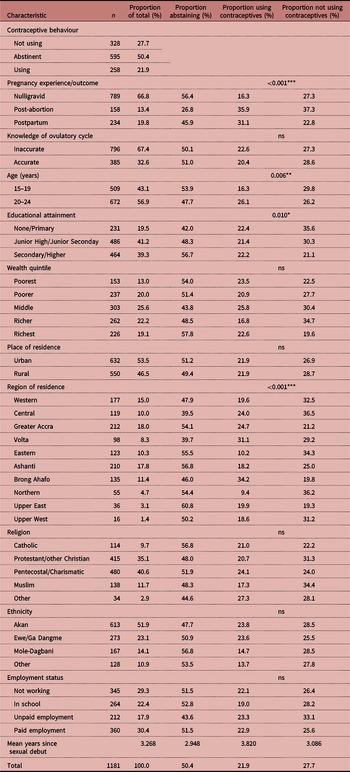
About half (50.4%) of respondents were not using any modern contraceptive method at the time of the survey because they had been abstinent at least 4 weeks beforehand (Table 1). Among the sexually active, more women were not using any modern contraceptive. About 67% of respondents had never conceived (were nulligravid), while over a tenth had had an abortion and a little under a fifth had given birth.
A third of the young women had accurate knowledge of the timing of ovulation. The mean duration of sexual activity among respondents was about 3 years with a standard deviation of 2.3. About a fifth of the respondents had only primary or no education and about 80% had at least junior high education. About a quarter of respondents were still in school, and approximately 48% were employed, although not all were being paid. A little over half were aged 20 or above (57%) and resided in urban areas (53.5%). Of the ten administrative regions, six represented between 10% and 18% and the others each represented less than 9% of the sample. Akans constituted the highest ethnic composition (48%). The Christian group constituted a large majority, with Muslims and other religions making up about 15% of the respondents.
Bivariate associations between pregnancy outcomes, years since sexual debut, age group, educational attainment, region of residence and religion and the dependent variable, contraceptive behaviour, showed statistically significant associations. Cross-tabulation results from Table 1 suggest that while the post-abortion women had the lowest proportion not sexually active (26.8%) they had the highest proportion of unmarried young women with an unmet need (37.3%). The nulligravid women tended to be more abstinent (56.4%) and also used modern contraception the least (16.3%). A greater proportion of postpartum women were abstinent (45.9%) than using contraception (23%). Current contraceptive users had the highest mean duration of sexual experience (3.82 years) while those sexually abstinent had the lowest mean (2.95 years). A higher proportion of women aged 15–19 (29.8%) than those aged 20–24 were current non-users and they also had the higher proportion that were sexually abstinent (53.9%). With increasing educational level, the proportion who were abstaining increased while the proportion not using contraception also declined.
Frequency and percentage distribution of unmarried adolescent and young adult women by their pregnancy outcomes, contraceptive behaviour and background characteristics, N=1181

Computed from the 2014 Ghana Demographic and Health Survey.
*p < 0.05; **p < 0.01; ***p < 0.001; ns, not significant.
Multivariate analyses
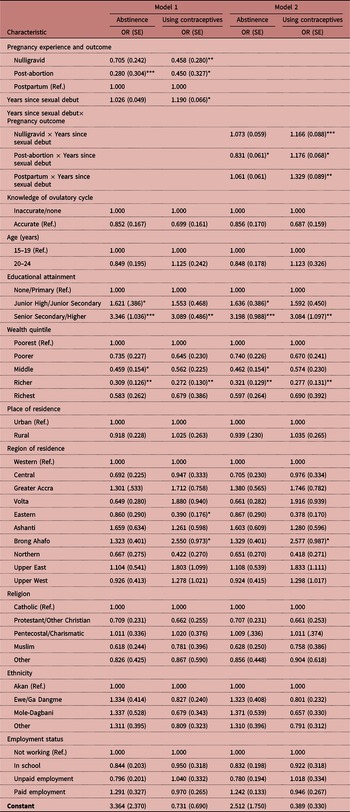
Results of the multinomial logistic regression analyses shown in Table 2 indicate a strong association between last pregnancy outcomes and both sexual abstinence and use of modern methods of contraception. Compared with postpartum women, post-abortion women were less likely (0.280 times) to be sexually abstinent and also less likely (0.450 times) to use modern contraception (Model 1). A unit increase in the duration of sexual experience was associated with a 0.19 increase in the odds of having a met need.
Predicted odds from multinomial logistic regression analyses of abstinence and using modern contraceptives among unmarried young women, by pregnancy outcomes and selected background characteristics

Computed from the 2014 Ghana Demographic and Health Survey.
OR: Odds ratio; SE: Standard Error; Ref.: reference category.
*p<0.05; **p<0.01; ***p<0.001.
In Model 2, only the interaction between years since sexual debut and post-abortion category was statistically significant, showing a negative correlation (exp β = 0.831) between duration of experience and odds of sexual abstinence. However, there was a positive correlation between years since sexual debut and having a met need among all three categories of young women.
Having junior secondary education was associated with higher odds of abstinence (1.621), but having secondary or higher education was associated with about three times the odds of being abstinent or using contraception when compared with having no formal education. Compared with the women in the poorest wealth categories, those in the richer category were less likely to abstain or have used modern contraception than not used. Residents of the Brong Ahafo Region were more likely than those of the Western Region to have a met need (3.580). Neither sexual abstinence nor having a met need among unmarried young women in Ghana were differentiated by urban–rural residence, age, employment status, religion or ethnicity.
Discussion
This cross-sectional study reveals a relationship between pregnancy outcome and experience and later contraceptive behaviour among unmarried young women in Ghana, corroborating findings that pregnancy outcomes and experiences predict later contraceptive use among US adolescents (Chernick et al., Reference Chernick, Schnall, Higgins, Stockwell, Castaño, Santelli and Dayan2015). First of all, it is evident that reproductive behaviours do not reflect unmarried Ghanaian young women’s desires to delay childbearing. Among the unmarried young women in this study, however, post-abortion women were found to be less likely to use contraceptives than their postpartum counterparts and were not significantly different from their nulligravid cohorts in this regard. This connotes that childbirth (perhaps the consequences young women face before, during and/or after) predisposes them to postpartum contraceptive use. The study found higher contraceptive use among postpartum than post-abortion unmarried young women. Banerjee et al. (Reference Banerjee, Gulati, Andersen, Acre, Warvadekar and Navin2015) found that post-abortion contraception acceptance in India was lowest among women aged under 25 years. Biney and Atiglo (Reference Biney and Atiglo2017) also found that, in Ghana, women aged under 25 were the least likely to access safe abortion services, and hence lacked the opportunity for post-abortion counselling. Post-abortion women may be less likely to re-visit the facilities where they received abortion care; that is, if health facilities were utilized (Sundaram et al., Reference Sundaram, Juarez, Bankole and Singh2012), due to stigma and lack of established structures in the health system. On the other hand, women who have facility-based deliveries tend to re-visit these facilities for postnatal care. Thus, post-abortion women may have inadequate and less-regular interaction with health workers and contraception counselling services than their postpartum counterparts. On the other hand, where they have access to post-abortion contraception counselling and are given a method, service providers may be disinclined to offer long-acting or hormonal methods (Banerjee et al., Reference Banerjee, Gulati, Andersen, Acre, Warvadekar and Navin2015) due to the young age of the respondents and the health worker’s own biases or misperceptions (Hindin et al., Reference Hindin, McGough and Adanu2014). This may explain the lower contraceptive uptake among this group. It is also likely that post-abortion women may continue to resort to abortion as an antidote to non-marital pregnancy. Perhaps also, they may want to test and be sure of their fecundity after an abortion and thereby continue to engage in sexual activity without contraception. It is to be acknowledged that a small percentage of the abortions may be deemed as spontaneous, hence it is possible that the adolescents/young women may have wanted to carry that particular pregnancy to term. However, at the time of the survey these women reported wanting to delay childbearing and hence were at risk of an unintended pregnancy.
The likelihood of using contraception in this study was lower among nulligravid and post-abortion women relative to postpartum women. Postpartum young women may have been provided with contraception or contraception counselling at their place of delivery, which in Ghana is most likely a health facility (GSS et al., 2015). Family planning interventions that occur at health service sites are effective at removing barriers to contraception (Hindin et al., Reference Hindin, Kalamar, Thompson and Upadhyay2016). Thus, could childbirth be the threshold at which contraceptive uptake is motivated into the conscious calculation among young unmarried women? There are some other possible explanations for higher contraception uptake among postpartum unmarried young women. First, it is possible that they have proven their fertility to stabilize their relationships where their relationship is unstable because future fertility is in doubt (Osei et al., Reference Osei, Mayhew, Biekro and Collumbien2014). Another possible explanation is the prohibition and stigmatization of non-marital sex and fertility among young women in certain societies in Ghana (Hall et al., Reference Hall, Manu, Morhe, Dalton, Loll and Dozier2018). A common anecdote is that an unmarried young woman with at least one child is derogatorily labelled as born-one in some circles. Postpartum women may thus be motivated to use more-effective modern methods to space or delay repeat childbirths until they are in stable unions or their current relationships become more formalized. Therefore, while the optimum objective is to prevent unintended pregnancy via increased contraception, young pregnant women can be encouraged to carry a pregnancy to term as this engenders later positive contraceptive behaviours. To this effect, efforts at reducing stigmatization and reintegrating young mothers into school and economic systems must be strengthened to reduce their social exclusion. It is evident in Ghana that young women whose first pregnancies were terminated through induced abortions have higher years of schooling than their counterparts who had live births (Biney & Nyarko, Reference Biney and Nyarko2017).
Again, infertility-related misconceptions about use of hormonal modern methods, especially, may predispose nulliparous women to reject modern methods for traditional methods or more ‘natural’ methods (Hindin et al., Reference Hindin, McGough and Adanu2014). The fear of permanent fertility-damaging side-effects of modern contraceptives, though misconceived and mainly received from non-clinical sources, may often override the fear of the side-effects of abortion (Biney, Reference Biney2011) at the point of sexual intercourse where the choice is theirs. Irrespective of the age at which young women initiate sex, the longer the years since sexual debut the more likely they are to be using contraceptives (Cwiak et al., Reference Cwiak, Howard, Hsieh, Ricciotti and Sucato2016). This was evident among all three groups of women in this study. Holding the frequency of coital experience constant, young women who have recently initiated sex may still be learning to develop their efficacy for contraceptive use whereas their counterparts who began much earlier may have mastered the ability to access and use them (Mosher et al., Reference Mosher, Jones and Abma2015). Nulligravid women seem to have particularly short durations of sexual experience and so have a reduced risk of conception. However, with prolonged coital experience these young women stand the risk of future unintended pregnancies.
Having accurate knowledge of the timing of ovulation was shown to be associated with less likelihood of using modern contraception among women but was not associated with sexual activity. This could suggest that they are making use of this natural method that has seemingly proved effective so far. It is also to be expected that where fear and misperception of contraceptives is rife, young women may tend to trust their knowledge of timing of ovulation and rely on the rhythm or other traditional methods.
The results also indicate that about a quarter of female adolescents and young adults in Ghana are at risk of unintended pregnancy because they are not using contraceptives, even though they intend to delay childbearing. While contraceptive use was not particularly high among the sexually active, there was a high prevalence of abstinence among young women who had initiated sexual activity. The findings indicate that unmarried young women who had initiated sex may have had their sexual debut about 3 years earlier and about half of them were sexually active at least 4 weeks prior to the 2014 GDHS.
This study found other significant factors to be associated with non-marital sexual activity and met need for contraceptives in Ghana. Women with a minimum of junior high education were more likely to be sexually abstinent as they seek to postpone childbirth, and those with secondary education were more likely to have met need for contraception. Formal education was associated with more-responsible contraceptive behaviour among young women. This further reinforces the need to strengthen sex education in schools, particularly as Ghana implements the Free Senior High School Policy to increase access to senior high education for all. In addition, unmarried young Muslim women were less likely to be sexually abstinent than have an unmet need when compared with their Catholic counterparts. While religiosity or attaching importance to religion has been found to influence initiating sexual behaviour among youth in Accra, Ghana, (Alhassan & Dodoo, Reference Alhassan and Dodoo2020), previous studies have also shown that Muslim women are less likely to initiate premarital sex than liberal Christian sects and religious groups in Ghana. Religious affiliation is rarely linked with family planning behaviour among young women. This presents a complexity which suggests the need for further exploration of the influence of religion in sexual and reproductive health behaviour.
The study has some limitations worth noting. The first is that contraceptive use was limited to modern methods although traditional methods could also be effective in preventing unintended pregnancies (Hubacher & Trussell, Reference Hubacher and Trussell2015; Festin et al., Reference Festin, Kiarie, Solo, Spieler, Malarcher, Van Look and Temmerman2016); however, having a met need was limited to the use of more-assessable modern contraceptive methods. Secondly, sexual abstinence within the 4 or more weeks prior to the survey does not imply volition to abstain but could also be due to other reasons, including lack of opportunity and suffering negative or coerced sexual debuts. Third, computing years since sexual debut did not take into account the frequency of sexual activity and number or types of partnerships during the period, for which information was not available in the dataset. Finally, women’s responses were subject to recall biases as self-reported retrospective information was sought from the respondents. In particular, due to the sensitivity of information regarding sexual activity and pregnancy termination from unmarried young women in Ghana, misreporting may have occurred. These limitations were mainly due to a paucity of data over which the authors had no control. That notwithstanding, the study provides valid information about the relationship between pregnancy outcomes and contraception that is relevant for policy, practice and further research.
In conclusion, this study investigated contraceptive use and sexual abstinence among unmarried young women with different pregnancy experiences and outcomes in Ghana. Unmarried young women were found to be at risk of unintended pregnancies, not wanting a child and not using modern contraception though sexually active. Nonetheless, sexual abstinence was a common strategy among sexually experienced unmarried young women in Ghana. Post-abortion women were the most sexually active but were less likely than postpartum women to use contraception. The study concludes that abortion tends to reinforce the risk of unintended pregnancies and repeat abortions while childbirth minimizes later risk by means of contraception. Particular attention must be paid to young abortion seekers to progressively make safe abortion services more accessible to them while strengthening the capacity of health workers and facilities to offer post-abortion contraceptive counselling. Targeted efforts to increase modern contraceptive uptake should improve reproductive biology education and service availability at health centres and also in schools in Ghana. Finally, abstinence is not considered in most studies but can help us understand young women’s contraceptive and reproductive health habits. Adolescent family planning programmes should consider, in addition to modern contraception, sexual abstinence (both primary and secondary), which is within the conscious calculation and choice of unmarried young women in Ghana.
Funding
This research received no specific grant from any funding agency, commercial entity or not-for-profit organization.
Conflicts of Interest
The authors have no conflicts of interest to declare.
Ethical Approval
Ethical clearance for the Ghana Demographic and Health Survey, in line with the global DHS Program, was provided by the Ghana Health Service Ethics Review Committee of the Ghana Health Service, Ghana, as well as the Institutional Review Board of ICF International, Maryland, USA. Informed consent was obtained from all participants prior to the interviews. In addition, for young girls below the age of 18 taking part in the study, parental consent was also obtained.