

There have been series of changes and advancement in the Nigerian work environment which is occasioned by a number of factors ranging from privatisation, politics and government policies. This has compelled employers to consider job variables such as organisational citizenship behaviour (OCB) as important work behaviour. In actual fact, specific research efforts have been geared towards understanding the concept across various organisations in Nigeria. However, a lot has to be done to accommodate some other explanatory variables that are predictive of OCB among employees in some selected organisations in Nigeria. It is not an understatement that organisations meet their goals as well as customers’ expectation when employees are willing to display OCB.
According to Organ (Reference Organ1988), OCB refers to ‘individual behaviour that is discretionary, not directly or explicitly recognised by the formal reward system, and that in the aggregate promotes the effective functioning of the organisation’. In the work environment, workers tend to align more with formal schedule of duty, paying little attention to other positive and constructive discretionary engagements which could enhance growth and sustainability. OCB extends beyond performances that are based on formal job expectations from employees. In other words, it reflects those actions performed by employees that surpass the minimum role requirements expected by the organisation which promote the welfare of co-workers, work groups and/or the organisation (Lovell et al., Reference Lovell, Kahn, Anton, Davidson, Dowling, Post and Mason1999).
Researchers and organisational behaviour analysts have continued to study OCB due to its potential consequences for various categories of stakeholders within the organisation such as workers, co-workers, managers, groups, teams and even the organisation as a whole. These consequences may include enhanced performance, reduced absenteeism, reduced turnover rates, improved job satisfaction and promotion of workers’ welfare to mention a few. However, several personal and job-related factors such as personality, job satisfaction, pattern of leadership, organisational climate could predict OCB. In view of this, the present study intends to focus on investigating the relationship between organisational climate and OCB among employees of selected private companies in Nigeria.
Litwin and Stringer (Reference Litwin and Stringer1968) viewed organisational climate as ‘a set of measurable properties of the work environment which are perceived directly or indirectly by people who live and work in this environment and assumed to influence their motivation and behaviour’. In the same vein, Brown and Leigh (Reference Brown and Leigh1996) viewed organisational climate as a set of properties within the work environment, perceived directly or indirectly by the employees, that is assumed to be a major force influencing employee behaviour. In fact, organisational climate is becoming more important than ever. This is because organisations need to ensure that employees who significantly add value to her growth are kept and satisfied (Brown & Leigh, Reference Brown and Leigh1996). Not only that they are kept and committed to the organisation but also be willing to go the extra mile for the organisation by using their discretion to keep the organisation going.
From the foregoing, organisational climate appears to relate to OCB at workplace, since work environment have a way of influencing work behaviour. For instance, if employees work in an unfriendly environment that creates a negative feeling of loss of confidence, they may be reluctant to engage in extra-role behaviour. Organisational climate has been positively linked to many behavioural outcomes such as commitment and job satisfaction, leadership behaviours, job performance, productivity, and quality of work group interaction (Bhaesajsanguan, Reference Bhaesajsanguan2010; Castro & Martins, Reference Castro and Martins2010).
Dimensions of organisational climate includes flexibility, innovation, outward focus and reflexivity. Flexibility refers to orientation towards change; innovation signifies the extent of encouragement and support for new ideas and innovative approaches. Outward focus indicates to the extent to which the organisation is responsive to the needs of the customer and the marketplace in general, while reflexivity means a concern for reviewing and reflecting upon objectives, strategies, work processes and the wider environment (West, Reference West1996; Reference West, Beyerlein, Johnson and Beyerlein2000).
However, in a bid to have a more robust data and understanding of the dynamics of OCB, there is a need to examine the impact of various dimensions of organisational climate on OCB among employees of private companies in Nigeria. Previous studies on the construct of OCB in Nigeria have focussed on government-owned enterprise (Ehigie & Otukoya, Reference Ehigie and Otukoya2007), banking sector (Nwankwo et al., Reference Nwankwo, Obi, Sydney-Agbor, Agu and Aboh2013), tertiary institutions (Ucho & Atime, Reference Ucho and Atime2013; Itiola et al., Reference Itiola, Odebiyi and Alabi2014), hospitality industry (Obiora & Okpu, Reference Obiora and Okpu2015). Data on manufacturing companies has been sparse.
Based on self-determination and field theories, the present study aimed at providing insights into how organisational climate relates to OCB. Specifically, the present study proposes that each of the dimensions of organisational climate has a significant relationship with OCB. This is because the field theory postulated that employees operate within an environment that ultimately determines their work outcomes. When an organisation is flexible, encourages innovations and support new ideas, shows concerns for reviewing objectives, strategies and work progress, employees are likely to display OCB. Drawing on the above theoretical rationale, we proposed that organisational climate could globally predict OCB. In other to achieve this, this paper consists of the following sections: literature review, results, discussion, conclusion and recommendation.
Literature Review
Theoretical Framework
Two theories reviewed for this study. These are field theory of behaviour and self-determination theory (SDT). While the first theory provided a framework for organisational climate, the second explained OCB.
Field theory is a conceptual model of human behaviour developed by Kurt Lewin in 1940s. It is a psychological theory which examines patterns of interaction between the individual and the total field, or environment. Lewin's work went far beyond the orthodox Gestalt concerns of perception and learning; his theory emphasised an individual's needs, personality and motivating forces. Although the former concentrated on the physiological aspects of human behaviour, Lewin treated psychology as a social science. Lewin adapted a branch of geometry known as topology to map the spatial relationships of goals and solutions contained in regions within a life space. His mathematical representation of life space also accounted for directions of pathways towards a goal and amount of attraction or repulsion towards a given object in the space. He also postulated that persons strive to maintain equilibrium with their environment; a tension (need) will stimulate locomotion (activity) to reinstate the equilibrium. Lewin adapted his field theory to the area of social psychology through his theory of group dynamics. In the context of this work, field theory has connection with organisational climate.
SDT was initially developed by Ryan and Deci (Reference Ryan and Deci2000) and has been elaborated and refined by them and other scholars from many countries over the years. SDT is a macro theory of human motivation and personality, concerning people's inherent growth tendencies and their innate psychological needs. It is concerned with the motivation behind the choices that people make without any external influence and interference. Research on SDT evolved from studies comparing the intrinsic and extrinsic motives: intrinsic values such as personal growth, emotional intimacy, community contribution and health are differentiated from extrinsic values such as financial success, appealing appearance, status and power (Kasser, Reference Kasser, Deci and Ryan2002; Vansteenkiste et al., Reference Vansteenkiste, Soenens, Duriez and Lopez2008).
These different value orientations are assumed to be associated with different outcomes. As intrinsically oriented individuals are focused on developing and actualising their inherent potential, they are likely to satisfy their basic psychological needs for autonomy, competence and relatedness and therefore function optimally (Kasser & Ryan, Reference Kasser and Ryan1996). On the contrary, extrinsically oriented individuals adopt an outward oriented focus and try to impress others by acquiring external signs of worth or importance. This impression management might lead them to engage in various stressful interpersonal comparisons and to develop a contingent sense of self-worth (Kernis et al., 2000) which are likely to forestall their well-being and performance.
Based on SDT, it is expected that the type of flexibility unemployed individuals are willing to display varies base on the function of the content of their work values. Specifically, it is argued that, other things being equal, unemployed individuals will be flexible in accepting particular types of jobs only if these jobs allow them to realise their work values. This is so because intrinsically oriented unemployed individuals highly value personal development and growth at work. They are expected to be more likely to accept a job that requires them to follow additional training. This is because following such a training programme would be seen as contributing to their personal growth. Furthermore, intrinsically oriented individuals would be unwilling to accept an undemanding job or under-employment, because such jobs provide only limited opportunities for skill development. Individuals who hold extrinsic work value orientation would be less flexible in accepting an underpaid job because such jobs do not allow them to realise their extrinsic work value orientation.
Review of Empirical Studies
A significant number of empirical studies have been conducted to investigate the phenomena of organisational climate and OCB. Most research findings consistently support the fact that favourable organisational climate predicts OCB. Organ and Ryan (Reference Organ and Ryan1995) conducted a meta-analysis to review 55 studies on the antecedents of OCB. They found that attitudinal measures of leader supportiveness, organisational commitment, perceived fairness and satisfaction, all correlated with OCB. Since then, studies on different antecedents of OCB have been conducted across the globe.
In India, Murugesan et al. (Reference Murugesan, Narayana and Kannan2013) investigated the relationship between organisational climate and OCB among software professionals whose organisational climate is not similar to those of other industries. They found that perceived organisational climate was positively correlated with OCB among software professionals.
In Pakistan, Madiha (Reference Madiha2012) examined the relationship between different dimensions of organisational climate and OCB among randomly selected faculty members (lecturers) from public university. All the dimensions of the organisational climate were found to be significantly related to OCB. He also found that gender had an explanatory power towards OCB.
In Nigeria, empirical data on the construct of OCB has continued to emerge. For instance, Ehigie and Otukoya (Reference Ehigie and Otukoya2007) investigated the antecedents of OCB among employees of National Electric Power Authority (NEPA), a government-owned enterprise. The study revealed that perceived organisational support and perceived fair interpersonal treatment were significant antecedents of OCB. In the banking sector, pay satisfaction and length of service (Nwankwo et al., Reference Nwankwo, Obi, Sydney-Agbor, Agu and Aboh2013) were found to influence OCB. In a related manner, individual employees’ personality, the employees’ degree of affective commitment, the employees’ perception of organisational justice, the employees’ spirituality and whether the employee belongs in the public or private sector were found to predict OCB among bank workers (Igbinomwanhia & Akinmayowa, Reference Igbinomwanhia and Akinmayowa2014). Also, Adeyemo et al. (Reference Adeyemo, Dzever and Nyanayo2015) ascertained that organisational climate predicted the quality of work-life balance among bank worker.
Studies on OCB in the tertiary institutions are also documented. Ucho and Atime (Reference Ucho and Atime2013) examined the relationship among distributive justice, age and OCB among university staff and found no significant relationship between age and dimensions of OCB (altruism, conscientiousness, sportsmanship and civic virtue) but established a significant relationship between distributive justice and the aforementioned dimensions of OCB. In another study, Itiola et al. (Reference Itiola, Odebiyi and Alabi2014) found the dimensions of OCB (altruism, courtesy, sportsmanship and general compliance) to predict job satisfaction of administrative staff of a state-owned tertiary institution in Nigeria.
Furthermore, Obiora and Okpu (Reference Obiora and Okpu2015) established that opportunity for creativity was strongly related to altruism, conscientiousness, civic virtue, courtesy and sportsmanship among employees in the hospitality industry in Nigeria. Ndubueze and Akanni (Reference Ndubueze and Akanni2015) studied the predictive roles of leadership styles on OCB and found that leadership style adopted by superiors predicted OCB. The study revealed that democratic leadership style positively predicted OCB but autocratic leadership style had an inverse relationship with OCB.
Method
Participants
Primary data were used for the study. Data were collected among employees of selected private companies in Abia state. A comprehensive list of registered companies in Abia state was obtained from the Corporate Affairs Commission. The list indicated that a majority of the manufacturing companies in Abia state came under categories, viz petrochemical and agro-allied/cosmetics. Thus, two companies were selected from each of the categories. These companies and their corresponding staff strength are as follows: Saclux Paint Nigeria Limited (212), Tonimas Nigeria Limited (136), Marc Jones International (98) and PZ Cusson (78) were purposively selected for the study, totalling 524.
Procedure
The proportionate stratified sampling technique was adopted to select 262 respondents which represented 50% of employees from each establishment using their nominal roll and staff spread across various departments. Data were collected using two standardised psychological scales. These are as follows:
Organisational Citizenship Behaviour Scale (OCBS). This is a 20-item scale developed by Spector and Fox (Reference Spector and Fox2010). It uses a five-point scale ranging from 1(Never) to 5(Everyday).
Organisational Climate Measure (OCM): It is a 16-item scale developed by Patterson et al. (Reference Patterson, West, Shackleton, Dawson, Lawthom, Maitlis, Robinson and Wallace2005). The response pattern includes strongly disagree (1), disagree (2), undecided (3), agree (4) and strongly agree (5).
We collected data with the assistance of the Human Resource Managers in each of the four organisations from respondents who indicated their willingness to participate in the study. Instructions on how to fill the questionnaire were provided and confidential treatment of the information supplied was assured as well.
Results
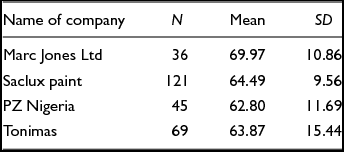
Table 1 showed descriptive analysis of OCB displayed by participants across the three organisations in the study. There was no statistically significant difference in OCB among the four organisations. This was reflected in the mean and standard deviation across the organisations. This indicated that employees in all the selected organisations were not different in their display of discretionary behaviours at workplace.
Organisational Citizenship Behaviour Across the Four Companies

F(3,256) = 0.276; p > .05.
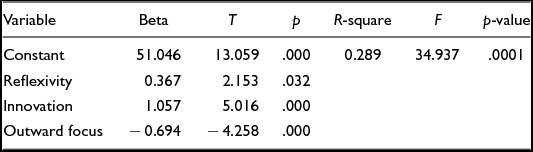
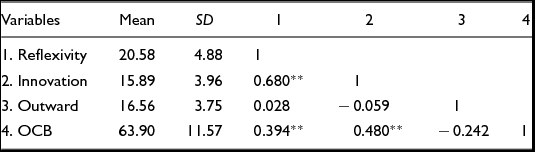
Results from Table 2 shows that organisational climate significantly predicted OCB among employees of private companies in south-east, Nigeria {F(3, 258) = 34.94, R2 = 0.29}. It further revealed that each of the dimensions of organisational climate independently related to OCB. Reflexivity significantly predicted OCB (t = 2.153, p < .05, β = 0.37). Table 3 further explains the relationship that exists between the dimensions of organisational climate and OCB. For instance, a significant positive correlation was found between reflexivity and OCB (r(260) = 0.39, p < .05). In addition, innovation independently predicted OCB (t = 5.016, p < .05, β = 1.057). There also existed a positive relationship between innovation and OCB (r(260) = 0.48, p < .05). However, outward focus has significant negative prediction on OCB (β = −0.69, t = −4.26, p < .05). This was also established on Table 3 where a significant inverse relationship between outward focus and OCB (r(260) = −0.242, p < .05) was found.
Summary Table of Multiple Regression Analysis of Organisational Climate and Organisational Citizenship Behaviour

{F (3, 258) = 34.937, p = .0001, R2 =0.289, R-adjusted = 0.281}.
Bivariate Correlation Showing on Dimensions of Organisational Climate and Organisational Citizenship Behaviour

**Correlation is significant at the 0.01 level (two-tailed).
Discussion
The main objective of this study was to determine the role of organisational climate in predicting OCB among employees of selected companies in Nigeria. The results showed that organisational climate significantly predicted OCB. This finding is in consonance with a number of previous findings. For instance, it agreed with Madiha (Reference Madiha2012) who found that all the dimensions of organisational climate significantly related to OCB among Pakistan samples. Murugesan et al. (Reference Murugesan, Narayana and Kannan2013) also found that perceived organisational climate positively correlated with OCB among Indian samples. It was however noted that climate dimensions of reflexivity and innovation independently predicted OCB, whereas outward focus has a significant inverse relationship with OCB. Most reviews have pointed to a strong relationship between organisational climate and OCB; these showed that organisations with a favourable and positive climate are most likely to enjoy more extra-role behaviour from their employees.
The outcome of this study suggested that individuals who have positive perception of climate and manner of operation in their work environment are more satisfied. More so, they tend to be more dedicated in the discharge of their work. On the contrary, those who harbour ill feelings about the condition of their work may be dissatisfied and unwilling to contribute beyond their specific work requirements. All other climate dimensions correlated with OCB except outward focus which was reported to have negative independent prediction. This finding is also a reflection of the inherent capacity of employees in the private companies to exhibit extra role work behaviour in other to make things run smoothly within the organisations that they work for.
The study concluded that organisational climate significantly predicted OCB among employees of selected private companies in south-east, Nigeria. However, out of the three dimensions of organisational climate (reflexivity, innovation and outward focus), only one (outward focus) had an inverse prediction on OCB. This implies that the climate encouraged the display of OCB.
Recommendations
Based on the findings of this study, the following recommendations were made:
-
1. The need for a proper understanding of work conditions that encourages OCB among workers is a veritable tool for achieving a productive and prosperous organisation. Thus, organisations need to encourage and sustain a positive organisational climate that facilitates adequate display of OCB among subordinate. Particularly, innovation should be encouraged.
-
2. Organisations should periodically review certain policies that hamper their success by ensuring a more conducive work environment and investing in workers welfare.