The fourth edition of the American Psychiatric Association's Diagnostic and Statistical Manual of Mental Disorders describes mental disorder as a clinically important collection of symptoms expressed behaviorally or psychologically that causes an individual distress or a more serious condition, such as increased risk of suffering pain, disability, death, or the loss of freedom.1-Reference Morrison3 During a traumatic event, a response, such as stress, may occur unexpectedly and of ten affects people differently. In everyday discourse, stress refers to a nonspecific response by the body to any demand for change, although it has a precise meaning in the strict clinical use. The Oxford Medical Dictionary defines stress as “any factor that threatens the health of an individual or has an adverse effect on the functioning of the body” and ‘‘a number of normal reactions (mental, emotional, and physiological) of the body, designed for self-preservation.’’4 More precisely, stress is the effect produced by external (physical or environmental) or internal (physiological or psychological) factors, referred to as stressors, which induce an alteration in biological equilibrium.5
There are 2 main types of stress: eustress and distress. Reactions to stress may be experienced physically (eg, increased pulse rate), psychologically (eg, feelings of fulfillment or anxiety), or both. Although stress typically is placed in a negative light (distress) and its positive effects often ignored, stress can be beneficial when it motivates people to accomplish more.Reference Selye6 This is known as eustress. In contrast, psychological distress occurs when the stress response is strong and long lasting and can result in symptoms of mental disorders that include posttraumatic stress, anxiety, depression, reduced self-esteem, social dysfunction, and difficulty in coping.Reference Huppert, Walters, Day and Elliott7 In laboratory experiments, distress is an aversive state in which an animal is unable to adapt completely to stressors and the resulting stress and displays maladaptive behaviors.5
Posttraumatic illness (PTI) is a descriptor that covers a wide range of trauma-related mental disorders. Acute stress disorder, substance-misuse disorders, psychotic disorders, mood disorders, somatoform disorders, dissociative disorders, and posttraumatic stress disorder are potential examples of PTIReference O'Brien8 if they occur after a definable traumatic event. There is wide variation in the experience of PTI. For instance, the incidence of PTI in female survivors of rape and/or sexual and physical abuse has been reported to be as low as 4% to as high as 81%.Reference O'Brien8 Owing to methodological differences of previous studies and individual and environmental factors, the prediction of PTI in trauma victims or people exposed to traumatic events is often difficult.
Politically motivated violence had adverse health effects on those immediately involved and their community, ranging from a loss of well-being or security to injury, illness, or death.Reference Arnold, Ortenwall and Birnbaum9 People who were mentally ill, those who were disabled, ethnic minorities, and non-US citizens were more likely to have higher population-level risk perception as measured by the color-coded alert level of the Homeland Security Advisory System after September 11, 2001. Often, these groups worried more and displayed risk-avoidance behaviors because of terrorism-related fears.Reference Eisenman, Wold and Fielding10 A national study investigating behavioral and lifestyle changes after the terrorist attacks on September 11, 2001, revealed that sex, age, race/ethnicity, and employment status were significant predictors for displaying these changes.Reference Torabi and Seo11 Individuals exposed to the 1995 sarin gas attack in the Tokyo subway system experienced various psychological and physical symptoms that were unrelated to the actual poisoning but were linked to the psychological aftermath of the disaster. The General Health Questionnaire (GHQ-30) showed a significant correlation with psychological symptoms, fear-reaction symptoms, somatization symptoms, chronic stress symptoms, and life-threatening symptoms.Reference Kawana, Ishimatsu, Matsui, Tamaki and Kanda12
Medical personnel face countless challenges in mass-casualty situations. Emergency physicians and nurses may confront many ethical decisions requiring immediate judgments with little time and information to make a collective decision, which can result in errors. When considering the limited resource availability of a hospital in a mass-casualty event, it is understood that people are sorted (triaged) in part based on the urgency of a person's condition or injuries. With appropriate triage, immediate medical intervention is administered to people with treatable life-threatening injuries; delayed or minimal care is provided to those with less-threatening injuries or less-immediate needs. Medical care, other than comfort care, may be withheld from victims with terminal conditions, especially if the number of victims far exceeds the number of health care providers. Triage decisions are event specific and based partially on the natural course of an injury or a condition. Given limited resources, the medical care rendered during a mass-casualty event may not be considered optimal. This inability to render top-of-the-line care can often lead to burnout and psychological distress among health care providers, especially nurses.
Stress in nurses has been studied extensively recently,Reference Chang, Hancock, Johnson, Daly and Jackson13 and several studies on stress among nursing students have been conducted as well.Reference Jones and Johnston14-Reference Jones and Johnston16 Nursing is a demanding profession with a high level of work-related stress. Poor workplace support, shortage of human and physical resources, and the ever-present death and dying can magnify the stress level. Those associated factors are intrinsic to nursing and are enhanced by environmental factors, such as the complexity of patients and their families, poor relationships with physicians, inadequate institutional commitment to nursing, the delivery of poor quality care,Reference Chang, Hancock, Johnson, Daly and Jackson13 and the necessity to continue professional development.Reference Hogston17 Nursing also has emotional demands that contribute to the daily stress of the work.Reference Mann and Cowburn18 Stress leads to more emotion-oriented coping, which is not constructiveReference Deary, Blenkin, Agius, Endler, Zealley and Wood19 and can cause nurses to seek social support.Reference LeSergent and Haney20 Even though stress is a normal reaction to a range of environmental circumstances,Reference Alexander, Fawcett and Runciman21 it can often have negative consequences, such as emotional exhaustion. It has been demonstrated that factors leading to stress, such as an increasing patient load, also lead to emotional exhaustion.Reference Maslach and Jackson22
One study suggests, however, that caring for victims of politically motivated violence has a positive psychological impact on health care workers and that greater levels of positive psychological impact are experienced by women.Reference Shiri, Wexler, Alkalay, Meiner and Kreitler23, Reference Shiri, Wexler, Alkalay, Meiner and Kreitler24 Proximity to stressors is also associated with higher levels of positive and negative psychological impact. For example, during the 2004 Southeast Asia tsunami, being involved in helping others in the acute phase or having responsibility for children when the tsunami struck seemed to lessen the psychological impact among those who witnessed the tsunami, as measured by GHQ-28.Reference Heir and Weisaeth25
The Nursing Profession In Sri Lanka
Although Sri Lanka has attained a higher level of health status and better health indicators compared with many other developing countries, the limited space and overcrowding in state-sector hospital environments create disorganized work conditions for nurses.Reference Beck26-Reference Abeykoon28 Although the Sri Lankan hospital management and health care system is influenced strongly by doctors,Reference Fernando29 issues related to staffing shortagesReference Jayasekara and Schultz30 and the lack of decision-making ability for nurses have become prominent. That lack of autonomy, which is influenced by the knowledge deficits of nurses and poor attitudes in relation to professional nursing, ultimately results in substandard nursing care for patients. Task-oriented nursing usually occurs because of workload demands. With many tasks to complete in a defined period of time, nurses must work quickly and efficiently to complete all of the tasks. Because early-in-career nurses have been taught to follow the practice of senior nurses, the traditional task-oriented nursing practice remains unchanged.
In Sri Lanka, nurses complete a 3-year general nursing diploma in one of the country's 11 nurses’ training schools under the direction of the Department of Health Services31; however, these schools have made minimal efforts to improve the standards of nursing care, nursing education, and attitudes toward the nursing profession.Reference Jayasekara32 It is not known whether the public perception of job prestige, working conditions, and the low salary are factors in the inadequate enrollment of students in nursing schools, which results in staffing shortages in hospitals.Reference De Silva and Rolls33 Almost all of the nurse trade unions in Sri Lanka are exceedingly politicized, and, apart from frequent protests regarding salary issues and interpersonal conflicts, they play a minimum or no role in improving the continuing professional development, autonomy, job satisfaction, public relations, and prestige of the nursing profession.
The War In Sri Lanka
Sri Lanka is a small island in the Indian Ocean with a population of 20 million people. The population consists mainly of 4 ethnicities: Sinhalese, Tamils, Moors, and Burgers. The war in Sri Lanka began in 1983 and lasted 26 years, with intermittent insurgencies against the government by ethnicity-based militant organizations. After 2 decades of fighting and 3 failed attempts at peace talks, a 3-year-long government-sponsored major military operation ended the war on May 18, 2009. During those 26 years, more than 80 000 people were killed, including 24 000 soldiers of the Sri Lankan security forces, 28 000 fighters of militant organizations, 1100 soldiers of the Indian army, and 25 000 civilians of all ethnicities. Almost 60 000 soldiers of the Sri Lankan security forces were wounded or disabled.34 The burden of care for them fell on an underresourced and inadequately staffed health care system. In the present study, the psychological distress experienced by nurses working in Sri Lanka is explored.
The purpose of this study was to test the hypothesis that self-reported, war-related stress is associated with an increase in the probability of psychological distress. The ethical clearance for recruiting human subjects was obtained from the ethical review committee of the Faculty of Medicine at the University of Kelaniya, Sri Lanka. Further approval was obtained from the institutional review board of Indiana University Bloomington.
Methods
Target Population
The study population consisted of nonsupervisory nurses from 2 Sri Lankan hospitals near the country's war region: the Teaching Hospital Anuradhapura (TH-Anuradhapura) and the Base Hospital Kebithigollawa (BH-Kebithigollawa). During the war, the 2 hospitals were the tertiary-care facilities nearest to the front. TH-Anuradhapura is the third largest hospital in the country (1328 beds in 2007) and is the only curative care institution with specialized departments within the district. Significant overcrowding and high turnover of the inpatient departments characterize TH-Anuradhapura. In the 6 months before data collection, the hospital provided care for 4697 war victims (an average of 783/mo). The BH-Kebithigollawa is a 38-bed rural hospital located in the same district as TH-Anuradhapura but is closer to the conflict areas. The hospital employs only 15 nurses in its 5 departments. At the time of sampling, the TH-Anuradhapura employed 626 nurses and 29 nurse supervisors.35 Anuradhapura is located almost 80 mi from the eastern and western coastlines of the country in an area not affected by 2004 tsunami. The effects of the tsunami are considered negligible in the present study.
Study Design
The descriptive cross-sectional survey method was adopted for BH-Kebithigollawa (pilot study) and for TH-Anuradhapura (main study). A pretest of study instruments and a pilot study were carried out at BH-Kebithigollewa. Eight nurses were randomly selected from across all of the departments. All 8 nurses responded to both self-administered study instruments with 100% completion within a mean time of 25 minutes per participant. The chief investigator of the study collected data during 3 consecutive shifts on a single day to minimize the spillover effect. An analysis of the pilot study confirmed the appropriateness of the study materials and methodology. Three days after completion of the pilot study at BH-Kebithigollawa, the same methodology was used at the larger nearby teaching hospital, TH-Anuradhapura.
Sampling
The sample size of the final study was determined by the following formulaReference Lwanga and Lemeshow36:
 $${\rm{n}}\, = \,Z_{{{\rm{1 {\hbox -} \alpha }}/{\rm{2}}}}^{{\rm{2}}} \,\left[ {{{{\rm{P}}}_{\rm{1}}}\,\left( {{\rm{1}}\,{\rm{ - }}\,{{{\rm{P}}}_{\rm{1}}}} \right)} \right]/{{{\rm{d}}}^2} = \left( {{\rm{1}}{\rm{.9}}{{{\rm{6}}}^{\rm{2}}} \,\left[ {\left( {{\rm{20}}\,\ast\,{\rm{80}}} \right)} \right]} \right)/{{{\rm{5}}}^{\rm{2}}} = {\rm{246}}\eqno\rm$$
where n = sample size; P = expected maximum prevalence of psychological distress (20%)Reference Flynn37;  $$-->$<>Z_{{{\rm{1 {\hbox -} \alpha }}/{\rm{2}}}}^{{\rm{2}}}$$$
= factor corresponding to type I error, which is 1.96 for 5% significance level; and d = absolute precision on either side of the proportion in percentage points. Five percent was added to the calculated sample size (246) to compensate for nonrespondents, reaching an adjusted sample size of 258.
Only nurses who had been working in their present department for a minimum period of 6 months before data collection were recruited in the study to eliminate the crossover effect. The stratified random sampling technique was applied to obtain a sample with a total of 258 nurses. The sample was selected proportionate to the number of nursing officers in each department. Of the 258 study invitations, 233 nurses responded. Owing to the fact that the main study was carried out identically to the pilot study, the results of the pilot study and the main study were combined to achieve a sample of 241. There were 36 departments and 626 nurses in the teaching hospital.
Data Collection
Data were collected during the last week of the 26-year-long war. The principal investigator and 2 nurses collected data from all of the study participants. Informed consent was verbally obtained from each participant. Responses were anonymous and confidentiality was ensured. The data collection was completed in 2 consecutive days to minimize the spillover effect. At an appropriate time absent of a heavy workload, questionnaires were administered after instructions about how to complete relevant fields. The primary spoken language ofthe nurses in the study was Sinhalese.
Instruments
A self-administered questionnaire was given to measure sociodemographic factors; economic factors; health-related factors; levels of social, family, and workplace support; workload; perception of workplace conditions; and degree of exposure to traumatic events. The GHQ-30 was given to assess psychological distress.
Questionnaire on Sociodemographic Data and Life Stressors
The Questionnaire on Sociodemographic Data and Life Stressors with close-ended questions was administered to measure all of the factors listed above. To be more appropriate to the cultural context, variables in this questionnaire were identified by a search of both local and international literature but based mainly on the mental health guidelines of the Ministry of Health-care and Nutrition of Sri Lanka.38 The guidelines indicated that people may be distressed because of the following reasons: not having enough money or time; experiencing failure at work or school; having relationship problems with spouse, parents, teachers, friends, siblings, workmates, and peers; experiencing domestic violence; using alcohol; having thoughts of self-harm; having medically unexplained symptoms; and living in fear.
GHQ-30
Brief screening instruments were used to identify people who were more likely than others to experience psychological distress because of baseline risk factors. Screening instruments that have population-norm values like the GHQ-30 were ideal because they were usually short, inexpensive, and resulted in a simple index with which to compare an individual to similar individuals in the reference population.Reference Goldberg and Williams39 The GHQ-30 produced a threshold value that distinguished those with likely mental disorders from those without mental disorders. In the absence of a full mental status interview, the GHQ-30 offered a good alternative to estimate the probability of a person having a psychiatric disorder.Reference Gelder, Lopez-Ibor and Andreason40, Reference Wancata, Alexandrowicz and Benda41 Participants who answered positively ≥6 of the 30 items on the GHQ-30 were coded as “case-ness,” which refers to the probability of being classified as a psychiatric case. A 5-factor structureReference Huppert, Walters, Day and Elliott7 was used to further code respondents as having anxiety, low self-esteem, depression, difficulty in coping, and social dysfunction. Several studiesReference Huppert, Walters, Day and Elliott7, Reference de Santiago, Vázquez and Díez42, Reference Rasul, Stansfeld, Davey-Smith, Hart and Gillis43 have shown that the GHQ-30 has good psychometric properties in the general population across a variety of cultures and languages. Following the 1988 explosion of Pan Am flight 103 over Lockerbie, Scotland and after the aircraft disaster at Coventry, England,Reference Livingston, Livingston and Fell44, Reference Chung, Easthope, Chung and Clark-Carter45 survivors experienced anxiety, depression, and psychological distress as measured by the GHQ-30. The prevalence of psychological distress among the survivors of the 2003 Bam, Iran earthquake, measured by the same test, was 3 times higher than the reported psychological distress among the general population. Female sex, lower education level, unemployment, and loss of family members were associated with severe psychological distress among the earthquake victims.Reference Montazeri, Baradaran and Omidvari46
One study has validated GHQ-30 in Sri LankaReference Sumathipala and Murray47 and another study on disabled soldiers in Sri Lanka that used the GHQ-30 found high psychological distress and somatic symptoms.Reference Kasthuriarachchi48, Reference Gunawardena, Senevirathne Rde and Athauda49 Six indices were created, each one representing a distinct factor of the GHQ-30. The weakness of a general screening tool is that although specificity may be high, sensitivity is often weak and many false-positives can occur with it. A factor analysis of the GHQ-30 in 10 randomly selected samples of 600 adults, each covering the age range of 18 to 98 years old, was conducted to overcome this problem.Reference Huppert, Walters, Day and Elliott7 The results indicated a highly consistent factor structure, and identified 5 distinct factors corresponding to anxiety, low self-esteem, depression, difficulty in coping, and social dysfunction. Similar studies also identified 3 to 5 distinct factors similar to those 5 factors, the most commonly discussed being anxiety, depression, social dysfunction, and low self-esteem.Reference Gelder, Lopez-Ibor and Andreason40 A similar factor structure (indices) is used in the present study by identifying participants who scored >20% of the questions positively for each factor.
During the present study, an attempt was made to create a new factor (new index) based on anxiety-related fear. The total score of the GHQ-30 had shown significant correlations (P < .01) when it was simultaneously administered with clinical interview schedules of measuring fear under conditions of politically motivated violence.Reference Kawana, Ishimatsu, Matsui, Tamaki and Kanda12 Six questions (2, 3, 5, 14, 19, and 28) were identified as reflecting anxiety-related fear. Questions 2, 3, and 5 were selected on the basis of the fact that fear causes loss of sleep and leads to risk-avoidance behavior.Reference Kawana, Ishimatsu, Matsui, Tamaki and Kanda12 Questions 2, 14, and 28 were supported by the fact that they were included in the anxiety factor, and question 19 directly reflected fear (J. Wong, personal communication, 2009). The new index based on anxiety-related fear was not validated during the present study.
Analysis Methods
Data were analyzed using SAS version 9.1 (SAS Institute, Cary, NC). Respondents were dichotomized into caseness or not according to their score on the GHQ-30. Chi square tests were used to determine the association between the 6 indices and the sociodemographic and life stressors variables. Dependency analysis using logistic regression investigated the dependency of the 6 indices on demographics and nondemographics variables. The number of the independent variables used each time was not >3 after eliminating the nonsignificant predictors; this had been fit with the sample size limitations. The 6 indices were anxiety, low self-esteem, depression, difficulty in coping, social dysfunction, and anxiety-related fear. The rationale for dependency analysis was to determine which independent variables affected the 6 indices significantly and to create a predictability or an influence diagram.
Results
All 8 nurses in the pilot study and 233 of the 258 nurses of the main study responded. Therefore, response rates for the pilot study and main study were 100% and 90.3%, respectively. Because the nonresponse rate in the main study was low, there was no attempt to analyze characteristics ofnonrespondents with the available data in each hospital's staff registers. Almost two-thirds of the surveyed nurses were younger than 35 years, and women represented 88% of the sample. One-third of the participants were unmarried and 31% had ≥2 children. Forty-one percent reported that they lived in an urban setting.
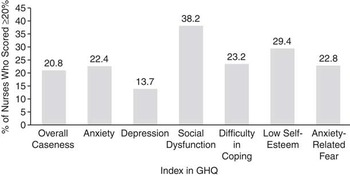
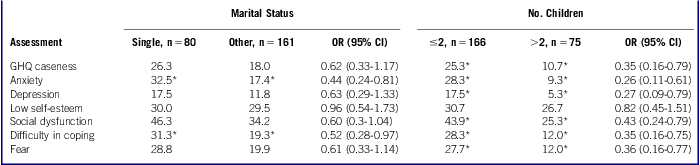
As measured by the GHQ-30, evidence of persistent psychological distress was found in 20.75% of respondents. Anxiety was found in 20.8%, depression in 13.7%, low self-esteem in 29.4%, social dysfunction in 38.2%, difficulty in coping in 23.2%, and anxiety-related fear in 22.8% (Figure 1). Multivariate logistic regression was used to discriminate caseness from normal psychological condition. Age (≤35 or >35 years old), residency (urban or rural), type of hospital (teaching or rural), total monthly family income (<50 000 or ≥50 000 in rupees; ie, 115 rupees = 1 US dollar) and living arrangement (with or without family members) did not statistically differentiate probable psychiatric cases from non-cases. Probability of having caseness was 8.42 (odds ratio [OR] 8.42, 95% confidence interval [CI] 1.12-63.45) times higher in women than in men. Because there were only a few participants who were divorced, separated, or widowed, they were combined with the married group for analysis. Respondents who had >2 children at home were 3 times less likely (OR 0.35, 95% CI 0.16-0.79) than others to be categorized as being a probable psychiatric case.
Caseness for the General Health Questionnaire (GHQ-30) and positive responses for each psychological index of the GHQ analyzed using the logistic regression procedure. Overall caseness for GHQ is defined as participants who responded with ≥6 (20%) positive answers to 30 questions. Positive responses for each of 6 psychological indices are defined as ≥20% positive answers to the subset of questions allotted for the particular index. Subsets of questions for each index are mutually exclusive but not exhaustive.

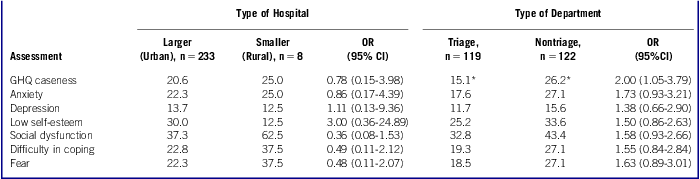
Emergency, outpatient, and surgical departments, operating theaters, and intensive care units were considered triage departments involved in the management of victims of war, whereas all of the other departments were considered nontriage departments. Almost half (49%) of the participants worked in triage departments. The majority (53%) of the nurses had a total service period of <5 years, and 37% of the nurses worked in their present department for <1 year. The risk of being a probable psychiatric case was 2 times higher (OR 2.00, 95% CI 1.05-3.79) among nurses who were not incorporated directly into the triage system of victim management compared with nurses who were integrated directly into the triage system.
The prevalence of self-reported mental disease of the participant or of a first-degree blood relative was 5.4%. The prevalences of self-reported conflict-related stressors and the recent death of a loved one were 36.1% and 25.3%, respectively. None of these were significantly associated with being a probable case of psychological disorder. Almost 50% of the participants reported nonspecific stressful experiences that were defined as “any other stressful event, which severely affected mental status, apart from professional life.” Nonspecific stressful experiences demonstrated statistically significant associations with 6 of the 7 psychological measurements. Nurses who experienced such a nonspecific event had 2.6 times higher caseness (OR 2.59, 95% CI 1.34-5.01) compared with those who did not report such an experience.
With dependency analysis using logistic regression, it was revealed that the probability that a participant had anxiety, depression, social dysfunction, or difficulty in coping within a specified time period was predicted by having ≤2 children (including the absence of children) and by female sex. Although experiencing nonspecific severe stressful events predicted low self-esteem, perceived economic problems predicted the probability of having anxiety-related fear. Although having ≤2 children predicted the probability of experiencing psychological problems consistently, younger age (younger than 35 years old) did not predict the probability of having psychological problems (Tables 1 and 2).
Psychological Assessment of Participants by Marital Status (Unmarried vs All Others), and Number of Living Children (≤2 vs >2 Offspring)
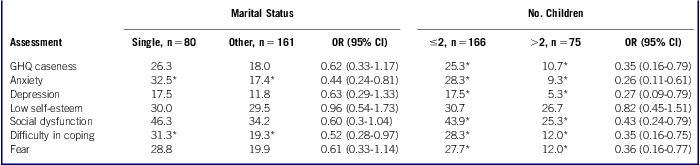
CI = confidence interval; GHQ = General Health Questionnaire; OR = odds ratio.
*Statistically significant.
Psychological Assessment of Participants by Workplace
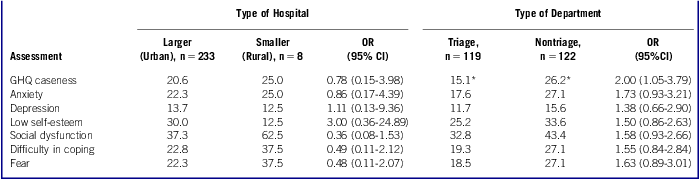
The main study and the pilot study were conducted in a large urban hospital and in a small rural hospital, respectively. Triage departments in both hospitals were responsible for providing emergency management to victims of war. CI = confidence interval; GHQ = General Health Questionnaire; OR = odds ratio. *Statistically significant.
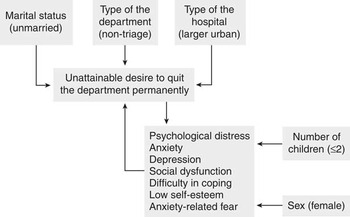
Employment in a nontriage department (OR 0.52, 95% CI 0.30-0.88), employment in a larger hospital (OR 13.91, 95% CI 1.68-115.07), or being unmarried (OR 2.79, 95% CI 1.59-4.89) was statistically significant in predicting a participant's desire to quit the department (but not the hospital or the nursing profession) permanently in comparison with being employed in a triage department, being employed in a smaller hospital, or being married, respectively.
Comment
This study has effectively used the GHQ-30 to assess posttrau-matic illness among health care providers in Sri Lanka. The questionnaire was relatively simple and quick to use and provided information similar to other studies. The results of the GHQ-30 show that the prevalence of potential cases of post-traumatic illness remains high (nearly 21%) in nurses, particularly among female nurses. There was no control population used in this study; the findings of a previous study that used the GHQ-30 and was conducted in 2001-2002 (during the war) in Anuradhapura (same district) can be used as a control. The 2001-2002 study revealed that the prevalence of psychological distress, or GHQ-30 caseness, was 8.9% among 461 men with a regular monthly income with an age range of 20 to 44 years.Reference Gunawardena, Senevirathne Rde and Athauda49 Therefore, the prevalence of psychological distress among nurses in Anuradhapura can be considered more than twice as high as that of the general population, although the dissimilarities in employment status and sex between the 2 study populations should be taken into account (Figure 2).
Predictability diagram based on dependency analysis. Being unmarried, working in a nontriage department, and working in a large urban hospital (distal determinants of psychological indices and distress) predict desire to quit the department permanently (proximal determinant), which consequently forms a vicious circle with psychological indices and distress. Having ≤2 or no children and female sex also are considered proximal determinants.

The results revealed an unexpected finding. Despite adequate sample size, self-reported war-related stress was not associated with an increase in the probability of posttraumatic illness. Nurses who were integrated directly into the triage system of disaster management were half as likely as other nurses to report psychological distress. Nurses in the triage system were also less likely to have the desire to quit their workplace, which implies satisfaction with the work being performed. This demonstrated the existence of positive psychological effects in hospital-based health workers who were caring for victims of politically motivated violence. Nurses in the rural hospital were also less likely than others to have the desire to quit their workplace. Because there was no compulsory service program in Sri Lanka for recruiting nurses in remote and rural areas, the decision to be employed in a rural area may be influenced by many factors,Reference Frehywot, Mullan, Payne and Ross50 such as a small workload in rural hospitals, the low cost of living in rural areas, and the family of the nurse residing in the particular rural area.
It is generally understood that a desire to quit the department has a cyclical relation with psychological indices. For example, the desire to quit the department may cause anxiety, which in return negatively affects the quality of the participant's work, including interpersonal relationships, and consequently increases the desire to quit the department. Dependency analysis revealed that the probability that a participant has 1 or all of the 6 positive psychological indices within a specified period can be predicted from the participant's desire to quit the department, but not the hospital or the nursing profession.
Although the reported presence of nonspecific life stressors did correspond to an increased risk of having psychological problems, specific events such as conflict-related stressors and the recent death of a loved one did not lead to an increased risk of having psychological problems. One finding that needs further study suggests that these nurses did not attribute their mental stress to the war specifically but rather to general life stresses. In a country so long at war, distinguishing between what is war related and what is life related may not be clear or done easily.
The nursing profession capitalizes on the caring nature of the people who seek employment in the field. The nurses who have more family care responsibilities in addition to caring for patients tended to have better psychological well-being than those with few or no family care responsibilities, and this eustress of having family care responsibilities may have enabled them to work more efficiently in a triage system and vice versa. It is also possible that the eustress of working as a nurse in the triage system enables nurses to have more family care responsibilities. Both possibilities, however, are consistent with using stress as a positive force to achieve a rewarding lifestyle and should be studied further.Reference Selye6 Family-related stressors, such as having a spouse and children, acted as buffers to distress in this sample. As a corollary, nurses without adequate social, family, or both support networks are at increased risk of psychological trauma and stress.
In many Sri Lankan hospitals that treat the victims of war, including the study setting, work in a triage department for at least 1 year is compulsory on a periodical basis (eg, approximately once during every 5-year period). Such a regulation is imposed to ensure equal distribution between more difficult and stressful jobs in nursing and to prevent overburdening nurses in triage departments. Under extreme circumstances, such as disability and excessive family responsibility, exceptions are granted to work in nontriage departments for longer periods or permanently. Conversely, nursing vacancies in triage departments are usually filled without additional effort by hospital administration because many nurses volunteer in triage departments either to gain a higher level of job satisfaction or to obtain higher extra-duty compensation. In this sense, it can be argued that nurses who have their own psychological challenges are assigned to less-stressful jobs in nontriage departments, whereas other nurses volunteer in triage departments. There also is a possibility that nurses who have their own psychological challenges may remain unmarried or have no children. This phenomenon limits the validity of study findings by introducing a selection bias that should have been overcome by using a cohort study design with a baseline psychological assessment and periodical follow-ups.
The new index based on anxiety-related fear was not validated during the study because the sample size was not sufficient for validation. Validation will be required before future applications of this new index.
Approximately 26.2% of the US population has some kind of mental disorder, although only 6% have a serious mental ill-ness.51 The prevalence of mental illnesses in Sri Lanka is 3%.52 The present study identified that 5.4% of participants reported having a first-degree blood relative with a mental illness. Therefore, reporting of mental illnesses is higher among nurses compared with the general population in Sri Lanka, although underreporting is probable because of relatively higher perceived discrimination in many Asian societies in relation to mental illness. The same phenomenon also can lead to a response bias that is almost counterbalanced among different groups of participants because of its equal effect on all of the participants.
Conclusions
Female sex is found to be the most significant predictor of psychological distress among nurses. Previous nonspecific or indirect stressors predict the presence of psychological distress in this sample of nurses. Being unmarried is associated with increased anxiety and more difficulty in coping. Having >2 children acts as a strong protective factor against negative psychological outcomes. Caring for war victims has a positive impact because these nurses have less psychological distress. The challenges of providing care in a war-torn country can be extreme, especially for those without adequate psychological or social support. The findings of this research also may be important for future research on the promotion of positive attitudes and eustress generation to complement a well-developed focus on distress prevention.Reference Butler, Panzer and Goldfrank53
Author Disclosures
The authors report no conflicts of interest.
Published Online: May 23, 2011. doi:10.1001/dmp.2011.36
Acknowledgments
Contributions made during the data collection phase of the study by Dr C. Jayasekara, Mrs D. Hettiarachchi (nursing sister), and Mrs L. Ekanayake (nursing officer) of Teaching Hospital Anuradhapura, Sri Lanka, are valued immensely.