Introduction
Prolonged Exposure (PE) and Eye Movement Desensitization and Reprocessing (EMDR) therapy show good results in the treatment of post-traumatic stress disorder (PTSD; Watts et al. Reference Watts, Schnurr, Mayo, Young-Xu, Weeks and Friedman2013). Also, in various PTSD patient populations, PE and EMDR have shown positive secondary effects on several co-morbid conditions (Bisson et al. Reference Bisson, Roberts, Andrew, Cooper and Lewis2013) albeit the secondary effects are more extensively investigated for PE (for a review see Van Minnen et al. Reference van Minnen, Zoellner, Harned and Mills2015) than for EMDR. Among the positive secondary PTSD treatment effects are clinically relevant reductions of symptoms of depression (Bisson et al. Reference Bisson, Roberts, Andrew, Cooper and Lewis2013; Ronconi et al. Reference Ronconi, Shiner and Watts2015; Van Minnen et al. Reference van Minnen, Zoellner, Harned and Mills2015) and, for PE, an increase in social functioning (Ronconi et al. Reference Ronconi, Shiner and Watts2015).
In patients with psychotic disorders, PTSD is a prevalent condition (12.4%; Achim et al. Reference Achim, Maziade, Raymond, Olivier, Mérette and Roy2011) and in patients with PTSD the likelihood of endorsing symptoms of psychosis is increased (odds ratio 3.55, 95% confidence interval 2.74–4.55; Sareen et al. Reference Sareen, Cox, Goodwin and Asmundson2005). However, in both clinical practice and studies, patients with the combination of PTSD and psychosis have been largely excluded from trauma-focused treatments (Becker et al. Reference Becker, Zayfert and Anderson2004; Ronconi et al. Reference Ronconi, Shiner and Watts2014). This exclusion is mainly due to the widespread belief that treatment of PTSD in patients with psychotic disorders is harmful and will result in an exacerbation of symptoms associated with the disorder (Becker et al. Reference Becker, Zayfert and Anderson2004; Van Minnen et al. Reference van Minnen, Hendriks and Olff2010). Recently this belief has been examined in three feasibility studies with psychotic individuals (Frueh et al. Reference Frueh, Grubaugh, Cusack, Kimble, Elhai and Knapp2009; van den Berg & van der Gaag, Reference van den Berg and van der Gaag2012; De Bont et al. Reference De Bont, Van Minnen and De Jongh2013a ). These studies reported promising neutral to positive results of PTSD treatment on symptoms associated with psychosis, depression and social function. Four other studies examined mixed severe mental illness (SMI) samples analysing outcomes in psychotic and non-psychotic individuals as one group (Rosenberg et al. Reference Rosenberg, Mueser, Jankowski, Salyers and Acker2004; Mueser et al. Reference Mueser, Rosenberg, Xie, Jankowski, Bolton, Lu, Hamblen, Rosenberg, McHugo and Wolfe2008, Reference Mueser, Gottlieb, Xie, Lu, Yanos, Rosenberg, Silverstein, Duva, Minsky, Wolfe and McHugo2015; Grubaugh et al. Reference Grubaugh, Clapp, Frueh, Tuerk, Knapp and Egede2016). Therefore these studies can only provide tentative evidence about the effects of PTSD treatment in psychotic individuals. Particularly, the SMI studies’ results showed that PTSD treatment had no negative effects on psychosis, depression or functioning; indeed some positive effects were found for depression and social functioning. Therefore, on the basis of all these studies we now assume that the effects of PTSD treatment in patients with psychotic disorders are similar to those found in non-psychotic patient groups, i.e. PTSD treatment reduces co-morbid symptoms instead of aggravates them, including symptoms of psychosis (van den Berg & van der Gaag, Reference van den Berg and van der Gaag2012; De Bont et al. Reference De Bont, Van Minnen and De Jongh2013a ), depression (Rosenberg et al. Reference Rosenberg, Mueser, Jankowski, Salyers and Acker2004; Mueser et al. Reference Mueser, Rosenberg, Xie, Jankowski, Bolton, Lu, Hamblen, Rosenberg, McHugo and Wolfe2008; van den Berg & van der Gaag, Reference van den Berg and van der Gaag2012) and social functioning (Mueser et al. Reference Mueser, Rosenberg, Xie, Jankowski, Bolton, Lu, Hamblen, Rosenberg, McHugo and Wolfe2008).
This study presents outcome data of a large randomized controlled trial (RCT) in a population of PTSD patients with psychosis (De Bont et al. Reference De Bont, van den Berg, van der Vleugel, de Roos, Mulder, Becker, de Jongh, van der Gaag and van Minnen2013b ). The primary outcome study demonstrated that PE and EMDR were effective in reducing PTSD symptom severity and that they were safe (Van den Berg et al. Reference van den Berg, de Bont, van der Vleugel, de Roos, de Jongh, Van Minnen and van der Gaag2015a ). The present study examines secondary effects of psychological trauma-focused treatments of PTSD in patients with chronic psychotic disorders. Based on the extensive evidence from various PTSD population studies without co-morbid psychotic disorders our hypothesis is that PE and EMDR will similarly reduce co-morbid depression and increase social functioning in patients with psychotic disorders. Based on indications from a few pilot studies in PTSD patients with psychosis, we specifically hypothesize that both psychological PTSD treatments will reduce symptoms of psychosis.
Method
This study is part of the RCT ‘Treating Trauma in Psychosis’ (TTIP). Our design paper described the trial's primary to quaternary objectives, inclusion and exclusion criteria, recruitment, CONSORT chart, measurement procedures, instruments, intervention conditions and statistical procedures (De Bont et al. Reference De Bont, van den Berg, van der Vleugel, de Roos, Mulder, Becker, de Jongh, van der Gaag and van Minnen2013b ).
The primary outcome paper of the RCT describes the safety and efficacy of PTSD treatment for patients with psychotic disorders and provides details on patient flow, sample characteristics, safety, control procedures, blinding, treatment protocols, temporary restrictions imposed on treatment as usual (TAU; including medication), integrity checks, early completion, completers, drop-outs, serious adverse events, and medical ethical reports (Van den Berg et al. Reference van den Berg, de Bont, van der Vleugel, de Roos, de Jongh, Van Minnen and van der Gaag2015a ). Therefore, only a brief description of the trial is presented below.
Design
This study is a single-blind RCT with three arms [PE, EMDR, and waiting list (WL)] and is registered at Current Controlled Trials (ISRCTN 79584912). The design was approved by the Medical Ethics Committee of the VU University Medical Center (NL: 36649.029.12).
Participants
Participants were recruited in 13 Dutch outpatient services. Recruitment involved two enrolment arms (De Bont et al. Reference De Bont, van den Berg, van der Vleugel, de Roos, Mulder, Becker, de Jongh, van der Gaag and van Minnen2013b ). In the first arm eligible individuals were recruited as part of a validation study (De Bont et al. Reference De Bont, van den Berg, van der Vleugel, de Roos, de Jongh, van der Gaag and van Minnen2015) of the Trauma Screening Questionnaire (TSQ; Brewin et al. Reference Brewin, Rose, Andrews, Green, Tata, McEvedy, Turner and Foa2002), in which 2608 adult patients in care for psychosis were screened to detect trauma exposure and possible PTSD. In the second arm caregivers referred individuals for possible participation. Subsequently, consenting patients fulfilling the Mini-International Neuropsychiatric Interview Plus (MINI Plus; Sheehan et al. Reference Sheehan, Lecrubier, Sheehan, Amorim, Janavs, Weiller, Hergueta, Baker and Dunbar1998) criteria for psychotic disorders and the Clinician-Administered PTSD Scale (CAPS; Blake et al. Reference Blake, Weathers, Nagy, Kaloupek, Gusman, Charney and Keane1998) criteria for PTSD were eligible for inclusion in our intervention study. Exclusion criteria (De Bont et al. Reference De Bont, van den Berg, van der Vleugel, de Roos, Mulder, Becker, de Jongh, van der Gaag and van Minnen2013b ) in terms of co-morbidity were restricted to mental retardation and severe suicidality (operationalized as MINI Plus ‘currently high suicide risk’ + BDI-II-score >35 + a serious attempt at suicide <6 months). Five patients were excluded because of severe suicidality. In addition, eight patients were excluded on the basis of our criterion that within 2 months prior to the study no changes in medication (mood regulators, antipsychotics) were allowed. Recruitment led to the inclusion and randomization of 155 participants with various and severe co-morbid conditions, thereby strengthening the study's generalizability (Bradley et al. Reference Bradley, Greene, Russ, Dutra and Westen2005) and clinical relevance (Tunis et al. Reference Tunis, Stryer and Clancy2003). None of the 155 participants received trauma-focused treatment in regular care, i.e. TAU.
Measures
Psychosis was extensively measured with three different tools:
-
(1) The Psychotic Symptom Rating Scale interview (PSYRATS; Haddock et al. Reference Haddock, McCarron, Tarrier and Faragher1999) assessed the severity of delusions (Delusion Rating Scale; DRS) and auditory hallucinations (Auditory Hallucinations Rating Scale; AHRS).
-
(2) The Green Paranoid Thoughts Scale (GPTS; Green et al. Reference Green, Freeman, Kuipers, Bebbington, Fowler, Dunn and Garety2008) is a self-report scale and assessed the severity of paranoid thoughts.
-
(3) The Structured Clinical Interview for Symptoms of Remission (Andreasen et al. Reference Andreasen, Carpenter, Kane, Lasser, Marder and Weinberger2005; Opler et al. Reference Opler, Yang, Caleo and Alberti2007) for the Positive and Negative Syndrome Scale (SCI-SR-PANSS; Kay et al. Reference Kay, Fiszbein and Opler1987) assessed remission of psychotic symptoms, based on eight symptoms of the PANSS. Each participant was interviewed for functional status on delusions, unusual content of thought, hallucinations and apathy. Scores on conceptual disorganization, lack of spontaneity, blunted affect and posturing were based on clinical observation. Note that we assessed all 155 psychotic participants and not just those with a diagnosis of schizophrenia for whom the SCI-SR-PANSS was originally designed. Individuals with no functional interference of any SCI-PANSS symptom are rated ‘in remission’. Individuals with at least one of the eight symptoms functionally interfering are rated ‘not in remission’. We omitted the 6-month-span remission criterion (Andreasen et al. Reference Andreasen, Carpenter, Kane, Lasser, Marder and Weinberger2005) and, as in the majority of remission studies (AlAqeel & Margolese, Reference AlAqeel and Margolese2012), only used the symptom severity criterion.
Depression severity was measured with the Beck Depression Inventory – II (BDI-II self-report; Beck et al. Reference Beck, Steer and Brown1996).
The Personal and Social Performance Scale (PSP; Morosini et al. Reference Morosini, Magliano, Brambilla, Ugolini and Pioli2000) globally assessed routine social functioning based on assessments in four main areas (socially useful activities, personal and social relationships, self-care, and disturbing and aggressive behaviours).
Changes in the medication regimen were checked with the patient weekly during treatment, and again at post-treatment and at the 6-month follow-up. Patients were reviewed at post-treatment and at the 6-month follow-up for (unauthorized) additional trauma-focused treatment.
Patients were reviewed for additional support from TAU.
Procedure
Demographic characteristics of the participants were recorded at baseline. All secondary outcome measures were assessed at baseline, post-treatment and at the 6-month follow-up. Blinded assessors performed the measurements throughout the study.
After screening and inclusion, participants completed a baseline assessment designed to meet all needs related to the objectives of the TTIP trial (De Bont et al. Reference De Bont, van den Berg, van der Vleugel, de Roos, Mulder, Becker, de Jongh, van der Gaag and van Minnen2013b ) including assessments on secondary outcomes. Then, 155 consenting individuals were randomly assigned to either eight weekly 90-min sessions of PE (n = 53) or EMDR (n = 55) for their PTSD, or to the WL condition (n = 47). At the 6-month follow-up assessment individuals in the WL condition were offered treatment of choice. All participants received a financial compensation of €25 for each assessment.
Treatment
The therapists provided patients in the WL condition with information about PTSD and an appointment after the follow-up period to discuss the patient's choices for PTSD treatment.
Patients in the treatment conditions received eight weekly scheduled treatment sessions, following official PTSD treatment manuals. Details of the protocols for PE (Foa et al. Reference Foa, Hembree and Rothbaum2007) and EMDR (Shapiro, Reference Shapiro2001) are already published (van den Berg et al. Reference van den Berg, de Bont, van der Vleugel, de Roos, de Jongh, Van Minnen and van der Gaag2015a ).
Multidisciplinary Assertive Community Treatment is TAU for patients with psychosis in The Netherlands. Teams in the 13 participating mental health services delivered comparable TAU in all three conditions to the 155 participants for their psychotic disorders. In this study TAU consisted of medication, and treatment and/or support by therapists, caseworkers, nurses and/or coaches; all this with the exclusion of trauma-focused interventions.
Training, supervision and treatment adherence
The training and supervision of therapists was aimed at strictly and solely applying the experimental procedures (PE and EMDR therapy protocols, and WL) in order to prevent secondary outcomes being dependent on unsanctioned interventions and deviations (Waller, Reference Waller2009). ‘Secondary’ symptoms that might possibly emerge during the sessions, such as auditory verbal hallucinations (AVHs) or delusions, which may or may not be trauma related in origin (Bentall et al. Reference Bentall, Wickham, Shevlin and Varese2012; Van Nierop et al. Reference van Nierop, Lataster, Smeets, Gunther, van Zelst, de Graaf, ten Have, van Dorsselaer, Bak, Myin-Germeys, Viechtbauer, van Os and van Winkel2014), were not to be targeted directly.
All treatment sessions were videotaped and 10% was randomly selected and rated by trained and blinded raters. Adherence was rated good or excellent in 91.2% of the PE and 97.1% of the EMDR sessions, indicating that the therapists had optimal fidelity concerning the treatment protocols.
Statistical analysis
Analyses were conducted with SPSS v. 20 (IBM Corp., USA). Baseline differences on demographic and clinical variables were analysed using analysis of variance, χ2 test and t test. Treatment outcome was compared across the three conditions at post-treatment, at 6-month follow-up and over time (i.e. over all data points), using interaction effects.
Linear mixed model (LMM) intention-to-treat (ITT) analyses were conducted on the continuous variables paranoid thoughts (GPTS), depression (BDI-II) and social functioning (PSP). Baseline scores were included as covariate, time as categorical variable, and treatment condition as a fixed effect. The intercept was treated as a random effect. Between-group effect sizes (PE v. WL and EMDR v. WL) were computed according to Cohen's d (Cohen, Reference Cohen1992) using estimated data from the LMM procedure.
Logistic generalized estimating equations (GEE; Twisk, Reference Twisk2013) with exchangeable correlation structure ITT analysis was used to examine effects on the dichotomous variable remission from psychosis (SCI-SR-PANSS).
Unfortunately, not all data from the AHRS and DRS were optimally suited for LMM analyses. Both interviews start with a dichotomous question on the presence or absence of symptoms (AVHs and delusion, respectively), forcing us to delete all observations from non-symptomatic individuals from the LMM analyses. Because GPTS continuous data of all 155 participants were available, the LMM of the DRS data was omitted. However, because an alternative instrument measuring hallucinations was lacking, we used the hallucinations AHRS continuous scores in the LMM analysis (from individuals who were symptomatic at any time point).
Sensitivity analysis was performed with completers (n = 113) and ITT analyses with the last observation carried forward (LOCF) (n = 155), with missing data conservatively replaced with a negative value, i.e. no loss of symptom.
Ethical standards
The authors assert that all procedures contributing to this work comply with the ethical standards of the relevant national and institutional committees on human experimentation and with the Helsinki Declaration of 1975, as revised in 2008.
Results
ITT analyses
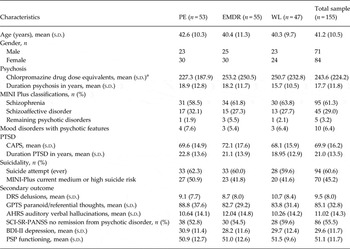
Details on the flow and baseline characteristics of the participants are published elsewhere (Van den Berg et al. Reference van den Berg, de Bont, van der Vleugel, de Roos, de Jongh, Van Minnen and van der Gaag2015a ) and are available online (Supplementary Fig. S1 and Supplementary Table S1). Table 1 shows the baseline characteristics of the secondary symptoms per condition and in total. The 61.9% individuals with active delusions and the 40.0% individuals with active hallucinations exhibited medium severe symptom intensity. The mean level of paranoid thoughts was relatively high (Freeman et al. Reference Freeman, Pugh, Vorontsova, Antley and Slater2010) considering our sample's heterogeneous mix of psychotic disorders. Of all individuals, 55.5% presented current core symptoms of schizophrenia, signalling impaired wellbeing and functioning. The baseline average depression score of the entire group scaled moderate to severe (Beck et al. Reference Beck, Steer and Brown1996); prominent were suicide attempts in the past (60.6%) and current medium to high suicidal risks (45.2%). The baseline mean score on personal and social performance indicated moderate to serious impairment of social, occupational or school functioning (Morosini et al. Reference Morosini, Magliano, Brambilla, Ugolini and Pioli2000). There were no differences between the conditions on any variables at baseline.
Baseline demographic, clinical and secondary symptom characteristics

AHRS, Auditory Hallucination Rating Scale; BDI-II, Beck Depression Inventory – II; CAPS, Clinician-Administered PTSD Scale; DRS, Delusion Rating Scale; EMDR, eye movement desensitization and reprocessing; GPTS, Green Paranoid Thought Scale; MINI Plus, MINI International Neuropsychiatric Interview-Plus; PSP, Personal and Social Performance scale; PTSD, post-traumatic stress disorder; SCI-SR-PANSS, Structured Clinical Interview for Symptoms of Remission for the Positive and Negative Syndrome Scale; s.d., standard deviation.
a 100 mg CPZ = 2 mg Haldol.
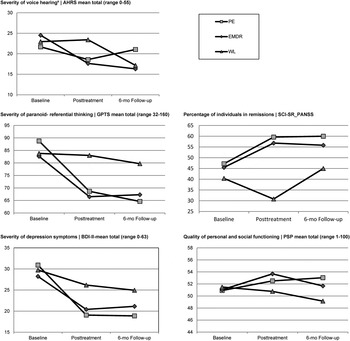
Fig. 1 summarizes the major findings of the study by presenting the observed trajectories of outcomes for each of the variables in the study.
Observed outcomes trajectories as a function of treatment group. AHRS, Auditory Hallucination Rating Scale; BDI-II, Beck Depression Inventory – II; CAPS, Clinician-Administered PTSD Scale; GPTS, Green Paranoid Thoughts Scale; SCI-SR-PANSS, Structured Clinical Interview for Symptoms of Remission for the Positive and Negative Syndrome Scale. a Mean scores are based on individuals who were actively hallucinating at baseline and/or post-treatment and/or follow-up.

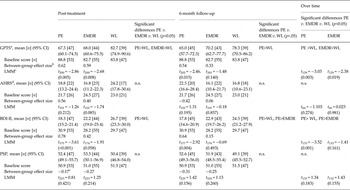
Table 2 presents estimated marginal means produced by the LMM procedure, pre-post effect sizes and LMM outcomes, based on ITT between-group analyses comparing PE and EMDR to WL. Compared to WL, PE and EMDR showed a significantly greater decrease of paranoid thoughts at post-treatment and over time; this was maintained at 6-month follow-up only for PE.
Estimated secondary severity outcomes as a function of treatment group (n=155) intention to treat

AHRS, Auditory Hallucination Rating Scale; BDI-II, Beck Depression Inventory-II; CAPS, Clinician-Administered PTSD Scale; CI, confidence interval; EMDR, eye movement desensitization and reprocessing; GPTS, Green Paranoid Thought Scale; LMM, Linear Mixed Model analyses; n.s., not significant; PE, prolonged exposure; PSP, Personal and Social Performance scale; s.d., standard deviation; WL, waiting list.
a Data reflect estimated marginal means (95% CI) from the LMM analyses.
b Between-group effect sizes concern the differences between the treatment conditions PE and EMDR v. WL condition at the different time points. Effect size, Cohen's d is calculated using the difference of estimated marginal means (LMM) divided by the average s.d..
c LMM outcome results (t values and p values) concern the comparison of PE and EMDR v. WL. Results of comparisons of PE v. EMDR are not included in this Table (available from first author).
d Note here that LMM was performed on a subsample of actively (i.e. pre, post and/or follow-up) hallucinating individuals.
e As opposed to the other instruments higher PSP mean scores represent improvement instead of worsening; a negative effect size here means that the between-group effect is positive for the experimental condition.
EMDR and WL yielded similar results in reducing depression, whereas PE was superior to WL at post-treatment, follow-up and over time, and also superior to EMDR (not presented in Table 2; at 6-month follow-up the between-group effect size PE v. EMDR = 0.48, p = 0.026, and over time p = 0.036).
PE, EMDR and WL did not differ on AVHs and social functioning.
LMM sensitivity analyses of completers (n = 113) and of ITT-LOCF yielded similar results.
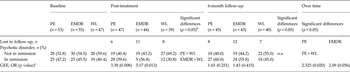
Table 3 presents GEE ITT between-group analyses of remission status, comparing PE and EMDR to WL. The treatments were associated with a significantly greater number of remissions from psychotic disorders than WL at post-treatment and over time (PE); ITT LOCF sensitivity analysis showed significantly more remission for PE only at post-treatment.
Status on remission from psychotic disorders (SCI-SR-PANSS) as a function of treatment group a

EMDR, Eye movement desensitization and reprocessing; GEE, generalized estimating equations; n.s., not significant; OR, odds ratio; PE, prolonged exposure; SCI-SR-PANSS, Structured Clinical Interview for Symptoms of Remission for the Positive and Negative Syndrome Scale; WL, waiting list.
a Status on remission: if none of the eight SCI-PANSS symptoms of psychosis interferes with functioning an individual is rated ‘in remission’. If at least one symptom interferes with functioning the individual is rated ‘not in remission’.
b Only significant differences (p < 0.05) between the conditions PE v. EMDR v. WL are included in the table. Non-significant differences are disregarded.
c GEE sensitivity analyses of ITT -LOCF showed significantly more post-treatment remission only for PE (OR 2.53, p = 0.025).
As was previously published (for details see Van den Berg et al. Reference van den Berg, de Bont, van der Vleugel, de Roos, de Jongh, Van Minnen and van der Gaag2015a ) there were no differences between conditions in additional support or non-trauma-focused psychotherapy (e.g. cognitive behaviour therapy) or changes in the use of medication. Moreover, and importantly, no participants received additional trauma-focused treatments.
Discussion
In our group of patients with psychotic disorders, PE and EMDR therapy were superior to the WL condition in reducing psychotic symptoms. Even though symptoms of psychosis were not directly addressed in these treatments, the severity of paranoid thoughts decreased significantly and rates of remission from psychotic disorders increased. Because co-morbid PTSD worsens the course and severity of psychotic disorders (Lysaker & Larocco, Reference Lysaker and Larocco2008), it is expected that reducing PTSD will attenuate psychosis. This empirical finding is in agreement with the assumed interactions between PTSD and SMI.
The strong and lasting decrease in the severity of paranoid thoughts following PTSD treatment was expected and is in line with results from pilot effect studies (Van den Berg & van der Gaag, 2012; De Bont et al. 2013a), studies on paranoia (Freeman, Reference Freeman2007; Freeman & Fowler, Reference Freeman and Fowler2009), a comparison of paranoia and PTSD (Gracie et al. Reference Gracie, Freeman, Green, Garety, Kuipers, Hardy, Ray, Dunn, Bebbington and Fowler2007; Alsawy et al. Reference Alsawy, Wood, Taylor and Morrison2016) and (meta-analytical) studies linking trauma to psychosis (Bentall et al. Reference Bentall, Wickham, Shevlin and Varese2012; Reiff et al. Reference Reiff, Castille, Muenzenmaier and Link2012; Varese et al. Reference Varese, Smeets, Drukker, Lieverse, Lataster, Viechtbauer, Read, van Os and Bentall2012; Van Nierop et al. 2014). Also, the integrated socio-developmental-cognitive model of schizophrenia (Howes & Murray, Reference Howes and Murray2014) would predict that successful reduction of anxiety and dysfunctional cognitions resulting from PTSD treatment abates the paranoid interpretations of aberrant information processing and helps prevent or diminish psychosis. However, the result that paranoid thoughts diminished may also partly be explained by the reduction of PTSD symptoms. PTSD was found to be associated with an increased likelihood of endorsing one or more psychotic symptoms (Butler et al. Reference Butler, Mueser, Sprock and Braff1996; Sareen et al. Reference Sareen, Cox, Goodwin and Asmundson2005) so reducing PTSD might reduce paranoia. Furthermore, notwithstanding the fact that paranoia and PTSD clearly differ from each other (Freeman et al. Reference Freeman, Thompson, Vorontsova, Dunn, Carter, Garety, Kuipers, Slater, Antley, Glucksman and Ehlers2013), they also share a number of features including increased arousal (e.g. hyper vigilance, poor sleep, anger) and negative cognitions (e.g. distrust in others).
Contrary to our expectation and in seeming contradiction to aetiological (Reiff et al. Reference Reiff, Castille, Muenzenmaier and Link2012; Varese et al. Reference Varese, Smeets, Drukker, Lieverse, Lataster, Viechtbauer, Read, van Os and Bentall2012; Van Nierop et al. 2014) and phenomenological (Hardy et al. Reference Hardy, Fowler, Freeman, Smith, Steel, Evans, Garety, Kuipers, Bebbington and Dunn2005; Gracie et al. Reference Gracie, Freeman, Green, Garety, Kuipers, Hardy, Ray, Dunn, Bebbington and Fowler2007; Alsawy et al. Reference Alsawy, Wood, Taylor and Morrison2016) findings, the severity of AVHs did not diminish to a greater extent in the treatment conditions compared to the WL condition. Unfortunately, our weakened analysis of data on AVHs yielded qualitatively unsatisfactory results. More research, preferably with continuous measures to assess AVHs, is needed to examine whether our unanticipated lack of PTSD treatment effect on verbal hallucinations can be replicated.
The reduction of symptoms of depression was significantly greater in PE than in EMDR therapy. The finding that depressive symptoms decreased together with PTSD during PE was expected. Both the co-morbidity rate of PTSD and depression (Kessler et al. Reference Kessler, Chiu, Demler and Walters2005) and the depression outcomes associated with treatments for PTSD (Ronconi et al. Reference Ronconi, Shiner and Watts2015) including studies examining SMI patients (Rosenberg et al. Reference Rosenberg, Mueser, Jankowski, Salyers and Acker2004; Mueser et al. Reference Mueser, Rosenberg, Xie, Jankowski, Bolton, Lu, Hamblen, Rosenberg, McHugo and Wolfe2008) indicate that depression attenuates alongside the reduction of PTSD. However, although similar to PE the expectation applies to EMDR (Kessler et al. Reference Kessler, Chiu, Demler and Walters2005; van den Berg & van der Gaag, 2012; Ronconi et al. Reference Ronconi, Shiner and Watts2015) the severity of depression did not decline with EMDR therapy. This could be a deviant result or there might be an alternative explanation. For example, both treatments demanded considerable effort and a certain amount of courage from the patients, but the disclosure of traumatic events is much more detailed in PE. Further, PE involves a considerable amount of homework whereas EMDR does not. Perhaps the higher degree of activation in PE and a heightened sense of personal accomplishment helped to reduce depression in PE.
No changes occurred in social functioning, possibly and partly due to the fact that not all traumas of our multi-trauma sample (Van den Berg et al. 2015a; De Bont et al. 2015) could be addressed in treatment, which may have limited social change. But an even more important factor might have been that the PSP is not very reactive to subtle changes in social function. A PSP score change reflects significant changes in one or more domains (work, friendship, etc.). Now the duration of the treatment (eight sessions) and assessment period (6-month follow-up) was very brief relative to the chronicity of patients’ behavioural and social dysfunction (mean duration of psychosis was 17.7 years). Subtle changes in social functioning might have occurred, but major changes were not to be expected in the short amount of time. So for future studies instruments suited for assessing subtle, short-term changes in social functioning or extended treatment and follow up periods using the PSP are recommended.
Generally speaking, our successful treatment of the PTSD symptoms of patients with psychosis helped reduce some of the burden of co-morbid symptoms as well. Our observations fit the network view on psychiatric disorders (e.g. Goekoop & Goekoop, Reference Goekoop and Goekoop2014) that postulates that symptoms (e.g. anxiety, voice hearing, depressed mood) fire up each other and that treatment of one symptom also benefits associated symptoms. For a long time, psychosis has been the highest ranking exclusion criterion for psychological PTSD treatment, out of fear of doing patients harm. Yet, our PTSD treatment outcome data demonstrate that together with the PTSD symptoms (Van den Berg et al. 2015a) significant additional symptom relief of psychosis can be achieved by trauma-focused treatment. This also holds true for symptoms of depression (for PE).
It could be regarded as a limitation that we used the SCI-SR-PANSS for assessing remission status in individuals with and without the diagnosis of schizophrenic disorder. After all the SCI-SR-PANSS was specifically designed for people with schizophrenic disorders. However, we believe that this is acceptable given the DSM-IV diagnostic features of our sample (61% schizophrenia, 29% schizoaffective, 6% mood with psychotic features) and given the fact that clinical manifestations of DSM-IV schizophrenic disorders are extraordinarily varied with very unclear syndrome boundaries (Tandon et al. Reference Tandon, Gaebel, Barch, Bustillo, Gur, Heckers, Malaspina, Owen, Schultz, Tsuang, Van Os and Carpenter2013). A limitation of the current study is the relatively impaired examination of AVHs and the absence of examination of other than verbal hallucinatory experiences, especially visual hallucinations. Another limitation is that in this study we did not monitor changes in our outcome variables during and between sessions. Insight in changes occurring during treatment is important, because a possible increase of symptomatology during treatment may also be a concern of clinicians, especially after the start of the trauma-focused sessions. This concern is addressed in a recent publication by Van den Berg et al. (Reference van den Berg, de Bont, van der Vleugel, de Roos, de Jongh, van Minnen and van der Gaag2015b ). The study demonstrates that in our study sample, compared to WL, the trauma-focused treatment groups were significantly associated with less symptom exacerbation and less adverse events during the treatment, including the first trauma-focused treatment sessions. Clearly all of these findings combined do not support the conventional idea that it is best clinical practice to withhold this patient group from trauma-focused therapy; on the contrary, all of these findings build a strong case that delivering PTSD treatment to patients with psychosis and PTSD deserves recognition and acceptance among clinicians and researchers.
The strengths of this study include its highly controlled design, the recruitment of patients in care for psychosis from routine clinical settings, the inclusion of patients with severe levels of co-morbidity, and the application of widely used PTSD treatment protocols. These strengths enhance the generalizability of the observed effects to patients in routine clinical practice, and add credibility to the idea that offering trauma-focused treatment to this patient group is clinically feasible.
Conclusions
To our knowledge this is the first RCT to treat psychotic patients with PTSD and examine clinically relevant secondary effects, in particular effects on psychosis. The PTSD symptoms were successfully treated by both PE and EMDR therapy, with strong secondary reductions of paranoid thoughts and with more patients achieving the status of remission from their psychotic disorder; in PE, depression was also reduced. The results indicate that patients with psychotic disorders benefit from PTSD treatment in more than one symptom domain. This finding agrees with that of other PTSD efficacy studies in non-psychotic populations; in addition our results fit the network model of interconnected psychiatric symptom domains and are congruent with the integrated sociodevelopmental-cognitive model of schizophrenia.
Supplementary material
For supplementary material accompanying this paper visit http://dx.doi.org/10.1017/S0033291716001094.
Acknowledgements
The authors thank all the participants, therapists, research assistants, local researchers, independent specialists, advisors, involved mental health workers, and all others who contributed to this study. We thank the 13 mental health organizations that participated in the trial: Altrecht, Arkin, Bavo-Europoort, GGNet, GGZ Drenthe, GGZ Duin en Bollenstreek, GGZ Eindhoven, GGZ Noord-Holland-Noord, GGZ Oost Brabant, Lentis, Parnassia, Pro Persona, and Yulius. Special thanks go to Marion Bruns, BSc, and Daniëlle Tilburgs, MSc, Parnassia Psychiatric Institute, for their role in the organization and management of the data collection, the filing and the double checks. Dutch Support Foundation ‘Stichting tot Steun VCVGZ’, Arnhem, The Netherlands (awarded to Dr van der Gaag). The ‘Stichting tot Steun VCVGZ’ had no role in the design and conduct of the study; collection, analysis, and interpretation of the data; in the preparation, review, or approval of the manuscript; or in the decision to submit the manuscript for publication. The views expressed in this article are those of the authors and do not necessarily reflect the opinions of the authors’ institutions.
Declaration of Interest
Mark van der Gaag and David van den Berg receive income for published books/book chapters about psychotic disorders and for training of professionals in the treatment of psychotic disorders. Ad de Jongh receives income for published books/book chapters about EMDR therapy and for training of professionals in this method. Agnes van Minnen receives income for published books/book chapters about PTSD and for training of professionals in Prolonged Exposure. Carlijn de Roos receives income for training of professionals in EMDR therapy. All other authors declare they have nothing to disclose.