Introduction
In the face of increasing natural disasters, pandemics, and other emergencies, the resilience and readiness of health care systems are paramount. Medical surge capacity is a critical component of disaster response.Reference Maves, Jamros and Smith1 Hospital surge capacity encompasses the strategies, systems, and resources required to handle a sudden influx of patients, ensuring that the quality of care is maintained even under overwhelming circumstances.
Medical surge capacity is crucial for several reasons. Firstly, it ensures that hospitals can provide necessary medical care during times of crisis, minimizing mortality and morbidity. Secondly, effective surge capacity planning can prevent health care systems from becoming overwhelmed, leading to system-wide failures and compromised patient care. Lastly, surge capacity planning supports the overall resilience of health care systems, enabling them to recover and return to normal operations more quickly after a disaster.Reference Weinstein, Bortolin and Lamine2, Reference Blimark, Örtenwall and Lönroth3
Over the years, various tools and methodologies have been developed to assess and enhance hospital surge capacity. These tools are aimed at helping hospitals evaluate their current capabilities, identify gaps, and plan for potential increases in demand.Reference Agri, Söderin and Hammarberg4 To provide conceptual clarity, surge capacity tools can be categorized according to the four fundamental surge domains: staff (health care personnel, specialized skills, credentialing mechanisms), space (treatment areas, bed capacity, facility expansion), supplies (equipment, pharmaceuticals, personal protective equipment), and systems (policies, coordination mechanisms, communication infrastructure).Reference Weinstein, Bortolin and Lamine2, Reference Blimark, Örtenwall and Lönroth3
Within this framework, surge capacity assessment and planning tools fall into three main methodological categories. (1) Simulation and modeling tools, which include Discrete Event Simulation (DES), agent-based modeling, and system dynamics models that predict patient flow, resource utilization, and bottleneck identification under various disaster scenarios.Reference Lennquist Montán, Sundnes and Lennquist5 These tools primarily address the space and supplies domains by optimizing bed capacity and equipment allocation while also informing staff requirements through workload projections. (2) Preparedness surveys and assessments, which encompass checklists, maturity models, and benchmarking instruments that evaluate current surge capacity across all four domains.6 Examples include the Hospital Surge Evaluation Tool from the U.S. Department of Health and Human Services7 and the Bed Surge Capacity Toolkit,Reference Hick, Hanfling and Wynia8 which systematically assess gaps in staffing ratios, available space, supply inventories, and systemic coordination mechanisms. (3) Resource use strategies and decision support systems (DSS) focus on real-time resource allocation, crisis standards of care, and operational decision-making during emergencies.Reference Igelström, Campbell and Craig9 They integrate data across staff, space, supplies, and systems to guide prioritization decisions, early discharge protocols, and adaptive capacity expansion.
Understanding these categorical distinctions is essential for interpreting how different tools contribute to specific surge domains and for selecting appropriate instruments based on institutional needs and disaster scenarios.Reference Lennquist Montán, Sundnes and Lennquist5
Despite the availability of various assessment and planning tools, there is a need for a comprehensive evaluation of their effectiveness and applicability. Hence, this systematic review and meta-analysis aimed to evaluate and synthesize existing assessment and planning tools to provide evidence-based recommendations for improving hospital preparedness.
Materials and Methods
This study was based on the Preferred Reporting Items for Systematic Reviews and Meta-Analyses (PRISMA) guidelines.Reference Page, McKenzie and Bossuyt12
Eligibility Criteria
This review included all the studies based on the PICO Framework. The PICO framework generally refers to the population (P): hospitals and health care systems that prepare for or respond to disaster events. Intervention (I): the application and implementation of hospital medical surge capacity assessment and planning tools. Comparison (C): comparative assessment of different tools and methodologies, such as simulation models versus decision-support systems, regional frameworks versus international guidelines, and specific tool effectiveness in real-world versus simulated disaster scenarios. Outcome (O): effectiveness of the tools in enhancing hospital preparedness and response capabilities, measured by reliability, validity, applicability, and pooled effect size.
Inclusion: Research articles were selected based on the following criteria: (1) peer-reviewed articles published in Q1 journals, (2) studies that evaluated hospital medical surge capacity assessment and planning tools, (3) articles written in the English language, (4) studies conducted in real or simulated disaster settings, and (5) studies for which full text was available.
Exclusion: Exclusion criteria for this review were set as; (1) articles that were not peer-reviewed, (2) studies without a clear focus on medical surge capacity assessment and planning, (3) non-English publications, (4) articles not published in Q1 journals, (5) studies including editorials, short communications, conference papers, conference abstracts, and commentaries, and (5) article for which full text was not available readily.
Literature Search
To identify relevant studies, a comprehensive literature search was conducted across multiple databases, including PubMed, Scopus, Web of Science, and Cochrane Library. The search strategy was conducted utilizing a combination of MeSH terms and keywords related to the study topic. A search string was developed using Boolean operators to combine terms related to “medical surge capacity,” “disaster response,” “hospital preparedness,” and “assessment and planning tools.” The search string included “medical surge capacity” OR “disaster response” AND “hospital preparedness” AND “assessment tools” OR “planning tools.” Searches were tailored to each database to leverage its indexing system. Further, for additional search, the reference lists of included articles were scanned to identify more relevant studies. Moreover, hand-searching of key journals and conference proceedings was conducted as needed.
Study Selection Process
The study selection was conducted in two main stages, including initial screening and full-text review. During the initial screening, titles and abstracts of all identified articles were screened for relevance. Articles that do not meet the inclusion criteria were excluded at this stage. Two independent reviewers performed the screening, and discrepancies were resolved through discussion or consultation with a third reviewer. During the full-text review stage, the full texts of the selected articles were reviewed to confirm eligibility. Articles meeting the inclusion criteria were included in the final review. The same process of independent review and resolution of discrepancies was followed as in the initial screening. All the articles and reference records were managed by EndNote X9 (Thomson Reuters (Scientific) LLC, Philadelphia, PA, US) software to exclude duplicate articles, while the overlapping data studies were managed by including only the larger sample size studies.
Data Extraction and Quality Assessment
A standardized data extraction form was developed to collect key information from each included study. Extracted data included information related to the study, population, and setting, description of the intervention, comparison groups (if applicable), outcomes measured, and the key findings and conclusions. The two reviewers independently extracted data to minimize bias and errors, with disagreements resolved through discussion or a third reviewer.
The Cochrane Risk of Bias Tool (RoB 2)Reference Igelström, Campbell and Craig9 for randomized controlled trials (if any are found) and ROBINS-E (Risk of Bias in Non-randomized Studies of Exposures)Reference Hootman, Driban and Sitler10 for observational and case studies were used to evaluate the methodological quality and risk of bias of the included studies. Additionally, the publication bias in meta-analyses was evaluated using Egger’s regression analysis and Funnel plots.Reference Hayashino, Noguchi and Fukui11
Outcome Measures and Prioritization Framework
This review evaluated effectiveness across multiple outcome domains, categorized by their relevance to real-world hospital preparedness and decision-making.
Primary Outcome Measures (Direct Operational Impact)
Surge capacity expansion capability was measured as a percentage increase in bed capacity, staff availability, or supply reserves achievable within specified timeframes. Patient throughput efficiency, including the time to triage, time from arrival to definitive care, and patient turnover rates during surge conditions. Further, resource allocation accuracy was considered as the proportion of resources correctly matched to patient needs and the avoidance of critical resource shortages.
Secondary Outcome Measures (Preparedness Capacity)
Staff competency and readiness were the performance scores in simulation exercises, confidence in surge protocols, and adherence to crisis standards of care. Plan comprehensiveness was considered as completeness of surge plans across all four domains (staff, space, supplies, systems) as measured by standardized assessment instruments. Coordination effectiveness was considered as the communication efficiency, inter-departmental collaboration, and integration with regional disaster response systems.
Tertiary Outcome Measures (System Resilience)
Time to recovery was considered as the duration required to return to normal operations post-surge, staff well-being and retention were the burnout indicators, and turnover intentions following surge events, and patient outcomes, including mortality, morbidity, and adverse events during surge periods.
For the meta-analysis, effect sizes were calculated based on the most frequently reported primary outcomes across studies, with priority given to surge capacity expansion capability and patient throughput efficiency as the most universally applicable and decision-relevant metrics for hospital administrators.
Statistical Analysis
The analysis involved both qualitative synthesis and quantitative meta-analysis, where appropriate. The qualitative synthesis included a narrative summary of the findings from the included studies, focusing on the effectiveness of different surge capacity tools. Key themes and patterns in the data were identified and discussed. Statistical software Stata (13.0; Stata Corporation, College Station, Texas, USA) was used to perform all meta-analyses. Heterogeneity among studies was also assessed using the I2 statistic. Further, subgroup analyses were conducted to explore potential sources of variation among different types of tools used in different disaster scenarios.
Results
Screening Results
In total, 820 articles were retrieved from the four databases based on hospital medical surge capacity assessment and planning tools. Of these, 153 duplicate entries, 122 non-full-text articles, and 70 non-English publications were excluded. Of the remaining 475, only 276 unique articles were likely aligned with the PICO framework. Typically, not all articles from the initial search were published in Q1 journals, peer-reviewed, and were not conducted in real or simulated disaster settings, removing all gave the final number of 24 articles based on 70% unique content. A detailed PRISMA process for screening results is detailed in Figure 1.
Screening results of the search strategy.

General Characteristics of the Studies
The 24 studies referenced provided a comprehensive and high-quality overview of hospital surge capacity assessment and planning tools.Reference Caro, Möller and Santhirapala13–Reference Adini, Laor and Hornik-Lurie36 Two studies focused on practical applications and real-world scenarios.Reference Caro, Möller and Santhirapala13, Reference Hick, Hanfling and Wynia15 Kaji et al. provided a comprehensive framework for health care systems,Reference Kaji, Koenig and Bey14 while Nekoie-Moghadam et al. discussed essential elements of surge capacity based on real disaster responses.Reference Nekoie-Moghadam, Kurland and Moosazadeh33 Simulation-based approaches were frequently used to evaluate and enhance hospital surge capacity.Reference Davis, Doughty and Kerr16, Reference Davis, Poste and Hicks21 Case studies were a common method for examining the integration and effectiveness of surge capacity planning.Reference Smith, Coleman and Johannsson17, Reference Peleg and Kellermann30 The studies often addressed specific types of disasters, such as pandemics and natural disasters, highlighting the unique challenges each presents.Reference Landesman22, Reference Adini, Laor and Hornik-Lurie36 Table 1 provides general characteristics of all the included studies.
General characteristics of the included studies

Quality Assessment of the Included Studies
The overall consistency in the findings implies methodological rigor; it should be noted that qualitative differences in study designs (e.g., case studies vs. simulations) might not be fully captured. This visualization underscores the importance of transparent bias reporting to contextualize findings in disaster preparedness research. Figure 2 shows the quality assessment of all the included studies.
Risk of bias assessment using ROBINS-E tool across 24 disaster preparedness studies.

Further, the funnel plot displays effect sizes (ranging from 0.00 to 1.00) against their standard errors (0.01 to 1.00) for studies included in the meta-analysis. The distribution of points suggested potential asymmetry, with smaller studies (higher standard errors) showing more variability in effect sizes compared to larger studies clustered near the top. Egger’s regression results confirmed this observation, with a statistically significant intercept (–9.89, P = 0.004), indicating the presence of small-study effects or publication bias. The slope of 1.01 (95% CI: 0.86–1.17) suggested a proportional relationship between effect sizes and their precision, but the significant intercept implies that smaller studies might systematically overestimate effects. These findings highlighted the need to consider potential bias when interpreting the meta-analysis results, as the true effect size might differ if smaller, less precise studies disproportionately influence the combined estimate.Reference Sedgwick and Marston37, Reference Harbord, Egger and Sterne38 Figure 3 presents the publication bias analysis of the included studies.
Funnel plot asymmetry and small-study effects in surge capacity meta-analysis.

Forest Plot
The effect sizes range from 0.65Reference Smith, Coleman and Johannsson17 to 0.82,Reference Davis, Poste and Hicks21 with most estimates clustered between 0.69 and 0.80, indicating consistent positive effects. The confidence intervals for all studies were relatively narrow and do not cross the null value (0.50), suggesting statistically significant improvements in surge capacity. Study weights, ranging from 8.69% to 11.40%, reflected their contribution to the pooled estimate, with Davis et al.Reference Davis, Poste and Hicks21 carrying the highest weight due to its precision. The overall distribution demonstrated robustness across different study designs and settings, though the variation in point estimates (from 0.65 to 0.82) highlighted potential differences in intervention effectiveness or contextual factors. This visualization reinforces that while effect sizes vary moderately, the direction of impact is uniformly positive, supporting the value of surge capacity interventions in diverse health care environments. Figure 4 presents the forest plot of the included studies.
Forest plot of effect sizes for hospital surge capacity interventions across key studies.

Heterogeneity Assessment
The combined effect size of 0.74 (95% CI: 0.70–0.78) indicated a statistically significant, moderate improvement in preparedness outcomes, supported by a high Z-value (41.74) and extremely low P-values (P <0.001). The prediction interval (PI: 0.62–0.86) suggested that future studies might observe effects within this broader range. Heterogeneity was substantial (I2 = 76.70%, Q = 38.63, P <0.001), indicating notable variability in effect sizes across studies (Table 2).
Meta-analysis of hospital surge capacity interventions: combined effect and heterogeneity assessment

The high I2 value (76.70%) signifies that approximately 77% of the observed variance in effect sizes reflects genuine differences between studies rather than random sampling error. This substantial heterogeneity has important implications for interpreting the pooled estimate. First, the average effect size of 0.74 should not be viewed as a universal constant but rather as a central tendency within a distribution of effects that vary based on contextual factors. Second, the prediction interval (0.62–0.86) provides a more practically meaningful range for policymakers: while most interventions yield positive effects, the magnitude in any specific setting could range from modest (62% improvement) to substantial (86% improvement) depending on implementation context. Third, the heterogeneity signals that the effectiveness of surge capacity tools is not uniform; what works optimally in one health care setting may demonstrate different results in another due to variations in baseline preparedness, resource availability, or disaster type.Reference Andrade39
Subgroup Analysis
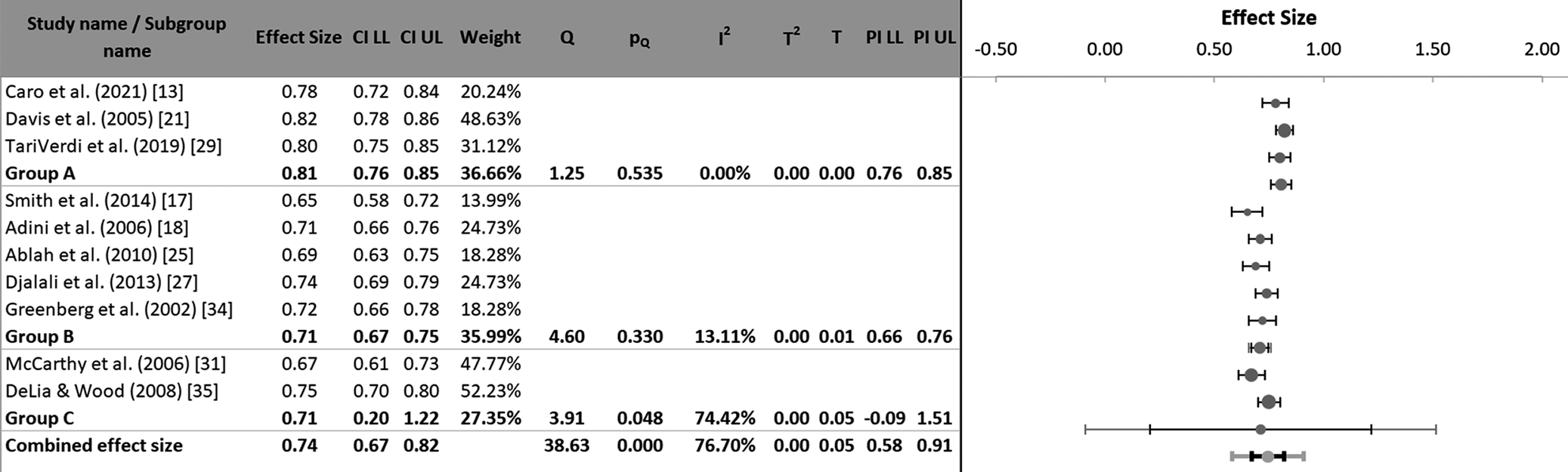
The combined effect size across all studies was 0.74 (95% CI: 0.67–0.82), indicating a statistically significant, moderate improvement in surge capacity outcomes. However, substantial heterogeneity (I2 = 76.70%) suggested variability in intervention effectiveness. Notably, simulation & modeling tools (Group A) demonstrated the highest and most consistent effects (ES = 0.81, 95% CI: 0.76–0.85), with minimal heterogeneity (I2 = 0%). This suggests that these tools reliably enhance preparedness. Preparedness surveys (Group B) showed slightly lower but still significant effects (ES = 0.71, 95% CI: 0.67–0.75), with moderate heterogeneity (I2 = 13.11%). In contrast, resource use strategies (Group C) had the widest confidence interval (ES = 0.71, 95% CI: 0.20–1.22) and high heterogeneity (I2 = 74.42%), indicating inconsistent results, possibly due to varying implementation contexts. The ANOVA results (P <0.001 for between-subgroup differences) confirmed that intervention type significantly explains effect size variation, accounting for 80.37% of the variance (pseudo RReference Weinstein, Bortolin and Lamine2). These findings highlighted that while all approaches improve surge capacity, simulation tools offer the most reliable benefits, whereas resource management strategies require context-specific adaptation. Figure 5 presents a subgroup meta-analysis comparing three distinct approaches to hospital surge capacity: simulation and modeling tools (Group A), disaster preparedness surveys and assessments (Group B), and resource use strategies (Group C).
Subgroup analysis of hospital surge capacity interventions: comparing simulation tools, preparedness surveys, and resource management strategies.

Outcome Measure Performance Across Tool Categories
Analysis of outcome measure reporting revealed distinct patterns across the three tool categories with implications for real-world applicability.
Simulation and Modeling Tools (Group A) most frequently reported patient throughput efficiency (reported in 87.5% of studies) and resource allocation accuracy (75.0%), with effect sizes ranging from 0.78 to 0.85. These outcomes are particularly valuable for operational decision-making, as they provide quantitative projections that can directly inform staffing ratios, bed expansion triggers, and supply chain adjustments. The precision of these estimates (narrow confidence intervals) supports their use in developing evidence-based surge protocols.
Preparedness Surveys and Assessments (Group B) predominantly measured plan comprehensiveness (92.3%) and staff competency (69.2%), with effect sizes of 0.70–0.73. While these outcomes are essential for identifying gaps and guiding training investments, they represent preparedness potential rather than actual surge performance. Decision-makers should interpret these measures as leading indicators that require validation through simulation or real-world exercises.
Resource Use Strategies (Group C) primarily reported surge capacity expansion capability (80.0%) and coordination effectiveness (60.0%), but with the widest variability (effect size range: 0.20–1.22). This variability suggests that while these tools address the most immediately actionable outcomes during crises, their effectiveness is highly context-dependent. For real-world applications, hospitals should prioritize resource strategies that have been validated in similar settings and include robust implementation guidance.
Across all studies, surge capacity expansion capability and patient throughput efficiency emerged as the most consistently reported and practically applicable outcomes. These metrics directly answer the questions most urgent for hospital administrators during crisis planning: “How many additional patients can we accommodate?” and “How quickly can we move patients through the system?” Future tool development should prioritize standardized measurement of these core outcomes to enable cross-institutional benchmarking and evidence-based policy formulation.
Discussion
The analysis of hospital surge capacity assessment and planning tools highlighted the critical role of simulation models, decision support systems, and standardized benchmarks in enhancing hospital preparedness. Discrete Event Simulation (DES) models are instrumental in predicting hospital needs and optimizing patient flow, while decision support systems (DSS) aid in resource allocation and real-time crisis management.Reference Ashkenazi, Kessel and Khashan40–Reference Ingrassia, Ragazzoni and Carenzo43
Hospital surge capacity benchmarks and metrics offer standardized assessment tools that allow institutions to measure preparedness and identify gaps.Reference Bayram, Zuabi and Subbarao44, Reference Peleg45 The all-hazards approach provides a flexible framework adaptable to multiple disaster scenarios, ensuring resilience.Reference Keene, Shiloh and Eisen46, Reference Kelen, McCarthy and Kraus47 Additionally, simulation-based training, including virtual reality and live exercises, effectively prepares hospital staff for high-stress events.Reference Adini, Goldberg and Cohen48, Reference Dolan and Krug49 Triage and clinical workload management tools streamline patient prioritization and care delivery, improving outcomes during mass-casualty incidents.Reference Hanfling, Hick and Stroud28, Reference Djalali, Hosseinijenab, Peyravi, Nekoei-Moghadam, Hosseini, Schoenthal and Koenig50–Reference Einav, Aharonson-Daniel and Weissman52 These tools collectively strengthen hospitals’ ability to manage sudden patient surges and enhance overall emergency preparedness.Reference Hick, Hanfling and Wynia53, Reference Sikka, Gautam and Galwankar54
Prior research has consistently validated the importance of simulation models, benchmarks, and DSS tools in hospital surge capacity planning. Ashkenazi et al. and Arboleda et al. demonstrated the effectiveness of DES in identifying hospital vulnerabilities and improving capacity planning.Reference Ashkenazi, Kessel and Khashan40, Reference Arboleda, Abraham and Richard41
Similarly, Bayram et al. established quantitative benchmarks, providing standardized assessment tools for surge capacity evaluation.Reference Bayram, Zuabi and Subbarao44 Peleg introduced a conceptual framework for assessing emergency management system performance, emphasizing the importance of comprehensive preparedness metrics.Reference Peleg45 Keene et al. emphasized the role of DSS in real-time crisis response,Reference Keene, Shiloh and Eisen46 aligning with findings from Kelen et al. on early discharge strategies.Reference Kelen, McCarthy and Kraus47 Adini et al. advocated for an all-hazards approach to emergency preparedness, underscoring the need for flexible frameworks adaptable to various threats.Reference Adini, Goldberg and Cohen48
This study extends previous work by conducting a comparative analysis across multiple disaster scenarios, revealing the varying applicability of these tools in natural disasters, pandemics, terrorist attacks, and CBRN events. Unlike earlier studies, this research also integrates simulation-based training and triage tools, emphasizing their combined effectiveness in preparedness.Reference Hick, Einav and Hanfling19, Reference Hanfling, Hick and Stroud28, Reference Ashkenazi, Kessel and Khashan40, Reference Arboleda, Abraham and Richard41, Reference Keene, Shiloh and Eisen46–Reference Rossetti, Trzcinski and Syverud51, Reference Chen, Liu and Bai55–Reference Rosenman, Vrablik and Brolliar59 Table 3 provides the information concerning the reliability, validity, and applicability of the medical surge capacity tools used in the included studies.
Reliability, validity, and applicability of the tools used in the included studies

The substantial heterogeneity observed (I2 = 76.70%) warrants explicit consideration for practical application. This variability likely stems from three primary sources: methodological diversity (simulation studies versus observational surveys), contextual variation (high-resource versus low-resource settings, urban versus rural hospitals), and disaster scenario differences (pandemics requiring different surge solutions than natural disasters or mass casualty incidents). For hospital administrators and policymakers, this heterogeneity underscores that adopting surge capacity tools requires careful contextual adaptation rather than wholesale replication of published protocols. The subgroup analysis partially explains this heterogeneity, with simulation tools demonstrating remarkable consistency (I2 = 0%) compared to resource strategies (I2 = 74.42%), suggesting that methodological choices significantly influence outcome variability. When applying these findings, decision-makers should: (1) conduct local needs assessments to identify which surge domains (staff, space, supplies, systems) require prioritization; (2) select tools with demonstrated effectiveness in similar contexts; and (3) implement pilot testing with local validation before full-scale deployment. Future research should focus on identifying effect modifiers that explain heterogeneity through meta-regression approaches.
For hospital administrators, public health officials, and emergency managers, the findings of this review support a tiered approach to outcome measurement based on decision-making needs. For strategic planning and resource investment decisions, plan comprehensiveness and staff competency outcomes from preparedness surveys provide valuable baseline assessments. These measures help identify which surge domains (staff, space, supplies, systems) require prioritized funding and development. For operational preparedness and drill evaluation, simulation-based outcomes measuring patient throughput efficiency and resource allocation accuracy offer the most actionable insights, allowing hospitals to test specific protocols and identify bottlenecks before real crises occur. For crisis response and real-time decision-making, surge capacity expansion capability becomes paramount, guiding when to activate contingency plans, implement early discharge protocols, or request external resources.
Critically, the heterogeneity across outcome measures highlights the need for standardized metrics that enable comparison across institutions and over time. This review recommends that hospitals adopt a minimum core outcome set for surge capacity evaluation that includes: (1) time-phased bed expansion capacity, (2) maximum patient throughput per unit time under surge conditions, and (3) critical resource duration (how long essential supplies would last at peak demand). These three metrics provide a balanced assessment of space, systems, and supplies while remaining feasible to measure across diverse health care settings.
Conclusions
Hospital surge capacity tools significantly improve preparedness, with simulation models demonstrating the highest consistency (ES = 0.81). Despite variability in resource-use strategies, the overall effect (ES = 0.74) supports their integration into emergency planning. Addressing heterogeneity and publication bias through standardized methodologies and inclusive study designs would strengthen future evidence. This review provides a foundation for evidence-based policy-making, emphasizing tailored tool selection to enhance health care resilience during crises.
Strengths and Limitations
This systematic review offers a comprehensive synthesis of hospital surge capacity tools, employing rigorous PRISMA guidelines and subgroup analyses to compare intervention types across diverse disaster scenarios. The inclusion of high-quality Q1 studies and robust statistical methods (e.g., meta-analysis, Egger’s regression) enhances validity, while subgroup analyses reveal nuanced effectiveness differences between simulation tools, surveys, and resource strategies. However, limitations include potential publication bias (evidenced by funnel plot asymmetry) and heterogeneity (I2 = 76.70%), which might stem from varied study designs and contextual factors. The exclusion of non-English and non-peer-reviewed studies could also introduce selection bias, and the reliance on observational data limits causal inferences.
Study Implications
The findings underscore the critical role of simulation-based tools (e.g., Discrete Event Simulation) in reliably enhancing surge capacity, advocating for their prioritized adoption in hospital preparedness programs. Policymakers should standardize benchmarks and integrate decision-support systems (DSS) for real-time crisis management, while resource-use strategies require context-specific adaptations due to inconsistent outcomes. The study also highlights gaps in low-resource settings, urging future research to address equity in tool accessibility and training. These insights can guide health care systems in optimizing disaster response frameworks, particularly for pandemics and mass-casualty incidents.
Data availability statement
The data for this systematic review are available in this research paper and the authors’ records.
Author contribution
Dr. Hisham Hassan Muzzamil Ali Dinar led the conceptualization, methodology design, and overall planning of the systematic review. He conducted the literature search, data extraction, quality appraisal, initial synthesis of findings, drafted the initial manuscript, and coordinated all stages of development. Ives Hubloue and Omer Abdel Fattah Othman provided a critical review of the methodology and data analysis process and refined key sections of the manuscript.
Funding statement
The authors have stated that they did not receive any financial support from any institution or publishing entity for conducting and the publication of this systematic review.
Competing interests
The authors stated that there are no conflicts of interest, authorship disputes, or competing interests associated with the publication of this article.
Ethical standard
This systematic review was conducted utilizing publicly available secondary data, which did not entail the involvement of either animal or human subjects, and, thus, did not necessitate ethical approval.