Tetralogy of Fallot remains one of the most common cyanotic congenital cardiac malformations, and the optimal surgical treatment remains complete repair. In those with severe stenosis of the pulmonary valve, in addition to muscular subpulmonary obstruction, insertion of a patch across the ventriculo-pulmonary junction, the so-called transannular repair, may be inevitable, but may also lead to pulmonary insufficiency. It has long been recognized that long-standing pulmonary insufficiency subsequent to surgical repair may adversely affect ventricular function.Reference Bove, Byrum and Thomas1 Although late postoperative haemodynamics and ventricular function are excellent in patients with mild pulmonary stenosis and pulmonary regurgitation of grade 2 or less, in those with moderate pulmonary stenosis and significant pulmonary regurgitation, the haemodynamics and ventricular function may be poor.Reference Oku, Shirontani, Sunakawa and Yokoyama2 Thus, despite the long history of surgical repair, pulmonary insufficiency remains a problem in the modern era, particularly for late results.Reference d’Udekem, Rubay and Shango-Lody3–Reference Giannopoulos, Chatzis, Bobos, Kirvassilis, Tsoutsinos and Sarris8
There are 2 potential strategies to eliminate postoperative pulmonary insufficiency. In the population of patients with predominantly muscular obstruction, but with normal or sub-normal diameter of the pulmonary valve, it may be best to avoid any transjunctional incision, an approach that may be feasible even in infants or young children.Reference Bigras, Boutin, McCrindle and Rebeyka9 In recent times, a transatrial-transpulmonary approach and primary repair has been favoured for such patients, even in the presence of anomalous coronary arteries.Reference Rao, Kadletz, Hornberger, Freedom and Black10–Reference Brizard, Mas, Sohn, Cochrane and Karl12 Resection of the obstructive subpulmonary musculature, with or without mild dilation of the pulmonary valve, can produce a pulmonary outflow tract of adequate size without creating significant pulmonary insufficiency. Such a strategy, however, is feasible only in a portion of the patients. There are a number of patients whose ventriculo-pulmonary junction is extremely underdeveloped, and in whom insertion of a transjunctional patch becomes essential. Even with the wider indications for the atrial approach, combined with approaching through the pulmonary trunk but without crossing the ventriculo-pulmonary junction, there are still a number of patients in whom this approach proves impossible.
The second strategy, therefore, is to protect as far as possible the function of the native pulmonary valvar leaflets, or to create a new valve in pulmonary position when the transjunctional repair is inevitable.Reference He, Kuo and Mee13 Different methods have been used to create a new valve, including insertion of a valved homograft patch,Reference d’Udekem, Rubay and Shango-Lody3, Reference Conte, Jashari, Eyskens, Gewillig, Dumoulin and Daenen7 monocusp patches constructed from xenografts, homografts, fascia lata, autologous pulmonary artery, or pericardium,Reference Roughneen, DeLeon, Parvathaneni, Cetta, Eidem and Vitullo5, Reference Bogers, Roofthooft, Pisters, Spitaels and Bos14–Reference Shatapathy, Aggarwal, Kamath and Sai27 devices made of Gore-Tex,Reference Yamagishi and Kurosawa28 or polytetrafluorethylene,Reference Roughneen, DeLeon, Parvathaneni, Cetta, Eidem and Vitullo5, Reference Turrentine, McCarthy, Vijay, Fiore and Brown29 creation of a bifoliate polytetrafluoroethylene prosthesis,Reference Quintessenza, Jacobs, Chai, Morell, Giroud and Boucek30, Reference Quintessenza, Jacobs, Morell, Giroud and Boucek31 or reconstruction of an autologous and competent trifoliate valve using native tissues.Reference Sievers, Storde and Rohwedder26 We have recently described our own technique of creating an autologous pericardial monocusp patch containing 2 glutaraldehyde-treated pericardial patches.Reference He32 In this study, we review our current strategy for repair of tetralogy of Fallot in children and adults.
Materials and methods
From April, 2001, through May, 2008, we undertook complete repair in 312 patients, having an average age of 11.3 years ±0.4 year-old, with a range from 4 to 48 years. The patients had been seen at Wuhan Heart Institute, The Central Hospital of Wuhan, and Tianjin TEDA International Cardiovascular Hospital, China. Of the group, 152 were aged from 4 to 10 years, 58 from 11 to 14 years, and 98 were older than 14 years. We have undertaken surgery in only a few patients with tetralogy of Fallot who are less than 4 years old at Wuhan Heart Institute because of lack of facilities for cardiac surgery in infants. Such facilities exist at TEDA International Cardiovascular Hospital, but we have excluded those patients from the present study, these being beyond the scope of our current investigation.
There were 180 male patients and 132 female. All had the typical morphology of tetralogy of Fallot, albeit that some had double outlet ventriculo-arterial connection from the right ventricle. All patients had clinical cyanosis, with haemoglobin in the range of 9.8 to 26.9 g, a large ventricular septal defect, stenosis of the subpulmonary outflow tract or pulmonary valve, and significant aortic overriding. The aortic override was greater than 55% in 48 patients, these having double outlet ventriculo-arterial connection. None of the patients had previously undergone construction of a shunt as palliative therapy.
All 74 patients except 2 undergoing surgery at Wuhan Heart Institute and its incorporated hospitals underwent catheterization of the right heart and angiography in addition to echocardiography. Author GWH had been the first to start complex cardiac surgery in this hospital, and the team members, including the echocardiographers, were initially relatively inexperienced. The patients undergoing surgery at TEDA International Cardiovascular Hospital were diagnosed using echocardiography alone, which served to confirm the basic diagnosis, the ventriculo-arterial connection, the size and location of ventricular septal defect, the size and contractility of left and right ventricles, the nature of the subpulmonary muscular stenosis, the diameter of the pulmonary valve, and the sizes of the left and right pulmonary arteries. The existence and patency of an arterial duct, and other anomalies such as persistent left superior caval vein, were also defined by echocardiography. Catheterization, when undertaken, was performed to visualize the ventricular septal defect, the aortic overriding, the left ventricular size and contractility, the morphology and size of the subpulmonary outflow tract and the pulmonary valve, along with the dimensions of the pulmonary trunk and left and right pulmonary arteries. The left and right pulmonary arteries were often not seen clearly from echocardiography, and this was one of the main reasons for performing catheterization.
The anaesthetic and cardiopulmonary bypass techniques were routine. The operation was performed under moderate hypothermia, usually 28°C with the lowest being 26°C, using a membranous oxygenator at flows of 2.2 to 2.4 L/M2. One surgeon (XCL) preferred to lower the temperature down to 18 to 20°C in a few cases when the return of blood was massive. Blood cardioplegia was used in all cases, being given every 25 minutes. Low flow perfusion was used when necessary according to the temperature, particularly when the intracardiac return was massive due to large collateral flow. Repair was mainly achieved through the right atrium, unless an incision in the subpulmonary outflow tract or pulmonary trunk was required as part of a transjunctional repair, indicated by a very small ventriculo-pulmonary junction or because of stenosis of the pulmonary trunk. The ventricular septal defect was closed using a Dacron patch inserted with interrupted or running stitches from the right atrium or the right ventricle. When approaching through the ventricle, the stitches securing the pulmonary arterial side of the repair were placed through either the opened right ventricular outflow tract, if a transjunctional patch was needed, or through the pulmonary trunk if the transjunctional repair was unnecessary.
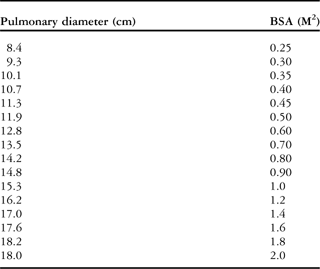
The right ventricular musculature and the pulmonary valve were approached principally through the right atrium, unless a transjunctional incision was required as discussed above (GWH). A ventricular incision was preferred by others (XCL & XRK). The indications for a transjunctional repair were, first, presence of a pulmonary valve with a diameter significantly less than normal (Table 1), it having been established that the valvar orifice could not gently be dilated using a Hegar dilator of the required size, or second, an anomalous pulmonary valve deemed likely to produce severe pulmonary insufficiency if a valved patch was not inserted.
Mean normal diameters of the pulmonary valve.
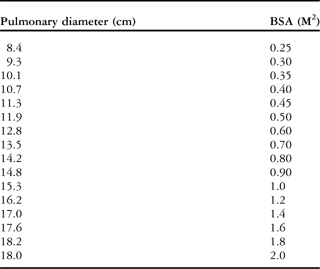
Adopted from the Royal Childrens’ Hospital, Melbourne, Australia.
BSA: Body surface area.
After the resuscitation of the heart, when the contractility was resumed, transoesophageal echocardiography was used to check the cardiac function, the dimensions of the right ventricular outflow tract, and the velocity of blood to the lungs. Cardiopulmonary bypass was then stopped, and the transoesophageal echocardiography repeated to check the cardiac performance and the repair. Such transoesophageal echocardiography was used routinely at TEDA International Cardiovascular Hospital, whereas at Wuhan Heart Institute, due to the lack of a paediatric probe, it was used only in patients weighing more than 25 Kg.
If a transjunctional repair was deemed necessary, we usually inserted a non-valved patch made of autologous pericardium. The patch was placed in a dish filled with 0.625% glutaraldehyde for 12 minutes, each side up in the solution for 6 minutes, and then thoroughly rinsed and kept in saline at the room temperature. At TEDA International Cardiovascular Hospital, for patients weighing less than 30 Kg, the autologous pericardium was reinforced with Dacron on its external surface.
After August, 2004, at Wuhan Heart Institute, when the diagnosis was certain and it had been determined that a transjunctional patch was required, a squared piece of the autologous pericardium was taken, either before or after the commencement of cardiopulmonary bypass. The pericardium was treated with glutaraldehyde as mentioned above, taken out from the dish, rinsed thoroughly by saline, and kept in saline at the room temperature.
We have described previously the creation of the monocusp patch.Reference Quintessenza, Jacobs, Chai, Morell, Giroud and Boucek30 Once we had decided on its size, the patch was tailored according to the expected size of the pulmonary trunk and the subpulmonary outflow tract. The patch was then folded with the smooth side of the patch facing the pulmonary flow. A 5-0 Prolene running stitch was used to sew the two side-edges of the monocusp, creating a monocusp-bearing patch. The patch was then sewn to the pulmonary trunk with a 5-0 Prolene stitch in running fashion, starting from the distal point of the incision into the pulmonary trunk. We paid particular attention to align the monocusp correctly with the remaining native pulmonary valvar leaflets. Due to the fact that most patients have bifoliate valves, this is not too difficult. We took care to open the pulmonary trunk at the anterior margin of the zone of apposition between the leaflets in order maximally to preserve the valvar function. After this procedure, the patch widened the pulmonary trunk, the monocusp being aligned with the remaining leaflets to create a complete valvar structure. A second autologous pericardial patch treated with glutaraldehyde was then used to reconstruct the opened proximal right ventricular outflow tract, joining it to the free edge of the first patch without disturbing the monocusp.Reference He32 Postoperative care was also routine. The patient was extubated when at the appropriate time, and when the haemodynamics were stable, either the same night or the next day in most patients.
All statistical analysis was performed with SPSS9.0 software (SPSS Inc, Chicago, IL). Data are expressed as mean ± SEM and were analyzed with unpaired t test, or χ 2 (or Fisher’s exact test when appropriate). Values of p less than 0.05 were considered significant.
Results
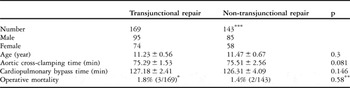
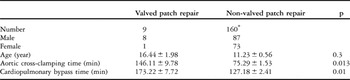
It proved possible to resection the obstructive right ventricular musculature, and perform a pulmonary valvotomy, completely performed through the right atrium in 192 patients. Of these, 52 did not require insertion of a patch in their right ventricular outflow tract. The repair was achieved through right ventricular outflow tract in 84, through the right atrium and the right ventricular outflow tract in 32, and additionally through the pulmonary trunk in 4 patients. A transjunctional patch was inserted in 54.2% of patients, being non-valved in 160 and valved in 9. In 1 patient, an incision was made only in the pulmonary trunk. In patients undergoing surgery at Wuhan Heart Institute and its incorporated hospitals, the transjunctional patch was inserted in 18 of 74 patients. In 4 patients, incisions were made in the pulmonary trunk in addition to the right atrium in order to facilitate the resection of right ventricular musculature, to perform a pulmonary valvotomy, or to repair a doubly committed and subarterial ventricular septal defect. In these four patients, the pulmonary arterial incision was directly closed without a patch. The final size of the right ventricular outflow tract and the pulmonary trunk in all patients reached the standard size for the body surface area (Table 1). The period of aortic cross-clamping was 75.3 ± 1.5 min in those requiring a transjunctional patch, and 75.5 ± 2.6 min in those not requiring such as patch (p = 0.081, Table 2). The time of cardiopulmonary bypass was 127.2 ± 2.4 min in those needing a transjunctional patch, and 126.3 ± 4.1 min in the others (p = 0.146, Table 2). Those having insertion of the valved monocusp required longer periods of aortic-cross clamping and cardiopulmonary bypass (Table 3). This was mainly due to the time required to construct the valve.
Comparison between transjunctional and non-transjunctional repair.

*One patient having double outlet right ventricle died 2 weeks after surgery due to massive intrapulmonary bleeding.
**Fisher’s Exact Test.
***One patient had no right ventricular outflow tract incision nor pulmonary arterial incision.
Comparison between valved and non- valved patch repair.

*One patient had a patch on the pulmonary trunk only.
Most patients came off cardiopulmonary bypass uneventfully, but in 31 patients, inotropic support was needed, producing gradual stabilization in 28. When the haemodynamics were stable, and the patient came off cardiopulmonary bypass uneventfully, the pressures across the right ventricular outflow tract were not measured.
All patients but 5 were discharged from hospital, giving a mortality of 1.6%. Of these, 1 was diagnosed with double outlet ventriculo-arterial connections and severe subpulmonary and pulmonary stenosis. In those with concordant ventriculo-arterial connections, the operative mortality was 1.5%. The operative mortality was similar in those with and without transjunctional patches (p = 0.58, Fisher’s exact text, Table 2).
All patients underwent transthoracic echocardiography at the time of discharge, and those without transjunctional patches had minimal pulmonary insufficiency. In those with a transjunctional patch, 3 having a non-valved patch had severe pulmonary insufficiency, and one of them had persistent right heart failure. He had a prolonged hospital stay, although he was finally discharged from the hospital. It was this experience that motivated our use of the valved patch. In the other patients, 43 had mild pulmonary insufficiency, and 4 had mild-to-moderate pulmonary insufficiency, but no right heart failure was observed. In all, three-tenths, or 49 of 160, patients had pulmonary regurgitation of various degrees.
The patients having a valved patch had minimal pulmonary insufficiency and good right ventricular function demonstrated by postoperative echocardiography. In the 9 patients with a monocusp patch, the pulmonary insufficiency was mild in 5 and minimal in 4 patients. None of the patients had significant stenosis of the right ventricular outflow tract.
Follow-up
Follow-up in China is rather difficult. All patients with monocusp patches, nonetheless, were followed up by telephone for 8 to 19 months, on average 11.9 months, after the operation, and all patients were well. Due to economic reasons, only three of them were able to come back to our hospital for transthoracic echocardiography. In these three patients, echocardiography showed a well preserved monocusp and minimal or mild pulmonary insufficiency, with good right ventricular function and without significant stenosis of right ventricular outflow tract.Reference He32 In patients operated at TEDA International Cardiovascular Hospital, only 31 had follow-up up to 1 year. In those patients, 6 had mild pulmonary insufficiency; 1 had a residual septal defect; and 1 had required aortic valvar replacement due to severe aortic regurgitation. The rest of patients were in excellent condition during the follow-up.
Discussion
Our review details our current strategy, and the results, for complete repair of tetralogy of Fallot in children and adults, with emphasis on the need for a precise repair, including adequate resection of the right ventricular outflow tract, repair of the ventricular septal defect, and preservation of the function of the pulmonary valve, either by protecting the native valvar leaflets or creating a monocusp patch for reconstruction of the right ventricular outflow tract.
Due to the adverse effect of the pulmonary insufficiency over the long-term after complete repair of tetralogy of Fallot, restrictive right ventricular physiology, defined by the presence of antegrade pulmonary artery flow in late diastole, was shown to have a protective influence.Reference He and Mee33, Reference Ilbawi, Idriss and DeLeon34 The complicated early postoperative course limits the use of this method to avoid pulmonary insufficiency.
Due to the existence of a particularly small pulmonary valve in some patients, a transjunctional, or so-called transannular, repair is essential in order to obtain adequate dimensions for the reconstructed pulmonary outflow tract. Under these circumstances, the creation of pulmonary insufficiency is inevitable if the repair is performed using a non-valved patch or conduit. Although the early operative course can be satisfactory in these circumstances,Reference Giannopoulos, Chatzis and Karros4 the pulmonary insufficiency may impact unfavourably on the late results.Reference Giannopoulos, Chatzis, Bobos, Kirvassilis, Tsoutsinos and Sarris8, Reference Singh, Greenberg, Yap, Delany, Keeton and Monro35–Reference de Ruijter, Weenink, Hitchcock, Meijboom and Bennink37
When obstruction of the right ventricular outflow tract and pulmonary insufficiency occur, reintervention is often required.Reference Faidutti, Christenson, Beghetti, Friedli and Kalangos38, Reference d’Udekem, Ovaert and Grandjean39 Homograft reconstruction of the right ventricular outflow tract of these patients induces regression of their right ventricular dilatation, and leads to their functional recovery.Reference d’Udekem, Ovaert and Grandjean39 It is reported, however, that use of the homograft monocusp does not solve this problem, as in the long-term, the gamma-irradiated patch behaves like a simple patch, with residual pulmonary stenosis in some patients.Reference Bogers, Roofthooft, Pisters, Spitaels and Bos14 The use of a valved conduit also creates problems with late stenosis or calcification, and therefore is not ideal for eliminating the pulmonary insufficiency, at least in correction of tetralogy of Fallot.Reference Abdulali, Silverton, Yakirevich and Ionescu20, Reference Yankah, Lange and Sievers40 The use of the monocusp patch is a simple way to eliminate this problem, although it has been reported that insertion of a monocuspid valve does not prevent short-term postoperative pulmonary insufficiency, and does not improve immediate postoperative outcome for these patients.Reference Bigras, Boutin, McCrindle and Rebeyka9
We have found that the chances of avoiding transjunctional repair is higher in young children and adults than in infants. Although the transjunctional incisions were needed in just over half our patients, there is room to lower this rate. In fact, in the patients operated at Wuhan Heart Institute and incorporated hospitals by GWH, transjunctional repair was needed in less than one-quarter of the patients, specifically in 17 of 74.
We have found that, in the setting of tetralogy of Fallot, it is rare to have complete absence of the leaflets of the pulmonary valve. The remaining leaflets may still provide some anti-regurgitant function. Their protection, therefore, is an important part of successful repair. Usually, it is not necessary to create more than one leaflet, which can be incorporated with the remaining native leaflets. As we previously demonstrated in an experimental study, the absence of one pulmonary leaflet in a valve of normal diameter would create a regurgitant flow that equals half of the forward flow.Reference He, Kuo and Mee13 This indicates that, even if only one pulmonary leaflet is created, regurgitant flow will be halved. This amount of pulmonary regurgitation would be further reduced if there are remaining leaflets of the pulmonary valve that can be incorporated in the reconstruction.
For those with poor native leaflets, or if it is predicted that a certain amount of pulmonary regurgitation would be created after the repair, we believe that the most feasible and economic way to eliminate pulmonary insufficiency is to create a durable monocusp valve.Reference He32 The advantages of this new method are multi-fold. First, the monocusp is a natural part of the pericardial patch, and not a separate piece sewn to the patch. It is expected, therefore, to be durable. Second, the technique allows a more accurate lining-up of the newly created monocusp with the remaining native leaflets. Third, after placement of the monocusp patch, before the second patch on right ventricular outflow tract is sewn, the function of the monocusp can be checked with the back-flow from the distal pulmonary trunk. Fourth, the method is easy and less time-consuming than the traditional monocusp. Finally, there is no additional cost, and therefore it is particularly applicable in developing areas.
Our clinical experience has proved the above advantages, except the durability that requires further study. The technique is simple with moderate increase of the cross-clamping time compared to the non-valve patch repair. If the patch is made before cardiopulmonary bypass, the time can be further reduced. Perioperative transoesophageal echocardiography demonstrated the effectiveness of this method on elimination of pulmonary insufficiency in the early postoperative course.
Limitation of study We do not have a long-term follow-up data available at this moment, and may be even later, because all these patients were from rural areas and had limited economic support. They do not come back to our hospital for follow-up, unless they have a problem. The long-term results of our repair, therefore, await further studies.
Acknowledgement
We gratefully thank our colleagues at the Surgical wards, the Operating Room, and Intensive Care Unit, echocardiographers, cardiologists at TEDA International Cardiovascular Hospital, Tianjin & Wuhan Heart Institute, the Central Hospital of Wuhan, China for their assistance in diagnosis, surgery, and postoperative care.