


INTRODUCTION
While international relations (IR) scholars have applied pragmatist insights to a number of questions, much of the discussion has centered on the epistemological and methodological implications of pragmatism.Footnote 1 Works that have directly applied pragmatism's unique insights on human action to explain social phenomena have remained fairly rare.Footnote 2 As a result, the literature has not yet fully explored the potential of this perspective to enrich our understanding of the normative dimension of social life in general and norm change in particular. Building on a pragmatist understanding of human action, I argue that deliberation and experimentation by actors in environments characterized by high uncertainty can lead to the development and legitimization of new norms that significantly alter inherited understandings of appropriate behavior. This approach enriches the constructivist research program on norm change by providing a general framework that can account for the origin of new norms and by showing how this process can occur in thinly institutionalized contexts and in situations with little or no social mobilization by activists or interest groups. In addition, while allowing for a fuller understanding of norm change by incorporating both material artifacts and tacit knowledge into the constitution of norms like many practice theory approaches, pragmatism's emphasis on reflection and deliberation helps explain norm change in circumstances less amenable to practice theory.
I demonstrate the value of a pragmatist approach by using it to shed light on a pivotal development in security politics that has gone largely unexplained: the origin of the practice in which a state might maintain a long-term, peacetime military presence on the territory of another equally sovereign state without interfering in the host state's domestic authority structures. For the sake of brevity, I label this practice “sovereign basing.” This phenomenon has been largely taken for granted in IR scholarship even though any number of studies of efforts to secure American interests around the globe presupposes the practice of sovereign basing.Footnote 3 Although a fundamental part of contemporary security politics, sovereign basing was unknown prior to the Second World War and was incompatible with the then-prevailing norms of sovereignty.Footnote 4 I argue that the traditional, inherited understanding of sovereignty, typified by a close link between the peacetime disposition of military forces and territorial authority, was transformed through the deliberations and interactions of policymakers in their effort to come to terms with the unprecedented security challenges following the Second World War.
The article proceeds as follows: after discussing sovereign basing in greater detail, I elaborate a general pragmatist framework of norm change. This is followed by a discussion of pragmatism's contribution to understanding norm change in the context of the recent practice turn in IR theory. I then explain the origins of sovereign basing in terms of the framework. I conclude with a consideration of alternative explanations and a brief discussion of the implications of a pragmatist perspective for IR theory.
Sovereign basing
Sovereign basing is defined as the long-term, peacetime presence of a foreign military on the territory of another sovereign state without interference into the host's domestic authority structures. These terms require some clarification to differentiate sovereign basing from other superficially similar phenomena. First, a long-term presence is one that is not purely transitory or tied to some temporary circumstance or condition, such as a brief passage of a military contingent or the period during which troops are being withdrawn from a state after a conflict. Second, I use the term peacetime in reference to the status of the host; in contrast, the presence of foreign allied military forces on the territory of a state currently at war has a long history.
Third, the forms of military presence that are relevant to this study are those with a territorial dimension involving a cession of use rights over a particular piece of the host's territory to the sending state, with the host retaining a residual right of control.Footnote 5 Thus, any long-term use rights acquired by the sending state for its military within the territory of the host is considered a “base,” regardless of its specific function (common defense, trans-shipment point, communications station, etc.). This demarcation excludes agreements governing nonterritorial presences, such as overflight rights and port access by naval ships, even if the latter involve activities like purchasing fuel or consumables or undergoing repairs while in port. Similarly, military advising missions are also generally excluded from consideration using this guideline.Footnote 6
Finally, how sovereignty is understood is central, as polities that are recognized as sovereign by other states might not actually be in a position, on their own authority, to deny the establishment of bases to a foreign military. They might, in effect, be puppets of the sending state. This kind of basing relationship, in which the host state is sovereign in name only and in which its domestic authority structures have been compromised by the sending state, closely resembles colonial arrangements given the inequality inherent in the relationship. Sovereign basing relationships can be distinguished from such unequal arrangements by applying Stephen Krasner's typology of sovereignty (Krasner Reference Krasner2001).Footnote 7 According to Krasner, a state has international legal sovereignty if it is recognized by other states as sovereign. In addition, a state possesses Vattelian sovereignty if external actors are excluded, both de jure and de facto, from domestic authority structures. That is, “[w]ithin its own boundaries the state has a monopoly over authoritative decision-making” (Krasner Reference Krasner2001, 232).Footnote 8 A host state is only considered to be in a sovereign basing relationship if it maintains both its international legal sovereignty and its Vattelian sovereignty.
Good examples of host states that possessed international legal sovereignty but that did not maintain their Vattelian sovereignty vis-à-vis the sending state were the Soviet satellite states of Eastern Europe during the Cold War. While they maintained their international legal personality, their Vattelian sovereignty was compromised because their domestic authority structures had been penetrated by the Soviet Union. Another example is the U.S. presence at Guantanamo Bay, Cuba. This presence was established under the auspices of the Platt Amendment, which was incorporated into the Cuban constitution upon American insistence and, in addition to granting military bases to the U.S., limited the possible scope of Cuban policies and allowed for U.S. intervention in the case of domestic unrest.
The peacetime presence of a foreign military on a state's territory prior to the Second World War was always accompanied by some violation of the host's Vattelian sovereignty, whether the presence was a shorter-term intervention or occupation or a longer-term arrangement such as a protectorate or customs receivership.Footnote 9 By contrast, basing arrangements today do not necessarily imply the penetration of host authority structures by the sending state. They also happen in a variety of contexts: while there are many basing relationships within an alliance like NATO, where members share a substantial set of interests and values, there are also many such arrangements where the extent of the common interests between the parties is limited to the agreement itself. The U.S. presence in Uzbekistan from late 2001 to 2005 is an example of this more commodified form of basing arrangement. Importantly, the U.S., while by far the dominant sending state in sovereign basing arrangements, is not the only one: both France and Russia have (or have had) military presences in countries in which they did not exercise any authoritative control.Footnote 10 Given the earlier connection between the presence of a foreign military and some form of local authoritative control, it is surprising just how much norms have changed.
A PRAGMATIST ACCOUNT OF CHANGE
A pragmatist understanding of action fits in well with recent developments in constructivist IR theorizing that emphasize the role of practices, understood as “incorporated and material patterns of action that are organized around the common, implicit understandings of the actors” (Neumann Reference Neumann2002, 629). Along with discourse, pragmatism highlights the role of both material artifacts and tacit forms of knowledge embedded in practices in the constitution of the social world. Although foundational works of constructivism incorporated practices along with discourse—and, like pragmatism, did not draw sharp distinctions between the two—much constructivist work has tended to emphasize the role of discourse in the elaboration and contestation of norms. This tendency to privilege discourse over practice resulted in a call for a practice turn in IR theory, and in recent years there has been an increasing interest in the role of practices and nondiscursive forms of knowledge in IR.Footnote 11
This section first develops three concepts rooted in pragmatist thought that together can be used to throw processes of norm change closely associated with practices into sharper relief: habits, environmental stimulus, and deliberative innovation. I then sketch a framework that captures the process of norm change. The section concludes with a discussion of the contribution of pragmatism to explaining norm change in the context of the practice turn in IR theory.
Habits
At the core of a pragmatist understanding of the social world is the concept of habit. First appearing in the work of Charles Peirce and William James, John Dewey later elaborated the concept as a centerpiece of his social theory. The pragmatist idea of habit departs significantly from common usages today, which tie habits to purely unreflective modes of thought and individual (nonsocial) action. According to pragmatism, habits are the modes of thought and action through which an actor engages with both the social and material aspects of the world, including everything from manner of gait and comporting oneself socially to the language one uses and how one perceives the world. They can be thought of as solutions to arrays of problems encountered in the need to interact in the world, and they serve to attain a given outcome or end (Dewey Reference Dewey and Boydston1922). They are, however, not merely functional, because once constituted, habits have a tendency for self-perpetuation and bias perception in ways that might ignore contradictory environmental cues, precluding possible alternative courses of action (Gronow Reference Gronow2011).
Habits are fundamentally social things. In fact, the emphasis on the social dimension of life is a central theme in both pragmatist epistemology and social theory, from Peirce's community of inquiry (Peirce Reference Peirce, Houser and Kloesel1877) to Dewey's discussion of habit acquisition (Dewey Reference Dewey and Boydston1922) and Mead's conception of the mind and self as emerging only through social interaction (Mead Reference Mead1934). Hans Joas underlines this in his assertion that “pragmatism is above all a reflection on the fact that the subject is embedded in praxis and sociality prior to any form of conscious intentionality of action” (Joas Reference Joas1993, 59).
The physical and mental acts or states that comprise a habit are not somehow the private possession of an individual, but are socially recognizable activities, express an intersubjective understanding, and importantly, are subject to change through social processes. Habits are learned either through the internalization of explicit, representational knowledge, or through the acquisition of tacit knowledge through practice and are, therefore, strongly socially conditioned. They embody norms of appropriate behavior under a given set of circumstances; Dewey's discussion of habits as “customs” and “conduct” is a clear statement of this proposition (Dewey Reference Dewey and Boydston1922). However, instead of regulating behavior externally through representative knowledge, the normative prescriptions of habit are not usually articulated and instead inhere in their execution, forming an often-unexamined foundation from which individuals act. Habits can therefore be thought of as “standing predilections and aversions” towards different courses of action (Dewey Reference Dewey and Boydston1922, 32). They are not mere rote behaviors and inaccessible unconscious foundations for action, but are habitual ways of perceiving the world and acting in it that must be adapted to the particular problem or issue at hand.
Although rooted in sociality, habits are enacted by individuals, not organizations or institutions. Rather, institutions can be understood as the habitual understandings and actions of a broader collectivity of actors that structure social interaction and are instantiated by the shared beliefs and interactions of the actors concerned (Gronow Reference Gronow2011). As Dewey argues, institutions, political and otherwise, are “embodied habits” (Dewey Reference Dewey and Boydston1922, 77).
A critically important aspect of habits is that they not only involve purely social artifacts like roles, institutions, and aspects of culture broadly understood, but that they are also defined by material objects. As Reijo Miettinen notes, material artifacts are central to a pragmatist understanding of human action (Reference Miettinen2006). The notion that the environment, broadly understood to include social and natural things, exerts an influence on habits and even pushes back on or “resists” them has a long history in pragmatist thought; this resistance to manipulation by objects also serves as the basis for pragmatist epistemology. While people might attach meaning to objects through discourse, objects in turn also shape practices and ideas (Dewey Reference Dewey and Boydston1922; Miettinen Reference Miettinen2006). For instance, the advent of nuclear weapons radically changed a wide array of habits related to security because of their vast destructive potential, a central material characteristic of them.
For pragmatists, the idea that human action has a habitual cast accounts for the stability of the social world, and habits are considered to be “the major explanation for the emergence of social structures” (Gronow Reference Gronow2011, 10). The implication of habits in the continuity of social life and structure was vividly expressed by James in his discussion of habit as the “enormous fly-wheel of society, its most precious conservative agent,” which “saves the children of fortune from the envious uprisings of the poorFootnote 12 ” (James Reference James1890, 121). When a habit operates smoothly without any significant hindrance and results in expected outcomes, there is little need or occasion for conscious thought and critical reflection on the part of the actor—in the words of James, our habitualized beliefs “‘pass’ so long as nothing challenges them” (James Reference James1907, 100). From a social perspective, habits as institutions might have extraordinary longevity over generations and be resistant to change (Dewey Reference Dewey and Boydston1922). First, institutions, particularly understood as culture, are in a sense self-perpetuating in that individuals are socialized to conform to them. Second, any aberration in an individual's enactment of a habit is likely to have little effect socially. As such, habits, and the structures they instantiate, can persist far into the future.
Environmental stimulus
The fact that habits, as tools for interacting with and solving problems in the world, incorporate social and often material artifacts means that the relevant environment of action with which pragmatism is concerned is quite broad. This environment includes other actors, material objects, and of course the habits that structure social life in the form of norms and institutions. As long as the environmental conditions to which a particular habit relates do not change, that habitual mode of action might continue, possibly indefinitely. However, if there is what I call an “environmental stimulus” that results in a significant incongruence between the expected effects of a given habit and the actual outcomes of action, the habit, whose execution was until then not a matter of conscious and critical deliberation, is critically reassessed in light of the environmental stimulus.
An environmental stimulus is any consequential change in either the social or material aspects of the world (and often both). Candidates for such stimuli include shocks of a material nature that might be more or less exogenous to ongoing social interactions. Environmental stimuli might also originate in factors endogenous to ongoing social interactions, such as the development of new technologies that are ultimately rooted in social and political developments or, in a more immediate sense, the coming into conflict of two or more habits, a mechanism which Dewey himself noted as a potential cause for deliberation and reflection (Dewey Reference Dewey and Boydston1922). This endogenous mechanism reflects the idea that the actions entailed in habits can change the environment, precipitating reassessments of other habits, and expresses the mutual implication of actor and environment, a reflection of the pragmatist tendency to break down traditional dualisms like that of subject and object. When the flow of activity of a habit is frustrated by an environment that no longer conforms to the expectations that in part constitute the habit, the actor critically assesses the habit since the action it prescribes is no longer appropriate or possible. This moment entails the operation of intelligence (Dewey Reference Dewey and Boydston1922; Mead Reference Mead1934). The same dynamic is discussed by Peirce in which the “irritation of doubt” is the motive for thinking (Peirce Reference Peirce, Houser and Kloesel1878).
Because an environmental stimulus always needs to be contextualized historically in terms of the particular habit being impacted and the developments in the environment relevant to that habit, it is impossible to formulate a universal definition of exactly what constitutes such a stimulus ex ante. It is, however, an umbrella concept for a change in the environment of action that precipitates a critical assessment of a habit, and so can be part of a framework for understanding norm change that is itself historically transposable. In addition, a generalization about environmental stimuli can be made. The social dimension of habits suggests that significant changes in widely shared institutions that are foundational to how actors understand and act in the world are likely to come about only under fairly extreme circumstances. Dewey, and more recently Joas, note the prominent roles that wars, revolutions, and other large-scale crises have played in unseating “established institutions” understood as habits (Dewey Reference Dewey and Boydston1922; Joas Reference Joas1996). Major wars and political crises may or may not precipitate the obsolescence of a habit and the development of new ones; they are, however, a good place to start looking for the origins of new norms.
Deliberative innovation
When an environmental stimulus precipitates the critical assessment of a habit, habitual action does not simply give way to pure rational calculation or some other basis for action. Rather, habits also provide the contextual understanding of the problem and play a crucial role in acting as resources for the development of new habits. Deliberative innovation ensues: actors faced with the failure of a certain habitual course of action reflect and deliberate on how to reconstitute action, a process which is informed by other habits of thought and action that continue unimpeded (and unquestioned) and act as tools in the development of new habits that resolve the given problem (Dewey Reference Dewey and Boydston1922). Settled habits are therefore solutions to earlier problems. However, the transition to the establishment of new, effective habits is often not a smooth one and proceeds in a halting, tentative manner given the lack of an applicable cognitive roadmap. As Dewey noted, “[o]utside the scope of habits, thought works gropingly, fumbling in confused uncertainty” (Dewey Reference Dewey and Boydston1922, 121). Both Peirce and James refer to this uncertainty as an uncomfortable state from which actors seek to free themselves (James Reference James1907; Peirce Reference Peirce, Houser and Kloesel1877).
Given that the “guideposts” of habit no longer provide reliable direction for action in such a situation, the actor must determine not only what means to select to reach a given end, but also what exactly the end or the goal of action should be in the new situation. Often, goals in such ambiguous situations are only vaguely defined and become more specified through subsequent decisions to employ certain means. That is, “motives and plans are products of reflection within action situations, not (antecedent) causes of action” (Joas and Knöbl Reference Joas and Knöbl2009, 518). The recourse to available means in the form of ongoing habits helps frame potential solutions. A period of experimentation then ensues in which a variety of potential solutions, predicated on ongoing habits, is evaluated.
The progressive redefinition of ends through the selection and employment of certain means indicates that the development of new habits in the face of uncertainty is an inherently contingent and creative process that does not lend itself to prediction (Joas and Knöbl Reference Joas and Knöbl2009). The potential creativity of action is in fact a central element of pragmatist thought, one that is expressed in, for example, the unpredictability and novelty associated with Mead's “I” (Mead Reference Mead1934); this creativity provides a point of origin for the emergence of new norms as expressed in novel habits (Joas Reference Joas1996). A pragmatist framework is therefore causal but nondeterministic. It is causal in the sense that an environmental stimulus spurs reflection and deliberative innovation to come to terms with the altered situation, but nondeterministic given the contingency, creativity, and therefore inherent unpredictability involved in establishing new habits.
Critically, the emergence of new habits and the normative prescriptions they embody is a social process. Because of the social nature of habits, any critical reflection on a habit, if it is to have any impact, happens in a social context. New habits emerge through a process of collective reflection, deliberation, and experimentation among actors whose shared habit has been rendered obsolete by the environmental stimulus in question.
The creativity and social context of deliberative innovation means that it is not reducible to simple mechanistic “adaptation” to changed circumstances, as misreadings of Dewey and James have often held (Joas Reference Joas1996, 138). The re-evaluation and recomposition of habit in the face of uncertainty following an environmental stimulus reflects the concerns of pragmatist epistemology for experimentation and the social context of inquiry first elaborated by Peirce. It is analogous to the elimination of doubt through convergence on an opinion in an attempt to establish a belief (habit) that acts as a guide to future action (Peirce Reference Peirce, Houser and Kloesel1877). As with the process of “fixing a belief” regarding the world, deliberative innovation is a process of learning how to move forward under new circumstances that have rendered old understandings obsolete.
A framework for norm change
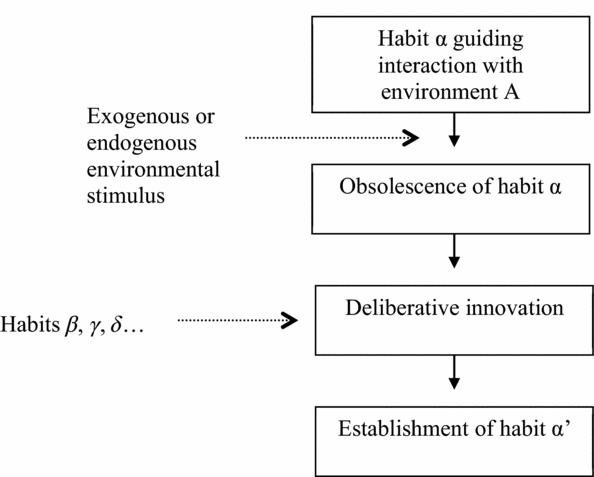
The pragmatist concepts of habit, environmental stimulus, and deliberative innovation allow us to sketch a framework for norm change as in Figure 1. Even though the discussion of causality in pragmatist accounts is context-dependent, the framework for norm change illustrated here is a general one and can be applied broadly.
A Pragmatist Framework for Norm Change

Pragmatism and the practice turn in IR
This discussion of a pragmatist understanding of action suggests broad areas of overlap with concerns central to the practice turn in IR. These include, but are not limited to, a focus on the habitual and nonreflective nature of much of human action, an interest in the significance of bodily actions and the material world, and an emphasis on the concrete and particular as opposed to the abstract and universal. As noted, however, discussions of specifically pragmatist scholars and concepts in IR literature are generally limited, with a few exceptions, to epistemological issues. There has been little effort to develop pragmatism's distinctive insights on human action as a contribution to the broader practice turn in IR theory. In contrast, these insights have been more fully developed in other subfields such as organization theory (Herrigel et al. Reference Herrigel, Wittke and Voskamp2013).
Pragmatism's unique contribution is its emphasis on reflexivity—the potential for the actor to reflect on his or her practices—and deliberation in the reconstitution of action that establishes new modes of appropriate behavior. These characteristics and the deliberative model of norm change discussed above are rooted in the philosophy of Peirce, James, Dewey, and Mead. In contrast, practice theorists lean more heavily on Wittgenstein's prioritization of the unarticulated and unreflective basis of rule-following (Schatzki et al. Reference Schatzki, Cetina and von Savigny2001; Shusterman Reference Shusterman1999). As a result, practice theorists generally draw a sharper distinction between reflective and nonreflective forms of action than pragmatists do, privileging the latter in discussions of social action. This difference has consequences for how each perspective understands the dynamics of social change.
Practice theory's emphasis on unreflective action and the uniqueness of nonrepresentational, tacit forms of knowledge tends to limit the purview of reflexivity. Vincent Pouliot, who like a number of IR scholars builds on the work of Pierre Bourdieu, strictly separates representational forms of knowledge from tacit knowledge embodied in practice, denying even the possibility that internalized forms of representational knowledge might form the basis of practice (Pouliot Reference Pouliot2008). This is indeed a faithful reading of Bourdieu, who holds that the reflection of an agent on his or her practice will only result in an inadequate and partial representation of that practice. Practical knowledge is therefore, at least in part, inaccessible to conscious reflection (Aboulafia Reference Aboulafia and Shusterman1999; Bourdieu Reference Bourdieu1977).
According to Bourdieu, the reach of reflexivity is also circumscribed by the nature of his central notion of habitus, the system of dispositions that serve as the tacit foundation of perception and action that agents acquire by virtue of their position in a social structure. While agents act strategically, the bounds of the reflexivity implied in strategic action are set by the phenomenon of “misrecognition” in which agents see their own habitus as natural and therefore inaccessible to reflection on their part (Bourdieu Reference Bourdieu1977). Some scholars have even argued that this situation makes the reproduction of social structures inevitable (Bohman Reference Bohman and Shusterman1999), and the concept of practice has frequently been used to explain the stability of social structures (Thevenot Reference Thevenot, Schatzki, Cetina and von Savigny2001).
The manner in which practice theorists conceive of social change reflects this foregrounding of tacit knowledge and a limited notion of reflexivity. Practice theorists have generally emphasized how changes in practice happen either through the incremental elaboration of practices over time (Barnes Reference Barnes, Schatzki, Cetina and von Savigny2001) or because of the inherently ambiguous and indeterminate meanings of practices (Doty Reference Doty1997). Bourdieu also notes how social change may result from the transposition of dispositions (habitus) into different contexts (Aboulafia Reference Aboulafia and Shusterman1999), a good example of which is the process that Frederic Merand discusses as giving rise to the European Security and Defense Policy (ESDP) in the context of the crisis in security politics at the end of the Cold War. In a sense, this mechanism is quite conservative: a critical factor in the success of ESDP as opposed to alternative security institutions in Europe was that it did not threaten the established routines of military and diplomatic elites (Merand Reference Merand2010).
In contrast, pragmatists dwell on the importance of reflexivity and deliberation at both the individual and social levels. For example, Peirce held that thought took the form of an inner dialogue and that the community of inquirers was the setting for the establishment of opinion. The concept of the dialogic nature of the individual and the attendant capacity for reflection was also developed by Mead, who made reflexivity the cornerstone of his understanding of the self and its relation to society (Mead Reference Mead1934; Wiley Reference Wiley1994). This emphasis on reflexivity dissolves the barrier between tacit, inarticulate knowledge and conscious thought that is characteristic of practice theory. While the formation of habits might indeed result in “thoughtless action,” the complete unthinking execution of habit is only one end of a spectrum (Dewey Reference Dewey and Boydston1922, 121). Similarly, while Mead distinguishes between the reflective and nonreflective, actors “typically move rather naturally between them in [their] daily lives” (Aboulafia Reference Aboulafia and Shusterman1999, 134).
Pragmatism therefore provides the practice turn with additional tools to theorize norm change. Although habits generally work in the background, they do not face insuperable barriers in being brought to conscious thought given a suitable stimulus. Through the process of deliberative innovation, the habit is reflected on by a group of actors who then seek to reconstitute action in the face of an uncertain environment in which accepted practices, outlooks, and valuations no longer apply. Norm change is the result of a social process of deliberation and experimentation. This mechanism is empirically illustrated in the following section.
SOVEREIGN BASING AND THE CHANGING NORMS OF SOVEREIGNTY
The above framework provides a unique perspective from which to explain norm change in international politics. This section will apply this framework to the development of sovereign basing and the attendant changes in the norms of sovereignty. After noting how sovereignty can be understood as a habit, I discuss how the pragmatist framework I developed above can be applied to explain the origin of sovereign basing by identifying the traditional understanding of sovereignty and its associated security practices, the environmental stimuli responsible for the re-assessment of security practices, and the process through which the new habit of sovereign basing developed.
Sovereignty as habit
Pragmatism encourages us to think about the institution of sovereignty as a historically contextualized “embodied habit.” Built on mutual recognition, sovereignty is fundamentally relational and is defined by how the representatives of recognized state actors interact with the world and draw on shared conceptual frameworks for developing strategies to achieve commonly understood ends. Because sovereign status is socially determined, it can be redefined through the actions of state representatives; it is not a “natural kind” with necessarily timeless and enduring characteristics (Biersteker and Weber Reference Biersteker and Weber1996). However, because sovereignty defines who the legitimate actors in international politics are in the first place, it is a foundational habit of the modern state system, and as such, it is likely to be particularly stable. This is especially true of what can be regarded as the core practices of sovereignty, such as those associated with fundamental diplomatic practices and the territorial nature of rule.Footnote 13
Policymakers and diplomats, socialized into the habit of sovereignty, possess a common framework for perceiving and dealing with problems related to international politics. In terms of achieving security prior to the development of sovereign basing, state leaders forged alliances with other states, declared neutrality, or strengthened their military, depending on what seemed like the best method to achieve their goals. Each time questions of security arose, the accepted tools of the trade shaped the options available to policymakers, who drew on this framework to understand the problems they confronted and to devise solutions for them.
The habit of sovereignty before sovereign basing
Prior to the environmental stimulus in security politics that led to the development of sovereign basing, policymakers’ understanding of sovereignty was in part expressed in a practice I call “military exclusivity” (habit α in Figure 1). That is, a state's military deployment in peacetime was limited to a state's territory and that of subordinated dependencies. This practice is best understood as a practical response to the endemic nature of territorial warfare in early modern Europe. Under these conditions, the claim to a particular parcel of territory was in the final instance secured by military means.Footnote 14 Indeed, in early modern Europe, it was generally understood that the acquisition of effective military control over a given territory provided an adequate legal claim to full sovereign rights over that territory (Bhuta Reference Bhuta2005; Schmitt Reference Schmitt1950). The military was therefore very much the tool of territorial acquisition, and the presence of a state's military in an area was an expression of the power of the state over that territory. The association between the presence of a foreign military and annexation was immediate and unavoidable. In such an environment, the peacetime presence of foreign forces in a given territory was not conceptually compatible with that territory's continued sovereign equality.Footnote 15
Diplomats and policymakers had imbibed a conception of sovereignty that subsumed the practice of military exclusivity through their practical engagement with diplomacy, and they saw it as part of the natural order of things, the unquestioned foundation for action. This inherited conception of sovereignty, understood as a habit that shaped perceptions of security problems and recommended certain solutions—which did not include sovereign basing—can be briefly illustrated by telling instances of policy choice. The crisis in the months before the Second World War is a good example. Despite the obvious nature of the German threat and the Anglo-French guarantee of Polish independence in March of 1939, which committed Britain and France to fight on the side of Poland, the British did not actually position any troops in France until weeks after the outbreak of war. By this time, Britain had shifted from appeasement to deterrence, and given the commitments made, stationing troops in France (Poland itself was too weak and exposed) would have been a low-risk move that would have presented Germany with a formidable threat and may have drawn out or even deterred a German attack on Poland because of the additional forces that the German military would have had to station in the west.Footnote 16
The absence of any move by Britain to station troops in France before the outbreak of war was in line with the habit of sovereignty at the time. A speech made by King Leopold III in October 1936, which severed Belgium's interwar military ties with France, perfectly expressed the then-prevalent notion of how traditional alliances subsumed the practice of military exclusivity. In the context of concerns over the potential for German aggression, Leopold noted: “An alliance, even if purely defensive, does not lead to the goal; for, no matter how prompt the help of an ally would be, it would not come until after the invader's attack, which will be overwhelming. To meet this attack we would be alone in any case.”Footnote 17 This common understanding meant that no peacetime presences of foreign militaries, whether for the benefit of Poland, France, Belgium, or any other country, were seriously contemplated.
Military exclusivity was also apparent in the actions of powerful state actors at the “fringes” of the state system, where states were institutionally or economically weaker and might therefore have taken actions not countenanced by actors in the center. A good example is British policy towards Latin America at the height of the empire in the nineteenth century. While the British had a colonial possession in almost every corner of the globe, the west coast of Central and South America were a marked exception. The British Navy squadrons in the area, deprived of a colonial port under British command, were supplied through makeshift arrangements that included, at different times, a storeship anchored in either Callao (Peru) or Valparaiso (Chile), and a privately leased warehouse and a powder magazine under local control, again in Valparaiso (Bach Reference Bach1970).
The alternative solution proposed to these awkward and unsatisfactory arrangements was the potential annexation of the Galapagos Islands as a naval base (Bach Reference Bach1970). In other words, a military presence on land required actual territorial rule. Indeed, any shore presence of foreign forces only happened in the context of some form of intervention or “gunboat diplomacy” in which domestic authority structures—at least locally—were usurped by the intervening state. Leasing a base from a sovereign country likely never occurred to anyone, least of all the republics of South America, which, living in a “classical zone of war” rife with territorial conflicts, had a clear understanding of military exclusivity and were sensitive to any transgressions of sovereignty (Holsti Reference Holsti1996, 151).
The actions of U.S. policymakers reflected the norms of the time as well, with a lease signed in 1864 by the U.S. for a coaling station at Yokohama, Japan an exception that proves the rule. The lease was concluded before Japan was thought of as a member of the recognized club of sovereign states, and, critically, also before Japanese policymakers themselves had been socialized into the norms of the system. The property was soon subleased to a private enterprise that supplied coal to U.S. naval vessels, and the original lease faded from the institutional memory of the U.S. Navy. When, at the end of the century, the Navy realized what it had in its possession, the Judge Advocate General at the time noted:
“Important changes in the relationship of the Japanese government to foreign countries have taken place since 1864 when this concession was granted. It is possible, therefore, that we have in this lease, effected thirty-five years ago, secured certain rights which could not now be obtained and which the Japanese government would be very willing to have us surrender. Japan having, since this lease was made, placed herself substantially in the same attitude as the western nations, would doubtless now be controlled by their ideas in such matters; and putting our government, for sake of fair consideration of this question, in place of Japan, it is highly improbable that the United States would grant to any foreign government whatever, in perpetual lease, a tract of land on our Atlantic or Pacific coast to be used as a naval depot and coaling station” (Livermore Reference Livermore1944, 120).
The exceptional circumstance of having a lease for military purposes in another sovereign state therefore only came about precisely because, at the time the lease was signed, the host did not share in the norms of the European state system.
As these brief examples illustrate, the habit of sovereignty under which policymakers and diplomats worked prior to the Second World War did not accommodate the peacetime stationing of troops on the territory of sovereign equals. Exceptions, when they occurred, were rare and explained by peculiar circumstances.Footnote 18 In any case, any isolated deviations from the habit of sovereignty at the time that truly resembled sovereign basing would not constitute a habit understood as an intersubjectively constituted, socially recognized set of predispositions and associated actions for interacting with the world.
Fundamental changes in the security environment
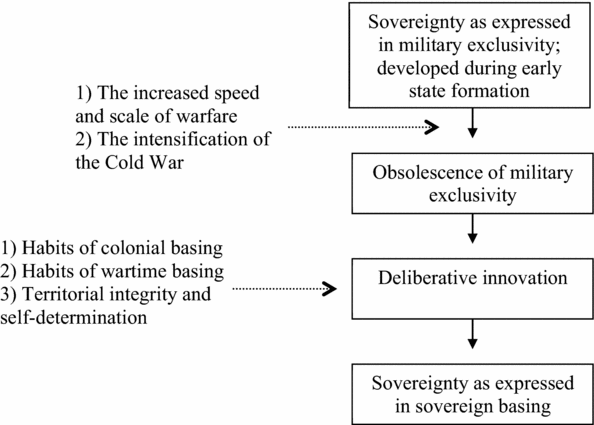
Military exclusivity, while durable over several hundred years, was recognized as obsolete by policymakers in the face of major changes in security politics during and immediately following the Second World War. The two principal components of this environmental stimulus, which together signaled the inadequacy of military exclusivity, were (1) the massively increased speed and destructiveness of warfare through the development of mechanized warfare, long-range strategic bombing, and nuclear weapons, and (2) the intensification of the Cold War, particularly from early 1948 through the onset of the Korean War.
As a result of this environmental stimulus, policymakers were faced with new problems that could not be addressed by the tools currently at their disposal. Traditional alliance structures, in which aid was only proffered after the onset of hostilities, were significantly devalued in the face of the sheer speed and destructiveness of modern warfare. For the states of Western Europe, strategic exposure to what was perceived as a growing Soviet threat meant that military exclusivity—and the associated prospect of having to wait until conflict broke out in order to receive help—was no longer tenable (Duke Reference Duke1993; Lundestad Reference Lundestad1986). For American policymakers, technological changes meant that the traditional approach of handling matters of territorial defense at the frontiers (and behind the oceans) was deemed insufficient in securing the U.S. against extensive destruction at home. As a result, U.S. plans made during the Second World War called for an expansion of the security perimeter beyond territory actually controlled by the U.S. (Converse Reference Converse2005). An early example of this logic was the conclusion of the 1940 Destroyers for Bases deal with Britain, which provided for the establishment of U.S. military installations in British colonies prior to U.S. entry into the war (Baptiste Reference Baptiste1976).Footnote 19
The post-war development of sovereign basing was significantly catalyzed by the intensification of the Cold War in a string of events from the communist coup in Czechoslovakia to the outbreak of the Korean War. These events appeared to confirm to many U.S. and western European policymakers that world communism was a transnational, globally expansive power directed from Moscow and greatly magnified the security threat that the Soviet Union was thought to pose to the U.S. and its allies. The devastated countries of Western Europe were thought to be particularly exposed given the strength of their domestic communist parties and the continued presence of large contingents of Soviet troops in the countries of Eastern Europe (Leffler Reference Leffler1992; Ross Reference Ross1988). In addition, conflict was seen in ideological terms rather than purely national terms, and forces were understood as being deployed in part to defend a transnational way of life against a likewise transnational threat (Harkavy Reference Harkavy1982; Stambuk Reference Stambuk1963).
Post-war policy innovation to achieve security
These changes in the security environment confronted policymakers with a completely alien terrain to navigate. Policymakers had little basis on which to consistently formulate clear preferences, rank order them, and make choices; nor could they unproblematically apply normative standards of action, which did not yet exist for these novel circumstances. Rather, faced with an uncertainty of aims aside from the vague goal of “security,” they engaged in a process of collective deliberation and experimentation—both within the policy apparatuses of states and between states—that was framed by ongoing habits and the means currently available to them to help define workable courses of action, set more specific aims, and so come to terms with the new situation. This process was emblematic of a pragmatist understanding of action: it was collective, recombinatory, and creative, built on past practices and applied to a novel situation.
The deliberations of policymakers were shaped by three principle habits (habits β, γ, δ. . . in Figure 1). First was the fact that several major powers, including the U.S., Great Britain, and France, had long availed themselves of basing troops abroad in the context of colonial basing structures. Not only had these states mastered the logistics of such deployments, their policy establishments also fancied themselves as having broader regional, if not global, interests to defend. Establishing and supporting military installations far from home would therefore seem to be a reasonable strategy to policymakers interested in exerting influence in a given part of the world. Indeed, U.S. policymakers initially thought of basing in terms of colonial precedents: wartime-era basing plans for the post-war era deviated little from pre-war experiences and focused on projecting power over the Atlantic and Pacific through minor colonial possessions held directly by the U.S. or Britain, with a few exceptions such as possible roles for bases on the Azores and Iceland. It was anticipated that even these fairly limited extensions might prove difficult given the sensitivity of establishing bases on foreign territory (Converse Reference Converse2005). The attitudes of U.S. military authorities in the first long-term U.S. bases on foreign, albeit colonial, territory—those bases acquired from Britain in the 1940 Destroyers for Bases Agreement—also bore the mark of prior American colonial experience. The U.S. military personnel stationed there had seen service in U.S. colonial outposts and proceeded to replicate their experience in the new bases, down to importing the stereotype of the “lazy native” (High Reference High2009, 5).
The second major circumstance that informed the development of sovereign basing was the existence of many hundreds of U.S. military installations in states around the globe and the habit of wartime collaboration between U.S. policymakers, including military personnel on location, and the host state authorities. Wartime needs had facilitated the establishment of these installations, just as wartime alliances had facilitated the presence of foreign troops time and again in history. Now, however, with the strategic landscape altered beyond recognition, these facilities entered a limbo from which some emerged re-purposed as long-term installations. When a solution to the new security difficulties that arose was needed, these bases and the habits of security cooperation to which they were tied became resources that might be utilized in some way. These relationships and dispositions of military assets would not have existed without the Second World War, but they were not sufficient in and of themselves to spawn the practice of sovereign basing. The confluence of the other factors discussed here was required to transform these wartime presences into lasting peacetime basing relationships.
Finally, both American policymakers and those of potential host states could point to the increasing delegitimization of colonial practices and the related increased salience of the notions of territorial integrity and self-determination as indicators of what kind of territorial arrangements might be made for the sake of security. The sharply decreased incidence of wars of territorial aggression and the repeated declarations that territory was inviolable, including the Atlantic Charter and UN Charter, helped make states secure within their borders independent of military might (Zacher Reference Zacher2001). The concept of territorial integrity is especially interesting, because it was exactly the lack of any sense of territorial integrity in the previous centuries of incessant territorial war that made military exclusivity necessary. When emerging norms began to support the notion that territory was inviolable independent of the presence or absence of a state's military on that territory, the door was opened to alternative territorial arrangements that might de-link military presence and territorial control. A legally regulated presence of foreign troops therefore need not be feared as occupation or annexation by a different name, since the territorial authority of a state was ensured through other means.
These habits provided the context and tools from which policymakers developed novel security solutions to the unprecedented challenges of the immediate post-war world. The development of sovereign basing was very much a process that required actors to reflect on both the objectives of policy and the means to achieve those objectives in an environment with a high degree of uncertainty in which inherited habits no longer provided appropriate guidance. At the time, particularly early in the process when the means for cementing a post-war order were still up for grabs, there were vague intentions, provisional arrangements, and a number of possible alternative courses of action—dynamics which speak to the deliberative and experimental nature of change according to a pragmatist paradigm.
In the United States, the immediate post-war years were marked by uncertainty over the means and ends of policy (Leffler Reference Leffler1992). While peace was the desired goal, the long-term political and military arrangements this might necessitate were unclear. Some sort of forward presence was desired given the radically new means of waging war. However, the shape this presence would take, whether in the form of latent rights, maintenance of bases by the host state for possible future U.S. use, a civilian caretaker presence, or some kind of U.S. military garrisoning, was up for debate, as was its relationship to the nascent United Nations (Converse Reference Converse2005). These alternatives were in essence experiments with the practical understanding of sovereignty and how it might be reconciled with novel security circumstances. Policy elites were divided about the advisability of foreign basing. While some, including Dean Acheson and General Omar Bradley, pushed the idea of stationing troops in other states on a long-term basis, others like George Kennan and generals George Marshall and Douglas MacArthur expressed doubts about the political viability of such deployments (Converse Reference Converse2005).
Concurrent with policy discussions in the U.S., there was significant policy discussion and sometimes even discoordination within prospective host states as to what kind of military relationship with the U.S. was desirable. In Great Britain, a long-term American presence was initially arranged through military channels between the countries’ respective air forces in 1948, a full year before the accommodation was presented to the Foreign Office for a “political decision” (Campbell Reference Campbell1984, 30). These developments were themselves predicated on an informal arrangement concluded in 1946 between the services to discreetly modify a handful of British airbases so they might host U.S. B-29 bombers (Orange Reference Orange2004). Other states that hosted U.S. forces displayed a similar lack of clear policy direction. In Salazar's Portugal, for example, the wartime agreement governing U.S. use of an airfield in the Azores expired on June 2, 1946 and was replaced by one in which the airfield would revert to Portugal with the exclusion of most, if not all, U.S. personnel. However, the Portuguese Minister of War, apparently unauthorized by Salazar, signed off on an unofficial agreement allowing continued U.S. maintenance and operation of the airfield in the Azores (Wagner Reference Wagner2008). Policy coordination problems and differences in opinion were also pronounced within the Canadian government, where policymakers struggled to achieve an overview of the permissions granted on various occasions for U.S. use of facilities on Canadian territory in the years after the war.Footnote 20
In addition, the temporary post-war presence of U.S. troops was for some years accounted for through a variety of mechanisms and under various rationales until more permanent arrangements crystalized. For example, while the agreement governing the post-war U.S. presence in France defined a legal status for U.S. troops on French territory and was predicated on the need to support the U.S. occupation of Germany, the initial post-war U.S. presence in Great Britain was tied to nascent security concerns regarding the Soviet Union and was built informally on war-time agreements and personal relationships. In Iceland, the initial U.S. presence was restricted to civilians because of the sensitivities of the local population to a foreign military presence.Footnote 21 This period of policy confusion, experimentation, and what sometimes appears to be benign neglect illustrates how the practice of sovereign basing developed over time and was not a pre-existing or obvious solution to the security difficulties faced by the states involved.
The discussions within the bureaucracies of different states and the policy experimentation that accompanied bargaining between potential hosts and the U.S. in efforts to meet novel security challenges typified the kind of deliberation and experimentation central to a pragmatist perspective. Policymakers were learning how to come to terms with a historically unprecedented situation through frank discussions and efforts to find mutually agreeable solutions. The result was a significant change in the habit of sovereignty, and the novelty of the arrangements that resulted from these deliberations was not lost on the participants: Winston Churchill noted that the arrival of U.S. forces in Britain was “unprecedented in times of peace.”Footnote 22 An important indication of the role of process in the establishment of sovereign basing was the development of the practice over several years before it took on a fairly standardized and legitimated form with the signing of the NATO Status of Forces Agreement (SOFA) on June 19, 1951. This agreement became a model for later SOFAs (Conderman Reference Conderman and Fleck2001).
Filling in Figure 1 with the details related to sovereign basing, we have Figure 2.
The Development of Sovereign Basing

The value of a pragmatist perspective
The pragmatist framework developed here is uniquely capable of explaining how norms of sovereignty governing the relation between the peacetime disposition of military forces and territorial authority changed. Alternative explanations drawn from the broader literature fall short in accounting for the empirics of the case. One set of alternatives is the mainstream constructivist literature that emphasizes either the importance of norm entrepreneurs or institutional socialization in norm change.Footnote 23 This literature, however, has two significant shortcomings in terms of explaining the origin of sovereign basing. First, while a number of mechanisms for the spread of norms are discussed, the issue of how new norms actually arise in the first place does not receive much attention.Footnote 24 Instead, these works often take the existence of a new norm either as a given or as the product of some historical contingency or specific individual agency (Finnemore and Sikkink Reference Finnemore and Sikkink1998). While contextual factors are of great importance, such explanations remain fragmentary, and there appears to be little effort to understand how the origin of norms might be a more generalizable phenomenon amenable to some abstraction.
In contrast, the process illustrated in Figure 1 is a framework that can be applied to understand the origin of new norms. The sequence of environmental stimulus followed by deliberative innovation and the establishment of new habits detailed here articulates the salient features of processes of norm change amenable to a pragmatist analysis. In addition, the possibility that environmental stimuli might in some cases be endogenized suggests a reduced reliance on ancillary explanations. This framework provides a roadmap for future inquiry; while dependent on historical context, it is a general analytical structure that can be transposed across time to help put the process of norm change into sharper relief.
Second, the framework allows for the analysis of norm change in situations where international or regional organizations play little or no role and where there is no significant social mobilization by norm entrepreneurs. In contrast, the literature on the spread of norms, noted above, emphasizes either or both of these factors. For example, the acceptance of a new norm by a state's representatives might be facilitated by interaction with—and promises of membership in—certain regional institutions or through the legitimacy of the institution itself to act as a “teacher.” Norms might also be adopted by states through the efforts of norm entrepreneurs—such as activists, interest groups, or other state leaders—to mobilize public pressure in order to effect change in state policies and standards of behavior.
In terms of the empirical puzzle of the origins of sovereign basing, an explanatory strategy resting on either or both of these factors is severely handicapped. For example, although many of the earliest sovereign basing relationships were between the U.S. and its NATO allies, the development of basing practices in many cases significantly preceded the signing of the North Atlantic Treaty. By August of 1949, when the treaty entered into force, U.S. forces were already ensconced in one capacity or another on a long-term basis in Canada, France, Portugal, and Britain under the auspices of bilateral agreements of varying degrees of informality and secrecy. As noted, it is not uncommon for basing relationships to exist completely outside of any institutional framework.Footnote 25 In addition, there was no social mobilization in favor of sovereign basing. Host country policymakers were in fact extremely sensitive to the potential for public opposition to foreign military presences and actively sought ways to minimize their profile and preclude open debate on the issue.Footnote 26
The absence of these mechanisms reflects the fact that basing practices did not originate as a response to a notion of sovereignty that was either aspired to or accepted as a result of some combination of political and public pressure and subsequently adopted through various mechanisms of socialization. Instead, the development of sovereign basing that upended traditional norms of sovereignty took place largely behind the closed doors of state security and diplomatic apparatuses through the practical efforts of policymakers to come to terms with the challenges of a new security environment. Basing agreements were often no more formal than an exchange of notes, the details of which, to the extent possible, were kept secret. Sovereign basing was arrived at through a process of deliberation and experimentation among state representatives, with a variety of provisional arrangements preceding more regularized longer-term peacetime presences.
Realist perspectives provide another set of alternative explanations for the development of sovereign basing. Indeed, the fact that sovereign basing concerns security issues arguably makes it a “hard case” to explain on the basis of norm change rather than traditional realist logics. Realism, however, does not provide a satisfying explanation for the development of sovereign basing.
While the emergence of sovereign basing coincided with what realists have identified as a shift from a multipolar to a bipolar world order, it is hard to argue that this structural shift somehow makes sovereign basing a logical necessity. After all, global security competition, which Kenneth Waltz identifies as a hallmark of a bipolar order, can be realized through a number of ways not related to sovereign basing, such as interventions or proxy wars (Waltz Reference Waltz1979). Such activities might benefit from bases in third countries, but they do not depend on them: the Soviet Union was extensively involved abroad even though its basing network paled in comparison to that of the United States. In addition to this problem, sovereign basing has outlived the bipolar structural conditions under which it developed. In fact, it has flourished both under unipolarity and the rise of China. While sovereign basing is facilitated by the material capabilities of a state, there is no reason for its occurrence to closely track changes in the material structure of the international system.
A different realist approach emphasizing the post-war hegemonic position of the U.S. would posit that the U.S. imposed its values on the part of the world under its sway, propagating a conception of sovereignty that better suited its interests (Gilpin Reference Gilpin1981). While this argument might finesse the persistence of sovereign basing through the transition from bipolarity to unipolarity, sovereign basing practices emerged through processes of deliberation between sending and host states, not imposition and coercion.Footnote 27 Sovereign basing, with its preservation of the Vattelian sovereignty of the host, is by definition not a coercive relationship, and deliberations between the U.S. and its allies took place among actors who saw themselves as equals, a fact which recalls Dewey's notion that the effective resolution of social and political questions requires open inquiry among equals with freedom of thought and speech (Putnam Reference Putnam1992). The ability of France to expel the U.S. military from its territory during the Cold War speaks to the importance of the voluntary cooperation of the host state. Also problematic for this argument is the fact that other (weaker) states, like France and Russia, have acted as sending states in such relationships, as noted above. A recent reference by former U.S. Defense Department spokesperson George Little to a “right” of Russia to enter into sovereign basing agreements suggests that these arrangements are thought of simply as a prerogative of statehood in general and not somehow as unique to U.S. security strategies (Meyer and Temkin Reference Meyer and Temkin2012).
Pragmatism's ability to explain norm change under the conditions noted here does not come without a cost relative to the aspirations of more mainstream theorizing, as its emphasis on historical context and the creative potential of action set fairly clear limits as to what might reasonably be expected of theory. This means that pragmatism cannot make use of the traditional positivist presumption that there are general causal laws that define transhistorical regularities in the social and political world (Friedrichs and Kratochwil Reference Friedrichs and Kratochwil2009). A related point is that pragmatism has a rather pessimistic view of the capacity for prediction in the social sciences. These characteristics are shared with practice theory and, to some extent, with much constructivist work (Finnemore and Sikkink Reference Finnemore and Sikkink2001).
This is not to say that a pragmatist perspective has nothing intelligent to say about the future. The very nature of habitual action suggests that there is a bias towards stasis, and that the immediate future will, in all likelihood, look a great deal like the immediate past. Once a habit is established, it will likely persist barring any future environmental stimuli that throw its applicability fundamentally into question.
With this in mind, we should expect sovereign basing to continue to be a legitimate policy option into the foreseeable future. Initially developed in the years following the Second World War, it is very much alive today despite significant shifts in world politics and repeated controversies and nationalist backlashes in specific basing relationships. Developments like the War on Terror have even led to a proliferation and differentiation of basing relationships.Footnote 28 Despite these changes and challenges, we can expect states to continue to seek recourse to sovereign basing as a security strategy, and there is little reason to think that a future return to bi- or multipolarity would not be compatible with sovereign basing practices. Even in the unlikely event that the U.S. basing network is dismantled due to domestic political or fiscal pressures, the habit itself, though not widely instantiated, would still be a legitimate policy option should the means and interest in it develop again.



Comments
No Comments have been published for this article.