

Introduction
Studies on fish parasitic nematodes from the Brazilian Amazon are extremely relevant, especially in this tropical area, which still lacks taxonomic distribution and ecological data (Centers for Disease Control, 2021). Poulin (Reference Poulin2021) discusses functional biogeography as the study of distributional or spatial patterns in biodiversity and their generating processes, where geographical patterns in parasite traits probably emerged in parallel patterns in their hosts, with the direct influence of bioclimatic factors playing a secondary role. The climate in the Amazon biome is humid equatorial with well-defined rainy and dry seasons. River levels rise and according to rainfall intensity, and some areas can become flooded, probably affecting host–parasite interactions and distributions. Updated fish nematode inventories in this specific biome are, therefore, paramount considering host–parasite interactions and their spatial distributions, especially one decade after the last checklist reported by Luque et al. (Reference Luque, Aguiar, Vieira, Gibson and Santos2011).
It is also relevant to outline that zoonotic species as food resources for low-income populations are based on artisanal fishing activities, and that health surveillance services in markets are still precarious (Cardia & Bresciani, Reference Cardia and Bresciani2012; Rodrigues et al., Reference Rodrigues, Santos, Ferreira, Teófilo, Pereira and Costa2017a). The generated data can be useful for planning, implementing and managing fish breeding systems and planning pest management protocols in the investigated areas, in addition to comprising an essential basis for human food security monitoring (Jennings et al., Reference Jennings, Stentiford, Leocadio, Jeffery, Metcalfe, Katsiadaki and Verner-Jeffreys2016).
In Brazil, Rudolphi (Reference Rudolphi1819), carried out the first studies on parasitic marine fish nematodes, describing a Thunnus thynnus (Linnaeus, 1758) parasite. Concerning freshwater fish, the first study was carried out by Diesing (Reference Diesing1839) on Arapaima gigas (Schinz, 1823) nematodes, followed by Travassos et al. (Reference Travassos, Artigas and Pereira1928) who carried out the first review of freshwater nematode fish in Brazil. More recently reviews and checklists have been published by Vicente et al. (Reference Vicente, Rodrigues and Gomes1985), Thatcher (Reference Thatcher1991, Reference Thatcher2006), Moravec (Reference Moravec1998), Eiras et al. (Reference Eiras, Takemoto, Pavanelli, emEiras, Takemoto and Pavanelli2010) and Luque et al. (Reference Luque, Aguiar, Vieira, Gibson and Santos2011). Since then, several species have been recorded and new ones described.
Despite being considered a megadiverse area, with estimates of three million fish species (Reis et al., Reference Reis, Albert, Di Dario, Mincarone, Petry and Rocha2016), knowledge about parasitic fish nematodes in the Amazon region are still incipient. After Moravec (Reference Moravec1998), Thatcher (Reference Thatcher2006) reported 19 species of fish parasitic nematodes for the area, and Luque et al. (Reference Luque, Aguiar, Vieira, Gibson and Santos2011) reported 140 named species for Brazil and 41 for the Brazilian Amazon region in a review. In this context, the aim of this study is to present an updated list of fish nematodes for the Brazilian Amazon biome in addition to data contained in the last parasitic fish nematode review (Luque et al., Reference Luque, Aguiar, Vieira, Gibson and Santos2011), with data on hosts and geographical distribution separated by Brazilian States.
Materials and methods
A bibliographical survey on fish nematode species, host records and geographical distributions was performed considering studies in the Brazilian Amazon region from 2010 to 2021, adding these new data to those previously recorded by Luque et al. (Reference Luque, Aguiar, Vieira, Gibson and Santos2011). The searches were carried out in Zoological Records Index, PubMed, Google Scholar, Scopus and Periodicals Capes database, which makes international scientific production available for teaching and research institutions in Brazil ( Coordenação de Aperfeiçoamento de Pessoal de Nível Superior, 2021). The following keywords were used: ‘Brazil, Amazon, fish and nematodes’. The Brazilian states that comprise the Amazon region are: Acre; Amazonas; Amapá; Maranhão; Mato Grosso; Pará; Rondônia; and Tocantins. The data are listed following parasite family and species, geographical region, host, site and related references.
Results
The new bibliographical search carried out on studies published from 2010 to 2021 on nematodes associated with fish for the Brazilian Amazon area added 80 articles, including new species descriptions, redescriptions and new geographical and host records. Forty-two of these articles reported the parasite identification at generic level and nine at the suprageneric level.
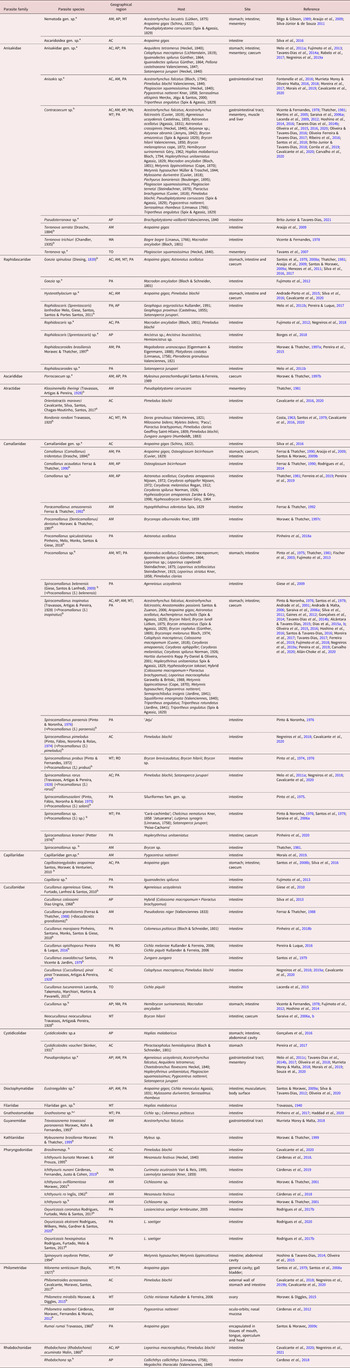
The new complete list reported herein complements the previous list by Luque et al. (Reference Luque, Aguiar, Vieira, Gibson and Santos2011) adding 14 species, four redescriptions,125 hosts and 15 geographical records and host–parasite associations to the Brazilian Amazon Region. The overall information on the Amazon Region now contained in this checklist adds the Capillariidae Railliet, 1915 and Guyanemidae Petter, 1974 families, 35 genera comprising 48 named and 28 undetermined larval and adult nematode species belonging to 93 host species and 20 undetermined host species. All data are presented in table 1.
List of species of fish parasitic nematodes recorded in the Amazon region of Brazil, including reports by Luque et al. (Reference Luque, Aguiar, Vieira, Gibson and Santos2011) and information published until September 2021. Geographical regions: Acre (AC); Amazonas (AM); Amapá (AP); Maranhão (MA); Mato Grosso (MT); Pará (PA); Rondônia (RO); and Tocantins (TO).

OBS: alarvae; blarvae and adults; all others are adults; chuman parasite.
Discussion
In the last decade, efforts have been made by governamental institutions to form taxonomists in the field of fish parasitology and perform sampling expeditions in the area. These new researchers based in different institutions in the Brazilian states of the Amazon biome were trained and improve the research in the area. Additional expeditions in collaboration with international partners also improved the partial reports described herein. Concerning fish parasitic nematodes, our search and the 80 new articles present a current scenario different from the one seen a decade ago (Luque et al., Reference Luque, Aguiar, Vieira, Gibson and Santos2011) with an addition of two families and 29 species, corresponding to a 52.89% increase.
Three families presented in the Brazilian Amazon region are noteworthy: Camallanidae Railliet & Henry, 1915; Anisakidae Skrjabin & Karokhin, 1945; and Guyanemidae Petter, 1974. Camallanidae species are widely represented in the Neotropics (Moravec, Reference Moravec1998), infecting not only fish but also amphibians and reptiles (Anderson et al., Reference Anderson, Chabaud and Willmott2009). Until recently, the most accepted system for diagnosing Camallanidae genera and subgenera was based on buccal capsule morphology (Moravec, Reference Moravec1998) but as genetic markers became a part of integrative studies, Procamallanus Baylis, 1923 and Spirocamallanus Olsen, 1952 were considered valid as independent genera (Ailán-Choke & Pereira, Reference Ailán-Choke and Pereira2021). Therefore, their generic names were adjusted in the current list.
Anisakidae, the largest family of nematodes, displaying zoonotic importance, currently represented by 46 species worldwide (Ángeles-Hernández et al., Reference Ángeles-Hernández, Gómez-de Anda, Reyes-Rodríguez, Vega-Sánchez, García-Reyna, Campos-Montiel, Calderón-Apodaca, Salgado-Miranda and Zepeda-Velázquez2020), presents 23 fish parasitic species reported in Brazil, five of them in the Amazon region (Luque et al., Reference Luque, Aguiar, Vieira, Gibson and Santos2011). A record of Anisakis sp. larvae for freshwater fish may sound strange as most species are associated to marine and brackish water. However, the ventriculus typology, without appendices, in addition to the shape of the lips and tail, may confirm the generic identification, bearing in mind that some possible definitive hosts are noted, such as the river dolphin Inia geoffrensis (Blainville, 1817), widely distributed in the Amazon Basin (Silva & Martin, Reference Silva and Martin2018).
Guyanemidae, with 166 valid species (Moravec, 2004), was reported by Luque et al. (Reference Luque, Aguiar, Vieira, Gibson and Santos2011) and included three parasitic fish species in Brazil, none of which were in the Amazon region. However, this family was recently recorded by Murrieta Morey & Malta (Reference Murrieta Morey and Malta2018) in the Amazon, from a single parasitic nematode species of no zoonotic importance in the Red-tailed Freshwater Barracuda Acestrorhynchus falcatus (Bloch, 1794).
These data undoubtedly represent a progress concerning Brazilian research on helminthological fish parasite studies in the last decade, following global trends of increased taxonomic studies and ecological knowledge (Luque et al., Reference Luque, Pereira, Alves, Oliva and Timi2017). On the other hand, these data, when related to the size of the study area and considering that it is acknowledged as megadiverse, also indicate that the number of produced articles is still low, indicating a still-significant knowledge gap in this area. Hence, efforts to explore this megadiverse area are still required.
Conclusion
This study highlights the progress and the lack of studies on fish parasitic nematodes in the Amazon Biome region and emphasizes the need for studies in this geographical area and the need to implement and strengthen taxonomic and ecological assessments.
Financial support
We would like to thank the non-governmental environmental organization Greenpeace Brazil for financial support through the award of a Master's scholarship to the Tatiana de Carvalho Program for Research and Conservation of Biodiversity in the Amazon, Foundation for Research Support of the State of Maranhão (FAPEMA - Brazil) and the Coordination for the Improvement of Higher Education Personnel (CAPES). Cláudia Portes Santos was sponsored by the National Research Council (CNPq).
Conflicts of interest
None.