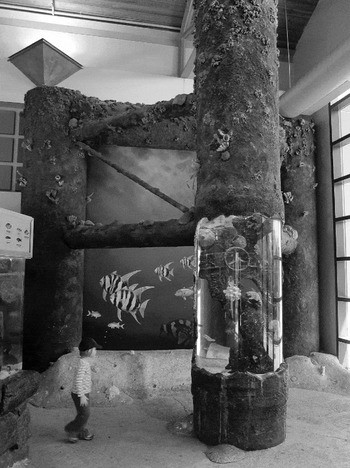
On 26 June 2010, the brand new Gulf of Mexico exhibit at the National Mississippi River Museum & Aquarium in Dubuque, Iowa opened devoid of life. The tanks were purposefully left empty, rather than showing the vibrant aquatic life of the Gulf, to highlight the oil spill associated with BP's Deepwater Horizon offshore drilling incident earlier in 2010. According to the museum's press release, the museum wanted
to open a Gulf exhibit recognizing the crisis that is happening on the Gulf Coast … The exhibit, without fish, now has the opportunity to make a bold statement related to the oil spill in the Gulf Coast by asking Museum & Aquarium visitors to imagine a lifeless Gulf.Footnote 1
While the Deepwater Horizon incident raised the American public's awareness of the environmental risks of offshore oil, environmental damage has by no means been the primary discourse about US offshore oil over the last twenty-five years. Oil has been seen as the intruder in American oceans when the nation has confronted a large spill, most prominently the Exxon Valdez in 1989, but at other times the resource goes relatively unnoticed. Although Californians have a history of fighting against offshore oil drilling, in the Gulf of Mexico region offshore oil is a way of life.Footnote 2
The National Mississippi River Museum & Aquarium's dramatic representation of an empty Gulf was a radical departure from the typical modern aquarium representation of the Gulf of Mexico. Rather than place the oil industry in opposition with the Gulf's ecosystem, aquarium displays have integrated the oil industry into it. Offshore oil structures are presented to the American public as an integral – and even necessary – part of nature in aquarium displays and education material.
To examine the integration of oil and ocean, this article analyzes aquarium displays depicting the ecosystems of the Gulf of Mexico to see the ways in which offshore oil structures have been naturalized. It focusses on aquariums in Texas and Louisiana that use oil structures as part of their public displays of the ocean environment. These facilities are owned by a variety of organizations, ranging from commercial restaurant chains to nonprofit environmentally focussed organizations. It also incorporates secondary educational material about the offshore ecosystems, including written school lessons, webcasts, and educational films produced by governmental agencies.
The article will argue that much of the public presentation of the Gulf ecosystem is tied up with the development of Rigs-to-Reefs programs, which allow the conversion of offshore oil structures into artificial reefs after they are decommissioned from active use.Footnote 3 The Rigs-to-Reefs concept developed as part of broad strategies to improve US fishing grounds and to make offshore oil production environmentally friendly, and Louisiana began the first state Rigs-to-Reefs program in 1986. In the wake of the Rigs-to-Reefs developments, aquariums located in the Gulf Coast chose to display Gulf of Mexico tanks highlighting the contribution of the oil industry to the Gulf's ecosystem. Although this was a valid presentation of the Gulf based on science, it was not the only option available to the designers. By placing these displays into the specific social and political context of the Rigs-to-Reefs program, we can see why Gulf Coast aquariums developed hybrid schemes for the representation of marine life in the region that mixed oil and water.
AQUARIUMS AS PLACES OF LEARNING
Before delving into the waters at Gulf Coast aquariums, we need to understand a little about their function as places of learning. Only an extremely small portion of the US population has ever seen an offshore oil platform, much less actually been to one. In addition, the vast majority of people have never been diving in the ocean to see the underwater life there. Aquariums, museums, and educational material play a key role in shaping how offshore structures and environments are perceived culturally.
Aquariums serve as a place of conservation learning. A significant three-year study, which surveyed more than 5,500 visitors of accredited institutions of the Association of Zoos and Aquariums, revealed that nearly half of the individuals surveyed believed their visit elevated their awareness of conservation and 42 percent of the individuals commented on the role of zoos and aquariums in education. Follow-up interviews with participants seven to eleven months after their visit showed that 61 percent of them were still able to talk about what they had learned from their previous visit.Footnote 4 A study of visitors to the National Aquarium in Baltimore has shown that visitors retained the conservation message of the aquarium in follow-up interviews six to eight weeks after their visit.Footnote 5
Visiting aquariums is part of “free-choice science learning,” recently defined as “the learning that individuals engage in throughout their lives when they have the opportunity to choose what, where, when and with whom, to learn.” As such, the displays contribute directly to the public understanding of science.Footnote 6 Of course, not all visitors get the same things out of their visits to scientific institutions. A study of aquarium visitors found that individuals with limited knowledge but moderate to high interest gained the most conservation knowledge from their visit.Footnote 7 We can conclude, then, that the messages stressed in exhibits can make a lasting impression on the average visitor.
Aquarium exhibits, and other environmental educational material, for that matter, are rarely neutral. They have a defined message – particularly a conservation message – that they want to impart. Contents may be influenced by controversies or recent events, such as the Gulf of Mexico exhibit in Dubuque.Footnote 8 In addition, corporate sponsorships of exhibits, which are a necessity for many nonprofit institutions to exist, can affect the contents of displays in various ways. Exhibit curators may prioritize certain elements within a display and deemphasize others, or even redefine their own goals in order to appeal to their sponsors.Footnote 9 Even more crucially, curators use both scientific and cultural understanding when designing what to show the public.
HYBRID EXHIBITS
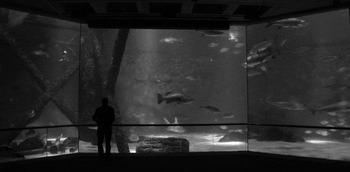
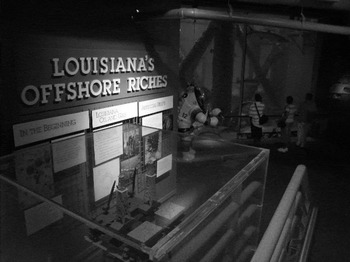
In the largest Gulf of Mexico tank in the world (Figure 1), which is located at Aquarium of the Americas in New Orleans, grouper, amberjack, and tarpon swim around and through a scaled-down version of a steel offshore oil jacket (the understructure of an oil production platform). Stingrays and sand tiger sharks circle the 400,000-gallon tank, while nurse sharks sit on the bottom amongst oilfield spare parts and piping. The legs of the replica platform are integrated seamlessly into the tank, and a replica platform itself sits above the waterline. The exhibit highlights “Louisiana's Offshore Riches.” A model offshore oil platform and text about the oil and gas industry is fitted alongside text and photographs about artificial reefs (Figure 2). The text on a board titled “Fishes and Rigs” lets the visitor know why the legs of an oil platform are appropriate in the exhibit: “You're looking at a scaled down model of an offshore production platform. Structures like this support marine ecosystems in the Gulf of Mexico and enhance populations of fish, shrimp, birds and other wildlife that feed on aquatic life.” The message to the visitor is that the structure not only serves as marine habitat, but also actually enhances life in the Gulf waters. The giant steel structures provide the kind of habitat that the barren mud–sand bottom of much of the Gulf of Mexico within US jurisdiction cannot.
Gulf of Mexico tank with prominent scaled-down version of an offshore oil jacket and platform, Aquarium of the Americas, New Orleans, Louisiana. 2009. Photo by the author.

Louisiana's Offshore Riches display adjacent to the Gulf of Mexico tank, Aquarium of the Americas, New Orleans, Louisiana. 2009. Photo by the author.

The 125,00 gallon Islands of Steel exhibit at the nonprofit Texas State Aquarium in Corpus Christi shows visitors a similar view of Gulf aquatic life. Opened the same year as its New Orleans counterpart in 1990, the exhibit features the steel legs of a jacket extending through the vertical space of the tank and numerous offshore species including nurse sharks, moray eels, amberjack, tarpon, and grouper. One side text on artificial reefs explains, “Production platforms, like natural reefs, help to increase the numbers and distribution of marine life in the Gulf. A typical platform provides about 4,000 square meters of surface area on which plants and animals can grow.” Accompanying photographs show close-ups of the small flora and fauna that grow on the steel legs – barnacles, oysters, hydroids, algae, and sponges all make an appearance in full color. The sea life photos appear side by side with images of production platforms above water and dramatic views of the legs from below, both of which serve to connect the oil industry with bountiful nature. One small panel mentions the 1979 Ixtoc I disaster that spilled 134 million gallons of oil in the Gulf, reminding us “that we must be cautious in our rush to harvest the ocean's riches,” but the overall exhibit stresses the environmental benefits of oil platforms. Visitors pick up on this: a feature review of the new facility in 1990 noted that while the one placard mentioned the Ixtoc I spill, the point of the Islands of Steel tank “is that the 3,500 oil and gas rigs in the Gulf do add desirable habitat for sea life,” and the journalist does not appear to question it.Footnote 10
Interpretive texts around the tank insist on this point, framing the “islands of steel” as “aquariums without walls” that are vital to the Gulf of Mexico ecosystem:
Naturally occurring reefs and rocky areas are rare in the Gulf of Mexico. Instead, sea life dependent upon hard surfaces settle on oil and gas platforms. Small fishes, attracted by food, find shelter amid the “legs.” Smaller fish attract larger predators, such as migratory fishes, which use the structures as feeding stations.
The Gulf sea life is described here as dependent on these structures; these man-made steel homes make up for the lack of natural habitats. To further underscore this message, the Texas State Aquarium featured an exhibit hall that screened the film Aquarium without Walls in the 1990s.Footnote 11 Made in 1989 and sponsored by Exxon Corporation, the film highlighted the life around the standing platforms where “Mother Nature and man's technology meet, and a miracle of life is acted out.” To illustrate the argument that “oil rigs have created homes for sea life unknown off Texas and Louisiana just a few decades ago,” the video showed images of a dazzling array of life around the platforms: sponges, sea squirts, corals, blennies, bristle worms, angelfish, butterfly fish, sheepshead, red snappers, groupers, eels, sculpins and many more make an appearance, affirming the argument made by the nearby “Islands of Steel” exhibit.Footnote 12
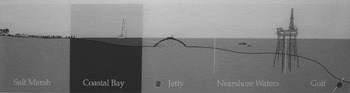
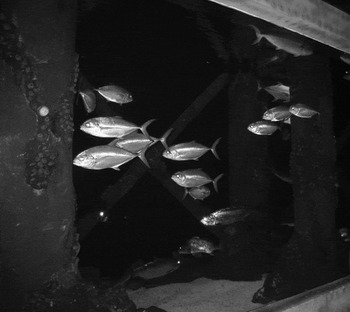
The sheer size of the tanks at the Aquarium of the Americas and the Texas State Aquarium allow the inclusion of relatively large replica oil structures, but even smaller aquariums built in the region after these two have chosen to show petroleum infrastructure as part of the habitat. Sea Center Texas, which is owned by the Texas Parks and Wildlife Department, has a 5,000-gallon tank dedicated to petroleum structures as artificial reefs. The oil platform clearly has a place in the ecosystem according to the graphic displaying the habitat zones that appears at the bottom of many of the displays (Figure 3). The Downtown Aquarium in Houston, owned by Landry's Restaurants, likewise features the bottom of an oil structure in the Gulf of Mexico tank (Figure 4). At the ABQ Biopark Aquarium owned by the City of Albuquerque, New Mexico, instead of incorporating the structure into the standard large fish and shark tank, the designers chose to make a separate display using a replica jacket section.Footnote 13 The visitor can walk through the legs and one tank of tropical fish is attached to a leg at eye level to show the colorful life around the platform (Figure 5).
Bottom section of the interpretive display showing the various habitat zones off the coast of Texas. An offshore oil facility is prominently placed at the line between the Nearshore Waters and Gulf zones. Sea Center Texas, Lake Jackson, Texas. 2010. Photo by the author.

Tank with replica of steel jacket, Downtown Aquarium, Houston, Texas. 2010. Photo by the author.

Rigs-to-Reefs display, ABQ BioPark Aquarium, Albuquerque, New Mexico. 2011. Photo by the author.

All of these displays integrate the steel oil jacket structure into the Gulf of Mexico ecosystem and highlight the ecosystem benefits brought by the structures' function as artificial reefs. The visitor to these aquariums, then, is confronted with a hybrid space – one that displays man's built environment and technological artifacts alongside and integrated with nature. The Gulf of Mexico is a vast ecosystem with much of it open water rather than dominated by such structures, yet these aquariums have chosen to focus on this particular hybrid part of the ecosystem. Such a choice was not inevitable: there are a few aquariums outside the Gulf Coast region that also have Gulf Coast tanks, for example the Tennessee Aquarium in Chattanooga and the National Mississippi River Museum in Iowa, and these do not use oil structures as part of the habitat. They show instead fish swimming around in empty tanks with sandy bottoms and a few rocky outcrops, which is a dominant Gulf habitat. So why was a hybrid technological–environmental space chosen as the ecosystem to display in the Gulf Coast?
THE GULF OF MEXICO AS A MAN-MADE ECOSYSTEM
Specific historical circumstances affected the presentation of Gulf waters as an oil-industry space. The hybrid spaces depicted in the aquarium exhibits have their genesis in understandings of the ecosystem of the Gulf of Mexico that came to the fore in the 1970s and 1980s.
Thousands of offshore oil and gas structures dotted the map of the western Gulf of Mexico by the late 1970s. The offshore oil business in the Gulf had started humbly in 1946 with Magnolia Petroleum Company's first operating platform five miles offshore of Morgan, Louisiana; by 1980, there were approximately four thousand production-related structures up to a thousand feet deep and 130 miles offshore.Footnote 14 The bottom of the Gulf of Mexico where these oil wells stand is characterized as a gently sloping sand–mud flat, although some mud lumps and salt domes break up the smooth service. Most of this landscape is sparsely populated, with only a few areas with larger concentrations of organisms. The only natural coral reef in the western Gulf is Flower Garden Banks off the coast of Texas.
The understructures of production platforms rise from the seafloor to the surface in a crisscrossed pattern. These steel jackets support the weight of the above-water tanks, equipment, and platform housing, but under the water they came to support sea life as well. Barnacles, spiny oysters, corals, and other colonizers attach themselves to the steel. Because the jackets extend vertically hundreds of feet through the water, various habitats with differing light and temperature conditions are created. The colonizers attract small fish which find food and hiding places in the new ecosystem, as well as larger fish that come for the prey and because the platforms are large visual markers.
By the 1970s, recreational fishermen had become regular visitors to offshore structures because of the larger sportsfish that could be caught there. Photographs from the Louisiana State Archives from the late 1970s show Louisiana sportsmen engaged in the increasingly common practice of tying up boats to operating oil platforms in order to fish. A study titled Recreational Fishing Use of Artificial Reefs on the Texas Coast prepared for the Texas Coastal and Marine Council in 1978 showed that almost all offshore fishing boat captains had previously fished off oil and gas structures in Texas and that half of all fishing trips visited them.Footnote 15 Local knowledge thus defined the standing oil platforms as functional artificial reef habitats with significant fish populations by the late 1970s.
In 1978, the Bureau of Land Management (BLM), which was the lead agency responsible for offshore oil leases at the time, was required to prepare environmental impact statements for oil and gas leases in the wake of the 1976 Federal Land Policy and Management Act (FLMPA; 43 USC 1701–1782); thus an increased understanding of the effect of oil and gas operations on the Gulf ecosystem was imperative. They contracted the Southwest Research Institute to prepare a large study of the offshore ecology of the Louisiana Outer Continental Shelf. The study had two areas of inquiry: pollutant fate and effects, and the artificial reef characteristics of standing platforms.Footnote 16 When the study was finally issued in 1981, it described Louisiana's offshore platforms as “artificial reefs which have apparently expanded the available habitat for numerous fish and invertebrate species that are dependent on hard banks as habitat.”Footnote 17 The study identified several species that had not been previously documented in the central Gulf waters or were thought to occur only on natural coral reefs, leading to the conclusion that “the platforms are contributing to the overall diversity of the OCS.”Footnote 18 In this study and others issued in the early 1980s, standing jackets are described as beneficial reef habitat.Footnote 19
Popular-scientific and conservation-focussed magazines based in the Gulf carried stories highlighting the biological diversity of standing platforms. The earliest, an article titled “From Rigs to Reefs” published in 1975 in Louisiana Conservationist, touted the transformation of steel legs to artificial reefs supporting game and food fish. The article is richly illustrated with underwater photographs featuring underwater biologists inspecting algae growing on the structure, schools of spadefish, barracuda lurking among the dark cross-beams, and impressively sized catches made with rod-and-reel and underwater spears.Footnote 20Texas Parks & Wildlife ran a similar article in 1982 about the fishing and diving possibilities around offshore production platforms. This article likewise has full-color close-up underwater photos of the fish and coral residents of platform jackets and a schematic showing the various habitat zones of the steel reefs. The article contrasts the vast “sediment-covered plain” of the Gulf of Mexico, which has “a lack of habitat diversity,” with the abundant life around the platform.Footnote 21
Within this context of portrayals of the Gulf ecosystem around standing platforms, it is no wonder that the exhibits that opened in 1990 at the Aquarium of the Americas and the Texas State Aquarium include scaled-down versions of offshore jackets as a major component of the tank habitat, with explanatory text reinforcing the integral nature of the steel structures. The displays contrast the natural mud bottom of the Gulf with the colorful and vibrant life on and around the structures just as the scientific studies and popular articles had done.
RIGS-TO-REEFS ON DISPLAY
The context of offshore oil production in these aquariums goes beyond the ad hoc function of standing platforms as artificial reefs into the deliberate reuse of structures as reefs. The exhibits not only show the oil structures as part of the habitat – they also have accompanying text highlighting legislation that allows platforms to stay as reefs after being decommissioned under various programs collectively known as Rigs-to-Reefs. For example, a display titled “Artificial Reefs” to one side of the large Gulf of Mexico tank at the Aquarium of the Americas explains to visitors the benefits of the Rigs-to-Reefs program:
Production platforms were never meant to be permanent structures. Laws require they be taken away when their wells run dry. But platforms create underwater habitats for marine life – and good fishing – that are lost when platforms are removed. In 1987 Louisiana started the Artificial Reef Program, which allows some platforms to be sunk in selected spots where they continue to support marine life communities.
The legislative development referred to in this exhibit grew out of the recognition in the 1980s that standing platforms added habitat and thus if those platforms were removed the new habitat would be lost.
Artificial reefs created to increase recreational fish catches had become more and more popular in the US after World War II. In 1961, the Sports Fishing Institute estimated that the number of anglers was growing at a rate of 270,000 persons per year and the annual catch was around 300 million edible fish. The increasing numbers of anglers led sportfishermen and governmental agencies to pursue artificial offshore reef development in the late 1950s and 1960s in earnest. A vast array of materials – old car bodies and trolley cars, decommissioned ships, concrete rubble, stone fragments, and old tires, among other things – were sunk in offshore waters to create reefs. By late 1971, approximately 150 artificial reefs and reef complexes had been created off US coastlines, most targeting commercial and recreational fish.Footnote 22 Texas and Louisiana had not been particularly active in the artificial reef boom, mainly because they already had lots of artificial reefs – their standing oil platforms. When proposals for a national artificial reef program came before the US Congress beginning in 1978, the function of the platforms as reefs took a central position in the debates.
Two bills aimed at marine artificial reef development came before the House Committee on Merchant Marine and Fisheries in 1981.Footnote 23 The Subcommittee on Fisheries and Wildlife Conservation and the Environment held a one-day hearing to consider the question of a national program for artificial reef development in response to these bills. The bills themselves made no mention of offshore oil structures, but the chairman of the hearing, John B. Breaux of Louisiana, had personal experience with fishing at oil structures: “Having participated in many enjoyable fishing trips offshore Louisiana, within sight of many such structures, I can attest to the ability of these giant reefs to provide orientation, shelter, and food to fish throughout the water column.”Footnote 24 Breaux's personal fishing experiences led him to automatically associate a coordinated reef program with offshore structures. Much of the testimony, both written and oral, also focused on offshore oil and gas structures, even though they were not overtly included in the bills.
Although nothing came of the 1981 bills, a later attempt would come to fruition as the National Fishing Enhancement Act of 1984, which mandated that the Department of Commerce write a plan for US artificial reef development.Footnote 25 The resultant National Artificial Reef Plan of 1985, a general thirty-nine-page guidance document, focusses on improving recreational fishing. The section on potential materials of opportunity listed ships, concrete, tires, and oil and gas structures.Footnote 26
In the wake of the National Artificial Reef Plan, both Louisiana (in 1986) and Texas (in 1989) established state-level artificial reef plans focussed on Rigs-to-Reefs to allow the conversion of obsolete offshore oil structures into artificial reefs. In both state plans, oil structures were touted as vital fish habitat.Footnote 27 The Louisiana Artificial Reef Plan highlighted the unintentional yet critical nature of habitats on offshore structures:
The development of the oil and gas industry in the Gulf of Mexico resulted in the creation of this country's most extensive artificial reef system … For over 40 years, Louisiana fishermen have benefited from the increased biological activity associated with this unintentional artificial reef habitat. Since these platforms are so commonplace off the Louisiana coast, many citizens and management groups believe that they are permanent and will always be available for fishing. This is, however, not the case … It was, therefore, imperative that Louisiana recognize this potential loss of habitat and plan to offset it by either creating new artificial reefs or preserving existing structures.Footnote 28
The Texas plan also stressed the ecological enhancement effect of offshore structures, going so far as to recommend that the Texas Parks and Wildlife Department “should actively pursue acquiring offshore platforms for use as artificial reefs in the Gulf of Mexico, in deference to other structures.”Footnote 29 This language shows that by 1990 the link between offshore oil and gas structures and improved fish habitat was clear. We should also note that these plans were written by leading fishery scientists, referencing up-to-date scientific publications that basically came to the same conclusion that petroleum structures converted into artificial reefs make good fish habitat.
As this legislation was underway, scientists continued to study the relationship between the Gulf environment and offshore oil structures through the 1980s, focussing on reusing obsolete structures deliberately as artificial reefs. The Gulf of Mexico Information Transfer meetings became a regular venue for both scientists and industry representatives to advocate making artificial reefs out of structures. In the papers given at these meetings, the Gulf ecosystem was clearly one in which steel structures and fish co-exist; the only question was how to best implement artificial reef programs to take advantage of the standing de facto reefs when the time came to remove the structures.Footnote 30 Jackets turned into artificial reefs were the natural choice.
These developments factored into the way that the Gulf of Mexico aquarium tanks are interpreted. Just as the Aquarium of the Americas interpretive text mentions the Louisiana Rigs-to-Reefs program, a similar educational display at the Texas State Aquarium discusses Rigs-to-Reefs (without naming the program) as a way to create long-lasting habitats:
In the past, rigs and platforms were dismantled and removed at the end of their production lives causing the destruction of established reef communities. Today, the petroleum industry offers the structures to coastal states that place them in select locations in the Gulf of Mexico. The habitats may last as long as one hundred years before they are destroyed by corrosion.
The Downtown Aquarium in Houston likewise has a placard next to its Gulf tank that explains, “Over the past twenty years, more than 200 platforms no longer in use have given rise to rich communities that have boosted the sport fishing industry in the Gulf as well as provided areas for continued research in the field of aquaculture.” These texts place the exhibit design within the context of a specific regulatory framework that developed for the Gulf of Mexico – one that emphasizes the beneficial effect of offshore structures both during and after their lifespan as production facilities. The benefit to sport fishing is specifically included, which makes sense considering that sportfishermen were the first and loudest advocates of Rigs-to-Reefs.
The artificial reef tank at Sea Center Texas, which opened in 1996, is the most explicit display about the regulatory framework of the exhibit. In this case, the interpretive text puts the underwater jacket into the context of other artificial reef-creation projects in which “water and the flat seafloor get a little help”, noting, “Since the 1940s, the Texas Parks and Wildlife Department has been placing artificial reefs in nearshore waters to attract plants and animals that normally can't live here. These reefs are built of materials like stone rubble, trees, concrete, old ships and oil rigs.” A bronze commemorative plaque is placed prominently on the wall next to the tank with the inscription, “The Texas Artificial Reef Program, which provided partial funding for this aquarium, was created by the 71st legislature through the Texas Artificial Reef Act of 1989. That important legislation was authored by Senator ‘Buster’ Brown of Lake Jackson.” The plaque has a particular context: the facility is run by Texas Wildlife and Fisheries, which is responsible for the Texas Artificial Reef Program and is located in Lake Jackson, the home of the author of the bill that created the program. Given the interconnections joining aquarium, environmental agency, and legislation, it seems entirely unsurprising that the institution decided to highlight the Artificial Reef Program next to a tank with steel oil jacket legs in the habitat.
The bronze plaque, however, hints at another important issue – sponsorship of exhibits. In this case, the Texas Artificial Reef Program itself had partially funded the aquarium. Aquariums rely to a great extent on corporate sponsorships, and, not unexpectedly, oil companies are primary sponsors of Gulf of Mexico tanks. In 1988, Tenneco Inc. and two of its operating divisions announced a $250,000 contribution to the Aquarium of the Americas to sponsor the Gulf of Mexico exhibit. Bob Taylor, vice president and general manager for Tenneco Oil Exploration and Production, explained the sponsorship rationale: “The Petroleum Wing of this facility will help demonstrate the positive impact of oil and gas platforms on marine life, thus providing further opportunity to explain the relationship between the petroleum industry and the abundant aquatic life of the Gulf of Mexico.”Footnote 31 In this statement, Taylor even refers to the section of the aquarium as “The Petroleum Wing,” which, although not the official name (it is named “Gulf of Mexico” on all facility maps), is indicative of how visible the oil industry is in the exhibit. The corporate sponsors are honored with their company logos on one of the posts separating the tank glass sections; in 2009, the sponsors included a who's who list of major oil and gas companies operating in the area – BP, Shell, ExxonMobil, Tenneco, and Chevron. As noted above, Exxon created the film that was shown at the Texas State Aquarium; the company is also still listed as the sponsor of the panel “Aquarium without Walls.” These sponsorships do not mean that the oil companies had a direct hand in the exhibit design, but it does show that the exhibits reflect an understanding of the ecology of the Gulf that oil companies would agree with – that offshore structures provide key habitat in the Gulf of Mexico, making them environmentally beneficial.Footnote 32
EXTENDING HYBRID ENVIRONMENTS TO THE CLASSROOM
The connection between the man-made structures in the Gulf of Mexico and the Gulf's natural environment permeates the aquarium exhibits, but it also reaches beyond them to educational materials. The same governmental agencies who were heavily involved in Rigs-to-Reefs policymaking also developed teachers' guides and webcasts designed for classroom use that reinforce the aquariums' presentation of the Gulf as a hybrid environment.
In 1997, the Minerals Management Service (MMS) Gulf of Mexico region – a division of the US Department of Interior that superseded BLM in managing offshore oil resources in 1982 – issued an educational poster titled “Islands of Life” and a companion booklet designed to help teachers introduce “a unique aspect of the Gulf of Mexico” to students in grades 6–8. The full-color poster shows a schematic of a standing platform in the background overlaid with photos of tropical fish and corals. A sea turtle, a migratory songbird, and a recreational diver all appear as well. The images all highlight the life around the platform. The booklet introduced the study this way:
Several thousand oil and gas production facilities located on the U.S. continental shelf of the Gulf of Mexico make up the largest artificial island and reef system in the world, an entire generation of Gulf Coast citizens now depends on them for energy, food, and recreation.Footnote 33
The offshore facilities are thus presented as integral to the ecosystem as well as cultural systems of the Gulf region. Indeed, the text emphasizes the crucial role of offshore structures in the Gulf environment:
Up until a few decades ago, many of these creatures would drift helplessly in the currents with little hope of survival because the central Gulf had few places that extend up from the muddy depths to the sunlit surface waters. However, our Nation's offshore oil and gas platforms now provide such a home in the form of hardened steel substrate for a myriad of sea creatures, establishing these “Islands of Life.”Footnote 34
A contrast is made here between what happened to the sea creatures before offshore oil development – they would drift aimlessly and probably die – and what happens to them now – they find new homes on the steel legs. The structures become literally “Islands of Life” in contrast to a sea of death. The companion booklet describes the many habitat zones and different species found on and around operating offshore platforms, supplemented by color photos. The text and images reinforce the notion of the structures as life-nourishing. One section discusses the development of Rigs-to-Reefs, citing the National Fishing Enhancement Act of 1984 as the empowering legislation.Footnote 35 This teacher material, which was updated in 2005, is still available on the website of the Bureau of Ocean Energy Management, Regulation, and Enforcement (BOEMRE), the successor of MMS.Footnote 36
The Texas Parks and Wildlife Department, the responsible governmental agency for the Texas Artificial Reef Program and owner of Sea Center Texas, targeted high-school students (grades 9–12) with a series of webcasts about the Gulf Coast ecosystem. “Treasures of the Gulf Coast”, which originally aired on 17 April 1999 and is now available online, invited students to explore the Gulf Coast, from coastal marshes to coral reefs.Footnote 37 Two of the segments featured artificial reefs with commentary by a scientist in the artificial reef program. In the presentation, students were told that “hard bottom habitat is very limiting” in the Gulf, thus petroleum structures, ships, and custom-made reef balls were all valuable to create fish habitat – “we need to do as much as we can to provide habitat for baby reef fish and other invertebrates that live in that ecosystem.” Offshore oil structures were “the best material that we've ever used” to make artificial reefs because of their structural complexity. Models out of popsicle sticks were used to demonstrate how the structures are laid on the seafloor and how creatures (made whimsically with smiley faces out of play-dough) attach to the structure as an artificial reef. This presentation stressed the role of the man-made structures as natural habitat – both when the structures are standing as operating facilities and afterward when they are left on the ocean floor as reefs.
The webcast “Rivers to the Ocean,” which aired on 3 May 2000, included a twenty-minute live dive at an oil platform in the Gulf.Footnote 38 The scientist–diver commented on the various creatures he saw under the platform and answered live questions from the students watching the original webcast. The video highlighted “the diversity of life and the abundance of life” around the platforms. One segment of the dive focussed on Rigs-to-Reefs and the functions of platforms as artificial reefs in providing substrate, shelter, food, and a community of animals for finding mates. A similar webcast, “Water, Wildlife & You,” which aired on 2 May 2001, included another live dive around a standing platform.Footnote 39 The pedagogical message of both dives was that the offshore oil structures provide habitat for an amazing array of ocean life. In these webcasts, which were viewed live by students and are still available for viewing online, the offshore structure is presented as the home of a complete ecosystem which would not exist if the structures were not in place. The man-made structures are thus presented as a vital piece of the natural world.
These extremely positive viewpoints on artificial reefs in the Gulf – created by Gulf Coast agencies and focussed on a Gulf Coast audience – can be contrasted with some teacher material written for National Geographic's educational outreach program. National Geographic's Xpeditions series includes two lesson plans with artificial reefs as a component: “Aquarium Habitats” (grades 3–5) and “The Pros and Cons of Artificial Reefs” (grades 9–12).Footnote 40 “Aquarium Habitats” asks students to consider pictures of aquarium displays at the Monterey Bay Aquarium and whether or not “the aquarium is a good human-made habitat for marine animals.” In the extended version of the lesson, students are asked to compare their aquarium ideas to artificial reefs as “human-made structures in the ocean or sea” which are “out in the open, where animals are free to come and go.” Students are directed to several websites to look at artificial reefs, including the Rigs-to-Reefs webpage by MMS. In this presentation, students are not directly told that artificial reefs are good, but because they are asked to contrast “closed” aquarium spaces with “open” artificial reefs they may be viewed positively. The lesson plan for the older students asks students to think critically about artificial reefs, both the arguments in favor and those against. The negative side is prompted with two questions: “How might artificial reefs ‘fool’ fishermen into thinking there are more fish than before the artificial reef existed?” and “What are the ecological arguments against artificial reefs?” In this material, unlike the MMS and Texas Parks and Wildlife presentations, potential arguments against artificial reefs are acknowledged. Arguments against reefs have been highly visible in the debate over Rigs-to-Reefs in California, which began in the late 1990s, but are almost nonexistent in the Gulf of Mexico discussions.Footnote 41 It is only in the last five years that the increasing abundance and habitat range of aquatic species in the Gulf of Mexico because of platform habitat availability has been discussed as a potential negative effect of offshore oil development.Footnote 42
The lack of a critical discussion of the drawbacks of artificial reefs in Gulf Coast educational programs reiterates how the social and political context of Rigs-to-Reefs has shaped understandings of the Gulf of Mexico ecosystem. The long-term local recreational fishing use of offshore facilities and the rig-conversion developments of the 1980s sparked the reimagining of oil jackets as life-giving. The agencies and the scientists working on the Gulf of Mexico ecosystems have in turn portrayed the artificial reef characteristics of offshore facilities as a positive because of the ocean life that gathers around them. Thus the structures themselves are presented as vital habitat in an otherwise sparse ocean.
SHOW AND TELL
The Gulf of Mexico aquarium exhibits in the Gulf region show visitors a particular part of the ocean's ecosystem and tell the story of a beneficial relationship between offshore oil and ocean life. The inclusion of offshore structures in these exhibits comes from a particular scientific, social, and political context. Gulf fishermen's experiences with standing offshore platforms encouraged many scientific studies of the structures as habitat. Anecdotal experience of fishing at offshore rigs combined with scientific findings bolstered arguments for creating Rigs-to-Reefs programs that would turn obsolete jackets into permanent artificial reefs. The major Gulf of Mexico aquarium exhibits at the Aquarium of the Americas and Texas State Aquarium both opened in 1990 on the heels of Rigs-to-Reefs programs being established in Louisiana and Texas. The later Sea Center Texas and Houston's Downtown Aquarium opened after the Rigs-to-Reefs programs were well established. The choice, then, of incorporating offshore structures in aquatic displays of the Gulf should come as no surprise. The thinking is clear: fish swim around structures in the Gulf because they provide habitat, therefore the structures should be integrated in the tanks as habitat. As the visitor experiences the Gulf of Mexico display, amberjack, grouper, and sharks swim rhythmically through the water, darting around and though the scaled-down version of an oil jacket. The steel structure becomes a place teeming with life. The interpretive texts at the exhibits and teaching materials aimed at classroom use all tell the same story about the creation of spaces for organisms to live on and around the platforms.
There is no arguing that vibrant communities of sea life do indeed crawl on and swim through offshore oil structures and artificial reefs constructed from old jackets, but the interpretation of these ecosystems and the choice to use oil structures in the aquarium displays is not a given; rather, it was a product of context. The exhibits are an accurate depiction of one subsection of the Gulf ecosystem, but they are just that – only one specific sub-ecosystem. The choice by the aquariums in the Gulf Coast to show this particular view of the Gulf reveals the social, political, and scientific context in which the exhibits were developed – that the Gulf of Mexico is a harmonious meeting place of oil and water.