Implications
Increasing milk yields together with rising ambient temperatures due to climate change result in considerable heat stress for dairy cows. Particularly this heat stress affects animal welfare and health negatively. This study demonstrated to which extent the temperature–humidity index as a measure of heat stress influences the incidence of veterinary treatments (metabolism, udder, fertility and foot/leg).
Introduction
Increasing milk production of dairy cows, which was realized through rapid progress in genetics and management, results in an increased metabolic heat production. This will become even more important under the scenarios of climatic change that will impede heat dissipation as suggested by the Intergovernmental Panel on Climate Change (IPCC, 2007). Beside the ambient temperature, the relative humidity plays a major role in evaluating the thermal environment an animal is exposed to (West, Reference West2003). Combining effects of temperature and relative humidity, the temperature–humidity index (THI) is widely used to measure heat stress in animals (National Research Council (NRC), 1971). On the basis of the THI, thresholds for heat stress in dairy cows have been established and were found to differ between regions and indices. Relative humidity is the major heat stress factor in humid climates, whereas air temperature is the major limiting factor in dry climates (Bohmanova et al., Reference Bohmanova, Misztal and Cole2007). In a recent study, Brügemann et al. (Reference Brügemann, Gernand, König von Borstel and König2012) defined thresholds for heat stress by evaluating production traits of different production systems in Northern Germany. A THI of 60 was identified as a general threshold for a substantial decline in milk yield. Heat stress has not only significant impacts on the animal performance, but also impacts animal welfare and health negatively as it results in reduced fertility and increased disease susceptibility (Amundson et al., Reference Amundson, Mader, Rasby and Hu2006; Hansen, Reference Hansen2007; Pegorer et al., Reference Pegorer, Vasconcelos, Trinca, Hansen and Barros2007; Villa-Mancera et al., Reference Villa-Mancera, Méndez-Mendoza, Huerta-Crispín, Vázquez-Flores and Córdova-Izquierdo2011). In general, animals with the highest milk yield have the greatest risk to be affected by heat stress. Animal responses to thermal challenge vary according to its type. Short-term adaptive changes in behavioral, physiological and immunological functions follow acute events, whereas impacts on the performance are shown after longer lasting challenges (Nienaber and Hahn, Reference Nienaber and Hahn2007). For dairy cows, heat loads increase to the point that body temperature rises, feed intake declines, and consequently, the productivity decreases (West, Reference West2003). Through increased respiratory rates, decreased feed intake, increased water intake and imbalances in blood gases and plasma electrolytes cattle try to counteract excessive heat loads (Beatty et al., Reference Beatty, Barnes, Taylor, Pethick, McCarthy and Maloney2006).
The capacity to compensate climatic effects may vary with the housing system. So far, only limited information on the interaction between different housing systems and heat stress is available under Central European environmental conditions, although heat stress in Holstein–Friesian dairy cows is of increasing concern. Analysis on seasonal THI dynamics pointed out that the overall warming in Europe will result in an increase of warm extremes rather than a decrease of cold extremes (Hollweg et al., Reference Hollweg, Böhm, Fast, Hennemuth, Keuler, Keup-Thiel, Lautenschlager, Legutke, Ratke, Rockel, Schubert, Woldt and Wunram2008). Extreme summer THI values represent a major challenge for dairy production and lactating animals are likely to be exposed to severe heat stress during summer months. Therefore, the present study was conducted to assess the impact of the THI on the frequency of medical treatments under the climatic conditions of Lower Saxony, Germany.
Material and methods
Animal herds and housing systems
The present study included eight Holstein–Friesian dairy herds distributed over the whole region of Lower Saxony, Germany. Herd sizes varied between 55 and 170 dairy cows. Mean annual milk yields ranged from 8000 to 10 000 kg. In all farms, cows were milked twice per day. The animals were kept in loose-housing systems with slatted floors. Three farms kept their cows on pasture during summer time, whereas in the other five farms the animals were kept indoor throughout the whole year. Two farms had a ventilation system. Rations were adjusted throughout the year as season and stage of lactation changed. Animals were bred all the year round and apart from one herd, artificial insemination was used. The percentage of replacement ranged between 10% and 30% in all farms.
THI measurements
Climate data including hourly mean temperature and relative humidity were obtained from the nearest meteorological station for the years 2003 and 2005. The six stations covered the whole region of Lower Saxony and were on average 39 km (±13 km; s.d.) away from the different farms. The maximum distance was 60 km. From the hourly temperatures and relative humidity values, the THI was calculated according to the following formula proposed by the NRC (1971):
 $${{\rm{THI}}\:{\rm{ = }}\:{\rm{(1}}{\rm{.8}} \times T\:{\rm{ + }}\:{\rm{32)}}\:{\rm{ - }}\:{\rm{(0}}{\rm{.55 - 0}}{\rm{.0055}}\times \,{\rm{RH)}} \times {\rm{(1}}{\rm{.8}} \times T{\rm{ - 26)}}}$$
where T is the temperature (°C) and RH is the relative humidity (%). Based on the hourly THI, the daily and monthly average, minimum and maximum THI were calculated for all six meteorological stations. For the average THI values, four different THI classes were defined: <40, ⩾40 to <50, ⩾50 to <60 and ⩾60.
Records of veterinary treatments
Records of all veterinary-treated cases from the years 2003 and 2005 were evaluated using the standard receipts, which have to be documented for each veterinary treatment according to the European regulation (EC) 178/2002 (Official Journal of the European Communities, 2002), which is also connected to national regulations (e.g. German regulation concerning veterinary medicine chest (German Federal Ministry of Justice, 2006)). Repeated disease treatments were counted if coded as new cases. A total of 8569 treatments were analyzed. The different diagnoses were summarized into the following diagnostic keys: metabolism (e.g. disorders of metabolism, lack of mineral nutrients and vitamins, milk fever, diseases of the digestive organs and displaced abomasum), udder (e.g. mastitis, delayed milk flow), fertility (e.g. ovarial cysts, abnormal estrous, endometritis, retained placenta) and foot/leg (e.g. panaritium, mortellaro, lameness, arthritis). Other treatments including those that are primarily dependent on management and independent on climate such as antiparasitics, antibiotics for dry cow therapy and vaccinations were excluded from the analysis (n = 3022). After exclusion, a final number of 5547 treatments remained for further analysis. For each year and farm, the number of monthly treatments was calculated. In order to enable comparability, the number of monthly treatments was related to the herd size of the different farms. Finally, these monthly treatment rates for the four diagnostic keys were related to the monthly average THI of the nearest meteorological station.
Statistical analysis
Data were analyzed with the MIXED procedure of the statistical package SAS 9.2 (SAS Institute Inc., 2008). Seasons were defined according to the CLINO reference of Lower Saxony (German Meteorological Service, 2012) in the following way: winter (December to February), spring (March to May), summer (June to August) and autumn (September to November). The following model was used in order to compare percentage of udder, metabolic, fertility or foot/leg treatments in the four THI classes:
 $${{{Y}_{ijklm}}\:{\rm{ = }}\:\mu \:{\rm{ + }}\:{\rm{TH}}{{{\rm{I}}}_i}\:{\rm{ + }}\:{{S}_j}\:{\rm{ + }}\:{\rm{Y}}{{{\rm{r}}}_k}\:{\rm{ + }}\:{{F}_l}\:{\rm{ + }}\:{{e}_{ijklm}}}$$
where Yijklm is the udder, metabolic, fertility or foot/leg incidence observed in the ith THI class, the jth season, the kth year and at the lth farm; μ is the mean effect, THI is the fixed effect of the THI class (i = <40, ⩾40 to <50, ⩾50 to <60, ⩾60); S is the fixed effect of the season (j = spring, summer, autumn, winter); Yr is the fixed effect of year (k = 2003, 2005); F is the random effect of the farm (l = 1 to 8); and eijklm is the error term. The significance of the fixed effects was analyzed by using the Tukey test (P ⩽ 0.05). In order to satisfy the assumptions of ANOVA, the monthly treatment rates were √arcsin (x)-transformed before analysis.
Results
THI
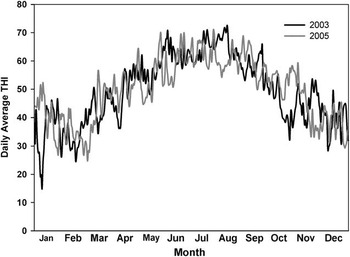
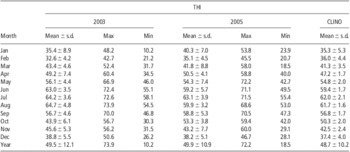
Courses of daily mean THI values averaged over all meteorological stations from the years 2003 and 2005 are presented in Figure 1. Beside a cold wave in January 2003 and a heat wave in June and August 2003, differences of the THI gradients between the 2 years were small. Monthly mean (±s.d.), minimum and maximum THI are summarized in Table 1. Average yearly temperature, relative humidity and THI averaged over all meteorological stations were 9.6 ± 7.7°C, 78.2 ± 12.1% and 49.5 ± 12.1 for 2003 and 9.8 ± 6.8°C, 80.6 ± 10.1% and 49.9 ± 10.9 for 2005, respectively. In winter the THI varied between 32.6 (February 2003) and 40.3 (January 2005), whereas the THI increased by 13 THI units from March to May. During summer months, averages were constantly above 60. During autumn, the THI values decreased from around 58 to 45 in both years. The difference between daily minimum and maximum THI was most pronounced during winter months. In January, minima of 10 and maxima of 48 were calculated. The number of days with hourly THI values above 60 was observed on more than 155 days per year, respectively, whereas during summer months this threshold was exceeded nearly every day. The daily maximum THI exceeded 65 and 70 on 106 and 40 days in 2003 and on 158 and 38 in 2005, respectively. In July, the highest number of days with daily maximum THI values above 65 (2003: 27 days; 2005: 24 days) and 70 (2003: 17 days; 2005: 12 days) were recorded.
Course of the daily mean temperature–humidity index (THI) values averaged over six meteorological stations from Lower Saxony, Germany, from the years 2003 and 2005.

Monthly mean ± s.d., minimum and maximum THI averaged over six meteorological stations from Lower Saxony, Germany, from the years 2003 and 2005 and the CLINO knowledge (1961–1990; German Meteorological Service, 2012)

s.d. = standard deviation; THI = temperature–humidity index.
Veterinary treatments
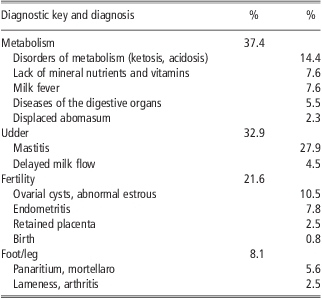
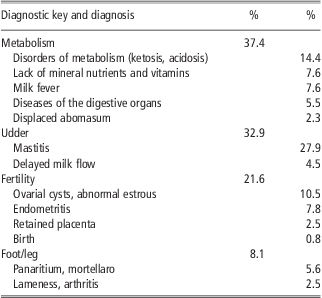
The incidence of the treatments according to the different diagnostic clusters is given in Table 2. Out of the 5547 treatments analyzed, 37.4%, 32.9%, 21.6% and 8.1% belonged to the complexes metabolism, udder, fertility and foot/leg, respectively. Disorders of metabolism, deficiency of minerals and vitamins and milk fever were found as the dominating diagnoses of the metabolism complex, whereas udder treatments were mainly related to mastitis. The most frequent causes of fertility treatments were ovarian cysts, abnormal estrous and endometritis. Among foot/leg therapies, panaritium and mortellaro were most prevalent. With regard to the management-dependent and climate-independent treatments, which accounted for more than 3000 treatments, antiparasitics (40%) were dominating and followed by antibiotics for dry cow therapy (27%) and vaccinations (13%).
Incidence of veterinary-treated cases according to four different diagnostic keys and different diagnoses using 5547 records from eight dairy herds distributed over Lower Saxony, Germany, from the years 2003 and 2005
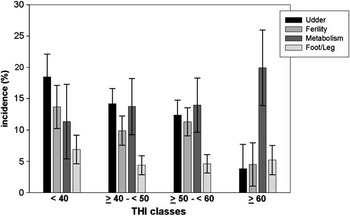
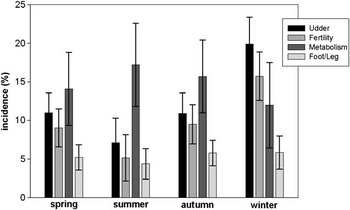
The udder, fertility, metabolism and foot/leg incidences were neither affected by the year (P > 0.05) and the season (P > 0.05) nor by the THI class (P > 0.05). There were non-significant trends of increasing incidence of metabolic treatments with increasing THI and increasing udder treatments with decreasing THI (Figure 2). As shown in Figure 3 non-significant seasonal trends of the four different diagnostic treatments were apparent. In tendency, metabolic therapies rose in summer and udder treatments declined in summer and peaked in winter. Between 2003 and 2005 for none of the disease complexes differences were found.
Least square means (±s.e.) of udder, fertility, metabolic and foot/leg incidence (n = 5547) from eight dairy herds distributed over Lower Saxony, Germany, from the years 2003 and 2005 according to four temperature–humidity index (THI) classes.

Seasonal effects of udder, fertility, metabolic and foot/leg incidences (least square means ± s.e.; n = 5547) from eight dairy herds distributed over Lower Saxony, Germany, from the years 2003 and 2005.

Discussion
The quantification of heat stress effects on the health of dairy cows is complicated by the fact that performance, welfare and health of the animals depend on various factors. Exposure to prolonged periods of extreme heat and humidity conditions induces physiological changes (Beatty et al., Reference Beatty, Barnes, Taylor, Pethick, McCarthy and Maloney2006). Berman (Reference Berman2005) stated that heat stress relief is influenced by environmental factors, including temperature, humidity, wind speed and direction, and by animal characteristics such as body weight, exposed body surface, milk production and hair coat. As in regions of intensive dairy production in general, heat stress is of increasing concern in Central Europe. Rising milk yields result in an increased production of metabolic heat by the animals. This effect might be potentiated by changing climatic conditions. The overall warming resulting in the proposed increase of warm extremes will enhance heat loads of the animals during summer months (Klein Tank and Können, Reference Klein Tank and Können2003).
In the present study, the relationship between incidences of veterinary treatments as an indicator for health and the THI as an indicator for heat stress was investigated. Although widely used as an important indicator of heat stress in dairy cows, factors such as wind speed and thermal radiation are not accounted for in the index. Gaughan et al. (Reference Gaughan, Mader, Holt and Lisle2008) proposed that wind speed is a major factor influencing heat loads. As found by Amundson et al. (Reference Amundson, Mader, Rasby and Hu2006) it has a positive effect on the pregnancy rate. The present study is compared with other studies using THI, wind speed as a climate factor was not included in the present study. Another factor that could not be taken into account on the farms is the exposure to solar radiation. This is another additional indicator for heat stress (Bohmanova et al., Reference Bohmanova, Misztal and Cole2007).
However, the effect of environmental warmth on cattle is commonly predicted by including humidity, which mainly affects the potential for evaporative heat loss from the body. Owing to the various temperature and humidity conditions found around the world, several THI formula are known. Accordingly, thresholds of heat stress vary between the different indices (Bohmanova et al., Reference Bohmanova, Misztal and Cole2007). Brügemann et al. (Reference Brügemann, König and Gernand2010) concluded that the THI of the NRC (1971) is more suitable than the index proposed by Ravagnolo and Misztal (Reference Ravagnolo and Misztal2000) for the environmental conditions found in the studied region of Lower Saxony, Germany. The threshold of THI = 60 was identified for the various regions characterized as a coastal region, a pasture-based region and a region of intensive crop production. Above this threshold heat stress effects on milk and protein yield were found (Brügemann et al., Reference Brügemann, König and Gernand2010; Brügemann et al., Reference Brügemann, Gernand, König von Borstel and König2012). Whenever environmental stressors in dairy cows are discussed, their remarkable adaptive ability to mobilize mechanisms against environmental stressors has to be considered (Nienaber and Hahn, Reference Nienaber and Hahn2007). As a consequence, the full impact of climatic variables on production, and likewise, on health parameters is delayed and may be related to altered dry matter intake, a delay between intake and utilization of consumed nutrients or changes in the endocrine status of the cow (West, Reference West2003). Especially heat waves, which are common in summer months under European conditions, expose dairy cows to long-term challenges due to the fact that physiological homeorhetic adaptations require weeks rather than days (Collier et al., Reference Collier, Dahl and VanBaale2006). Findings of the present study could not underline the high exposure of dairy cows to extreme THI values above 60 during considerable periods in summer months under Central European conditions. However, the THI threshold of 60 was exceeded on more than 155 days per year and almost every day in summer months. It has to be mentioned here that in the present study climate data of meteorological stations covering the whole region of Lower Saxony were averaged. The number of extreme THI values was calculated for each location and was finally averaged. Therefore, even a higher number of extreme THI values is expected when single locations are considered.
Despite the influence on production traits, studies evaluating the effect of heat stress on the animal health of dairy cows are lacking (Kadzere et al., Reference Kadzere, Murphy, Silanikove and Maltz2002). Especially the effect on the frequency of ailments is not found in the literature to the author's knowledge. Nevertheless, widely studied is the effect of thermal stress before insemination on the reproductive efficiency, commonly measured as conception, non-return or pregnancy rate. Villa-Mancera et al. (Reference Villa-Mancera, Méndez-Mendoza, Huerta-Crispín, Vázquez-Flores and Córdova-Izquierdo2011) and Garcia-Ispierto et al. (Reference García-Ispierto, López-Gatius, Bech-Sabat, Santolaria, Yániz, Nogareda, De Rensis and López-Béjar2007) indicated decreasing conception rates with increasing THI. Rising body temperatures 1 day before artificial insemination may influence oocytes, and thus, result in reduced conception rates (Roth, Reference Roth2008). Furthermore, different climate variables, such as temperature, humidity, wind speed and rainfall, during the 2 days preceding the insemination had the greatest influence on the conception rate. A negative effect of high daily THI on the non-return rate was reported by Ravagnolo and Misztal (Reference Ravagnolo and Misztal2002). Compared with other periods before and after insemination, the THI on the day of insemination showed the highest effect. Amundson et al. (Reference Amundson, Mader, Rasby and Hu2006) found that the negative associations of temperature and THI with pregnancy rate are most pronounced during the first 21 days of the breeding season. In the present study, no significant effects of the THI classes and seasons on the incidence of fertility treatments were found. In tendency, the incidence was higher in THI classes below 50 than in classes above this value. This trend is contrary to DuBois and Williams (Reference DuBois and Williams1980), who found higher incidences of retained placenta and postpartum metritis during warm months than during cold months. Accordingly, heat stress was stated to shorten the gestation period and enhancing the incidence of retained placenta and postpartum metritis. In the present study, an influence of breeding season can be excluded, because the calvings were equally distributed throughout the whole year and a seasonal pattern was not observed in any of the farms. Nevertheless, the monitoring of the animals (e.g. estrus) may vary with the workload of the farmer during the course of the year.
Although effects of THI on the metabolism are well known (West, Reference West2003), studies evaluating this effect are rarely found in the literature. Heat stress effects on feeding behavior of dairy cows including lower feed intake, selective consumption of concentrates and minimal intake of forages predispose dairy cows to metabolism diseases, for example, acidosis (Collier et al., Reference Collier, Dahl and VanBaale2006; Staples and Thatcher, Reference Staples and Thatcher2011). As presented here, influences of THI and season on the incidence of metabolism treatments were not found.
With regard to the other disease complexes, studies evaluated different results about the relationship between mastitis treatments and climatic conditions. Shathele (Reference Shathele2009) mentioned high clinical mastitis incidence occurring when the ambient temperature fell below 21°C during cold months. However, differences in the occurrence of the different organisms causing mastitis throughout the year may affect the incidence. Findings showed that streptococcal mastitis pathogens were more prevalent than coliform pathogens during periods of high ambient temperature (Harmon, Reference Harmon1994). In the present study, udder treatments were not affected by THI and season. A trend of increasing udder incidences with increasing THI values, as it was expected in other studies could not be observed.
The low variation of foot/leg treatments between months indicated a relative independence on the THI. According to the present results, an effect of heat stress is not expected on this disease complex.
Conclusions
In the present study, it was shown that under the environmental conditions of Lower Saxony, Germany, dairy cows are exposed to heat stress during summer months. However, effects of heat stress on the incidence of medical treatments were found for neither of the metabolism, udder, fertility and foot/leg complexes.
Acknowledgements
This study was funded by the Ministry of Lower Saxony within the KLIFF project.