Implications
The interest by the textile industry for the alpaca fiber would increase if prickling factor is reduced or even eliminated increasing its economic value. Prickling might be reduced by decreasing the medullation percentage by animal selection, which could be combined with mechanical dehairing processes. This would lead to a better positioning of the alpaca fiber in the natural fibers textile market, encouraging its consumption and even outmatching other noble fibers, motivating and encouraging the entire productive chain, impacting the economic income of alpaca farmers.
Introduction
The alpaca fiber diameter (FD) varies from 18 to 36 μm, being the thinner categories highly appreciated (Gutiérrez et al., Reference Gutiérrez, Goyache, Burgos and Cervantes2009). However, the alpaca fiber presents some limitations in the textile industry due to a high diameter variability and a high incidence of fiber medullation which may appear at any fineness degree, reducing the comfort feeling of the garments (Frank, Reference Frank2008). Fiber medullation appears as an empty porous space that can store air and water. Frequency of medullated fibers depends on the primary/secondary follicles ratio, being also influenced by the follicular maturation directly related to the age of the animal (Antonini et al., Reference Antonini, Gonzales and Valbonesi2004). Garments quality can be assessed by subjectively evaluating the softness, understood as a low resistance to compression (McGregor, Reference McGregor2014). In this sense, the physical properties of the alpaca fiber suggest that it has a softer feeling to the touch, when compared to other animal fibers with similar diameter (McGregor, Reference McGregor2014). Objectively, the Australian alpaca fiber (Huacaya and Suri genetic types) has a resistance to compression between 2.8 and 6.7 kPa, similar to the finer Australian cashmere fiber taken by the Australian Wool Testing Authority with compression values from 4.5 to 7.7 kPa, and much lower than the wool of Australian Merino sheep with values around 10 kPa, although the FD of the latter is only of 18 to 18.5 μm (McGregor, Reference McGregor2014).
Comfort factor, expressed as the percentage of fibers smaller than 30 μm, has been used alternatively as an indicator of softness (Naylor, Reference Naylor1992). However, this trait does not seem to be useful for that, as seen on some clothes with high comfort factor and low FD still showed prickling effect against the skin. Naylor and Hansford (Reference Naylor and Hansford1999) suggested that this discomfort or prickle factor corresponds to any exceptional fiber with a diameter >30 μm, and also McGregor (Reference McGregor1997) indicated that prickle factor increases when the incidence of fibers larger than 30 μm is >5%.
Related to prickling is the definition of the objectionable fibers in sheep. These contaminating fibers would gather the kemp, colored fibers and medullated fibers (Sánchez et al., Reference Sánchez, Urioste, Peñagaricano, Neimaur, Sienra, Naya and Kremer2016). Thus, quality tests were established in this concern, in which only a maximum of 100 contaminating fibers per kilogram of top were allowed (Hansford, Reference Hansford2003). Kemp does not appear in alpaca fiber, but both colored and medullated fibers are common. Colored fibers create problems in dyeing and medullated fibers are more related to itching because of their physical–chemical properties (Frank, Reference Frank2008). Then, itching should be caused by the resistance of the hair to be bent having two possible components that might operate simultaneously, the FD and the presence of medulla (Frank, Reference Frank2008). The fine medullated fibers will bend with less resistance than the coarse medullated fibers, but they might be more resistant than coarse unmedullated fibers. This would be in consonance with the idea that the stronger structure of the medulla would modify the physical resistance of the fiber, as reported for natural and artificial fibers (Naylor, Reference Naylor1992).
The selection for decreasing the alpaca FD has been extremely successful with an important genetic progress (Gutiérrez et al., Reference Gutiérrez, Goyache, Burgos and Cervantes2009; Cervantes et al., Reference Cervantes, Pérez-Cabal, Morante, Burgos, Salgado, Nieto, Goyache and Gutiérrez2010; Gutiérrez et al., Reference Gutiérrez, Varona, Pun, Morante, Burgos, Cervantes and Pérez-Cabal2011; Gutiérrez et al., Reference Gutiérrez, Cervantes, Pérez-Cabal, Burgos and Morante2014; Cruz et al., Reference Cruz, Cervantes, Burgos, Morante and Gutiérrez2015 and Reference Cruz, Cervantes, Burgos, Morante and Gutiérrez2017) without worsening other traits. Therefore, selection against medullation is expected to also have success depending on the magnitude of the concerned genetic parameters. The aim of this study was to estimate the genetic parameters related to the percentage of medullation (PM) and medullated fiber diameter (MFD), and their genetic correlations with other traits of interest to explore the possibility of using these traits as selection criteria in a breeding program aiming to reduce or remove the prickling.
Material and methods
Material
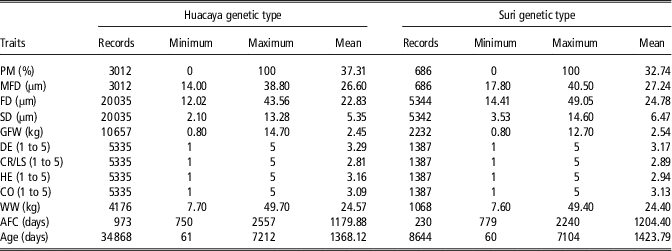
The data was obtained from PacoPro v5.6, software of the Pacomarca experimental farm, collected between 2000 and 2017. The fiber samples were taken from the mid side, and analyzed in the OFDA 100® device (Lupton and Pfeiffer, Reference Lupton and Pfeiffer1998), quantifying the proportion of continuous medullated fibers, in percentage (Table 1).
Number of records, minimum, maximum and mean of fiber, functional and secondary traits for Huacaya and Suri genetic types alpacas

PM = percentage medullation fiber; MFD = medullated fiber diameter; FD = fiber diameter; SD = standard deviations of fiber diameter; GFW = greasy fleece weight; DE = density; CR = crimp; LS = lock structure; HE = head conformation; CO = coverage of legs; WW = weaning weight; AFC = age at first calving.
The traits analyzed were PM, MFD, FD, standard deviation (SD) of FD, greasy fleece weight (GFW) as fiber traits as described by Gutiérrez et al. (Reference Gutiérrez, Goyache, Burgos and Cervantes2009); density (DE), crimp (CR) in Huacaya and lock structure (LS) in Suri, head conformation (HE), leg coverage (CO) as morphological traits as described by Cervantes et al. (Reference Cervantes, Pérez-Cabal, Morante, Burgos, Salgado, Nieto, Goyache and Gutiérrez2010); weaning weight (WW) as described by Cruz et al. (Reference Cruz, Cervantes, Burgos, Morante and Gutiérrez2017); age at first calving (AFC) for reproductive traits as described by Cruz et al. (Reference Cruz, Cervantes, Burgos, Morante and Gutiérrez2015). Data were separately analyzed for the Huacaya and Suri genetic types.
The number of records for medullation traits were 3698, corresponding to 1869 (665 male and 1204 female) for Huacaya genetic type and 414 (137 males and 277 female) for Suri genetic type. There were 209 sires of Huacaya genetic type, 187 of them with progeny in the data and 86 of them also with own record. Note that some of the sires were parents of other sires or dams in the pedigree that do not have their own record in turn. Conversely there were 941 dams of Huacaya genetic type, 903 dams with progeny in the data and 595 dams with record and progeny in the data. Concerning the Suri genetic type, there were 108 sires, 68 of them with progeny in the data and 17 of them with record and progeny in the data. The number of Suri dams was 263, from them 216 with progeny in the data and 122 with record and progeny in the data. The total number of records were 71 041 for fiber trait, 26 888 for morphological traits, 5244 for preweaning trait and 1203 for the reproductive trait for both genetic types. The presence of several recorded offspring from each of a smaller group of dams and sires provided enough information about relationship useful to estimate genetic parameters. It was also helped by disposing of several parent–offspring pairs, repeated records and a dense pedigree information.
Methods
Genetic parameters were estimated via a multitrait restricted maximum likelihood procedure applied to mixed linear models. Fiber traits were analyzed together with those morphological, preweaning and reproductive traits previously analyzed (Cruz et al., Reference Cruz, Cervantes, Burgos, Morante and Gutiérrez2017) all together.
The model fitted for DE, CR, LS, HE, CO and AFC was:
 $${\bf y}{\equals}{\bf Xb}\,{\plus}\,{\bf Zu}\,{\plus}\,{\bf e}$$
The model fitted for PM, MFD, FD, SD and GFW was y = Xb + Zu + Pp + e
And the model fitted for WW was
 $${\bf y}{\equals}{\bf Xb}\,{\plus}\,{\bf Zu}\,{\plus}\,{\bf Wm}\,{\plus}\,{\bf e}$$
with
 $$\eqalign { \left( {\matrix{ u \cr m \cr p \cr e \cr } } \right)\,\sim\,N\left( {\left[ {\matrix{ 0 \cr 0 \cr 0 \cr 0 \cr } } \right],\left[ {\matrix{ {{\bf{A}} \,\otimes\,{\bf{G}} _{0} } & {{\bf{A}} \,\otimes\,{\bf{C}} _{0} } & 0 & 0 \cr {{\bf{A}} \,\otimes\,{\bf{C}} _{0} } & {{\bf{A}} \,\otimes\,{\bf{M}} _{0} } & 0 & 0 \cr 0 & 0 & {{\bf{I}} _{p} \,\otimes\,{\bf{P}} _{0} } & 0 \cr 0 & 0 & 0 & {{\bf{I}} _{e} \,\otimes\,{\bf{R}} _{0} } \cr } } \right]} \right)$$
where y is the vector of observations, b is the vector of fixed effects, u is the vector representing the additive genetic effects, m is the vector representing the maternal genetic effects, p corresponds to the vector of permanent environments of individuals for fiber traits, e is the vector of residuals; X, Z, P and W are the incidence matrices for fixed, direct genetic, permanent and maternal genetic effects, respectively, I e is the identity matrix of equal order to the number of records, I p is the identity matrix of equal order to the number of permanent environmental subclasses, A is the numerator relationship matrix, R 0 is the residual covariance matrix among measurements on the same animal, G 0 is the covariance matrix for additive genetic effects, M 0 is the covariance matrix for maternal genetic effect for WW, C 0 is the matrix for covariance between direct and maternal genetic effects, P 0 is the covariance matrix for permanent environmental effects and ⊗ the Kronecker product (Cruz et al., Reference Cruz, Cervantes, Burgos, Morante and Gutiérrez2017).
The fixed effects for fiber traits were color with three levels (white, cream and black), month–year of recording as contemporary group with 50 levels, sex with two levels and age as linear and quadratic covariate (Cruz et al., Reference Cruz, Cervantes, Burgos, Morante and Gutiérrez2017). For the morphological traits the fixed effects were color with three levels, sex with two levels and year of recording as contemporary group with 13 levels. The fixed effects included in the models for WW were sex with two levels, color with three levels, year of calving as contemporary group with 14 levels, age at weaning as linear covariate and age of the mother as linear and quadratic covariate (Cruz et al., Reference Cruz, Cervantes, Burgos, Morante and Gutiérrez2017). The fixed effects for reproductive trait were color with three levels, year of recording as contemporary group with 12 levels and age as linear and quadratic covariate (Cruz et al., Reference Cruz, Cervantes, Burgos, Morante and Gutiérrez2017). Huacaya and Suri genetic types were independently analyzed. Genetic parameters were estimated using the VCE 6.0 program (Neumaier and Groeneveld, Reference Neumaier and Groeneveld1998).
Results
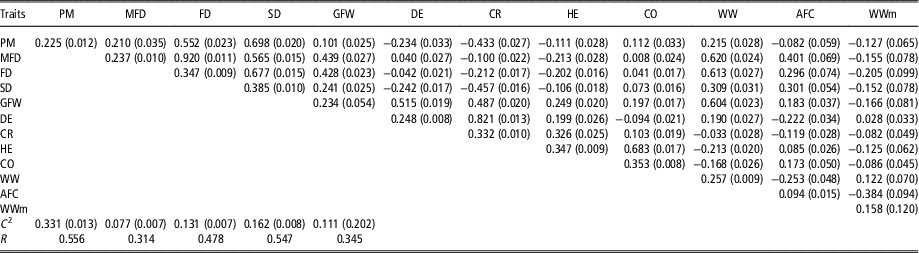
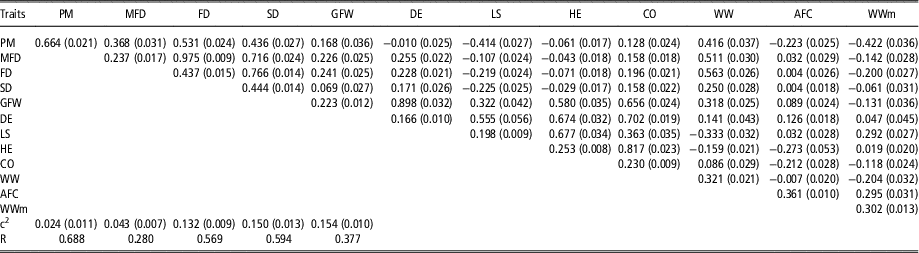
The estimated heritabilities for all the involved traits, the permanent environmental ratio, the repeatabilities and the genetic correlations between traits, with their respective standard error, are shown in Table 2 for the Huacaya genetic type and in Table 3 for the Suri genetic type. The heritabilities for PM were found to be moderate to high of 0.225 and 0.664, respectively, for Huacaya and Suri, and moderate of 0.237 for MFD in both genetic types. The repeatabilities were high for PM of 0.556 and 0.688, and moderate for MFD of 0.314 and 0.288 in Huacaya and Suri, respectively. The heritabilities and genetic correlations for the rest of the traits had already been estimated in this population (Gutiérrez et al., Reference Gutiérrez, Goyache, Burgos and Cervantes2009; Cervantes et al., Reference Cervantes, Pérez-Cabal, Morante, Burgos, Salgado, Nieto, Goyache and Gutiérrez2010; Gutiérrez et al., Reference Gutiérrez, Cervantes, Pérez-Cabal, Burgos and Morante2014; Cruz et al., Reference Cruz, Cervantes, Burgos, Morante and Gutiérrez2015 and Reference Cruz, Cervantes, Burgos, Morante and Gutiérrez2017), but were estimated again here with some more records, resulting, respectively, for Huacaya and Suri, 0.347 and 0.437 for FD, 0.385 and 0.444 for SD, 0.234 and 0.223 for GFW. They ranged from 0.248 to 0.353 for morphological traits in the Huacaya genetic type and from 0.166 to 0.253 in the Suri genetic type; 0.257 for WW in Huacaya genetic type and 0.321 in Suri genetic type, 0.094 and 0.361 for AFC, and 0.158 and 0.302 for the maternal genetic effects the WW in Huacaya and Suri genetic types, respectively.
Heritabilities (in diagonal), genetic correlations (above diagonal), permanent environmental variances ratio (row C2), repeatabilities (row R) and their corresponding errors (in brackets) for fiber, morphological, functional and secondary traits in Huacaya genetic type alpaca

PM = percentage medullation fiber; MFD = medullated fiber diameter; FD = fiber diameter; SD = standard deviations of fiber diameter; GFW = greasy fleece weight; DE = density; CR = crimp; HE = head conformation; CO = coverage of legs; WW = weaning weight; AFC = age at first calving; WWm = maternal genetic effect for weaning weight.
Heritabilities (in diagonal), genetic correlations (above diagonal), permanent environmental variances ratio (row C2), repeatabilities (row R) and their corresponding errors (in brackets) for fiber, morphological, functional and secondary traits in Suri genetic type alpaca

PM = percentage medullation fiber; MFD = medullated fiber diameter; FD = fiber diameter; SD = standard deviations of fiber diameter; GFW = greasy fleece weight; DE = density; LS = lock structure; HE = head conformation; CO = coverage of legs; WW = weaning weight; AFC = age at first calving; WWm = maternal genetic effect for weaning weight.
The genetic correlations between PM and FD were high (0.552 and 0.531) in Huacaya and Suri genetic types, respectively, while the genetic correlations between MFD and FD were very high (0.920 and 0.975) in both genetic types, respectively, and the genetic correlations between PM and MFD were moderate (0.210 and 0.368) for Huacaya and Suri genetic type, respectively. The genetic correlations of PM and MFD with the rest of fiber traits in Huacaya genetic type were moderate to high for PM (0.101 to 0.698 in absolute value) and moderate for MFD (0.439 to 0.565 in absolute value). These genetic correlations in the Suri genetic type were moderate for PM (0.168 to 0.436 in absolute value) and moderate to high for MFD (0.226 to 0.716 in absolute value).
The genetic correlations of medullated fiber with morphological traits were moderate for PM (−0.111 to −0.433) and very low to moderate for MFD (0.008 to −0.213) in Huacaya genetic type. These genetic correlations were from very low to moderate for PM (−0.010 to −0.414) in Huacaya genetic type and similar for MFD (−0.043 to 0.255) in the Suri genetic type. The genetic correlations of medullated fiber with WW in both genetic types were moderate for PM (0.215 in Huacaya and 0.416 in Suri), and high for MFD (0.620 in Huacaya and 0.511 in Suri). The genetic correlations between medullated fiber with the reproductive trait (AFC) were low to moderate for PM (−0.082 and −0.223) and similar for MFD (0.401 and 0.032) in Huacaya and Suri genetic types, respectively. Likewise, the genetic correlations between medullated fiber with the maternal genetic effect of WW were moderate for PM (−0.127 and −0.422) and moderate for MFD (−0.155 and −0.142 for Huacaya and Suri genetic types, respectively).
Discussion
Although there is a high PM variability in alpacas, the PM mean in the highly selected animals of Pacomarca experimental farm was found to be 37.31% in Huacaya genetic type and 32.74% in Suri genetic type (Table 1), higher percentages than those reported by Pinares et al. (Reference Pinares, Gutiérrez, Cruz, Morante, Cervantes, Burgos and Gutiérrez2018) in the males of the same highly selected Pacomarca experimental farm (24%). It was a similar value to that reported by Wang et al. (Reference Wang, Wang and Liu2003) in Australian alpacas (32.28%), higher than the 24.4% value reported in another Australian alpaca population (Aylan-Parker and McGregor, Reference Aylan-Parker and McGregor2002). Nonetheless all these values are much lower than the 66.49% mean reported by Quispe et al. (Reference Quispe, Poma and Purroy2013) in non selected Peruvian alpacas. Table 1 shows also an enormous PM variability, from 0% to 100% in both genetic types, variability not present in other species. Thus, for instance, the PM was between 0.1% and 4.6% in Angora goats (McGregor et al., Reference McGregor, Butler and Ferguson2013; Taddeo et al., Reference Taddeo, Duga, Almeida, Willems and Somlo2000), between 0% and 5.1% in cashmere goats (McGregor, Reference McGregor2014), up to 23.52% in sheep wool (Cilek, Reference Cilek2015), and between 35.5% and 46.6% in lamas (Martinez et al., Reference Martinez, Iñiguez and Rodríguez1997) with enormous variability (Frank et al., Reference Frank, Hick, Lamas, Gauna and Molina2006). In fact, there have been found animals with high PM in all the diameter rank in the data. This was also reported by Scobie et al. (Reference Scobie, Grosvenor, Bray, Tandon, Meade and Cooper2015) in New Zealand Romney sheep, suggesting that medullated wool was not only dependant on the diameter, but also on the nutrition, climate, genotype and body regions. In fact, there were medullated hair found in wool with 14 μm, and non-medullation in wool with 68 μm. They commented that independently of all these effects, the impact of these kemp and gare fibers was negligible in the finished product in ultra fine Merino sheep. Similar variations in medullation across all the diameter rank appeared also in Australian alpacas (Aylan-Parker and McGregor, Reference Aylan-Parker and McGregor2002) and also Pinares et al. (Reference Pinares, Gutiérrez, Cruz, Morante, Cervantes, Burgos and Gutiérrez2018) reported that when observing alpaca fibers using a projection microscope, both fine but medullated fibers, and coarse but not medullated fibers were usually observed. They also found that the continuously strongly medullated fibers were found in the right skewed tail of the distribution, inferring that the thick fibers were mainly medullated. However, a great difference in FD between medullated and not medullated was found in Angora and cashmere goats, being, respectively, 40 and 18 μm, justifying the use of mechanical dehairing techniques (Frank, Reference Frank2008; McGregor, Reference McGregor2014) unlike alpacas in which the difference between the fine fiber and coarse fiber is much lower, with a FD mean of 22.83 μm and a MFD mean of 26.60 μm in Huacaya genetic type, and FD mean of 24.78 μm and a MFD mean of 27.24 μm in Suri (Table 1), having only 3.77 and 2.46 μm of difference between non-medullated and medullated fiber in both genetic types, what currently discourages the mechanical dehairing in this species. However, reducing PM in alpaca fiber would help to reduce the contamination improving particularly the dyeing process and reducing the prickling with the improvement if the softness, making easier in addition the hypothetical future use of mechanical dehairing.
The heritabilities found in this work showed that decreasing PM would be possible by artificial selection. These values were 0.225 and 0.237 for, respectively, PM and MFD for Huacaya genetic type, and 0.664 and 0.237 for Suri genetic type, suggesting the PM heritability in Suri genetic type the possible existence of a major gene segregating, maybe the same found for FD reported by Pérez-Cabal et al. (Reference Pérez-Cabal, Cervantes, Morante, Burgos, Goyache and Gutiérrez2010). These values were similar than others estimated in other species, being 0.37 for PM in sheep (Sánchez et al., Reference Sánchez, Urioste, Peñagaricano, Neimaur, Sienra, Naya and Kremer2016), 0.23 in Angora goats (Allain and Roguet, Reference Allain and Roguet2006) and 0.29 in Argentinean lamas (Frank et al., Reference Frank, Hick, Molina and Caruso2011). This is promising since under similar heritabilities, such as those for FD and SD, a satisfactory response to selection has been shown in the same population with an important genetic progress (Gutiérrez et al., Reference Gutiérrez, Cervantes, Pérez-Cabal, Burgos and Morante2014), especially in Huacaya genetic type for FD.
The genetic correlations of medullated fiber with other fiber traits were high and favorable (0.920 in Huacaya and 0.975 in Suri between MFD and FD). The correlation between PM and MFD (0.210 in Huacaya and 0.368 in Suri) shows that the selection against medullation would lead to a reduction of MFD, although the response would be much smaller than selecting directly using FD as criterion. Likewise, the reduction of the PM and MFD would also reduce the SD in both genetic types, which is favorable. However, the GFW would be adversely affected, and dealing with this genetic correlation should be needed, for example, by the use of a selection index with appropriate weights on the traits. Even though correlation between FD and GFW estimated by Gutiérrez et al. (Reference Gutiérrez, Goyache, Burgos and Cervantes2009) in the same population gathering both Suri and Huacaya genetic types was very low (0.116), it has been updated here using a greater number of records, increasing the precision and becoming higher (0.428 in Huacaya and 0.241 in Suri). Interestingly to comment, there has been a supposedly correlated response in PM in this population as a consequence of the successful selection based on FD, but it has probably been weaker than desired because of a not too high genetic correlation between those traits (0.531 in Suri and 0.552 in Huacaya). Direct selection on PM is expected to greatly reduce it.
A very satisfactory result was that the genetic correlations of PM and MFD with morphological traits in Huacaya genetic type, were all of them favorable or negligible, except a very low value of 0.112 for the pair PM–CO. In Suri genetic type these correlations were also favorable but with more exceptions such as for the pairs MFD–DE (0.255), PM–CO (0.128) and MFD–CO (0.158). The heritabilities of MFD and FD and its genetic correlation would help to the choice of only one of these traits as an additional selection criterion, and the most indicated would be the FD, due to its greater heritability and its high genetic correlation with MFD. There was an unfavorable genetic correlation between CO and PM. Leg coverage is a demand of some breeders as the animals score better in shows. It could be controlled using a index in both genetic types. However, fiber in legs is coarse and medullated without any textile value, coulding be ignored this feature from the textile point of view. On other hand, it has to be noted that the reduction of medullated fiber would lead to smaller animals in both genetic types, given the positive genetic correlation of PM with WW, similar to the reported between WW and FD by Cruz et al. (Reference Cruz, Cervantes, Burgos, Morante and Gutiérrez2017). These morphological changes that could cause the selection against the medullation would bring about some minor losses if animals were bred for meat, and also for the animals that would be participating in shows that would be less appreciated. Nevertheless the balance would be probably favorable as smaller animals have lower maintenance requirements and the production of fiber would be much more efficient by the production of fine fiber and the increase in follicular DE, due to the negative relationship between fiber traits and DE.
The genetic correlations between medullated fiber with reproductive traits, were very low and similar to those reported by Cruz et al. (Reference Cruz, Cervantes, Burgos, Morante and Gutiérrez2017) between FD and AFC. The magnitude and sign of the correlations suggest that selecting to reduce PM would not worsen reproductive performance, except the relationship between AFC and PM in Suri genetic type with a slight unfavorable genetic correlation of −0.223. This would slightly increase the AFC when selecting against medullation, directly affecting still more fertility, because alpacas having a seasonal ovulation have a short time to try to become pregnant. In addition, staring gestation would delay with the consequent increase in the risk of becoming open during the year.
The genetic correlations between direct genetic effects of medullated fiber and maternal genetic effects of WW were favorable, low in Huacaya genetic type but moderate in Suri genetic type. Nonetheless, the genetic parameters obtained in the last genetic type have to be interpreted with caution due to the small number of records.
Monitoring possible negative effects of reducing medullation on thermoregulation should be also recommended given that greater heat losses have been found in alpaca samples of finer fiber under the same fiber DE, but this effect seems to be counterbalanced by a higher DE of finer fleeces (Moore et al., Reference Moore, Maloney and Blache2015). Moreover, management improvements are also expected that will help in the maintenance of animals under better climatic conditions.
The moderate to high estimated heritabilities for medullated fiber in this population of alpaca (PM and MFD) in both genetic types, encourage to face a breeding program aimed to eliminate prickling of alpaca cloths. Such a breeding program would base the selection in a combined genetic index (Gutiérrez et al., Reference Gutiérrez, Cervantes, Pérez-Cabal, Burgos and Morante2014) that would reduce PM at maximum, that would bring about also a correlated reduction of FD. Using this criterion, selecting would be optimized against the resistance to bending, decreasing or even removing the characteristic prickling feeling that decreases the economic value of the alpaca fiber in an international trading market. Although everything seems to indicate that selecting against the medullation will reduce or eliminate the problem of itching in the alpaca fiber, it should be noted that this type of selection will only have this effect if the medullation is truly the main cause of this undesired effect.
Acknowledgements
None.
Declaration of interest
No conflict of interest.
Ethics statement
The work complies with the National Research Standards.
Software and data repository resources
None of the data were deposited in an official repository.