


1. Introduction
In the South American country Suriname, Dutch has been the single official language of education and government since 1876 and is reportedly the primary home language of 50 percent of the Surinamese households (Algemeen Bureau voor de Statistiek 2006, 2012). The country is said to have developed a separate variety of Dutch (see Muysken Reference Muysken, Yakpo and Muysken2017), which is also officially acknowledged by the Nederlandse Taalunie (‘Dutch Language Union’). Both codification projects (see, e.g., Van Donselaar Reference Van Donselaar1976, De Bies Reference De Bies, Martin and Smedts2009) and attitudinal data (Ghyselen et al. Reference Ghyselen, Grondelaers, Misier-Patadien and Balesar2022) support this idea of endoglossic standardization. However, it is unclear what the formal characteristics of the Surinamese Dutch variety are and how fundamentally it differs from European varieties of Dutch (i.e. Netherlandic and Belgian Dutch). On the one hand, divergence from European Dutch can be expected as political independence (1975) has increased awareness of the own identity, both in language and culture, and also meant the end of an explicitly Europocentric language policy. On the other hand, the active Surinamese diaspora in the Netherlands stimulates continuous cultural and linguistic exchange between Suriname and the Netherlands (Yakpo, Van den Berg, & Borges Reference Yakpo, den Berg, Borges, Carlin, Léglise, Migge and Tjon Sie Fat2015:172). Moreover, Surinamese primary and secondary education still mainly rely on Netherlandic coursebooks and reference works, implying continuous exonormative influence (especially in writing) (Berends Reference Berends2016: 30). Typical Surinamese Dutch lexical, phonetic, morphological, and syntactic features have been signaled (Gobardhan-Rambocus Reference Gobardhan-Rambocus, Gobardhan-Rambocus and Safdar Hassankhan1993, Van Donselaar Reference Van Donselaar and van der Sijs2005, De Kleine Reference De Kleine2007, De Bies Reference De Bies, Martin and Smedts2009, van der Sijs Reference van der Sijs2014, Yakpo & Muysken Reference Yakpo and Muysken2017), but it is not clear who uses them, when, to what degree and whether they can indeed be considered inherent characteristics of Surinamese Dutch.
To study the degree to which Surinamese Dutch differs from European Dutch varieties, this article zooms in on one of the most frequently studied variables in variationist sociolinguistics: coronal stop deletion in word-final consonant clusters, for instance, in words such as echt (‘really’), gewerkt (‘worked’), and worst (‘sausage’). Coronal stop deletion – claimed to be driven by a universal tendency to avoid word-final consonant clusters (Goeman Reference Goeman1999:1) – provides an ideal testing ground to study the divergence of Surinamese Dutch from European Dutch varieties. After all, the phenomenon has been studied thoroughly in European Dutch (de Vries et al. Reference de Vries, Franken, Jansen, Gerritsen, Vruggink and Zeef1974, Van Hout Reference Van Hout, Daalder and Gerritsen1981, Reference Van Hout1989b, Reference Van Hout, van Reenen and Schouten1989a, Schouten Reference Schouten1984, Hinskens Reference Hinskens1993, Goeman Reference Goeman1999, De Wulf & Taeldeman Reference De Wulf and Taeldeman2006, Mitterer & Ernestus Reference Mitterer and Ernestus2006, Schuppler et al. Reference Schuppler, van Dommelen, Koreman and Ernestus2012) and has been signaled as a characteristic of Surinamese Dutch (De Bies Reference De Bies, Martin and Smedts2009:12–13, De Kleine Reference De Kleine, Hinskens and Taeldeman2013:842, Berends Reference Berends2016: 25–27, Yakpo & Muysken Reference Yakpo and Muysken2017:289). Moreover, previous research involving other languages has shown that the language-internal conditioning of coronal stop deletion is partly language- and variety-specific (cf. Goeman Reference Goeman1999, Tagliamonte & Temple Reference Tagliamonte and Temple2005, Temple Reference Temple2009, Walker Reference Walker2012, Purse & Turk Reference Purse and Turk2016, Tanner, Sonderegger, & Wagner Reference Tanner, Sonderegger and Wagner2017, Purse Reference Purse2019, Ciancia Reference Ciancia2020). Hence, a thorough analysis of the conditioning of coronal stop deletion in Surinamese Dutch – currently still lacking – can be revealing: If this conditioning differs significantly from the one in European Dutch varieties, this would be clear phonetic evidence that Surinamese Dutch is a separate variety of Dutch.
In what follows, we first discuss coronal stop deletion and its conditioning in Dutch (section 2), after which we elaborate on our research questions (section 3) and methodology (section 4). Sections 5 and 6 introduce and discuss the results.
2. Conditions for coronal stop deletion in European Dutch
Coronal stop deletion in word-final consonant clusters, also known as [t/d]-deletion, is one of the “showcase variables in the study of sociolinguistic variation and change” (Walker Reference Walker2012:399). It has been studied widely in varieties of English (cf. Labov et al. Reference Labov, Cohen, Robins and Lewis1968, Wolfram Reference Wolfram1969, Fasold Reference Fasold1972, Guy Reference Guy and Labov1980, Tagliamonte & Temple Reference Tagliamonte and Temple2005, Temple Reference Temple2009, Walker Reference Walker2012, Tamminga Reference Tamminga2018, Ciancia Reference Ciancia2020) and of Dutch (cf. de Vries et al. Reference de Vries, Franken, Jansen, Gerritsen, Vruggink and Zeef1974, Van Hout Reference Van Hout, Daalder and Gerritsen1981, Reference Van Hout, van Reenen and Schouten1989a, Reference Van Hout1989b, Schouten Reference Schouten1984, Hinskens Reference Hinskens1993, Goeman Reference Goeman1999, Stroop Reference Stroop2004, De Wulf & Taeldeman Reference De Wulf and Taeldeman2006, Mitterer & Ernestus Reference Mitterer and Ernestus2006, Schuppler et al. Reference Schuppler, Ernestus, van Dommelen and Koreman2010, Reference Schuppler, van Dommelen, Koreman and Ernestus2012), as its variability is “not solely attributable to universal phonetic continuous speech processes” but is also “a function of higher levels of linguistic organization, specifically the morphophonology” (Tagliamonte & Temple Reference Tagliamonte and Temple2005: 282). In the Dutch context, final stop deletion is generally referred to as [t]-deletion, since Dutch is a language with final devoicing (Ouddeken Reference Ouddeken2020), meaning that word-final /d/ does not occur. The variable is generally treated as a binary one (Tagliamonte & Temple Reference Tagliamonte and Temple2005, Schuppler et al. Reference Schuppler, van Dommelen, Koreman and Ernestus2012, Tamminga Reference Tamminga2018, Ciancia Reference Ciancia2020), with /t,d/ either present or deleted, or as a tertiary one, with as the third category cases of ‘reduced’ [t]Footnote 1 (Van Hout Reference Van Hout1989b, Goeman Reference Goeman1999:161, Stroop Reference Stroop2004:762, De Wulf & Taeldeman Reference De Wulf and Taeldeman2006:268). Recently, some studies have explored the continuous character of the variable as well (Schuppler et al. Reference Schuppler, van Dommelen, Koreman and Ernestus2012, Purse & Turk Reference Purse and Turk2016, Purse Reference Purse2019). As the present study is a first exploration of coronal stop deletion in Surinamese Dutch, we treat [t]-deletion as a binary variable, with reduced instances of [t] categorized as present and only those instances where [t] is not audible categorized as null instances.
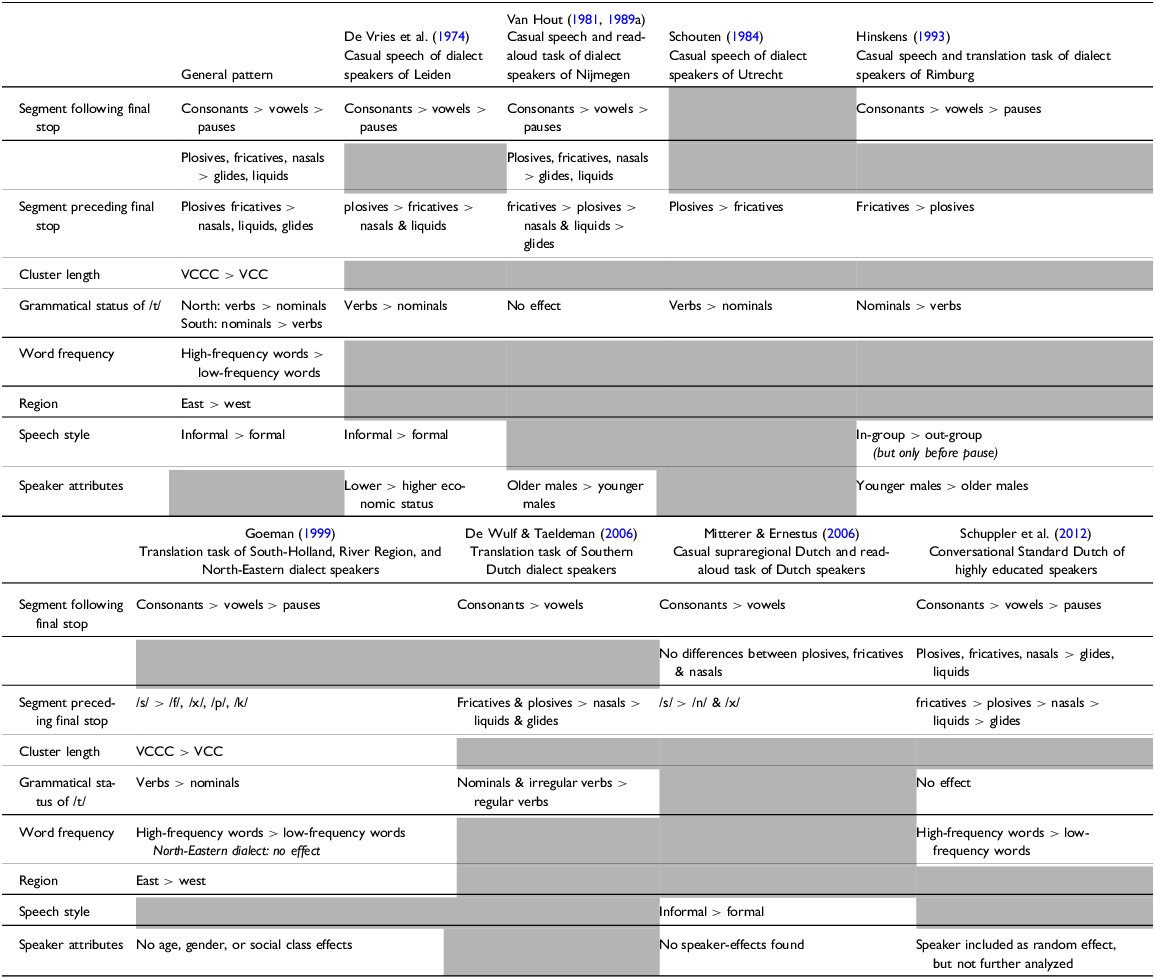
Three language-internal variables have been shown to be the most important constraining factors of coronal stop deletion in both English and Dutch: the segment following the coronal stop, the segment(s) preceding the coronal stop, and the grammatical status of the coronal stop. In what follows, we focus on the results for Dutch (see table 1). Firstly, concerning the segment following the coronal stop, research shows that consonants trigger more deletion than vowels and that vowels trigger more deletion than pauses (de Vries et al. Reference de Vries, Franken, Jansen, Gerritsen, Vruggink and Zeef1974:242, Van Hout Reference Van Hout, Daalder and Gerritsen1981:32, Goeman Reference Goeman1999:175, Mitterer & Ernestus Reference Mitterer and Ernestus2006:81, Schuppler et al. Reference Schuppler, van Dommelen, Koreman and Ernestus2012:597–599). With regard to the different types of consonants that can follow a coronal stop, it has been observed that plosives, fricatives, and nasals often tend to trigger deletion, while glides and liquids do not. This is, for example, the case for informal supraregional Dutch (Mitterer & Ernestus Reference Mitterer and Ernestus2006:82, 84, Schuppler et al. Reference Schuppler, van Dommelen, Koreman and Ernestus2012:601) and the dialect of Nijmegen in the Netherlands (Van Hout Reference Van Hout1989b:186–188). These tendencies are often explained by referring to the obligatory contour principle, that states that the more phonological features a sound shares with [t], the more likely it is that [t] will be deleted (Guy & Boberg Reference Guy and Boberg1997). Nasal [n] (+cor, -cont), plosives (-son, -cont), and sibilant fricatives (+cor, -son) all share two features with [t], unlike glides and liquids. The exact hierarchy of consonants can be considered variety-specific, as it seems to differ for all varieties just mentioned. Note, however, that not much data are available on differences between specific consonants following the coronal stop. Coetzee & Kawahara (Reference Coetzee and Kawahara2013:60) pertinently point out that it is standard practice to lump all consonants together when studying the impact of the segment following word-final coronal stops. This comment was made in the context of English varieties but also holds for most studies on [t]-deletion in Dutch (e.g. Goeman Reference Goeman1999, De Wulf & Taeldeman Reference De Wulf and Taeldeman2006).
Summary of research results for the conditioning of coronal stop deletion in Dutch

A second predictor is the segment(s) preceding word-final /t/. The impact of the preceding phonological segment seems variety-specific in Dutch, but unlike for English varieties, it does not always follow the obligatory contour principle.Footnote 2 The findings of Schuppler et al. (Reference Schuppler, van Dommelen, Koreman and Ernestus2012:601) on conversational Standard Netherlandic Dutch, for instance, seem to be in line with the principle (fricatives > plosives > nasals > liquids > glides), whereas those of Mitterer & Ernestus on supraregional Dutch are not (/s/>/n/ & /x/) (Reference Mitterer and Ernestus2006:81). The principle is not followed in the Netherlandic Dutch dialects of Nijmegen (fricatives > plosives > nasals & liquids > glides) (Van Hout Reference Van Hout, Daalder and Gerritsen1981: 26, Reference Van Hout1989b) and Leiden (plosives > fricatives > nasals & liquids) (de Vries et al. Reference de Vries, Franken, Jansen, Gerritsen, Vruggink and Zeef1974:243) either. It is important to note that in the Dutch context, though, final stop deletion is often studied only in contexts in which the final stop is preceded by an obstruent, as this is considered to be the main context in which final stop deletion occurs (Goeman Reference Goeman1999:157, De Wulf & Taeldeman Reference De Wulf and Taeldeman2006: 256). However, the findings of such studies – comparing fricatives and plosives only – do not point towards an unequivocal effect of the preceding segment either. Schouten (Reference Schouten1984:290), for instance, found more frequent [t]-deletion after plosives than after fricatives for the dialect of Utrecht, whereas Hinskens (Reference Hinskens1993:247) found the opposite for the Rimburg dialect. Goeman found no differences between plosives and fricatives for the dialects in South Holland, De Betuwe, and North Eastern dialects, except in /st/-clusters, which trigger more [t]-deletion than clusters with other fricatives (Reference Goeman1999:175–178). De Wulf & Taeldeman (Reference De Wulf and Taeldeman2006:255–258), finally, did not find any differences at all for Belgian Dutch dialects.
Closely linked to the previous segment is the final cluster length. In both English and Dutch, [t] is more likely to be deleted in clusters of the type VCCC (e.g. worst ‘sausage’) than in clusters of the type VCC (e.g. mist ‘fog’) (Labov Reference Labov1989:90, Coetzee & Kawahara Reference Coetzee and Kawahara2013:60, Ciancia Reference Ciancia2020:64). According to Goeman (Reference Goeman1999:167–168, 427), this is due to the articulatory complexity of long consonant clusters. Another possible explanation is perceptual in nature: Leaving out one out of three consonants leaves more recoverable material for the listener than leaving out one of only two.
Another major predictor is the grammatical status of the final stop. Goeman (Reference Goeman1999:429–430, 477, 491), Schouten (Reference Schouten1984:168–170) and De Vries et al. (Reference de Vries, Franken, Jansen, Gerritsen, Vruggink and Zeef1974:245) infer from their northern Dutch data that verbal forms trigger deletion more easily than nominal forms. De Wulf & Taeldeman (Reference De Wulf and Taeldeman2006:252–254), however, conclude for Southern Dutch (i.e. Dutch in Belgium) that [t] is deleted more often if the status of /t/ is ambiguous (irregular verb forms such as wist ‘knew’) or if /t/ holds no disambiguating information in the sentence (nominals such as worst ‘sausage’). These findings are consistent with morphological effects for English varieties (Foulkes Reference Foulkes, Aarts and McMahon2006:634, Walker Reference Walker2012:399, Coetzee & Kawahara Reference Coetzee and Kawahara2013:60, Tamminga Reference Tamminga2018:14, Purse Reference Purse2019:1, Ciancia Reference Ciancia2020:64). Similarly, Hinskens (Reference Hinskens1993:245) found for the Netherlandic Limburg dialect of Rimburg that /t/ as part of a lexeme (i.e. acht ‘eight’) is deleted more often than a morphemic /t/ (i.e. werkt ‘works’). Geographically speaking, Rimburg is one of the most southern parts of the Netherlands and thus very close to Belgium. One might hence conclude that in Dutch, the impact of the grammatical status of /t/ is geographically conditioned. However, for some varieties of Dutch, such as conversational Standard Netherlandic Dutch (Schuppler et al. Reference Schuppler, van Dommelen, Koreman and Ernestus2012:599) and the Nijmegen dialect (Van Hout Reference Van Hout1989b:106–107), no effect of grammatical status was found, except in a subset of homophonous words.
Besides the main constraints, several studies have identified word frequency as a factor influencing coronal stop deletion (Goeman Reference Goeman1999, Bybee Reference Bybee2002, Schuppler et al. Reference Schuppler, van Dommelen, Koreman and Ernestus2012, Walker Reference Walker2012, Coetzee & Kawahara Reference Coetzee and Kawahara2013, Ciancia Reference Ciancia2020). The general effect seems to be that final stops are reduced more often in high-frequency tokens. However, this effect does not hold for all varieties of English and Dutch and also seems to be influenced by methodological factors (same vs. different corpus as frequency baseline; word vs. stem vs. bigram frequency). Frequency effects have been found for informal supraregional Dutch (Schuppler et al. Reference Schuppler, van Dommelen, Koreman and Ernestus2012:600) and the dialects of South-Holland and the River Region in the Netherlands (Goeman Reference Goeman1999:479), whereas no effects were found for the dialects of the North-Eastern part of the Netherlands (Goeman Reference Goeman1999:471, 479).
In considering the effects of the grammatical status of /t,d/, word frequency, and the preceding phonological context on [t/d]-deletion, it has to be borne in mind that these factors might to a certain extent be collinear. Tagliamonte & Temple (Reference Tagliamonte and Temple2005), for instance, raise the question whether the morphological effect of monomorphemic words – [t] being deleted more often in monomorphemic words than in words where /t/ is a separate morpheme – is not rather a phonological effect of the preceding segment, as many monomorphemic words end in /st/, and sibilant fricatives are also important predictors of deletion. In a similar vein, Walker (Reference Walker2012:410) emphasizes that frequency categories overlap with morphological categories and that examining factors such as frequency and grammatical status in isolation might hence obscure their real impact.
Language-externally, there seems to be clear diatopic variation. In the Dutch-German dialect continuum, for instance, western dialects barely show coronal stop deletion in final consonant clusters; the phenomenon grows stronger moving eastwards (Goeman Reference Goeman1999).Footnote 3 Besides region, speech style seems to be an influencing language-external factor. The more spontaneous a conversation is, the more often the final stop is deleted (de Vries et al. Reference de Vries, Franken, Jansen, Gerritsen, Vruggink and Zeef1974:246–247, Mitterer & Ernestus Reference Mitterer and Ernestus2006:96). While stylistic patterning generally also involves social patterning (cf. Labov Reference Labov1972:240, Bell Reference Bell1984:151), there is only limited evidence of social factors (e.g. age, social class, gender, or ethnicity) influencing [t/d]-deletion. For Dutch, the earliest studies found some social patterning – Van Hout (Reference Van Hout1989b:100) found that older males from Nijmegen deleted more than younger males and De Vries et. al. (Reference de Vries, Franken, Jansen, Gerritsen, Vruggink and Zeef1974:247) found that people from Leiden with a higher socio-economic status deleted less – but this was not replicated in other contemporaneous studies (e.g. Schouten Reference Schouten1984, Hinskens Reference Hinskens1993). More recently, Goeman (Reference Goeman1999:487) did not find any age, gender, or social class effects in his data on Dutch dialect speakers. It has to be remarked, however, that a broader pool of Dutch-speaking respondents – not restricted to those who reported speaking the local, traditional dialect frequently (Goeman Reference Goeman1999:69) – and a different set of tasks – not only oriented towards “translating” words or sentences in the local dialect – would probably yield more socially stratified data. After all, word-final [t]-deletion is generally not accepted as part of the Netherlandic and Belgian Standard Dutch pronunciation norms and adherence to such norms (and dialects) has been demonstrated to be socially stratified (e.g. Ghyselen & Van Keymeulen Reference Ghyselen and Van Keymeulen2014).
3. Research questions
As far as Surinamese Dutch is concerned, little is known about the occurrence and conditioning of coronal stop deletion. The observation has been made that “many Surinamese do not pronounce /t/ at the end of a word” (De Bies Reference De Bies, Martin and Smedts2009:13, the first author’s translation), and that this is especially so “in consonant clusters” (De Kleine Reference De Kleine, Hinskens and Taeldeman2013:842), but quantitative data are not available. The current study hopes to fill this gap, addressing the following questions:
-
1. To what extent does [t]-deletion occur in Surinamese Dutch?
-
2. Which linguistic and extralinguistic factors condition [t]-deletion in Surinamese Dutch?
-
3. Are the conditioning factors for [t]-deletion in Surinamese Dutch similar to those observed in European Dutch?
As far as RQ1 is concerned, we might hypothesize that [t]-deletion will be highly frequent, for two reasons. A first reason is related to the language contact situation in Suriname. In multilingual and multiethnic Suriname, Dutch is used alongside many languages, the most influential one being Sranan(tongo), an English-based creole used widely as informal lingua franca. This intensive contact has been shown to influence Surinamese Dutch both lexically and grammatically (see Muysken Reference Muysken, Yakpo and Muysken2017) and might also have an impact on coronal stop deletion because basic Sranan vocabulary does not have word-final consonant clusters ending in /t/ or /d/ (see Blanker 2005). Moreover, Sranan does not have /t/-suffixes, contrary to Dutch. While Dutch, for instance, builds simple past forms by combining the verb root with the suffixes -te(n) and -de(n) (regular verbs such as werkte ‘worked’) or -t(en) (several irregular verbs such as wist ‘knew’), the simple past tense in Sranan is formed by combining infinitives with the particle ben (for a process with no activity) or ben e (for a process with activity). Similarly, while Dutch builds regular past participles by combining the verb root with the prefix /γə-/ and the suffixes /t/ or /d/, there are no past participles in Sranan; perfect tenses are indicated by the particle ben (past perfect) or just the verb stem with no particle (present perfect) (Menke Reference Menke1986:2, Hart, Wilsterman, & Overman Reference Hart, Wilsterman and Overman2001: 33, Blanker & Dubbeldam Reference Blanker and Dubbeldam2014:451–452). In Sranan, a verb with no particle could thus be a simple present or a perfect present tense (see (1)) and a verb with the particle ben could be a simple past or a perfect past tense (see (2)). We might hence hypothesize that due to Sranan influence, coronal stop deletion will be very strong in Surinamese Dutch. A second potentially influencing factor is normative tradition. While the European Dutch areas have been marked by a strong emphasis on acquiring Standard Dutch – see, for example, Lybaert (Reference Lybaert2014:3–4, 10) and pronunciation guidelines such as the ABN-uitspraakgids (Paardekooper Reference Paardekooper1998), the ANS (Booij, Jansen, & Rys Reference Booij, Jansen and Rys2020 ), and Klink Klaar (Timmermans Reference Timmermans2021) – Berends argues that for Surinamese Dutch “no prescriptive books are the norm, but the development of Surinamese Dutch in everyday use” (Berends Reference Berends2016:22-23, first author’s translation).


As far as conditioning factors are concerned (RQ2), this study considers the linguistic segments preceding word-final /t,d/ and the following segment, consonant cluster length, word frequency, the grammatical status of /t,d/, speaker age, and speech style.
Given that Dutch was imported into Suriname from the Netherlands and that there is still a strong “transnational social space, in which goods, people, ideas and language practices are continuously exchanged” (Yakpo, Van den Berg, & Borges Reference Yakpo, den Berg, Borges, Carlin, Léglise, Migge and Tjon Sie Fat2015:172, cf. introduction), one might expect the conditioning to be similar to that found in Netherlandic Dutch (RQ3). While it proves difficult to determine the exact conditioning of [t]-deletion in Netherlandic Dutch (as became clear in section 2), the following five principles seem to typify final stop deletion in all studies on Netherlandic Dutch: (i) when followed by a vowel, /t/ is deleted more than before a pause; (ii) plosives, fricatives, and nasals as following segments trigger more deletion than liquids and glides; (iii) verbal forms trigger more deletion than nominal forms in the Netherlands (with the exception of Nijmegen and conversational Standard Dutch) and nominal forms trigger more deletion than verbal forms in Dutch-speaking Belgium; (iv) /t/ in high-frequency words is more often deleted than in low-frequency words; (v) the more spontaneous a conversation is, the more often the final stop is deleted. Given the endogenous standardization that Surinamese Dutch is said to be undergoing, with language contact with Sranan as an important driving force (Muysken Reference Muysken, Yakpo and Muysken2017), we might however also hypothesize that [t]-deletion will permeate more formal communication styles as the lack of word-final coronal stops is not stylistically bound in Sranan.
4. Methodology
4.1. Corpus
The data for this study come from recordings made in 2020 of 22 CreoleFootnote 4 women who grew up in the Surinamese capital Paramaribo and who reported having Dutch as their mother tongueFootnote 5 (Ghyselen Reference Ghyselen2023). Ten of the speakers were aged between 25 and 37 years at the time of recording; 11 were between 50 and 60 years old. One respondent, who was 42 years old at the time of recording (born in 1978), falls in between those two age categories but is counted among the latter for this study. All speakers had completed some form of higher education (higher vocational education or university) but had not received language-related training (i.e. no teachers, journalists, linguists, interpreters, etc.). Speakers who had lived in the Netherlands or Belgium for more than one year were not eligible for the study.
Five recordings were made for each participant. First, speakers were asked to record (i) a 60-minute conversation with a Creole friend of about their age and also (ii) a 60-minute conversation with a friend of a different, non-Creole background (again, of the same generation). To make the conversations as spontaneous and informal as possible, the researcher was not present during these recordings. Respondents were also instructed to “speak as they would normally speak to the friend in question.” Thus, no language (variety) was imposed; respondents could switch to Sranan or another language if they wanted. Once those two recordings were completed, (iii) a sociolinguistic interview (30 to 60 minutes) was conducted. During that interview, respondents discussed their language use in the recordings and their views on language variation and multilingualism in Suriname with a white, Belgian-Dutch-speaking interviewer. Again, no language (variety) was imposed. After the interview, respondents completed (iv) a grammar task (8 to 10 minutes), in which they were asked to answer 20 picture-based questions. They were asked to answer “in Surinamese Standard Dutch.” Finally, respondents were given (v) a read-aloud task “in Surinamese Standard Dutch,” consisting of 92 sentences (largely nonsense sentences, based on Van Hout et al. (Reference Van Hout, De Schutter, Crom, Huinck, Kloots, Van de Velde, Huls and Weltens1999)). All speakers in the study (22 main speakers and 40 interlocutors) gave informed consent and completed a socio-biographic questionnaire.
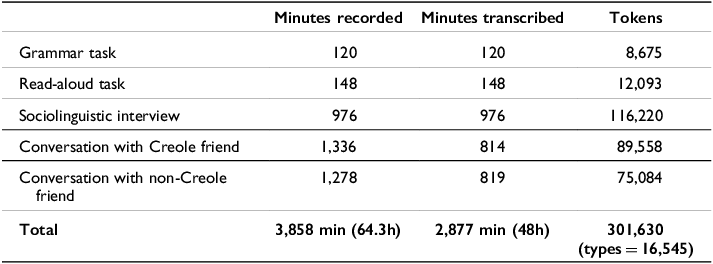
All conversations were transcribed orthographically using the program ELAN. Of the informal conversations with friends, 40 minutes were transcribed; the sociolinguistic interviews and the grammar and read-aloud tasks were fully transcribed. The result is the Corpus Gesproken Surinaams-Nederlands (‘Corpus of Spoken Surinamese Dutch’) (see Ghyselen Reference Ghyselen2023), a corpus of 48 hours of transcribed speech, comprising 301,630 words (see table 2).
Statistics Corpus Gesproken Surinaams-Nederlands

The major advantages of the corpus are that (i) it allows the investigation of stylistic intraspeaker variation, (ii) it contains a lot of metadata about the speakers’ sociolinguistic background, and (iii) it can also reveal age-related patterns, which in turn may indicate language change. The dataset also has limitations. For example, the corpus currently contains data from “only” 62 speakers (22 main respondents and 40 interlocutors) and the main respondents all have the same gender, educational background, native language, and ethnicity. However, although the language use in the dataset is not representative of the variability in the Surinamese language community, it does provide a good starting point for describing Surinamese Dutch. Creole speakers from Paramaribo were chosen because that ethnic group supposedly has had Dutch as their mother tongue (besides Sranantongo) for the longest time (De Kleine Reference De Kleine, Hinskens and Taeldeman2013). The choice of highly educated women was based on the idea that they are often the leaders of change in standardization processes (cf. Labov Reference Labov1990).
4.2. Coding
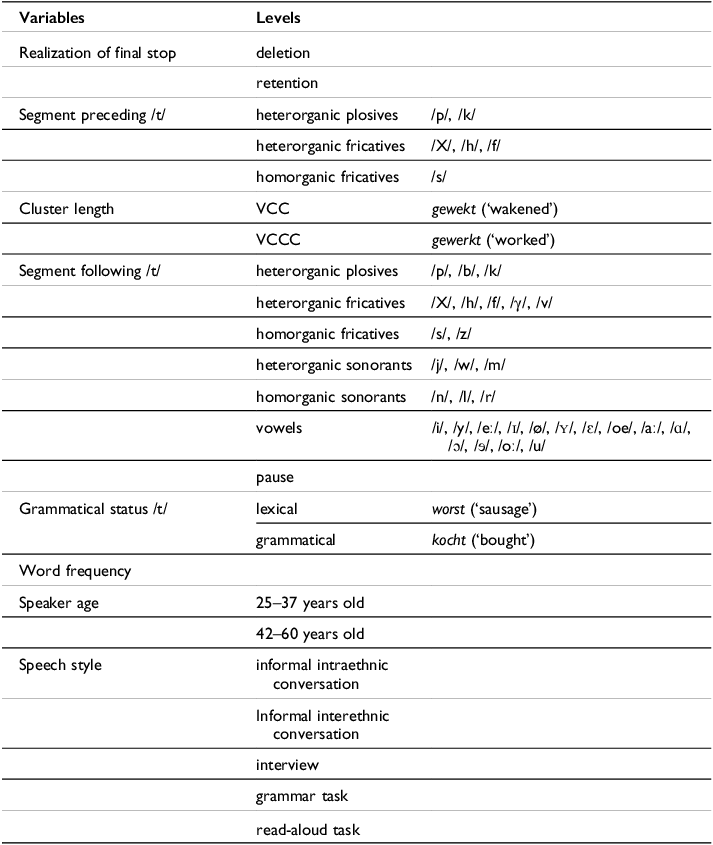
All tokens of word-final /t/ preceded by an obstruent were selected from the corpus using regular expressions. Only the speech of the 22 main respondents was analyzed because only these speakers have data points across speech styles. The obstruent criterion was introduced to guarantee comparability with studies on European Dutch (e.g. Schouten Reference Schouten1984, Hinskens Reference Hinskens1993, Goeman Reference Goeman1999:157, De Wulf & Taeldeman Reference De Wulf and Taeldeman2006). If the phoneme following /t,d/ was either /t/ or /d/ (homorganic plosives), the token was disregarded. Due to assimilation processes in such contexts, it is extremely difficult to determine whether the coronal stop is deleted or retained (De Schutter & Taeldeman Reference De Schutter and Taeldeman1986, Ouddeken Reference Ouddeken2020). Ultimately, 7,418 relevant tokens were attested in the corpus. These were subsequently coded for eight factors (see table 3).
Variables included in the study and (for categorical variables) their levels

Tokens were coded auditorily by the first author of this article. Each token was coded as retained or deleted, with any audible reflex of a stop being categorized as retention. To guarantee coding reliability, a subset of 300 tokens was also annotated by the second and third authors. The second author – like the first author – annotated on an auditory basis, whereas the third author coded the data based on the acoustic signal. For the acoustic coding, a stop was considered to be deleted when no closure or release phase could be detected in the spectrogram and waveform. A Cohen’s Kappa score of κ = 0.64 (with 67% of all cases annotated identically) points to substantial agreement between annotators (Landis & Koch Reference Landis and Koch1977:165). A comparison between the auditory and acoustic annotations showed that they correspond well.
The phonological segments before and after the coronal stop were coded as a combination of manner and place of articulation (see table 3). Alveolars were labeled “homorganic,” whereas other place categories were subsumed under the heading “heterorganic.” Note in table 3 that due to Dutch assimilation principles (Ouddeken Reference Ouddeken2020), no voiced consonants are attested preceding final stops. Table 3 also indicates how a fine-grained categorization was used for the following segment (cf. Schuppler et al. Reference Schuppler, van Dommelen, Koreman and Ernestus2012, Ciancia Reference Ciancia2020), in contrast to the typical tripartite distinction between pauses, vowels, and consonants, used in much earlier research on Dutch (see, e.g., Goeman Reference Goeman1999:397, 445, De Wulf & Taeldeman Reference De Wulf and Taeldeman2006). This allows us to discover potentially finer-grained distinctions in the conditioning of [t]-deletion in Surinamese Dutch.
The grammatical status of /t/ was coded manually, inspired by the binary classification into “suffixes” and “parts of stem” Goeman used in earlier research on Dutch (Reference Goeman1999:159). /t/ was considered lexical – and thus part of the stem – in substantives (worst ‘sausage’), adjectives (slecht ‘bad’), adverbs (eerst ‘first’), numerals (acht ‘eight’), and first-person singular present tense (ik vind ‘I find’). In the second- and third-person singular present tense (jij/hij klopt ‘you/he hits’), the singular past tense (kocht ‘bought’), past participles (gewerkt ‘worked’), and superlatives (mooist ‘most beautiful’) /t/ was coded as grammatical (i.e. a suffix).
To calculate word frequencies, some studies rely on external corpora. However, given that there are no corpora of spoken Surinamese Dutch available other than the one recently compiled and used in this study (Ghyselen Reference Ghyselen2023), we opted for the method used by Walker (Reference Walker2012), calculating word frequencies within our corpus (which has in total 301,630 tokens and 16,545 types). This was done using the corpus query tool Exact from the EXMARaLDa software package,Footnote 6 on all spontaneous speech samples (interviews and informal conversations) of all participants (not only main respondents) in the corpus.
4.3. Statistical analysis
Following the coding of the variables, we analyzed the data combining partitioning techniques (random forest and conditional inference tree modeling) with mixed-effects logistic regression. This combination was opted for as our dataset (i) can be described as a “large-p, little-n”-case (many potential predictors, but data sparsity for some combinations of predictors), (ii) is plagued by collinearity issues and skewness in some linear predictors, and (iii) contains random variables (speaker and word) which have to be taken into account when assessing the impact of the main predictors. Each technique is discussed below with special attention to its advantages and limitations.
Random forest and conditional inference tree
Given that there are many potentially relevant predictors, while some parts of the dataset have only a few observations, we start by exploring the data via random forest and conditional inference tree (CIT) modeling (Tagliamonte & Baayen Reference Tagliamonte and Harald Baayen2012, Levshina Reference Levshina, Paquot and Gries2020). These machine learning techniques predict the value of a response variable based on several predictors using recursive partitioning. They have as advantage that they can handle unbalanced datasets and highly intercorrelated predictors well, cases in which regression models are not suitable (Levshina Reference Levshina, Paquot and Gries2020:613). Via random forest modeling – an ensemble method averaging over several inference trees generated on the basis of multiple random samples of the original dataset and of the predictor set – we first calculate the conditional permutation-based variable importance score of all predictors in our study.Footnote 7 These scores indicate the predictive importance of each factor, taking into account all other predictors and the way they interact (see Strobl, Malley, & Tutz Reference Strobl, Malley and Tutz2009, Levshina Reference Levshina, Paquot and Gries2020 for mathematical details). Given the technique’s ensemble character, each time considering other combinations of predictors, random forest results are said to be more reliable than those of individual conditional inference trees (Strobl et al. Reference Strobl, Malley and Tutz2009, Levshina Reference Levshina, Paquot and Gries2020:616–617). Individual trees, however, give a more detailed insight into how the predictors influence [t]-deletion probabilities. Therefore, a conditional inference tree was generated, using an alpha-level of 0.05 as criterion for splitting nodesFootnote 8 to ensure that the right-sized tree is grown without additional (post-)pruning or cross-validation (cf. R-documentation partykit-package).Footnote 9
A drawback of the random forest and CIT analyses is that we cannot take the potential effect of the word form into account. It might well be that some word forms simply trigger more [t]-deletion, independent of their frequency, the grammatical status of the final stop in the word, and the phonological build-up of the final consonant cluster. Random trees and forests, however – as implemented in the R-package Partykit (Hothorn, Hornik, & Zeileis Reference Hothorn, Hornik and Zeileis2006, Hothorn & Zeileis Reference Hothorn and Zeileis2015) – do not easily allow including such “random factors” – i.e. variables of which the levels are non-repeatable, random samples of a much larger population (Baayen Reference Baayen2008:264). In this specific case, we can include the random factor “speaker” in the analyses, but only because this factor has a fairly low number of levels in our dataset (22). Moreover, it is important to consider that CIT results can be unstable (Levshina Reference Levshina, Paquot and Gries2020:621). Hence, it is advisable to combine the partitioning techniques with other methods, such as mixed-effects logistic models (Tagliamonte & Baayen Reference Tagliamonte and Harald Baayen2012, Levshina Reference Levshina, Paquot and Gries2020:641), which does allow taking random effects into account systematically.
Regression analysis
Mixed-effects logistic regression is only possible when a number of assumptions are met. Predictors, for instance, cannot be correlated, and a sufficient number of observations are needed in all cells. A multicollinearity check on our data points to high collinearity for the following predictors:
-
Cluster length – Preceding Segment (X2<0.001, Cramer’s V=0.34Footnote 10 ): CCC-clusters occur only rarely when C2 is a heterorganic fricative (only 0.95% of such words occur with CCC). They are found more frequently when C2 is a plosive (19.64%) and most frequently when C2 is a homorganic fricative (37.97%).
-
Morphological Class – Preceding Segment (X²=0.001, Cramer’s V=0.41): lexical /t/’s occur only rarely after heterorganic plosives (only 2.68% of such words occur with lexical /t/), more after heterorganic fricatives (41.35%) and – proportionally seen – most after homorganic fricatives (49.69%).
-
Token Frequency – Cluster length (visual inspection via dotplot): forms ending in CCC are generally low-frequency (<50); the corpus frequency of VCC-forms varies from one to 2,426.
-
Token frequency – Preceding Segment (visual inspection via dotplot): high-frequency forms (≥1,999) generally have a heterorganic fricative preceding the final coronal stop; forms in which a homorganic fricative precedes the final stop are generally low-frequency forms (<330); forms with a plosive as penultimate segment have frequencies up to 998 in the corpus, but not higher.
To avoid multicollinearity issues, we decided to exclude token frequency from the logistic model and to assess the potential impact of this predictor afterwards by checking whether the random effect corrections for “word form” are correlated to the corpus frequencies of those forms. Concerning cluster length, preceding segment, and morphological class, we decided to merge those predictors in a new predictor PrecedingSegmentsMorphClass, dropping categories that had too few observations due to collinearity. Data sparsity was checked by calculating frequencies of [t]-deletion and [t]-retention for all predictors and all two-way combinations of predictors. Several empty cells were found, more specifically for the read-aloud and grammar task (e.g. no tokens of [t]-deletion preceding vowels, heterorganic and homorganic fricatives or homorganic sonorants in the read-aloud task) and for the following word form structures (penultimatesegment.previoussegment.grammaticalfunction): C.fric_het.lexical, C.fric_het.grammatical, C.plos_het.lexical, V.plos_het.lexical and C.fric_hom.grammatical. As a consequence, we decided to perform logistic regression on the spontaneous data only and to drop the named levels of the ‘merged’ predictor PrecedingSegmentsMorphClass.
The regression was performed with the glmer function of the R-package lme4 (Bates et al. Reference Bates, Maechler, Bolker and Walker2015). We started with a model including (i) random intercepts for Speaker and Word, (ii) the predictors Age (0=25-37), SpeechSetting (0=infintra), FollowingSegment (0=fric_het) and PrecedingSegmentsMorphClass (0= V.fric_het.grammatical) and (iii) all two-by-two interactions of these predictors. We followed the backwise selection procedure proposed by Gries (Reference Gries2015:112), first looking for the optimal random-effects structure (checking whether one or both of the random intercepts could be deleted) and subsequently finding the optimal fixed-effects structure.Footnote 11 The best model was selected through anova()-based comparison of null models and fitted models.
5. Results
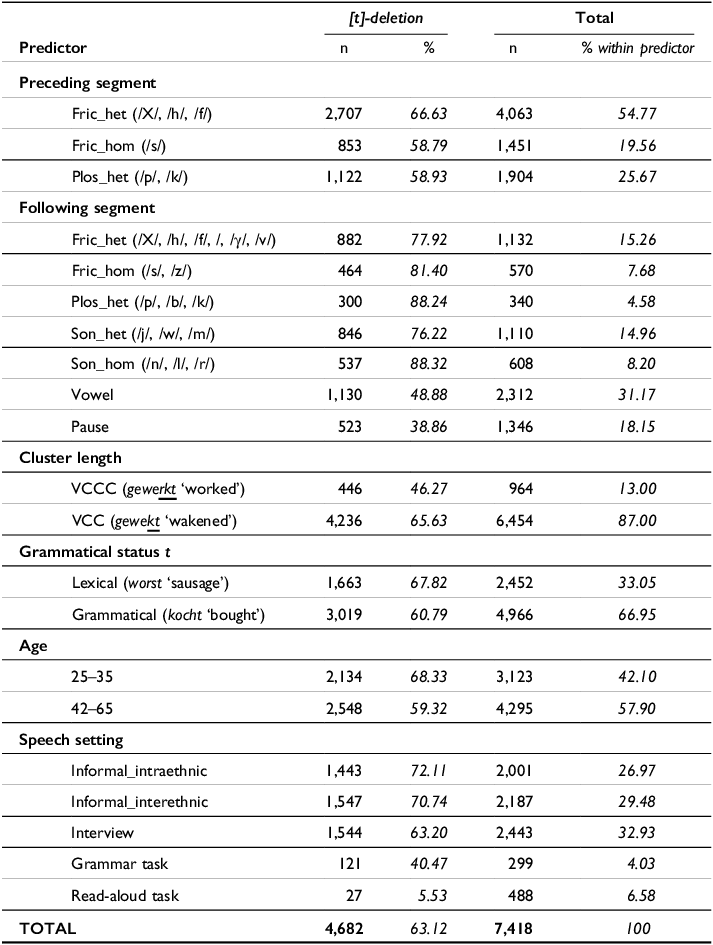
As can be seen in table 4, the Surinamese Dutch speakers in the corpus delete final coronal stops in the majority of cases (63%), indicating that [t]-deletion is indeed a highly relevant linguistic variable in Surinamese Dutch. The table also shows that the deletion percentages vary among the various levels of the predictors introduced in section 2. To draw conclusions about these predictors multivariate analyses are needed, as there are several imbalances in the corpus. Table 4 (see % within predictor) reveals, for example, that there is more spontaneous data than read-aloud data or more tokens followed by a vowel than by a pause. Below, we first discuss the results of the random forest and conditional inference tree analysis (section 5.1), followed by those of the regression analysis (section 5.2).
Observations of [t]-deletion & percentage of deleted [t]’s per predictor level, total amount of observations with word-final /t/ (deleted + retained), and distribution of all observations within the predictor (in percentages)

5.1. Random forest and conditional inference tree results
Figure 1 visualizes the permutation-based variable importance scores calculated on the basis of random forest modeling. These indicate that the segment following the final consonant and the speech setting are the most important predictors for [t]-deletion in our dataset, with scores of respectively 0.49 and 0.44. The random forest analysis also points towards considerable interspeaker variation (score of 0.22) and an effect of word frequency on [t]-deletion rates (score of 0.15). The predictor “speaker” was included (also in the CIT) to avoid random speaker effects distorting the effect of other predictors. The impact of the age of a speaker, the segment preceding the final stop, the morphological status of the final stop, and the cluster length seems to be marginal, given that the importance scores for these predictors (respectively 0.06, 0.06, 0.06, and 0.03) are close to the zero-line of “no importance.” The model’s C-value – “an index of concordance between the predicted probability and the observed response” (Baayen Reference Baayen2008:204) – is 0.89, indicating that it has strong predictive power (0.5 = random predictions, 1 = perfect predictions).
Conditional permutation-based variable importance per predictor, calculated on the basis of random forest modeling.

To assess how the predictors influence [t]-deletion probabilities, a conditional inference tree was generated. The result is a fairly complex tree of eight levels (see figures 2 and 3; tree cut in two for readability), including all predictors except cluster length. The tree has a C-value of 0.811, which indicates a fairly high predictive power.
Part 1 of conditional inference tree (following segment is not a vowel or a pause).

Part 2 of conditional inference tree (following segment is a vowel or a pause).

Assessing the impact of the predictors included in the tree, we can draw the following conclusions:
-
The segment following the final coronal stop is the most important predictor (full ellipse marked in yellow), with less [t]-deletion before pauses and vowels. Pauses seem to trigger [t]-deletion more often than vowels (contrary to what De Vries et al. (Reference de Vries, Franken, Jansen, Gerritsen, Vruggink and Zeef1974:242), Van Hout (Reference Van Hout, Daalder and Gerritsen1981:32), and Goeman (Reference Goeman1999:175) observed for Netherlandic Dutch dialects), but this effect only emerges for grammatical /t/’s in informal conversations and only for some speakers. Looking at differences among following consonants, a distinction that emerges in various subbranches of the tree is one between fricatives and heterorganic sonorants on the one hand and plosives and homorganic sonorants on the other, the latter triggering more [t]-deletion. This effect, which does not really align with previous literature (Van Hout Reference Van Hout1989b:186–188, Schuppler et al. Reference Schuppler, van Dommelen, Koreman and Ernestus2012:601), is, however, minor: The splits are generally made at the bottom of the tree.
-
Speech setting is the second most important predictor (ellipse with dashed line marked in blue), with more [t]-deletion in spontaneous conversations (intraethnic informal conversation, interethnic informal conversation, and sociolinguistic interview) than in the grammar and read-aloud tasks. Important to remember here is that respondents were instructed to speak “Standard Surinamese Dutch” in the task settings, whereas they did not receive such instruction for the spontaneous conversations. At lower branches in the tree, consistent splits can be found between the read-aloud task (a pronunciation task) and the grammar task (a picture-based description task), the latter triggering more [t]-deletion. In the read-aloud task, /t/’s are almost never deleted preceding pauses and vowels, except by one speaker (87-2). In the spontaneous conversations, [t]-deletion rates are lower in the interview setting than in the informal conversations, at least for ten of the 22 speakers. The eldest of these ten speakers also seem to distinguish between intraethnic and interethnic conversations – with more deletion in the latter – but this effect is only found for grammatical /t/’s preceded by heterorganic fricatives and followed by a consonant.
-
In the spontaneous conversations, there is quite some interspeaker variation in the degree to which /t/’s are dropped (ellipse with dotted line marked in pink). Speakers also seem to vary in the degree to which their [t]-deletion behavior can be explained in terms of language-internal and stylistic factors. For some speakers, specifically speakers 60−2, 60−3, 61−1, 62−2, 63−1, 65−1, 65−2, 70−1, 83−1, 84−2, for instance, the formality of the speech setting (interview versus informal conversation with a friend) and the morphological function of the coronal stop seem to predict their [t]-deletion behavior for words ending in consonant clusters, whereas that is not the case for other speakers, such as 60−1, 63−2, 78−1, 84−1, 85−1, 87−2, 90−1, 94−1, 94−2, 95−1, 62−1, 91−1.
-
The segment preceding the final stop (a heterorganic fricative, homorganic fricative, or a heterorganic plosive) influences [t]-deletion to a lesser extent than the predictors discussed above. It provides cues to split the data at five places in the tree (stadium with dotted line marked in red), but no straightforward conclusions can be drawn, due to complex interactions with the other predictors in the model. For instance, in the context of the final stop being followed by a consonant in spontaneous speech settings, some speakers delete [t] more after heterorganic fricatives than after homorganic fricatives and heterorganic plosives, whereas for other speakers, another split is made (between fricatives and plosives), but only for low-frequency word forms. In the context preceding pauses or vowels, the effect is reversed for some respondents, as they drop final coronal stops more easily after homorganic fricatives and heterorganic plosives than after heterorganic fricatives, albeit only for lexical /t/’s in low-frequency word forms. Other speakers in this context show the same reversed effect, now however distinguishing between homorganic fricatives on the one hand – with higher rates of [t]-deletion – and heterorganic fricatives and plosives.
-
Three splits are made based on the frequency of the word forms in the corpus (full stadium marked in purple), each time signaling more [t]-deletion in high-frequency word forms. However, this effect is attested only for final stops followed by pauses or consonants in spontaneous conversations, and only for specific speakers. When final stops are followed by pauses, the effect seems restricted to grammatical /t/’s.Footnote 12
-
In line with the random forest results, the tree shows that age plays a minor role in the [t]-deletion behaviour (rectangle with dashed line marked in orange). In spontaneous conversations, final /t/’s with a grammatical function followed by a consonant and preceded by a heterorganic fricative tend to be deleted more often by younger speakers than by older speakers. This effect is, however, only observed among a specific group of speakers. It has to be remarked that a more general age effect emerges – implying more [t]-deletion among younger speakers, independent of the grammatical function of /t/ and the segment preceding and following /t/ – when excluding “speaker” as predictor in the tree.Footnote 13 In a random forest model without speaker as random factor, however, the importance score of age remains low.
-
The impact of the morphological status of the coronal stop (full rectangle marked in green) is secondary to the effect of the following segment, the speech setting, and the speaker, and is not straightforward. When the final stop is followed by a vowel or pause, for instance, lexical /t/’s tend to be deleted more frequently than grammatical /t/’s, but for some speakers, this effect is observed only when the preceding segment is a homorganic fricative, whereas for others it is independent of the preceding segment. In the context of a stop being followed by a consonant, there is also evidence of lexical /t/ being dropped more easily, but the effect is only attested in specific contexts, for instance, when the preceding segment is a heterorganic fricative in informal conversations or when the following segment is not a plosive or heterorganic sonorant in the interview setting.
5.2. Regression analysis results
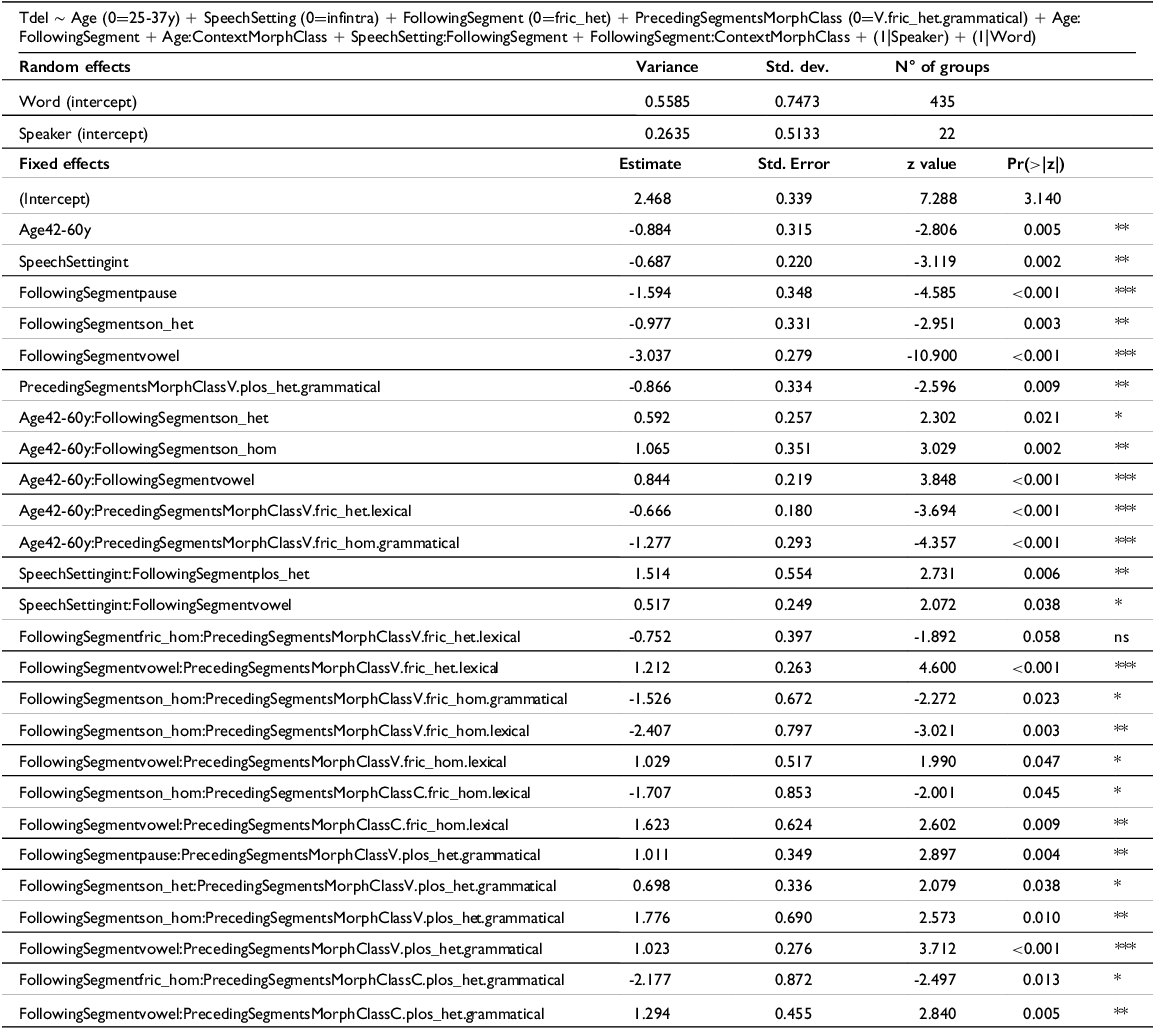
The results of the regression analyses are summarized in table 5, in which we only include effects for predictors that turned out to be significant. In terms of power, the final model has a C-measure of 0.82, a conditional R2 score of 0.403, and a marginal R2-score of 0.25, all of which are acceptable values. The conditional R2 score, a value between zero and one, indicates the amount of variation in the response variable explained by the model. Where both the C-measure and the conditional R2 are calculated taking both fixed and random effects into account, the marginal R2 of the model, a value between zero and one, indicates how much of the variation in the response variable is captured exclusively by the fixed effects in the model (see Winter Reference Winter2020:264).
Regression table (only significant fixed effects are included)

As can be deduced from table 5, significant effects were found for age, speech setting, following segment, and ‘PrecedingSegmentsMorphClass’. The effects of age, speech setting, and PrecedingSegmentsMorphClass, however, all interact with the segment following the final coronal stop. Moreover, the age effect interacts with PrecedingSegmentsMorphClass. Figure 4 visualizes all fixed effects.
Probability of [t]-deletion for the different categories of Age, Following Segment, PrecedingSegments, MorphClass, and Speech Setting (estimates on the basis of mixed-effects logistic regression).

Close inspection of the estimates in table 5 and figure 4 leads to the following conclusions:
-
The following segment is the most important predictor. In general, the following pattern can be found: If the final coronal stop is followed by an obstruent (fric_het, fric_hom, plos_het) or a homorganic sonorant, [t]-deletion rates are higher than when it is followed by a heterorganic sonorant. [t]-deletion probabilities drop more drastically when /t/ is followed by a pause or a vowel, with the lowest probabilities being found before vowels. This pattern varies somewhat depending on the consonant(s) preceding the final stop and the grammatical status of /t/. The difference between vowels and other following segments is, for instance, smaller when lexical /t/’s are preceded by a fricative (independent of cluster length) or when a grammatical /t/ is preceded by a plosive and another consonant. The high deletion rates before homorganic sonorants drop when the preceding segment is a homorganic sonorant. For /t/’s followed by homorganic fricatives, deletion-probabilities are lower when a lexical /t/ is preceded by a vowel and a heterorganic fricative (V.fric_het.lexical) or when a grammatical /t/ is preceded by a consonant and a heterorganic plosive (C.plos_het.grammatical).
-
Preceding segment, cluster length, and morphological class: If we want to assess the impact of cluster length, preceding segment, and the morphological class of /t/ – which we merged in one predictor “PrecedingSegmentsMorphClass” due to collinearity issues – we have to carefully compare categories in the right-hand plots in figure 4. In these plots, dark colored labels (top graph) and lines (bottom graph) – black, dark green, dark brown – represent grammatical /t/’s and light colors (grey, light green) lexical /t/’s. Bold labels (top graph) and dashed lines (bottom graph) represent CCt-clusters, and the contrast between heterorganic fricatives, homorganic fricatives, and heterorganic plosives is visualized through color categories (black/grey vs. (dark) green vs. brown). The plots show a distinction between preceding plosives and fricatives (cluster length and grammatical status being equal), with fricatives triggering more deletion. This effect, however, only holds in specific contexts (among young speakers and when the following segment is a fricative or plosive). No clear differences can be observed between homorganic and heterorganic fricatives. Concerning cluster length (comparing brown to bold/dashed brown and light green to bold/dashed light green), the effect is again context-sensitive. [t]-deletion rates are, for instance, higher for VCC-clusters than for CCC-clusters, but this effect is only significant for grammatical /t/’s preceded by a plosive and followed by a heterorganic sonorant. An effect of grammatical status is also attested – namely higher deletion rates for grammatical /t/’s – but only for young speakers and when the preceding segment is a heterorganic fricative and the following one a homorganic fricative.
-
Age: respondents from the older age group show lower probabilities of [t]-deletion in the contexts “V.fric_het.lexical” and “V.fric_hom.grammatical.” A significant interaction term indicates that age does not impact [t]-deletion when the following segment is a vowel or a sonorant (heterorganic or homorganic).
-
Speech setting: [t]-deletion rates are generally lower in the interview setting, but not when the following segment is a vowel or a (heterorganic) plosive.
Turning now to the random effects for word form and speaker in the model, it can be observed that the variance among word forms (0.56) is higher than the variance among speakers (0.26). As word frequency might be an important explanatory factor in this variance (see section 2) – a factor we could not include in the regression analyses because of collinearity issues – figure 5 shows the random intercepts for the different word forms in function of their frequency in the corpus.
Random intercepts for Word in function of their frequency in the corpus. Token frequency was log transformed to reduce the skewness of the data and to provide a more efficient visualization.

The plot indicates that in word forms such as gezegd (past participle of zeggen ‘to say’) and gevraagd (past participle of vragen ‘to ask’) [t]-deletion rates are higher than can be expected on the basis of the predictors (evidenced by high positive random intercept values), whereas in forms such as wist (simple past of weten ‘to know’) and lukt (simple present third singular of lukken ‘to succeed, be successful, manage’) they are low (evidenced by a strongly negative random intercept value). Turning to the relation between the intercepts and a word’s frequency, the correlation between the random intercept corrections and the frequency of the token in the corpus is weak: No pattern can be detected in figure 5, and Pearson’s product-moment correlation is weak (correlation=0.17, p<0.001). The most frequent words in this dataset are thus not systematically the ones with the highest probability of [t]-deletion, contrary to earlier findings for Dutch (Goeman Reference Goeman1999:479, Schuppler et al. Reference Schuppler, van Dommelen, Koreman and Ernestus2012 600).
6. Discussion and conclusion
Our analysis of the [t]-deletion behavior of 22 highly educated, Creole mother-tongue speakers of Dutch in Paramaribo indicates that [t]-deletion is highly frequent in Surinamese Dutch (RQ1): 63 percent of all word-final /t/’s preceded by an obstruent were deleted in our data, with percentages rising to an average of 72 percent in informal conversations with friends. Comparing these overall frequencies to the ones reported in Schuppler et al. (Reference Schuppler, van Dommelen, Koreman and Ernestus2012:602) – who from all previous research on [t]-deletion in European Dutch build on a corpus most similar in design to the Corpus Gesproken Surinaams-Nederlands – it is clear that [t]-deletion is far more frequent in Surinamese Dutch than in European Netherlandic Dutch: Whereas the highly educated males conducting informal conversations in the Ernestus corpus of Spontaneous Dutch (Ernestus Reference Ernestus2000) deleted their final /t/’s in 49 percent of all possible cases when preceded by an obstruent, this was the case in 72 percent of all cases for the Surinamese highly educated women. Of course, we have to bear in mind that Schuppler et al.’s annotations are based on acoustic analyses, whereas ours were auditorily based, but given the fact that we found a fairly high correlation between acoustic and auditory categorizations of a random subset of our data (see section 4.2.), it seems safe to conclude that [t]-deletion is indeed more frequent in Surinamese than in Netherlandic Dutch. This observation is in line with the hypotheses that language contact with Sranan – which does not have word-final consonant clusters ending in /t/or /d/ nor /t/-suffixes – and the lack of a strong normative tradition in Suriname has stimulated [t]-deletion in Surinamese Dutch.
Concerning the conditioning of [t]-deletion (RQ2), the data indicate that the segment following the final stop is the most important predictor. In line with the obligatory contour principle, we observed the following hierarchy, from highest to lowest probability of [t]-deletion: obstruents and homorganic sonorants > heterorganic sonorants > pauses > vowels. The speech setting is the second-best predictor, with formality as an important factor: informal conversations > sociolinguistic interviews with a non-Surinamese, white interviewer > picture description task > read-aloud task. It is important to note, though, that deletion rates are still relatively high in the interviews and picture description tasks (overall frequencies of respectively 63 and 41 percent), especially considering the fact that the speakers were instructed to speak “Standard Surinamese Dutch” in the picture description and the read-aloud task. [t]-deletion has clearly permeated more formal communication styles – as we hypothesized – but the stylistic patterning shows it is not considered “standard” or appropriate for formal contexts by everyone. Overall, there is much individual variation; the global deletion rates per speaker vary between 43 and 78 percent.
Five other factors were found to impact [t]-deletion rates – the age of the speaker, the morphological status of /t/, the segment preceding the final stop, the frequency of the word containing the final stop, and cluster length – but the effects of these factors were small and interacted with the phonetic context. Age-wise, respondents from the younger age group (25–37 years old) showed higher probabilities of [t]-deletion in a number of phonetic contexts than speakers in the older age group (42–60 years old). Concerning the segment preceding the final /t/, fricatives were found to stimulate [t]-deletion more than plosives, but only in very specific contexts and only for a subgroup of speakers, as could be seen in the inference tree (figures 2–3). No differences were found between homorganic and heterorganic fricatives in the regression analysis, whereas the inference tree showed different results for different speakers. Frequency effects were found implying more [t]-deletion in high-frequency word forms, but only in lower branches of the conditional inference tree. The effect was not confirmed in a logistic regression analysis with word form as random predictor, so cautiousness is needed. Concerning the grammatical status of /t/, the effect is all but clear. In the conditional inference tree, lexical /t/’s were more likely to be deleted than grammatical /t/’s, whereas the logistic regression indicated higher deletion rates for grammatical /t/’s, but only for young speakers and when the preceding segment is a heterorganic fricative and the following one a homorganic fricative. As for cluster length, [t]-deletion rates were found to be higher for VCC-clusters than for CCC-clusters, but the effect was very small and only found for grammatical /t/’s preceded by a plosive and followed by a heterorganic sonorant. In the CIT analysis, cluster length did not emerge as predictor. In sum: the effects of preceding segments, word frequency, cluster length, and the morphological status of /t/ are fairly complex in Surinamese Dutch.
At the beginning of this article, we set out to study the conditioning of [t]-deletion to gain insight into the degree to which Surinamese Dutch differs from European Dutch varieties. The idea was that if the conditioning were to differ significantly from the one in European Dutch varieties, this would be clear phonetic evidence that Surinamese Dutch is a variety in its own right. However, in comparing our research results to those on European Dutch varieties (see RQ3), we have to bear a few methodological issues in mind. First, our data point to severe collinearity among predictors (e.g. between cluster length and the preceding segment or token frequency and cluster length), which is an issue that has not always been considered in earlier research. To bypass this problem, we merged several predictors in our research (morphological class, cluster length, and preceding segment), but this of course complicates data comparability. Moreover, our research carefully considered interactions between predictors, which has not always been the case in earlier research, as the introduction of multivariate statistics into the field of sociolinguistics and the wide availability of the necessary software are fairly recent developments. Thirdly, we also have to bear in mind that our research focuses on highly educated women who were given the tasks (i) to speak as “they would naturally speak” (with a friend or an interviewer) and (ii) to speak as “standard” as possible, whereas in several studies on European Dutch, the task was to translate sentences into the local, regional dialect (Hinskens Reference Hinskens1993, Goeman Reference Goeman1999, De Wulf & Taeldeman Reference De Wulf and Taeldeman2006) and/or to study specifically targeted dialect speakers (de Vries et al. Reference de Vries, Franken, Jansen, Gerritsen, Vruggink and Zeef1974, Schouten Reference Schouten1984). The data of Mitterer & Ernestus (Reference Mitterer and Ernestus2006) and Schuppler et al. (Reference Schuppler, van Dommelen, Koreman and Ernestus2012) are closest to ours (spontaneous and non-dialectal). It is, however, important to remark that Schuppler et al. (Reference Schuppler, van Dommelen, Koreman and Ernestus2012) build on data from the west of the Netherlands, where [t]-deletion is known to occur less (in the local dialect at least) than in the east of the European Dutch area, and that Mitterer & Ernestus (Reference Mitterer and Ernestus2006) build on a regionally and socially stratified corpus of spoken European Dutch, but do not offer any information on the social or regional background of the speakers they include in their analysis.
Taking these caveats into consideration, we can draw a number of conclusions concerning the similarities and differences of [t]-deletion conditioning in Surinamese and European Dutch. Firstly, some patterns are clearly similar, such as the context effect, the obligatory contour principle observed in the effect of the following consonant, and the frequency effect that emerged in the inference tree (but not in the regression analysis). There are, however, also differences. Whereas research on European Dutch, for instance, consistently shows that /t/’s followed by a vowel are deleted more often than /t/’s followed by a pause, the reverse tendency was found in our dataset. The (weak) evidence concerning the impact of cluster length (VCC > VCCC) also contradicts general European tendencies. An important difference to take into consideration is the age effect in our data (younger > older), as it contradicts the European tendencies observed by Van Hout (Reference Van Hout1989b:100) and Goeman (Reference Goeman1999) and can be indicative of a change towards more [t]-deletion in Suriname.
The high frequency of [t]-deletion in the spoken Dutch of our respondents indicates that this feature is an inherent characteristic of the Surinamese Dutch spoken by Creoles. The fact that it is also used frequently (though not by all speakers) in more formal contexts and contexts in which the instruction was to speak “Standard Surinamese Dutch,” along with the observation that young speakers delete final /t/’s more, might be a sign that the feature is endoglossically standardizing and becoming a part of a Surinamese Dutch pronunciation norm. That its conditioning is in several respects different from the conditioning in European Dutch can be considered support for the idea that Surinamese Dutch is indeed not only ideologically but also formally a separate variety of Dutch.
It is clear that more research is necessary if we want to fully understand the status and conditioning of [t]-deletion in Surinamese Dutch. Firstly, the results provide much insight into [t]-deletion by highly educated female Creoles in Paramaribo, but to know whether [t]-deletion can be considered a feature of “Standard Surinamese Dutch,” speakers of other major social and ethnic groups also need to be studied. We hope that the Corpus of Spoken Surinamese Dutch can in the future be extended to include Surinamese speakers of, for instance, Hindustani, Javanese, Maroon, mixed, or indigenous backgrounds. An interesting question is then whether ethnic groups who historically have had less contact with Sranan show lower rates of [t]-deletion. Secondly, to benchmark the Surinamese data, new research into contemporary European Dutch, focusing on spontaneously spoken supraregional Dutch in different regions and among different age groups would be a great asset. This would allow us to map contemporary patterns of phonetic convergence or divergence. To conclude, follow-up research yielding a more fine-grained categorization of the realization of final [t] than the binary split used in this study could also lead to a deeper insight into the phenomenon, along with an inclusion of other predictors. We specifically think it might be interesting to add predictors that have in the past been shown to be relevant to [t]-deletion, such as syntactic or prosodic boundaries (Schuppler et al. Reference Schuppler, van Dommelen, Koreman and Ernestus2012, Coetzee & Kawahara Reference Coetzee and Kawahara2013, Tamminga Reference Tamminga2018) and bigram frequency (Schuppler et al. Reference Schuppler, van Dommelen, Koreman and Ernestus2012, Walker Reference Walker2012) or conditional frequency (Purse, Fruehwald, & Tamminga Reference Purse, Fruehwald and Tamminga2022:25), and predictors that have been signaled to be important for phonetic reduction in general, such as neighborhood density, semantic predictability, and discourse mention (Clopper & Turnbull Reference Clopper, Turnbull, Cangemi, Clayards, Niebuhr, Schuppler and Zellers2018:27). While the study we presented in this article was clearly exploratory, it shows that [t]-deletion is a particularly interesting phenomenon to study in the context of the potential emergence of an endoglossic Dutch norm in Suriname. On a methodological level, it provides evidence for the importance of taking interactions and collinearity between predictors into account in research into the conditioning of [t]-deletion – not only in Dutch but also in other languages, such as English.