Background
The high prevalence of mental disorder following combat-related deployment is well documented (Fear et al., Reference Fear, Jones, Murphy, Hull, Iversen, Coker, Machell, Sundin, Woodhead, Jones, Greenberg, Landau, Dandeker, Rona, Hotopf and Wessely2010). Research regarding antecedent trauma and the mental health impact of deployment has been somewhat contradictory. Some research suggests that antecedent trauma reduces the mental health impact of deployment (known as inoculation) (Owens et al., Reference Owens, Dashevsky, Chard, Mohamed, Haji, Heppner and Baker2009), some research suggests that antecedent trauma increases the mental health impact of deployment (known as sensitization) (Solomon and Flum, Reference Solomon and Flum1988), and yet other research suggests that there is no interactive effect (Van Voorhees et al., Reference Van Voorhees, Dennis, Calhoun and Beckham2014). However, these studies have generally been cross-sectional and have defined prior trauma in a variety of ways, some including childhood trauma alongside adult trauma, whilst others have considered them separately.
Childhood trauma is likely to have different implications to adult antecedent trauma due to its impact at potentially critical periods of brain development (Teicher et al., Reference Teicher, Anderson, Ohashi and Polcari2014). Some studies have treated childhood adversity as a continuous concept (Iversen et al., Reference Iversen, Fear, Simonoff, Hull, Horn, Greenberg, Hotopf, Rona and Wessely2007) whilst others have focussed on particular types of childhood trauma, such as child abuse (Fritch et al., Reference Fritch, Mishkind, Reger and Gahm2010). In general, the literature regarding childhood adversity/trauma and deployment demonstrates that childhood adversity/trauma has an independent association with post-deployment disorder (Cabrera et al., Reference Cabrera, Hoge, Bliese, Castro and Messer2007). However, there have been challenges in exploring the associations of particular types of childhood traumatic experience as they tend to cluster, with most of those who experience childhood trauma/adversity experiencing more than one type (Finkelhor et al., Reference Finkelhor, Ormrod and Turner2007).
Previously we investigated childhood trauma and disorder in determining mental disorder and associated outcomes across the Australian Defence Force (ADF) compared with employed civilian males, aged 18–60 years. We attempted to overcome the issue of clustering by forming mutually exclusive categories based on the types of childhood trauma experienced. We then compared these different childhood trauma categories with each other and with no childhood trauma. We found important differences in the associations of different types of childhood trauma with mental disorder as well as with suicidality (Syed Sheriff et al., Reference Syed Sheriff, Van Hooff, Malhi, Grace and McFarlane2018).
In order to better inform early intervention and prevention strategies, we investigated the association of childhood trauma with the development of probable disorder (anxiety/affective, depression, PTSD or alcohol use disorder) between pre- and post-deployment assessments. We also sought to investigate the extent that this relationship was mediated by pre-deployment symptoms. Due to evidence of important gender differences within military populations (Rona et al., Reference Rona, Fear, Hull and Wessely2007), and the fact that we did not have sufficient female responders for a meaningful separate analysis, we have limited this analysis to males. In addition, due to demonstrated differences in the impact of deployment for Reservists (Hotopf et al., Reference Hotopf, Hull, Fear, Browne, Horn, Iversen, Jones, Murphy, Bland, Earnshaw, Greenberg, Hughes, Tate, Dandeker, Rona and Wessely2006), we have included only Regular male ADF personnel deployed to Afghanistan.
Methods
The Joint Health Command Low-Risk Ethical Review Panel provided ethical approval for this analysis. This sample was taken from the Middle East Area of Operations (MEAO) Prospective Study (Davy et al., Reference Davy, Dobson, Lawrence-Wood, Lorimer, Moores, Lawrence, Horsley, Crockett and McFarlane2012), which assessed ADF members deploying to Afghanistan after June 2010, and returning by June 2012 (Operation SLIPPER). In total, 3074 ADF members deployed during this period and were thus eligible. However, due to many of these being subject to extensive training commitments and short lead-up time, many could not be approached for participation. Thus, personnel from 13 units and a Navy ship, as well as those deploying into Coalition units, were approached to participate. In all, 1871 ADF members participated in the ‘pre-deployment’ assessment. In total, 1324 (70.8% retention rate) also participated within 4 months following their deployment (the ‘post-deployment’ assessment). Participants spanned all ranks and Services, and included Special Forces (who were unidentifiable, and classified under Army Service), and full-time Reservists. However, we excluded females and Reservists from this analysis. In total, 1009 male Regular ADF personnel completed pre-and post-assessments and were included in this analysis.
Procedure
Prior to deployment, eligible participants attended briefings where researchers described the study and provided information and materials. Participants were informed that although initial consent was for both assessments together, they could withdraw at any time. They were also informed that participation was anonymous, and that their results would not be identifiable, or provided to the military. Military personnel were not involved in recruitment or data collection.
Participants completed and returned consent forms and questionnaires either at the briefing or later (by post). Following deployment, the researchers sent participants hard-copy and electronic questionnaires with unique de-identified study IDs (not military IDs) attached.
At both assessments, non-responders received email and reminders by post 1 week after receiving study materials, and telephone messages 1 week later. This study was approved by the Australian Defence Human Research Ethics Committee (no. 488-07) and the University of Adelaide Human Research Ethics Committee (no. H-064-2008).
Variables (pre-deployment assessment)
Demographics
Data regarding Service (Navy, Army or Royal Air Force) and rank were obtained from military records. Participants reported their age, educational qualifications and prior deployment history. Ranks were grouped into other ranks (Private to Corporal equivalents), Non-Commissioned Officers (Sergeant to Warrant Officer equivalents) and Commissioned Officers (Lieutenant to General equivalents).
Trauma history
Participants were asked to indicate if they had ever experienced 18 specific traumatic events listed in the questionnaire. Of these items, 11 were adapted from the Composite International Diagnostic Interview (Kessler and Ustun, Reference Kessler and Ustun2004), and seven were based on systematic recoding of the ‘other’ trauma category from a previous community study (Goldney et al., Reference Goldney, Wilson, Dal Grande, Fisher and McFarlane2000). Participants were also asked the age at which they had first experienced each event.
These events were coded according to those which had first occurred prior to the age of 18 years (childhood) and those that first occurred aged 18 years or over (adult). Although the questionnaire was not exactly the same as that used in our previous study (Syed Sheriff et al., Reference Syed Sheriff, Van Hooff, Malhi, Grace and McFarlane2018), we used the same system of coding trauma by type. Trauma types were coded as ‘non-interpersonal’ (life-threatening accident or natural disaster) or ‘interpersonal’ (rape, sexual molestation, serious physical attack/assault, threatened with a weapon/held captive/kidnapped, tortured or victim of terrorists, threatened/harassed without a weapon, experienced domestic violence, child abuse-emotional, child abuse-physical). As our aim was to compare different types of traumatic experiences with no trauma, we coded all types of trauma that had not already been coded as either interpersonal or non-interpersonal as ‘unclassified’ (direct combat, witnessed someone badly injured/killed, witnessed domestic violence, found a dead body, witnessed suicide/attempt, other stressful event and shocked because of event to someone close).
As per our previous study (Syed Sheriff et al., Reference Syed Sheriff, Van Hooff, Malhi, Grace and McFarlane2018), mutually exclusive childhood trauma categories were formed so that each could be compared with each other and with ‘no childhood trauma’ as a reference category. These were non-interpersonal (without interpersonal), interpersonal (without non-interpersonal), both non-interpersonal and interpersonal and unclassified (without either interpersonal or non-interpersonal).
Pre- and post-deployment assessment: probable mental disorder
Anxiety/affective disorder
The Kessler Distress Scale (K10) (Kessler et al., Reference Kessler, Andrews, Colpe, Hiripi, Mroczek, Normand, Walters and Zaslavsky2002) detects symptoms found in several common disorders, including affective disorders and anxiety. Participants rate the 10 questions in reference to the previous 4 weeks. Total scores range from 10 to 50, with higher scores indicating greater distress. The K10 is widely used in epidemiological research and clinical screening and demonstrates high factorial validity and internal consistency. It performs at least as well as, or better than similar questionnaires (Andrews and Slade, Reference Andrews and Slade2001). A previous study in the ADF demonstrated an optimal epidemiological cut-off point of ⩾25 to indicate probable 30-day anxiety or affective disorder (Searle et al., Reference Searle, Van Hooff, McFarlane, Davies, Fairweather-Schmidt, Hodson, Benassi and Steele2015).
Depression
Depressive symptoms were assessed using the nine-item depression module of the Patient Health Questionnaire (PHQ-9), which correspond to the nine criteria for DSM-IV depressive disorder (Kroenke et al., Reference Kroenke, Spitzer and Williams2002). Respondents rated the severity of symptoms over the previous 2 weeks on a four-point (i.e. 0–3) Likert scale with the total score ranging from 0 to 27, with higher scores indicating greater depressive symptoms. The PHQ-9 has strong psychometric properties including high diagnostic validity in depression detecting, internal consistency and test–retest reliability. An epidemiological cut-off point of ⩾10 was used to indicate probable 30-day depression (Kroenke et al., Reference Kroenke, Spitzer, Williams and Lowe2010).
PTSD
DSM IV PTSD was assessed using the Post-traumatic Stress Disorder Checklist civilian version (PCL-C) (Weathers et al., Reference Weathers, Litz, Herman, Huska and Keane1993), which allows ratings to be based on any lifetime trauma (not just military-related). Respondents rate symptoms in the past month, which are summed to give a total score, ranging from 17 to 85. Higher scores indicate a greater severity of PTSD symptoms. The PCL shows high validity and reliability. We chose a cut-off score of ⩾53, previously validated against the CIDI in this population to indicate a probable 30-day disorder (Searle et al., Reference Searle, Van Hooff, McFarlane, Davies, Fairweather-Schmidt, Hodson, Benassi and Steele2015).
Alcohol use disorders
The AUDIT comprises 10 questions on alcohol consumption, dependence and problems, over the last 12 months. Total scores range from zero to 40. Higher scores indicate more problematic alcohol consumption. The AUDIT demonstrates high internal consistency, factorial convergent and criterion validity (Reinert and Allen, Reference Reinert and Allen2002). Previous research within the ADF population demonstrated an optimal epidemiological cut-off of ⩾20 for a probable 30-day alcohol disorder (Searle et al., Reference Searle, Van Hooff, McFarlane, Davies, Fairweather-Schmidt, Hodson, Benassi and Steele2015).
Any disorder
Any individual that scored equal or above the pre-specified epidemiological cut-off on any of the K10, PCL, PHQ or AUDIT was coded as having a probable 30-day disorder. Those who had a greater number of probable 30-day disorders at the post-deployment assessment than at pre-deployment assessment were coded as having a new post-deployment probable disorder.
Post-deployment assessment
Index deployment trauma
A 26-item questionnaire adapted from the Deployment Risk and Resilience Inventory (Vogt et al., Reference Vogt, Proctor, King, King and Vasterling2008), the King's College Gulf War Survey (Unwin et al., Reference Unwin, Blatchley, Coker, Ferry, Hotopf, Hull, Ismail, Palmer, David and Wessely1999) and the Traumatic Stressors Exposure Scale (TSES-R) was utilised to retrospectively report trauma experienced on their most recent deployment to the MEAO. Each trauma item was coded dichotomously. The 26 items were grouped into nine broader exposure categories based on US factor-analytic research on combat exposures (Wilk et al., Reference Wilk, Bliese, Kim, Thomas, McGurk and Hoge2010) and previous research within this Australian sample (Davy et al., Reference Davy, Dobson, Lawrence-Wood, Lorimer, Moores, Lawrence, Horsley, Crockett and McFarlane2012; Dobson et al., Reference Dobson, Treloar, Zheng, Anderson, Bredhauer, Kanesarajah, Loos, Pasmore and Waller2012). Traumas experienced within each of these nine categories were summed to create a count of the number of deployment-related trauma types experienced, ranging from zero to nine (Dobson et al., Reference Dobson, Treloar, Zheng, Anderson, Bredhauer, Kanesarajah, Loos, Pasmore and Waller2012). Thus, rather than frequency or severity, it reflected the range of trauma experienced. Previously, similar trauma count variables have shown consistent significant associations with mental disorder outcomes (Sareen et al., Reference Sareen, Henriksen, Bolton, Afifi, Stein and Asmundson2013).
Analysis
All analyses were performed in STATA version 14.2. Descriptive analyses were utilised to describe the sample and compare them to the rest of the MEAO male regular ADF population. We then analysed the difference in proportions of probable disorder between pre- and post-deployment assessments. Analyses were then performed for the prevalence and associations of new post-deployment probable disorder with demographic (age, education and relationship status) and service factors (rank and Service), childhood trauma (by number of types and by category compared with no childhood trauma as the reference category), adult factors prior to the index deployment (combat, deployment and trauma), pre-deployment symptoms and index deployment factors (trauma, deployment length and combat).
Next, logistic regression analyses were performed to calculate associations between childhood trauma categories (compared with no childhood trauma as the reference category) and new post-deployment probable disorder. In the first model (Model 1), we controlled for demographics (age, education and relationship status), service factors (rank and service) and adult trauma (prior to the index deployment). In the second model (Model 2), we controlled for the same factors as in Model 1 and also for index deployment trauma. In the third model (Model 3), we controlled for the same factors as in Model 2 and also for pre-deployment baseline symptoms.
We examined mediator pathways between childhood trauma and new post-deployment probable disorder using logistic regression models. As the outcome of interest was dichotomous, we utilised generalised structural equation modelling (GSEM) within STATA. The GSEM pathway utilised the link ‘logit’ and the family ‘Bernoulli’.
We calculated associations between childhood trauma categories (compared with no childhood trauma as the reference category) and new post-deployment probable disorder. We then reran the GSEM analysis adding baseline symptoms (PHQ score) as a mediator (Acock, Reference Acock2006). The total indirect pathways were calculated utilizing non-linear combinations of estimators. In order to exclude the possibility that our results were due to confounding by deployment trauma, we then repeated the analysis controlling for demographics, service factors and adult factors prior to the index deployment (adult trauma and deployment), and also added index deployment trauma count, as well as baseline symptoms as mediators.
Results
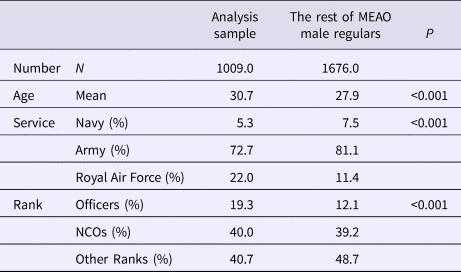
Compared to the rest of the male MEAO deployed personnel, the sample of 1009 used in this analysis were older, a higher proportion were Officers and a higher proportion were in the Royal Air Force (see Table 1).
Sample characteristics

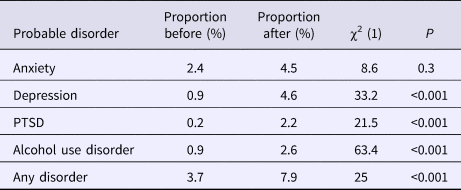
Significantly more of the sample had a probable mental disorder at post-deployment than at the pre-deployment assessment. This was the case for all of the individual disorders, other than anxiety (see Table 2).
Pre- and post-deployment probable disorder

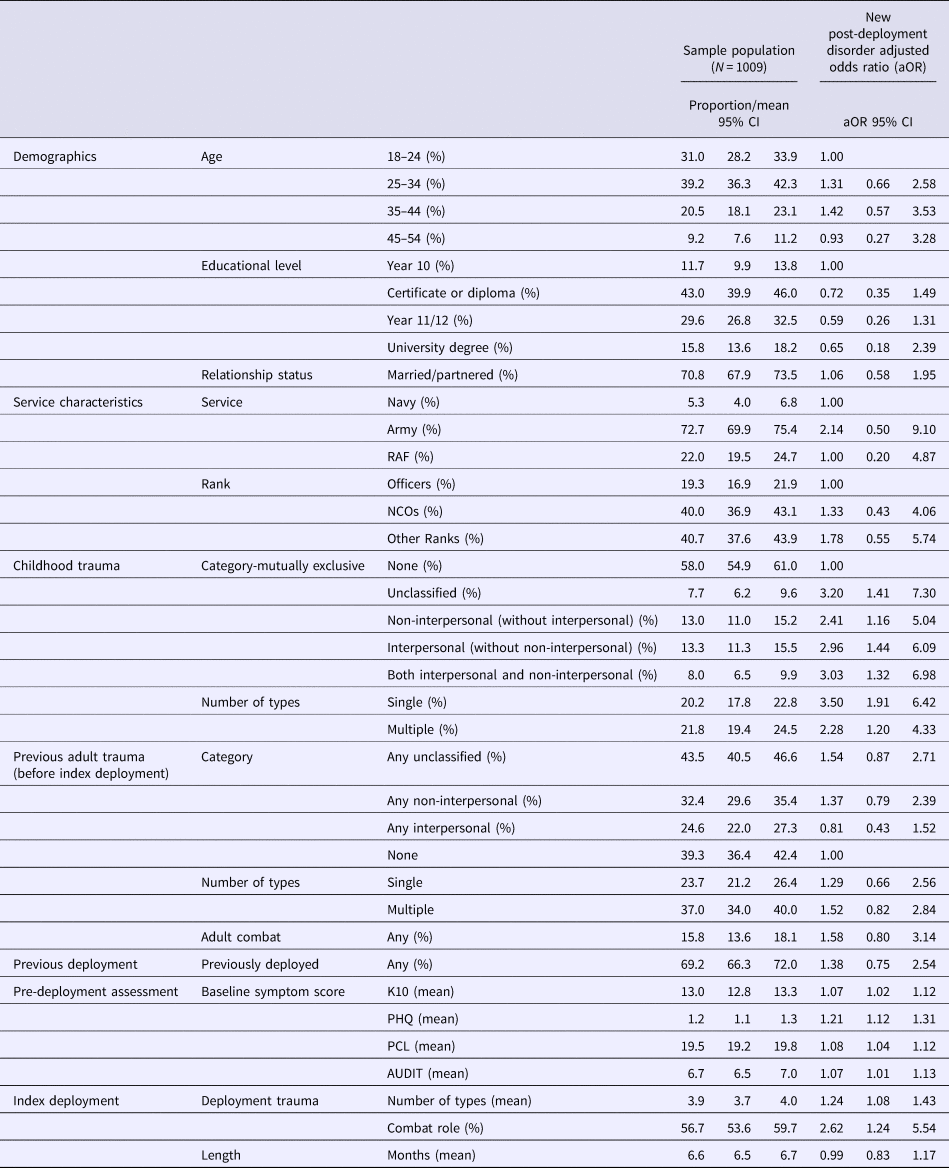
In total, 41.9% (95% CI 39.0–45.0) of the sample experienced childhood trauma. About one-fifth of the sample (21.3%, 95% CI 18.9–23.9) experienced childhood interpersonal trauma (interpersonal trauma and both interpersonal and non-interpersonal trauma), and about one-fifth (20.7%, 95% CI 18.3–23.2) experienced childhood trauma that was not interpersonal in nature (non-interpersonal and unclassified trauma).
The development of post-deployment probable disorder was associated with all categories of childhood trauma (compared with no childhood trauma), index deployment factors (number of types of trauma or having a combat role) and with baseline symptoms (on any of the scales – but most notably with the PHQ). Post-deployment probable disorder was not associated with demographic or service factors, adult factors prior to the index deployment (adult trauma, combat or previous deployment) or index deployment length (see Table 3).
Prevalence and associations of new post-deployment probable disorder

All aORs control for demographics (age, highest education and relationship status) and service factors (rank and Service).
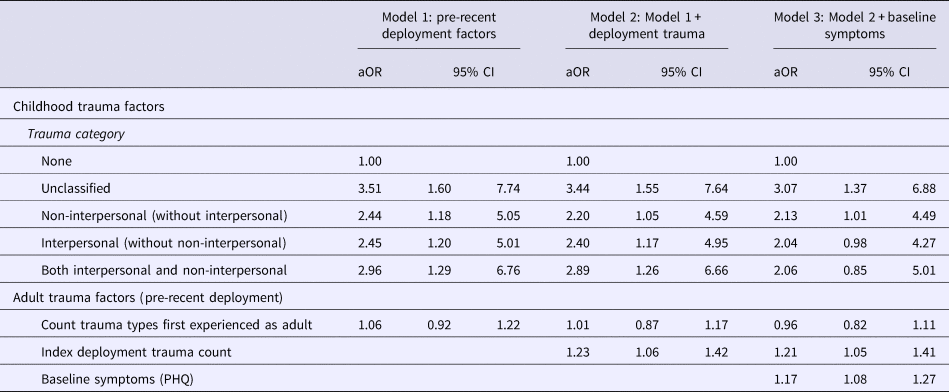
Regression analyses demonstrated that (compared with no childhood trauma), all childhood trauma categories had a significant association with new post-deployment probable disorder, controlling for demographics, service factors, previous deployment, previous adult trauma and index deployment trauma. However, when also controlling for pre-deployment symptoms (PHQ score), the association became non-significant for categories that included childhood interpersonal trauma (i.e. interpersonal trauma alone and both interpersonal and non-interpersonal trauma, see Table 4).
Logistic regression analysis of new post-deployment probable disorder

Demographics (age, highest education, relationship status), service factors (rank Service) and previous deployment were controlled for in all models. None of these factors were significant in any model.
GSEM
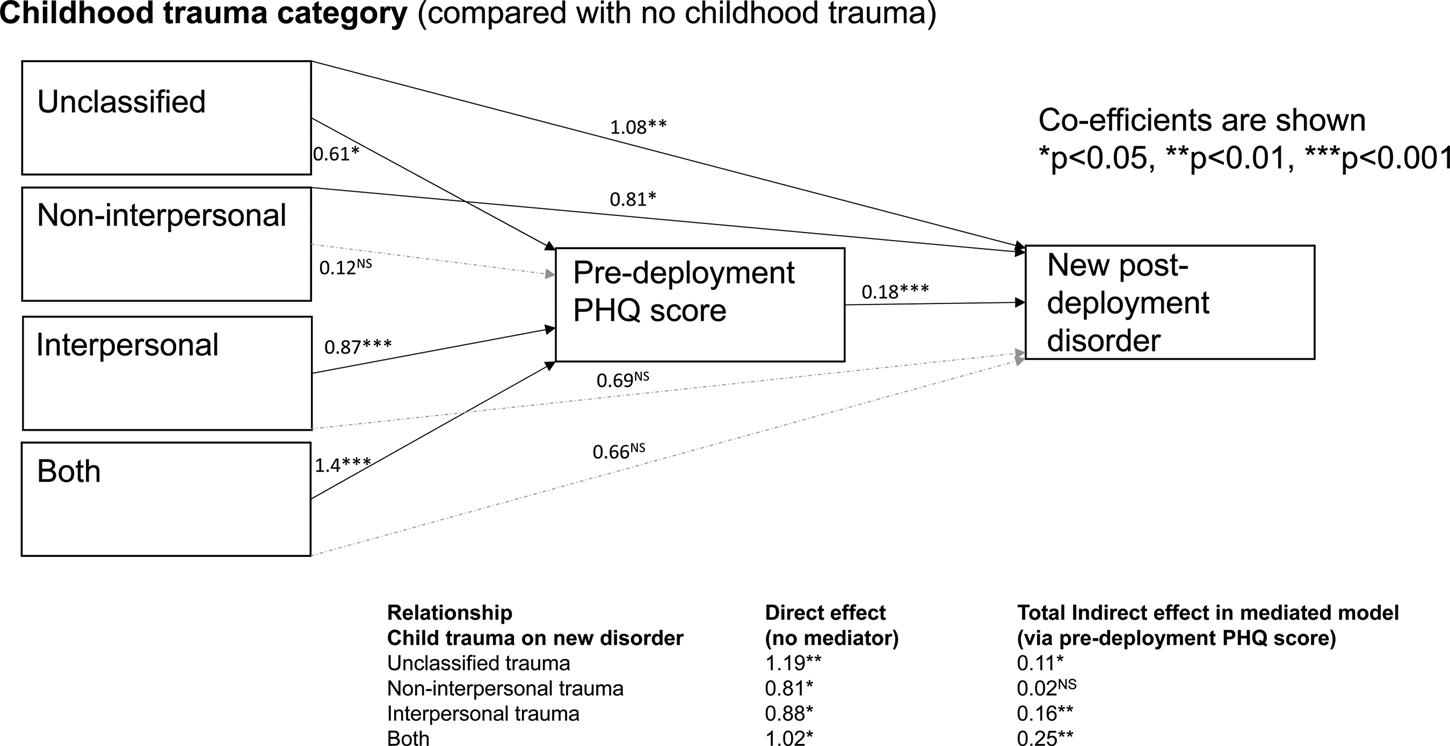
Compared with no childhood trauma, all categories of childhood trauma were associated with new post-deployment probable disorder, see Fig. 1. However, once the pre-deployment PHQ score was included as a mediator, this association became non-significant for childhood interpersonal trauma categories (interpersonal trauma and both interpersonal and non-interpersonal trauma). The mediator pathways for those categories were highly significant, demonstrated by the mediated total indirect effect, indicated in Fig. 1. This suggests full mediation of the association between childhood interpersonal trauma and new post-deployment probable disorder by the pre-deployment PHQ score. However, the results for non-interpersonal childhood trauma did not suggest mediation by pre-deployment PHQ score. The results for unclassified childhood trauma suggested only partial mediation.
Generalised Structural Equation Modelling Pathway Analysis.

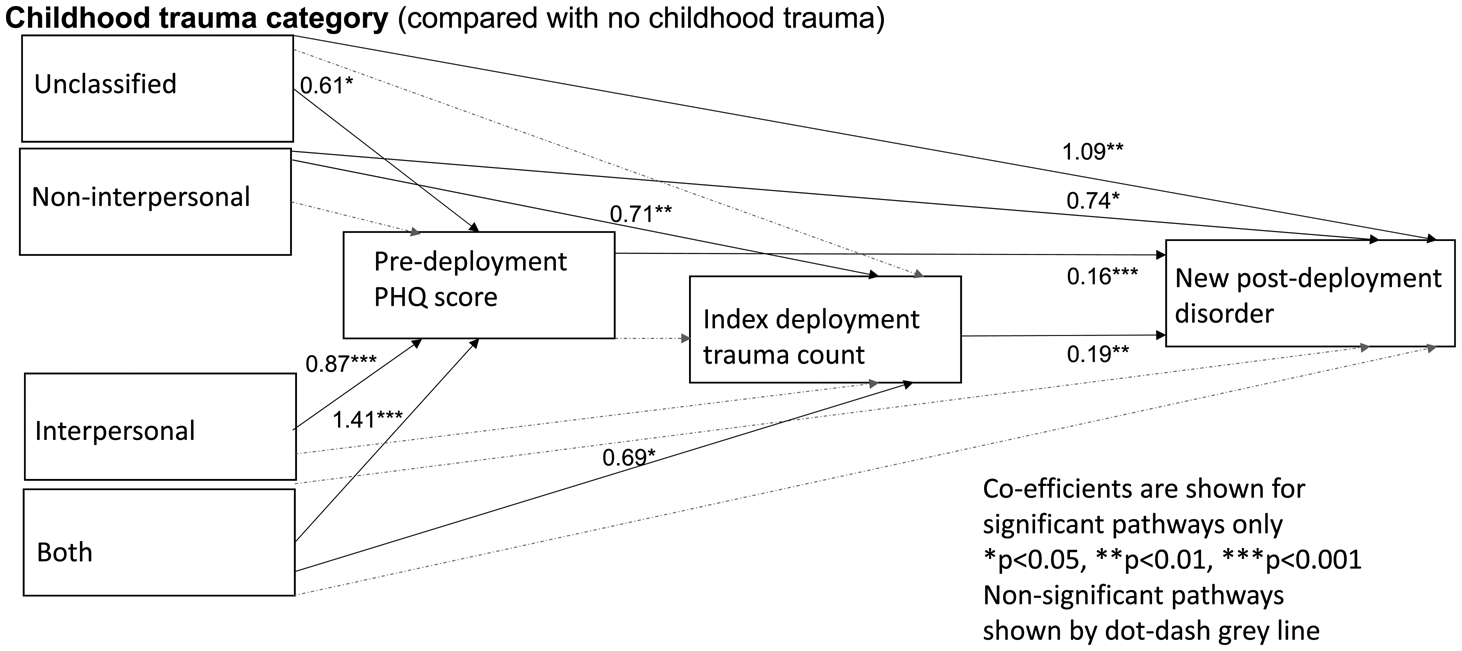
We then conducted a GSEM analysis which controlled for demographics, service factors and adult factors prior to the index deployment (deployment and adult trauma), see Fig. 2. When we added pre-deployment PHQ score and index deployment trauma count as mediators, childhood trauma that was not interpersonal in nature (unclassified trauma and non-interpersonal trauma) continued to have a direct and significant association with new post-deployment probable disorder. In contrast, childhood trauma categories that included interpersonal trauma did not have a direct association with new post-deployment probable disorder.
Generalised Structural Equation Modelling Pathway Analysis, including index deployment trauma as a mediator. Controlling for demographics (age, current relationship and educational attainment), service factors (rank and Service) and previous adult factors (adult trauma and deployment), none of which had a significant association with post-deployment new disorder.

Discussion
Very few prospective studies have investigated the influence of childhood factors on the development of post-deployment disorder (Berntsen et al., Reference Berntsen, Johannessen, Thomsen, Bertelsen, Hoyle and Rubin2012). In this current study, pre-deployment probable disorder rates were very low (3.7%), consistent with the aim to deploy healthy personnel. This is likely to be the result of pre-deployment screening and/or the increased likelihood of those with mental health vulnerabilities transitioning out of military service early (Van Hooff, Reference Van Hooff, Lawrence-Wood, Hodson, Sadler, Benassi, Hansen, Grace, Avery, Searle, Iannos, Abraham, Baur and McFarlane2018). This is an example of the ‘healthy worker survivor effect’ (Arrighi and Hertz-Picciotto, Reference Arrighi and Hertz-Picciotto1994), where health assessments have the effect of maintaining the fitness of the population, whereas those who are at risk may leave. It is likely that stringent pre-deployment assessments make this a particularly extreme example.
The very low rates of probable disorder may also be related to relatively low rates of childhood trauma. In this current study, a total of 42.0% (95% CI 39.0–45.1) of the sample experienced childhood trauma compared with 56.2% (95% CI 51.7–60.7) of the general ADF population (Syed Sheriff et al., Reference Syed Sheriff, Van Hooff, Malhi, Grace and McFarlane2018). Although these studies used different measures for childhood trauma, with the latter including more items, they both included items for trauma types not specifically asked about. The rate of childhood trauma in this male deployment sample appears to be similar to the rate in Australian employed civilian males, of 42.2% (95% CI 39.3–48.3) (Syed Sheriff et al., Reference Syed Sheriff, Van Hooff, Malhi, Grace and McFarlane2018).
There were higher rates of probable disorder at post-deployment than at pre-deployment. The development of post-deployment probable disorder was associated with index deployment factors (deployment trauma and having a combat role). This is broadly consistent with the current literature, which suggests that some deployment experiences, and particularly combat, are associated with PTSD post-deployment (Rona et al., Reference Rona, Hooper, Jones, Iversen, Hull, Murphy, Hotopf and Wessely2009; Fear et al., Reference Fear, Jones, Murphy, Hull, Iversen, Coker, Machell, Sundin, Woodhead, Jones, Greenberg, Landau, Dandeker, Rona, Hotopf and Wessely2010).
This current study demonstrates that there was not an association between adult factors prior to the index deployment (including previous combat) and post-deployment probable disorder. Again, this is likely to be due to pre-deployment screening and self-selection, with those who had significant prior trauma-related symptoms being less likely to deploy.
Given that the post-deployment assessment was conducted less than 4 months following deployment, there is also the substantial probability that it was too early to detect delayed onset post-deployment disorders, particularly PTSD (Berntsen et al., Reference Berntsen, Johannessen, Thomsen, Bertelsen, Hoyle and Rubin2012). Therefore, these post-deployment disorder rates may underestimate the true rates of post-deployment disorder.
Baseline symptoms fully mediated the relationship between childhood interpersonal trauma and developing a post-deployment probable disorder. Whilst there are no studies with which to directly compare our findings, a previous study in the ADF demonstrated that baseline symptoms fully mediated the association between antecedent trauma and PTSD symptoms post-deployment (Searle et al., Reference Searle, Van Hooff, Lawrence-Wood, Grace, Saccone, Davy, Lorimer and McFarlane2017). Our study adds significantly to this by demonstrating that the impact of childhood interpersonal trauma was fully mediated by pre-deployment symptoms, whilst other types of childhood trauma had a significant and direct association with developing a post-deployment probable disorder.
There was a lack of association of developing a post-deployment probable disorder with trauma first occurring in adulthood (prior to the index deployment). However, trauma types which first occurred in childhood did have an association with developing a post-deployment probable disorder. This is consistent with a recent study in the Danish military where childhood adversity was central to the development of PTSD post-deployment (Berntsen et al., Reference Berntsen, Johannessen, Thomsen, Bertelsen, Hoyle and Rubin2012). This suggests a greater capacity for adaptation to adult trauma than events first occurring in childhood.
Symptoms at the pre-deployment assessment were associated with developing a post-deployment probable disorder. It seems intuitive that those with a higher level of baseline symptomatology were closer to the threshold for disorder, so would be more likely to reach threshold post-deployment than others. This was the case for all baseline symptom measures included in our analysis. It appears that this is the pathway by which interpersonal childhood trauma exerts its influence on the development of post-deployment disorder. However, GSEM demonstrated that the association between non-interpersonal childhood trauma and post-deployment disorder was not mediated by baseline symptoms. These findings are consistent with a previous study which demonstrated that across the whole ADF and civilian male populations, non-interpersonal childhood trauma was not associated with adult mental disorder. In the same way, non-interpersonal childhood trauma did not appear to be associated with elevated baseline symptomatology in this current study. However, experiencing childhood trauma that was non-interpersonal in nature did increase the odds of post-deployment new disorder. GSEM analyses suggest that this association was not fully mediated by index deployment trauma either.
Strengths
This analysis utilised a prospective study design with a large sample size. Personnel from recent Afghanistan operations and who often worked alongside Allied forces were assessed. Selection bias was minimised by recruiting from a wide cross-section of units preparing to deploy (rather than from a treatment-seeking population). A wide range of previous trauma was assessed prior to deployment.
Limitations
The retrospective reporting of childhood trauma is prone to bias. However, this would be likely to affect all types of childhood trauma, whereas these analyses demonstrate significant and interesting differences. Whilst retrospective trauma reporting is a generally accepted methodology, there is the risk that that trauma recollection may be distorted by a post-deployment disorder, especially when deployment trauma is assessed at the same time as symptoms following deployment.
There were some differences between the sample and general deploying population, and therefore these results may not be entirely representative. This is an intrinsic hazard of investigating deploying personnel, where the short notice and training associated with deployment precludes approaching all potential participants. In addition, there was not a measure of other forms of childhood adversity, such as neglect, in this study.
Implications
For those who experienced interpersonal trauma as children, the association with new post-deployment disorder was fully mediated by pre-deployment symptoms, whereas for those who had experienced other types of trauma, a direct and significant association remained. This is potentially a very meaningful result. The consequences of childhood traumatic experiences are not only far-reaching but are potentially recognizable early. This finding suggests that there are different pathways of effect of different types of childhood trauma on the development of post-deployment disorder. Non-interpersonal trauma, such as disasters and accidents, are those in which there is a substantial threat to life (Forbes et al., Reference Forbes, Lockwood, Phelps, Wade, Creamer, Bryant, McFarlane, Silove, Rees, Chapman, Slade, Mills, Teesson and O'Donnell2014). The associated fear memories for these traumatic events may have a different long-term impact on interpreting current threat than those associated with interpersonal experiences, which may instead exert their influence through pre-existing dysphoria (Sartory et al., Reference Sartory, Cwik, Knuppertz, Schurholt, Lebens, Seitz and Schulze2013). However, it is beyond the scope of this study to decipher whether the post-deployment disorder associated with childhood non-interpersonal trauma is mild/self-limiting or has more important long-term consequences. In addition, these findings may explain the possible reasons for contradictory research findings regarding antecedent trauma, and the pitfalls of analysing antecedent trauma by count (regardless of category) and/or of lumping childhood and adult trauma together.
Conclusion
Taken together, these findings indicate that childhood trauma is an important determinant of developing a post-deployment probable disorder. In addition, that an understanding of childhood factors is essential in determining the necessary support for those being deployed, as pre-deployment symptom screening alone is likely to be insufficient in identifying all those at risk.
Author ORCIDs
Rebecca Syed Sheriff, 0000-0002-5934-6722; Gin S Malhi, 0000-0002-4524-9091.
Acknowledgements
We thank all investigators and scientific advisors for their contribution to the design of the MEAO Prospective Study. We also thank the study teams at the Centre for Military and Veterans' Health and the University of Adelaide for their role in data collection. Most importantly, we thank all of the ADF personnel who participated in the study.
Financial support
The Middle East Area of Operations (MEAO) Prospective Study was funded by the Australian Department of Defence. While the Australian Department of Defence was involved with the study design and data collection, it had no role in the analysis and interpretation of the data, or the decision to submit the manuscript for publication. Views and opinions expressed within this report are those of the authors, and do not necessarily reflect the official policy or position of the Australian Department of Defence. RSS had full access to all the data in the study and final responsibility for the decision to submit for publication.
Conflict of interest
RSS receives funding from Australian Rotary Health in the form of a Ph.D. scholarship. AM and MVH receive funding from the Departments of Veterans' Affairs and the Australian Department of Defence. AM is the principal adviser in psychiatry to the Department of Veterans' Affairs and has advisory roles with the Australian Department of Defence. GM reports grants from NHMRC, Ramsay Research and Teaching Fund, American Foundation for Suicide Prevention, and the NSW Agency for Clinical Innovation and NSW Ministry of Health, and personal fees from Astrazeneca, Elsevier, Lundbeck, and Janssen-Cilag, Servier, and Melbourne University, outside of the submitted work. There is no conflict of interest in the present study for any of the other authors.