Introduction
Major depression and depressive symptoms in particular, often defined as minor, subthreshold or subsyndromal depression, are a very common feature of late life (Copeland et al. Reference Copeland, Beekman, Braam, Dewey, Delespaul, Fuhrer, Hooijer, Lawlor, Kivela, Lobo, Magnusson, Mann, Meller, Prince, Reischies, Roelands, Skoog, Turrina, deVries and Wilson2004; Djernes, Reference Djernes2006). Although methodological differences between studies preclude reaching a consensus regarding the prevalence of depression, around 12% of individuals aged ⩾65 years are affected by depressive syndrome in Europe (Copeland et al. Reference Copeland, Beekman, Braam, Dewey, Delespaul, Fuhrer, Hooijer, Lawlor, Kivela, Lobo, Magnusson, Mann, Meller, Prince, Reischies, Roelands, Skoog, Turrina, deVries and Wilson2004). Higher levels of depression among women and in southern Europe than in North America or Asia are consistent across studies, with a prevalence of depressive symptoms in elderly Italians of about 30% in men and >50% in women (Minicuci et al. Reference Minicuci, Maggi, Pavan, Enzi and Crepaldi2002; Dalle Carbonare et al. Reference Dalle Carbonare, Maggi, Noale, Giannini, Rozzini, Lo Cascio and Crepaldi2009).
Depression has been reported to be significantly associated with a wide range of behavioral, physical and sociodemographic factors, including female gender, co-morbid medical conditions, poor self-perceived health, cognitive impairment, functional impairment, lack or loss of social contacts, prior depression, sleep disturbances, unhealthy lifestyles and lower socio-economic status (Cole & Dendukuri, Reference Cole and Dendukuri2003; Djernes, Reference Djernes2006). These associations are often bidirectional and complex (Schoevers et al. Reference Schoevers, Geerlings, Deeg, Holwerda, Jonker and Beekman2009) and it is likely that depression and most of these health-related variables affect each other reciprocally. Because all these conditions have been shown to be independently associated with both depression and mortality, these mutual relationships may provide valuable clues about the mechanisms through which depression exerts its effect on mortality (Schulz et al. Reference Schulz, Drayer and Rollman2002).
During the past decades the influence of depression on mortality has been investigated in numerous studies, the majority of which have demonstrated that depression may increase the risk of death, suggesting an overall stronger effect for men and a high correlation with cardiovascular disease (Wulsin et al. Reference Wulsin, Vaillant and Wells1999). The association has been confirmed by studies focused specifically on elderly populations (Schulz et al. Reference Schulz, Beach, Ives, Martire, Ariyo and Kop2000; Rozzini et al. Reference Rozzini, Sabatini, Frisoni and Trabucchi2001, Reference Rozzini, Sabatini, Frisoni and Trabucchi2002; Saz & Dewey, Reference Saz and Dewey2001; St John & Montgomery, Reference St John and Montgomery2009). Despite some contradictory findings, the scientific evidence supporting the influence of depression on mortality among elderly subjects is strong (Schulz et al. Reference Schulz, Drayer and Rollman2002).
Recent studies have focused their attention on the relationship between longitudinal changes in the course of depressive illness and mortality. This steadily increasing body of literature is based on the hypothesis that, because of the fluctuating nature of depression over time, repeated measures are more reliable for determining its influence on mortality than a single measure, as changes in duration and severity may represent different risks for mortality (Geerlings et al. Reference Geerlings, Beekman, Deeg, Twisk and Van Tilburg2002). It has been argued that different lengths of exposure to depression may affect the association with mortality because with a longer duration the negative effects on both biological and psychosocial functioning should have more time to accumulate (Schoevers et al. Reference Schoevers, Geerlings, Deeg, Holwerda, Jonker and Beekman2009). Overall, the results of previous studies suggest that long-standing depression predicts mortality even after controlling for possible confounding factors (Pulska et al. Reference Pulska, Pahkala, Laippala and Kivelä1999) and that both severity and persistence of depression are associated with a higher mortality risk (Geerlings et al. Reference Geerlings, Beekman, Deeg, Twisk and Van Tilburg2002; Schoevers et al. Reference Schoevers, Geerlings, Deeg, Holwerda, Jonker and Beekman2009; Zhang et al. Reference Zhang, Kahana, Kahana, Hu and Pozuelo2009; Bogner et al. Reference Bogner, Morales, Reynolds, Cary and Bruce2011). According to the few studies analyzing gender differences, changes in depressive status, and in incident depression in particular, are associated with all-cause (Anstey & Luszcz, Reference Anstey and Luszcz2002) and cardiovascular disease mortality (Penninx et al. Reference Penninx, Guralnik, Mendes de Leon, Pahor, Visser, Corti and Wallace1998) only for elderly men, whereas the higher burden of depression in women may be attributable to a greater susceptibility to depression, a higher persistence of the condition and a lower probability of death (Barry et al. Reference Barry, Allore, Guo, Bruce and Gill2008).
Despite this growing interest in the effects of longitudinal changes in depression on mortality, and although most depressive symptoms remit partially or completely either spontaneously or with treatment (Gelenberg, Reference Gelenberg1999), little is known about the possible reduction in mortality due to remission of symptoms over time. Moreover, even studies with multiple measurements of late-life depression have focused on the negative effects of duration and persistence on mortality (Penninx et al. Reference Penninx, Guralnik, Mendes de Leon, Pahor, Visser, Corti and Wallace1998; Pulska et al. Reference Pulska, Pahkala, Laippala and Kivelä1999; Anstey & Luszcz, Reference Anstey and Luszcz2002; Geerlings et al. Reference Geerlings, Beekman, Deeg, Twisk and Van Tilburg2002; Barry et al. Reference Barry, Allore, Guo, Bruce and Gill2008; Schoevers et al. Reference Schoevers, Geerlings, Deeg, Holwerda, Jonker and Beekman2009; Zhang et al. Reference Zhang, Kahana, Kahana, Hu and Pozuelo2009; Bogner et al. Reference Bogner, Morales, Reynolds, Cary and Bruce2011).
Following these considerations, the aim of the present study was to examine whether, and to what degree, the transition of depressive symptoms from one class of severity to another positively or negatively influences the mortality of elderly subjects. In the analysis presented here, we explore these issues in the Italian Longitudinal Study on Aging (ILSA) unified data set, which contains both explanatory and outcome variables derived from a longitudinal, multicenter, population-based study on a large sample of elderly individuals, started in 1992 and followed-up 3 years later, with collection of mortality data up to 10 years after baseline.
Method
Study sample and design
The present work is part of the ILSA, which has been described in detail elsewhere (Maggi et al. Reference Maggi, Zucchetto, Grigoletto, Baldereschi, Candelise, Scarpini, Scarlato and Amaducci1994; ILSA, 1997; Scafato et al. Reference Scafato, Galluzzo, Gandin, Ghirini, Baldereschi, Capurso, Maggi and Farchi2008). The main objectives of the ILSA are to investigate the frequency, risk and protective factors of major age-associated conditions and to study physical and functional changes among an Italian elderly cohort. In brief, a random sample of 5632 subjects aged 65–84 years, both community dwelling and institutionalized, was selected from the demographic lists of eight municipalities located across Italy. The sample of each center was stratified by age and sex, using an equal allocation strategy (88 subjects of each gender for each of the four 5-year age classes).
The ILSA cohort was first examined in 1992–1993, and extensively re-examined in two longitudinal waves initiated in 1995 and 2000. Informed consent was obtained from all participants before starting the study. The three surveys had a two-phase design. Phase 1 (screening) was administered to all participants and included: a personal interview on self-reported sociodemographic characteristics, health habits, family and medical history, signs and symptoms of diseases and their risk factors; a nurse visit, during which blood pressure and pulse rate measurements were performed and a blood sample was drawn; and a physical examination, carried out by a general physician, that included diagnostic tests and the administration of a neuropsychological battery, also comprising the Italian version of the 30-item Geriatric Depression Scale (GDS; Brink et al. Reference Brink, Yesavage, Lum, Heersema, Adey and Rose1982). In Phase 2 (confirmation), only participants who screened positive for one or more of the major chronic diseases under study were examined by a specialist to confirm or exclude suspected diagnoses, through a standardized clinical examination.
Of the original sample of 5632 persons, 170 were ineligible for inclusion in the study because they had died or moved before 1 March 1992, and for 86 it was impossible to contact the subject or a reliable informant. Of the remaining 5376 subjects of whom vital status could be ascertained, 3214 subjects underwent depression assessment at baseline and 2070 at the second survey. The study group for the analysis of the effect of changes in depressive status consists of the 1941 subjects who participated in both GDS measurements.
Measurements
The present analysis was based on: assessment of depressive symptoms at baseline (1992–1993) and the second survey (1995–1996); longitudinal changes in severity between the two assessments; time to death from each GDS assessment to the end of follow-up (10-year and 7-year mortality); and a comprehensive set of potentially confounding or explanatory factors as measured at baseline.
Depressive symptoms
Depressive symptoms were measured by administering the 30-item Italian version of the GDS (Brink et al. Reference Brink, Yesavage, Lum, Heersema, Adey and Rose1982), which is a reliable and valid case-finding tool designed specifically for elderly populations. If six or more items were missing, the total score was set to missing; otherwise the total score obtained was divided by the number of items answered and multiplied by 30 (total number of GDS items). According to cut-offs suggested by the authors and already adopted in other ILSA analyses, depressive symptoms were categorized as absent (score <10), mild (10–19) or severe (⩾20). Longitudinal changes in the course of depressive symptoms (categorized as stable, remitted, worsened) were obtained by crossing GDS results at the first and second examinations, thus obtaining nine different subgroups according to the stability of the depressive symptoms, or the transition to a worse or better class of severity.
Vital status ascertainment and mortality
Information on vital status was monitored during the three main surveys and through a telephone interview conducted 2 years after the baseline screening. For deceased participants or those unable to answer, information was collected from a proxy respondent. Detailed mortality data were retrieved from death certificates obtained through the General Registry Offices. The total follow-up period was from 1 March 1992 to 28 February 2002. The outcome presented in this study is all-cause mortality from first or second GDS assessment to the end of follow-up (10-year or 7-year mortality).
Covariates
All covariates were selected from the baseline data and their potential confounding or explanatory role in the relationship between mortality and depressive symptoms over time was analyzed. The categorical variables used were:
Education: the number of years of school attended, grouped into 0–3, 4–7, ⩾8 years.
Marital status: married (including individuals living with a partner) versus non-married (including widowed, separated/divorced, never married).
Cohabitation status: not living alone versus living alone.
Procreation: having children versus not having children.
Smoking habit: current smoker, ex-smoker or never smoker.
Alcohol consumption: wine, beer, and liqueur consumers, grouped into current drinker, ex-drinker, never drinker.
Cognitive impairment: the total score obtained on the Mini-Mental State Examination (MMSE; Folstein et al. Reference Folstein, Folstein and McHugh1975) was divided by the maximum obtainable in the items answered. Subjects were grouped into two categories: without cognitive impairment (score ratio ⩾0.80) and with mild to severe cognitive impairment (<0.80).
Activities of daily living (ADL): degree of dependence in the main basic activities of daily life (eating, continence, transferring in and out of bed, toileting, dressing and bathing) assessed through the ADL scale (Katz et al. Reference Katz, Downs, Cash and Grotz1970), and categorized as dependent in one or more ADL, or independent in all ADL.
Instrumental ADL (IADL): level of performance of more sophisticated tasks of everyday life (using the telephone, shopping, preparing meals, doing housework and laundry, using private or public means of transport, handling medications and managing money) according to the IADL scale (Lawton & Brody, Reference Lawton and Brody1969), classified as dependent in one or more IADL, or independent in all applicable IADL.
The quantitative variables analyzed as covariates were: age (years), systolic blood pressure (SBP, mmHg), diastolic blood pressure (DBP, mmHg), blood glucose (GLUC, mg/dl), total serum cholesterol (CHOL, mg/dl), high density lipoprotein cholesterol (HDL-CH, mg/dl), body mass index (BMI, kg/m2) and disease count (range 0–11). The variable disease count was obtained by adding up the number of diseases diagnosed following the two-phase diagnostic procedure, including physical examination and the review of medical records, as only 19% of women and 20% of men were not affected by any of the chronic diseases under investigation in the ILSA study: cardiovascular diseases (hypertension, myocardial infarction, angina pectoris, cardiac arrhythmia, congestive heart failure), diabetes, peripheral artery disease, stroke, dementia, parkinsonism, and distal symmetric neuropathy.
Statistical analysis
The distribution of covariates according to depressive symptoms severity at baseline was analyzed using χ2 statistics for categorical variables, and a linearity test was used to determine whether a relationship held for quantitative variables.
Cox proportional hazards regression models were used to examine the association between depressive symptoms and mortality. The mortality risk was expressed as the mortality hazard ratio (MHR) and the association was considered statistically significant when the 95% confidence interval (CI) did not include one.
Initially, age and depression severity were entered as independent variables into two different models, the first with depression as assessed at entry and survival time counted from date of assessment until the end of follow-up (10-year mortality), and the second with depression as assessed 3 years later and 7-year mortality. A similar Cox regression model adjusting for age was then fitted into data of participants in both assessments, with 7-year mortality as the dependent variable, depressive status at baseline and transition in severity between the two surveys as independent variables. In the last step, all other covariates significantly related to the 7-year survival time according to a forward stepwise selection procedure were entered into the model and added to changes in severity as independent variables.
All analyses were conducted separately for men and women. Data investigated in sex-aggregated form were also adjusted for gender.
The proportionality assumption was tested to verify that the ratio of hazard rates for different levels of independent variables was constant (Kalbfleisch & Prentice, Reference Kalbfleisch and Prentice1980), and no violation was detected.
Results
Severity of depressive symptoms
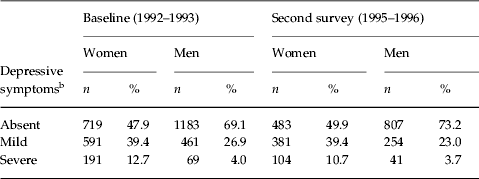
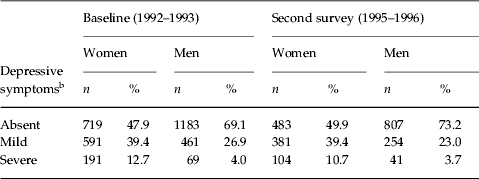
A total of 3214 subjects (46.7% women and 53.3% men) out of the original study population completed the GDS at the baseline examination. Of these, 1273 (637 positive for depression) were lost to follow-up because they had died, moved or were not reachable during the 3-year period, or for inability or refusal to participate in the second depression measurement. During the second survey, 3 years later, the GDS was administered to 2070 subjects (46.8% women and 53.2% men), of whom 129 underwent only the second GDS assessment because at the time of the first survey they refused to participate or were unable to answer for physical or other reasons. Finally, 1941 subjects (675 of whom were positive at baseline) participated in both depression assessments. Table 1 shows the sex-specific distribution of depressive symptoms for participants in each GDS assessment, according to the three classes of severity. The prevalence of depressive symptoms does not change substantially over time and is higher in women (52.1–50.1%) than in men (30.9–26.8%), with a frequency of severe depression in women about three times that in men.
Severity of depressive symptoms at first (n = 3214) and second (n = 2070) ILSA survey by gendera
ILSA, Italian Longitudinal Study on Aging.
a Number and percentage of participants in each Geriatric Depression Scale (GDS) assessment, according to gender and relative class of depressive symptoms. Column percentages may not total 100 because of rounding.
b Categorized according to GDS score as: absent (<10), mild (10–19 ) and severe (⩾20).
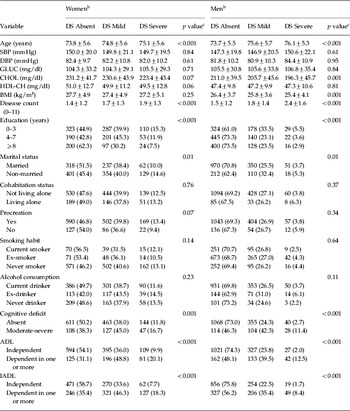
A preliminary descriptive analysis of the sex-specific distribution of sociodemographic characteristics, life habits, cognitive and functional impairment, chronic diseases and conditions and biological risk factors – subsequently analyzed as possible confounders – by level of severity of depression at first measurement was also carried out (Table 2). As expected, non-depressed subjects, compared with those with depressive symptoms, seem to have overall better health and social conditions that decrease with increasing severity. In both genders, higher levels of depressive symptoms seem to be significantly related to increasing age, high co-morbidity, low education level, cognitive impairment, dependence in one or more ADL or IADL (p < 0.001), and non-married status (p = 0.01). The linearity tests performed on all quantitative variables confirm a significant relationship for age and disease count in both genders (p < 0.001). Among men, total cholesterol and BMI show an inverse significant association (p < 0.001) with severity of depressive symptoms, whereas for women there is a weak relationship only for total cholesterol (p = 0.07).
Characteristics of the sample by gender and depressive symptoms severity at baselinea

ADL, Activities of daily living; BMI, Body mass index; CHOL, total serum cholesterol; DBP, diastolic blood pressure; DS, depressive symptoms; GLUC, blood glucose; HDL-CH, high density lipoprotein cholesterol; IADL, instrumental activities of daily living; SBP, systolic blood pressure.
a Data are given as mean ± standard deviation for quantitative variables and as number (percentage) for categorical variables. Percentages may not total 100 because of rounding.
b The number of participants in the baseline Geriatric Depression Scale (GDS) assessment was 1501 for women and 1713 for men. The total number of observations for variables listed may vary slightly because of missing information.
c p values were determined using the linearity test for quantitative variables and the χ2 test for categorical variables.
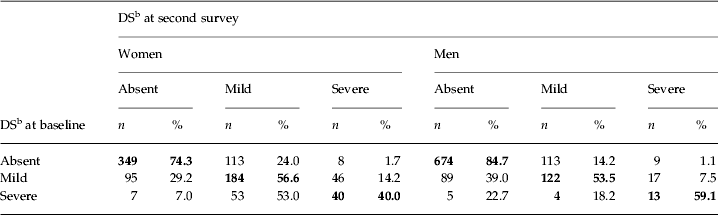
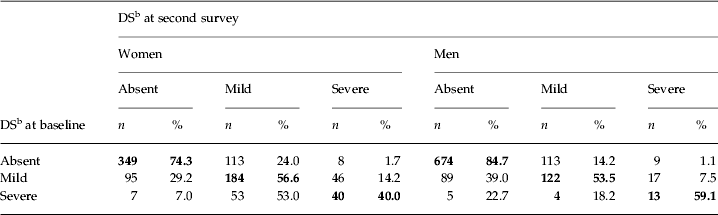
Table 3 illustrates the transition between the three classes of severity in the 1941 subjects (46.1% women and 53.9% men) who underwent both GDS assessments. The diagonals from the top left- to the bottom right-hand corners of the table represent stability of symptoms for women and men respectively. The cells above the main diagonals report data for participants with worsening of depressive symptoms and the cells below refer to those with various levels of remission. Summing figures in the three areas of the table thus identified, 573 out of the 895 women (64.0%) and 809 out of the 1046 men (77.3%) remain in the same class of severity of the first assessment; 18.7% of women and 13.3% of men pass to a worse class of severity; and for 17.3% of women and 9.4% of men there is an improvement.
Changes in severity of depressive symptoms from the first to the second ILSA survey by gender (n = 1941)a
ILSA, Italian Longitudinal Study on Aging; DS, depressive symptoms.
a Data are given crossing number and percentage of participants in both Geriatric Depression Scale (GDS) assessments, according to severity of DS, thus obtaining nine different subgroups of subjects for each gender: stability of symptoms (cells in the main diagonals, in bold), worsening (cells above the diagonals) or remission (cells below the diagonals). Column percentages may not total 100 because of rounding.
b Categorized according to GDS score as: absent (<10), mild (10–19 ) and severe (⩾20).
Mortality and course of depressive symptoms
The 10-year follow-up period for subjects who underwent GDS assessment at baseline (n = 3214) amounted to 22 163 person-years (10 496 for women and 11 667 for men). A total of 1209 individuals (37.6%) died between the first survey and the end of follow-up. Among subjects who participated in the second GDS assessment 3 years after baseline (n = 2070), there were 496 deaths (24.0%) with a total follow-up time of 8135 person-years (3732 for women and 4403 for men).
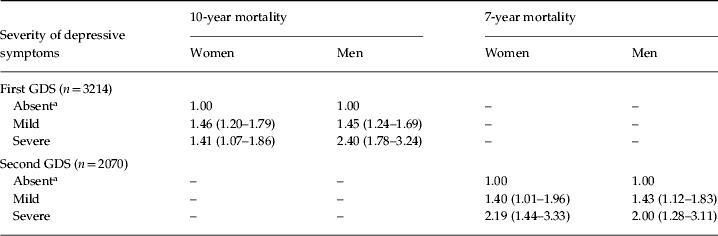
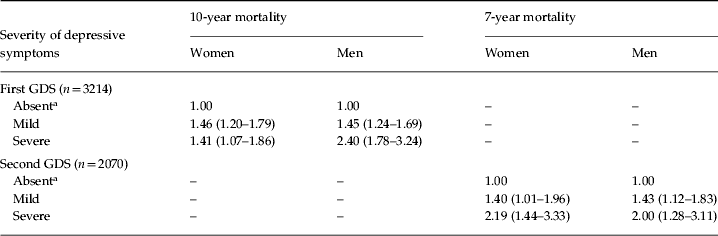
Table 4 presents the results of the first Cox proportional hazards models, adjusting for age, fitted into data to investigate the association of the depressive severity levels as assessed at first and second measurement with 10- and 7-year mortality respectively. MHRs for mild and severe depression show a significant association with excess mortality of women and men in both models, demonstrating the internal consistency of the observed association, which is independent of the different depression measurements, duration of follow-up and characteristics of the participating cohort subgroups. With the exception of women in the first model, the estimated risk ratios are about twofold larger for subjects with severe depression than for those with mild symptoms, suggesting a stronger severity effect for men and for a shorter duration of follow-up.
Association of depressive symptoms severity at first and second ILSA survey with 10-year and 7-year mortality by gender
ILSA, Italian Longitudinal Study on Aging; GDS, Geriatric Depression Scale.
Values given as mortality hazard ratio (95% confidence interval) based on Cox regression models adjusting for age.
a Reference category.
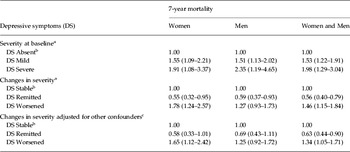
The effect of depression severity at baseline and of its changes over time with regard to 7-year mortality was then estimated for the 1941 subjects participating in both GDS assessments (Table 5). The association of severity with mortality is confirmed. Moreover, total or partial remission of symptoms was found to be significantly associated with a reduction in mortality risk (45% for women and 41% for men). According to results of the Cox model adjusting for age, the transition to a worse severity status leads to an increased risk (78% for women and 27% for men), although the latter MHR for men just fails to reach statistical significance at a p level of 5%. For this reason, a sex-aggregated analysis was conducted, adjusting also for gender. As shown in Table 5, changes in severity of depression are significantly associated with 7-year mortality, with an estimated relative risk reduced by 44% for subjects with remission, and increased by 46% for those whose symptoms had worsened.
Association of severity of depressive symptoms at baseline and of changes between the two ILSA assessments with 7-year mortality, by gender (n = 1941)

ILSA, Italian Longitudinal Study on Aging; MHR, mortality hazard ratio; CI, confidence interval.
a MHR (95% CI) based on Cox regression models adjusting for age. Sex-aggregated data are also adjusted for gender.
b Reference category.
c MHR (95% CI) based on a Cox regression model adjusting for other covariates selected through a forward stepwise selection approach. Covariates that entered into the model as significantly related to survival time were: smoking habit, activities of daily living (ADL) and disease count (for women and sex-aggregated data); smoking habit, cohabitation status and disease count (for men).
The role of changes in severity of depressive symptoms on mortality was then analyzed by entering into the model all other potential confounders, selected through a forward stepwise procedure (Table 5), to estimate MHRs adjusted for these potential confounders. As some results did not reach statistical significance, sex-aggregated data were also examined. Some of the variables included in the model were significantly associated with depression and turned out to be powerful predictors of mortality (results not discussed here), but comparison of results obtained with the last two models presented in Table 5 shows that the previously observed association between longitudinal changes in depressive symptoms and mortality, although slightly weakened, is not significantly modified by the possible confounders.
Discussion
The present study confirms the association between depression and excess mortality in the elderly (Schulz et al. Reference Schulz, Beach, Ives, Martire, Ariyo and Kop2000, Reference Schulz, Drayer and Rollman2002), showing that both mild and severe levels significantly predict mortality many years later. The overall larger risk found for severe depression than for moderate symptoms (Rozzini et al. Reference Rozzini, Sabatini, Frisoni and Trabucchi2001; Geerlings et al. Reference Geerlings, Beekman, Deeg, Twisk and Van Tilburg2002; Schoevers et al. Reference Schoevers, Geerlings, Deeg, Holwerda, Jonker and Beekman2009; St John & Montgomery, Reference St John and Montgomery2009; Zhang et al. Reference Zhang, Kahana, Kahana, Hu and Pozuelo2009), the slightly reduced effects for women (Saz & Dewey, Reference Saz and Dewey2001; Anstey & Luszcz, Reference Anstey and Luszcz2002; Schulz et al. Reference Schulz, Drayer and Rollman2002; Barry et al. Reference Barry, Allore, Guo, Bruce and Gill2008) and for longer follow-up periods (Saz & Dewey, Reference Saz and Dewey2001; Zhang et al. Reference Zhang, Kahana, Kahana, Hu and Pozuelo2009) are all comparable to those reported in previous studies. In addition, our findings suggest that changes in severity of symptoms occurring over a 3-year interval are powerful and significant predictors of 7-year mortality, even after controlling for a comprehensive set of potentially confounding factors, leading to a 37–44% reduction in risk in subjects with transition to a better status, and to a 34–46% excess mortality for those with worsened symptoms, as compared to individuals with stability of depressive condition.
We agree with the literature stating that longitudinal repeated measures of depression in older individuals are more suitable to clarifying its relationship with mortality (Penninx et al. Reference Penninx, Guralnik, Mendes de Leon, Pahor, Visser, Corti and Wallace1998; Pulska et al. Reference Pulska, Pahkala, Laippala and Kivelä1999; Anstey & Luszcz, Reference Anstey and Luszcz2002; Geerlings et al. Reference Geerlings, Beekman, Deeg, Twisk and Van Tilburg2002; Barry et al. Reference Barry, Allore, Guo, Bruce and Gill2008; Schoevers et al. Reference Schoevers, Geerlings, Deeg, Holwerda, Jonker and Beekman2009; Zhang et al. Reference Zhang, Kahana, Kahana, Hu and Pozuelo2009), making it possible to verify whether depressive symptoms reflect a temporary condition or a chronic style or trait. Our findings are consistent with previous data regarding the effects of persistence of depressive symptoms on excess mortality (Pulska et al. Reference Pulska, Pahkala, Laippala and Kivelä1999; Geerlings et al. Reference Geerlings, Beekman, Deeg, Twisk and Van Tilburg2002; Barry et al. Reference Barry, Allore, Guo, Bruce and Gill2008; Schoevers et al. Reference Schoevers, Geerlings, Deeg, Holwerda, Jonker and Beekman2009; Zhang et al. Reference Zhang, Kahana, Kahana, Hu and Pozuelo2009; Bogner et al. Reference Bogner, Morales, Reynolds, Cary and Bruce2011), but extend the magnitude of the association demonstrating that total or partial remission of symptoms is associated with a significant reduction in mortality. To our knowledge, this is the first study on this aspect of the relationship between longitudinal changes in depression and mortality conducted on a large sample of elderly subjects, of both genders, with a relatively long follow-up, based on all-cause mortality. A recent randomized control trial has shown that decreasing depression may improve survival in adult women with advanced breast cancer (Giese-Davis et al. Reference Giese-Davis, Collie, Rancourt, Neri, Kraemer and Spiegel2011). On the contrary, the few prior studies that have included remitted depression among the parameters under investigation in elderly populations, either living in the community (Pulska et al. Reference Pulska, Pahkala, Laippala and Kivelä1999; Anstey & Luszcz, Reference Anstey and Luszcz2002; Geerlings et al. Reference Geerlings, Beekman, Deeg, Twisk and Van Tilburg2002; Schoevers et al. Reference Schoevers, Geerlings, Deeg, Holwerda, Jonker and Beekman2009; Zhang et al. Reference Zhang, Kahana, Kahana, Hu and Pozuelo2009) or recruited from primary care settings (Bogner et al. Reference Bogner, Morales, Reynolds, Cary and Bruce2011), tend to explore its impact on excess and not on reduced mortality, often using as reference category the absence of depressive symptoms instead of their stability over time, thus failing to find any significant association.
Although the originality of our finding that a reduction in the exposure to depressive symptoms is followed by the reversibility of the depression–mortality association might strengthen the presumption of a cause–effect relationship, the exact mechanism by which depression exerts its effect on mortality is still unknown. It has been argued that the motivational depletion related to depressed mood (Schulz et al. Reference Schulz, Beach, Ives, Martire, Ariyo and Kop2000) could influence unhealthy lifestyles, physical inactivity, non-compliance with medical treatment and disengagement from supportive networks, leading to, or accompanied by, an impairment of the neuroendocrine and immune systems and a reduction in cognitive and physical functioning. Yet, the relationship between most of the behavioral, biological and functional risk factors involved in the depression–mortality association is bidirectional (Schoevers et al. Reference Schoevers, Geerlings, Deeg, Holwerda, Jonker and Beekman2009), leaving us with a crucial question: which came first, depression or the hypothesized mediating mechanism (Schulz et al. Reference Schulz, Drayer and Rollman2002)? With the data at our disposal and according to the objectives of our investigation, any inference on this matter cannot be simply justified, and requires further specific prospective studies. In the ILSA population, we were only able to ascertain that increasing severity of depressive symptoms at baseline was significantly associated with a worst health and social status, and a relevant decline in cognitive and daily living abilities. However, as shown by multivariate analysis, these differences do not explain or eliminate the association with subsequent mortality. Thus, we suggest that future research is needed to establish the pathway that connects depression with mortality, leading to a survival time gradually decreasing with severity and persistence of symptoms, as shown in previous studies, and increasing with their reduction, as demonstrated for the first time by our findings. This is particularly important from a public health perspective, given the relatively high proportion of elderly individuals affected by worsening of depressive symptoms or their total or partial remission (in our study 15.8% and 13.0%, respectively), leading to a large fraction of the population in whom interventions might be practicable and recommended.
The present study has some limitations that should be considered when interpreting the results. First, in the ILSA there was no clinical diagnosis of depression. Thus our results are based on the assessment of depressive symptoms through a psychometric scale (GDS) and do not pertain to major depression. Nevertheless, the GDS has proven to be a reliable and valid measure of geriatric depression, able to discriminate between levels of severity and with no item related to somatic symptoms, less useful in the elderly (Brink et al. Reference Brink, Yesavage, Lum, Heersema, Adey and Rose1982). Moreover, consistent with previous observations (Schulz et al. Reference Schulz, Beach, Ives, Martire, Ariyo and Kop2000), our data suggest that even subthreshold forms affect the risk of death of older individuals. Second, no adjustments were made for treatment of depression, which may have influenced prognosis, leading to an underestimation of the strength of the association with mortality. However, in the ILSA cohort only 1% of participants with depressive symptoms were taking antidepressants (Marzari et al. Reference Marzari, Maggi, Manzato, Destro, Noale, Bianchi, Minicuci, Farchi, Baldereschi, Di Carlo and Crepaldi2005), which reflects the low level of treatment usually reported for elderly people (Gelenberg, Reference Gelenberg1999; Geerlings et al. Reference Geerlings, Beekman, Deeg, Twisk and Van Tilburg2002). In addition, even among those treated, the effectiveness of interventions has been reported as modest (Cole & Dendukuri, Reference Cole and Dendukuri2003) and whether treating depression can reduce mortality is still unknown (Schulz et al. Reference Schulz, Drayer and Rollman2002). Third, the relatively high level of non-response and withdrawals caused a progressive reduction of the study sample. However, it is noteworthy that sample attrition and a high proportion of loss to follow-up are very common features of epidemiologic studies on elderly people, and an inevitable consequence of measuring depression over a relatively long period of time (Geerlings et al. Reference Geerlings, Beekman, Deeg, Twisk and Van Tilburg2002). Moreover, consistent with other analyses of ILSA data where non-response bias has generally been shown to be minimal (ILSA, 1997; Scafato et al. Reference Scafato, Galluzzo, Gandin, Ghirini, Baldereschi, Capurso, Maggi and Farchi2008), the age and sex distribution of participants and non-participants in the two GDS assessments were almost overlapping and similar to that of the study sample, with a response rate slightly higher among men and decreasing with age. Finally, the regression to the mean may have played a role in the variations in severity observed between the first and the second depression assessment. Because of this, a partial misclassification of participants in the first measurement may have occurred (i.e. some of the non-depressed subjects were in fact affected by mild depression and some of those classified as severely depressed in reality had mild symptoms), also affecting the observed changes in severity. However, it should be noted that misclassifications tend to diminish the relative risks, instead of increasing them, as demonstrated by the fact that in case of misclassification of all participants, no differences could be detected.
We consider that these weaknesses are balanced by the strengths of our study, which include: the use of repeated measures of depression; the large number of subjects; the follow-up duration; the appropriate modeling of changes in depression to verify the hypothesis of a relationship between remission and mortality reduction; and the amount and accuracy of baseline data on sociodemographic characteristics, prevalent clinical and subclinical conditions, cognitive and disability status, and biological and behavioral risk factors examined as potential confounders, avoiding the potential bias represented by the use of self-perceived indicators as possible mediators, given the poor self-perception of health and social conditions typical of depressed mood.
Our findings may have important future implications from a clinical, research and public health perspective, highlighting the need to enhance case finding of late-life depression by simple screening instruments, to improve effective pharmacological and non-pharmacological interventions and to further investigate processes and factors related to longitudinal changes in depressive symptoms, in order to lower the impact of potentially modifiable risk factors and reduce unnecessary suffering, excessive use of health-care resources and adverse impact on quality of life.
Appendix: The ILSA Working Group
E. Scafato, G. Farchi, L. Galluzzo, C. Gandin (Istituto Superiore di Sanità, Rome); A. Capurso, F. Panza, V. Solfrizzi, V. Lepore, P. Livrea (University of Bari); L. Motta, G. Carnazzo, M. Motta, P. Bentivegna (University of Catania); S. Bonaiuto, G. Cruciani, D. Postacchini [Italian National Research Center on Aging (INRCA), Fermo]; D. Inzitari, L. Amaducci (University of Florence); A. Di Carlo, M. Baldereschi (Institute of Neuroscience, CNR, Florence); C. Gandolfo, M. Conti (University of Genoa); N. Canal, M. Franceschi (San Raffaele Institute, Milan); G. Scarlato, L. Candelise, E. Scapini (University of Milan); F. Rengo, P. Abete, F. Cacciatore (University of Naples); G. Enzi, L. Battistin, G. Sergi, G. Crepaldi (University of Padua); S. Maggi, N. Minicuci, M. Noale (CNR, Aging Section, Padua); F. Grigoletto, E. Perissinotto (Institute of Hygiene, University of Padua); P. Carbonin (Università Cattolica del Sacro Cuore, Rome).
Acknowledgements
As part of the Targeted Project on Aging, the ILSA was supported by the Italian National Research Council (CNR) with grants to each research unit from 1991 to 1995. The study was then funded by the Italian Ministry of Health (D.L. 502/92, 1998) through the programs ‘Epidemiology of the Elderly’ (Istituto Superiore di Sanità) and ‘Estimates of Health Needs of the Elderly’ (Tuscany Region).
We thank L. Di Pasquale and S. Martire for their administrative support and assistance in preparing the manuscript.
Declaration of Interest
None.