Introduction
As the diets of many ‘populations in transition’ undergo significant changes in less than a generation, and in the absence of reliable biomarkers,Reference Wilkinson, Yai and O’Brien 1 retrospective dietary reports are often the only source of information on prenatal maternal nutritional factors relevant to the Developmental Origins of Health and Disease (DOHaD). Yup’ik Alaskans continue to have a relatively low prevalence of diabetes (3.3%)Reference Mohatt, Plaetke and Klejka 2 despite experiencing a dietary transition toward less locally harvested and more store-bought foods.Reference Bersamin, Luick, Ruppert, Stern and Zidenberg-Cherr 3 This stands in contrast to the high diabetes prevalence among many other Native North American groups,Reference Gohdes, Kaufman and Valway 4 first noted in the 1950s as a consequence of a similar dietary transition.Reference Conti 5 Continued involvement in a local marine-based economy has therefore been offered as one explanation for what appears to be a protective effect against the development of diabetes.Reference Adler, Schraer, Boyko and Murphy 6 , Reference Schraer, Risica and Ebbesson 7
Previously, Parkinson et al.Reference Parkinson, Cruz and Heyward 8 compared the lipid profiles of two Yup’ik groups (one coastal and the other one riverine), and one group of non-Native Alaskans. They found that Yupiit had more positive lipid profiles than non-Natives, and that coastal Yupiit had more positive lipid profiles than riverine Yupiit.Reference Parkinson, Cruz and Heyward 8 As coastal Yupiit eat more marine mammals, which are higher in n-3 polyunsaturated fatty acids (PUFAs) than riverine populations, the authors suggested a diet-based protective effect.Reference Parkinson, Cruz and Heyward 8 Adler et al.Reference Adler, Schraer, Boyko and Murphy 6 provided direct support for this suggestion by demonstrating that salmon and seal oil, when consumed frequently enough, did in fact have a protective effect against impaired glucose tolerance even though obesity prevalence among both groups is comparable with the U.S. population (32 v. 30%, respectively).Reference Mohatt, Plaetke and Klejka 2 , Reference Baskin, Ard, Franklin and Allison 9
Subsequent research revealed that even though Yupiit were more overweight and obese than nearby Athabascans, they had a lower prevalence of diabetes than their neighbors, which the authors attributed to more marine mammals and fish in Yup’ik diets.Reference Murphy, Schraer and Thiele 10 In other words, the benefit of a diet higher in marine mammals did not appear to be protection against the metabolic syndrome per se, but specifically seemed to act to lower diabetes risk. By studying normoglycemic Athabascans and Alaska Natives (Yupiit and Inupiat), Schraer et al.Reference Schraer, Risica and Ebbesson 7 then discovered that Alaska Natives generally had greater insulin sensitivity than Athabascans, providing the first physiological explanation for their lower prevalence of diabetes. Speculating about a genetic predisposition to insulin resistance among Athabascans, these authors suggested that Neel’s thrifty genotype hypothesisReference Neel 11 might explain the discrepancy in insulin sensitivity as both groups had similar subsistence-based diets and both were rapidly changing to include more store-bought foods.Reference Schraer, Risica and Ebbesson 7 Other authors, however, have suggested that although both groups continue to rely on locally harvested foods, and Athabascans are related to Paleo-Indian groups rather than those of Paleo-Eskimo origin,Reference Raghavan, DeGiorgio and Albrechtsen 12 the nutritional histories of the two groups do not support a thrifty genotype explanation that would favor a more ‘efficient’ (i.e. insulin resistant, glucose sparing) metabolism for Athabascans.Reference Benyshek and Watson 13
There have been four major Alaska Native diet surveys from the 1950s to 2006.Reference Ballew, Ross and Wells 14 – Reference Nobmann, Byers and Lanier 17 Heller and Scott’sReference Heller and Scott 15 study found that the diet was energetically adequate and macronutrient proportions were relatively equal (1 out of 3 protein, 1 out of 3 fat and 1 out of 3 carbohydrates). It is worth noting, however, that according to some estimates,Reference Draper 18 carbohydrates would have likely made up only 5–10% of the Alaskan Native prehistoric diet. Draper found that by the mid-20th century, imported market foods were supplying roughly half of the calories for Alaska Natives living in rural areas.Reference Draper 18 In 1978, protein and fat had decreased and carbohydrates increased, and by 1987–1988, were the same as macronutrient proportions for the general U.S. population (according to NHANES II).Reference Knapp and Panruk 16 , Reference Nobmann, Byers and Lanier 17 This has held into the present, albeit with significant regional variation.Reference Ballew, Tzilkowski and Hamrick 19 The colonial period in southwest Alaska, marked by infectious disease epidemics, missionary activity and local education for children, resulted in a host of interrelated social and economic changes for Yup’ik people. These included a sharp population decline, the establishment of permanent villages and nuclear households, formal schooling for children, the introduction of biomedicine and market foods, and the end of shamanism and near-ubiquitous adoption of Catholicism.Reference Pete 20 Despite these manifold and significant changes affecting – and affected by –Yup’ik people, many features of pre-colonial native Yup’ik culture and diet (the two so inextricably intertwined) remain clearly evident in Native Alaskan communities today, particularly among the Nelson Island villages.Reference Fienup-Riordan 21
Given the dietary history of the Yupiit outlined above, an alternative explanation to the thrifty genotype hypothesis regarding differences in insulin sensitivity among local indigenous groups is that the origin of insulin sensitivity has an important developmental component. Investigations into the specific components of maternal prenatal diet that play an important role in early human development have shown that an adequate amount of PUFAs seems to have an especially critical role in mediating normal growth.Reference Koletzko, Lien and Agostoni 25 This provides reason to believe that the low prevalence of diabetes reported among Yupiit might in part be the result of a generation-long protective effect from the consumption of marine-based foods before and during pregnancy by Yup’ik mothers. Despite the fact that adult diets today are being supplemented by store-bought foods and paralleled by increasing obesity, this could explain why the typical increase in diabetes has yet to be observed. Unfortunately, it remains unclear whether or not Yup’ik women with children now grown and eating store-bought foods were, in fact, still relying heavily on traditional foods when they were pregnant.
Epidemiological evidence from populations experiencing a sudden and extreme dietary shift over a short period of time demonstrates a relationship between maternal prenatal nutrition and the metabolic health of offspring in adulthood.Reference Hales, Barker and Clark 22 , Reference Hales and Barker 23 These studies were the first of many to shift attention away from purely genetic or lifestyle explanations for metabolic disorders and toward developmental explanations highlighting the added importance of the early environment (conception, gestation, early postnatal growth) on adult health, a concept known today as the Developmental Origins of Health and Disease. The developmental pathway to diabetes has had additional support from experimental animal models demonstrating differences in insulin sensitivity (a primary marker of diabetes risk) between experimental and control groups of offspring when only the maternal diet during gestation is manipulated.Reference Benyshek, Johnston and Martin 24 Further investigations into the specific components of the maternal prenatal diet important in early human development have shown that an adequate amount of long-chain polyunsaturated fatty acids (LC-PUFAs) seems to have an especially critical role in mediating normal growth.Reference Koletzko, Lien and Agostoni 25
To date, human-based research investigating the effects of prenatal maternal diets rich in specific nutrients on the health of offspring has been limited to effects in infancy and childhood.Reference Koletzko, Lien and Agostoni 25 , Reference Szajewska, Horvath and Koletzko 26 Part of this is because research on the influence of a maternal prenatal diet on the metabolic health of adult offspring requires reasonably reliable estimates of maternal diets in the remote past. A longitudinal or cross-sectional study design is ideal for examining this effect, but the rapid pace of dietary change in small-scale communities, where the prevalence of metabolic disorders are often the highest, precludes such an approach.
Presenting our work with Yup’ik mothers as a case study, we argue that for small-scale communities experiencing rapid dietary transitions, the investigation of nutrition-related chronic disorders suspected to have a developmental component will necessitate the retrospective collection of information on past diets.Reference Benyshek 27 Preliminary qualitative methods are an essential part of this process – either as a step toward the validation of a population and question-specific quantitative dietary survey, or as the only appropriate method to estimate past food intake when the time period of interest is both sensitive and significant (e.g. difficult pregnancy, economic turmoil, poverty, undernutrition, sickness).
Methods
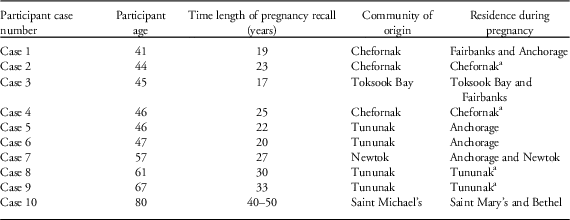
The authors investigated the contribution of store-bought and locally harvested foods in the prenatal diets of Yup’ik women who were pregnant 20–40 years ago. Initial visits to Yup’ik communities convinced the authors that a food frequency questionnaire (FFQ) would not only have to be tailored to the specific study population and time period of interest, but that gaps in the literature necessitated supplementation with conversational interviews (CIs).Reference Smith, Johnson and Easton 28 A total of 10 women participated in the study (four who lived in rural villages, three in cities and three who lived in both a village and a city throughout their past pregnancy) (Table 1). The purposive sample design targeted Yup’ik women with adult-aged children, currently residing in the city of Anchorage, Alaska.
Participant characteristics sorted by participant age

a Stayed last 1–2 months and gave birth in Bethel Prematernal Home.
The FFQ included a pre-selected list of food groups known to be available in the region 30–50 years ago.Reference Heller and Scott 15 , Reference Knapp and Panruk 16 , Reference Fienup-Riordan 29 A total of 20 food groups were included on the questionnaire, including 10 traditional (sea mammal muscle, sea mammal organs, bird eggs, waterfowl muscle, fish, land mammal muscle, land mammal organs, wild berries, wild plants and seal oil) and 10 market (store meat, cheese, chicken eggs, breakfast cereal, soft or pilot bread, pasta or rice, canned soups, store vegetables, store fruit and desserts/snacks). Participants were asked to (1) choose whether they consumed each food choice never, year-round or seasonally, during their past pregnancy and (2) how frequently they consumed each food (one of five choices) during their past pregnancy: less than three times a month, one to two times a week, three to six times a week, one to two times a day or three or more times a day. To compare participants based on how frequently different foods were consumed during a past pregnancy, the authors assumed the time period of 9 months. Ranks were then created based on each of the frequencies participants could choose for each food. Overall, seasonality had a minimal effect on the ranking of FFQ data, and only contributed one additional rank and was therefore eliminated from the final analysis.
Energy, macronutrient and PUFA intake estimates were calculated based on a combination of data obtained from both the FFQs and CIs and from two internet-based nutrient databases: (1) for traditional foods, the Alaska Native Science Commission (ANSC), Alaska Traditional Knowledge and Native Foods Database (http://www.nativeknowledge.org/start.htm), which originated during the Arctic Contamination Conference of 1993 in Anchorage, Alaska to address the long-term environmental consequences of the Cold War with particular attention to the consumption of subsistence foods by Alaska Natives 30 and (2) for market foods, the United States Department of Agriculture (USDA) National Nutrient Database for Standard Reference (http://ndb.nal.usda.gov/) 31 (Table 2).
Percent average daily intake of energy, macronutrients and fatty acids computed from participant reports of foods consumed during a past pregnancy

SFA, saturated fatty acids; PUFA, polyunsaturated fatty acids.
The food groups pre-selected on the FFQ were non-specific (e.g. fish), which was problematic, considering the variability in terms of macronutrient composition of different fish species. Therefore, macronutrients were calculated for the most commonly reported fish species (and preparation) from the CIs. If the most commonly reported food type was not available in the ANSC database, the next most commonly reported food type was used and so on. Similarly, if the most commonly reported food was present in the ANSC database and did not include all of the desired nutrients (usually missing specific fatty acid composition), the next most commonly reported food that did include all of the desired nutrients was used and so on. No less than the second most commonly reported food type needed to be used. Because portion size choices were not included on the FFQ, and participants were asked to assume ‘average’ portion sizes, estimates were calculated based on Quantity Not Specified (QNS) serving sizes provided in the USDA National Nutrient Database. Because most traditional foods are not included in this database, and the ANSC database only provides standardized amounts (100 g) not necessarily reflecting average portion size, the QNS for a proxy market food was used to calculate the estimates for traditional foods (e.g. QNS non-specified meat portion for seal meat, olive oil for seal oil, ice cream for agutak and so forth).
The CI was a one-on-one semi-directed interview. A guide was used to direct participants toward topics related to diet, but participants were otherwise encouraged to speak freely. The purpose of the CI was to supplement, as opposed to cross-check, the FFQ data. Because the majority of participants had more than one pregnancy (one to six; mean=3), the most recent was selected. All foods reported were coded, organized into food lists categorized as either locally harvested or store-bought, and grouped into one of the 20 food groups on the FFQ. University of Nevada Las Vegas Institutional Review Board approvals were obtained before the start of the project and all respondents were provided with explanations of the study aims and procedures and signed consent forms before their participation.
Results
All participants included in this study (n=10) were born in one of five Yup’ik villages (1930–1969) located in southwestern Alaska (Table 1). All participants lived in their home village until young adulthood. Four participants recalled a pregnancy from their home village, three from their home village and Fairbanks, Anchorage, or Bethel, and three from Anchorage and/or Fairbanks. Participants’ ages ranged from 41 to 80 years of age, with a mean of 54. Participants’ children’s current ages (for whom their pregnancy with was being recalled) ranged from 17 to 33 years of age (mean=24), excluding the eldest participant (age 80) who could not remember an exact pregnancy, but whose children are now in their 40s and 50s.
FFQ
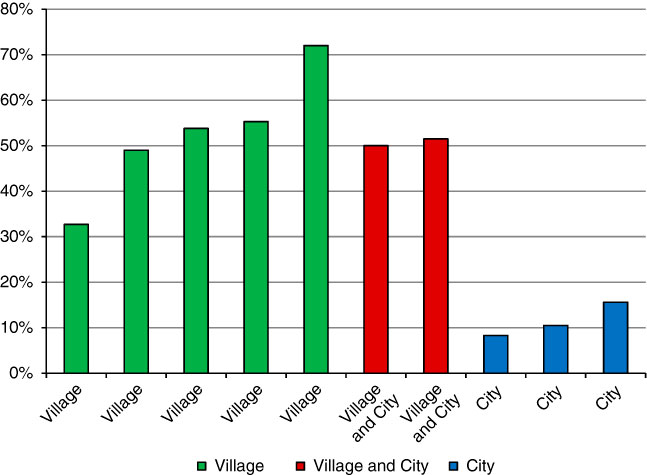
(Fig. 1)
Percent of traditional foods consumed by study participants based on residence during pregnancy as reported in food frequency questionnaires.

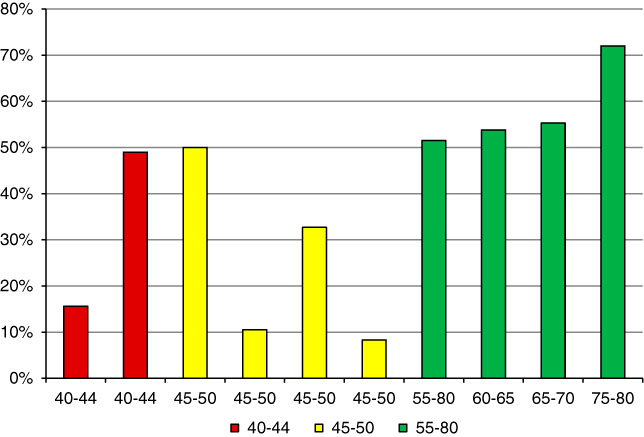
Although statistical significance could not be assessed with this sample, preliminary evidence indicates that the contribution of locally harvested to store-bought foods in participants’ diets during a past pregnancy were affected by residence during pregnancy, participant age (Figs 2 and 3) and elapsed time to recall.
Percent of traditional foods consumed during pregnancy as reported in food frequency questionnaires by participant age.

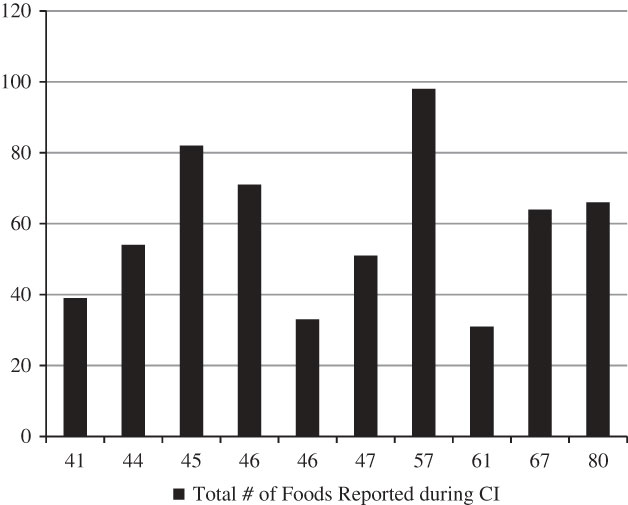
Number of different foods reported during conversational interview by participant age.

CIs
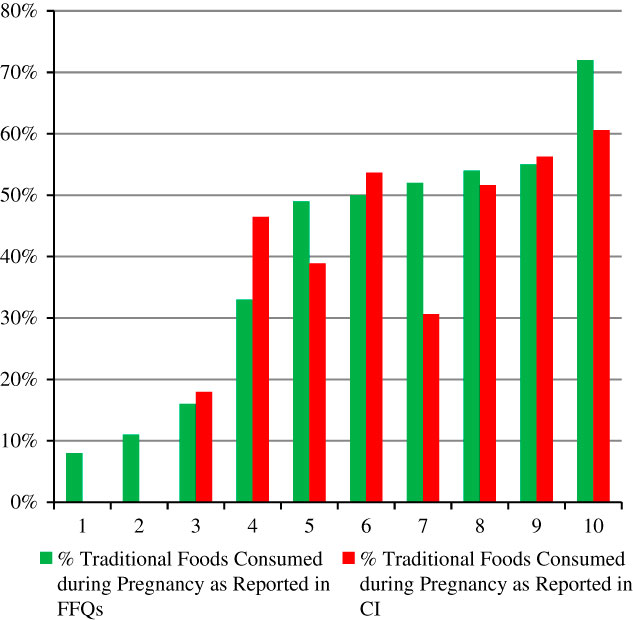
CI analyses are partially consistent with FFQs, indicating that participants reporting less locally harvested foods on the FFQ reported eating less during the CI (Fig. 4). There was also a trend toward less variety (i.e. fewer types of foods being reported) among participants reporting fewer methods of preparation. Participants who reported the fewest number of locally harvested foods during the CI reported the fewest number of foods of any kind, but a similar trend was not visible with store-bought foods. There did not appear to be a relationship between participant age and the number of foods reported during the CI.
Comparison of percent of traditional foods consumed during pregnancy as reported in food frequency questionnaire to percent reported in conversational interview.

Nutrient intake estimates
Dietary intake estimates are consistent with previous research and indicate that even though locally harvested foods consumed by this group during a past pregnancy contributed less to total energy than store-bought foods (31 and 69%, respectively), they contributed similar amounts of protein (47 v. 53%) and fat (46 v. 54%), lower carbohydrates (7 v. 93% from store-bought foods) and saturated fats (23 v. 77%), and the bulk of PUFAs (73 v. 27%). This suggests that, despite the dietary transition toward market foods among Yup’ik communities beginning in the 1950s, the diets of Yup’ik women during their pregnancies 17–50 years ago were indeed high in PUFAs because of the continued intake of some traditional foods. This was more pronounced among Yup’ik women who lived in their home village during their past pregnancy than those who lived in urban areas.
Discussion
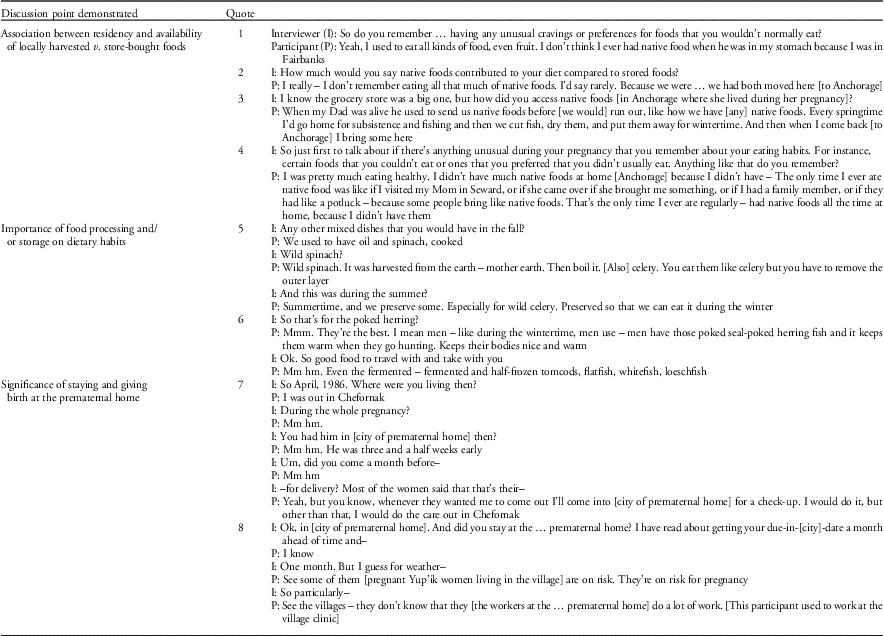
As expected, women still living in their home village during their past pregnancy reported consuming locally harvested foods more frequently than women living in Anchorage and/or Fairbanks. Even today, the use of locally harvested foods in Yup’ik villages remains high relative to other Alaska Native villages, but this was even more pronounced 20–30 years ago.Reference VanStone 32 In the nearest cities, however, access to traditional Yup’ik foods is almost entirely dependent on gifts/exchanges from visiting friends and relatives.Reference Lee 33 Indeed, a few participants used their memory of where they were living during their pregnancy as their own proxy for whether or not they had access to traditional Yup’ik foods (Table 3, quotes 1–3). When native foods were available outside of the village, the context was always one of a handful of identifiable circumstances (Table 3, quote 4).
Quotes from conversational interviews

The importance of harvest season for diet has become one theme that is perhaps over-emphasized in research in the Arctic because of a rather narrow interpretation of arctic hunter-gatherers.Reference Stopp 34 , Reference Frink, Bodenhorn and Delle 35 The lack of attention on the importance of storage and processing, which was and continues to be critical for maintaining food stores through the winter months when harvests are scarce,Reference Stopp 34 , Reference Frink, Bodenhorn and Delle 35 might contribute to the conflation of seasonal consumption with seasonal harvesting. It might also be the case that a greater number of subsistence studies in the Arctic fall under the purview of U.S. and Alaska state fish and wildlife regulatory bodies, which understandably focuses on harvesting counts over meal planning. The current study indicates that dietary intake of locally harvested foods is not limited to seasonal availability of the catch, but that there are methods of processing and storing foods that researchers know little about (Table 3, quotes 5 and 6).
CIs indicated that four out of the five women who lived in their home villages during pregnancy gave birth and likely stayed at a Native health corporation prematernal clinic (prematernal home) during their last month of pregnancy, but did not have access to any locally harvested foods. The effect of this on the contribution of locally harvested to store-bought foods on past diet during pregnancy is not clear from the small sample and the lack of detail in the FFQ (e.g. separate trimesters). The only participant in this sample who resided in her home village during her past pregnancy but who did not give birth or stay at the prematernal home was the eldest participant. This participant did, in fact, report consuming more traditional foods during her past pregnancy, but this effect might have less to do with greater access to traditional foods as a result of not staying at the prematernal home and more to do with limited access to store foods because of the time period of her pregnancy (i.e. native stores – the primary source of these foods – were established in the 1970sReference Fienup-Riordan 29 ).
When asked about access to traditional foods while staying in the prematernal home, participants all clearly stated that they had none. It is interesting to note, however, that this information was not offered without prompting. For instance, when participants who lived in their home village during the course of their past pregnancy were asked where their child of the recalled pregnancy was born, their response was always the name of their village. This is not likely because of reporting error or cultural idiosyncrasies, but simply a less clinical definition of birthplace that translates to the place where their child was raised because, when specifically asked about delivery in the prematernal home, answers were clear and in the affirmative. Nevertheless, it was difficult to elicit information on the details of participants’ stay in the prematernal home (length of time before delivery, types of non-traditional foods eaten and so forth) (Table 3, quotes 7 and 8).
According to FFQs, Yup’ik women with adult-aged children currently living in Anchorage all reported consuming some locally harvested and store-bought foods during a past pregnancy (17–50 years ago), the degree to which generally coincided with residence during pregnancy. Other factors affecting access to traditional foods and their preparation surfaced during the interviews that had not been factored into the FFQs, but which had an effect on the dietary reports. In addition, seasonality, which was included in the FFQs, did not have a significant effect on dietary reports as expected.
Energy, macronutrient and fatty acid estimates based on foods reported by this group are consistent with previous research, and indicate an increase in carbohydrates and saturated fats relative to PUFAs with decreased intake of locally harvested foods. However, the nutrient intake data estimates demonstrate that, overall, the diets of Yup’ik women 17–50 years ago were indeed high in PUFAs because of the continued intake of traditional foods, especially for women who were pregnant in their home villages, and despite a transition toward more market foods beginning in the 1950s. A large body of epidemiological and experimental animal research has shown that maternal nutrition during pregnancy and lactation can significantly alter metabolic function of adult offspring.Reference Benyshek 36 Given the well-established cardiometabolic benefits associated with diets rich in LC-PUFAs,Reference Liu, Qiu and Mu 37 – Reference Paniagua, Pérez-Martinez and Gjelstad 39 several experimental animal studies have investigated the effects of maternal prenatal/lactation diets varying in the content and ratios of n-3 and n-6 LC-PUFAs on bone growth/formation, systolic blood pressure and levels of serum leptin, insulin and triacylglycerols in neonatal offspring,Reference Korotkova, Gabrielsson and Hanson 40 – Reference Korotkova, Gabrielsson and Hanson 42 as well as adult offspring weaned onto control and high-saturated fat western diets.Reference Korotkova, Ohlsson and Hanson 43 – Reference Benyshek, Kachinski and Jin 45 These studies suggest that LC-PUFA diet content, and perhaps more importantly, more balanced n-6 to n-3 PUFA ratios, may be key dietary variables in the developmental programming of cardiometabolic function and bone growth in adult offspring. The current preliminary study was focused on methods for obtaining retrospective dietary information and did not analyze the anthropometrics or diabetes status of participants, or their adult children and grandchildren. Nevertheless, the findings reported here, indicating a high n-3 PUFA content of Yup’ik women’s diets during past pregnancies 17–50 years ago, coupled with previous dietary dataReference Heller and Scott 15 suggesting that diets in general were energetically adequate, appears more consistent with a developmental origins, rather than a thrifty genotype explanation for the relatively low diabetes prevalence currently reported among Yup’ik Alaskans.
Although it is widely recognized that American Indians and Alaska Natives are not a homogenous group, they are often lumped together (e.g. ‘AI/AN’) as an ethnic/racial at-risk population in epidemiological studies of diabetes. Nevertheless, the evidence is clear that, as a group, specific American Indian and Alaska Native populations do suffer disproportionately from diabetes and that this is, at least in part, a consequence of similarly experiencing a dietary transition away from traditional and toward store-bought foods. There are clearly exceptions to this trend, however – the relatively low prevalence of diabetes among Yup’ik Alaskans being one example. Population-specific differences in dietary content, and in the extent and timing of disruptions to traditional foodways that may significantly affect prenatal diets, may reveal important factors that help explain these differences. Research approaches that improve the quality of remote dietary recall during pregnancy need to be further developed and refined in order to investigate the role of maternal dietary factors in the developmental origins of metabolic disease – especially among populations experiencing rapid dietary transitions. Evidence from this study suggests that dietary data derived from questionnaires can be improved by using in-depth interviews to collect preliminary data. This can then help researchers frame questions and provide interview prompts in ways that will optimize the accuracy of remote dietary histories and facilitate future DOHaD-oriented research.
Acknowledgments
The authors thank their research assistant, Pauline Haas, and their colleague, Liam Frink, for their invaluable contributions to this study.
Financial Support
The authors received financial support from the University of Nevada Las Vegas, Department of Anthropology, Edwards and Olswang Grant for the research described in this article.
Conflicts of Interest
None.
Ethical Standards
University of Nevada Las Vegas (UNLV) Institutional Review Board (IRB) approvals were obtained before the start of the project and all respondents were provided with explanations of the study aims and procedures and signed consent forms prior to their participation.