The impetus for this work comes from data from the mid-1990s that revealed
that women were entering political science graduate programs in proportions
relatively equal to men. Yet, in looking at who actually completes doctoral
degrees, the data show a greater disparity between men and women. As an
example, for the political science2
Includes
degrees granted in political science, government, public
administration, public policy analysis, and international relations
and affairs.
doctorates awarded in 1996, 32.9% were
received by women. Thus, women are entering political science graduate
programs in roughly equal proportions, but they either have not been staying
in the department to complete their Ph.D. degrees at the same level as the
men or they are taking a longer time for completion.
To determine ways to improve retention and success rates among graduate
students, we undertook a survey of all currently active graduate students in
Ph.D.-granting institutions in the Midwest region (funded by the Midwest
Political Science Association). A random sample of the students was
contacted and asked to complete a mailed questionnaire comprised of queries
about current experiences and statuses in their graduate programs (see
Appendix A).3
A copy of the questionnaire that
was mailed to graduate students is available from the authors of
this report. The questionnaire went through several revisions and
was pilot tested among graduate students before being finalized.
Standard procedures for such surveys were followed, including
guarantees of anonymity and follow-up mailings to increase response
rates.
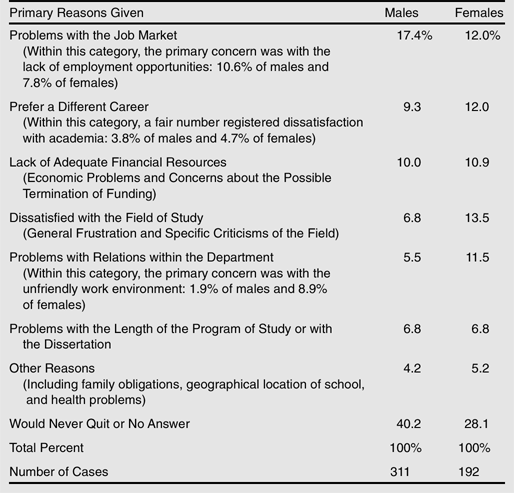
We asked respondents whether they had ever seriously considered leaving
graduate school before completing their degree objective. We also asked, via
an open-ended format, if the student should decide to quit graduate school,
what would be the primary reason (Table 1). For
men, the single most frequently cited reason is the lack of employment
opportunities; for women, it is an unfriendly (unsupportive) work
environment.
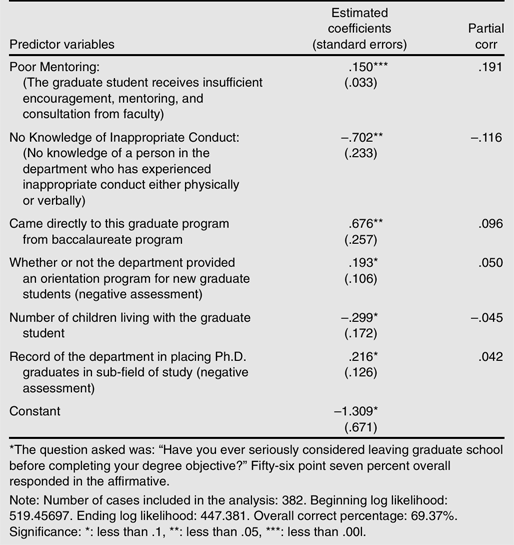
In Table 2, we present the set of factors that best
predicts the probability of giving serious thought to quitting graduate
school.4
Other factors that were tested
but were not found to be significantly related (in a mulitvariate
model) to the serious thought of leaving graduate school are: degree
plan upon entering graduate school (MA, Ph.D. or other), criteria
used in selecting the graduate program (such as reputation or cost),
level and type of funding (graduate/teaching assistantship or a
fellowship), the number of hours the student works for pay outside
of any assistantship or fellowship, the student's career goals, what
the student's highest academic degree was before entering the
current program, undergraduate major, previous degree, most recent
GPA, GRE scores, frequency of participation in social get-togethers,
involvement in a personal relationship, whether minorities or women
are on the faculty, assessment of methods and statistics coursework,
year of birth, gender, and race.
Good mentoring appears to
be the most effective mechanism to work against attrition. Negative reports
about the availability of faculty encouragement and consultation (Poor
Mentoring) are significantly tied to a higher probability of serious
consideration of leaving graduate school (see Appendix B for a listing of
the items used in this and other scales). This finding confirms the previous
research that has demonstrated that faculty mentoring and supportive
advising are important elements of graduate student retention (Lewis 1996;
Girves and Wemmerus 1988). While good mentoring works against attrition, the
most important factor that contributes to the thought of leaving graduate
school is knowledge of inappropriate conduct (either in terms of physical
behavior or verbal communication) by a department member.
We also developed an index of satisfaction and dissatisfaction with the
graduate student experience using seven questionnaire items. The mean score
on the dissatisfaction scale was significantly higher among those who
considered leaving their graduate program (before achieving their degree
objective), than among those who did not consider leaving. The index of
dissatisfaction, therefore, was used as an indicator of who would
successfully complete their degree objectives.
The best predictor of level of dissatisfaction with the graduate student
experience is whether the graduate student receives sufficient
encouragement, mentoring, and consultation from faculty. Thus, good
mentoring by faculty was determined to be the best way to both improve
satisfaction levels of graduate students and to reduce serious thoughts of
leaving a program. Other work has unfortunately shown that mentoring
relationships for women graduate students are less established and less
likely to be with same-sex mentors (Heinrich 1991).
Our findings also demonstrated that perceptions of how department chairs and
faculty respond to reports of discriminatory and other inappropriate
practices are of critical importance in determining satisfaction with the
graduate training experience. The second best predictor of dissatisfaction
in graduate school is a scale that measures whether the respondent thinks
that incidents of sexual or racial harassment would be handled promptly and
appropriately by the department. Our findings also show that the provision
of an orientation program to incoming students does help to reduce the
average level of dissatisfaction. The lack of an adequate orientation
program hinders a woman's satisfaction more than a man's satisfaction.
Equally interesting were findings contrary to some of those in the existing
literature: The receipt of an assistantship or fellowship was found in our
survey of political science graduate students to have an insignificant
impact on satisfaction levels. Girves and Wemmerus [1988] suggested that
reliance on one's own financial resources contributes to both lengthening
the time to completion of a degree as well as increasing the attrition
rate.
Another important finding from our survey of graduate students in
Ph.D.-granting departments in the Midwest region was that women and men do
not differ significantly with regard to degree objectives. Seventy-eight
percent of women and 82% of men planned to get a Ph.D. upon entering
graduate school. Others had a goal of a Master's degree or some other
advanced degree. Once the degree is completed, however, men do have somewhat
higher career goals than women. Among those who plan to pursue an academic
career, 48% of men but only 42% of women plan to work at a college or
university with a graduate program. Others plan to work at a teaching
college or a university that offers only undergraduate degrees. Career goals
are related in a bivariate fashion to the thought of quitting graduate
school. Among those who plan to work at a college or university with a
graduate program, only 50% have seriously thought of leaving graduate school
before completing their degree objective. While among those who plan to work
at a four-year college or university, 62% have thought about quitting
graduate school.
These degree objectives and career goals are to some degree outside the realm
of the responsibility of the faculty of the degree-granting institutions.
But issues of mentoring, responsiveness of the faculty to possible
inappropriate behavior, and the decision to offer orientation programs are
all very much within the realm of activities that can be undertaken to
improve the graduate student experience. For the remainder of this article,
therefore, we would like to discuss what departments can do to help improve
the experiences of their graduate students.
We anticipated that many departments would have already initiated measures to
help students and several questions were included in the questionnaire to
assess this facet of the graduate student experience. A question asked
whether a support group was available for women in the department. Follow-up
questions asked about the degree of participation in the support group. In
addition, an open-ended question asked whether the support group was
helpful, and why or why not. Among those women who participated in a support
group, the list of benefits included: help with future employment (5.7%), a
chance to learn the perspectives of other women (3.6%), camaraderie or
social interaction (3.1%), and the chance to share concerns with like-minded
people (2.6%). Noteworthy is the fact that the most frequently cited
benefits of a support group are instrumental rather than social or
emotional.
We also asked whether the graduate student's department had any women
faculty. Ninety-eight percent said yes. Ninety-one percent said that at
least one of the females was tenured. Thus, women faculty are theoretically
available as mentors to graduate students. We asked in an open-ended format
whether the respondents could identify some ways in which women faculty had
been helpful to them. Among those who responded to this query, a majority of
both male and female graduate students said that female faculty were just
the same as male faculty and provided the same services, such as
professional mentoring, advising, providing feedback on work, serving as
dissertation advisors or committee members, and encouraging research
interests. Female graduate students were more likely than male graduate
students to say that female professors provided help beyond what was
provided by male faculty. The most frequently mentioned “extras” as provided
by female faculty were service as a “role model” (4.7% of females),
approachability–i.e. someone to talk to (3.6% of females), being more
supportive (9.9% of females), and providing a unique understanding of
problems faced by women (4.7%). A small portion of the total (1.6% of males
and females combined) said that female professors were less helpful than
male professors.
These findings, together with those presented in the April 2003 issue of
PS, provide empirical support for a set of suggestions on how
“ushering” students through graduate programs might be accomplished more
fruitfully, allowing departmental chairs and leaders in our profession to
take the necessary steps toward eliminating some of the obstacles that
graduate students face. One of the clearest findings is that faculty
mentoring and departmental orientation programs do contribute to a favorable
experience for graduate students. We cannot say whether the orientation
programs were a causal factor that resulted in an overall positive
experience for graduate students, or if having a positive atmosphere causes
the department to develop an orientation program as one intervention to help
students. If the former is the case, it would appear that orientation
programs serve as vehicles to “level the playing field” by letting all
graduate students know departmental norms and expections, operating policies
and procedures, and opportunities available. In either case, orientation
programs provide important information about the department and how to
proceed to achieve one's aspirations.
The question that arises is what else can be done to help women achieve
higher levels of satisfaction, that is, levels more comparable to those of
men? The findings suggest several places to start. Departments need to
reassess the extent of sexual and racial harassment and whether measures to
prevent and address harassment heretofore instituted are adequate. Within
the questionnaire, students were asked: “Since entering graduate school have
you ever been involved in an interaction with a department member which
involved behavior you perceived as inappropriate either in terms of physical
conduct or verbal communication?” A profound difference between the
experiences of men and women emerges on this measure. Women were much more
likely to report an experience with or personal knowledge of inappropriate
behavior than were men. A majority of both sexes responded negatively to
this query, yet women are significantly more likely to have experienced
inappropriate behavior by a faculty member (28%) than have men (18%).
Respondents were also asked whether they know of any other person in their
department who has experienced such behavior. For this broader query about
knowledge of inappropriate behavior, 50% of women and 36% of men said “yes.”
Questions were also asked about the response of the department to reports of
such incidents. One question asked students to agree or disagree with the
statement: “The department has a zero tolerance policy toward racial and
sexual harassment.” Significant gender differences occurred on this
question, with women more likely to disagree.
It is the query about whether the respondent knows of any person in their
department who has experienced such behavior that is included in the
logistic regression model (Table 2). The
regression model shows that personal knowledge of inappropriate behavior
affects thoughts about leaving graduate school before completing the degree
objective. This awareness of inappropriate conduct by a department member is
much more widespread among graduate students than we would have guessed and
it raises questions about the effect it has on students' lives and careers.
Given the many years that universities have had operant harassment policies,
the unequal power between faculty and students, and the data reported here,
departments cannot be complacent in thinking that their policies are
working. The data reported here assures departments that the failure to act
on any single experience will affect not only the specific party but,
through common knowledge, harm the experience for other women and men as
well. Departments can do better by setting, promoting, and enforcing a zero
tolerance policy towards harassment. They can also back up that policy when
necessary through appropriate investigation and action. Departments can
better train their faculty to avoid subtle classroom bias and faculty
themselves can participate in other sensitivity exercises such as those
suggested by Paludi (1998).5
See also Hall and
Sandler (1982) and Sandler, Silverberg, and Hall
(1996).
On average, men and women differ in their reasons for considering leaving a
program (e.g., lack of employment opportunities versus lack of a supportive
environment). We need to entertain the idea that female students may have a
different worldview than male students. The institutionalization of support
groups for female students is not, in itself, sufficient help. Burdened with
their academic load and responsibilities, graduate students have limited
time and, as seen in this study, the value of the support groups is often
seen as instrumental rather than solely supportive.
We have already shown that departmental attention to faculty mentoring,
regularized communication, orientation programs, and decisive action when
incidents of discrimination and harassment occur can reduce thoughts of
leaving a graduate program prematurely and can increase levels of
satisfaction with the graduate experience. Departments can improve their
faculty's response to graduate student concerns generally and can take
responsibility to see that each student has a mentor. This would
significantly improve satisfaction for both men and women. If left
unaddressed, these issues create a reverberating wave of ramifications, with
a portion of women and minorities failing at each level, leaving the
profession deficient in their perspectives.
We emphasize again that economic capital (i.e., access to assistantships and
fellowships) is not a major factor for explaining dissatisfaction or the
serious consideration of leaving graduate school. This may mean that the
distribution of financial awards is perceived as equitable, or that, simply,
it is less salient vis-à-vis the dependent variables–in part because the
majority of the graduate students surveyed are fully funded. Past and
ongoing departmental attention to fairness in allocating awards, however,
needs to be sustained.
In addition, undue weight should not be placed upon GRE scores in admissions
decisions. Morrison and Morrison (1995), in a meta-analysis of 30 published
studies, could not find a significant correlation between first-year
graduate GPAs and GRE verbal and quantitative scores, a finding supporting
others' works (Lipschutz 1993; Girves and Wemmerus 1988). In addition,
researchers have found that these traditional admissions criteria are biased
against minorities and women (Vaseleck 1994) and under-predict aptitude for
older, non-traditional students (Brazziel 1992; Clark 1984; Swinton
1987).
Finally, we need more research. We need it to assess any cumulative effect
there may be of differential experiences with advisors, in the classroom, or
exposure to inappropriate behavior. We also need to investigate to what
degree perceived differences are based on objective variations in treatment
versus variations in subjective assessments. Beyond more data, however,
departments may want to consider introducing faculty to extant research on
biases in teaching styles that disadvantage females and minorities and
differential perceptions of what constitutes harassment and its effects on
human lives. With close attention and early intervention in these areas,
academic departments can think and act prospectively in planning for their
discipline's future human resources needs, while making the academic climate
more supportive for all our students.
This study was commissioned and funded by the Executive Council of the
Midwest Political Science Association. Additional funding was provided
by the Department of Political Science at the University of Iowa. This
article could not have been written without the invaluable research
assistance of Erik Gartzke, Kristen Holmes, Brian Kessel and Ha-Lyong
Jung.