1. Introduction
The Dispute Settlement System (DSS) of the World Trade Organization (WTO) is widely seen as the key pillar of the multilateral trading system. This unique system for settling trade disputes through judicial processes was put in place in 1995 with the establishment of the WTO as an international organization. The WTO's predecessor, the General Agreement on Tariffs and Trade (GATT), also had a procedure for settling disputes, but it suffered from several serious shortcomings. During the Uruguay Round, GATT contacting parties agreed to redesign dispute settlement in several ways in order to rectify these shortcomings. The reform was significant.
The new system has been called the ‘jewel in the crown’ of the WTO and has led to a vast body of literature. Much attention has been paid in this regard to why, and under what circumstances, countries initiate disputes (Bown, Reference Bown2005; Horn et al., Reference Horn, Mavroidis and Nordstrom1999), which countries are the most and least active initiators or targets of WTO disputes (Horn et al., Reference Horn, Johannesson and Mavroidis2011), and how legal capacity, economic stakes, and power relations influence the prospects of litigation (Kim, Reference Kim2008; Sattler and Bernauer, Reference Sattler and Bernauer2011; Elsig and Stucki, Reference Elsig and Stucki2012). Others have looked at what type of disputes escalate and, hence, move on from the consultation stage to the panel stage and beyond (Guzmann and Simmons, Reference Guzmann and Simmons2002), which countries are most likely to win claims they have made before panels (Hoekman et al., Reference Hoekman, Horn, Mavroidis, Thomas and Trachtman2009), what role third parties play in WTO disputes (Bown, Reference Bown2005; Busch and Reinhardt, Reference Busch and Reinhardt2006), and how private actors are involved in WTO litigation (see Shaffer, Reference Shaffer2003; Eckhardt and De Bièvre, Reference Eckhardt and DeBièvre2015). Finally, questions on economic effects (Bown, Reference Bown2004) and on authority of the court-like system (Shaffer et al., forthcoming) have been addressed.
What is lacking so far, however, are studies that explain the origins of this significant legalization leap, in particular the introduction of judicial processes. This extraordinary move to law was not anticipated at the outset of the negotiations by any GATT expert. Given the importance of the court today, it is still puzzling how little research has been conducted on the design of the WTO DSS. The work that does exist is United States (US) focused and suggests that one (or a combination) of the following factors explains the creation of the DSS: (a) a move by US negotiators in an attempt to tie Congress's hands (Thompson, Reference Thompson2007); (b) the desire of the US to improve the legitimacy of the system (Pelc, Reference Pelc2010; Goldstein and Gowa, Reference Goldstein and Gowa2002); or (c) simply to help enforce rules that reflect US objectives (Goldstein and Steinberg, Reference Goldstein and Steinberg2008).
In this article, we attempt to overcome this US bias by also looking at the crucial role of the European Community (EC). In addition, we provide an explanation that departs from the usual accounts in the tradition of the rational design (RD) research programme (Koremenos et al., Reference Koremenos, Lipson and Snidal2001). Like others before us, we suggest that the RD literature has not sufficiently taken into account the context in which negotiations took place. Building on the concept of ‘experiential learning’, we argue that the interpretations of the GATT dispute settlement system of the time, and of ongoing disputes, significantly conditioned the preferences of the actors involved in the negotiations. Negotiators take into account past behavior within a given institution when assessing whether they will be on the winning or losing side when rules change. Empirically, we show how experiential learning has affected the positions of both the US and the EC. In the case of the US, the proposals of the early negotiations phase were characterized by US negotiators' discontent with the situation in which other parties (in particular the EC) were often able to block the establishment of panels. US negotiators also embraced a judicial system because they anticipated that few parties would bring cases against the US. In comparison, at the beginning of the negotiation process, the EC was pursuing a laggard approach. However, the outcomes of the disputes that arose during the period of the negotiations (under the GATT dispute settlement provisions existing at that time) led the EC to change its overall approach to the negotiations from that of a reluctant actor favoring non-judicial means of dispute settlement to that of a supporter of the new system. This preference shift proved important for the reforms that occurred. Finally, the article, as part of a special issue on ‘Judicial Politics in International Trade Relations' (De Bièvre and Poletti, Reference De Bièvre and Poletti2015), aims to further our knowledge on judicialization of international trade relations in general and in the WTO in particular (see also Poletti et al., Reference Poletti, Bièvre and Chatagnier2015).
We structure this article as follows. The next section outlines the argument as to how experiential learning affects the design of judicial institutions in the multilateral trade organization. Section 3 provides empirical evidence for our argument. Based on an analysis of GATT cases, interviews, and negotiation documents, we illustrate the development of US and EC positions over time and the key role experiential learning played in this process. Section 4 discusses the results and concludes.
2. Experiential learning and trade negotiations
The literature on the design of international institutions has suggested that uncertainty is an important explanation for treaty design in general (Koremenos et al., Reference Koremenos, Lipson and Snidal2001; see also Koremenos, Reference Koremenos2005) and for trade agreements in particular (Rosendorff and Milner, Reference Rosendorff and Milner2001; Rosendorff, Reference Rosendorff2005). Whereas the literature works with different types and forms of uncertainty, explanations boil down to the lack of sufficient knowledge about the future distribution of gains from cooperation. The RD literature has been helpful in advancing research on explaining design differences across international institutions and has offered testable conjectures on how uncertainty drives design. However, it has suffered from two blind spots. The first relates to the role of negotiations. The RD literature has not addressed the question of how negotiations can alter positions and eventually preferences within its (static) framework. Negotiation-related dynamics may lead to different outcomes than those predicted by RD. The second concerns the context of negotiations and in particular the fact that many institutions are not created from scratch, but usually build upon existing institutions. That is, new institutions are designed with existing knowledge about past practices and experiences.
We are certainly not the first to observe that not controlling for contextual variables biases research on design choices. In a recent article, Copelovitch and Putnam (Reference Copelovitch and Putnam2014) have convincingly argued that the institutional context plays a key role (i.e. ‘has an independent influence’) in the strategic decisions of actors on the design of international agreements. The authors point in particular to the importance of ‘the presence or absence of existing and prior agreements between prospective partners in “new” cooperation’ (Copelovitch and Putnam, Reference Copelovitch and Putnam2014: 471). That is, according to Copelovitch and Putnam (Reference Copelovitch and Putnam2014: 484), ‘more extensive present and past cooperation may ameliorate (or exacerbate) states' concerns about cheating by their counterparts … [as it] mediates uncertainty over the preferences of negotiating partners by offering information about prior commitments and the incentives those commitments create’. Although they convincingly show that past cooperation independently affects outcomes by using different contextual proxies, there is a need to deepen the analysis on the type contextual factors and the causal mechanisms at work.
Building on some of the insights from the RD literature, and the aforementioned observations by Copelovitch and Putnam (Reference Copelovitch and Putnam2014), we develop an argument as to how context affected the design outcomes of the WTO DSS. Our first step is to define what the context is in our case. The context under scrutiny is the preexisting GATT dispute settlement system and the outcomes it produced.Footnote 1 The next question we need to address is how experience with the GATT system affected the design of the new WTO DSS after we have controlled for other factors. Based on the assumption that a key element in negotiations is uncertainty and that actors look for information to address uncertainty, we argue that clues from actual behavior are a proxy for negotiators in forming their expectations about a future system. Forming expectations takes place through what is known as ‘learning’ from the outputs of the current system. The idea that learning shapes preferences of actors is well established in psychology (Kolb, Reference Kolb1984), as well as in business studies (Delios and Henisz, Reference Delios and Henisz2003; Tsang, Reference Tsang1999). Political scientist and international relations scholars increasingly pay attention to the concept of learning as well. For instance, within the literature on historical institutionalism, there is a wide-ranging debate on the circumstances under which historically formed institutions transform over time. One way through which institutional change can occur is when the actors involved go through a process of ‘strategic learning’ – i.e. assimilate new information and revise their perception on the functioning of the institution in question – and alter the institutional environment in which they operate (Hay and Wincott, Reference Hay and Wincott1998). Learning also plays an important role in the literature on policy diffusion. For example, there is a large body of literature which argues that the spread of liberal policies (e.g. tariff reductions, protection of minority rights, and privatization) across the globe since the end of the twentieth century, is the result of policy makers learning from their own (domestic) experience with liberalization, as well as from policy experiments elsewhere (for an overview of this literature see Dobbin et al., Reference Dobbin, Simmons and Garrett2007).
Most of the literature assumes that learning happens when (new) information changes the beliefs of actors (whether individuals or firms) about cause and effect (Levy, Reference Levy1994; Elkins and Simmons, Reference Elkins and Simmons2005).Footnote 2 Whereas various forms of learning are described, for the purpose of our argument, we suggest focusing on experiential learning, a type of Bayesian learning or updating. ‘Bayesian learning takes place as new data consistent with a hypothesized relationship accumulate, or fail to. As information accumulates, some hypotheses are discarded and others are reinforced. The more consistent the evidence, the more likely [actors] will converge on a narrow range of interpretations' (Dobbin et al., Reference Dobbin, Simmons and Garrett2007: 460). Information (data) can come from previous experience or from interaction and observation (Huth and Russett, Reference Huth and Russett1984; Powell, Reference Powell1988). If information originates from actors' own past experience, we use the term ‘experiential learning’. As Delios and Henisz (Reference Delios and Henisz2003: 1154) write with respect to international investment decisions by firms: ‘Experience in a host country, for example, provides important information about its business environment thereby reducing uncertainty, and enabling a firm to make a better evaluation of potential future expansions. Investment experience broadens a firm's perception of its alternatives and increases the extent of its search.’ We expect a similar process to take place in the context of the institutional design choice of (treaty) negotiators. In the end, past experience may lead not only to the adjustment and modification of strategies in negotiations, but may also lead to a change in preferences.Footnote 3
Moving to the world of trade negotiations in the context of the Uruguay Round, we assume that the more negotiators expect to gain from an institutional change, the more likely they are to advocate a move away from the status quo. Alternatively, negotiators who fear negative distributional consequences from dispute rulings will be reluctant to agree on a reform. Building on the concept of ‘experiential learning’, we ask what types of clues do treaty negotiators rely upon that affect learning, eventual adaptations of positions, or even a shift in preferences? We expect negotiators to look in particular at the past and existing usage of the GATT dispute settlement system and to learn from the outcomes of cases their countries have been party to. The information they draw upon will in turn condition their positions in current negotiations. Our expectation is that negotiators focus in particular on both overall success (countries' wins and losses when engaged in disputes) and lessons learned in specific disputes. Based on this experience, negotiators periodically update the information received and if their assessment of the distributional consequences changes (experiential learning), this can lead to a change of strategies, or can go as far as preference shifts.
We illustrate shifting negotiation strategies in the context of the Uruguay Round negotiations on dispute settlement with an example drawn from South Korea. As South Korea faced legal complaints in the mid-1980s, it was reluctant to engage in a move away from the status quo. In order to play a constructive role, early on in the negotiations it supported an enhanced role of mediation within dispute settlement processes and the introduction of non-compulsory arbitration procedures.Footnote 4 This reflected the concern about losing the blocking power when moving to a more legalized system. Over time, when automaticity and more streamlined processes for implementation became more widely accepted during the negotiations, South Korean negotiators modified their bargaining strategy and suggested that when adopting a panel report and defining a reasonable time frame for implementation, the Council should take into consideration political, economic, and social factors. This was an attempt to allow some flexibility in implementing the reports' recommendations in the future based on experience at the time. While engaged in these negotiations South Korea faced three cases concerning beef imports, where, for domestic political reasons, it needed more time for implementation.Footnote 5 In sum, South Korea's changing submissions at the different stages of the negotiations could not be understood without analyzing the cases in which it was concurrently involved.
3. The creation of the WTO's dispute settlement system: a case of experiential learning?
In the empirical section, for simplicity, we focus on the two leading actors in the system: the US and the EC. They were the major trade powers at the time. Given the nature of multilateral trade negotiations in the 1980s, the US and EC preferences needed to overlap in order for a move away from the status quo to occur. In addition, the US and the EC were by far the most active participants in the GATT Dispute Settlement system, both as initiators and as targets. When looking at the 1950–1989 period, the EC and the US were involved (as the defendant and/or the complainant) in 190 of all 207 cases filed (Hudec, Reference Hudec1993). This explains why dispute settlement design was a salient issue for both of these GATT contracting parties.
We first provide an overview of the reforms that were agreed and discuss how these came as a surprise to many of the Geneva-based diplomats. Second, we discuss the cases in which the US and EC were involved in the 1980s and which informed and shaped the negotiators' ‘experiential learning’. Third, we provide evidence based on archival research and in-depth interviews with participating negotiators by tracing the effects of disputes that occurred during the time of the negotiations.
3.1 From GATT to the WTO – embracing judicialization
The early GATT era was characterized by an anti-legal attitude. Disputes were solved through diplomatic–political processes. Over time, some forms of low-level legalization occurred with the introduction of panels composed of independent experts. However, the system suffered from parties' blocking power, which could be exerted on multiple occasions. Dispute settlement decisions were taken on the basis of a ‘positive consensus', i.e. there had to be no objection from any member to the decision. As a result, individual GATT contracting parties (especially defendants such as the EC and Japan) had de facto veto power over the establishment of panels, the approval of panel reports, and the authorization of retaliation, which meant that many cases dragged on for a long time without a decision being taken. Therefore complainants (most notably the US) frustrated with the slow decision-making procedures, often decided unilaterally to impose trade sanctions without the approval of the GATT (Bernauer et al., Reference Bernauer, Elsig, Pauwelyn, Daunton, Narlikar and Stern2012). When, in the early 1980s, the preparations for the Uruguay Round negotiations began, many parties therefore considered that the DSS based on the 1979 Understanding was not working well.Footnote 6 Nevertheless, the originally intended reforms were rather general. In a GATT Council Meeting held in 1982, a draft text by the Preparatory Committee chaired by the Canadian Ambassador was discussed. This document called for ‘improvement in the operation of the dispute settlement procedures based on more constructive consultation, greater recourse to conciliation and the more effective resolution of disputes at the multilateral level without creating a situation of “impasse”’.Footnote 7 The Ministerial Declaration was even less ambitious stating that the 1979 Understanding should remain ‘the essential framework of procedures for the settlement of disputes'.Footnote 8 No significant change was needed but ‘there (was) scope for more effective use of the existing mechanism and for specific improvements in procedures'.Footnote 9 Finally, it was stressed that ‘obstruction in the process of dispute settlement shall be avoided’.Footnote 10
In the run-up to the Uruguay Round negotiations, the Director-General of the GATT commissioned an external panel of experts to draw up a list of issues that needed to be addressed by the new trade round. In relation to dispute settlement, this report referred to some of the procedural problems, such as the need to speed up the process and the composition of panels (e.g., panelists should be experts on the GATT legal system). It mentioned moreover that panels should clearly indicate the rationale for decisions, and it focused, among other issues, on the Director-General's role in mediation and conciliation and more systematic implementation of panel reports. Yet it also abstained from formulating more concrete proposals. The 1986 ministerial conference launching the Uruguay Trade Round described the objective in the area of settling disputes as being ‘to improve and strengthen the rules and the procedures … while recognizing the contribution by more effective and enforceable GATT rules and disciplines … negotiations shall include the development of adequate arrangements for overseeing and monitoring of the procedures that would facilitate compliance with adopted recommendations'.Footnote 11 The negotiations on dispute settlement started in 1987 and key issues were agreed by 1992. In 1993, negotiators presented the Understanding on Rules and Procedures Governing the Settlement of Disputes (DSU), which came into effect with the creation of the WTO in 1995.
The key changes to the old system were, first, that the veto power held by defendants at the commencement of the process was eliminated by granting complainants the right to a panel;Footnote 12 second, by the introduction of ‘negative consensus' decision-making for the adoption of panels, Appellate Body (AB) reports, and the authorization of countermeasures a type of automaticity was introduced;Footnote 13 third, with the agreement to create an appeal institution (the AB) a court-like body was established, which received considerable authority. Finally, it was agreed that states should abstain from taking unilateral actions.
Most of these outcomes were surprising. Interviews with former GATT officials who closely followed the negotiations suggest that neither automaticity nor the creation of the AB could have been foreseen at the beginning of the negotiations.Footnote 14 One official put it as follows in relation to the AB: ‘I couldn't believe it myself. Why had the US accepted the creation of the Appellate Body?’Footnote 15
3.2 EC and US experience with GATT dispute settlement in the 1980s
In line with our argument that practices with existing rules and past and ongoing disputes provide negotiators with clues about how to address existing uncertainty, we focus on both the EC and US experience as defendants and as complainants during the time of negotiations. We rely on a database compiled by Hudec et al. (Reference Hudec, Kennedy and Sgarbossa1993; see also Hudec, Reference Hudec1993).
3.2.1 EC and US as defendants
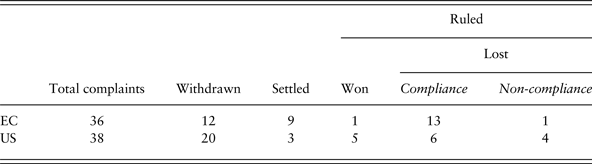
When comparing the role of the two trading blocs as defendants, we compare the overall number of cases brought against them and provide descriptive evidence on the different litigation outcomes. Table 1 provides an overview of these outcomes by showing the total number of complaints brought against the EC and the US; the number of cases that were withdrawn by the complainant before a settlement or ruling was reached; the number of cases settled; and, for those cases that ended up in a legal ruling, the number of cases won and lost by both parties. Finally, we provide information on the compliance record of the EC and the US with lost rulings.
EC and US as defendants (1980–1989)

Source: Hudec et al. (Reference Hudec, Kennedy and Sgarbossa1993).
Even though Table 1 shows that the EC and the US were targeted more or less equally and that the number of cases that received a ruling was the same, there are some striking differences between the two. The US had a much lower percentage of settled cases (8%) than the EC (25%). When compared to the average percentage of all GATT cases that were settled (32%), the low number of US disputes settled becomes even more striking. In addition, 20 out of a total of 38 (i.e. 53%) of all cases brought against the US were withdrawn, while withdrawal took place in ‘only’ 33%Footnote 16 of all cases in which the EC was the defendant. In other words, as Hudec et al. (Reference Hudec, Kennedy and Sgarbossa1993: 37) put it, ‘[t]he United States emerges as an unruly defendant that is difficult to bring into court’. The US was not too concerned being targeted as the percentage of cases it won was relatively high and complainants would often withdraw their claims.
Next we turn to the substantive outcomes of cases that eventually received a legal ruling. In this respect, it is important to note that at that time it was not very likely that a defendant would win a case. In the 1980s, the chance of winning as a defendant was about 15%. In other words, in 85% of the cases the violation complaint filed against the defendant was granted (Hudec et al., Reference Hudec, Kennedy and Sgarbossa1993). The US was a clear outlier, as it won five out of 15 (i.e. 33%) of its cases as defendant. This relatively high percentage of rulings in favor of the US is even more significant if one takes into account the aforementioned fact that the US settled very few cases and that many cases against the US were withdrawn before they were even brought to ‘court’. By contrast, the EC figures were below the average of all GATT countries, as only one (or 8%) of all cases filed against the EC resulted in a legal victory for the EC. These numbers suggest that the US was well able to use legal reasoning to defend cases brought against it, while the EC's record as a defendant in disputes was less positive.
A final aspect worth mentioning is how the two parties responded to legal rulings against them (i.e. the ruled cases that were lost by either the EC or the US in Table 1). We distinguish between compliance and non-compliance in this regard. Compliance means that ‘the legal claim has been fully (or almost fully) vindicated [by the defendant], usually by removing a measure found to be in violation of GATT’. Non-compliance outcome cases are those ‘in which the legal system has failed to enforce a valid claim’ (Hudec, Reference Hudec1993: 276). Table 1 shows that the EC was much more willing than the US to accept the rulings of the GATT dispute settlement process. In 13 out of 14 lost cases (i.e. 92%), the EC complied with the decision taken, while the US complied in only six out of 10 cases (i.e. 60%). In other words, in 40% of the cases the US ignored the legal ruling and did not change its policy. The US clearly felt less obliged to comply with international law than the EC did.
3.2.2 EC and US as complainants
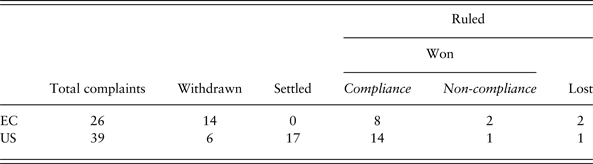
Next, we discuss the role of the EC and the US as complainants in the 1980s (see Table 2 for a summary). When looking at the total number of cases brought we find that the US was definitely more active than the EC (39 and 26 cases respectively). If we focus on the outcomes, an even more interesting distinction becomes apparent. In disputes involving the US, 85% of all cases ended in either a legal ruling (41%) or a settlement (44%). Only six out of 39 (i.e. 15%) cases were withdrawn by the US, which was far below the 39% GATT average for that period. The EC, on the other hand, had a rather similar percentage to the US of cases that received a ruling (46%), but it did not settle a single case and it withdrew more cases (without waiting for a settlement or legal ruling) than any other GATT member at that time: 14 out of 26 cases (54%). This suggests that the EC was not persuaded that its own legal claims were valid and that the panel would rule in its favor.

Table 2 also shows the success rate of the EC and the US as complainants and, again, the US was more successful than the EC. It is important to note, however, that the differences here are definitely less significant than when they acted as defendants. Of all cases that received a legal ruling, the US won 15 out of 16 cases (i.e. 94%). The EC, on the other hand, won ten out of 12 cases (i.e. 83%).
Finally, we look at how the losing defendants responded in cases that were brought against them by the EC and the US. As Table 2 shows, countries were more likely to comply in cases brought by the US (93%) than those brought by the EC (80%). The numbers for the EC are in line with the average of all GATT countries (84% compliance rate), while the US again scores higher than average.
In sum, the US was more actively using the dispute settlement system than any other GATT member, had a high likelihood of winning the cases in which it was the complainant, was able to settle many cases both as complainant and defendant, won relatively a high percentage of the cases in which it was the defendant and used its powers when it deemed it necessary not to comply. When the US won cases in which it was the complainant, the compliance rate was also extraordinarily high. So, the US experience with the system, with the important exception of blocking cases, was generally positive. Addressing multiple veto points in the process would certainly have benefited the US, given the existing experience.
The EC by contrast had been much more reactive: when acting as a defendant it settled many cases and for cases that reached a ruling, it lost nearly all of the claims brought. In disputes in which it was the complainant, the EC withdrew many cases. This points to the lack of a legal capacities and a critical stance towards dispute settlement. Or as Hudec et al. (Reference Hudec, Kennedy and Sgarbossa1993: 56) put it: ‘The Community had a rather pronounced legal policy in this direction. Throughout the 1960s and 1970s the Community was opposed to extensive use of the GATT DS procedure, fearing it had more to lose than to gain from a litigation oriented approach to commercial policy problems. Acting under this policy, the Community occasionally filed GATT lawsuits as a defense device, a tit-for-tat reminder designed to discourage complaints by others rather than an actual attempt to win legal victories. Once the message was received, withdrawal of the complaint was often a more desirable outcome for the EC than to strengthen GATT law by pursuing the complaint to a ruling.’ Therefore, the EC was reluctant to engage in a reform of the DSS.
3.3 The US and EC approaches through the lenses of experiential learning
3.3.1 The US: Championing automaticity, accommodating the AB
In the late 1970s and early 1980s, the US became increasingly frustrated by the fact that many dispute settlement cases were not resolved (Stone Sweet, Reference Stone Sweet and Volcansek1997). In particular, the US was frustrated by a series of cases brought against the EC. Problems with the EC, especially regarding its agricultural policy, had been at the top of the US agenda during the Tokyo Round, and ‘no Tokyo Round legal reforms could claim success without achieving some visible change in EC policy’ (Hudec, Reference Hudec1993: 145). Therefore, from 1980 on, the US was very active in filing complaints against the EC, in the hope that doing so would force a change in EC policy. All of these cases were aimed at what the EC regarded as vital elements of its regional policy, in particular its Common Agricultural Policy (CAP). Both the US and the EC realized that if these claims were to be successful, it would be impossible for the EC to continue the CAP in its original form. So the stakes were high and the EC fought the legal and political battle with all the means at its disposal. The EC's behavior strongly frustrated the US and turned out to be pivotal in fuelling the desire of the US to change the GATT dispute settlement system.
Part of the problem, according to US trade policy-makers and experts, was that panel reports were inadequate and/or GATT rules were unclear on some key issues. Although this frustrated the US, there was one issue that led it to become even more frustrated: the possibility of defendants to block cases (even after a panel ruling). In particular, the EC, as a defendant in cases brought by the US, often blocked the process. A series of cases brought against the EC in the 1980s – i.e. Pasta (1981–1983); Canned Fruit (1982–1985), Citrus (1982–1985), and VAT (1982–1984) – were particularly notable in this regard. In all these cases, the panel ruled in favor of the US, but the EC did not accept its legal defeat and blocked the adoption of the reports for a substantial period of time (Hudec, Reference Hudec1993: 202).Footnote 17 Even though the US and the EC eventually settled some of the disputes (e.g. the Pasta dispute), the US was not at all happy with the way the EC had acted during these blocked cases. One US negotiator put it as follows: ‘the EC was using tactics … Commission officials used to string out the process'.Footnote 18
The frustration with the aforementioned cases was voiced in the US submission to the DSU negotiations that started in 1987. The US argued that the ‘most obvious problem is that some disputes have not been resolved, perhaps partly because of inadequate panel reports or difficult rules in a few cases, but more often because one or more parties have been unwilling to allow a resolution’.Footnote 19 It pushed for a speeding up of the processes and suggested binding arbitration.Footnote 20 While the US continued to use the legal venues aggressively at the start of the negotiations (see Hudec, Reference Hudec1993: 203–208), it was the 1988 US Omnibus Trade Act in particular that encouraged the US trade negotiators to continue to pursue and expand the US's unilateral approach to generate additional attacks on foreign trade barriers (Hudec, Reference Hudec1993: 226–227). An EC negotiator remembered that the Omnibus Act ‘became an obsession with people’.Footnote 21 The US responded to criticism by claiming that it was forced to act unilaterally as the GATT was not strong enough, nor comprehensive enough, to do the job (Hudec, Reference Hudec1993: 230). This external event advanced the US objective of addressing blockage in the GATT legal process.Footnote 22 In 1989 the negotiators agreed on provisionally applying the ‘right to a panel’ approach, under which parties could no longer block the establishment of the panel. In addition, more support for binding arbitration developed, while calls increased for taming US unilateralism through an improved legal system (Elsig, Reference Elsig2014).
In 1990 and 1991 negotiators worked on providing checks on panel reports, should these become binding. In this respect, two control tools for addressing the issue of poor quality panel reports stand out. First, following the North American Free Trade Agreement (NAFTA) model, and with the support of the US, an interim report stage was suggested, during which disputing parties would receive a draft report and be provided with the opportunity to give input to influence and correct the legal reasoning. Second, Canada suggested the ‘establishment of a standing review tribunal’.Footnote 23 This was the first attempt to link adoption of reports with the possibility to appeal the legal reasoning of panels. The EC (as we see below) was becoming increasingly supportive of such an additional mechanism as the negotiations progressed. The US was less supportive of the idea; in particular, the chief negotiator was worried about unnecessarily prolonging the implementation phase.Footnote 24 Again, the US experience was that it won almost all of the cases it brought; therefore it pushed for restricting the overall time frame. In addition, the US negotiators wanted the time frames for compliance with rulings to be consistent with the general time frames defined in the US Omnibus Act.Footnote 25 This concern was fully addressed by the negotiators of the DSU having defined strict time frames. The US negotiators also stressed that appeals should only be about ‘extraordinary cases where a panel report contains legal interpretations that are questionable’.Footnote 26 The US negotiators' expectation, shared by almost all negotiators, was that the AB would be involved only in rare cases, an expectation that later turned out to be false (Elsig, Reference Elsig2014). In the end, the US support for the AB was only lukewarm. Reflecting on the negotiations, the chief US negotiator stressed the importance of the overall experience with the existing system suggesting that: ‘there is an incurable tendency to fight the old war and rewrite this experience with new rules'.Footnote 27 Other US negotiators also suggested that the chief negotiator ‘anticipated the US to be on the complainant side’, which helped push automaticity and acceptance of the AB.Footnote 28
3.3.2 The EC: from laggard on automaticity to a cheerleader for the AB
At the beginning of the negotiations to reform the dispute settlement mechanism of the GATT, the EC was reluctant to play a pro-active role (Elsig, Reference Elsig2014). If disputes arose, these were handled by officials from Directorate-General (DG) Trade and DG Agriculture without any involvement of officials from the Legal Service of the Commission.Footnote 29 Given the experience with the existing system, the EC chief negotiator was ready to make only minor changes. What the caseload suggested was that the EC's agricultural policy was a prominent target; this led to both DG Agriculture and DG Trade taking a defensive stance at the beginning of the negotiations.
A pivotal cause of concern to the EC was that many new cases could be brought as so-called non-violation complaints. An EC negotiator recalled that ‘the agricultural people [in the EC] were in particular afraid of non-violation cases'.Footnote 30 To understand non-violation complaints, one has to go back to the establishment of the GATT in 1947. When the GATT negotiators had achieved substantial tariff reductions among the GATT members, one of the biggest concerns was how to make sure that the value of tariff reductions could be guaranteed. The idea was to set up an advanced dispute settlement system (with the possibility to appeal) within the framework of the proposed International Trade Organization (ITO). As the ITO was never established – and hence a stringent dispute settlement system did not see the light of day – the GATT drafters were very concerned that contracting parties would take all kinds of actions to evade the binding tariff reductions (Arnold, Reference Arnold1994; Cho, Reference Cho1998). In response, those responsible for drafting the GATT introduced the so-called non-violation provision. Article XXIII of the GATT (1947), which was the primary source of GATT enforcement, was formulated in such a way that a GATT member could claim that it faced losses (and claim compensation) as a result of the imposition of a certain trade policy measure by another member, even if that measure was not in violation of GATT rules. As a result, as Arnold (Reference Arnold1994: 195) put it, ‘[t]he GATT provide[d] a cause of action both for violations of GATT obligations (“violation complaints”) and for frustration of legitimate expectations of market access following tariff concessions (“non-violation complaints”)’.
Throughout GATT history there have always been debates on whether the use of non-violation cases should be kept to a minimum or should be more extensive. Contracting parties involved in disputes have inconsistently (but naturally) defended either one of these two positions depending on their interests and their position during a particular case. Overall, most GATT panel decisions ‘tried to impose a certain amount of discipline on this vague provision by requiring that the measure in dispute meet certain criteria before a non-violation case exists' (Cho, Reference Cho1998: 316). Yet there have also been several high-profile non-violation cases in which the panel adopted a rather broad view on what a non-violation case could be (Hudec, Reference Hudec1993). Given the ambiguity of the non-violation provision, it is not surprising that it was a much-debated issue during the negotiations on the DSU (Stewart, Reference Stewart1993).
A landmark non-violation case that significantly affected the EC's position during the negotiations was the EEC–Oilseed case.Footnote 31 This case was brought by the US in 1988 and was aimed at the EC's scheme for subsidies on oilseeds.Footnote 32 The origin of this case dates back to the beginning of the 1960s when, during the GATT ‘Dillon Round’, the EC and the US struck a deal on reciprocal elimination of tariffs on oilseeds. However, over time, the EC established a regime of price subsidization with the purpose of stimulating domestic production of oilseeds. Although the subsidy was not in violation of the agreement on tariff elimination signed at the beginning of the 1960s, the subsidy acted just like the tariff the EC had promised to eliminate: from the beginning of the 1980s onwards, domestic EC oilseed production increased sharply to the detriment of US exports. Some estimates suggest that the value of US oilseed exports to the EC decreased by about US$1 billion per year during the first half of the 1980s.Footnote 33 The US repeatedly requested the EC to remove its subsidies, but as the EC was not willing to change its subsidy policy, the US finally decided to file a complaint against the EC in 1988 (Arnold, Reference Arnold1994; Hudec, Reference Hudec1993). At the stage of establishment of the panel, there was already intense controversy. The French representative to GATT and the representative of DG Trade (Tran Van Thin) disagreed over the establishment of the panel.Footnote 34 It then took more than a year for the EC to agree upon the panel composition and the terms of reference. When the panel was finally established, it moved fast. In December 1989 the panel submitted its report (for details see Hudec, Reference Hudec1993). Although the EC had clearly lost the case, it dragged on for another three years. The EC accepted the panel report, but it did not comply with the ruling. Later – after angry protests by farmers in France, Germany, and Italy – the EC blocked another panel report which assessed the (lack of) compliance (Arnold, Reference Arnold1994).
This case illustrates the EC's insistence, based on case experience, that non-violation complaints should be treated differently from other cases. However, the case also substantially affected the EC position vis-à-vis legalization during the Uruguay Round negotiations in an indirect way. One of the three experts in the Oilseed case panel, Pierre Pescatore,Footnote 35 felt ‘that the defense of the EC position [during this case] was wrong and ridiculous'.Footnote 36 Pescatore met with the President of the Commission and various high officials from the several DGs, after which understanding grew in Brussels that panels had become much more legalized and that the lack of EC lawyers in disputes was working against the EC.Footnote 37 In the end, the Commission decided that for the purpose of litigation, the Legal Service would take the lead, and a small litigation group within the Division ‘External Relations and Trade’ was set up. At the same time, awareness was growing that officials with legal expertise should support negotiators in Geneva.Footnote 38 A principal EC negotiator remembered that the EC ‘then also started to inject serious law into its cases … this had some success. As I recall it, after losing the first banana case [on the quota system for individual Member States that was then still in force], we actually won a number of GATT cases, among which a procurement case [based on the old Tokyo Round Procurement Code] and the first tuna case, all against the US. This helped overcome much of the last resistance inside the Commission (and perhaps also in some Member States) against the new judicialized WTO system, since it showed that the Commission could hold its own in the legal game, even against the US.’Footnote 39
The first head of the litigation group also became actively involved in the negotiations on the DSU although ‘resistance against lawyers was initially strong’, but the ‘oilseed case in the end changed the balance between non-lawyers and lawyers'.Footnote 40 It further helped the transformation from a defensive to a more active role in the negotiations, in particular supporting automaticity and the creation of the AB. While the EC position often appeared divided due to internal disagreement over the increasing participation of lawyers in the EC team during the negotiations, the EC moved toward accepting automaticity. However, it waited until towards the end of the negotiations to officially concede and join the consensus.Footnote 41 What is noteworthy is that the EC became actively involved in the discussions on creating the AB and supported the creation of such a legalized body.
The EC's acceptance of a move to law was greatly shaped by experiential learning spurred by an improving record in winning disputes towards the end of the Round. An unintended process starting after the Oilseed case further changed the perception in Brussels and led to the strengthening of legal advice and importantly to greater participation of legal experts in the EC negotiation team. Thus, this change of EC position was important to enable the move toward a consensual agreement in the negotiations dominated by the US and the EC.Footnote 42 However, the support of the EC for legalization was conditional on finding a solution to the issue of non-violation complaints and the EC dragged its heels on this issue until the end of the negotiations.Footnote 43 One US negotiator recalled the strong insistence on this matter by the chief EC negotiator on the DSU: ‘He was a robot, he kept on saying that the Commission could never give in … we spent so much time on this, incredible.’Footnote 44 Finally, it was agreed that non-violation complaints would allow parties more control over the process, recommendations were not automatically binding, and the focus was on finding mutually acceptable solutions in these types of disputes (see Article XXVI DSU).
4. Discussion and conclusion
This article shows how, in negotiating judicial procedures and institutions, existing experience with the current rules and case law affects the expectations and positions held by negotiators. These actors take into account past behavior within a given institution and predict whether the contracting party they represent will be on the winning side or the losing side when rules change. The case study provides evidence of how context mattered when negotiating and agreeing on key changes to the preexisting dispute settlement system of the GATT era. The evidence shows how experiential learning, namely the preoccupation with old cases (e.g., US cases being blocked and the EC losing cases) significantly shaped the stances adopted at the beginning of the negotiations. The case study then provided evidence on how expectations about the future prospects for legal cases (the US anticipating a complainant role and the EC expecting to be confronted with non-violation complaints) affected design outcomes. Finally, the analysis has traced the effect of a landmark case (the Oilseed case) and has shown how this helped trigger a shift in the EC's position. This was further supported and consolidated by positive experience in cases towards the end of the negotiations. Thus the article provides empirical evidence for ‘the importance of prior institutional and legal commitments in shaping states' choices about the design features of new agreements' (Copelovitch and Putnam, Reference Copelovitch and Putnam2014: 488).
In terms of the legalization leap towards judicial processes, the study shows that the existing literature has not only paid little attention to the EC as one of two main trading powers during the 1980s, but also that experiential learning is an important concept for explaining a substantial part of the observed outcomes. Purely US-based explanations lack explanatory power for this legalization leap. First, there is little evidence that the US supported a move to law to tie Congress's hands. If it had done so, we should witness hand-tying strategies after Congress passed the US Omnibus Act of 1988. However, this event did not affect the US position as such. Rather, it led to some adaptations of the negotiation positions taken by other contracting parties. It dampened the opposition toward a move to law, creating discomfort among negotiators about the effects a unilateral approach towards dispute settlement could have on the entire system. Second, whereas the US negotiators were optimistic that the new and updated WTO rules were in its favor (Goldstein and Steinberg, Reference Goldstein and Steinberg2008), the evidence presented in this article suggests that existing practice and experience with cases were equally, if not more, important for understanding the US position in the negotiations.
What are the key observations that arise out of this study? First, negotiations on judicial institutions are characterized by significant uncertainty, even when negotiators use clues from past and current patterns. A US negotiator recalled that ‘there was a lot of uncertainty until the end what these procedures should be … we had no factual basis what happens after panel … No one had any idea what would happen’.Footnote 45 This statement suggests that negotiations on procedures are different from negotiations on substantive commitments in that uncertainty might be a more important element in the former. Second, interview material also suggests that the outcomes of negotiations on judicial institutions are shaped by individual negotiators' experience with different legal traditions (e.g., common law vs. civil law systems). This affects individual negotiators' preferences for certain procedural rules over others, depending on past experience gathered within domestic legal settings. Future research could further investigate how different domestic legal traditions affect design choices in dispute settlement provisions at the international level. Finally, the study suggests that the composition of negotiating teams matters, illustrated by the EC's gradual shift of position during the WTO DSS negotiations. It might be important for actors without past exposure to the work of an existing institution to be invited to join the negotiating team. Allowing ‘outsiders' to join the group ensures that more information is considered that is not filtered through past experience. In addition, such a decision may temper one-sided approaches to ‘fighting old wars'.