Introduction
The genus Stephania Lour. (Menispermaceae) consists of c.60 species distributed in tropical and subtropical Asia, tropical Africa and Oceania (Lo et al., Reference Lo, Chen, Gilbert, Wu and Raven2008). Plants of this genus are commonly used in Asian folk medicine to treat a wide range of ailments including malaria, fever, dysentery and tuberculosis (Semwal et al., Reference Semwal, Badoni, Semwal, Kothiyal, Singh and Rawat2010).
Stephania pierrei Diels is a species recorded from the Indo-Chinese Peninsula (Forman, Reference Forman1988, Reference Forman, Smitinand and Larsen1991). The tuber is traditionally used in Cambodia for the treatment of body oedema, migraine and heart disease (Dy Phon, Reference Dy Phon2000). Its tuber extract possesses antimalarial, anticancer and anticholinesterase activities (Likhitwitayawuid et al., Reference Likhitwitayawuid, Angerhofer, Chai, Pezzuto, Cordell and Ruangrungsi1993; Semwal et al., Reference Semwal, Badoni, Semwal, Kothiyal, Singh and Rawat2010).
Lectotypification
Stephania pierrei was originally described by Diels (Reference Diels1910). His description was based on the specimens collected in Cambodia by the French botanist Jean Baptiste Louis Pierre: Pierre 753 (male flowers), Pierre 755c (fruits) and Pierre 755d (male flowers). In the notes following the diagnosis of Stephania pierrei, Diels additionally described Pierre 754 (Deon ba, Vietnam; that we identified as Pierre 754c – see the remark below), Harmand s.n. A & B (along the Mekong, Laos), Teysmann s.n. (Thailand), and Ducloux 73 (Yunnan, China). The two latter specimens could not be found. However, according to Diels, Ducloux 73 has petalous flowers. For this reason, it cannot be considered to be Stephania pierrei. We confirm that Pierre 754c and Harmand s.n. A & B are specimens of Stephania pierrei.
Diels did not designate a holotype in his publication in 1910. Hence, we select among the syntypes a specimen as the lectotype of the name Stephania pierrei (Art. 8.2 & 9.2 in McNeill et al., Reference McNeill, Barrie, Buck, Demoulin, Greuter, Hawksworth, Herendeen, Knapp, Marhold, Prado, Prud’homme van Reine, Smith, Wiersma and Turland2012) and, based on our recent collections, we provide a more precise description of the species. The syntype which best fits the protologue of Stephania pierrei is Pierre 755d; it includes male flowers, mature leaves, and a diagnostic illustration of the flowers drawn by E. Delpy. It has been selected as the lectotype of Stephania pierrei.
Note. It is known that Pierre coded his specimens long after he collected them and they were often mixed. Indeed, three and six specimens were identified with the vouchers Pierre 754 and Pierre 755, respectively. The nine specimens were collected in different places in Cambodia, Laos and Vietnam, and at different times. Two specimens of Pierre 754 correspond to Stephania pierrei Diels (Kompong Speu, ‘Samrong Tong Province’, Cambodia, iv 1870: Pierre 754a; Deon La, Vietnam, vi 1866: Pierre 754c) while one is S. oblata Craib (Kompong Speu, ‘Samrong Tong Province’, Cambodia, April 1870: Pierre 754b). The six specimens of Pierre 755 were distinguished in a previous work (Hul et al., Reference Hul, Dary, Jacques, Ollivier, Bun and Jabbour2014) by adding the letters a to d. Four of them correspond to Stephania pierrei (Pierre 755c, three specimens, and Pierre 755d, a single specimen).
Description
Stephania pierrei Diels, Pflanzenreich IV, 94 (Heft 46): 276 (1910), emend. Hul & Dary. – Type: Cambodia, Kamput (Kampot), v 1874, male flowers, Pierre 755d (lecto P!, P00748190, chosen here; isolecto MPU, MPU026852); Kompong Speu, ‘Samrong Tong Province’, Chereer (Chereev) Mountain, iv 1870, male flowers, Pierre 753 (syn B!, B100294302; isosyn MPU, MPU026854); Pursath (Pursat), vi 1870, fruits, Pierre 755c (syn P!, P02384062; isosyn Herbarium of the Faculty of Pharmacy in Phnom Penh; K, K000644772; MPU, MPU026853; P, P02384063; RUPP). Laos, ‘Sud du Laos, Bords du Mé-Kông’, 1875–77, male flowers, Harmand s.n. A (syn P!, P00966753); loc. cit., fruits, Harmand s.n. B (syn P!, P02384064; isosyn P!, P02384067). Vietnam, Tay Ninh, Deon la (Deon ba), vi 1866, fruits, Pierre 754c (syn P!, P02315815; isosyn P!, P02315816; VNM, VNM00001593). Fig. 1.
Stephania erecta Craib, Bull. Misc. Inform. Kew: 229 (1922). – Type: Thailand, Phetchabun, Kerr 5689 (holo K, K000644771).
Stephania pierrei. A, male flowers (Hul, Peou & Dary 5001). B, female flowers (Hul, Peou & Dary 5005). C, fruits (Dary & Li 12). Photo: C. Dary.

Erect herb or slender climber to 3 m, dioecious, with colourless sap, glabrous; root tuberous, subglobulose or obovoid, rarely hemispherical, 9–20(–25) cm diam., up to 8 kg. Leaves simple, peltate, glabrous, sometimes ± papillate on both surfaces, abaxially whitish; petiole geniculate and slightly swollen at base, (1–)1.5–4.5(–6) cm; blades orbicular, suborbicular, sometimes ovate, 2–6 × 2–5 cm, papyraceous, base ± truncate or rounded, margin entire, apex obtuse, emarginate (or acuminate), usually mucronulate; palmately nerved with veins slightly raised on the abaxial surface, ± reticulate on both surfaces. Male inflorescences axillary, umbelliform cymes, 4–10 × 5–9 mm, peduncles 1–4 cm long, slender; bracts lacking. Flowers 4–6(–10), pedicellate; pedicels 1.5–2 mm long (Fig. 1A), sometimes with minute subulate bracteoles, 1–1.5 × 0.2–0.3 mm; sepals (4–)5–6(–8), yellowish-greenish, fleshy, orbicular-obovate, 1–2 × 0.5–1 mm, concave, ± unguiculate; petals 0; synandrium 5–8-locular, sessile or subsessile. Female inflorescences as the male but condensed (Fig. 1B), 3–5 × 4–7 mm; peduncles 1–2.5 cm long, slender; bracts lacking. Flowers 7–15(–18), pedicellate; pedicels 1.5–2(–2.5) mm long, accrescent, sometimes with minute subulate bracteoles, 1 × 0.2 mm; sepals 1–2, yellowish, broadly ovate or obovate, concave, 0.5–1.5 × 1 mm; petals 0; carpels ovoid, 1 × 0.5 mm, stigma 2–10-fid. Drupes suborbicular or obovoid (Fig. 1C), 6–8 × 5–7 mm; pedicels 3–5 mm long; horseshoe-shaped endocarp, condyle perforate, abaxially marked by 4 rows of 16–20 ± flattened and sharp projections.
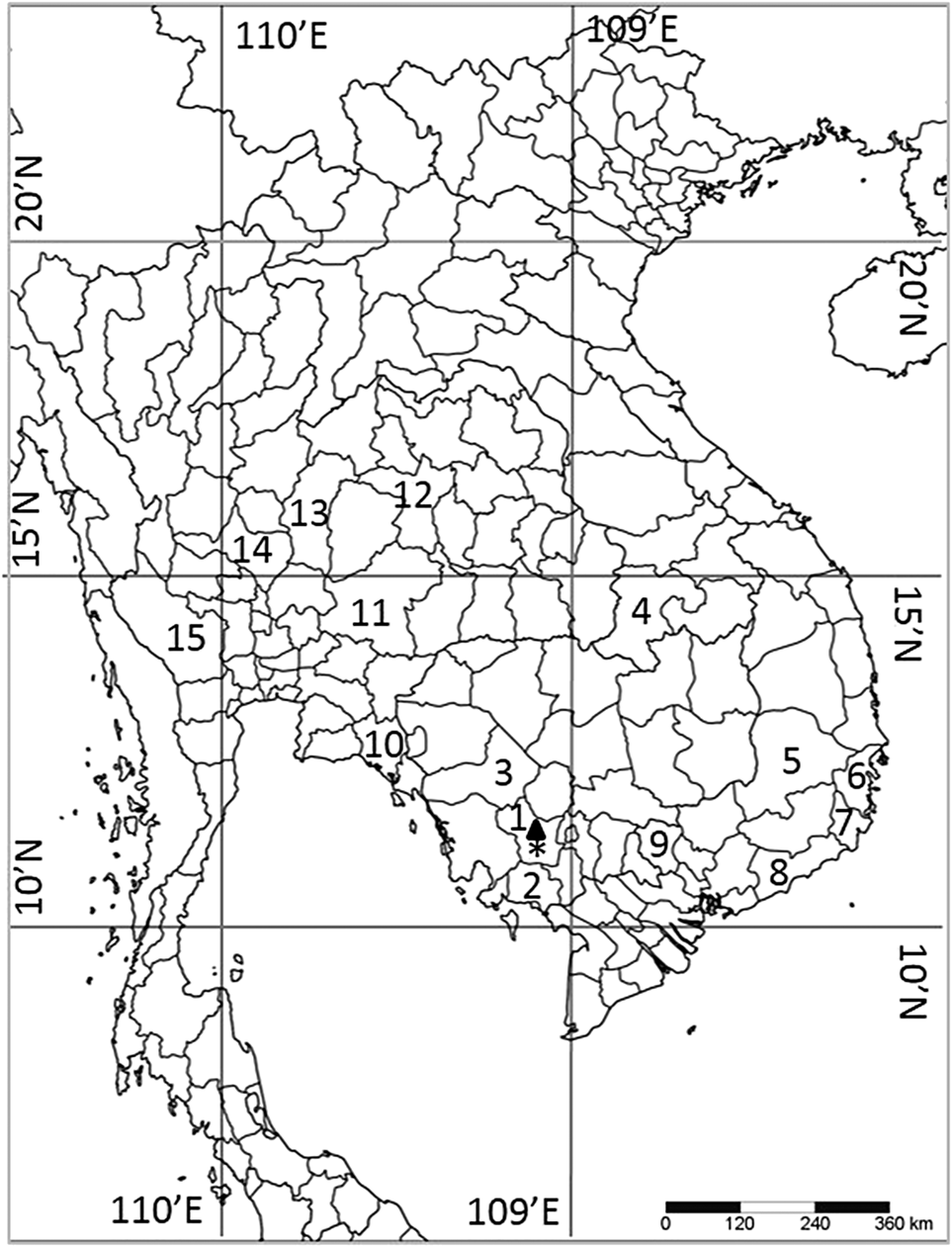
Distribution. Cambodia, Laos, Thailand and Vietnam (Fig. 2).
Collection sites of Stephania pierrei reported by Gagnepain (Reference Gagnepain1938) and Forman (Reference Forman, Smitinand and Larsen1991). Cambodia: Kampong Speu (1), Kampot (2), Pursat (3); Laos: Champasak (4); Vietnam: Dak Lak (5), Khanh Hoa (6), Ninh Thuan (7), Binh Thuan (8), Tay Ninh (9); Thailand: Chanthaburi (10), Nakhon Rachasima (11), between Khon Kaen and Sithan (12), Phetchabun (13), Nakhon Sawan (14), Kanchanaburi (15). The triangle and the asterisk stand for the localities where Dary & Li 11 & 12 and Hul, Peou & Dary 5001 to 5005 were collected, respectively.
Habitat and ecology. Semi- and evergreen forest, free land next to rice fields, bushes, and open vegetation.
Proposed IUCN status. EN A2cd. We consider the natural populations of Stephania pierrei to be under threat from habitat destruction and over-collecting. Our observations in the last three years showed that hundreds of tubers were used to produce traditional medications. A less harmful use of Stephania pierrei consists of collecting leaves to make a local jelly dessert called ‘Cha Huoy’ in the Kampong Speu province (C. Dary and S. Hul, pers. obs.). Moreover, the area of occupancy is only 64 km2, and the collection sites of the species in Cambodia, Laos, Thailand and Vietnam belong to multiple-use areas. For these reasons, and despite its large extent of occurrence of 406,284 km2 (GeoCAT tool; Bachman et al., Reference Bachman, Moat, Hill, De La Torre and Scott2011), we recommend the IUCN status ‘Endangered’ (IUCN, 2001).
Phenology. Flowering in April–August, fruiting in May–September.
Additional specimens examined. Cambodia. sin. loc., 1883–85, male flowers, Couderc s.n. (P). Kompong Speu: Samrong Tong, Chereer Mountain, iv 1870, male flowers, Pierre 754a (P); Chbar Môn, 11°24′41″N, 104°29′510″E, viii 2013, male flowers, Dary & Li 11 (Herbarium of the Faculty of Pharmacy in Phnom Penh; P); loc. cit., fruits, Dary & Li 12 (Herbarium of the Faculty of Pharmacy in Phnom Penh; P); Samrong Tong, 11°23′920″N, 104°29′132″E, 28 vii 2014, male flowers, Hul, Peou & Dary 5001 (P; RUPP), 5002 (P; RUPP), 5003 (P; RUPP), 5004 (P; RUPP), and 5005 (female flowers and fruits; P; RUPP); Pursat: Bakan, 12°38′59″N, 103°47′36″E, 3 vii 2015, sterile, Hul, Peou & Thi 5045 (Herbarium of the Faculty of Pharmacy in Phnom Penh; P; RUPP).
Laos. ‘Iter Mekong austro Cochinchinae’, i 1877, male flowers, Pierre 755e A (leg. Harmand) (P); loc. cit., fruits, Pierre 755e B (leg. Harmand) (P).
Thailand. Chanthaburi: 12°52′N, 102°10′E, 27 viii 1972, Larsen et al. 32132 (P).
Vietnam. Binh Thuan: Phanthiet, Ambulance, 25 x 1924, fruits, Evrard 1524 (P); from Lagi to Pho Tri, 2 vii 1925, male flowers, Evrard 2307 (P); Dac Lac (Dak Lak): Buon Ho, v 1965, male flowers, Dournes s.n. (P); loc. cit., v 1965, female flowers, Dournes s.n. (P); Khanh Hoa: Nui-hon-heo, 27 ix 1922, female flowers, Poilane 4761 (P; VNM); Ninh Thuan: Phan Rang, Balap, 25 vi 1919, male flowers, Poilane 88 (P; VNM); Phan Rang, 26 vi 1919, male flowers, Poilane 94 (P; VNM); Song-long-song, 29 vi 1919, female flowers and fruits, Poilane 135 (P; VNM); Cana, 15 vii 1930, fruits, Poilane 17870 (P); near Phan Rang, vi–viii 1959, male flowers, Schnell 10632 (P).
Acknowledgements
We thank Mark Newman, Philip Thomas (E) and two anonymous reviewers for their constructive comments that greatly improved the manuscript, and Robert Vogt (B) for sending a syntype on loan (Pierre 753). Assistance was also received from Philippe Bessioud (Phytochemistry Laboratory, Phnom Penh Faculty of Pharmacy), Bernard Fabre (Institut Pierre Fabre, Toulouse), Youleang Peou and Sothiren Thi (RUPP Herbarium), as well as Laurent Randrihasipara and Élodie Lerat (members of the Global Plants Initiative Programme in P). Chhavarath Dary was supported by a scholarship from the French government.