





Introduction
Adolescence is a key developmental period marked by heightened emotional sensitivity to interpersonal stress, which contributes to increased risk for psychopathology such as depressive symptoms, anxiety symptoms, and behavior problems (Herres et al., Reference Herres, Ewing and Kobak2016; Rudolph, Reference Rudolph2002; Spear, Reference Spear2009). Emotional reactivity, defined as the degree to which youth negative and positive emotions change in response to stressors, is one key pathway through which interpersonal experiences shape adolescent mental health (Nock et al., Reference Nock, Wedig, Holmberg and Hooley2008; Shapero et al., Reference Shapero, Abramson and Alloy2016). Family conflict, particularly parent–adolescent conflict, is a salient context for these emotional responses and has been consistently associated with more negative emotions, lower positive emotions, and adjustment problems (Arslan et al., Reference Arslan, Boele, Dietvorst, Lucassen and Keijsers2024; Branje et al., Reference Branje, Van Doorn, Van Der Valk and Meeus2009; Chiang et al., Reference Chiang, Ting, Hung, Sung and Chen2024; Silva et al., Reference Silva, Ford and Miller2020). However, most studies have focused on adolescents’ own emotional reactivity, with less attention to how parents’ emotional reactivity to parent-youth conflict may also shape youth psychopathology (e.g., Charbonneau et al., Reference Charbonneau, Mezulis and Hyde2009; Davies et al., Reference Davies, Cicchetti, Thompson, Bascoe and Cummings2020; Hare et al., Reference Hare, Tottenham, Galvan, Voss, Glover and Casey2008). Parent emotional responses in relation to conflict may be a key but underexamined aspect of the family emotional climate that contributes to adolescent emotional security and regulation. Building on this gap, the present study aims to utilize daily reports from both parents and adolescents to capture emotional reactivity to parent-youth conflict in everyday life and examines how adolescent and parent emotional reactivity jointly relate to adolescent depressive symptoms, anxiety symptoms, and externalizing problems.
Theoretical frameworks
Emotional security theory proposes that exposure to family conflict would undermine youth’s sense of safety and stability in the family, which in turn disrupts their emotion regulation and increases risk for psychopathology (Davies & Cummings, Reference Davies and Cummings1994; Davies et al., Reference Davies, Winter and Cicchetti2006). To date, emotional reactivity to family conflicts has been identified as a core manifestation of emotional insecurity, reflecting heightened vigilance, distress, and difficulty recovering when conflict occurs (Cummings & Miller-Graff, Reference Cummings and Miller-Graff2015; Davies et al., Reference Davies, Forman, Rasi and Stevens2002). As one component of emotional security (Davies & Cummings, Reference Davies and Cummings1994), we defined emotional reactivity as the degree to which daily emotional states covary with conflict on a given day, following daily-diary frameworks that distinguish exposure to stressors from emotional responses to those stressors (Almeida, Reference Almeida2005). Consistent with this view, studies have linked higher emotional reactivity in conflictual family contexts to greater internalizing and externalizing problems among children and adolescents (Buehler & Welsh, Reference Buehler and Welsh2009; Shapero & Steinberg, Reference Shapero and Steinberg2013). For instance, in a longitudinal study of 235 U.S. children (77% White, 17% Black, 2% multiracial, 3% others) followed from kindergarten into adolescence, Davies et al. (Reference Davies, Thompson, Martin and Cummings2021) indexed emotional reactivity by coding videotaped seven-minute family problem-solving discussions. Trained coders rated four dimensions on nine-point scales: demonstrative displays of distress, aversive complaints and dogmatic assertions of viewpoints, confident and well-regulated communication of viewpoints, and comfort and constructive problem solving. The two regulated codes were reverse-scored, and all four were averaged into a single index of negative emotional reactivity. Exposure to interparental conflict predicted increases in this index, which in turn predicted adolescents’ psychological problems. Similarly, in a daily diary study of 139 Taiwanese adolescents (mean age = 13.30), greater increases in negative emotions on days with higher-than-usual interparental conflict were prospectively associated with depressive symptoms and anxiety symptoms six months later (Chiang & Bai, Reference Chiang and Bai2024). Together, these findings suggest that emotional reactivity to family conflict functions as a developmental marker linking the family conflict environment to adolescent psychopathology, and that the strength of this reactivity is shaped by the cumulative history of conflict exposure within the family.
Building on emotional security theory, the sensitization hypothesis suggests that repeated exposure to destructive family conflict leads not to habituation but to heightened emotional reactivity to later conflicts (Goeke-Morey et al., Reference Goeke-Morey, Papp and Cummings2013). Longitudinal and experimental work indicates that youth with a history of higher family or interparental conflict show stronger negative emotional responses, more threatening appraisals, and greater insecurity when exposed to subsequent conflict, and that this pattern predicts later psychopathology (Keller et al., Reference Keller, Gilbert, Koss, Cummings and Davies2011; Koss et al., Reference Koss, George, Davies, Cicchetti, Cummings and Sturge-Apple2013; López-Larrosa et al., Reference López-Larrosa, Sánchez-Souto, Ha and Cummings2019). Recent daily diary studies further extend sensitization processes into parent–adolescent conflict, showing that youth from high-conflict parent–adolescent relationships exhibit stronger day-to-day emotional reactivity when conflict with parents occurs, highlighting parent-adolescent conflict as a proximal context of risk (Chiang et al., Reference Chiang, Chen and Liu2023). In the present study, we draw on emotional security theory and the sensitization hypothesis to frame emotional reactivity to daily parent-adolescent conflict as a developmental linkage that may connect the family conflict with adolescent depressive symptoms, anxiety symptoms, and externalizing problems over time.
Intensive longitudinal methods, such as daily diary designs, provide a powerful way to operationalize emotional reactivity as within-person covariation between conflict and same-day emotions in everyday life (e.g., Bylsma et al., Reference Bylsma, Taylor-Clift and Rottenberg2011; Herres et al., Reference Herres, Caporino, Cummings and Kendall2018; Mroczek et al., Reference Mroczek, Stawski, Turiano, Chan, Almeida, Neupert and Spiro2015). Daily studies show that family conflict fluctuates from day to day and that these fluctuations are tied to adolescents’ same-day negative and positive emotions, offering ecologically valid evidence of conflict-related emotional processes. Moreover, recent work has begun to demonstrate that individual differences in daily emotional reactivity to family or interpersonal stressors prospectively predict later youth mental health problems, supporting the concept that sensitization processes captured in daily life may index emerging risk (Chiang et al., Reference Chiang, Chen and Liu2023; Herres et al., Reference Herres, Ewing and Kobak2016; Shapero & Steinberg, Reference Shapero and Steinberg2013).
These approaches differ in how emotional reactivity is assessed. Observational measures capture emotional and behavioral responses during structured family conflict interactions (Davies et al., Reference Davies, Thompson, Martin and Cummings2021), whereas questionnaire measures assess adolescents’ retrospective perceptions of their typical responses to family conflict (Buehler & Welsh, Reference Buehler and Welsh2009; Davies et al., Reference Davies, Forman, Rasi and Stevens2002). Daily diary approaches estimate reactivity from the within-person association between daily conflict and same-day emotions (Chiang & Bai, Reference Chiang and Bai2024; Herres et al., Reference Herres, Caporino, Cummings and Kendall2018). The present study follows the latter approach, capturing conflict-related changes in adolescents’ subjective emotional states during naturally occurring conflicts. Thus, although these approaches share a focus on emotional responses to conflict, they differ in informant, response channel, timescale, and scope, and our findings relate specifically to adolescents’ subjective emotional responses in relation to conflict.
In the present study, we examined depressive symptoms, anxiety symptoms, and externalizing problems because they represent core indicators of adolescent psychopathology in the developmental psychopathology literature, spanning both internalizing and externalizing domains (Achenbach et al., Reference Achenbach, Ivanova, Rescorla, Turner and Althoff2016; Aldao et al., Reference Aldao, Gee, De Los Reyes and Seager2016; Rutter & Sroufe, Reference Rutter and Sroufe2000; Smith et al., Reference Smith, Atkinson, Davis, Riley and Oltmanns2020). Emotional reactivity in relation to conflict and daily stress has been linked to each of these outcomes. Adolescents who exhibit stronger negative emotional reactivity to stress report greater depressive and anxiety symptoms concurrently and prospectively (Chiang & Bai, Reference Chiang and Bai2024; Schneiders et al., Reference Schneiders, Nicolson, Berkhof, Feron, van Os and deVries2006; Shapero et al., Reference Shapero, Abramson and Alloy2016), and heightened emotional responses to daily family and school stressors have also been associated with externalizing problems and problem behavior (Bai & Repetti, Reference Bai and Repetti2018; Chiang et al., Reference Chiang, Ting, Hung, Sung and Chen2024).
Theoretically, emotional reactivity may operate through both shared and symptom-specific pathways. As a transdiagnostic process, emotion dysregulation reflects a common risk factor related to both internalizing and externalizing psychopathology (McLaughlin et al., Reference McLaughlin, Hatzenbuehler, Mennin and Nolen-Hoeksema2011). Within the internalizing domain, we further distinguished depressive and anxiety symptoms, as the two may show distinct associations with emotional reactivity. For example, Clark and Watson (Reference Clark and Watson1991) found that heightened negative affect is shared across depression and anxiety, whereas diminished positive affect is relatively specific to depression. This distinction indicates that negative emotional (NE) reactivity may be associated with both symptom domains, whereas positive emotional (PE) reactivity may be more closely tied to depressive symptoms. Supporting this hypothesis, a recent study showed that greater increases in negative emotions (i.e., negative emotional reactivity) predicted increased depressive symptoms and anxiety symptoms, while greater declines in positive emotions (i.e., PE reactivity) were only associated with depressive symptoms rather than anxiety symptoms (Chiang & Bai, Reference Chiang and Bai2025). Moreover, prior evidence suggests that greater reactivity in positive emotions was more closely related to externalizing problems while NE reactivity was associated with internalizing problems (Chiang & Chen, Reference Chiang and Chen2025). Thus, we hypothesized that negative emotional reactivity may be linked to adolescent internalizing problems, while positive emotional reactivity may be more closely related to adolescent externalizing problems. Examining this constellation of outcomes therefore allows the present study to evaluate whether emotional reactivity to parent–adolescent conflict confers broad risk across domains or operates through domain-specific pathways.
Parent emotional reactivity
Although emotional security theory and sensitization hypothesis have provided essential knowledge on developmental mechanisms in youth emotional reactivity and psychopathology, emotional processes in families often unfold in dyadic and transactional ways beyond the individual level. Parent emotional reactions to conflict are a central feature of the family emotional climate (Morris et al., Reference Morris, Criss, Silk and Houltberg2017; Tan et al., Reference Tan, Oppenheimer, Ladouceur, Butterfield and Silk2020) and may shape how secure or threatened adolescents feel in the family. The tripartite model of family emotion regulation emphasizes that parents contribute to youth emotion regulation through their own emotional expressions and regulation, through emotion-related parenting practices, and through the broader emotional climate of the family (Morris et al., Reference Morris, Silk, Steinberg, Myers and Robinson2007). From this perspective, parents’ dysregulated emotional reactivity in conflict may shape how youth learn to express and manage emotion, signal that conflict is threatening and uncontrollable, and create a family environment marked by heightened tension and unpredictability, all of which can contribute to adolescent psychopathology. Moreover, parent emotional reactivity may provide unique information because it captures the interpersonal conditions of conflict rather than adolescents’ internal responses. Whereas adolescent reactivity indexes youths’ own distress, parents’ dysregulated emotional responses shape the emotional climate in which conflict unfolds, model maladaptive responding, and signal that conflict is threatening and uncontrollable (Butler, Reference Butler2011; Morris et al., Reference Morris, Silk, Steinberg, Myers and Robinson2007). These processes may confer risk for adolescent psychopathology through pathways that operate independently of adolescents’ own emotional responses, supporting the expectation that parent reactivity predicts adolescent outcomes above and beyond adolescent reactivity.
Prior research has examined parents’ negative and positive emotional expressions primarily as features of hostile or constructive interparental conflict (Cummings & Davies, Reference Cummings and Davies2010; Du Rocher Schudlich & Cummings, Reference Du Rocher Schudlich and Cummings2003), and daily diary studies have examined adolescents’ emotional reactivity to parent–adolescent conflict as a predictor of their psychopathology (Chiang & Bai, Reference Chiang and Bai2024; Chiang et al., Reference Chiang, Chen and Liu2023). However, limited research has directly assessed how parents’ own emotions fluctuate in response to daily conflict with adolescents, or whether this parent reactivity predicts adolescent psychopathology above and beyond adolescents’ own reactivity. To address this gap, the present study uses parallel daily reports from parents and adolescents to derive indices of both parent and adolescent emotional reactivity to parent–adolescent conflict and tests how these reactivity indices are prospectively associated with adolescent psychopathology.
Age differences in the relationship between emotional reactivity and psychopathology
Another consideration concerns potential age differences in the associations between emotional reactivity and adolescent psychopathology. A substantial body of research has examined age-related differences in emotional reactivity and regulation, particularly across adulthood and aging, documenting systematic variation in how strongly individuals respond to laboratory inductions and to naturally occurring daily stressors (Kunzmann & Grühn, Reference Kunzmann and Grühn2005; Neupert et al., Reference Neupert, Almeida and Charles2007; Schweizer et al., Reference Schweizer, Stretton, Van Belle, Price, Calder and Dalgleish2019; Stawski et al., Reference Stawski, Sliwinski, Almeida and Smyth2008). In adolescence, research similarly indicates that emotional reactivity and regulation shift with age, such that older adolescents show greater success in down-regulating negative emotions, especially in social contexts (Silvers et al., Reference Silvers, McRae, Gabrieli, Gross, Remy and Ochsner2012). In an EEG study of 20 Chinese adolescents (aged 13–14) and 20 adults, adolescents exhibited stronger neural responses to negative stimuli than adults, indicating heightened emotional susceptibility during adolescence (Meng et al., Reference Meng, Liu, Zhang, Li, Yao, Ding and Yang2016). Similarly, across two samples of participants aged 10–23 in the United States, age predicted improvements in emotion regulation but was unrelated to emotional reactivity, with regulation gains most pronounced for social stimuli (Silvers et al., Reference Silvers, McRae, Gabrieli, Gross, Remy and Ochsner2012).This work, however, has largely characterized age differences in emotional responding itself, with few findings regarding whether these age-related differences are related to development of psychopathology. As a result, it remains unclear whether the strength of the link between daily emotional reactivity and later psychopathology changes as adolescents grow older.
Theoretically, several considerations suggest that these associations may be age-graded. Emotional reactivity to parent–adolescent conflict, and particularly parent emotional reactivity, may be more strongly associated with psychopathology earlier in adolescence, when youth are less skilled at regulating emotions and remain more dependent on parents for emotional support and co-regulation, and these associations may attenuate over time as adolescents’ regulatory capacities strengthen and their social worlds broaden beyond the family (Silvers et al., Reference Silvers, McRae, Gabrieli, Gross, Remy and Ochsner2012). In addition, the structure and meaning of parent–adolescent conflict shift as dyads move from a more hierarchical toward a more egalitarian relationship (Branje, Reference Branje2018; Chiang & Bai, Reference Chiang and Bai2022), which may alter how threatening or salient parent emotional responses feel to youth at different ages. Yet few studies have directly tested whether associations between adolescent or parent emotional reactivity and depressive symptoms, anxiety symptoms, or externalizing problems vary by age across adolescence. In the present study, we take a first step toward addressing this developmental question by examining whether adolescent age moderates the prospective associations between both adolescent and parent emotional reactivity to daily parent–adolescent conflict and adolescent psychopathology.
The current study
The present study extends prior work by testing how adolescent and parent emotional reactivity to daily parent–adolescent conflict are jointly associated with adolescent psychopathology over time, and whether these associations differ across adolescence. We focus on negative and positive emotional reactivity assessed in daily life as key processes linking family conflict to adolescent developmental psychopathology, including depressive symptoms, anxiety symptoms, and externalizing problems. In the present study, adolescent NE reactivity refers to within-person increases in negative emotions (e.g., distress, anger) on days with higher-than-usual parent–adolescent conflict, and PE reactivity refers to within-person declines in positive emotions (e.g., happiness, excitement). Parent negative and positive emotional reactivity are defined in parallel based on parents’ own daily emotions. We examined reactivity in both negative and positive emotions because the two may reflect distinct vulnerability processes. Positive emotions support coping and recovery from stress (Fredrickson, Reference Fredrickson2001), and greater declines in positive emotions under stress have been linked to adolescent maladjustment beyond elevations in negative emotions (Bai & Repetti, Reference Bai and Repetti2018; Chiang & Chen, Reference Chiang and Chen2025). Diminished PE responses in relation to conflict may therefore index problems in maintaining the emotion regulation that facilitates recovery.
First, we hypothesized that greater adolescent emotional reactivity to daily parent-adolescent conflict would be associated with increased depressive symptoms, anxiety symptoms, and externalizing problems six months later. Second, we hypothesized that greater parent emotional reactivity to daily parent-adolescent conflict would be associated with increased adolescent depressive symptoms, anxiety symptoms, and externalizing problems, over and above adolescent emotional reactivity. Drawing on the tripartite model and temporal interpersonal emotion systems (TIES; Butler, Reference Butler2011), we expected that parents’ dysregulated emotional responses to conflict would exacerbate vulnerability to psychopathology beyond youth’s own emotional responses.
Last, we examined whether adolescent age moderated the associations between emotional reactivity and psychopathology outcomes. Based on developmental work suggesting that emotion regulation capacities improve across adolescence, whereas basic emotional reactivity remains relatively stable (Silvers et al., Reference Silvers, McRae, Gabrieli, Gross, Remy and Ochsner2012), we hypothesized that the strength of associations between both adolescent and parent emotional reactivity and later psychopathology would be stronger for younger adolescents compared to older adolescents. Consistent with evidence that average emotional experience carries independent significance for psychological adjustment (Dejonckheere et al., Reference Dejonckheere, Mestdagh, Houben, Rutten, Sels, Kuppens and Tuerlinckx2019), adolescents’ person-mean levels of daily positive and negative emotions were retained as covariates across all analytic models. By adjusting for mean emotional intensity, we aimed to test whether indices of emotional reactivity to parent-adolescent conflict explain unique variance in adolescent depressive symptoms, anxiety symptoms, and externalizing problems over and above their average levels of emotions.
Method
Participants
Participants were drawn from an ongoing longitudinal study conducted in Taiwan, from which the present analyses included 237 adolescents between the ages of 12 and 17 (M = 14.80, SD = 2.08; 58% female) and their primary caregivers (M age = 42.36, SD age = 8.57; 68% female). All adolescents self-identified as Taiwanese. Adolescents also self-reported their gender identity, which corresponded to sex assigned at birth for all participants in this sample. The majority of participating parents also identified as Taiwanese (94%), and all parents were married biological mothers or fathers residing with their adolescent child in the same household for most of the time. Parents reported their annual household income, which was categorized into five income levels according to household income distribution statistics for Taipei City published by the Taiwan government (Directorate-General of Budget, 2022). Household socioeconomic status varied across the sample: 4.6% of parents reported low income, 6.7% lower-middle income, 52.7% middle income, 32% upper-middle income, and 3% upper income. Participants completed questionnaire assessments at baseline addressing demographic background, family characteristics, relationship quality, and mental health, followed by a 10-day daily diary protocol. A six-month follow-up assessment was subsequently administered. Data collection took place between 2022 and 2024.
Procedure
Families were recruited through two middle schools and three high schools in Taiwan, with recruitment facilitated by school administrators and instructional staff. Eligibility required that both the adolescent and one parent enroll jointly and satisfy three criteria: (a) the participating parent served as the adolescent’s primary caregiver, (b) household members had reliable internet access and the capacity to complete electronic surveys, and (c) the parent and adolescent shared a primary residence. Daily diary surveys were administered via personalized links distributed to participants’ preferred digital platforms (e.g., email, mobile applications) each evening across two consecutive weeks, spanning Monday through Friday. Participants received monetary compensation upon study completion (e.g., gift cards): families were provided the equivalent of $35 USD for completing the baseline and daily diary phases, and $15 USD for the follow-up assessment. Written informed consent was obtained from parents, and adolescent assent was documented prior to participation. All study procedures received approval from the relevant Institutional Review Board. Adherence to the protocol was strong: only two parent–adolescent dyads failed to complete the follow-up assessment, and the daily diary compliance rate, calculated as the proportion of completed diary days relative to total scheduled days, was 96%.
Measures
Baseline and follow-up measures
Depressive symptoms. Adolescents’ depressive symptoms were assessed at baseline and six-month follow-up using the 9-item Patient Health Questionnaire (PHQ-9; Kroenke et al., Reference Kroenke, Spitzer and Williams2001), a widely used brief clinical instrument with well-established validity across child and adult populations (Fonseca-Pedrero et al., Reference Fonseca-Pedrero, Díez-Gómez, Pérez-Albéniz, Al-Halabí, Lucas-Molina and Debbané2023; Liu & Adrian, Reference Liu and Adrian2019). Participants rated the frequency of nine depressive symptom experiences over the preceding two weeks (e.g., “little interest or pleasure in doing things,” “feeling down, depressed, or hopeless”) on a four-point scale ranging from 0 (not at all) to 3 (nearly every day). Item responses were averaged to produce a composite depressive symptom score. Internal consistency was good at both time points (Cronbach’s alpha = 0.88 at baseline; 0.86 at follow-up).
Anxiety symptoms. Anxiety was assessed at both time points using the Generalized Anxiety Disorder-7 (GAD-7; Spitzer et al., Reference Spitzer, Kroenke, Williams and Löwe2006), which has demonstrated strong psychometric performance across diverse samples (Casares et al., Reference Casares, Díez-Gómez, Pérez-Albéniz, Lucas-Molina and Fonseca-Pedrero2024). Adolescents rated seven anxiety-related symptoms over the past two weeks (e.g., “feeling nervous, anxious, or on edge,” “trouble relaxing”) on a four-point scale from 0 (not at all) to 3 (nearly every day). Responses were averaged to yield a single anxiety composite score. Cronbach’s alpha values were 0.84 at baseline and 0.85 at follow-up.
Externalizing problems. Adolescents reported their externalizing problems using the six items adapted from previous studies at baseline and follow-up assessments. The measure was derived from a large-scale, longitudinal project in Taiwan (Taiwan Youth Project; Yi, Reference Yi2020). The items assessed the frequency of behavioral problems, such as vandalizing, getting into fights, and arguing with others. Items were rated on a four-point scale from 1 (never) to 4 (always) and averaged to create a single score for adolescent externalizing problems. Confirmatory factor analyses supported a one-factor structure at both assessments, with good model fit (baseline: CFI = .96, TLI = .95, RMSEA = .031, SRMR = .040; follow-up: CFI = .97, TLI = .96, RMSEA = .022, SRMR = .036) and all standardized factor loadings greater than .79. Cronbach’s alpha was 0.90 at baseline and follow-up assessments.
Daily measures
Daily emotions. Each day, both parents and adolescents reported ten emotional states adapted from the Positive and Negative Affect Schedule-Expanded Form (PANAS-X; Watson & Clark, Reference Watson and Clark1994). Positive emotions were indexed by five items (i.e., happy, excited, inspired, attentive, active), and negative emotions were indexed by five items (i.e., distressed, sad, afraid, angry, upset), each rated using a 0-to-10 slider scale anchored at 0 (not at all true) and 10 (very much true). Positive and negative emotion items were averaged separately to form daily composite scores. Reliability was evaluated using both between-person (R KF) and within-person (Rc) indices. For positive emotions, R KF = 0.86 (parents) and 0.88 (adolescents); Rc = 0.82 (parents) and 0.85 (adolescents). For negative emotions, R KF = 0.88 (parents) and 0.85 (adolescents); Rc = 0.85 (parents) and 0.81 (adolescents).
Daily parent–adolescent conflict. Two items adapted from prior work (Chiang et al., Reference Chiang, Chen and Liu2023) were used to assess daily parent–adolescent conflict, including “I argued with my parent today” and “I had conflicts with my parent today.” Responses were provided on a 0-to-10 slider scale (0 = not at all, 10 = very much), and items were averaged to create a single daily conflict index. Between-person reliability was R KF = 0.87 (parents) and 0.85 (adolescents); within-person reliability was Rc = 0.83 (parents) and 0.81 (adolescents).
Analytical plan
Following established operationalizations in the emotional reactivity literature (Ong et al., Reference Ong, Gardner, Urganci, Gunaydin and Selcuk2020; Santee & Starr, Reference Santee and Starr2022), emotional reactivity was defined as the within-person association between a stressor and concurrent emotional states, operationalized as person-specific slopes derived from multilevel modeling. This approach permitted the extraction of individual-level empirical Bayes estimates of reactivity, allowing the intercept and slope to vary randomly across participants (Bai et al., Reference Bai, Robles, Reynolds and Repetti2020; Chiang & Bai, Reference Chiang and Bai2024). Because both parents and adolescents provided daily reports of conflict and emotional experience, separate within-person slopes were estimated for each reporter using their own data. Negative emotional (NE) reactivity was interpreted such that higher values reflected greater elevations in negative emotions on days characterized by higher conflict. For positive emotional reactivity (PE reactivity), within-person slopes were reverse-coded (multiplied by −1) such that higher scores reflect greater declines in positive emotions on days with elevated conflict (Bai & Repetti, Reference Bai and Repetti2018). As a result, higher values of PE reactivity reflected greater declines of positive emotions under higher-conflict conditions, facilitating parallel interpretation across both outcomes.
Next, we used hierarchical regression models to examine the prospective associations between adolescent and parent emotional reactivity and adolescent psychopathology. We first entered the index of adolescent and parent NE reactivity to predict adolescent depressive symptoms, anxiety symptoms, and externalizing problems at the follow-up. In order to examine prospective differences, baseline levels of dependent variables (i.e., outcomes at baseline) were controlled in the analyses. In the second step, we included the interaction term between NE reactivity and adolescent age to examine the age differences in the associations between NE reactivity and adolescent psychopathology. The same procedures were repeated for PE reactivity models. Furthermore, we controlled for mean levels of emotions and adolescent sex in all models. All estimates were standardized for effect size comparison. All analyses were conducted in R version 4.5.3. with the nlme (Pinheiro et al., Reference Pinheiro and Bates2026) and reghelper packages (Hughes, Reference Hughes2023).
Results
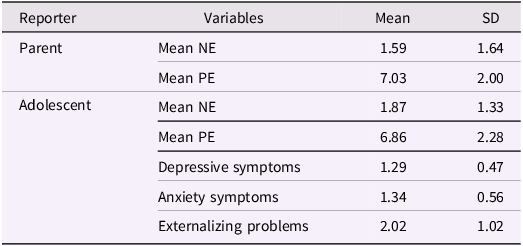
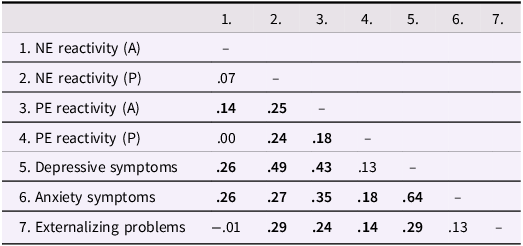
Descriptive statistics were presented in Table 1. Overall, adolescents reported low levels of depressive symptoms, anxiety symptoms, and externalizing problems, consistent with levels observed in general community samples of adolescents (McLaughlin & King, Reference McLaughlin and King2015; Vélez et al., Reference Vélez, Krause, McKinnon, Brunwasser, Freres, Abenavoli and Gillham2016; Yen et al., Reference Yen, Yang, Wang, Lin, Liu, Wu and Tang2014). Similarly, mean levels of daily parent–adolescent conflict were low, in line with prior daily diary studies indicating that overt conflict occurs on a minority of days in community families (Silva et al., Reference Silva, Ford and Miller2020; Timmons & Margolin, Reference Timmons and Margolin2015). Correlations were reported in Table 2.
Descriptive statistics
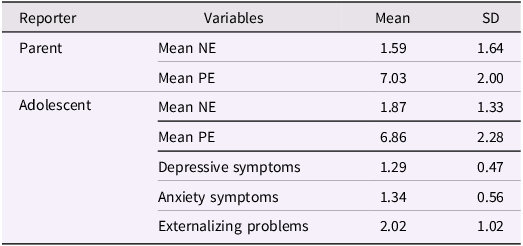
Table 1. Long description
A table comparing mean values and standard deviations of various variables reported by parents and adolescents. The table has two rows for reporters: Parent and Adolescent. Each reporter row contains several variables with their corresponding mean and standard deviation (SD) values. For Parents, the variables are Mean NE with a mean of 1.59 and SD of 1.64, and Mean PE with a mean of 7.03 and SD of 2.00. For Adolescents, the variables are Mean NE with a mean of 1.87 and SD of 1.33, Mean PE with a mean of 6.86 and SD of 2.28, Depressive symptoms with a mean of 1.29 and SD of 0.47, Anxiety symptoms with a mean of 1.34 and SD of 0.56, and Externalizing problems with a mean of 2.02 and SD of 1.02.
Correlations between primary variables
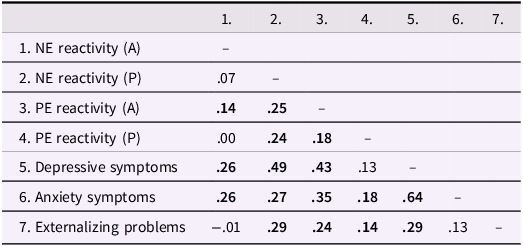
Table 2. Long description
A table showing correlations between different variables. The table has seven rows and seven columns, including row and column headers. The row labels are: 1. NE reactivity (A), 2. NE reactivity (P), 3. PE reactivity (A), 4. PE reactivity (P), 5. Depressive symptoms, 6. Anxiety symptoms, 7. Externalizing problems. The column headers are numbered from 1 to 7. Row 1: No value. Row 2: .07. Row 3: .14, .25. Row 4: .00, .24, .18. Row 5: .26, .49, .43, .13. Row 6: .26, .27, .35, .18, .64. Row 7: -.01, .29, .24, .14, .29, .13.
Note: NE: negative emotion; PE: positive emotion; A: adolescent report; P: parent report. Bold values indicate statistically significant (p < .05).
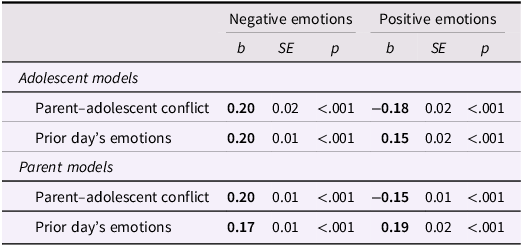
We first used multilevel models to examine the within-person associations between parent–adolescent conflict and positive and negative emotions of adolescents and parents, after controlling for prior day’s emotions. As shown in Table 3, daily parent–adolescent conflict was associated with greater adolescent negative emotions (b = 0.20, p < .001) and lower positive emotions (b = −0.18, p < .001), suggesting that adolescents exhibit greater NE and PE reactivity to daily parent–adolescent conflicts. Next, daily parent–adolescent conflict was associated with greater parent negative emotions (b = 0.20, p < .001) and lower positive emotions (b = −0.15, p < .001), indicating that parents exhibit greater NE and PE reactivity to daily parent–adolescent conflicts. Thus, these within-person slopes were calculated to produce four indices: adolescent NE reactivity, adolescent PE reactivity, parent NE reactivity, and parent PE reactivity.
Multilevel models of the associations between daily parent–adolescent conflict and positive and negative emotions
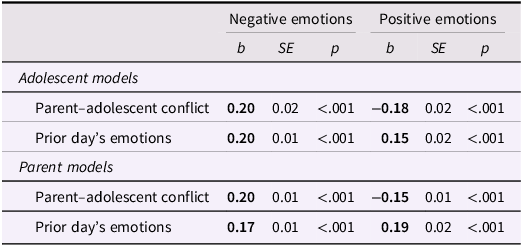
Table 3. Long description
A table comparing the associations between daily parent-adolescent conflict and emotions in adolescents and parents. The table has 6 rows and 6 columns. Column headers are Negative emotions b, Negative emotions SE, Negative emotions p, Positive emotions b, Positive emotions SE, Positive emotions p. Row labels are Adolescent models Parent-adolescent conflict, Adolescent models Prior day’s emotions, Parent models Parent-adolescent conflict, Parent models Prior day’s emotions. Row 1: Negative emotions b 0.20, Negative emotions SE 0.02, Negative emotions p 0.000, Positive emotions b -0.18, Positive emotions SE 0.02, Positive emotions p 0.000. Row 2: Negative emotions b 0.20, Negative emotions SE 0.01, Negative emotions p 0.000, Positive emotions b 0.15, Positive emotions SE 0.02, Positive emotions p 0.000. Row 3: Negative emotions b 0.20, Negative emotions SE 0.01, Negative emotions p 0.000, Positive emotions b -0.15, Positive emotions SE 0.01, Positive emotions p 0.000. Row 4: Negative emotions b 0.17, Negative emotions SE 0.01, Negative emotions p 0.000, Positive emotions b 0.19, Positive emotions SE 0.02, Positive emotions p 0.000.
Using hierarchical regression models, we then examined the prospective associations between parent and adolescent emotional reactivity and adolescent psychopathology in two steps. In the first step, we evaluated the main effects of adolescent and parent emotional reactivity, while controlling for outcomes at baseline, adolescent mean levels of emotions, sex, and age. In the second step, we investigated the moderating role of age in the associations between emotional reactivity and all outcomes.
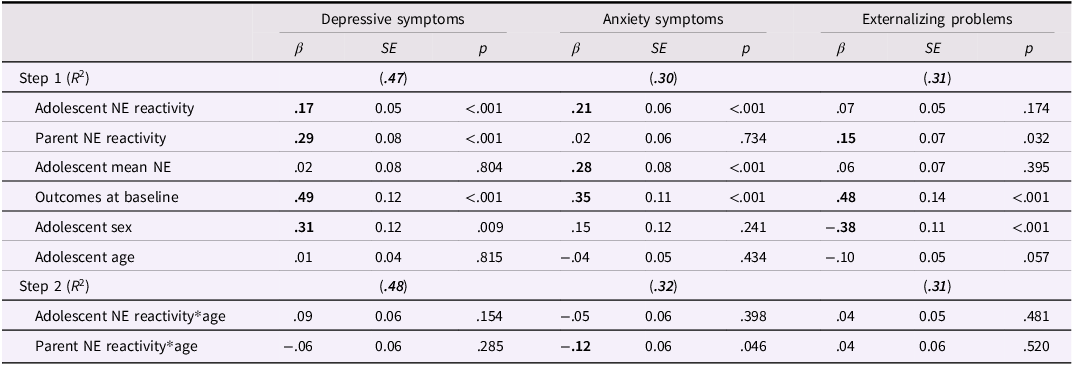
The results of negative emotion models were presented in Table 4. In the NE models, greater adolescent NE reactivity was associated with higher depressive symptoms (β = .17, p < .001) and higher anxiety symptoms (β = .21, p < .001), but was not significantly associated with externalizing problems (β = .07, p = .174). Greater parent NE reactivity was associated with higher depressive symptoms (β = .29, p < .001) and higher externalizing problems (β = .15, p = .032), but was not associated with anxiety symptoms (β = .02, p = .734).
Summary of multiple regression analyses of negative emotion reactivity predicting adolescent psychopathology
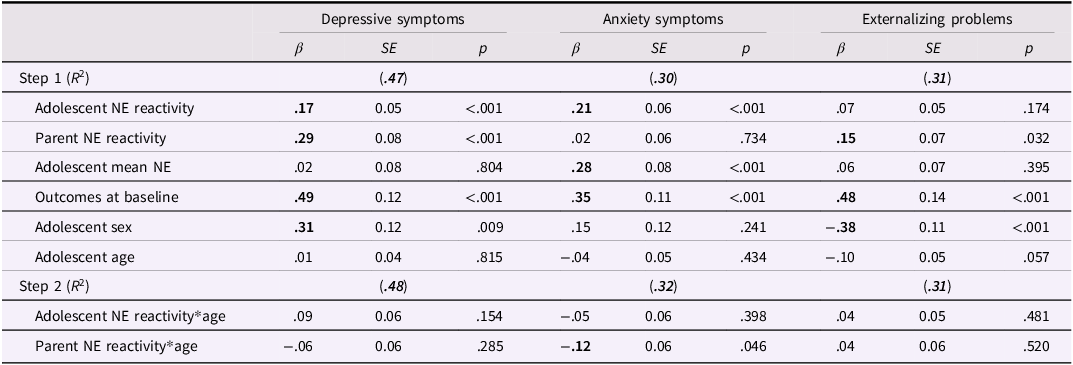
Table 4. Long description
A table summarizing multiple regression analyses of negative emotion reactivity predicting adolescent psychopathology. The table has 12 rows and 11 columns. Column headers are: Depressive symptoms, Anxiety symptoms, Externalizing problems. Row labels are: Step 1 (R squared), Adolescent NE reactivity, Parent NE reactivity, Adolescent mean NE, Outcomes at baseline, Adolescent sex, Adolescent age, Step 2 (R squared), Adolescent NE reactivity*age, Parent NE reactivity*age. Each column contains values for beta, standard error (SE), and p-value. Row 1: Depressive symptoms: R squared (.47), Anxiety symptoms: R squared (.30), Externalizing problems: R squared (.31). Row 2: Depressive symptoms: beta (.17), SE (0.05), p (<.000); Anxiety symptoms: beta (.21), SE (0.06), p (<.000); Externalizing problems: beta (.07), SE (0.05), p (.174). Row 3: Depressive symptoms: beta (.29), SE (0.08), p (<.000); Anxiety symptoms: beta (.02), SE (0.06), p (.734); Externalizing problems: beta (.15), SE (0.07), p (.032). Row 4: Depressive symptoms: beta (.02), SE (0.08), p (.804); Anxiety symptoms: beta (.28), SE (0.08), p (<.000); Externalizing problems: beta (.06), SE (0.07), p (.395). Row 5: Depressive symptoms: beta (.49), SE (0.12), p (.000); Anxiety symptoms: beta (.35), SE (0.11), p (.000); Externalizing problems: beta (.48), SE (0.14), p (.000). Row 6: Depressive symptoms: beta (.31), SE (0.12), p (.009); Anxiety symptoms: beta (.15), SE (0.12), p (.241); Externalizing problems: beta (-.38), SE (0.11), p (<.000). Row 7: Depressive symptoms: beta (.01), SE (0.04), p (.815); Anxiety symptoms: beta (-.04), SE (0.05), p (.434); Externalizing problems: beta (-.10), SE (0.05), p (.057). Row 8: Depressive symptoms: R squared (.48), Anxiety symptoms: R squared (.32), Externalizing problems: R squared (.31). Row 9: Depressive symptoms: beta (.09), SE (0.06), p (.154); Anxiety symptoms: beta (-.05), SE (0.06), p (.398); Externalizing problems: beta (.04), SE (0.05), p (.481). Row 10: Depressive symptoms: beta (-.06), SE (0.06), p (.285); Anxiety symptoms: beta (-.12), SE (0.06), p (.046); Externalizing problems: beta (.04), SE (0.06), p (.520).
Note: NE: negative emotion. Bold values indicate statistically significant (p < .05).
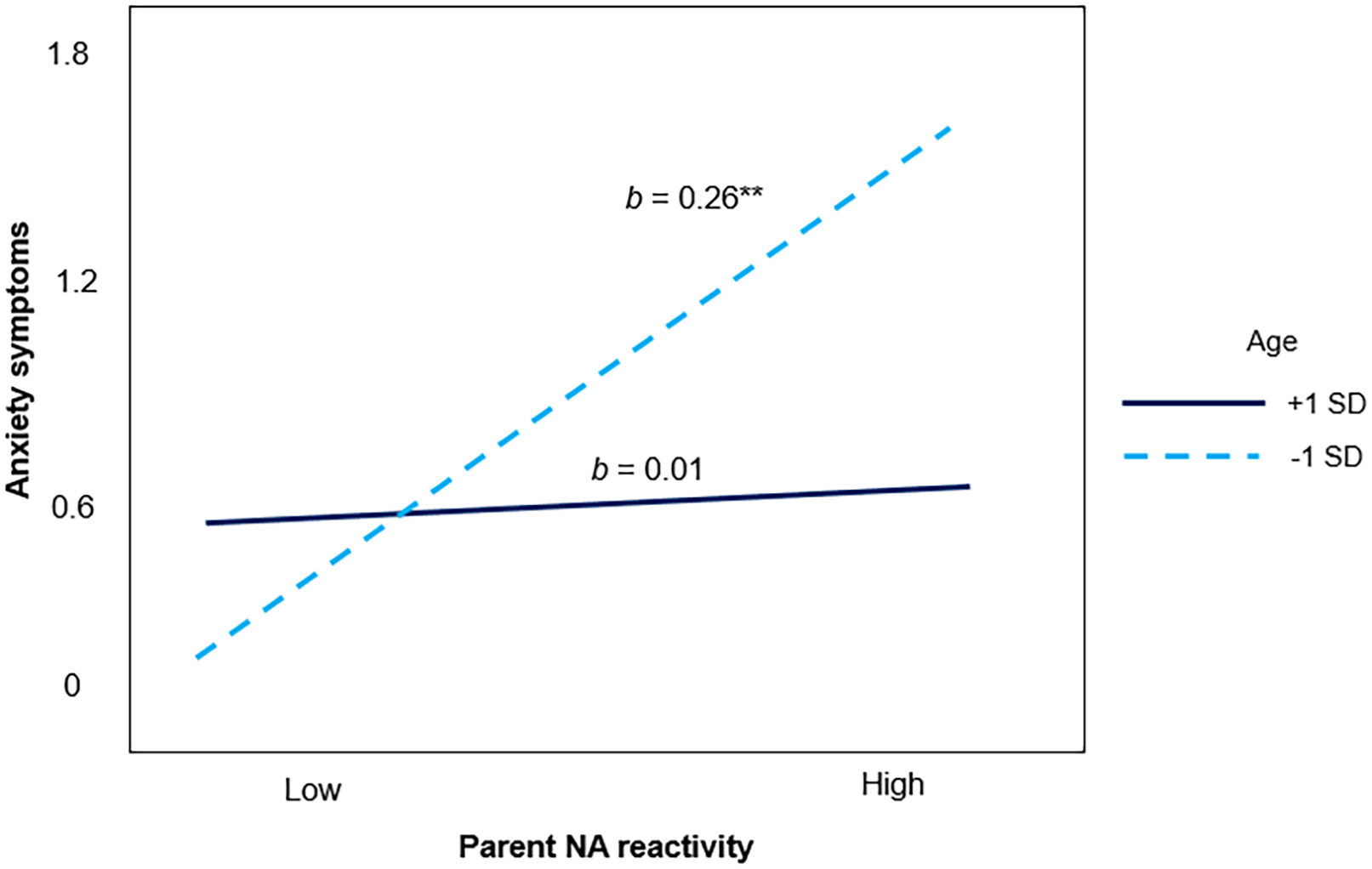
Furthermore, the interaction between parent NE reactivity and age was significantly associated with anxiety symptoms (β = −.12, p = .046). Thus, simple slope analysis was conducted to examine age differences in the association between parent NE reactivity and adolescent anxiety symptoms. As shown in Figure 1, parent NE reactivity was associated with increased anxiety symptoms only for younger adolescents (b = 0.26, p < .01). However, parent NE reactivity was not associated with anxiety symptoms for older adolescents (b = 0.01, p = .94). No other age interaction terms were significantly associated with depressive symptoms or externalizing problems.
The moderating effect of age in the association between parent negative emotional reactivity and adolescent anxiety symptoms. **p < .01.

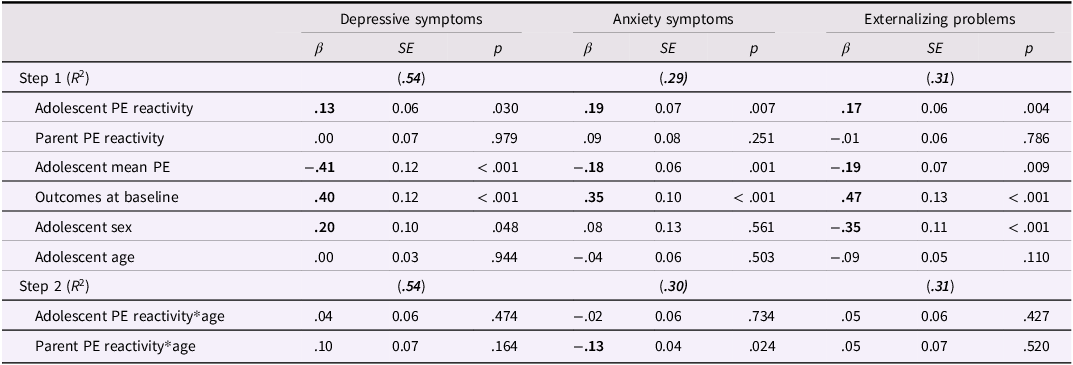
The results of PE models were presented in Table 5. In the PE models, greater adolescent PE reactivity was associated with higher depressive symptoms (β = .13, p = .030), higher anxiety symptoms (β = .19, p = .007), and higher externalizing problems (β = .17, p = .004). Parent PE reactivity was not significantly associated with depressive symptoms (β = .00, p = .979), anxiety symptoms (β = .09, p = .251), or externalizing problems (β = −.01, p = .786).
Summary of multiple regression analyses of positive emotion reactivity predicting adolescent psychopathology
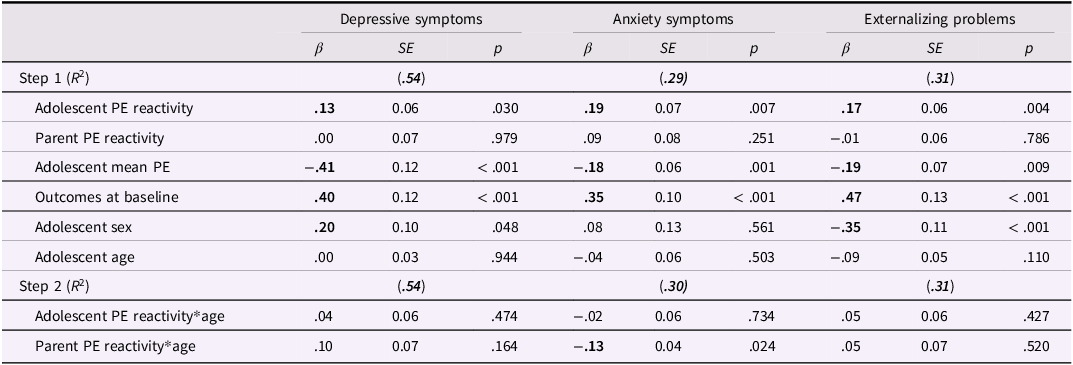
Table 5. Long description
A table with three columns labeled Depressive symptoms, Anxiety symptoms, and Externalizing problems, each with beta, SE, and p values. The table has two main sections: Step 1 and Step 2, each with multiple rows of data. Step 1 includes rows for Adolescent PE reactivity, Parent PE reactivity, Adolescent mean PE, Outcomes at baseline, Adolescent sex, and Adolescent age. Step 2 includes rows for Adolescent PE reactivity*age and Parent PE reactivity*age. Each row provides beta, SE, and p values for the respective variables across the three symptom categories. Notable values include significant p values for Adolescent PE reactivity across all symptom categories in Step 1 and non-significant p values for Parent PE reactivity.
Note. PE: positive emotion. Bold values indicate statistically significant (p < .05).
The interaction between parent PE reactivity and age was significantly associated with anxiety symptoms (β = −.13, p = .024). Thus, simple slope analysis was conducted to examine age differences in the association between parent PE reactivity and adolescent anxiety symptoms. Parent PE reactivity was associated with increased anxiety symptoms only for younger adolescents (b = 0.18, p = .007). However, parent PE reactivity was not associated with anxiety symptoms for older adolescents (b = -0.08, p = .476).
A sensitivity power analysis conducted in G*Power (Version 3.1; Faul et al., Reference Faul, Erdfelder, Buchner and Lang2009) evaluated the smallest interaction effect detectable given the present design. The models were sensitive to interaction effects as small as f 2 = .06 (critical F = 3.05), an effect falling between small and medium by conventional benchmarks (Cohen, Reference Cohen1988). Thus, the analyses were powered to detect small-to-medium interaction effects.
Discussion
The present study examined how adolescent and parent emotional reactivity to daily parent–adolescent conflict prospectively relate to adolescent depressive symptoms, anxiety symptoms, and externalizing problems over six months, while accounting for baseline psychopathology and mean levels of daily emotions. The results showed that greater adolescent NE reactivity to conflict was associated with higher depressive symptoms and anxiety symptoms at follow-up, and adolescent PE reactivity was associated with higher depressive symptoms, anxiety symptoms, and externalizing problems, highlighting the importance of both negative and positive emotional processes. Beyond adolescent responses, parent NE reactivity to parent–adolescent conflict uniquely predicted higher adolescent depressive symptoms and externalizing problems, even after adolescent emotional reactivity, mean emotions, and covariates were included in the models. In contrast, parent PE reactivity was not significantly associated with any psychopathology outcomes. Finally, adolescent age moderated the associations between parent emotional reactivity and anxiety symptoms. Parent NE and PE reactivity were associated with higher anxiety symptoms only for younger adolescents, whereas these associations were nonsignificant among older adolescents. No age differences emerged for links between adolescent emotional reactivity and psychopathology. Together, these findings suggest that adolescent and parent emotional reactivity to daily parent–adolescent conflict may represent distinct but complementary risk processes, with parents’ reactivity particularly salient for anxiety in earlier adolescence.
Adolescent emotional reactivity to parent–adolescent conflict was prospectively associated with internalizing psychopathology. Greater NE reactivity, reflected in same-day increases in negative emotions on high-conflict days, was associated with higher depressive symptoms and anxiety symptoms six months later, over and above baseline symptoms, mean daily emotions, and demographics. This pattern aligns with emotional security theory and the sensitization hypothesis, which propose that repeated exposure to family conflict heightens youth’s distress and vigilance in response to subsequent conflict and, in turn, undermines their emotional security and regulation (Cummings & Davies, Reference Cummings and Davies1996; Davies et al., Reference Davies, Winter and Cicchetti2006; Davies & Martin, Reference Davies and Martin2013). Consistent with previous findings (Atkinson et al., Reference Atkinson, Dadds, Chipuer and Dawe2009; Fosco & Feinberg, Reference Fosco and Feinberg2015; Silva et al., Reference Silva, Calheiros and Carvalho2016), one possibility is that youth with stronger emotional reactivity to family conflict may be more likely to engage in maladaptive processes such as threat appraisals, worry, and rumination, which have been implicated in the development of depression and anxiety, although these processes were not assessed in the present study.
On the other hand, adolescent NE reactivity was not significantly associated with externalizing problems, suggesting that heightened negative emotions in response to parent–adolescent conflict may be more proximally tied to internalizing than to disruptive behavior. One possibility is that externalizing problems are more closely linked to other aspects of conflict dynamics, such as coercive interaction patterns or deficits in impulse control (e.g., Gunlicks-Stoessel & Powers, Reference Gunlicks-Stoessel and Powers2008; Revill et al., Reference Revill, Patton, Connor, Sheffield, Wood, Castellanos-Ryan and Gullo2020; Zhang et al., Reference Zhang, Hanson, Piehler and Ha2024), that were not directly captured by our affective indices. At the same time, adolescent PE reactivity, indicating greater declines in positive emotion on conflict days, predicted all three psychopathology outcomes. The findings suggest that difficulties maintaining positive emotions in the face of conflict may reflect a broader emotional vulnerability that extends across internalizing and behavioral domains.
The results also suggest that parent emotional reactivity to daily conflict is associated with adolescent psychopathology, consistent with dyadic perspectives on family emotion processes. Greater parent NE reactivity, reflected in increased parent negative emotions on days with higher parent–adolescent conflict, was associated with higher adolescent depressive symptoms and externalizing problems at follow-up, even after accounting for adolescent emotional reactivity, mean daily emotions, and outcomes at baseline. These findings are consistent with the tripartite model of family emotion regulation and Temporal Interpersonal Emotion Systems (TIES), which position parental emotional expression and regulation as central elements of the dyadic emotion system (Butler, Reference Butler2011; Morris et al., Reference Morris, Criss, Silk and Houltberg2017). Parents who react to conflict with heightened negative emotions may communicate that conflict is highly threatening, escalate the negative intensity of interactions, and create a family climate characterized by tension and unpredictability (Almeida et al., Reference Almeida, Wethington and Chandler1999; Luebbe & Bell, Reference Luebbe and Bell2014), thereby reducing adolescent emotional security and increasing risk for both internalizing and behavioral problems (Chiang & Bai, Reference Chiang and Bai2025; Ogbaselase et al., Reference Ogbaselase, Mancini and Luebbe2022). The unique association between parent NE reactivity and externalizing problems, which did not emerge for adolescents’ own reactivity, may further reflect coercive family processes. When parents respond to conflict with escalating negative emotions, disagreements may be more likely to intensify into hostile exchanges that model and inadvertently reinforce escalation (Granic & Patterson, Reference Granic and Patterson2006). Adolescents who repeatedly observe and participate in such exchanges may generalize these patterns beyond the family, exhibiting irritability, defiance, and aggression in other contexts. As a result, adolescents’ own emotional reactivity may primarily index internal distress processes that are proximally tied to internalizing symptoms, whereas parents’ emotional reactivity captures the interpersonal escalation dynamics of conflict that carry greater relevance for behavioral problems.
In contrast, parent PE reactivity was not significantly associated with adolescent depressive symptoms, anxiety symptoms, or externalizing problems. Positive emotion during conflict may be particularly ambiguous for adolescents, especially when parents manage their emotions by suppressing negativity or amplifying positivity, strategies that have been linked to lower parental authenticity, well-being, relationship quality, and responsiveness during caregiving (Le & Impett, Reference Le and Impett2016). In line with research on positive emotion socialization (Breaux et al., Reference Breaux, Lewis, Cash, Shroff, Burkhouse and Kujawa2022; Ramakrishnan et al., Reference Ramakrishnan, Garside, Labella and Klimes-Dougan2019), it may also be that risk is carried more by parents’ unsupportive responses to youth positive emotions than by parents’ own decreases in positive mood on high-conflict days. Taken together, the results suggest that parent and adolescent emotional reactivity may function as distinct but interconnected components of a dyadic emotion system: adolescent NE reactivity primarily predicts internalizing problems, whereas parents’ NE reactivity uniquely signals risk for both depressive and externalizing problems. The present findings extend prior studies of adolescent emotional reactivity (Chiang & Bai, Reference Chiang and Bai2024; Chiang & Chen, Reference Chiang and Chen2025), which examined adolescents’ responses alone, by demonstrating that parents’ emotional reactivity to the same daily conflicts uniquely predicted adolescent depressive symptoms and externalizing problems beyond adolescents’ own reactivity, positioning the dyad rather than the individual as the unit of emotional risk. Thus, parent reactivity may confer risk through several complementary processes: modeling dysregulated responding, signaling that conflict is threatening and uncontrollable, escalating the negative intensity of dyadic exchanges, and creating a family climate of tension and unpredictability (Granic & Patterson, Reference Granic and Patterson2006; Morris et al., Reference Morris, Criss, Silk and Houltberg2017). Future research incorporating discrete emotion assessments, adolescents’ appraisals of parental emotional displays, and momentary regulation strategies would help specify which of these processes account for the prospective associations observed in the current study.
Moreover, the findings highlight the age differences in the links between parent emotional reactivity and adolescent anxiety symptoms, suggesting the importance of developmental timing in understanding family emotion processes. Parent NE reactivity to parent–adolescent conflict predicted higher anxiety symptoms only among younger adolescents, whereas this association was not significant for older adolescents. A similar pattern emerged for parent PE reactivity, such that greater declines in parent positive emotions on conflict days were associated with higher anxiety symptoms among younger, but not older, youth. These findings suggest that parent emotional responses may be particularly salient for anxiety early in adolescence, when youth are still more dependent on parents for emotional support and co-regulation and when the parent–adolescent relationship remains relatively more hierarchical. This age-graded pattern aligns with developmental work indicating that emotion regulation capacities improve across adolescence, whereas basic emotional reactivity shows fewer age differences (Silvers et al., Reference Silvers, McRae, Gabrieli, Gross, Remy and Ochsner2012). Younger adolescents may have fewer regulatory resources to buffer against interpersonal stressors and threat during conflict (Latham et al., Reference Latham, Cook, Simmons, Byrne, Kettle, Schwartz and Allen2017; Quevedo et al., Reference Quevedo, Benning, Gunnar and Dahl2009). As adolescents grow older and relationships with parents become more egalitarian and autonomy-supportive, conflict may carry different meanings, and youth’s expanding social worlds may weaken the impact of parent day-to-day emotional reactions on their anxiety. These results underscore the value of targeting parent emotion regulation in family-based interventions particularly during early and mid-adolescence, when parent emotional reactivity to conflict may be tied to adolescents’ anxiety trajectories.
Several limitations should be considered when interpreting these findings. First, measures in this study relied on self-reports from adolescents and parents, which may be influenced by shared method variance and reporting biases. Emotional reactivity was operationalized at the subjective level, and future research would benefit from integrating physiological indices of reactivity during conflict interactions, such as cortisol, heart rate, or autonomic arousal, to capture multi-system responses to parent–adolescent conflict (e.g., Beijersbergen et al., Reference Beijersbergen, Bakermans-Kranenburg, Van IJzendoorn and Juffer2008; Lucas-Thompson et al., Reference Lucas-Thompson, Lunkenheimer and Granger2017). In addition, because daily conflict and emotions were assessed concurrently each evening, the within-person slopes used to index emotional reactivity reflect the strength of same-day conflict-emotion covariation and cannot establish the direction of these daily linkages. It is plausible that heightened negative or diminished positive emotions contributed to more intense conflict, or that unmeasured contextual stressors influenced both. This interpretive ambiguity is inherent to naturalistic daily designs; experimental paradigms can isolate directionality but at the cost of the contextual and relational features that characterize parent–adolescent conflict in everyday life. Future designs incorporating multiple assessments within days can better disentangle the temporal ordering of conflict and emotional experience. Second, the sample consisted of Taiwanese families, which provides an important but culturally specific context; replication with more diverse and representative samples across cultural, socioeconomic, and family-structure backgrounds is needed to evaluate the generalizability of these patterns. Third, although the daily diary design offered rich information about day-to-day fluctuations in conflict and emotion, more intensive repeated measures (e.g., multiple prompts per day and longer assessment periods) would allow researchers to better capture momentary dynamics and temporal interpersonal emotion processes as they unfold in real time. Relatedly, the length of the present time series constrained our analytic options. Because robust estimation of within-person dynamic parameters in frameworks such as dynamic structural equation modeling (DSEM) requires substantially more time points than were available here (McNeish & Hamaker, Reference McNeish and Hamaker2020; Schultzberg & Muthén, Reference Schultzberg and Muthén2018), we relied on a two-step approach in which empirical Bayes estimates of person-specific reactivity slopes were extracted from multilevel models and entered into subsequent regressions. Notably, this two-step approach remains the most common analytic strategy for quantifying emotional reactivity in daily diary and ecological momentary assessment research (e.g., Ha et al., Reference Ha, Van Roekel, Iida, Kornienko, Engels and Kuntsche2019; Herres et al., Reference Herres, Ewing and Kobak2016; Ong et al., Reference Ong, Gardner, Urganci, Gunaydin and Selcuk2020; Santee & Starr, Reference Santee and Starr2022; Stawski et al., Reference Stawski, Sliwinski, Almeida and Smyth2008; Sun et al., Reference Sun, Yap, Tung, Bei and Wiley2023), and its use here facilitates direct comparability of the present findings with this broader literature. Nevertheless, the two-step approach does not account for the uncertainty of the slope estimates. Future research employing intensive ecological momentary assessment designs with longer time series can apply DSEM to model within-person emotion dynamics and their prospective associations with psychopathology simultaneously, while also disentangling the temporal ordering of daily conflict and emotional experience. Fourth, although the longitudinal design and adjustment for baseline psychopathology strengthen confidence in the prospective associations observed, the study remains correlational and cannot establish causal effects. Future research using cross-lagged panel models, experimental designs, or family-based interventions that actively target parent and adolescent emotional reactivity will be important for testing whether changes in reactivity lead to subsequent changes in adolescent mental health. Fifth, the focus on parent–adolescent dyads precluded examination of other family members; extending this work to include couple reactivity in interparental conflict, and triangulating across multiple dyads within the family system, will be important for fully understanding how emotional processes in different subsystems jointly contribute to adolescent psychopathology (Xia et al., Reference Xia, Bray and Fosco2022). Sixth, our measure of positive emotion primarily captured activated positive emotional states. The items included emotions such as excited and active, whereas low-arousal positive states, such as calm, relaxed, and content, were not assessed. Thus, PE reactivity in the current study should be interpreted as adolescents’ reactivity in activated positive emotions rather than positive affect more broadly. Because affective valence and activation represent distinct dimensions of emotional experience (Russell, Reference Russell2003), decreases in these positive emotions may reflect reduced energy or engagement in response to stress. Future research should include both activated and low-arousal positive emotions and examine their reactivity separately to determine whether the associations observed in the current study are specific to activated positive emotions or extend to positive affect in general. Next, our measure captures the magnitude of emotional responses to conflict but not their time course. Specifically, day-level covariation between conflict and emotion does not distinguish anticipatory vigilance from distress during conflict or capture recovery after conflict, which is central to accounts of emotional insecurity (Davies et al., Reference Davies, Winter and Cicchetti2006). More frequent assessments within each day could distinguish emotional reactivity from recovery and assess vigilance before conflict occurs. Finally, the present sample was a community sample characterized by relatively low levels of psychopathology and daily parent–adolescent conflict. The results identified in this study may operate differently in families characterized by clinical levels of adolescent psychopathology, high-conflict family environments, or exposure to cumulative adversity. Future research should replicate and extend this work in higher-risk and clinical populations to evaluate whether adolescent and parent emotional reactivity to daily conflict might confer similar or amplified risk for psychopathology.
In conclusion, this study highlights adolescent and parent emotional reactivity to daily parent–adolescent conflict as distinct yet interconnected processes that shape adolescent psychopathology over time. Greater adolescent NE and PE reactivity predicted higher depressive symptoms and anxiety symptoms, and PE reactivity also predicted more externalizing problems. Furthermore, parent NE reactivity uniquely predicts adolescent depressive symptoms and externalizing problems, and is linked to anxiety only among younger adolescents, underscoring the importance of parent emotional responses as part of the dyadic emotion system, particularly in early adolescence. Taken together, the findings identify daily emotional reactivity to parent–adolescent conflict as a key preventive target linked to adolescent psychopathology, and show that adolescents and parents contribute in partly distinct ways. The results suggest that prevention efforts and family-based interventions should incorporate both parents and youth real-time emotional responses to better promote youth mental health and adjustment.
Data availability statement
Availability of Data: The data that support the findings of this study are available from the corresponding author upon reasonable request.
Availability of Code: Analysis code (R scripts) is available from the corresponding author upon reasonable request.
Availability of Methods/material: Study materials including questionnaires and measures are available from the corresponding author upon reasonable request.
Acknowledgments
We thank the teachers, schools, and families who supported this research.
Pre-registration statement
Reasons: The analyses presented in this manuscript were not pre-registered because the study was part of an ongoing longitudinal project and hypotheses were developed following data collection.
Funding statement
Data collection was supported by the National Science and Technology Council (NSTC 113-2410-H-004). The funding agency had no role in the study design; collection, analysis, or interpretation of the data; writing of the manuscript; or the decision to submit the paper for publication.
Competing interests
The authors declare no competing interests.

 Open access

