Introduction
The expected ‘decline of the family’ in modern societies with developed welfare systems has found little evidence: parents and adult children still maintain a high frequency of contact as they age, express commitments to support each other, and are involved in intergenerational transfers within the family. This is reassuring if we consider that close family ties are known to positively affect health, most obviously through the provision of solidarity (Antonucci Reference Antonucci, Birren and Schaie2001; Davey and Eggebeen Reference Davey and Eggebeen1998; Krause Reference Krause, Binstock and George2001; Ross, Mirowsky and Goldsteen Reference Ross, Mirowsky and Goldsteen1990). Yet, ‘too much’ intergenerational solidarity may result in feelings of powerlessness (as the literature has shown since Wheaton Reference Wheaton and Greenley1985), especially when parents grow old. On the one side, the peculiar role taken on by adult children in the mid- and late-life of parents provides forms of support that friends and partner – usually similar in age and lifestyle – might fail to provide. On the other side, the parent–child role reversal may be an especially painful experience for the parents. Increasing feelings of incompetence and lack of autonomy (Krause Reference Krause1987; Seeman, Bruce and McAvay Reference Seeman, Bruce and McAvay1996; Silverstein, Chen and Heller Reference Silverstein, Chen and Heller1996) in turn reinforce the network tendency towards treating the ageing person as dependent. Avoiding this cycle should be a priority to couple solidarity and wellbeing in old age, while preventing loss of control over one's life. This argument broadens the view of intervention in social networks to improve wellbeing.
Two strands have mainly driven the research in this field, one focusing on the intensity of solidarity and the other looking more at qualitative aspects of social relations. Combining these two aspects, the association between changes in family solidarity and a specific personal characteristic, the Locus of Control (LOC), are tested. This psychological construct derived by Rotter's social learning theory (Reference Rotter1954, Reference Rotter1966) refers to individuals' belief regarding the extent to which they can influence outcomes.
Especially in old age, LOC serves as a psychological pathway bolstered by family ties, through which they influence cognitive and emotional states (e.g. Krause Reference Krause1987; Thoits Reference Thoits2010 also provides a great review of these mechanisms). The study of the sense of control has received attention in ageing contexts only recently, but the utility of the construct has already been shown across domains related to health and ageing, as demonstrated by the inclusion of a chapter devoted to the LOC in the Handbook of the Psychology of Aging (Lachman, Neupert and Agrigoroaei Reference Lachman, Neupert, Agrigoroaei, Schaie and Willis2011). The literature has established a direct link from LOC to several health outcomes (e.g. Berkman et al. Reference Berkman, Glass, Brisette and Seeman2000; Krause Reference Krause1987; Mirowsky and Ross Reference Mirowsky and Ross2003), which in turn influence ageing outcomes in multiple domains. Maintaining a high LOC is an essential protective factor for subjective wellbeing, preventing depression as well as physical disorders generated by a sense of powerlessness in the face of (health) losses in later life (Lachman, Neupert and Agrigoroaei Reference Lachman, Neupert, Agrigoroaei, Schaie and Willis2011). Recent longitudinal research has also pointed at the importance of control in preserving cognitive functioning in older ages (e.g. Neupert and Allaire Reference Neupert and Allaire2012), which is central to the goal of the active ageing policy framework (World Health Organization 2002): those who have higher control tend to maintain higher levels of effort as well as frequency of engagement in memory tasks or physical activities. Moreover, they are found to improve more on cognitive tests with practice and are less likely to show ageing-related declines in cognitive functioning over time (Caplan and Schooler Reference Caplan and Schooler2003). A better LOC is therefore a key indicator of successful ageing. As such, it is important to shed light on the mechanisms behind the changes in the LOC over the lifecourse and in later life in particular.
Further understanding of the relationship between family solidarity and perceived control in an older population is particularly relevant in ageing societies where family networks constitute the basis of care provision for older people and children are a more common source of support than formal state or paid-for sources of care (Grundy and Read Reference Grundy and Read2012). In the English context, which is the focus of this paper, Breeze and Stafford (Reference Breeze, Stafford, Banks, Lessof, Nazroo, Rogers, Stafford and Steptoe2010) have shown that 41 per cent of women and 32 per cent of men aged 50 and over rely exclusively on informal sources for support in later life, while 8 per cent of women and 5 per cent of men depend on formal sources of support (for a discussion, see also Vlachantoni et al. Reference Vlachantoni, Shaw, Evandrou and Falkingham2013).
While research on family solidarity has advanced considerably, much remains to be learned about the association between a change in intergenerational solidarity and a change in LOC in order to contribute to the academic literature departing from Wheaton's (Reference Wheaton and Greenley1985) question ‘can there be too much of a good thing?’ I aim to answer the call for assessing the relative effect of ‘specific types of socially supportive behaviors’ (Krause Reference Krause1987: 589), by concentrating on the change in different dimensions of parent–child solidarity as a predictor of the LOC of the parents. The empirical analyses rely on data from the English Longitudinal Study of Ageing (ELSA). Despite the focus on the English context, this study has high potential of generalisation for ageing societies in and outside of the United Kingdom. Indeed, cross-country comparable data including England (such as from the OASIS project) show that intergenerational solidarity is considerable in both northern and southern European welfare states, although with a stronger emphasis on an ideal of independence between generations in the north than in the south (Daatland and Lowenstein Reference Daatland and Lowenstein2005). In England, contact between parents and children is found to be less frequent than, for example, in Mediterranean countries (e.g. Tomassini et al. Reference Tomassini, Kalogirou, Grundy, Fokkema, Martikainen, Broese van Groenou and Karisto2004 in a comparison between Italy and Great Britain). Yet, levels of contact are high in all European countries and intergenerational solidarity in England shows the same trend as across the rest of Europe (Glaser, Tomassini and Grundy Reference Glaser, Tomassini and Grundy2004). Concerning LOC, small differences in the level of externality among European countries and between Europe and the United States of America (USA) have been found (Berry et al. Reference Berry, Poortinga, Segal and Dasen1992).
Because the pathways by which family solidarity affects LOC may differ for men and women, due to the gender differences both in the relationship with children and in the psychological process of LOC formation (e.g. Arber and Ginn Reference Arber and Ginn1993; Shye et al. Reference Shye, Mullooly, Freeborn and Pope1995; Tomassini, Wolf and Rosina Reference Tomassini, Wolf and Rosina2003), gender-specific analyses will be carried out.
Our approach is novel in adopting a longitudinal analysis of intra-individual change in LOC associated to a multi-dimensional perspective on intergenerational solidarity.
Background and hypotheses
Locus of control and intergenerational solidarity
LOC is a measure of generalised expectancies, conceptualised over a continuum which ranges from external to internal (Lefcourt Reference Lefcourt1976). An external (or low) sense of control defines a person's belief that behaviours are guided by fate, luck or powerful others. On the contrary, individuals with an internal (or high) control orientation believe that personal decisions and efforts guide their future.
The cognitive theory of depression (Beck Reference Beck1987) posits that internal control creates higher chances of success and acts as a self-fulfilling prophecy. Rather, the sense of powerlessness is a form of subjective alienation that results in depression, anxiety and even physical disorders (Ross and Mirowsky Reference Ross and Mirowsky1989; Silverstein and Bengtson Reference Silverstein and Bengtson1994). Although not the same as health (Ross et al. Reference Ross, Mirowsky and Goldsteen1990), LOC is linked to performance, behaviours (Lachman and Andreoletti Reference Lachman and Andreoletti2006) and better memory and intellectual functioning (Neupert and Allaire Reference Neupert and Allaire2012). Both theoretical and empirical evidence spanning several decades substantiate this claim (e.g. Berkman et al. Reference Berkman, Glass, Brisette and Seeman2000; Caplan and Schooler Reference Caplan and Schooler2003; Ryan and Deci Reference Ryan and Deci2000). Also data from the British Whitehall studies showed that those who reported lower LOC had poorer health and higher risk for cardiovascular disease (Marmot Reference Marmot2004).
Scientists and practitioners across behavioural sciences and medical disciplines (i.e. sociologists, e.g. Durkheim [Reference Durkheim1897] 1951; Fischer Reference Fischer1982; psychoanalysts, e.g. Bowlby Reference Bowlby1969; epidemiologists, e.g. Cobb Reference Cobb1976; Fowler and Christakis Reference Fowler and Christakis2008; and anthropologists, e.g. Bott Reference Bott1957) have all emphasised the role of the family in promoting health. Although empirical evidence is still inconclusive about the effect of different solidarity dimensions on LOC, as recently highlighted by Thoits (Reference Thoits2011), several studies have indirectly related to it, establishing robust associations between family relations, network size, social contacts and the more general social support, on the one side, and physical and psychological wellbeing in old age, on the other (e.g. Fernandez-Ballesteros, Zamarron and Ruiz Reference Fernandez-Ballesteros, Zamarron and Ruiz2001; Grundy and Sloggett Reference Grundy and Sloggett2003; Katz Reference Katz2009). The study of the association between intergenerational solidarity and LOC is central to the understanding of successful ageing.
Yet, apart from experiments carried out by psychologists, previous empirical research on intergenerational solidarity and LOC faces some limitations in that it is mainly cross-sectional, thus it does not take into account changes over the lifecourse nor does it consider that perception varies across individuals. As pointed out by Neupert and Allaire (Reference Neupert and Allaire2012), deducing within-person associations from between-person data does not use the information that certain sets of observations came from certain units. The methodological approach adopted here controls for selection of who receives support and reduces the bias of the parameters due to omitted variables by following individuals over time. This allows for identification of intra-individual variability in control beliefs and solidarity, and determines how these constructs are associated within persons over time.
Previous research in this field also tends to combine several forms of solidarity and varies in study design, outcomes and operationalisations used. However, in addition to the nature of ties, type, quantity and quality of solidarity may also have important effects on mental wellbeing and, therefore, be determinant in explaining favourable or adverse psychological consequences for recipients of solidarity (Wolff and Agree Reference Wolff and Agree2004; Zunzunegui et al. Reference Zunzunegui, Alvarado, Del Ser and Otero2003). Concerning the nature of ties, this reasoning is particularly important for parent–child relationships. Unlike friends, chosen and often sharing similar cohort values, members of the family crossing generations are more exposed to conflicts, but they are also the main source of informal support in later life. Among the six types of solidarity (i.e. associational, affectual, functional, consensual, normative and structural dimensions) proposed by Bengtson and his colleagues (Bengtson and Roberts Reference Bengtson and Roberts1991), previous research has often restricted the attention to functional solidarity. Because functional solidarity relates to practical support exchanged between generations, it is likely to reflect a perceived loss of independence when provided in high amount, thus being associated with increasing risk of depression in the elderly parent (Finkel et al. Reference Finkel, Campbell, Brunell, Dalton, Scarbeck and Chartrand2006; Lee, Netzer and Coward Reference Lee, Netzer and Coward1995). However, intergenerational solidarity includes both behaviours and feelings. Therefore, this study focuses on association and affect structures, operationalising them as frequency of contact and reliance/closeness between parents and adult children, and it additionally controls for the functional dimension (i.e. help in-kind up family lines). In contrast to the other forms of solidarity, contact could be seen mainly as voluntary exchange (Heylen and Mortelmans Reference Heylen and Mortelmans2009; Tomassini et al. Reference Tomassini, Kalogirou, Grundy, Fokkema, Martikainen, Broese van Groenou and Karisto2004) and such information about how often people interact with each other may better assess their relationship (van Gaalen and Dykstra Reference van Gaalen and Dykstra2006). In fact, when contact is frequent, children and parents tend to be more aware of each other's needs. This, in turn, increases other forms of intergenerational exchange (van Gaalen and Dykstra Reference van Gaalen and Dykstra2006); moreover, a positive correlation between contact frequency and perceived quality of the relationship has been shown (Kalmijn and Dykstra Reference Kalmijn, Dykstra, Dykstra, Kalmijn, Knijn, Komter, Liefbroer and Mulder2006). Affectual solidarity is recognised as a ‘powerful predictor of health’ (Wolff and Agree Reference Wolff and Agree2004: S174).
Too much of a good thing?
Ross and Mirowsky (Reference Ross and Mirowsky1989) describe two main contrasting views of the relation between family solidarity and LOC. According to the facilitation perspective, having a supportive other provides confidence. This is the general assumption behind the consistent amount of studies dealing with intergenerational relationships both in the USA (e.g. Greenwell and Bengtson Reference Greenwell and Bengtson1997; Lawton, Silverstein and Bengtson Reference Lawton, Silverstein and Bengtson1994) and in Europe (e.g. Bordone Reference Bordone2009; Hank Reference Hank2007; Tomassini et al. Reference Tomassini, Kalogirou, Grundy, Fokkema, Martikainen, Broese van Groenou and Karisto2004): the concern about a declining supportive role of the family in modern ageing societies with more mobility and individualistic aspirations (Popenoe Reference Popenoe1993) lies on the basis of a positive effect of family solidarity on several health and health-related outcomes. Empirically, the protective effect of social ties through the increase of feelings of control was observed in enhanced coping with post-partum depression (Cutrona and Troutman Reference Cutrona and Troutman1986) and abortion (Major et al. Reference Major, Cozzarelli, Sciacchitano, Lynne Cooper, Testa and Mueller1990). Especially, the affectual dimension of solidarity (i.e. reliance and emotional closeness) has been found to increase feelings of personal competence (e.g. Cohen and Wills Reference Cohen and Wills1985; Merz and Consedine Reference Merz and Consedine2009; Rodin, Timko and Harris Reference Rodin, Timko and Harris1985).
In contrast, the displacement perspective holds that solidarity detracts from control. Social ties may imply trade-offs, whose cost is lack of control over one's life. Especially in later life, tension arises between the desire for autonomy and the likely need to become dependent on adult children – to whom older parents were formerly providers (e.g. Silverstein et al. Reference Silverstein, Gans, Lowenstein, Giarrusso and Bengtson2010). Gerontologists have indeed observed that societies such as the USA, where independence is promoted, tend to negatively evaluate dependence in later life (Lee Reference Lee1985; Lee, Netzer and Coward Reference Lee, Netzer and Coward1995). In a similar vein, the theory of social breakdown (Bengtson and Kuypers Reference Bengtson, Kuypers, Munnichs, Mussen and Olbrich1986) proposes a cycle of increasing dependency and erosion of control associated with intergenerational solidarity. The decline in recipient confidence and sense of competence in performing activities may in turn foster older adult dependency and therefore increase the risk for onset of disability (e.g. Martire et al. Reference Martire, Stephens, Druley and Wojno2002). Especially for solidarity dimensions involving care-giving between generations, the costs may outweigh the benefits on wellbeing (Hughes and Waite Reference Hughes and Waite2002). Studies on functional solidarity have shown that parents benefit from moderate levels of help, but ‘excessive support received from family members may increase distress’ (Silverstein, Chen and Heller Reference Silverstein, Chen and Heller1996: 970). However, while significant others may be perceived as demanding and burdensome in ordinary circumstances, older adults may benefit from contingent exchange, that is support received from their adult children when experiencing a need (Davey and Eggebeen Reference Davey and Eggebeen1998; Liang, Krause and Bennett Reference Liang, Krause and Bennett2001; Silverstein and Bengtson Reference Silverstein and Bengtson1994): negative exchanges, resulting in depressive outcomes, tend to become more common when inadequate amounts of solidarity are provided (see Wolff and Agree Reference Wolff and Agree2004 on reciprocity, respect and adequacy of functional solidarity). Therefore, despite children's best intentions, their efforts of solidarity are not always positive for receiving parents, depending on the type, the amount and the need of them (Bengtson and Schaie Reference Bengtson and Schaie1999; Krause Reference Krause, Binstock and George2001; see also Martire et al. Reference Martire, Stephens, Druley and Wojno2002 on the effect of spouse's care).
Although the term ‘solidarity’ connotes beneficent intentions, it is acknowledged that not all ties are supportive (e.g. the research on obesity by Christakis and Fowler Reference Christakis and Fowler2007 and the work by Liang, Krause and Bennett Reference Liang, Krause and Bennett2001 on social support and psychological wellbeing). Over time, research has therefore moved away from the idea of family members maximising positive relationships and minimising negative interactions (van Gaalen and Dykstra Reference van Gaalen and Dykstra2006): ‘conflict is a normal aspect of family relations’ (Lowenstein Reference Lowenstein2007: 101) and it can be found in families with high levels of solidarity as well as it might be absent in families with low levels of solidarity, depending on specific contexts (Bengtson et al. Reference Bengtson, Giarrusso, Mabry and Silverstein2002; van Gaalen and Dykstra Reference van Gaalen and Dykstra2006). Yet, in spite of the promising results based on non-representative samples and cross-sectional research, evidence on the association between changes in the amount of different types of solidarity and changes in the LOC, accounting for parent–child conflict, is very sparse. Indirect evidence based on longitudinal analysis, as for example the work by Väänänen et al. (Reference Väänänen, Buunk, Kivimäki, Vahtera and Koskenvuo2008), shows that a change towards receiving more support affects the onset of women's depressive symptoms.
We therefore retrieve the question raised by Wheaton in 1985, with a premise: ‘given the intergenerational conflict within the family, can there be too much of a good thing?’
In this reasoning, it is important not to neglect the potential role of gender differences. More than by any other aspect of social status, variation has been found across mother–child and father–child relations in later life: mothers tend to experience closer as well as more conflictual relationships with children in comparison to fathers (Fischer Reference Fischer1982; Gerstel and Gallagher Reference Gerstel and Gallagher1993). On the one side, due to the care-giving aspect of mothers' social role, the costs associated with intergenerational solidarity disproportionately affect them. On the other side, the literature has also shown that women tend to report lower levels of internal control over the lifecourse compared to men (Mirowsky and Ross Reference Mirowsky and Ross1984). They are also emotionally more influenced by close social relationships than men (Acitelli and Antonucci Reference Acitelli and Antonucci1994) and, more than among men, women's risk of depression may be reduced by supportive social relationships (Kendler, Mayers and Prescott Reference Kendler, Mayers and Prescott2005). These findings call for the desirability of modelling the relationship solidarity–LOC differently for women and men. In contexts of population ageing and increased longevity, detailing the benefits of changes in the different types of family solidarity for LOC among women and men is therefore a key agenda for social sciences.
Hypotheses
In our view, considering the effect of changes in the level of family solidarity on LOC sheds light on the knowledge of intergenerational relationships and of the (gender-specific) pathways to LOC decline with ageing. To that end, we test the two perspectives on the association between solidarity and LOC proposed by Ross and Mirowski (Reference Ross and Mirowsky1989).
-
1 Based on the facilitation perspective, when solidarity increases, LOC internalises (increases).
-
2 However, if the displacement perspective holds, increasing amounts of solidarity can detract from control.
Based on previous findings discussed above, this study hypothesises that an increase in affectual solidarity is associated with a more internal LOC. As Davey and Eggebeen (Reference Davey and Eggebeen1998: P93) argue, ‘it may be good to be overbenefited with regard to emotional support, but harmful to be overbenefited in instrumental domains’ (i.e. functional solidarity). Although associational solidarity is usually a more voluntary form of solidarity, it is recognised as a strong predictor of other types of support, including the functional dimension (van Gaalen and Dykstra Reference van Gaalen and Dykstra2006). Therefore, the effect of an increase in the frequency of contact on the LOC of the parent can be positive or negative, according to whether the emotional benefits or the costs of stressful interactions prevail. This ambiguity increases the relevance of the following empirical analysis in order to determine the dominating association.
Moreover, from previous evidence, questions remain open about the consistency of the association between solidarity and LOC in different sub-groups, in particular the two sexes. Although multivariate analyses have often used gender as a control variable, gender-specific models have shown inconsistent results on men and women in the strength of the association between solidarity and various health-related outcomes (e.g. Shye et al. Reference Shye, Mullooly, Freeborn and Pope1995). Being a woman is a predisposing factor to have more contact as well as to be more intimate with children relative to men. Therefore, gender gaps are expected in the direction of solidarity being more significant for changes in LOC of women than men.
Data and method
Sample description and variables' construction
We test the hypotheses on panel data from the ELSA (2002, 2004, 2006 and 2008). This interdisciplinary data source investigates health, economic position and quality of life as people age. Drawn from respondents to the Health Survey of England, the ELSA sample is representative of the English population aged 50 years and over, resident in the household sector (Marmot et al. Reference Marmot, Nazroo, Banks, Blundell, Erens, Lessof and Huppert2010).
In wave 1, a household response rate of 70 per cent and an individual response rate of 67 per cent were obtained. The response rate in wave 2, conditional upon having taken part in wave 1, was 82 per cent. This rate corresponds to a wave-to-wave attrition rate (Nathan Reference Nathan1999). Eighty-six per cent of the eligible sample members (i.e. not known to have died, moved into an institution or moved outside Great Britain) who responded in wave 2 were successfully reinterviewed in wave 3. The number of respondents to wave 4 divided by total eligible individuals gives a response rate of 74.3 per cent for wave 4.
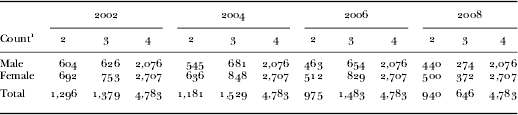
We consider only respondents with at least one child and interviewed at least twice over the follow-up. The final sample fulfilling these requirements consists of 28,561 interviews (15,970 of women and 12,591 of men) and is comprised of 8,658 persons (4,811 females and 3,847 males) aged 50–90 (Table 1).Footnote 1
Breakdown of the sample, by wave and sex

Note: 1. Count indicates the number of times the same person is interviewed over the four survey years.
Source: English Longitudinal Study of Ageing; author's calculations.
The dependent variable is assessed with a shortened version of the Rotter External–Internal Locus of Control Scale (Rotter Reference Rotter1966), constructed according to three questions from the self-completed part of the ELSA questionnaire (‘How often do you feel that what happens to you is out of your control?’; ‘How much do you agree or disagree with the following statements: ‘I feel that what happens in my life is often determined by factors beyond my control’; ‘At home, I feel I have control over what happens in most situations’). Built on the sum of the original answer categories (‘often; sometimes; not often; never’ for the first question and ‘strongly agree; moderately agree; slightly agree; slightly disagree; moderately disagree; strongly disagree’ for the other two statements), a scale from 3 to 16 was created, being certain that all responses were coded in the same direction. Higher values represent more internal control. Over the four-wave follow-up period, 7,966 people changed their LOC at least once. Almost 60 per cent of the total 15,298 changes head towards a decline, mainly in the range of one to three units. Cronbach's alpha (Cronbach Reference Cronbach1951) for this construct is 0.6.
The explanatory variables capture intergenerational solidarity. The associational dimension is measured by the items asking ‘How often, on average, do you meet up with your children?’ and ‘How often, on average, do you speak on the phone with your children?’ (α=0.7). These questions are answered by parents about those children who do not live with them. The original responses (‘less than once a year or never; once or twice a year; every few months; once or twice a month; once or twice a week; three or more times a week’) were summed to yield a total score ranging from 1 (meeting and/or calling every few months or less) to 5 (meeting and/or calling almost daily).Footnote 2 Having contact with the children 2–4 times a week was the modal (65.85%) response. We notice that phone calls and home visits to parents might be used as substitutes (Hogerbrugge and Komter Reference Hogerbrugge and Komter2012) as they both function as a reminder for the parents that ‘they are loved, thereby providing them with a sense of purpose and an incentive to sustain their physical and mental well-being’ (Wolff and Agree Reference Wolff and Agree2004: S174). However, descriptive analysis on the ELSA data (not included in the paper, available on request) shows a high correlation between the frequency of face-to-face contact and the frequency of phone calls for both men and women, suggesting a common underlying construct and therefore indicating that they could be considered together in a single variable.
The variable for affectual solidarity is constructed (following Grzywacz and Marks Reference Grzywacz and Marks1999) out of the following questions ‘How much do your children understand the way you feel about things?’; ‘How much can you rely on the children if you have a problem?’; ‘How much can you open up to your children about your worries?’; and ‘How much do your children let you down when you are counting on them?’ After coding all the responses in the same direction and summing them up (‘not at all; a little; some; a lot’), the full range of the combined variable is 4–16, with a median value of 14 for both women and men and α=0.8. The original categories have been collapsed into ‘low (values below 13); middle (values from 13 to 15); and high affectual solidarity (values above 15)’. The three categories have been calculated according to the 25th and 75th percentiles.
Using solidarity measures drawn from ELSA, we can test our hypotheses for the dimensions of associational and affectual solidarity. Unfortunately, ELSA does not investigate the amount of functional help received by the parent. Despite this limitation and the close link between receiving functional help and being in need of it, we can control for the functional dimension of intergenerational solidarity as well as for conflict.
The functional solidarity dummy variable is given value 1 if the individual receives help in daily activities (activities of daily living (ADL) or instrumental activities of daily living (IADL)) from children, children-in-law or grandchildren; 0 otherwise.
Based on the answers ‘not at all; a little; some; a lot’ to the questions ‘How much do your children criticise you?’ and ‘How much do your children get on your nerves?’, the degree of conflict between parents and children ranges from 0 (‘not at all’ answered to both questions) to 6 (‘a lot’ answered to both questions).
Additionally, the following control variables are included in the analysis in order to assess the role of potentially confounding covariates. The choice of the controls reflects the evidence from the literature on what affects both solidarity and LOC. Previous studies note that the sense of control over one's life declines in the later portion of the lifespan, when older adults are faced with greater obstacles to goal attainment (Lachman, Neupert and Agrigoroaei Reference Lachman, Neupert, Agrigoroaei, Schaie and Willis2011). Age is included in the regression models as three dummies to be able to include also the waves as controls for period-effects. In order to change the LOC of an ageing person, difficulties in small daily tasks might count more than the diagnosis from a doctor of a chronic disease, especially if this has no impact on the person's daily life independence. Therefore, health is measured by functional limitations and difficulties to autonomously perform ADLs and IADLs. The measure of functional limitations includes mobility difficulties due to health or physical problems in the following tasks: walking 100 yards; sitting for two hours; getting up from the chair after sitting for long periods; climbing several flights of stairs without resting; climbing one flight of stairs without resting; stooping, kneeling or crouching; reaching or extending the arms above shoulder level; pulling or pushing large objects like a living room chair; lifting or carrying weights over 10 pounds like a heavy bag of groceries; picking up a 5p coin from the table. The indicator of ADL refers to activities that are regularly performed for self-care, work, home-making and leisure. They include: dressing (including putting on shoes and socks); walking across a room; bathing or showering; eating, such as cutting up the food; getting in or out of bed and using the toilet, including getting up or down. The concept of IADL includes activities that are not strictly necessary for functioning but allow for an independent life. These include: using a map to get around in a strange place; preparing a hot meal; shopping for groceries; making telephone calls; taking medications; doing work around the house or garden; managing money (e.g. paying bills and keeping track of expenses). Additionally, a shortened version of the CES-D indicator (Center for Epidemiologic Studies – Depression Scale; Radloff Reference Radloff1977) measures symptoms of depression over a 0–8 scale, taking into account whether the person, during the week before the interview, ‘felt depressed; felt everything he/she did was an effort; felt that sleep was restless; was happy; felt lonely; enjoyed life; felt sad; could not get going for much of the time’. An indicator of self-reported health is also included as a dummy variable which has value 0 if the respondent evaluates the own health as at least good; 1 otherwise. Long-standing illnesses are measured on the basis of the limitation they cause: 0=no long-standing illness; 1=long-standing illness, not limiting; 2=long-standing illness, limiting.
Although the salience of the provisions may vary both inter-individually and intra-individually, all social interactions are essential for adequate personal adjustment. In this study, transitions to separation, divorce and widowhood assemble under the definition of marital disruption. One study of about 1,000 couples followed for eight years found that a bad marriage accelerates the normal decline in health as people age (Umberson et al. Reference Umberson, Williams, Powers, Liu and Needham2006). The high number of married people at the first interview and remaining married through the follow-up period in the ELSA sample allows for a distinction by quality of marriage based on how close the respondent defines the relationship with the partner. In order to control for the fact that needs for intimacy and social connection are not only met within the family, frequency of contact with friends and employment status (‘retired; working; other’) are included.
We will make use of separate models to test the gender-specific association between solidarity and LOC.
Estimation
With panel data the sources of variation are two: between and within individuals. A major problem of the traditional ‘between-individuals’ approach is the limited knowledge of selection: who receives more or less solidarity? In particular, the ‘optimal’ level of social embeddedness varies by individual. Hence, inference would be based on theoretical assumptions about the selection process. The use of ‘within-person’ analysis controls for the personal proclivity of the individual, specifying a statistical model that yields consistent estimates of the parameters in the presence of unobserved heterogeneity.
The linear regression model with fixed-effects is (Greene Reference Greene2001):
 $$\eqalign{& y_{it} = {\bf \beta} ^' x_{it} + {\rm \alpha} _i + {\rm \delta} _t + {\rm \varepsilon} _{it} \quad \quad \quad \quad \quad E\left[ {{\rm \varepsilon} _{it} \vert x_{i1}, x_{i2},..., x_{iT(i)}} \right] = 0, \cr & \quad \quad \quad \quad \quad \quad \quad \quad \quad \quad \quad \quad \quad \quad \;{\rm Var}\left[ {{\rm \varepsilon} _{it} \vert x_{i1}, x_{i2},..., x_{iT(i)}} \right] = {\rm \sigma} ^2 ^'} $$
where t=1,…, T(i) refers to the time and i=1,…, N refers to the person; vector β is a set of parameters of primary interest; α i is the group-specific heterogeneity and varies across individuals, representing the combined effect on y of all unobserved variables that are constant over time. Since the number of periods is fairly small, time-specific effects (δ t ) are accommodated by adding a set of time-specific dummy variables to the model (Greene Reference Greene2001). In this way, period effects which might endanger causal inference (and lead to endogeneity) are excluded. The error term ε it is different for each individual at each point in time and it captures any disturbance that influences the LOC in a time-varying way.
In this model, the interpretation of the beta coefficients would be: for a given individual i, as x varies across time by one unit, y increases or decreases by β units. The focus is on within-individual changes in x associated to within-individual changes in y. Including binary variables in the model for the various levels of solidarity allows an interpretation of non-linear effects: the individual-specific intercepts in the above equation and the binary regressors in the equation with binary variables will have both the same source (i.e. the unobserved variables that vary across individuals, but not over time) (Stock and Watson Reference Stock and Watson2003). In other words, we examine whether within-person changes in intergenerational solidarity are associated with within-person changes in LOC.
While random effects models estimate the effects of time-invariant variables, they may be biased because they do not control for omitted variables. On the contrary, fixed-effects models do not estimate the effects of variables whose values do not change over the time considered, but they control for them: fixed-effects models ‘partial out’ the effects of time-invariant variables – whether observable or unobservable. The way in which the partialling out is done varies by the statistical technique being used. Estimation by fixed-effects regression based on the demeaning variables method relies on a within-transformation of the data where for each person the within-subject mean of each variable (both the Xs and Y) is subtracted from the actual values: each unit serves as its own control group. Since the mean of a time-constant variable is equal to all values of the variable, the individual constants are eliminated. As a consequence, with fixed-effects models the correlation between observed factors (i.e. solidarity) and unobserved influences of a person's traits (e.g. preferences or inclinations to certain behaviours) contained in α i does not affect the estimate of the association between a change in solidarity and a change in LOC. The Hausman test (Reference Hausman1978) applied to our data justifies the use of fixed-effects regressions from an econometric point of view: it suggests that unit-specific effects are correlated with some of the independent variables in the models. A random-effects specification would therefore be inconsistent and likely biased.
Results
Descriptive findings
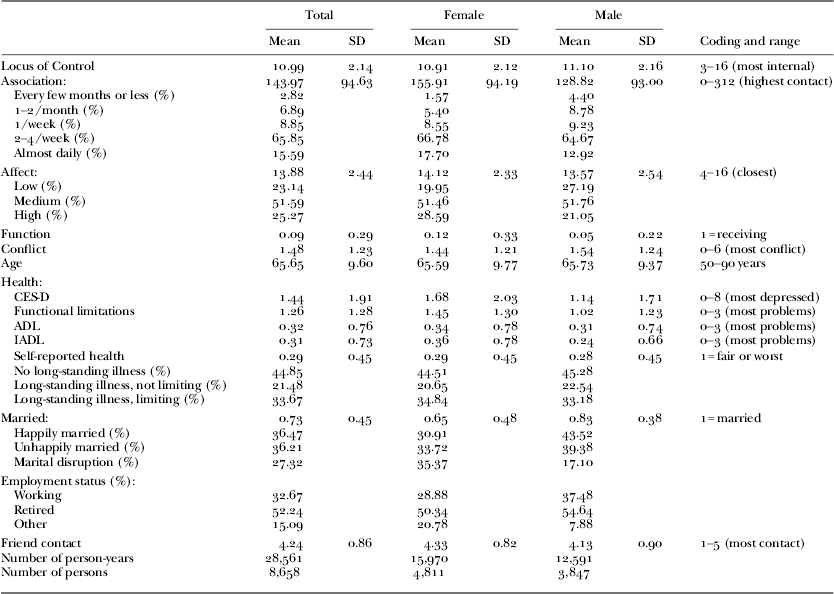
The mean values and standard deviations (SD) of study variables for the total sample and by gender are shown in Table 2. For women, LOC averages 10.91 (SD=2.12), for men it averages 11.10 (SD=2.16). The mean level of associational solidarity for women is 155.91 (SD=94.19): on average, interviewed mothers meet or talk to their children about 3 times a week; fathers have an average contact with children of 2.5 times a week (mean=128.82; SD=93.00).
Description of variables on pooled data: percentage or mean and standard deviation (SD)

Notes: CES-D: Centre for Epidemiological Studies – Depression Scale. ADL: activities of daily living. IADL: instrumental activities of daily living.
Source: English Longitudinal Study of Ageing; author's calculations.
In terms of affectual solidarity, about 51 per cent of the sample reports medium levels (51.46% among women and 51.76% among men).
Only a small percentage of the sample receives functional solidarity, with the proportion of female receivers being more than double than male receivers (12 and 5%, respectively).
On average conflict between parents and children is reported to be below 1.55 for both mothers and fathers, on a scale between 0 and 6 (where 6 is highest conflict).
Socio-demographic characteristics of the respondents in Table 2 reveal that the average age of the sample is 65.6 among women and 65.7 among men. In terms of health status, women report more problems than men (i.e. higher depression, more functional limitations, more problems with ADL as well as IADL, slightly worst self-reported health and long-standing illnesses that are considered to be physically limiting). The large majority of the sample is married: 65 per cent among women and 83 per cent among men, as typical among non-institutionalised elderly population in ageing societies. Reflecting the longer life expectancy of women, 35.37 per cent of the interviewed mothers have faced a marital disruption (18.3% of these accounting for separation, 49.8% being divorced and 31.9% being widowed); while the percentage of men was 17.10 (25.9, 49.1 and 25.0% for separated, divorcees and widowers, respectively). The majority of men and women interviewed are retired. High levels of contacts with friends are reported (mean=4.33, SD=0.82 for women; mean=4.13, SD=0.90 for men on a five-point scale where 5 is highest contact).
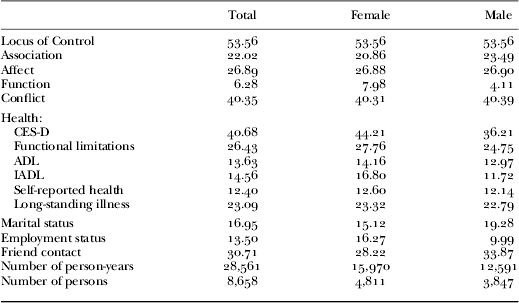
The focus of this study is on changes in LOC associated with changes in the solidarity dimensions' levels. Table 3 shows the changes (improvement or deterioration) in the various circumstances accounted for in the following analysis. The percentages relate to person-years. For example, out of 28,561 interviews over four waves, 53.56 per cent do not show the same level of LOC as at the previous interview. Gender differences point to more changes in the level of associational solidarity among men (23.49%) than among women (20.86%), while affectual solidarity changes for similar proportions of women and men (about 27%). Functional support changes from wave to wave more for mothers (7.98%) than for fathers (4.11%). Forty per cent of the person-years among both the female and the male samples change the level of conflict with the children over the four-wave follow-up.
Descriptive statistics for panel data analysis: percentage of changes between waves

Notes: CES-D: Centre for Epidemiological Studies – Depression Scale. ADL: activities of daily living. IADL: instrumental activities of daily living.
Source: English Longitudinal Study of Ageing; author's calculations.
Fixed-effects analyses
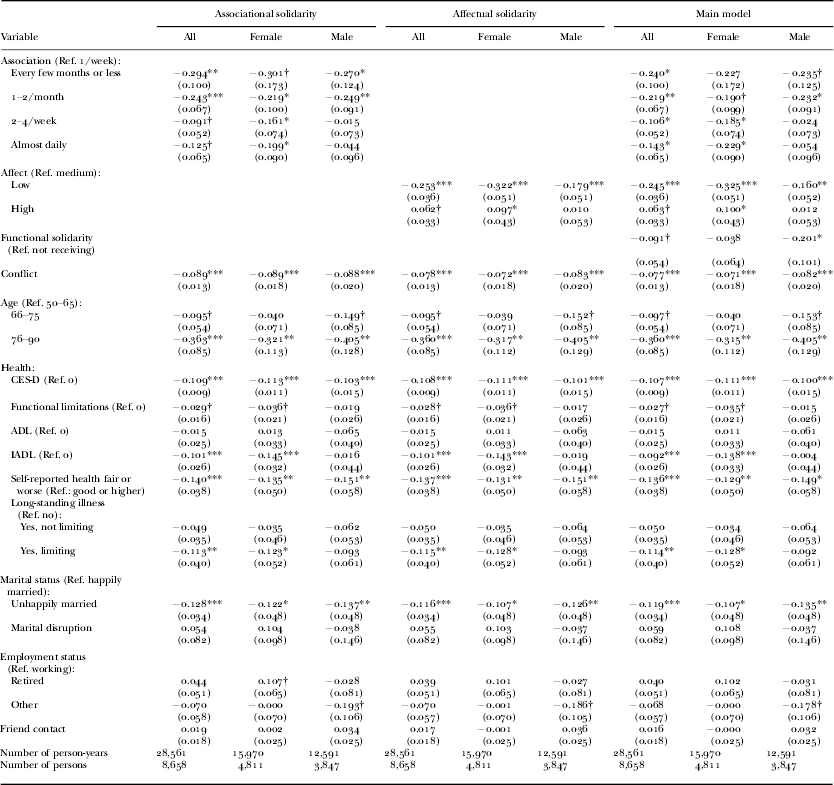
Fixed-effects regressions are performed on the full sample under study as well as by gender, including first only contact (associational solidarity model) and then only closeness (affectual solidarity model) between parent and children. Moreover, the ‘Main model’ considers both types of solidarity together, additionally including an indicator of whether the parent receives functional help from the children. All the regressions control for age, mental and physical health, marital status, employment status, friendships of the parent, and intergenerational conflict. The fixed-effects method examines the extent to which the independent variables can predict intra-individual variability in LOC. Table 4 shows the results: the coefficients in these regressions measure the association between within-person changes in the independent variables and within-person changes in LOC over time.
Fixed-effects estimates of the parental Locus of Control: beta coefficients (and standard errors)

Notes: Ref.: reference category. All models include survey year (three dummies, Ref. 2002). Empty cell=variable (row) not in the model (column).
Source: English Longitudinal Study of Ageing, author's calculations.
Significance levels: † p<0.10, * p<0.05, ** p<0.01, *** p<0.001.
Associational dimension
A decline in contact is associated with a drop in parental LOC for both men and women: a change in associational solidarity from once a week to every few months or less is associated with a decrease of 0.301 in mothers' LOC and of 0.270 in fathers' LOC; the coefficients for a decline from once a week to once or twice a month are −0.219 and −0.249 for women and men, respectively, and both statistically significant. Less obvious, and of particular interest, is the statistically significant fall in LOC associated with increasing frequency of contact: a change from meeting and/or calling the children once a week to having contact two to four times a week goes together with a significantly less internal LOC for women. Even larger is the (negative) association between a change from once a week to daily contact and the change in women's LOC. For mothers, the inverted U-shaped relationship between associational solidarity and LOC holds also when controlling for affectual and functional solidarity, conflict, the relevant time-varying covariates, and the observable and unobservable time-constant variables (‘Main model’). The results indicate that for men an increase in associational solidarity is statistically significantly associated with a (positive) change in LOC if using low frequency of contact as the level of reference. Neither benefit nor harm derives from further increases.
Affectual dimension
The multivariate analysis confirms the expected positive association between intergenerational affection and control. The results suggest that the more a parent can rely on the children, open up to them and feel understood by them, the higher the parental LOC. While a decline from medium to low levels of affectual solidarity is negatively associated with a decline in LOC for both men and women, the positive association between an increase from medium to high levels of affect and LOC is statistically significant only for mothers. However, if we would consider an increase from low to high levels of affectual solidarity (i.e. low affectual solidarity as reference), the change in LOC would be large and statistically significant for both men and women (beta coefficients are middle=0.322***; high=0.419*** for women; middle=0.179***; high=0.189** for men; **p<0.01, ***p<0.001), pointing to a larger beneficial effect on LOC associated with larger increases in affectual solidarity.
The post-estimation F-test on the ‘Main model’ suggests that the explanatory variables also have an additive effect. Controlling for the selection of who receives functional help, we find that the functional dimension of upward solidarity is associated with a decline in the own LOC compared to a condition in which there is no transfer of functional solidarity from the younger to the older generation. However, the slightly significant effect in the model where the whole sample is included (pooling women and men) is mainly driven by the male sample: a change from not receiving to receiving functional solidarity from the younger generation is associated with a decline of 0.2 units in paternal LOC, significant at the 5 per cent level. For both mothers and fathers, an increase in the level of conflict with children is associated with a statistically significant decline in LOC.
The control variables confirm an expected age effect: younger elderly tend to see themselves as actors impacting and affecting their future, while the oldest-old are holding a more external LOC. The results clearly show also a strong association between decreasing health (both mental and physical status) and decreasing LOC: an increase in the symptoms of depression and a deterioration of self-reported health are associated with a statistically significant decline in LOC. In women, the onset of limiting long-standing illness and an increasing number of problems with IADL are associated with a significant decline in LOC.
An unhappy marriage is associated with a less internal LOC. No significant effect emerges for the association between LOC and the transition to marital disruption. However, we acknowledge that divorce or separation may be the culmination of marital unhappiness and this may in turn shape one's relationship with one's child(ren), either increasing it or decreasing it (depending on several characteristics of both the parent and the child). Widowhood may rather be an unexpected event which, contrary to divorce, is likely to reduce the LOC over one's own life and attract solidarity. The small sub-sample facing these transitions in our data does not allow for a distinction. Neither change in the employment status nor in the frequency of contact with friends is associated in a statistically significant way with changes in LOC.
Robustness checks: solidarity and LOC by health status
The fixed-effects estimator is based on the assumption of strict exogeneity of the covariates. The violation of such an assumption, which would generate endogeneity and therefore produce a biased estimator, can arise from four main sources: period effects, unobserved heterogeneity (i.e. omitted variables may be correlated with both LOC and solidarity), measurement errors and simultaneity. In order to avoid the first source of endogeneity, our analysis has included wave-dummies which control for period shocks. The second source of bias was also overcome: fixed-effects models control for time-constant unobserved heterogeneity. Although time-varying unobserved heterogeneity may still be a problem, when T is not too large (as in our case) most unobserved variables are likely to be time-constant. As for measurement errors (third source of bias), we acknowledge that solidarity is reported by the parents. Writing the regression model as we did above assumes a direction of causation: solidarity affects LOC. Simultaneity issues (fourth source) may, however, endanger the results of this analysis if LOC changes before solidarity changes: the fixed-effects estimator uses all the information before the change in solidarity, therefore changes in the dependent variable (i.e. LOC) may trigger changes in the explanatory variable (in particular associational solidarity).
One could think of two main (endogenous) reasons for an increase in associational solidarity (i.e. reasons for both an increase in solidarity and a decrease in LOC): a decline in health and/or death of the spouse. Indeed, other reasons for a change in the frequency of contact with the children between the two interviews (independent of a change in health and in marital status) might be found in exogenous events (e.g. a newborn grandchild) that do not affect our results.
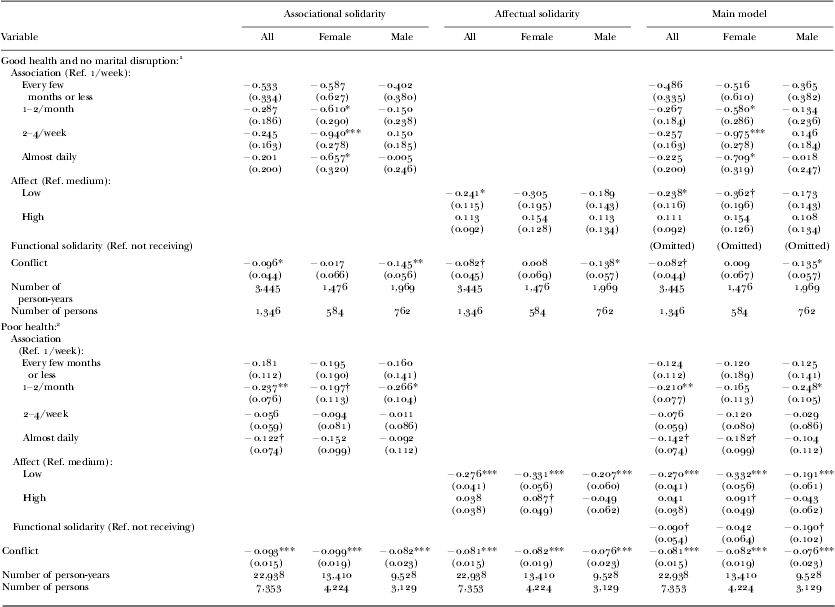
The analysis in Table 4 has controlled for health and marital status changes by including the transition to health worsening and marital disruption in the multivariate regression. A way additionally to explore the association between solidarity and LOC is to consider only the sub-sample of respondents which does not experience poor health: we retain in the sample only people with CES-D=0, functional limitations=0, ADL=0, IADL=0, long-standing illness=no and self-reported health=at least good in all the years of follow-up (functional solidarity is omitted, as it is conditional on the need for help). To exclude also the potential confounding effect of prior widowhood on LOC, we follow Väänänen et al. (Reference Väänänen, Buunk, Kivimäki, Vahtera and Koskenvuo2008) and perform the regression analysis on the sub-group of persons who had not experienced marital disruption during the year before the assessment of LOC. The statistically significant association between an increase in associational solidarity and a decrease in LOC for mothers also in this model (upper part of Table 5) gives insight into a causal effect of changes in the frequency of contact on LOC shift: the change in solidarity would most likely depend on factors which affect the frequency of contact, but that do not directly affect LOC internality.
Fixed-effects estimates of the parental Locus of Control by health: beta coefficients (and standard errors)

Notes: Ref.: reference category. Empty cell=variable (row) not in the model (column). All models include survey year (three dummies, Ref. 2002). 1. Centre for Epidemiological Studies – Depression Scale (CES-D)=0, functional limitations=0, activities of daily living (ADL)=0, instrumental activities of daily living (IADL)=0, long-standing illness=0, self-reported health=at least good in all the years of follow-up; no marital disruption in the year before the interview. Models control for age, marital status, employment, friend contact, conflict, and wave. 2. CES-D >0, functional limitations >0, ADL >0, IADL >0, long-standing illness=yes (either not limiting or limiting), self-reported health=fair or worst. Models control for age, CES-D, functional limitations, ADL, IADL, long-standing illness, marital status, employment, friend contact, conflict and wave.
Source: English Longitudinal Study of Ageing; author's calculations.
Significance levels: † p<0.10, * p<0.05, ** p<0.01, *** p<0.001.
For the sake of completeness, the bottom part of Table 5 reports the results of the same models, carried out on the sub-sample which has at least one health problem at first interview and during the follow-up interviews (i.e. CES-D >0, functional limitations >0, ADL >0, IADL >0, long-standing illness=yes, either not limiting or limiting, self-reported health=fair or worst). This result of a non-statistically significant association between increases in associational solidarity and LOC, in light of the result obtained on the healthy sub-sample, additionally informs us of the importance of contingency: provision of solidarity when the recipient is in a condition of need may be well perceived, but not adequate amounts of solidarity may have negative effects on the recipient's LOC. The association between affectual solidarity and LOC in the models of Table 5 still shows the same direction as in the corresponding models on the full sample in Table 4. However, only a decline in parent–child closeness in the sub-sample facing poor health is significantly associated with a (negative) change in LOC for both men and women.
Discussion
The fact that social ties affect wellbeing is well documented. It is, however, still necessary to understand better the psychological mechanisms at work in order to enable intervention which could help maintain LOC in later life and, therefore, promote cognitive and physical health within the active ageing policy framework (World Health Organization 2002). As Lachman, Neupert and Agrigoroaei (Reference Lachman, Neupert, Agrigoroaei, Schaie and Willis2011: 179) observed, ‘it is an important goal of ageing research to identify those factors that enable adults to remain resilient and to maintain their sense of control in the face of ageing-related declines’. Loss of control with ageing does not cause disease, but ‘it alters the physiological state of the individual and leads to an increased physical and mental vulnerability’ (Shupe Reference Shupe, Birren and Livingston1985: 184). In this study, we focused on the association between changes in intergenerational solidarity and changes in the LOC of the parents from a within-person perspective.
The results of this study offer a contribution to the academic literature on parent–child solidarity dynamics, highlighting not only that solidarity and control are coupled together, but also the importance of distinguishing between different types and amounts of solidarity. As LOC is an accepted and validated construct associated with several health and ageing outcomes, this study also provides indirect evidence for health and informal support strategies.
Facilitation and displacement hypotheses have been tested for associational and affectual solidarity dimensions between parent and child, controlling for selection on who receives functional help from the children and intergenerational conflict, as well as the relevant socio-demographic time-varying characteristics.
In agreement with the facilitation perspective, affectual solidarity is positively associated with LOC (Hypothesis 1). The development of intimacy and trust with children is associated with an increase in the LOC of the elderly parent (i.e. making it more internal).
While recognising in the child a significant other to rely on brings together self-confidence, we expected that an increase in associational solidarity may bring together a decrease in the LOC of the parent (i.e. it becomes more external). The association between frequency of contact and LOC follows an inverted U-shape for women: not only a decline, but also an increase in associational solidarity is associated with a more external sense of control, in agreement with the displacement hypothesis (Hypothesis 2). This also means that if contact is rare, a moderate increase is positively associated with LOC internality; however, changes to frequent face-to-face meetings or phone calls with the children may not have any positive effect on LOC or even be harmful.
The hypotheses tested, derived from theories and previous empirical evidence, also contribute to the knowledge on the potential gender-specific social pathways to LOC decline in later life. As gender is a predisposing factor for different involvement in intergenerational solidarity exchange within the family, we have carried out the analyses for mothers and fathers separately. Empirical ground is obtained for the results presented above, especially for mothers. Also previous empirical evidence on the relationship between solidarity and mortality or depression indicated inconsistent results on gender (e.g. Shye et al. Reference Shye, Mullooly, Freeborn and Pope1995), with women being more emotionally influenced by close social relationships than men (Väänänen et al. Reference Väänänen, Buunk, Kivimäki, Vahtera and Koskenvuo2008).
Apart from possible restrictions of the statistical power due to the relatively small numbers included in some groups, the more significant association between changes in solidarity and changes in LOC for mothers than for fathers points to the expected higher costs associated with the role of kin-keepers, the more frequent interactions with kin, and the higher exchange of support with children that women shoulder in comparison to men. Moreover, because of the value women attach to reciprocal altruism (Acitelli and Antonucci Reference Acitelli and Antonucci1994), their sense of control may also depend on the role of being a good support provider, which may be lacking when individuals receive more (Väänänen et al. Reference Väänänen, Buunk, Kivimäki, Vahtera and Koskenvuo2008).
The outcome of this study extends the findings by Silverstein, Chen and Heller (Reference Silverstein, Chen and Heller1996) and Bengtson and Schaie (Reference Bengtson and Schaie1999) of a curvilinear relationship between (functional) solidarity and LOC to the associational dimension of intergenerational relationships within the family. The relevance of this result is hedged in the importance of associational solidarity within the wide discussion on informal support: the frequency of contact is a type of solidarity invading the private sphere of independence and can be viewed as a form of support in itself, given that it meets a social need. It is also considered to be an indirect indicator of forms of instrumental support that are too idiosyncratic to measure in large-scale surveys (Kalmijn and Dykstra Reference Kalmijn, Dykstra, Dykstra, Kalmijn, Knijn, Komter, Liefbroer and Mulder2006). In particular, more parent–child contact increases the likelihood of exchanges of help in kind as support providers are more aware of the recipient's needs. However, this may also be gender-specific. Different from mothers, fathers are more likely to be part of obligatory ties or of ties where keeping in touch is a means to reciprocate the (expected or previous) receipt of financial support. As van Gaalen and Dykstra (Reference van Gaalen and Dykstra2006) argued, frequent contact between children and fathers is often accompanied by moderate rather than high levels of support exchange usually observed for mothers.
Additionally, we note that men's mobilisation of support tends to be more heavily based on their spouses than on their children (Lowenthal and Haven Reference Lowenthal and Haven1968). Therefore, fathers are more likely to be exposed to a potential loss of their sense of purpose and a consequent decline in cognitive abilities when faced with large amounts of tangible help from the younger generation in later life. Their perception of the role reversal as undermining the balance between autonomy and dependency is indeed reflected in the large and significant coefficient of receiving functional solidarity for men in our analysis.
In order to replicate the analysis of Silverstein, Chen and Heller (Reference Silverstein, Chen and Heller1996) and Bengtson and Schaie (Reference Bengtson and Schaie1999) on functional solidarity, a classification of the tangible help received by older people would have been necessary. The lower internal control emerging for parents (especially fathers) receiving functional assistance points to a combination of selection and causal effects which cannot be disentangled by this analysis. In the same way as for affectual solidarity, probably due to the greater sense of purpose coming with the adoption of a productive social role, we may think that parents hold a higher LOC when they are able to reciprocate and feel ‘useful’ as compared to situations of purely receiving. Unfortunately, ELSA does not provide information about functional transfers from parents to children (down the family line) other than in the form of time for care. The possible use of grandparenting as a proxy for responsibilities would, however, limit the analysis to the sub-sample of grandparents, most likely living close to a grandchild; while caring for a relative outside the household is linked to an (endogenous) condition of need.
The findings of this study must be considered alongside the following three methodological caveats. First, sub-groups of a population may behave differently.Footnote 3 There is likely no general formula to establish how much solidarity fits a certain person. Therefore, in the inverted U-shaped relation between associational solidarity and LOC, the actual level at which both a decline and an increase in solidarity are associated with a decline in LOC may differ from person to person and, on average, from country to country: outside England, in a cultural system with strong filial expectations and in countries with weaker welfare systems (e.g. in the Mediterranean part of Europe), the average level of intergenerational solidarity within the family tends to be higher than in England. There, the frequency of parent–child contact at which a further increase brings together a loss in control is likely to be set at a higher value than for England. Although contextual characteristics may affect the solidarity–LOC relationship, British research on family and kinship shows that family ties remain strong in England similar to the other European countries, despite society becoming more affluent and the welfare system more developed (for a detailed review, see e.g. Chan and Ermisch Reference Chan and Ermisch2011). Moreover, family networks, and children in particular, constitute the basis of care provision for older people in the English context as well as in the other European countries. Therefore, this analysis adds to the literature on the association of specific sources of solidarity with LOC by providing the basis for a generalisation of the results for ageing societies, which may be developed using, for example, data from the Survey of Health, Ageing and Retirement in Europe. Second, we acknowledge that reverse causality may be a limitation for this study. People with lower LOC recall more attention from their children. An analysis with lagged variables would not have solved the issue for two main reasons: first, these changes are often simultaneous or act in the short run; second, under fixed-effects and within transformation Δy i,t−1 (i.e. the change between two waves in the dependent variable when using a lagged variable) is correlated with ε i . Therefore, the fixed-effects estimator would be biased. Yet, as changes in the level of solidarity were examined between two to four points in time over a six-year period, the procedure used may hide other transitions that may have taken place between the interviews (e.g. worsening of partner's health). However, by controlling for as many events suggested by previous literature to contribute to a change in LOC prior to a change in intergenerational solidarity as available in the dataset, this study could establish an association between changes in solidarity and changes in LOC over time. Moreover, the additional analysis carried out on those parents who do not face any decline in either mental or physical conditions over the follow-up interviews and are not affected by a negative life-event (such as widowhood) in the year preceding the interview provides some evidence for the temporal ordering of the solidarity and control relationship. Confirming the results obtained on the whole sample, this finding is in line with the assumption made in writing the regression model: solidarity is likely to affect LOC, independently from a change in health or in marital status.
The third limitation to this study lies in the assumption that time-varying characteristics of the children are exogenous and affect the level of solidarity, but not (directly) the internality of control. For example, an increase in (in-person or telephone) contact might reflect problems that the child has experienced (e.g. divorce or job loss) or the need of the child for some advice (e.g. with the own children). If so, the children's problems would very likely be beyond the parents' control: hearing about them with such frequency might detract from the parents' LOC.
The current inquiry also has several strengths. First, the large dataset which draws a nationally representative sample of the English population aged 50 and older allows an extensive analysis of the association between intergenerational solidarity and LOC. Second, the fixed-effects method controls for unobserved heterogeneity and provides within-individual estimates. Third, the robustness checks additionally provide a way to offset the lack of information about the amount of solidarity wished by the parent: when parents are not vulnerable, the preference to be independent may prevail and non-contingent support may not be beneficial. This finding confirms previous results on functional solidarity (Seeman, Bruce and McAvay Reference Seeman, Bruce and McAvay1996). However, as predicted by Davey and Eggebeen (Reference Davey and Eggebeen1998), older adults who experience a need will benefit (or at least will not be harmed) from receiving solidarity from their adult children. It will be interesting to test more specific hypotheses regarding differences in cases of stressful situations such as divorce or widowhood, the onset of specific diseases, and so forth.
The literature has shown that LOC is directly associated with behavioural, motivational and physiological domains, arguing that those who maintain higher levels of internality are less exposed to ageing-related outcomes. Although ageing is influenced to some degree by genetic factors, a large component is determined by one's own control. As the review by Lachman, Neupert and Agrigoroaei (Reference Lachman, Neupert, Agrigoroaei, Schaie and Willis2011) discusses, interventions to maintain cognitive functioning and to promote health behaviours have been shown to be more successful if LOC is also directly addressed in conjunction with skills training. Therefore, a deep understanding of how an individual LOC changes in later life is central to the active ageing debate.
In this vein, the presented results give rise to some very critical implications on current social policy aimed at ensuring successful ageing for individuals and society. Independently of whether elderly care belongs to formal or informal sources, public or private facilities, it is important to take into account the psychological wellbeing of the fragile ageing population. Specifically, this study extends our understanding of ageing, suggesting that the best way for enhancing elderly people's LOC is to provide them with solidarity, without undermining their autonomy. In particular, needs of the recipients to maintain a productive social role also in later life should be taken into account in order to prevent losses in their LOC. This can aid the design of formal and informal social support interventions for elderly care, considering not only functional solidarity, but also other forms of exchange which may have an additive effect. As Lachman, Neupert and Agrigoroaei suggest, studies which pay ‘attention to the sense of control can enrich the work by researchers, policy makers, clinicians, and other scientists and practitioners interested in promoting good health and well-being in adulthood and later life’ (2011: 176), due to the demonstrated utility of the construct across domains related to health and ageing. Our examination of changes in different types of solidarity contributes to a better understanding of the complex effect of solidarity on LOC that is also closely related to gender roles in adult life.
The insights obtained from the results of this study should stimulate future research to further clarify the causality pattern between family solidarity dimensions and LOC in older people (e.g. by using an instrumental variable approach) and to explore the effects of solidarity in a broader sense (e.g. additionally considering the role played by formal support). Longer series of panel data may also allow us to determine whether the observed association solidarity–LOC is the result of a life-long cumulative exposure or of a sudden (age-related) change in the structure of intergenerational solidarity.
Acknowledgements
The author wishes to thank Mike Murphy, Karsten Hank and Pearl Dykstra for their precious comments on previous versions of this paper. The author acknowledges funding from the Austrian Science Fund (FWF): Z171-G11. The data were made available through the UK Data Archive. ELSA was developed by a team of researchers based at the University College of London, the National Centre for Social Research and the Institute for Fiscal Studies. The data were collected by the National Centre for Social Research. The funding is provided by the National Institute of Aging in the USA, and a consortium of UK Government departments co-ordinated by the Office for National Statistics. The developers and funders of ELSA and the Archive do not bear any responsibility for the analyses or interpretations presented here.