Introduction
Stroke is a major health problem and the main cause of complex adult disability. Annually, 16 million people worldwide have a stroke, and 62 million people are living with its consequences (Mukherjee & Patil, Reference Mukherjee and Patil2011). Most stroke survivors experience impairments such as hemiparesis, spasticity, aphasia and cognitive impairment that cause functional difficulties in performing everyday tasks (Mayo, Wood-Dauphinee, Cote, Duncan, & Carlton, Reference Mayo, Wood-Dauphinee, Cote, Durcan and Carlton2002).
These impairments in turn cause reduced PA levels, leading to secondary aerobic deconditioning and reduced muscle strength (Gebruers, Vanroy, Truijen, Engelborghs, & De Deyn, Reference Gebruers, Vanroy, Truijen, Engelborghs and De Deyn2010; Rand, Eng, Tang, Hung, & Jeng, Reference Rand, Eng, Tang, Hung and Jeng2010). General deconditioning through inactivity is evidenced by cardiorespiratory fitness levels of between 26% and 87% that of matched healthy subjects (Smith, Saunders, & Mead, Reference Smith, Saunders and Mead2012) and by bilaterally impaired muscle strength (Gerrits et al., Reference Gerrits, Beltman, Koppe, Konijnenbelt, Elich, de Haan and Janssen2009). Deconditioning limits ability to function, causing more inactivity and deconditioning, in an inactivity cycle (Saunders, Sanderson, Brazzell, Greig, & Mead, Reference Saunders, Sanderson, Brazzelli, Greig and Mead2013). Breaking this cycle through PA engagement may ameliorate deconditioning, lessening associated functional decline.
However, stroke survivors face diverse barriers that limit their PA engagement (Morris, Oliver, Kroll, & Macgillivray, Reference Morris, Oliver, Kroll and Macgillivray2012; Nicholson et al., Reference Nicholson, Sniehotta, van Wijck, Greig, Johnston, McMurdo and Mead2013). After briefly describing the benefits of PA, this commentary will examine barriers to PA using the International Classification of Functioning and Disability (World Health Organisation, 2001) before making some suggestions for approaches to support stroke survivors in regular PA.
Defining Physical Activity
PA has been defined as any bodily movement resulting in an increase in energy expenditure above baseline resting energy expenditure (Caspersen, Powell, & Christenson, Reference Caspersen, Powell and Christenson1985). In that definition, exercise is described as a sub-category of PA and involves planned, structured and repetitive bodily movement, with the objective of improving or maintaining physical fitness. For the purpose of this commentary, we adopt the broad definition of PA that includes, but is not limited to, exercise. Consideration of PA intensity is also relevant. Intensity of PA is measured in metabolic equivalents. An MET is defined as the ratio of the associated metabolic rate for a specific activity, divided by the resting metabolic rate. The resting metabolic rate is approximately 1 MET and reflects the energy cost of sitting quietly (Ainsworth et al., Reference Ainsworth, Haskell, Leon, Jacobs, Montoye, Sallis and Paffenbarger1993). Using this categorisation, low intensity activity involves sitting tasks, but also slow walking up to a speed of 4km/hour. Moderate activity involves energy consumption of three to six metabolic equivalents, for example, walking at 5 km/hour (Ainsworth et al., Reference Ainsworth, Haskell, Leon, Jacobs, Montoye, Sallis and Paffenbarger1993). Vigorous activity involves energy consumption of greater than six metabolic equivalents, for example, jogging or heavy lifting (Ainsworth et al., Reference Ainsworth, Haskell, Leon, Jacobs, Montoye, Sallis and Paffenbarger1993).
Stroke survivors are recommended to undertake low to moderate intensity of PA at least 3 days per week (Billinger et al., Reference Billinger, Arena, Bernhardt, Eng, Franklin, Johnson and Tang2014). These levels of intensity include structured aerobic, muscle strengthening and flexibility exercises, but also household tasks, walking, hobbies and other activities with those levels of energy expenditure and which stroke survivors are likely to engage in. The potential role of engagement in low to medium intensity PA in improving stroke outcomes has generated much research interest. An overview of benefits is presented below.
Benefits of Physical Activity After Stroke
Physical Benefits
There is now good evidence from high quality trials and reviews that post stroke cardiorespiratory and mixed training (i.e. strength and cardiorespiratory training) improve aerobic capacity (Pang, Eng, Dawson, & Gylfadottir, Reference Pang, Eng, Dawson and Gylfadottir2006), gait speed and walking capacity (Saunders et al., Reference Saunders, Sanderson, Brazzelli, Greig and Mead2013; Veerbeek, Koolstra, Ket, van Wegen, & Kwakkel, Reference Veerbeek, Koolstra, Ket, van Wegen and Kwakkel2011) can improve disability and balance, although evidence for mixed training is weaker. Even late after stroke, benefits of strength training on muscle strength, balance and walking capacity have been shown (Hill et al., Reference Hill, Gjellesvik, Moen, Trhaug, Fimland, Helgerud and Hoff2012). Furthermore, there is evidence suggesting that exercise involving strengthening and weight bearing improves bone density following stroke, thus reducing fracture risk (Borschmann, Pang, Bernhardt, & Iuliano-Burns, Reference Borschmann, Pang, Bernhardt and Iuliano-Burns2012). Flexibility and neuromuscular training are also effective in improving balance and reducing fear of falling (Ding, Reference Ding2012; Schmidt et al., Reference Schmidt, Van Puymbroeck, Altenburger, Dierks, Miller, Damush and Williams2012). Thus, effects of PA for specific training effects to reverse post stroke deconditioning are now established. However, PA engagement also has other benefits.
Other Benefits
First, regular PA may reduce secondary stroke risk (Hackam & Spence, Reference Hackam and Spence2007; Hillen et al., Reference Hillen, Coshall, Tilling, Rudd, McGovern and Wolfe2003; Lee, Nam, Heo, & Kim, Reference Lee, Nam, Heo and Kim2001). The effect may occur because moderate intensity aerobic activity improves risk factors including glucose tolerance (Ivey, Ryan, Hafer-Macko, Goldberg & Macko, Reference Ivey, Ryan, Hafer-Macko, Goldberg and Macko2007), blood pressure and total cholesterol (Billinger et al., Reference Billinger, Mattlage, Ashenden, Lentz, Harter and Rippee2012; Rimmer, Rauworth, Wang, & Hill, Reference Rimmer, Rauworth, Wang, Nicola and Hill2009). Although the evidence is still relatively limited, the potential for secondary risk reduction makes the argument for engagement in PA by stroke survivors even more compelling.
Second, PA engagement may reduce depression. Post stroke depression is common, affecting 30%–35% of stroke survivors at some point (Hackett & Pickles, Reference Hackett and Pickles2014). Individual randomised controlled trials (Lai et al., Reference Lai, Studenski, Richards, Perera, Reker, Rigler and Duncan2006; Sims et al., Reference Sims, Galea, Taylor, Dodd, Jespersen, Joubert and Joubert2009) and systematic reviews (Graven, Brock, Hill, & Joubert, Reference Graven, Brock, Hill and Joubert2011; Eng & Reime, Reference Eng and Reime2014) show strength training and mixed aerobic and strength training may improve depression and enhance quality of life in the short term. However, depression was defined differently in each study, making generalisable conclusions about who is most likely to benefit from such training difficult. These studies also show diminished effects on depression at follow-up, but because none reported post-intervention PA adherence, it is unclear if this was actually due to diminishing effects of exercise, or to limited long-term exercise adherence. Long-terms effectiveness of PA on depression and adherence rates are areas for further investigation. Nonetheless, evidence of benefits of PA, for post stroke depression is growing, and has important implications for depression management.
This body of high quality evidence has informed evidence-based PA and exercise recommendations (Billinger et al., Reference Billinger, Arena, Bernhardt, Eng, Franklin, Johnson and Tang2014; Gordon et al., Reference Gordon, Gulanick, Costa, Fletcher, Franklin, Roth and Shephard2004). These recommend stroke survivors undertake PA three times per week for 20–50 minutes, incorporating aerobic exercise, strength training and flexibility training, and have generated expectations that stroke survivors should be supported to achieve the recommendations.
However, stroke survivors are not meeting recommended levels of PA. Although samples were small, individual stroke studies (Paul, Wyke, Dybus, Rafferty, & Alexander, 2015; Rand, Eng, Tang, Jeng, Hung, Reference Rand, Eng, Tang, Jeng and Hung2009; Tieges et al., Reference Tieges, Mead, Allerhand, Duncan, van Wijck, Fitzsimons and Chastin2015a) and systematic reviews of activity behaviour (English, Manns, Tucak, & Bernhardt, Reference English, Manns, Tucak and Bernhardt2014; Field, Gebrauers, Sugavanum, Nicholson, & Mead, Reference Field, Gebrauers, Sugavanum, Nicholson and Mead2013; Nicholson et al., Reference Nicholson, Sniehotta, van Wijck, Greig, Johnston, McMurdo and Mead2013) show ambulatory step counts for community dwelling stroke survivors of between half and two-thirds age-matched normative values, suggesting stroke survivors are less active than their peers. A United States survey also shows fewer stroke survivors meet weekly PA guidelines than age matched healthy peers (17.9% vs. 25.0%) and have lower levels of moderate (46.1% vs. 54.7%) and vigorous (9.1% vs. 19.6%) leisure activity (Butler & Evenson, Reference Butler and Evenson2014). Understanding why stroke survivors are less active than their peers is vital if they are to be supported to meet recommended PA levels.
Using the ICF Framework to Understand Factors Influencing Stroke Survivors’ Physical Activity Engagement
The ICF
In defining influences on PA engagement, it is helpful to use a holistic framework. Socio-ecological models propose that interactions between personal biological and psychological influences, physical, social and cultural environmental influences, and community, organisational and policy influences determine health behaviour (Sallis, Owen, & Fisher, Reference Sallis, Owen, Fisher, Glanz, Rimer and Viswanith2008). The models propose that multi-level interventions are required for sustainable health behaviour change. Using such models to conceptualise barriers should help to pinpoint where action is required to effectively support PA after stroke.
The World Health Organisation's ICF (World Health Organisation, 2002) is a socio-ecological model that has been used to conceptualise PA barriers in disabled populations (Mulligan, Hale, Whitehead, & Baxter, Reference Mulligan, Hale, Whitehead and Baxter2012; van der Ploeg, van der Beek, van der Woude, & van Mechelen, Reference van der Ploeg, van der Beek, van der Woude and van Mechelen2004) and therefore has relevance for stroke.
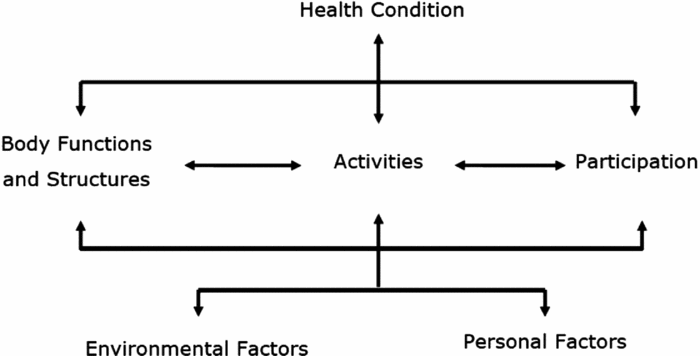
The ICF describes health conditions via body function and structure (i.e., physiological function and anatomical structure), activities (i.e., task execution) and participation (i.e., involvement in a life situation). The model suggests these constructs of health are influenced by personal factors, that is, individual characteristics unrelated to health, such as age, sex and psychological characteristics. Environmental factors are also proposed to influence health constructs and include physical, social and attitudinal characteristics of the environment. The model proposes that interactions between personal and environmental context and the health condition determine disability and functioning. Disability is described as impairments of body structure or function, activity limitations for task performance and restrictions in participation in life situations (World Health Organisation, 2001). The model's bi-directional arrows indicate dynamic relationships between constructs (Figure 1).
ICF framework (World Health Organization, 2001).

Thus, whilst physical impairment resulting from stroke may restrict engagement in PA, an accessible environment for PA tailored to individual impairments, could enhance confidence and support PA engagement, improving impairment and enhancing confidence for further engagement (Ravesloot et al., Reference Ravesloot, Ruggeiero, Ipsen, Traci, Seekins, Boehm and Rigles2011). Exploration of the ICF domains for stroke survivors and the interactions between constructs may therefore indicate where interventions are necessary to support PA engagement. The remainder of this paper will review barriers faced by stroke survivors using ICF constructs as a guide, and discuss how these interactions may influence PA engagement.
Body Structure/Function Impairment and PA
Impaired body structure or function has been identified as an important barrier to PA engagement in a review of barriers to PA involving people with long-term neurological conditions (Mulligan et al., Reference Mulligan, Hale, Whitehead and Baxter2012). This finding is endorsed in studies involving stroke survivors. Several qualitative studies (Damush, Plue, & Bakas, Reference Damush, Plue and Bakas2007; Nicholson et al., Reference Nicholson, Sniehotta, van Wijck, Greig, Johnston, McMurdo and Mead2013; Patterson & Ross-Edwards, Reference Patterson and Ross-Edwards2009; Robison, Wiles, & Ellis-Hill, Reference Robison, Wiles and Ellis-Hill2009) show that stroke survivors’ perceptions of limited movement, strength and mobility act as barriers to PA engagement after stroke. These perceptions are supported by quantitative studies involving community dwelling sedentary stroke survivors showing correlations between physical impairment measures and daily step-count (a proxy measure of walking activity) (Danielsson, Willen, & Sunnerhagen, Reference Danielsson, Willen and Sunnerhagen2012 ; Tiedemann et al., Reference Tiedemann, Sherrington, Dean, Rissel, Lord, Kirkham and O'Rourke2012; Zalewski & Dvorak, Reference Zalewski and Dvorak2011). However, in one study, only 5% of variance in exercise class attendance was predicted by physical impairment measures, suggesting other factors, including environmental or personal factors may influence PA engagement (Tiedemann et al., Reference Tiedemann, Sherrington, Dean, Rissel, Lord, Kirkham and O'Rourke2012). These findings suggest that whilst physical impairment is important in determining engagement, it is only part of the story.
Similarly, balance impairment is also reported to influence PA levels. Several studies show positive associations between Berg Balance scores, steps taken per day (Michael, Allen, Macko, Reference Michael, Allen and Macko2005, Reference Michael, Allen and Macko2006) and accelerometer activity counts (Rand et al., Reference Rand, Eng, Tang, Jeng and Hung2009). However, the role of balance in predicting step count has not been equivocally established, given that another study (Fulk, Reynolds, Mondal, & Deutsch, Reference Fulk, Reynolds, Mondal and Deutsch2010) found that Berg balance scores did not significantly predict daily step count in stroke survivors living in the community. That study was small however, and involved participants whose mean gait speed at 1.01 m/s was only slightly less than that of the healthy comparisons at 1.34 m/s, therefore general conclusions for survivors with poorer balance and mobility cannot be made. Nonetheless, for many stroke survivors, balance impairment probably plays a part in influencing PA engagement involving walking activity.
Additionally, several qualitative studies show perceptions of poor balance influence fear of falling, that act as an important barrier to PA engagement (Morris, Oliver, Kroll, & Macgillivray, 2012; Patterson & Ross-Edwards, 2010; Simpson, Eng, & Tawashy, Reference Simpson, Eng and Tawashy2011). These studies illustrate how ICF constructs interlink, with balance impairment leading to personal emotional responses, including fear, that in turn limit engagement. However, like balance, more exploration of the influence of fear of falling on activity levels is required, since in another study it was not confirmed as a predictor of PA engagement (Tiedemann et al., Reference Tiedemann, Sherrington, Dean, Rissel, Lord, Kirkham and O'Rourke2012) suggesting that its role in PA engagement is as yet uncertain.
The impact of cognitive impairment on PA engagement after stroke has not been fully explored, however a review of barriers to PA for people with long-term neurological conditions, including stroke, highlighted cognitive impairment as a barrier to PA (Mulligan et al., Reference Mulligan, Hale, Whitehead and Baxter2012). Prevalence of cognitive impairment after stroke ranges from 22% to 77% (Douiri, Rudd, & Wolfe, Reference Douiri, Rudd and Wolfe2013; Riepe, Riss, Bittner, & Huber, Reference Riepe, Riss, Bittner and Huber2004). The heterogeneity in prevalence rates is probable because of differences in study methods, case mix and inclusion or exclusion of participants with pre stroke dementia (Douiri et al., Reference Douiri, Rudd and Wolfe2013). Its importance for PA is illustrated in qualitative studies showing that memory and attention impairments limited stroke survivors’ engagement in PA, often through the impact that those impairments have on confidence and competence to engage in groups and other organised PA (Morris et al., Reference Morris, Oliver, Kroll and Macgillivray2012; Nicholson et al., Reference Nicholson, Donaghy, Johnston, Sniehotta, van Wijck, Johnston and Mead2014). Given the prevalence rates of cognitive impairment experienced by stroke survivors, it is imperative to explore how to ensure inclusion in PA studies and programmes of people with cognitive impairment.
Likewise, communication impairment is common after stroke, with studies reporting between 15% and 38% of stroke survivors experiencing aphasia in the acute phase (Inatomi et al., Reference Inatomi, Yonehara, Omiya, Hashimoto, Hirano and Uchino2008; Laska, Hellblom, Murray, Kahan, & Von Arbin, Reference Laska, Hellblom, Murray, Kahan and Von Arbin2001). There is little evidence of the impact of communication difficulties on PA engagement, possibly because participants with communication difficulties, or combined cognitive and communication difficulties are often deliberately excluded from PA studies. However, qualitative studies have provided some evidence that people with communication difficulties may be less likely to engage in PA because their communication impairment negatively influences interactions with others reducing confidence to cope in group situations (Morris, Oliver, Kroll, Joice, & Williams, Reference Morris, Oliver, Kroll, Joice and Williams2015).
Inclusion of people with cognitive and communication impairments in future PA studies will enhance understanding of how those impairments influence PA engagement. Furthermore, in collaboration with speech and language therapists, the deliberate adaptation of PA interventions and services to ensure inclusive environments in which people with communication and cognitive impairment are supported to engage in PA could enhance their confidence and likelihood of engaging in PA. This would be particularly important within group settings to ensure these stroke survivors receive the same opportunities as other survivors to become active.
Post stroke fatigue is another PA barrier affecting between 30% and 68% of stroke survivors, depending on whether depression-related fatigue is included (Duncan, Kutlubaev, Dennis, Greig, & Mead, Reference Duncan, Kutlubaev, Dennis, Greig and Mead2012). Fatigue is likely to be biological in origin, an early consequence of the stroke lesion itself, and can therefore, at least in the early stages of stroke, be viewed as an impairment within the ICF, leading to activity limitation and participation restriction in relation to PA (White et al., Reference White, Gray, Magin, Attia, Sturm, Carter and Pollack2012). However, a published review and model of fatigue (Wu, Mead, Macleod, & Chalder, Reference Wu, Mead, Macleod and Chalder2015) suggests that viewing fatigue only as an impairment directly arising from the stroke itself is too simplistic. Although the evidence is by no means comprehensive, the review suggests that fatigue may also emerge as a consequence of complex interactions between pre or post stroke depression and anxiety, post stroke physical impairments, and personal psychological and behavioural responses to stroke. The model suggests that the influence of these factors emerges over time after stroke and can perpetuate early onset fatigue, or lead to secondary, late onset fatigue (Wu et al., Reference Wu, Mead, Macleod and Chalder2015). Inactivity and restricted participation in PA resulting both from primary fatigue, and fatigue secondary to these other factors may in turn worsen fatigue, leading to further inactivity and associated participation restriction (Wu et al., Reference Wu, Mead, Macleod and Chalder2015).
Fatigue can thus be viewed as a primary (lesion related) or secondary (related to post stroke sequelae) impairment that causes restricted engagement in PA. Effective interventions are not established, but may involve graded PA combined with psychological and behavioural interventions to reverse the inactivity cycle (Billinger et al., Reference Billinger, Arena, Bernhardt, Eng, Franklin, Johnson and Tang2014). This holistic approach to PA engagement would address impairments (depression and fatigue), that cause, or are a consequence of, activity limitation (inactivity) and that lead eventually to wider participation restrictions (Wu et al., Reference Wu, Mead, Macleod and Chalder2015; Zedlitz, Rietveld, Geurts, & Fasotti, Reference Zedlitz, Rietveld, Geurts and Fasotti2012). Again, the ICF is a useful model for understanding and explaining the interactions between these concepts and for understanding where and how interventions may effect change.
Stroke survivors are often elderly with comorbid conditions that survey data show act as barriers to PA engagement (Rimmer, Wang, & Smith, Reference Rimmer, Wang and Smith2008), in addition to stroke related impairments. Poor cardiovascular health, obesity, musculoskeletal problems and dementia related cognitive impairment cause activity limitations and may make PA engagement difficult (Billinger et al., Reference Billinger, Arena, Bernhardt, Eng, Franklin, Johnson and Tang2014; Tiedemann et al., Reference Tiedemann, Sherrington, Dean, Rissel, Lord, Kirkham and O'Rourke2012). Qualitative studies also show that stroke survivors view existing health conditions as barriers to PA (Morris et al., Reference Morris, Oliver, Kroll, Joice and Williams2015; Nicholson et al., Reference Nicholson, Donaghy, Johnston, Sniehotta, van Wijck, Johnston and Mead2014), illustrating that PA interventions need to accommodate existing impairments and activity limitations alongside stroke related impairments. The ICF predicts that such impairments co-exist with influence personal psychological constructs such as confidence and self-efficacy for exercise that are likely also to influence PA engagement in elderly disabled populations (Geidl, Semrau, & Pfeifer, Reference Geidl, Semrau and Pfeifer2014). However, in stroke, the precise role these personal factors as determinants of PA and their interactions with comorbidities to determine PA require to be more fully tested.
These examples illustrate how impairments act as barriers to PA in complex and dynamic ways. Strategies to promote PA engagement should be tailored to an individual's impairments and comorbidities and address personal emotional influences stemming from impairment, such as fear and low confidence that may prevent PA engagement. Future research should map mechanisms by which stroke-related impairments restrict PA engagement, using the ICF as a guiding framework. This should examine how impairments influence personal contextual factors, such as fear and confidence and vice versa. In this way, comprehensive assessment tools and tailored interventions to promote PA can be developed.
ICF Personal Factors and Physical Activity
So far, we have highlighted personal factors that emerge as a response to stroke related impairments. Understanding more broadly how personal factors may influence PA engagement after stroke is also important if effective, tailored interventions to support PA are to be developed. The ICF defines personal factors as features of individual that are not part of their health condition. Attributes, such as personal experiences, attitudes and beliefs, values and preferences that construct the unique backgrounds and identities of stroke survivors, may influence experiences of PA (Banks, Bernhardt, Churilov, & Cumming, Reference Banks, Bernhardt, Churilov and Cumming2012; Huber, Sillick, & Skarakis-Doyle, Reference Huber, Sillick and Skarakis-Doyle2010). Below, personal factors that may influence PA engagement are discussed.
Perceptions of Self
Identity and self-concept may be important for engagement in PA by stroke survivors (Morris et al., Reference Morris, Oliver, Kroll, Joice and Williams2015; Robison, Wiles, & Ellis-Hill, Reference Robison, Wiles and Ellis-Hill2009) but are not well described within the ICF (Geidl et al., Reference Geidl, Semrau and Pfeifer2014). In this section, we discuss how self-concept may influence PA engagement.
Participation in life situations and activities such as work, sport, hobbies and social and family roles serve to support a persons’ sense of social identity (Ellis-Hill, Payne, & Ward, Reference Ellis-Hill, Payne and Ward2008). After stroke, restricted ability to participate in valued activities and life roles may affect self-identity (Reed, Harrington, Duggan, & Wood, Reference Reed, Harrington, Duggan and Wood2010; Robison et al., Reference Robison, Wiles and Ellis-Hill2009). Researchers have suggested that after stroke, stroke survivors seek to maintain identity by redefining themselves, whilst retaining links to their pre stroke selves, in a phenomenon known as identity continuity (Wolfenden & Grace, Reference Wolfenden and Grace2012). Here, stroke survivors draw on personal contextual factors and experiences to establish their post stroke selves, rather than focusing solely on loss caused by stroke (Ellis-Hill et al., Reference Ellis-Hill, Payne and Ward2008). Our qualitative research (Morris et al., Reference Morris, Oliver, Kroll, Joice and Williams2015) and other qualitative studies (Reed et al., Reference Reed, Harrington, Duggan and Wood2010; Sharma, Bulley, & van Wijck, Reference Sharma, Bulley and van Wijck2012) suggest PA supports identity continuity. Findings suggest that stroke survivors and families view PA as a mediator of participation in valued life activities and social roles, including previously valued PA that enhances both pre and post stroke sense of self. PA may thus act as an enabler, by developing physical skills, stamina and confidence that facilitate engagement in wider social and enjoyable activities and roles (Morris et al., Reference Morris, Oliver, Kroll, Joice and Williams2015; Sharma et al., Reference Sharma, Bulley and van Wijck2012). Studies were small however and the premise requires empirical testing.
Congruently, matching activities to sense of identity may enhance long-term engagement in PA. Qualitative studies suggest that traditional gym-based exercise classes may not appeal to all stroke survivors because it does not match their experiences or sense of self. PA that reflects preferences and interests is thus more likely to support engagement (Banks et al., Reference Banks, Bernhardt, Churilov and Cumming2012; Morris et al., Reference Morris, Oliver, Kroll, Joice and Williams2015; Wiles et al., Reference Wiles, Demain, Robison, Kileff, Ellis-Hill and Mcpherson2008). However, counter-intuitively, matching post stroke activity to pre stroke interests and preferences may not always support engagement. Several qualitative studies report that stroke survivors often give up valued pre stroke activities because it does not lead to expected outcomes compared to pre stroke performance (Damush et al., Reference Damush, Plue and Bakas2007; Morris, Macgillivray, & Mcfarlane, Reference Morris, Macgillivray and Mcfarlane2014). Health behaviour models explain this finding by suggesting that outcome expectations influence motivation for PA (Geidl et al., Reference Geidl, Semrau and Pfeifer2014), and are significant predictors of PA engagement after stroke (Resnick et al., Reference Resnick, Michael, Shaughnessy, Kopunek, Nahm and Macko2008; Shaughnessy, Resnick & Macko, Reference Shaughnessy, Resnick and Macko2006). However, where outcome expectations are not met, motivation to continue may be diminished (Geidl et al., Reference Geidl, Semrau and Pfeifer2014). This evidence suggests adapting activities to post stroke abilities, setting realistic outcomes and taking a graded approach to outcome achievement is probably important for engagement (Geidl et al., Reference Geidl, Semrau and Pfeifer2014). Goal setting frameworks such as the Goal Setting and Action Planning Framework may be useful (Scobbie, Dixon, & Wyke, Reference Scobbie, Dixon and Wyke2011), enabling stroke survivors to identify and achieve goals through participation in activities relevant to post stroke identity.
Beliefs About PA
PA engagement also appears more likely if stroke survivors perceive it as valuable to their condition (Morris et al., Reference Morris, Oliver, Kroll, Joice and Williams2015; Nicholson et al., Reference Nicholson, Donaghy, Johnston, Sniehotta, van Wijck, Johnston and Mead2014; Rimmer et al., Reference Rimmer, Wang and Smith2008; Reed et al., Reference Reed, Harrington, Duggan and Wood2010). For some stroke survivors, secondary preventative effects of PA appear to be important motivators for engagement, however, stroke survivors with fewer beliefs about the benefits of PA report being less purposefully active (Morris et al., Reference Morris, Oliver, Kroll, Joice and Williams2015). These qualitative findings are supported by survey research, involving 83 community dwelling stroke survivors, using the Barriers to PA and Disability Survey (Rimmer et al., Reference Rimmer, Wang and Smith2008). The study showed believing exercise would worsen their condition was a barrier to PA engagement, suggesting a role for education to change these beliefs. Development of strategies for PA education to address these beliefs is thus a priority area for future research.
Self-Efficacy for PA
Self-efficacy is defined as ‘belief in one's capabilities to organise and execute courses of action required to produce given attainments’ (Bandura, Reference Bandura1986). Self-efficacy beliefs are central to decision making and important predictors of PA behaviour in general populations (Parschau et al., Reference Parschau, Fleig, Koring, Lange, Knoll, Schwarzer and Lippke2013) and after stroke (Shaughnessy et al., Reference Shaughnessy, Resnick and Macko2006). Self-efficacy stems from experience, good or bad – where stroke survivors have had negative experiences of PA, self-efficacy may be lowered (Bandura, Reference Bandura1986; Biddle & Mutrie, Reference Biddle and Mutrie2008; Morris et al., Reference Morris, Oliver, Kroll and Macgillivray2012, Reference Morris, Oliver, Kroll, Joice and Williams2015; Nicholson et al., Reference Nicholson, Sniehotta, van Wijck, Greig, Johnston, McMurdo and Mead2013). These assumptions are confirmed by qualitative data illustrating that active stroke survivors whose pre stroke habits and lifestyle involved PA, reported greater motivation and confidence for PA after stroke than those for whom PA previously played no part in their lives (Morris et al., Reference Morris, Oliver, Kroll and Macgillivray2012, Reference Morris, Oliver, Kroll, Joice and Williams2015; Nicholson et al., Reference Nicholson, Sniehotta, van Wijck, Greig, Johnston, McMurdo and Mead2013, Reference Nicholson, Donaghy, Johnston, Sniehotta, van Wijck, Johnston and Mead2014). Understanding, assessing and supporting stroke survivors’ self-efficacy by exploring and tailoring activity to preferences, ability and previous experiences for achievement of expected outcomes appears vital to PA promotion after stroke.
Fear is a related personal factor that acts as a barrier to PA after stroke. Two reviews (Morris et al., Reference Morris, Oliver, Kroll and Macgillivray2012; Nicholson et al., Reference Nicholson, Sniehotta, van Wijck, Greig, Johnston, McMurdo and Mead2013) show fear of falling, of pain, of embarrassment, of further stroke are barriers to PA engagement. Fear of inactivity causing another stroke is also important (Morris et al., Reference Morris, Oliver, Kroll and Macgillivray2012, Reference Morris, Oliver, Kroll, Joice and Williams2015; Nicholson et al., Reference Nicholson, Donaghy, Johnston, Sniehotta, van Wijck, Johnston and Mead2014) and stroke survivors appear to balance these fears against confidence and desire to be active. Falls self-efficacy and fear of falling are related and also reflect that decisional balance (Andersson, Kamwendob, & Appelrosa, Reference Andersson, Kamwendob and Appelrosa2008). Fear of falling may thus be mediated by belief in ability to engage in PA without falling (Li, Fisher, Harmer, & Macaulay, Reference Li, Fisher, Harmer and Macaulay2005). Reduced fear of falling is reported as an important outcome of engaging in PA in organised groups (Damush et al., Reference Damush, Plue and Bakas2007; Patterson & Ross-Edwards, Reference Patterson and Ross-Edwards2009), suggesting that being able to engage in PA safely improves self-efficacy and reduces fear, facilitating ongoing and future engagement in PA. Thus, evaluation of fears with survivors, and creation of experiences that generate self-efficacy to reduce fear of falling may be critical to supporting PA engagement after stroke.
Determination
Self-determination is conceptualised by internal desire to control achievement of personal goals (Biddle & Mutrie, Reference Biddle and Mutrie2008; Deci & Ryan, Reference Deci and Ryan2008). Many stroke survivors report determination to overcome stroke, which acts as a motivator for PA engagement activities (Damush et al., Reference Damush, Plue and Bakas2007; Morris et al., Reference Morris, Oliver, Kroll and Macgillivray2012, Reference Morris, Oliver, Kroll, Joice and Williams2015; Nicholson et al., Reference Nicholson, Sniehotta, van Wijck, Greig, Johnston, McMurdo and Mead2013). These stroke survivors appear to prioritise PA and overcome environmental barriers, irrespective of disability (Damush et al., Reference Damush, Plue and Bakas2007; Graham, Kremer, & Wheeler, Reference Graham, Kremer and Wheeler2008; Morris et al., Reference Morris, Oliver, Kroll and Macgillivray2012).
Intrinsic enjoyment is a motivating influence captured within self-determination theory (Biddle & Mutrie, Reference Biddle and Mutrie2008). Qualitative studies show that where stroke survivors enjoyed PA, engagement appeared more likely (Carin-Levy, Kendall, Young, & Mead, Reference Carin-Levy, Kendall, Young and Mead2009; Graham et al., Reference Graham, Kremer and Wheeler2008; Reed et al., Reference Reed, Harrington, Duggan and Wood2010). Conversely, lack of interest in PA in community dwelling stroke survivors was a barrier to engagement (Rimmer et al., Reference Rimmer, Wang and Smith2008), reflecting the importance of intrinsic motivation to PA engagement. Understanding the motivation of stroke survivors and providing opportunities for enjoyable, meaningful PA appears vital for long-term engagement. These examples illustrate how interactions within the ICF between personal and environmental factors are salient to PA, and how personal responses such as determination and enjoyment may overcome environmental barriers that might for other stroke survivors prevent PA engagement.
In summary, although evidence is limited to a few qualitative studies, ICF personal factors appear important to PA engagement. Stroke survivors’ PA beliefs, emotional responses to stroke, confidence to achieve desired outcomes, determination and perceptions of PA as enjoyable are emerging as key concerns when considering ways to support stroke survivors in PA. More longitudinal quantitative studies to examine the relative contribution of these factors to engagement in PA after stroke, and their interactions with environmental factors, are required. This would enable more fine-grained targeting of appropriate interventions to occur.
Environmental Factors and Physical Activity
Environmental influences within the ICF also appear important to PA engagement. These include physical, social and attitudinal and policy/service and community environments (World Health Organisation, 2002). However, it is their interaction with personal factors and body/structure/function domains that may contribute most to PA engagement (Ravesloot et al., Reference Ravesloot, Ruggeiero, Ipsen, Traci, Seekins, Boehm and Rigles2011).
Social Environment
Reviews and qualitative studies illustrate how family can facilitate or hinder PA (Morris et al., Reference Morris, Oliver, Kroll and Macgillivray2012, Reference Morris, Oliver, Kroll, Joice and Williams2015; Nicholson et al., Reference Nicholson, Sniehotta, van Wijck, Greig, Johnston, McMurdo and Mead2013; Resnick et al., Reference Resnick, Michael, Shaughnessy, Kopunek, Nahm and Macko2008). In one study, spousal carers reported common-sense approaches to support stroke survivors’ PA engagement, including mobility goal setting, monitoring and feedback, in the context of partnership that represented couples’ identities (Morris et al., Reference Morris, Oliver, Kroll, Joice and Williams2015). However, other partners were reported as being less supportive, or overbearing, which inhibited stroke survivors’ PA engagement. Findings concur with health behaviour change models that recognise social normative beliefs as predictors of behaviour (Ajzen, Reference Ajzen1991). Research illustrating how family beliefs, intentions and behaviours determine PA and lifestyle behaviours reflect the usefulness of such models (Lawrence, Kerr, Watson, Paton, & Ellis, Reference Lee, Nam, Heo and Kim2010). Interventions to support stroke survivors in PA should thus account for social normative beliefs to build personally relevant common-sense strategies and social environments for PA (Morris et al., Reference Morris, Oliver, Kroll and Macgillivray2012, Reference Morris, Oliver, Kroll, Joice and Williams2015).
Exercising with other stroke survivors provides opportunity to share experiences that provide benchmarks for improvement and hope (Nicholson et al., Reference Nicholson, Donaghy, Johnston, Sniehotta, van Wijck, Johnston and Mead2014; Patterson & Ross-Edwards, Reference Patterson and Ross-Edwards2009; Reed et al., Reference Reed, Harrington, Duggan and Wood2010) and provide role models that may enhance self-efficacy (Biddle & Mutrie, Reference Biddle and Mutrie2008). This social support is often valued by stroke survivors (Damush et al., Reference Damush, Plue and Bakas2007; Resnick et al., Reference Resnick, Michael, Shaughnessy, Kopunek, Nahm and Macko2008). However, the time-limited and health care-orientated nature of many PA programmes is not always facilitatory of ongoing lifestyle change. Evidence shows that without ongoing support, PA levels after such programmes decline (Mead, Greig, & Cunningham, Reference Mead, Greig and Cunningham2007; Mudge, Barber, & Stott, Reference Mudge, Barber and Stott2009). Whilst such programmes may provide support for PA immediately post stroke, long-term opportunities that provide social support for PA in communities are vital to support ongoing PA engagement. Linking to self-identity and the ICF personal factors discussed above, these opportunities should provide choice and match individual preferences.
Qualitative studies suggest health professionals can be important in encouraging stroke survivors and directing them to opportunities for activity (Damush et al., Reference Damush, Plue and Bakas2007; Patterson & Ross-Edwards, Reference Patterson and Ross-Edwards2009; Resnick et al., Reference Resnick, Michael, Shaughnessy, Kopunek, Nahm and Macko2008). However, our qualitative study showed differences between stroke survivors and physiotherapists in meaning and value of PA (Morris et al., Reference Morris, Oliver, Kroll, Joice and Williams2015). Physiotherapists tended to see PA purely in terms of supporting physical recovery. Stroke survivors and carers viewed it as a mediator to return to valued activities. These differences may explain why physiotherapists are not always successful in facilitating PA engagement. Indeed, instruction from physiotherapists to be active was in one trial, not more effective than usual care in increasing engagement in PA (Boysen et al., Reference Boysen, Krarup, Zeng, Oskedra, Ko˜rv, Andersen and Truelsen2009), suggesting that the intervention did not address the more complex personal environmental factors that influence PA. As we illustrate here, the ICF may support professionals to more fully understand barriers and facilitators to PA and thus develop understanding and skills to tailor activities towards stroke survivors’ social context, abilities, interests, longer-term life goals and personally relevant environments whilst addressing motivational barriers.
Physical Environment
Opportunities to be active are also critical (Michie, van Stralen, & West, Reference Michie, van Stralen and West2011) and must be accessible to people with disability. Transport and accessibility, cost, inconvenient timing of opportunities and lack of appropriate equipment, can be barriers to engagement in PA after stroke (Morris et al., Reference Morris, Oliver, Kroll and Macgillivray2012, Reference Morris, Oliver, Kroll, Joice and Williams2015; Nicholson et al., Reference Nicholson, Donaghy, Johnston, Sniehotta, van Wijck, Johnston and Mead2014; Rimmer et al., Reference Rimmer, Wang and Smith2008). Given that enjoyment is a key facilitator of engagement in PA, a wide range of accessible all-weather activities should be available and accessible to stroke survivors within their communities, irrespective of impairment. This can include walking or cycling opportunities, indoor and outdoor activities and group and individual support that is tailored and adapted to individual abilities. Such services are the responsibility of communities and public and health services.
The ICF may guide thinking about the barriers to PA engagement after stroke by highlighting social and physical environmental issues and their interactions in determining PA engagement. Using socio-ecological models such as the ICF is vital to facilitate accessible PA opportunities for all citizens irrespective of disability. These need to account for environmental influences on PA engagement whether these are physical, social or policy/community environmental influences (Morris & Williams, Reference Morris and Williams2009; Sallis et al., Reference Sallis, Owen, Fisher, Glanz, Rimer and Viswanith2008). As with personal factors, much of the evidence to date is qualitative, and quantitative studies are now required to more fully evaluate the actual and predictive role of these factors on PA engagement after stroke. However, only addressing personal or environmental factors is insufficient to change behaviour, and, as we have illustrated, holistic, innovative approaches to address all ICF domains are required.
The Need for Innovative Solutions
Behaviour Change Techniques
Health psychology theories define and model personal determinants of behaviour to facilitate behaviour change (Biddle & Mutrie, Reference Biddle and Mutrie2008; Geidl et al., Reference Geidl, Semrau and Pfeifer2014). They are used to explain and predict behaviour, and have spawned many behaviour change techniques, including motivational interviewing to assess readiness and barriers to PA engagement, goal setting, monitoring and feedback. Their efficacy for changing behaviour is established (Biddle & Mutrie, Reference Biddle and Mutrie2008; Michie, et al., Reference Michie, Abraham, Whittington, McAteer and Gupta2009), however use after stroke is as yet limited. Our review indicated that theoretically based behaviour change interventions delivered in rehabilitation, with long-term follow-up, may support PA engagement up to 1 year (Morris et al., Reference Morris, Macgillivray and Mcfarlane2014), however the evidence base was limited and conclusions must be cautious. It is therefore timely to propose a mapping exercise to match behaviour change theories and techniques to the ICF constructs and known barriers to PA after stroke. This would enable us to match behaviour change approaches to specific barriers faced by stroke survivors, and pinpoint salient targets for new intervention development.
Delivery Approaches
More pragmatically, accessible and affordable PA opportunities within communities are vital. However, innovative PA interventions that provide a range of activity types matched to stroke survivors’ interests and preferences are also required. Widespread use of mobile phone technology may provide one useful solution. Applications under investigation include the starfish mobile phone application (Paul, Wyke, Dybus, Rafferty, & Alexander, Reference Paul, Wyke, Brewster, Dybus, Rafferty and Alexander2015b) that provides group support, group competition, goal setting and self-regulation for walking to stroke survivors on a mobile telephone. Early evidence suggests it is a cheap, acceptable, accessible application that stroke survivors enjoy in environments of their choice. Furthermore, walking is an easily available activity that survivors can access and enjoy. Studies evaluating tele-rehabilitation to enhance physical function and engagement in physical activities such as Tai Chi (Tousignant et al., Reference Tousignant, Corriveau, Kairy, Berg, Dubois, Gosselin and Daggett2014) are also emerging. These approaches use social networking, and may provide social and motivational support and enhance self-efficacy in accessible and cost effective ways without need for transportation and expensive gym facilities. However, long-term behaviour monitoring via electronic approaches may be costly, and efficacy and cost effectiveness is not yet established. Accessibility of devices for people with limited dexterity should also be explored before widespread adoption.
Conclusions and Next Steps
The evidence supporting PA engagement after stroke for physical and mental health benefits is now incontrovertible. However, we are only just beginning to understand the complex array of influences on stroke survivors’ engagement in PA. The ICF provides a framework by which we can begin to understand how the complex interactions between Body, that is, stroke-related impairments; Person, that is personal characteristics; and Environment, that is social and physical environment; influence wider participation in activities such as PA engagement. However, to date, much of the evidence is qualitative and to more fully understand PA engagement, more quantitative research is required to measure the relative influence of these factors on PA at different stages after stroke. Guided by the concepts within the ICF, such research will help to determine the most salient predictors of PA and enable researchers to develop and target novel interventions most appropriately. The main challenge facing researchers and practitioners is supporting survivors’ long-term engagement in PA. That may require practitioners, such as physiotherapists and other healthcare professionals to make changes to their professional practice, by prioritising PA promotion for stroke survivors and by developing new skills and technologies to support sustained behaviour change. It may also require carers, family and stroke survivors to adopt lifestyle changes that support long-term PA engagement. It requires convincing arguments to policy makers for accessible PA programmes offering a range of activities to suit all levels of disability, informed by appropriate socio-ecological frameworks. It requires individualised, theoretically based behaviour change interventions that are accessible and adaptable to individual preferences and abilities. Irrespective of approaches used to engage stroke survivors in PA, activities themselves need to be tailored to interests and preferences and ability. Future research should focus on novel, but comprehensive, approaches to achieve that goal.
Financial Support
The author received no specific grant from any funding agency, commercial or not-for-profit sectors.
Conflicts of Interest
None.