Introduction
Vestibular schwannomas account for approximately 10 per cent of all intracranial tumours.Reference Foote, Friedman, Buatti, Meeks, Bova and Kubilis1,Reference Linskey, Flickinger and Lunsford2 Vestibular schwannomas display varying rates and patterns of growth, with many of them showing no growth for prolonged periods of time; therefore, the option of ‘wait and scan’ is a widely adopted management plan.Reference Stangerup, Caye-Thomasen, Tos and Thomsen3 Nevertheless, the optimal treatment for sporadic, growing, small-to-medium sized vestibular schwannomas remains a topic of great controversy.Reference Carlson, Tveiten, Driscoll, Goplen, Neff and Pollock4,Reference Gauden, Weir, Hawthorne and Kaye5 The incidence of vestibular schwannomas worldwide is increasing, currently sitting at over 20 million cases per year. This, in part, is the result of an ageing population as well as advances in diagnostic imaging technology (magnetic resonance imaging (MRI)).Reference Stangerup, Caye-Thomasen, Tos and Thomsen3 It is vital to determine the optimal management options according to the pre-treatment growth rate, to maximise the success rates in reducing or stabilising these tumours.Reference Stangerup, Caye-Thomasen, Tos and Thomsen3
Over the past few decades, treatment options have evolved, and stereotactic radiosurgery has emerged as an alternative to conventional surgical resection strategies, which carry a higher risk of irreversible facial nerve and cranial injuries. Stereotactic radiosurgery has been shown to be an effective method of establishing growth control in more than 93 per cent of cases.Reference Foote, Friedman, Buatti, Meeks, Bova and Kubilis1,Reference Linskey, Flickinger and Lunsford2,Reference Chopra, Kondziolka, Niranjan, Lunsford and Flickinger6–Reference Wangerid, Bartek, Svensson and Förander9 Adverse radiation effects, including brainstem and cranial nerve injuries, are known complications, and thus it is prudent to assess not only the appropriate radiation doses, but also prognostic indicators for their effectiveness.Reference Hayhurst, Monsalves, Bernstein, Gentili, Heydarian and Tsao10,Reference Hayhurst and Zadeh11 Pre-treatment growth rates in other central nervous system tumours, such as gliomas, have been shown to be a predictor of effective response to stereotactic radiosurgery.Reference Rockne, Rockhill, Mrugala, Spence, Kalet and Hendrickson12 However, extrapolation of these data to vestibular schwannomas should be performed with caution given the differences in the biological and physiological behaviours of these various tumours. Given the potential quiescence of vestibular schwannomas, it has been suggested that stereotactic radiosurgery is only useful in controlling tumour growth when the growth potential has been objectively established by cross-sectional imaging prior to treatment.Reference Lau, Olivera, Miller, Downes, Danner and van Loveren13,Reference Miller, Lau, Vasan, Danner, Samy Youssef and van Loveren14
Research has yet to determine the exact impact of the pre-treatment vestibular schwannoma growth rate on the efficacy of stereotactic radiosurgery, as the outcomes remain unclear and only a limited number of studies have been identified to assess this relationship.Reference Sweeney, Yajnik, Hartsell, Bovis and Venkatesan15–Reference Varughese, Wentzel-Larsen, Pedersen, Mahesparan and Lund-Johansen19 Given the controversy surrounding this topic, as well as the lack of a unifying opinion in the literature, this review aimed primarily to establish the impact of pre-treatment tumour growth on the true efficacy of stereotactic radiosurgery in patients with fast-growing vestibular schwannomas. The secondary aim was to assess reported adverse radiation effects of stereotactic radiosurgery in the same group of patients.
Methods
Protocol and registration
This review was performed in accordance with the Preferred Reporting Items for Systematic Reviews and Meta-Analyses (‘PRISMA’) checklist.Reference Moher, Liberati, Tetzlaff, Altman, Altman and Antes20 Prospective Register of Systematic Reviews ‘PROSPERO’ registration (number: CRD42020185547) was completed.
Literature search
A literature search was undertaken using Embase, Medline and PubMed databases, with the Medical Subject Heading words ‘vestibular/acoustic neuroma’, ‘vestibular system/nerve’, ‘radiotherapy/stereotactic’, ‘progress’/‘enlarge’/‘increase’, and ‘rapid’/‘fast’ (Tables 1–3, in the supplementary material, available on The Journal of Laryngology & Otology website). This resulted in a plethora of articles, which were then screened by title and abstract.
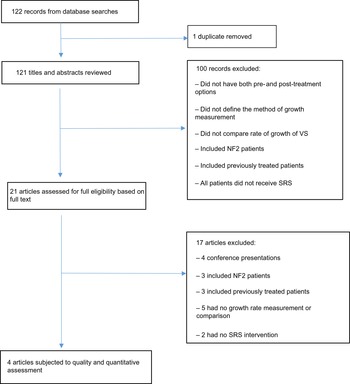
Following the initial screening, 121 articles were identified as being relevant to the study. On further review, 100 articles were excluded based on selection criteria set by the contributors. The full text of 21 articles was then reviewed to determine full eligibility; through this process, a further 17 articles were excluded. The final four papers were included in an extensive qualitative and quantitative analysis (Figure 1).
Preferred Reporting Items for Systematic Reviews and Meta-Analyses (‘PRISMA’) flowchart. VS = vestibular schwannoma; NF2 = neurofibromatosis type 2; SRS = stereotactic radiosurgery

Selection criteria
Inclusion and exclusion criteria were established to ensure a relatively homogeneous patient population was obtained. In order to be included in the final analysis, fulfilment of the selection criteria was necessary. The selected patient populations in the studies were required to include sporadic growing vestibular schwannomas treated with stereotactic radiosurgery only. The limit for date of publication was set at 20 years prior to 2019; this ensured that the relevant advancements in imaging modalities as well as radiotherapy techniques such as intensity-modulated radiation therapy were also considered in the review. Both English and German language publications were included. The references of the selected studies were also screened.
Studies in which stereotactic radiosurgery was utilised as a second-line treatment option to control tumour growth or those with neurofibromatosis type 2 patients were excluded. Case reports and conference abstracts were also excluded. The database search results were subsequently screened by two of the authors independently (LH and CY). In case of any discrepancies between the two authors, a decision was made following discussion with the senior author (GK) to obtain a consensus.
Risk of bias assessment
The ROBINS-I (‘Risk Of Bias In Non-randomised Studies - of Interventions’) tool was used in this systematic review, as the studies selected for the final analysis were non-randomised.Reference Sterne, Hernán, Reeves, Savović, Berkman and Viswanathan21 This tool allowed the evaluation of risk of bias in estimates of the effectiveness of an intervention from studies that did not utilise randomisation. This was performed independently by the fourth author (MAMS) and subsequently revalidated by the second and third authors (LH and CY). The Egger's test, funnel plot and meta-regression were explored if 10 or more studies were identified.Reference Harrer, Cuijpers, Furukawa and Ebert22
Outcomes definition
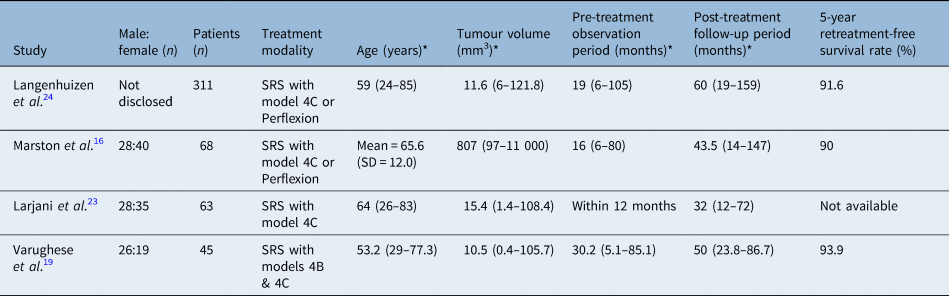
The outcome of success in this systematic review was defined as static or decreasing tumour size following treatment with stereotactic radiosurgery. Those with increasing size following treatment were labelled as treatment failure here. These outcomes were based on the outcome definitions from the respective selected studies in the analysis, whereby measurements were performed using MRI (Table 1).Reference Marston, Jacob, Carlson, Pollock, Driscoll and Link16,Reference Varughese, Wentzel-Larsen, Pedersen, Mahesparan and Lund-Johansen19,Reference Larjani, Monsalves, Pebdani, Krischek, Gentili and Cusimano23,Reference Langenhuizen, Zinger, Hanssens, Kunst, Mulder and Leenstra24
Characteristics of selected studies

CPA = cerebellopontine angle
Data extraction, synthesis and analysis
The data from the studies selected in the final analysis were reviewed and extracted by the second, third and fourth authors (LH, CY and MAMS) independently. Utilising this data, meta-analysis with the random-effects model for the proportion of successful events was performed to enable effect size estimation. This was then analysed using R programming language.Reference Balduzzi, Rücker and Schwarzer25 The proportion effect size estimator was utilised, as the selected studies consisted of case series and observational studies without comparative arms.Reference Murad, Sultan, Haffar and Bazerbachi26 Further sub-analysis based on the tumour growth rate was also explored if this information was available. The data were subsequently transformed using the Freeman–Tukey double arcsine in order to increase the estimation accuracy.Reference Murad, Sultan, Haffar and Bazerbachi26 A p-value of 0.05 or less was deemed to be statistically significant.
Results
Search strategy
A total of 122 studies was initially identified (Figure 1). Four studies were selected in the final analysis following extensive review (Table 1).Reference Marston, Jacob, Carlson, Pollock, Driscoll and Link16,Reference Varughese, Wentzel-Larsen, Pedersen, Mahesparan and Lund-Johansen19,Reference Larjani, Monsalves, Pebdani, Krischek, Gentili and Cusimano23,Reference Langenhuizen, Zinger, Hanssens, Kunst, Mulder and Leenstra24
Main findings
Across the four studies, a total of 487 patients were identified, with an overall female predominance. The five-year treatment-free survival rate ranged from 90 to 93.9 per cent (Table 2).Reference Marston, Jacob, Carlson, Pollock, Driscoll and Link16,Reference Varughese, Wentzel-Larsen, Pedersen, Mahesparan and Lund-Johansen19,Reference Larjani, Monsalves, Pebdani, Krischek, Gentili and Cusimano23,Reference Langenhuizen, Zinger, Hanssens, Kunst, Mulder and Leenstra24 Disparities amongst the analysed studies were apparent, such as the stereotactic radiosurgery failure definitions, the size of the treated tumours, and the pre- and post-treatment follow-up period, which all varied widely (Tables 1 and 2). Methods used to determine the post-treatment growth also differed, and only Larjani et al. carried out pre- and post-treatment imaging scans, which were blindly reviewed.Reference Larjani, Monsalves, Pebdani, Krischek, Gentili and Cusimano23
Basic demographics

* Data represent median (range) values, unless indicated otherwise. SRS = stereotactic radiosurgery; SD = standard deviation
Risk of bias
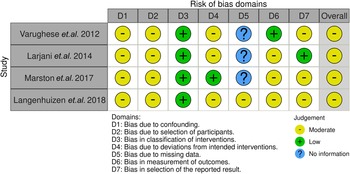
The studies selected in this review were shown to carry an overall moderate risk of bias (Figure 2). Bias due to confounding factors, participant selections and deviation from intended interventions domains were all judged as carrying moderate risk. However, all the studies included had a low risk of bias in the classification of interventions domain. Bias due to missing data could not be confirmed in three of the selected studies.Reference Marston, Jacob, Carlson, Pollock, Driscoll and Link16,Reference Varughese, Wentzel-Larsen, Pedersen, Mahesparan and Lund-Johansen19,Reference Larjani, Monsalves, Pebdani, Krischek, Gentili and Cusimano23
ROBINS-I (‘Risk Of Bias In Non-randomised Studies - of Interventions’) tool assessment.

Proportional success rate for static or decreasing tumour size
The studies in our analysis revealed high success rates of stereotactic radiosurgery in stabilising or decreasing the vestibular schwannoma tumour size in general.Reference Marston, Jacob, Carlson, Pollock, Driscoll and Link16,Reference Varughese, Wentzel-Larsen, Pedersen, Mahesparan and Lund-Johansen19,Reference Larjani, Monsalves, Pebdani, Krischek, Gentili and Cusimano23,Reference Langenhuizen, Zinger, Hanssens, Kunst, Mulder and Leenstra24 Subsequent meta-analysis (Figure 3) confirmed the treatment success rate at 91 per cent (95 per cent confidence interval (CI) = 0.83–0.97, p < 0.01, I 2 = 80 per cent). The data from Varughese et al.'s study demonstrated a substantial degree of heterogeneity, thus suggesting the study is an outlier in terms of the tabulated stereotactic radiosurgery treatment success rate (Figure 3).Reference Varughese, Wentzel-Larsen, Pedersen, Mahesparan and Lund-Johansen19 A second meta-analysis model (Figure 4) was therefore subsequently performed in which the Varughese et al. study was excluded.Reference Varughese, Wentzel-Larsen, Pedersen, Mahesparan and Lund-Johansen19 Here, a success rate of 88 per cent (95 per cent CI = 0.85–0.91, p = 0.47, I 2 = 0 per cent) was obtained, although this is not significant despite consistency in all other variables.
Meta-analysis of overall stereotactic radiosurgery treatment success rate. IV = inverse variance; CI = confidence interval

Meta-analysis of overall stereotactic radiosurgery treatment success rate following outlier removal. IV = inverse variance; CI = confidence interval

Impact of stereotactic radiosurgery on fast-growing tumours
Langenhuizen et al. classified 149 patients in the fast-growing vestibular schwannoma group; the treatment failed in 25 of these patients (16.8 per cent) (p = 0.004).Reference Langenhuizen, Zinger, Hanssens, Kunst, Mulder and Leenstra24 Marston et al. had 26 patients in the fast-growing category and 8 (30.8 per cent) of these had treatment failure (p = 0.007).Reference Marston, Jacob, Carlson, Pollock, Driscoll and Link16 The datasets in the remaining two papers were not suitable for pooling.Reference Varughese, Wentzel-Larsen, Pedersen, Mahesparan and Lund-Johansen19,Reference Larjani, Monsalves, Pebdani, Krischek, Gentili and Cusimano23 Explorative meta-analysis (Figure 5) showed a success rate of 79 per cent (95 per cent CI = 0.64–0.91, p = 0.11, I 2 = 62 per cent) in terms of stabilising or decreasing the size of fast-growing tumours with stereotactic radiosurgery, although this finding was not statistically significant (p > 0.05).Reference Varughese, Wentzel-Larsen, Pedersen, Mahesparan and Lund-Johansen19,Reference Larjani, Monsalves, Pebdani, Krischek, Gentili and Cusimano23
Meta-analysis of stereotactic radiosurgery treatment success rate in fast-growing vestibular schwannomas. IV = inverse variance; CI = confidence interval

Stereotactic radiosurgery: adverse radiation effects
In our analysis, only three of the four studies explored the adverse radiation effects associated with stereotactic radiosurgery.Reference Marston, Jacob, Carlson, Pollock, Driscoll and Link16,Reference Varughese, Wentzel-Larsen, Pedersen, Mahesparan and Lund-Johansen19,Reference Larjani, Monsalves, Pebdani, Krischek, Gentili and Cusimano23 On exploration of the adverse radiation effects related to stereotactic radiosurgery, Varughese et al. reported that 21 per cent of patients suffered a reduction in their hearing following treatment, 6 per cent had a degree of facial nerve dysfunction, and 4 per cent had post-stereotactic radiosurgery hydrocephalus requiring shunting.Reference Varughese, Wentzel-Larsen, Pedersen, Mahesparan and Lund-Johansen19 Meanwhile, Marston et al. had limited post-treatment audiological data, whereby only 11 out of 68 patients had complete data, with 7 of these patients having a significant reduction in their hearing post stereotactic radiosurgery.Reference Marston, Jacob, Carlson, Pollock, Driscoll and Link16 There were no reported trigeminal or facial nerve side effects, nor were there any highlighted incidents of post-treatment tinnitus or objective balance issues. These side effects were, however, noted by Larjani et al., where 27 per cent of patients reported imbalance, 12.7 per cent had tinnitus, 9.5 per cent had facial numbness, 4.8 per cent had facial nerve palsy and 1.6 per cent also had hydrocephalus post stereotactic radiosurgery.Reference Larjani, Monsalves, Pebdani, Krischek, Gentili and Cusimano23 Lastly, patient well-being post stereotactic radiosurgery, using established patient-reported outcome measures, was only explored by Varughese et al. using both the 36-item Short Form Survey (‘SF-36’) questionnaire and mental health scores, which portrayed significant improvement following stereotactic radiosurgery.Reference Varughese, Wentzel-Larsen, Pedersen, Mahesparan and Lund-Johansen19
Discussion
Main findings
This review aimed to determine whether the success of stereotactic radiosurgery for vestibular schwannomas is compromised in those showing a fast-growing tumour prior to treatment. The overall success rate of stereotactic radiosurgery was between 88 and 91 per cent (Figures 3 and 4), with a lower success rate, 79 per cent, in fast-growing vestibular schwannomas (Figure 5). Such results should be interpreted with caution, as they do not imply that fast-growing vestibular schwannomas do not respond to stereotactic radiosurgery, as the studies examined growth rates of vestibular schwannomas following stereotactic radiosurgery, and the results seen immediately post treatment may not be a unifying concept to be directly correlated with long-term outcomes. However, the ability of stereotactic radiosurgery to induce stabilisation or a reduction in tumour size appeared to be lower in the fast-growing vestibular schwannoma group. These results should therefore be taken into account when stereotactic radiosurgery is being considered as a management option in this sub-group. It is also vital to recognise that most tumours will show a degree of size increment in the first year following stereotactic radiosurgery, with further involution in the second year.Reference Ton, Sheldon, Tikka, Locke, Crowther and Kontorinis27
Langenhuizen et al. concluded that fast-growing tumours are less radiosensitive.Reference Langenhuizen, Zinger, Hanssens, Kunst, Mulder and Leenstra24 Their study postulates that this is secondary to a superior DNA repair system or potentially secondary to the indirect effects of radiotherapy, such as decreased tumour vascularity.Reference Langenhuizen, Zinger, Hanssens, Kunst, Mulder and Leenstra24 Stereotactic radiosurgery was, however, efficacious for slow-growing tumours. This resulted in the conclusion that treatment strategies in vestibular schwannomas should be determined by the rate of tumour growth.Reference Langenhuizen, Zinger, Hanssens, Kunst, Mulder and Leenstra24 A similar conclusion was reached by Marston et al., who concluded that pre-treatment tumour growth was a strong predictor of tumour control.Reference Marston, Jacob, Carlson, Pollock, Driscoll and Link16
On the contrary, Larjani et al. did not identify a significant difference between the outcomes of fast- and slow-growing tumours following stereotactic radiosurgery based on tumour volume.Reference Larjani, Monsalves, Pebdani, Krischek, Gentili and Cusimano23 This was also the outcome displayed in our meta-analysis (Figure 5). Larjani et al. argued that the reason for continued growth post treatment may be the variability in intrinsic molecular properties between tumours, thus resulting in varying degrees of radio-resistance.Reference Larjani, Monsalves, Pebdani, Krischek, Gentili and Cusimano23 Furthermore, Larjani et al. observed that fast-growing vestibular schwannomas experienced the greatest change in growth following stereotactic radiosurgery, with those that continued to grow at significant rates post treatment being associated with adverse radiation effects.Reference Larjani, Monsalves, Pebdani, Krischek, Gentili and Cusimano23 Conversely, Varughese et al. did observe a relationship between tumour size at treatment and the rates of successful control in terms of tumour size reduction or stabilisation following stereotactic radiosurgery.Reference Varughese, Wentzel-Larsen, Pedersen, Mahesparan and Lund-Johansen19
The studies by Larjani et al. and Varughese et al. did examine tumour growth as a covariate, but failed to show any statistical correlation between the pre-treatment growth rate and response to stereotactic radiosurgery.Reference Varughese, Wentzel-Larsen, Pedersen, Mahesparan and Lund-Johansen19,Reference Larjani, Monsalves, Pebdani, Krischek, Gentili and Cusimano23 However, as mentioned previously, Larjani et al. noted greater post-treatment changes in fast-growing tumours.Reference Larjani, Monsalves, Pebdani, Krischek, Gentili and Cusimano23 This relationship was also partly mirrored in the retrospective study by Killeen et al., where it was concluded that smaller pre-treatment tumour volume and greater linear tumour growth rates pre-treatment were associated with greater changes to tumour size post stereotactic radiosurgery.Reference Killeen, Tolisano, Isaacson, Kutz, Barnett and Wardak28 Overall, from the literature it can be concluded that faster-growing tumours are less radiosensitive.
Limitations
The principal challenge in assessing the literature was the methodological inconsistencies among the individual studies, which subsequently made the task of drawing comparisons and coming to conclusions based on their evidence somewhat challenging, particularly because of the variability in the definition of fast-growing vestibular schwannomas and treatment failure (Table 1). Only three of the studies explored the ‘retreatment-free survival rate’, all with different tumour volumes, with Marston et al. having the largest range (Table 2).Reference Marston, Jacob, Carlson, Pollock, Driscoll and Link16,Reference Varughese, Wentzel-Larsen, Pedersen, Mahesparan and Lund-Johansen19,Reference Langenhuizen, Zinger, Hanssens, Kunst, Mulder and Leenstra24
The studies in our analysis also lacked a comparative (control) arm, therefore it was not possible to perform a more rigorous effect size estimator such as an odds ratio.Reference Marston, Jacob, Carlson, Pollock, Driscoll and Link16,Reference Varughese, Wentzel-Larsen, Pedersen, Mahesparan and Lund-Johansen19,Reference Larjani, Monsalves, Pebdani, Krischek, Gentili and Cusimano23,Reference Langenhuizen, Zinger, Hanssens, Kunst, Mulder and Leenstra24,Reference Murad, Sultan, Haffar and Bazerbachi26 For maximum value to be achieved in any future research, there is a requirement for greater consistency in definitions and classifications, particularly in the method of assessing and describing tumour growth. Prospective studies with standardised methods of reporting growth rates and responses to treatment are required to better assess the exact success rates of stereotactic radiosurgery in the management of fast-growing vestibular schwannomas.
Additionally, the measurement methodology of vestibular schwannomas was not standardised across the studies, which may impact both the accuracy of individual measurements and the comparison between the studies (Table 1). A short follow-up period post treatment was identified as a limitation by two of the studies, which limits the clinical applicability of their results.Reference Marston, Jacob, Carlson, Pollock, Driscoll and Link16,Reference Varughese, Wentzel-Larsen, Pedersen, Mahesparan and Lund-Johansen19
Further limitations specific to individual studies include the retrospective nature of the study by Langenhuizen et al., alongside the variability in the imaging modalities being used.Reference Langenhuizen, Zinger, Hanssens, Kunst, Mulder and Leenstra24 A potential treatment selection bias was identified in Marston et al.Reference Marston, Jacob, Carlson, Pollock, Driscoll and Link16 Arbitrary cut-off points between the slow-, medium- and fast-growing categories by Larjani et al., without clear definitions of these parameters to enable external validation of their findings, was also an issue when attempting to draw conclusions.Reference Larjani, Monsalves, Pebdani, Krischek, Gentili and Cusimano23
Given the large variability in the methodology and definitions of the studies (Table 1), it was extremely difficult to combine the results in a meaningful way. None of the selected studies in our analysis had standardised the ‘success’ criteria definition, thus limiting the data pooling for the meta-analysis to a proportional method only. Post-treatment tumour size was not recorded by all the selected studies, which limits mean-difference analysis for effect size. As a result of the weaknesses highlighted, the limitation of our review arises from the lack of rigour between the selected studies.Reference Marston, Jacob, Carlson, Pollock, Driscoll and Link16,Reference Varughese, Wentzel-Larsen, Pedersen, Mahesparan and Lund-Johansen19,Reference Larjani, Monsalves, Pebdani, Krischek, Gentili and Cusimano23,Reference Langenhuizen, Zinger, Hanssens, Kunst, Mulder and Leenstra24 However, we utilised a blinded review strategy and independent data extraction to overcome this limitation. Here, the proportionate meta-analysis to determine the success rate as the effect size estimator with arcsine transformation enabled the best information pooling for translation. This was due to the differences in the study definitions as noted by the I 2 indexes and vestibular schwannoma rarity.Reference Murad, Sultan, Haffar and Bazerbachi26
Conclusion
Although the described morbidity of stereotactic radiosurgery when dealing with vestibular schwannomas is low, deciding whether or not it is the most appropriate treatment modality is paramount. Our results indicate that stereotactic radiosurgery as a treatment modality has statistically significant success rates at stabilising or decreasing the tumour burden of vestibular schwannomas (Figure 3, p < 0.01). This success rate, however, is diminished for fast-growing tumours, although this finding is not statistically significant (Figure 5, p = 0.11). The limitations of individual studies and a lack of standardised definitions between the studies are the main factors restricting the available evidence in drawing appropriate conclusions in the management of vestibular schwannomas.
At present, available evidence on the correlation between pre-treatment tumour size and the effectiveness of stereotactic radiosurgery is limited, heterogeneous, and at times conflicting. This highlights the uncertainty regarding the optimal management of vestibular schwannomas according to tumour growth rate. Further research is required to account for the limitations in the available literature and therefore allow for a meaningful conclusion to be drawn.
Supplementary material
The supplementary material for this article can be found at https://doi.org/10.1017/S0022215123000786
Acknowledgement
We would like to thank the library service at Greater Glasgow and Clyde NHS Trust for their help with the literature search.
Competing interests
None.