1. Introduction
Agricultural activities, like other economic activities, may create various environmental problems. However, the most important feature of the relationship between agriculture and the environment is that the two are directly linked to each other, which is not the case for most other economic sectors. Although technological improvements have eased this difficult relationship between agriculture and environmental conditions to a certain extent, close interactions can still be observed. For example, soil pollution in a region is likely to reduce crop yields in that region, while the pollution itself may be directly caused by agricultural production in previous periods. In addition, while the agricultural sector contributes to global greenhouse gas emissions at a considerable level, the negative impacts of global climate change on agricultural production is also a given.
The efforts to maintain food security and safety, together with the aim of reducing agriculture-based environmental problems, have led to the current focus on sustainable agricultural policies. Sustainable agricultureFootnote 1 can be defined by using the sustainable development definition in the Brundtland Report of the World Commission on Environment and Development (1987). Accordingly, an agricultural system that meets today’s needs without compromising the possibility of meeting future generations’ needs can be expressed as ‘sustainable agriculture’. However, there is a wide variety of interpretations of sustainable agriculture. As Hansen (Reference Hansen1996) quoted from the definition used by the American Society of Agronomy, ‘a sustainable agriculture is one that improves long-term environmental quality and the base of resources, meets the basic food and fiber needs of people, has economic applicability and enhances the life quality of farmers and community as a whole.’Footnote 2 According to Ikerd (Reference Ikerd1990, 18), farming systems that have the capacity of maintaining their productivity and utility indefinitely can be argued to be sustainable. Ikerd mentions, in addition, that these systems have to be resource-conserving, environmentally compatible, socially supportive, and commercially competitive. Moreover, UNEP (2011, 42) emphasizes that transition to green agriculture refers to the increasing use of agricultural practices and technologies that will maintain and positively affect farm productivity and profitability while securing the food supply and ecosystem services on a sustainable basis. This transition also involves gradually revealing positive externalities while reducing negative externalities, restoring ecological resources by using resources more efficiently, and reducing pollution. Within this context, this study aims to reveal the need for a sustainable agricultural policy scheme for Turkey that consists of policies that, on the one hand, provide for the long-term food security and safety of the country while facilitating the conservation of natural resources by increasing environmental quality, and, on the other hand, improve the standards of living of agricultural producers.
It can be argued that the agricultural sector is strategically important for Turkey, given the aims of ensuring food safety and the security of the population, raising the standards of living of the highly rural population compared with developed economies, and providing sufficient and high-quality inputs to industry. According to data of the Turkish Statistical Institute (TurkStat), the agricultural sector accounted for 6.1% of GDP in 2017, while 19.3% of total labour was employed in this sector. As of the same year, agriculture and agriculture-based industry accounted for 12.8% of total exports with a share in total imports of 6.9%. Turkey’s agriculture grew by 2.3% annually in the period between 2000 and 2017. Various studies revealed that the agricultural growth in this period was due to the increase in productivity and the intensification of agricultural production (Atiyas and Bakış Reference Atiyas and Bakış2013; Özden Reference Özden2014; Eruygur et al. Reference Eruygur, Kıymaz and Küçüker2016).
However, Turkey’s agriculture still faces some important structural problems, such as small farm size, high production costs, insufficient organization of farmers, low income and education levels of farmers, and, finally, insufficient use of capital and technology in production. This study claims that, in addition to these structural problems identified in the literature, the sustainability of agriculture is another serious issue for Turkey.
In this respect, the contributions of this study are twofold. First, the study evaluates the environmental impact of agriculture, and, second, it assesses the existing implementations of agri-environmental support policy instruments in Turkey in light of the above-mentioned challenges of sustainable agriculture.
The remainder of the study is organized as follows: the second section scrutinizes the environmental conditions of Turkish agriculture; the third section provides an evaluation of the existing agricultural supports with environmental purposes; and the fourth section discusses the favourable characteristics of green agricultural policies for Turkey in light of this study’s findings. Finally, the fifth section concludes.
2. Evaluation of Agricultural Production in Turkey from an Environmental Perspective
For the analysis of agricultural resource use in Turkey, it is necessary to begin with an evaluation of soil and water use. In 2017, total agricultural land area constituted 49.4% (almost 38 million ha, including meadows and pastures), while forest area accounted for 28.5% (22.3 million ha) of Turkey’s total land area. When meadows and pastures are excluded, the share of the agricultural area is 30.4% (almost 23.4 million ha) and 26% of this total is cultivated. Figure 1 demonstrates that both total agricultural land (excluding meadows and pastures) and cultivated land have decreased significantly compared with the year 2000. Calculations using FAO (2019a) data show that in the period 2000–2017, total agricultural land (sum of arable land and land under permanent crops) in OECD countries and in the EU decreased by 7.0% and 8.9%, respectively, while it increased by 4.1% in the world. In the same period, however, Turkey’s total agricultural land decreased by 10.1%.

Agricultural lands in Turkey have been facing serious problems, such as salinity, erosion, and desertification, due to human intervention as well as natural factors (MoD 2014a, 13). Erosion is one of the main land problems in Turkey, and active erosion occurs in 59% of the country’s cultivated agricultural areas and 64% of its pasture areas. In general, in Turkey, 17.4 million ha of land suffer from very severe erosion while 28.3 million ha and 15.6 million ha are subject to severe and medium severe erosion, respectively. In contrast, only 12.3% of arable land in the EU (13.8 million ha) is estimated to suffer from moderate to high erosion (MoD 2014a, 14; Eurostat 2019a). In Turkey, the reasons for erosion can be listed as follows:
-
Ignoring land capability classification in land use,
-
Cultivation in marginal areas with steep slopes,
-
Improper methods used in soil processing,
-
Insufficient measures to protect soil and water in cultivation areas,
-
Improper use of pastures such as early and over-grazing (MoFWA 2013, 14–15).
Desertification is considered to be a serious threat in countries with arid-semi-humid climates such as Turkey. According to the Desertification Risk Map of Turkey,Footnote 3 approximately half of the country’s land area is subject to a high risk of desertification. This study identifies Konya-Karapınar, Iğdır-Aralık and Urfa-Ceylanpınar as very high-risk regions. The Salt Lake Basin, Ereğli-Karaman Region, Urfa-Ceylanpınar-Mardin-Batman Line and Eskişehir district form the middle- and high-risk groups (Görücü et al. Reference Görücü, Akça and Apaydın2017, 63).
Soil salinity is another problem that Turkey faces. Owing to excessive irrigation, increased salt content of soil leads to water insufficiency for plants, resulting in plant death stemming from physiological drought (Kük and Burgess Reference Kük and Burgess2010; Yiğitbaşoğlu Reference Yiğitbaşoğlu2000). The Harran Plain is one of the areas that have been severely affected by salinization. In this region, soil salinity has increased dramatically due to excessive water use and lack of advanced drainage systems in the region (Kendirli et al. Reference Kendirli, Çakmak and Uçar2005).
Turkey is classified among the countries facing future problems of high water risk (Aküzüm et al. Reference Aküzüm, Çakmak and Gökalp2010; OECD 2017). Water pollution has also emerged as a problem in some regions despite low intensity of input use. Recent data on water quality show that 20–50% of surface water observation areas are polluted or exposed to high nitrogen pollution (OECD 2016, 53). According to the OECD (2012, 47), in Turkey, water quality in most agricultural catchments is lower and there are local incidents of groundwater pollution caused by chemical fertilizers and pesticides.
According to the State Hydraulic Works (DSİ 2017, 41, 196), Turkey has 8.5 million ha of economically irrigable land and 6.21 million ha of this area was open for irrigation as of the end of 2017.Footnote 4 However, it is expected that an additional 2 million ha of land will be irrigated by 2023. Although water use is of great importance for increasing agricultural productivity, excessive water use can be considered as a serious problem in terms of agricultural and environmental sustainability.
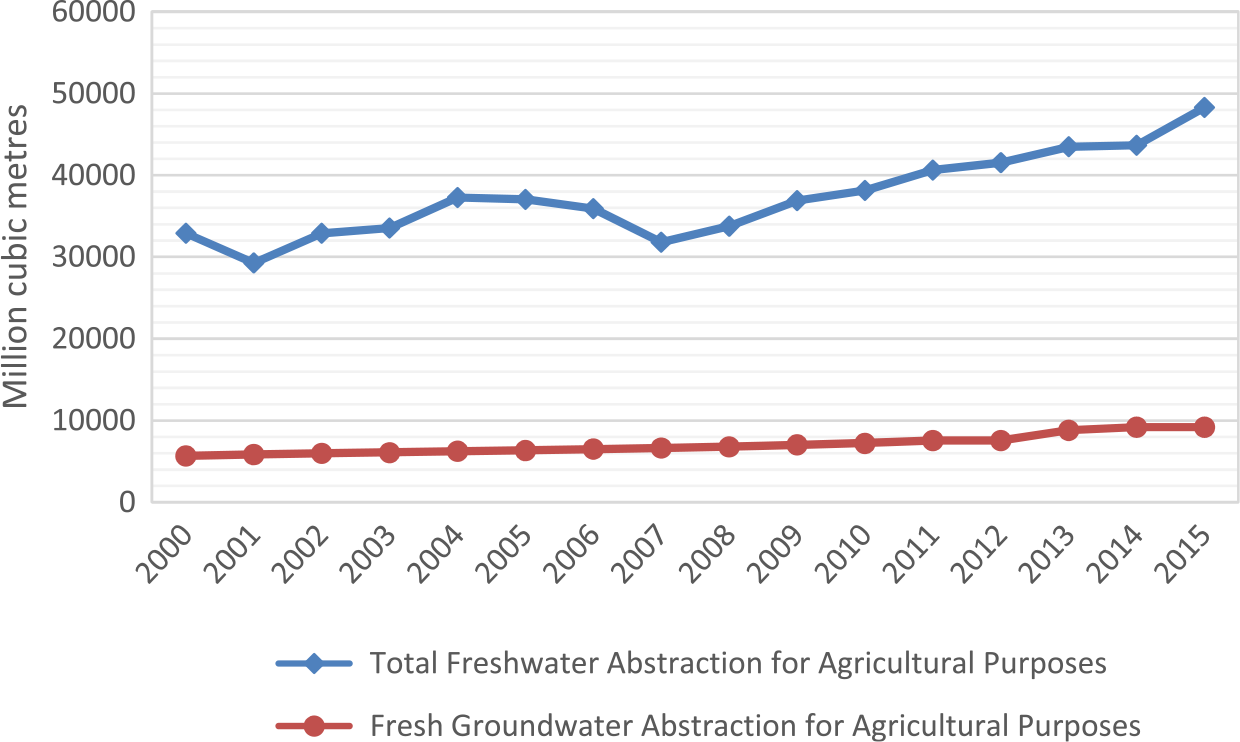
Figure 2 illustrates the agricultural water use trends in Turkey. According to the latest OECD data, approximately 84% of total water use in Turkey was carried out by the agricultural sector in 2014. Following an increasing trend since 2000, this rate was over 80% during the 2000s. On the other hand, our calculations for the year 2014 based on Eurostat (2019b) and OECD (2019a) data show that agricultural water use accounts for 31% and 59% of total freshwater abstraction in the EU and the OECD, respectively. Globally, agriculture accounts for 70% of total freshwater abstraction (FAO 2017, 2).

Surface irrigation methods are in widespread use at a very high rate of 70% and can be considered as the main cause of excessive water use in Turkish agriculture. As for the remaining 30%, pressurized irrigation systems are used (DSİ 2017, 183). Another unfavourable practice of water use in Turkey’s agriculture is the usage of individual wells that result in excessive irrigation. OECD data show that in the period between 2000 and 2014, total groundwater abstraction increased by 41%, while groundwater abstraction for agricultural purposes increased by 62%. The same statistics demonstrate that almost 63% of total groundwater abstraction was used in agriculture in 2014. For the same year, however, the proportion of agricultural groundwater abstraction to the total was 41% in the EU and 55% in the OECD (Eurostat 2019b; OECD 2019a). As a result of this practice, groundwater levels decreased over time in Turkey. Consequently, the wetlands that are fed with groundwater dry up, and the rich ecosystems of these areas are left seriously damaged (Yiğitbaşoğlu Reference Yiğitbaşoğlu2000).
In order to obtain a clearer picture of the environmental sustainability of agriculture in Turkey, one needs to combine the above-mentioned resource use trends with input use trends. Table 1 shows Turkey’s fertilizer and pesticide uses since 2000. In the period of 2000–2017, an increase in fertilizer use was experienced despite a decline in agricultural area of about 3 million ha. This led to an increase in fertilizer use per hectare from 79.2 kg to 113.1 kg. Pesticide use per hectare in the same period increased from 1.76 kg to 2.31 kg.

According to our calculations based on FAO (2019b) data, in the period of 2000–2017, the average rate of change of fertilizer use for the OECD, the EU, and the world was +2.6%, –9.1%, and +42.5%, respectively. The same period witnessed a 26.6% increase in fertilizer use in Turkey. When evaluated on a per hectare basis, fertilizer use decreased in the EU by 0.3% (from 146.21 kg/ha to 145.72 kg/ha), while it increased in OECD countries and in the world by 9.6% (from 117.56 kg/ha to 128.88 kg/ha) and 36.4% (from 90.40 kg/ha to 123.33 kg/ha), respectively. In the same period, the rate of increase was 42.8% in Turkey (from 79.18 kg/ha to 113.08 kg/ha).
In the case of pesticide use, we see a similar picture. Our calculations using FAO (2019c) data reveal that pesticide use increased by 4% in the OECD and 34.3% in the world while it decreased in the EU by 3.8% on average in the period of 2000–2017. However, in the same period, it rose by 16.5% in Turkey. While pesticide use per hectare increased by 11.2% in OECD countries (from 2.53 kg/ha to 2.81 kg/ha), 5.6% in the EU (from 2.92 kg/ha to 3.09 kg/ha), and 28.6% in the world (from 2.05 kg/ha to 2.64 kg/ha), the rate of increase was 31.4% in Turkey during the same period.
Another group of data shown in Table 1 presents plant-nutrient balances. The plant-nutrient balance gives information about the pressure of agriculture on the environment, and a nutrient deficit (i.e. a negative value) indicates a decrease in soil fertility while a nutrient surplus indicates soil, water, and air pollution risk (OECD 2019b). Nitrogen and phosphorous fertilizers are widely used in Turkish agriculture. The values shown in the table indicate that there is a significant plant-nutrient surplus in the soils of Turkey. This situation may cause a serious environmental pollution risk, as well as being a source of potential economic inefficiency. Yiğitbaşoğlu (Reference Yiğitbaşoğlu2000) draws attention to the negative impacts of excessive use of fertilizers, such as a change in the pH level of the soil, which consequently damages the soil fauna. Thus, the excessive use of nitrogen and phosphorous fertilizers in Turkey increases the risk of loss of biodiversity (Evrendilek and Ertekin Reference Evrendilek and Ertekin2002). Due to data availability issues, a comparison with the OECD and the EU is possible only for the period of 2004–2015. An examination of the nutrient balances reveals that, during this period, nitrogen nutrient surpluses dropped by 7%, 7.5% and 10.3% in the OECD, the EU and Turkey, respectively. Turkey seems to have performed better than the OECD and the EU in this period in terms of total nitrogen surpluses. However, an examination of Turkey’s figures for 2000–2017 suggests that the drop in 2015 was not permanent, contrary to the OECD and the EU. The same tendency is seen for nitrogen nutrient balances per hectare, as well. On the other hand, when we review the phosphorus nutrient balance for the period of 2004–2015, the situation differs. In this case, Turkey’s rate of decrease (3.9%) seems to be considerably lower than that of the OECD (23.5%) and the EU (67.9%). Additionally, phosphorus nutrient surplus per hectare increased by 2.8% in Turkey, whereas it dropped by 19.5% in the OECD and 66.7% in the EU.
Intensive use of chemicals and pesticides in Turkey has been carried out mostly in the Mediterranean, Marmara and Aegean regions, and plant nutrients are concentrated the most in these regions. However, it should be noted that the use of chemical inputs in Turkey differs significantly among regions (Dağhan and Öztürk Reference Dağhan, Öztürk, Hakeem, Sabir, Öztürk and Mermut2015, 295; Lundell et al. Reference Lundell, Lampietti, Pertev, Pohlmeier, Akder, Ocek and Shreyasi2004, 17, 20; Redman and Hemmami Reference Redman and Hemmami2008: 25). Although there are no concrete data on which regions or basins have concentrated soil and water pollution due to fertilizer and pesticide use, some inferences can be made based on the assumption that input use will increase environmental pollution in the groups of products whose production increases continuously. According to the Report of Environment Problems and Priorities 2019 (with 2017 data), while excessive use of fertilizers is the most important factor for soil pollution in Amasya, Bolu, Çankırı, Eskişehir, Kırşehir, Osmaniye and Hatay provinces, excessive use of pesticides is the main polluting factor in Denizli, Isparta, Karaman, Malatya, Muğla and Kahramanmaraş.Footnote 5 In the case of water pollution, surface and ground water pollution caused by the excessive use of fertilizers and pesticides is of primary concern. According to the report, water pollution in the Meriç–Ergene–Marmara, Susurluk–Gediz, Kızılırmak–Yeşilırmak, Eastern Black Sea–Çoruh and Tigris–Euphrates basins has been found to be of primary importance as an environmental problem. The common characteristic of all these basins is that the excessive use of fertilizers and pesticides is the main source of ground water pollution, while it is the secondary source of surface water pollution.Footnote 6 Animal husbandry was also cited in the report as another important factor creating water pollution (MoEU 2019).
Considering the linkage between agricultural input use, agricultural production, and environmental pollution, one can make some comments regarding the geographical distribution of pollution types and corresponding product groups. There are three agricultural product groups for which total production levels have been increasing continuously over the last decade, implying that input use in their production is not likely to fall and consequently is likely to cause pollution. These are oilseeds, vegetables and fruits, and organic products. As the share of organic products in total agricultural production is very low and the level of environmentally harmful input use is negligible, our focus here will be on the other two groups.
The production of oilseeds (except cotton) is mainly carried out in the Trakya/Marmara region, followed by the Mediterranean and Central Anatolia regions. Therefore, negative environmental effects of fertilizer use are expected to be more intense in these areas. Fruit production in Turkey is performed in all regions; however, production is most concentrated along the Mediterranean coastline, Menteşe coastline, Aegean coastline, Inner Aegean region, Marmara region, Kocaeli, Sinop, Giresun-Ordu, Upper Euphrates and Gaziantep-Şanlıurfa. More than 60% of the production of vegetables under cover, which has shown great improvement in recent periods, is carried out in the Mediterranean region (especially in Antalya, Mersin and Adana provinces). According to MoEU (2018) data, as of 2017, the use of pesticides is concentrated especially in the Marmara, Aegean and Mediterranean regions. The provinces with the most pesticide use are listed as Antalya, Manisa, Adana, Mersin and Aydın. Among these provinces, Mersin, Manisa, Antalya and Adana were ranked as the top four in fruit production in 2017, while Aydın was ranked sixth. In vegetable production, Antalya, Mersin, and Adana are ranked as the top three, Manisa is ranked seventh, and Aydın is ranked 22nd (TurkStat 2019). Considering these facts, the geographical distribution of soil and water pollution caused by the use of fertilizers and pesticides seems to be mostly in line with the production of these two product groups.
Another aspect of pollution caused by excessive use of fertilizers is the presence of heavy metals in the content of these fertilizers. Heavy metals such as cadmium, arsenic, lead, chromium, and copper pollute soil and water resources in this way. In addition to the use of fertilizers and pesticides, the use of surface waters polluted by sectors such as industry and mining are also considered as reasons for serious soil pollution (Dağhan and Öztürk Reference Dağhan, Öztürk, Hakeem, Sabir, Öztürk and Mermut2015).
Activities in the agricultural sector also lead to significant greenhouse gas (GHG) emissions aside from problems related to soil and water resources. Calculations using UNFCCC (2020) data show that 12% of total GHG emissions were caused by agricultural activities in 2017 in Turkey, whereas the same figures for the OECD and the EU are 9% and 10%, respectively. The primary GHGs emitted by the agricultural sector are methane and nitrous oxide. Therefore, we focus on emissions of these two gases in the comparisons below.
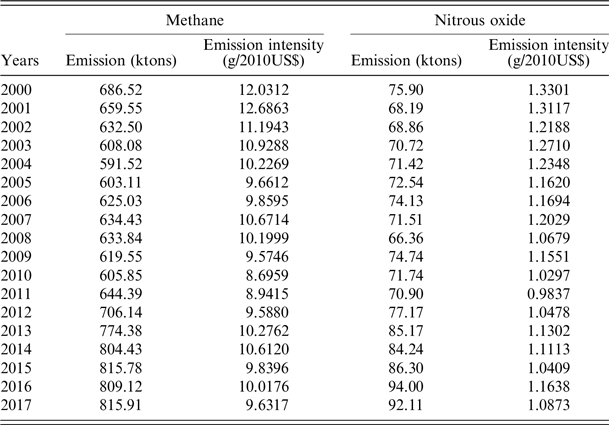
FAO (2019d) data show that during the period of 2000–2017 agricultural emissions of methane increased by 18.8% in Turkey and 12% in the world. However, the OECD and the EU decreased their agricultural methane emissions by 7.4% and 10.4%, respectively. Turkey increased agricultural nitrous oxide emissions by 21.4% while the rate of increase for this GHG was 22.1% in the world. Similar to the case of methane, the OECD and the EU decreased agricultural nitrous oxide emissions by 3.7% and 1%, respectively. For the same period, we also calculated emission intensities of these gases for Turkey, the EU, the OECD and the world using agricultural value added (in 2010 US$) based on data from the FAO (2019e). Table 2 presents Turkey’s emissions and emission intensities of methane and nitrous oxide for the period of 2000–2017. In this period, methane and nitrous oxide emission intensities in Turkey dropped by 19.9% and 18.3%, respectively.Footnote 7 The same period also witnessed decreases in emission intensities in the world, the OECD and the EU. While methane emission intensity decreased by 29.5% (from 65.59 g/2010US$ to 46.27 g/2010US$) in the world, the rate of decrease was 20% (from 48.24 g/2010US$ to 38.61 g/2010US$) and 16.5% (from 45.11 g/2010US$ to 37.67 g/2010US$) in the OECD and the EU, respectively. In the same period, nitrous oxide emission intensity reached a decrease rate of 23.1% (from 3.31 g/2010US$ to 2.55 g/2010US$) in the world. For the OECD and the EU, decreases in nitrous oxide emission intensities were 14.5% (from 3.15 g/2010US$ to 2.70 g/2010US$) and 10.3% (from 2.85 g/2010US$ to 2.56 g/2010US$), respectively.
Agricultural GHG emissions and emission intensities in Turkey.

Source: FAO (2019d) and authors’ calculations.
The figures above suggest that, in contrast to the OECD and the EU, Turkey’s agricultural GHG emissions are increasing even more rapidly than those of the world. However, we have to point out that Turkey’s agricultural emission intensities for these GHGs have been considerably lower. We also want to highlight that there are different reasons for the decrease in the emission intensities. In the 2000–2017 period, the agricultural value added increased significantly in Turkey (48.5%) and in the world (58.8%). This was the main reason underlying the decrease in agricultural emission intensities. On the other hand, in the OECD and the EU, decreases in emission intensities were caused by decreasing agricultural GHG emissions.
The investigation in this section reveals that agricultural production exhibits a significant environmental sustainability problem. Although the environmental pressure originating from agriculture in Turkey is lower than it is in the OECD and the EU due to low input use per hectare, the intensity of input use is increasing and the existence of inefficient input use patterns is mentioned for the country (OECD 2016, 55). We have shown that for almost all of the pressure indicators above, Turkey has been converging to the levels of the OECD and the EU. If we consider the regional disparities in input use, some regions in Turkey, such as the Marmara, Aegean and Mediterranean, are even likely to have environmental pressure at levels similar to the OECD and the EU. The main reason for this convergence may be that while members of these organizations have taken considerable measures and made efforts towards improving their agri-environmental performance, Turkey has fallen behind in these efforts, focusing only on increases in agricultural production. Considering that the agricultural productivity increases experienced since 2000 can be attributed to excessive input use, today Turkey is faced with serious deterioration, especially in soil and water pollution indicators. In spite of having some advantages in the case of GHG emission intensities, Turkey has been increasing its agricultural emissions more rapidly than the world, the OECD, and the EU. In the end, wrong irrigation and land use practices along with pollution of the soil and water resources suggest that crop yield losses are likely to emerge in the future.
3. Evaluation of Environment-based Agricultural Supports in Turkey
The status of environmental sustainability in Turkish agriculture, which has been presented in Section 2, requires a swift design of a green agricultural policy framework in accordance with the country’s conditions. Although the pressure of agriculture on the environment in Turkey is lower than it is in developed countries, it tends to increase over time. For this reason, the development of environment-friendly agricultural policies for Turkey is of great importance for both maintaining agricultural production increases in the long run and overcoming the existing environmental problems as well as preventing potential new ones.
In Turkey, regulations regarding agri-environmental support instruments were largely constructed in the mid-2000s. Agricultural subsidies for environmental purposes provided within the scope of existing agricultural policies comprise Good Agricultural Practices Support, Organic Agriculture Support, Environmentally Based Agricultural Land Protection Programme Support, Soil Analysis Support, and Biological and Biotechnological Control Support. In this section, developments in these supports during their application periods are evaluated.
3.1. Good Agricultural Practices Support (GAPS)
The first legal arrangement for good agricultural practices (GAP) in Turkey was the ‘Regulation on Good Agricultural Practices’, which was issued in 2004. After two changes, this first regulation was abolished in 2010 and replaced with the new ‘Regulation on Good Agricultural Practices’. This new regulation has also experienced two changes to date. According to the definitions in these regulations, the aim of GAP is to facilitate an agricultural production system that is ‘socially liveable, economically profitable and productive, that protects human health, and cares about animal health and welfare together with the environment’. Therefore, GAP can be considered as practices that prioritize the provision of the environmental, economic, and social sustainability of an agricultural system.
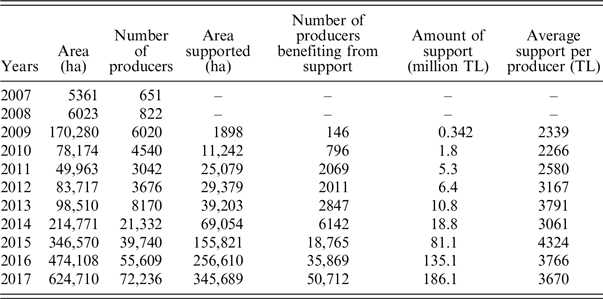
In Turkey, production within the scope of GAP started in 2007 on a voluntary basis, and as of 2008, field-based support payments have been made to producers (Toprak Reference Toprak2015, 57–59). A support amount of 20 TL/da was determined in 2009 for GAPS and a total of 342,000 TL was paid to 146 producers, as can be seen from Table 3. In 2015, ornamental and medicinal aromatic plants were included in GAPS payments. In this context, a total of 81.1 million TL was paid to 18,765 producers with unit amounts of support of 50 TL/da for fruits and vegetables, 100 TL/da for ornamental and medicinal aromatic plants, and 150 TL/da for greenhouse cultivation. For the years 2016 and 2017, the unit amounts of support remained the same for all three groups. In 2016, 135.1 million TL was paid to 35,689 producers, while in 2017 the total support amount paid to 50,712 producers was 186.1 million TL. The supported area was only 1.1% of the total GAP area with 1898 ha in 2009 and it increased up to 345,689 ha in 2017, representing 55% of the total area in that year. Average support per producer increased to 3760 TL in 2017 from 2339 TL in 2009, corresponding to an increase of approximately 57%. However, in real terms, the change in average support per producer was –17.4%.

3.2. Organic Agriculture Support (OAS)
In Turkey, organic agricultural production started with dried fruits in order to meet export demand in the 1980s and the first legal arrangement on this issue was introduced by a regulation in 1994. This regulation was abolished with a new regulation in 2002 and the Organic Agriculture Law was enacted in 2004 in order to strengthen the legal framework. Two more additional regulations were issued in 2005 and 2010, which abolished the previous ones, and to date the last regulation has been the subject of six changes.
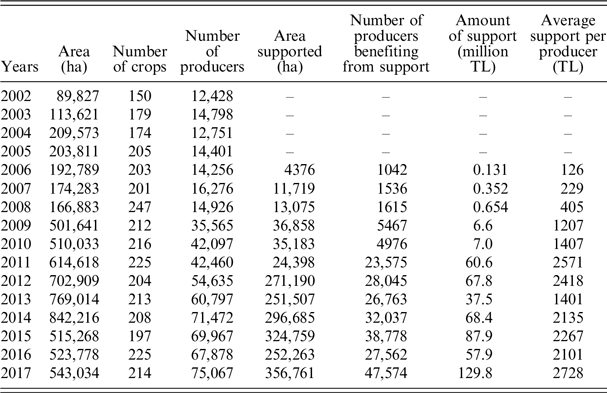
Table 4 summarizes some developments in organic agriculture in Turkey since 2002. According to the table, the production area increased to 543,034 ha from 89,827 ha and the number of producers increased to 75,067 from 12,428 in the 2002–2017 period. Area-based support payments for organic agriculture started at 3 TL/da in 2005 and the unit amount of payment reached 18 TL/da in 2008. The area supported constituted 2.1% of the total organic agriculture with only 4376 ha in 2005; it increased to almost 357,000 ha and reached 65.7% of the total organic production area in 2017. In the same period, the number of producers benefiting from the support increased from 1042 to 47,574 while the total amount of support increased from 131,000 TL to 129.8 million TL. In 2011, the support amount reached 25 TL/da, and in the following year, the support payments were made in two categories. The unit amounts of support for these categories were 10 TL/da for field crops and 35 TL/da for fruit and vegetables in 2012. Between 2013 and 2015, unit amounts of supports were 10 TL/da for field crops and 70 TL/da for fruit and vegetables. Since 2016, OAS payments have been made in four categories and unit amounts of payment were determined as 10 TL/da, 30 TL/da, 70 TL/da, and 100 TL/da (MoFAL 2014; 2015; 2016a; 2018).
Indicators related to organic agriculture and OAS (including transition process).

Source: MoAF (2018).
Average support per producer increased due to the increasing trend in unit support during the 2006–2017 period and reached 2728 TL in 2017 with more than a twentyfold increase, suggesting a 793% rise in real terms. In light of these explanations, the increase in the unit amount of OAS can be considered as the main reason for the rapid increase in organic production area and the number of producers since 2008.
3.3. Environmentally-based Agricultural Land Protection (EBALP) Programme Support
The EBALP Programme is among the support practices adopted to reduce the environmental impact of agriculture in Turkey. The aim of the EBALP Programme is to protect soil and water quality, maintain the sustainability of natural resources, prevent erosion and protect environmentally sensitive areas to reduce the negative effects of agriculture. The programme was introduced as a sub-component of the Turkish Agriculture Reform Implementation Project (ARIP) financed by the World Bank in 2005 and it was implemented in four pilot provinces between 2006 and 2008. Following this pilot implementation, the EBALP Programme has been financed by internal sources since 2009 (Hasdemir and Hasdemir Reference Hasdemir and Hasdemir2016). Although the first regulation on the EBALP Program was issued in 2005, it was abolished in 2011. Since then, the legal arrangements related to the EBALP Program have been made by cabinet decrees.
In the areas to be supported within the scope of the EBALP Programme, payments are made according to the following three different categories for three years:
-
First category (30 TL/da)Footnote 8 : Minimum-tillage agricultural practices.
-
Second category (60 TL/da): Protection of soil and water structure, and erosion prevention practices.
-
Third Category (135 TL/da): Eco-friendly agricultural techniques and cultural practices (MoFAL 2016b).
Hence, producers who benefit from the GAPS and the OAS can also benefit from the EBALP Programme support within the third category.
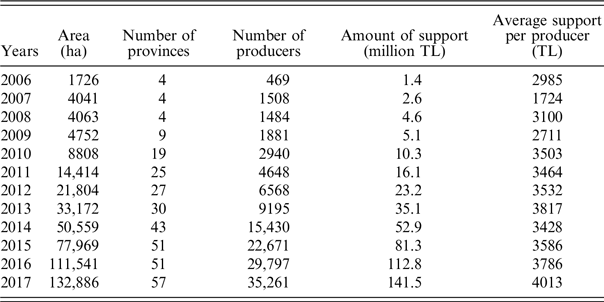
Table 5 shows that the application area increased from 1726 hectares to 4063 hectares in the period of 2006–2008, while the number of supported producers increased from 469 to 1484 and the amount of support increased from 1.4 million TL to 4.6 million TL. Following the completion of the pilot application, the EBALP Programme expanded after 2009. The programme was carried out in nine provinces in 2009 and in 57 provinces in 2017. In parallel, the area included in the programme and the number of producers benefiting from the support have also increased rapidly. While the amount of support paid to producers participating in the programme was 5.1 million TL in 2009, it reached 141.4 million TL in 2017. On the other hand, it should be noted that although average support per producer increased from 2985 TL to 4013 TL between 2006 and 2017, it decreased by 44.5% in real terms.

3.4. Soil Analysis Support (SAS)
Another green agricultural support in Turkey is the SAS. SAS payments were made in the form of additional direct income support of 1 TL/da between 2005 and 2008. It has been paid as a separate form of support since 2009. In formulating SAS, policymakers considered it as a measure to prevent unaware and unnecessary use of fertilizers, and for this reason it was designed and implemented as a precondition for benefiting from fertilizer support. Application of this procedure requires compulsory soil analysis for farms of 50 da or more in size, and for each additional 50 da, an additional analysis is a precondition to benefit from the fertilizer support.
Within the scope of this application, SAS payments were made with a unit amount of support of 2.5 TL/da between 2010 and 2016. However, due to problems such as abusive behavioursFootnote 9 in this period, SAS was abolished in 2016 and no payment was made in 2017 regarding the 2016 production period. This support was then put into effect again with some changes in implementation beginning from the 2017 production period and the amount of support was determined as 40 TL/da. In the new SAS application, payments were decided to be made to the laboratories conducting the analysis instead of to farmers.
As can be seen from Table 6, the number of producers benefiting from support increased from 194,978 to almost 244,000 in the 2010–2016 period and the amount of support increased from 68.5 million TL to 93.8 million TL. In the same period, the average support per producer increased from 351.3 TL to 385 TL, suggesting a decrease of 30.3% in real terms.

3.5. Biological and Biotechnological Control Support (BBCS)
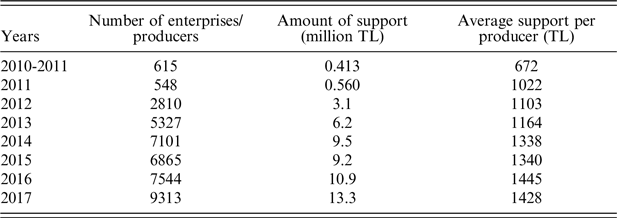
The last environmental support instrument discussed in this section is BBCS. The aim of this support instrument for the dissemination of biological and biotechnological methods is reducing the negative effects of chemical control methods on human and environmental health. BBCS was adopted in a later period than the other support instruments analysed in this section and was introduced by a cabinet decree in 2010 for the first time. Initially, BBCS was paid only to greenhouse producers for the 2010 and 2011 production periods. In 2011, open field production of tomatoes and citrus fruits was also included in BBCS. In the scope of the BBCS application, unit amounts of support varying between 30 TL/da and 200 TL/da (a package total of 200 TL/da) were determined with respect to the control method used (pheromones, beneficial insects, etc.) in greenhouse production in 2010–2011. With the introduction of open field supports in 2011, use of biological and biotechnological control in tomato and citrus fruit production was supported with a unit amount of 20 TL/da. In 2012, open field production of apples and grapes was also included in the BBCS coverage and the unit amounts of support increased to 430 TL/da in greenhouses and to 60 TL/da in open fields. In the following period, amounts of unit support increased together with the coverage, and by 2018, the greenhouse and open field package payments increased to 520 TL/da and 100 TL/da, respectively (MoFAL 2018).
According to Table 7, the number of producers benefiting from BBCS reached 9313 and the total amount of support increased to 13.3 million TL in 2017. In the period of 2011–2017, the average support per producer increased by 39.7%. However, there was a real decrease of 15% in the average support for the same period.

4. Discussion
Considering the developments in environmental-based agricultural support instruments explained in the previous section, it can be claimed that a very small portion of Turkey’s agricultural land is subject to green environmental practices. For example, the areas subject to good agricultural practices and organic agriculture in 2017 constituted 3.1% and 2.7% of total cultivated agricultural areas, respectively. In terms of supported area, these rates are even smaller. Similarly, areas subject to the EBALP and SAS hardly reached 0.7% and 1.9% of total cultivated agricultural areas, respectively, in 2017. In addition, as presented in Table 8, the environmental-based supports have a very small share in total agricultural support, although they have tended to increase over the years. However, as the environmental conditions of agriculture in Turkey reveal, Turkey needs a green transformation in agriculture given risk factors such as climate change, water scarcity, and water and soil pollution.

Although positive steps have been taken since the mid-2000s, the effects of those measures and policies have been limited, and the green transition process seems to be slow. Since Turkey is a latecomer in the area of agri-environmental policies, the legal framework concerning this area has been subject to frequent changes. Creating uncertainty and confusion for producers, the lack of a stable regulatory framework may have hindered the transition towards green agriculture and can be considered as one of the reasons for this slow progress. Therefore, continuous implementation of a carefully designed and coherent policy package will open a window of opportunity for producers to adapt to the green transition.
Another reason is the lack of information and guidance that would enable producers to adopt environment-friendly agricultural practices as pinpointed in various studies in the relevant literature (Aydın et al. Reference Aydın, Özkan, Aktürk, Kiracı and Hurma2015; Demiryürek et al. Reference Demiryürek, Stopes and Güzel2008; Hasdemir and Hasdemir Reference Hasdemir and Hasdemir2016; Polat and Dellal Reference Polat and Dellal2016a; Polat and Dellal Reference Polat and Dellal2016b; Özbilge Reference Özbilge2007; Özerol and Bressers Reference Özerol and Bressers2017). In this regard, providing widespread training and agricultural extension activities will increase the environmental awareness of producers and encourage them to adopt environment-friendly agricultural practices.
Green transition in agriculture is a costly process for agricultural producers as much as it is necessary for Turkey. Some recent papers, such as those by Ataseven and Sumelius (Reference Ataseven and Sumelius2014), Aydın et al. (Reference Aydın, Özkan, Aktürk, Kiracı and Hurma2015), and Polat and Dellal (Reference Polat and Dellal2016b), underline the importance of the amount of support for the adoption of green agricultural practices. Considering the costs of the green transition and the existing high agricultural production costs in Turkey together, it can be stated that increasing environment-based agricultural supports is a necessity to speed up the transition process. This can also be regarded as a step towards improving the standards of living of producers, which is among the objectives of sustainable agricultural policies. As presented in the previous section, for all support payments except the OAS, average support per producer decreased in real terms in the periods considered. Hence, it can be assumed that these support payments did not contribute much to raising the standards of living of farmers. The small scale of farms and the low income levels of family enterprises in Turkey highlight the importance of this issue once again.
In addition, due to the weakness or lack of farmers’ organizations in Turkey, producers do not have enough power in the market and they have to supply their products at low prices. Therefore, strengthening farmers’ cooperatives and encouraging the organization of farmers can stimulate a green transition by providing diffusion of knowledge and experience regarding green agricultural practices among farmers. Moreover, farmers’ organizations may serve as a means of facilitating the transition process by increasing the capacity of farmers to adapt to changes. Furthermore, the establishment of organized structures such as green agricultural cooperatives can facilitate the adoption of technologies (renewable energy use, rain water collection systems, water-saving irrigation systems, etc.) that will increase resource use efficiency. Studies on different countries have shown that cooperatives provide their members with higher and more secure incomes, and lower input prices (Wanyama Reference Wanyama2014, 42–43). In addition, cooperatives can guide small agricultural enterprises towards organic/environment-friendly production,Footnote 10 facilitate the marketing of their products, and contribute to environmental and social sustainability in this way (Burjorjee et al. Reference Burjorjee, Nelis and Roth2017; Song et al. Reference Song, Qi, Zhang and Vernooy2014). Therefore, green agricultural cooperatives can play a significant role in creating a sustainable agricultural model in agricultural systems where small-scale farmers suffer from low income levels and high production costs, such as in Turkey.
5. Conclusion
Developed countries faced the negative effects of intensive agricultural production on the environment in an earlier period. Environmental problems and particularly agriculture-based environmental degradation have led to the formulation of sustainable agricultural policies in these countries. Following developed countries, policy discussions towards greener agriculture has been a hot topic in the world since 2000. Along with these developments, Turkey has made legal arrangements for some environment-friendly agricultural methods and introduced various agricultural support instruments for environmental purposes in the post-2000 period.
This study began by evaluating the sustainability of Turkish agriculture depending on several environmental indicators and the findings demonstrate that there are significant environmental problems stemming from the agricultural sector. The study suggests that the main sources of these problems are inefficient use of inputs and improper agricultural practices. While excessive uses of fertilizers and pesticides in some regions cause inefficiency, environmentally unfavourable practices in the use of water and soil resources can be listed among the reasons for agriculture-based environmental problems in Turkey.
After the investigation of agriculture-based environmental problems, the study focused on the evaluation of agri-environmental supports in Turkey. Five support instruments can be observed and it was found that they have limited impact on stimulating a green transition in agriculture. These support payments have reached a small number of producers and they constitute a small portion of total agricultural support. As a result, a very small portion of total cultivated agricultural land area is subject to environment-friendly agricultural techniques. Although the amount of support has increased over the years, it is still far from being sufficient to ensure a green agricultural transition in Turkey.
In conclusion, a green agricultural transformation in Turkey requires an internally consistent sustainable agricultural support policy framework that will not create additional uncertainty for agricultural producers. Furthermore, such a framework must consider existing structural problems as well as environmental ones. In this sense, reducing the costs of the transition to sustainable agriculture, strengthening farmers by encouraging farmers’ organization, increasing farmers’ incomes, and enhancing the knowledge of farmers about sustainable agricultural practices are prerequisites for this policy framework. Training and extension activities that will enable agricultural producers to adopt sustainable farming practices are also regarded as a complementary aspect of these policies. In this respect, together with the field services of the Ministry of Agriculture and Forestry, a widespread network of effectively organized green agricultural cooperatives could serve as an important means of reaching a wider farmer base.
Declaration of Interest Statement
We wish to confirm that there are no known conflicts of interest associated with this research and this research did not receive any specific grants from funding agencies in the public, commercial, or not-for-profit sectors that could have influenced its outcome.
Acknowledgements
A preliminary version of this article was presented in the Conference on Economics and Politics of Environment after the United Nations Paris Conference held on 30 April 2018 in Başkent University, Ankara, Turkey. We are grateful to Ahmet Şahinöz and the members of organization committee for their invitation. We would like to thank two anonymous reviewers for their useful comments and suggestions. We are also grateful to Rahim Yeni, Derya Güler Aydın and Itır İmer for their comments on a previous version of this paper.
About the Authors
Onur Yeni is Assistant Professor of Economics at the Hacettepe University and Vice Director of Hacettepe University Social Policy Research Center. He received his BSc and MA degrees in economics from Hacettepe University respectively in 2006 and 2008. In 2013, taking the TÜBİTAK PhD research grant, he pursued his PhD research at University of Tübingen, Germany. He received a PhD degree in economics from Hacettepe University in 2015. His research mainly focuses on the economics of the environment, agriculture–environment relationship and applied microeconomics.
Özgür Teoman is Associate Professor of Economics at the Hacettepe University. He received his MA and PhD degrees in economics from Hacettepe University respectively in 1994 and 1999. He conducted postdoctoral research at Massey University, New Zealand in 2006. He co-authored the book New Policy Quest in Agriculture: Deficiency Payment which was published in 2005 and contributed to some edited books on agricultural economics. His research mainly focuses on agricultural economics, economic history and macroeconomics.