Introduction
Every year an estimated 1 million people die by suicide, with one suicide every 40 s around the world (Hawton & van Heeringen, Reference Hawton and van Heeringen2009). It is one of the 10 commonest causes of death in young people and hence a key contributor to potential years of life lost (Levi et al. Reference Levi, La Vecchia, Lucchini, Negri, Saxena, Maulik and Saraceno2003). Rather than being the result of a single underlying disease process, suicide risk is influenced by a range of factors occurring at different stages of life (Gunnell & Lewis, Reference Gunnell and Lewis2005). One of the common proximal contributors is psychiatric disorder, especially depression and substance misuse (Cavanagh et al. Reference Cavanagh, Carson, Sharpe and Lawrie2003), but other factors, including those from early life, are also thought to be involved (Gunnell & Lewis, Reference Gunnell and Lewis2005).
A standard approach to investigate the causes of suicide is the psychological autopsy (interviews with friends/family/colleagues/carers associated with the deceased) which has been informative about the psychological and contextual circumstances near to suicide (Gould et al. Reference Gould, Fisher, Parides, Flory and Shaffer1996; Hawton et al. Reference Hawton, Appleby, Platt, Foster, Cooper, Malmberg and Simkin1998; Foster et al. Reference Foster, Gillespie, McClelland and Patterson1999; Cheng et al. Reference Cheng, Chen, Chen and Jenkins2000; Conner et al. Reference Conner, Beautrais, Brent, Conwell, Phillips and Schneider2011). However, the role of early life factors on suicide mortality in adulthood has been poorly documented, although available psychological autopsy studies identify severe adverse life events, starting at a very young age, amongst those who die by suicide (Séguin et al. Reference Séguin, Lesage, Turecki, Bouchard, Chawky, Tremblay, Daigle and Guy2007, Reference Séguin, Renaud, Lesage, Robert and Turecki2011). Of note, psychological autopsy studies are based on the accounts by others of events in the distant past of the individual who has died from suicide and so are prone to recall bias. Few prospective studies are of sufficient size or have sufficiently detailed data to investigate early life influences on suicide mortality. The Finnish 1981 Birth Study (n ∼ 5300) found that most males (but not females) who died by suicide (n = 13) and/or made serious suicide attempts requiring hospital admission (n = 17) between 16 and 24 years had behavioural problems by age 8 years (Sourander et al. Reference Sourander, Klomek, Niemelä, Haavisto, Gyllenberg, Helenius, Sillanmäki, Ristkari, Kumpulainen, Tamminen, Moilanen, Piha, Almqvist and Gould2009). Prospective and record linkage studies from various countries have reported associations of perinatal circumstances, such as lower birth weight, teenage motherhood and multiparity, with suicide (Mittendorfer-Rutz et al. Reference Mittendorfer-Rutz, Rasmussen and Wasserman2004; Riordan et al. Reference Riordan, Selvaraj, Stark and Gilbert2006, Reference Riordan, Morris, Hattie and Stark2012) but not all findings are consistent (Osler et al. Reference Osler, Nybo Andersen and Nordentoft2008; Gravseth et al. Reference Gravseth, Mehlum, Bjerkedal and Kristensen2010). Furthermore, most studies have focused on risk factors identified at a single point in the life course, rather than over the period of early development.
The prospectively recorded data on members of the 1958 British Birth Cohort provide a unique opportunity to examine associations of early life factors, including prenatal circumstances, many aspects of development and emotional adversities by age 7 years, with suicide mortality, in a nationwide population followed up from birth to age 50 years. This study aimed to elucidate early life antecedents of suicide, including the possible mediating role of early child development.
Method
Study sample
The 1958 Birth Cohort is a prospective study of 98% of births in England, Scotland and Wales during 1 week in March 1958 (n = 17 638) (Power & Elliott, Reference Power and Elliott2006). We used information collected at the birth survey and subsequent data collection when participants were aged 7 years. Deaths up to 31 May 2009 were ascertained through death certificates (the cohort is flagged in the National Health Service Central Register, NHSCR) or notification to the study team. The NHSCR is not notified of deaths of emigrants. Emigration dates were not available; hence the 1168 cohort members who had emigrated permanently from Britain were excluded from our study (n = 16 470).
Mortality
In keeping with the Office for National Statistics (Brock & Griffiths, Reference Brock and Griffiths2003), suicides were identified from International Classification of Diseases, ninth revision (ICD-9) codes E950–59 (suicide) and E980–89 (undetermined intent) or tenth revision (ICD-10) codes X60–84 (suicide) and Y10–34 (undetermined intent). We have excluded seven pending verdicts (ICD-9 code 988.88; ICD-10 code Y33.9). Combining suicide and undetermined intent deaths will capture most suicides, although a few may be missed especially in more recent years (Gunnell et al. Reference Gunnell, Bennewith, Simkin, Cooper, Klineberg, Rodway, Sutton, Steeg, Wells and Hawton2013).
Early risk factors
Risk factors were chosen based on previous findings in the literature and theoretical considerations, using information obtained at birth and age 7 years from medical practitioners, mothers, teachers and health visitors.
Prenatal circumstances
Birth weight, recorded by the medical doctor at birth, was categorized as low (<2.5 kg) or normal (⩾2.5 kg). Gestational age was estimated from the date of the mother's last menstrual period. Maternal smoking after the fourth month of pregnancy (non-smoker: <1 or smoker: ⩾1 cigarette/day) was reported shortly after birth. Mother's age at their last birthday was categorized into three groups: ⩽19, 20–29 or >29 years. The child's birth order, reported by mothers when their child was 7 years (including all live and still births and deaths by 7 years) was coded as ⩽1, 2, 3 or ⩾4.
Developmental factors
Bladder control
Mothers reported whether their child was dry (no/yes) during the day between 3 and 7 years or the night between 5 and 7 years.
School tests
At 7 years, children took age-appropriate tests at school for mathematics and reading (Jefferis et al. Reference Jefferis, Power and Hertzman2002). Arithmetic comprised 10 problems with graded levels of difficulty; for poor readers teachers read out items. Reading skills were measured by the Southgate test requiring an appropriate word to be selected corresponding to a picture. Test scores were standardized for age at testing and grouped into quintiles.
Behaviour problems
Childhood behaviour was assessed by teachers using the Bristol Social Adjustment Guide (BSAG) (Stott, Reference Stott1969) and by mothers using the Rutter Behaviour Scale (Elander & Rutter, Reference Elander and Rutter1996) at 7 years. The BSAG consists of 146 behaviour items assessing 12 syndromes, grouped into internalizing (items such as miserable, and fearful) and externalizing (e.g. resentful/aggressive, and bullies) scores; participants had a score of 1 if an item applied and 0 if it did not apply. The Rutter Scale consists of 14 behaviour items, three of which were used to derive an internalizing score (e.g. worries, being miserable/tearful or solitary/withdrawn) and four for an externalizing score (e.g. destructive, irritable, disobedience and fighting); participants had a score of 2 if an item applied ‘frequently’, 1 for ‘sometimes’ and 0 for ‘never’. The BSAG and Rutter scales demonstrate adequate reliability, sensitivity and external validity in epidemiological surveys (Clark et al. Reference Clark, Rodgers, Caldwell, Power and Stansfeld2007). As in previous studies (Clark et al. Reference Clark, Rodgers, Caldwell, Power and Stansfeld2007), scores approximating the top 13% were used to define a problem, the lowest 50% were not problem behaviour, and the remainder were intermediate.
Socio-economic adversity
Father's socio-economic position was obtained from mother's report of their husband's occupation soon after the child's birth (or if missing at 7 years). Occupations were categorized according to the 1951 Registrar General's Classification into two categories: non-manual (I/II/IIINM) and manual (IIIM/IV/V). The presence or absence of basic amenities, including a bathroom, indoor lavatory and hot water, was reported by mothers when their child was 7 years.
Emotional adversity
After the 7 years interview with parents, health visitors recorded whether the family was having difficulties because of father's or mother's death, divorce/separation, or domestic tension (no/yes). Health visitors also reported whether the child had had contact with social services and mothers reported whether their child had ever resided in institutional (local authority or voluntary) care. Appearance of neglect was ascertained from teacher's (BSAG) report that the ‘appearance of child’ was scruffy or dirty at 7 years. Mothers reported (Rutter scale) whether their child had never/sometimes/frequently been bullied by peers. We created a cumulative emotional adversity score by counting the reports of parental death, neglected appearance, domestic tension, institutional care, contact with social services, parental divorce or separation, and frequent bullying. Scores ranged from 0 to 5 and were categorized as 0, 1, 2 or ⩾3 adverse emotional experiences.
Statistical analyses
Cox proportional hazard models, implemented in SPSS version 19 (IBM, USA), were used to investigate associations of prenatal and childhood risk factors with suicide deaths occurring up to 31 May 2009. Observations were censored: (1) on the date of death from causes other than suicide; or (2) 31 May 2009 if participants were still alive. In a first stage of analysis, we estimated hazard ratios (HRs) and 95% confidence intervals (95% CIs) in univariable analysis based on the maximum number of participants available for each variable. We tested whether there were differences in associations by sex by including an interaction term between sex and the relevant risk factor (categorical variables were treated continuously). In a second stage, we performed multivariable analysis to assess whether prenatal and postnatal factors were associated independently with suicide risk. Specifically, multivariable analysis was used to indicate whether early developmental markers, such as cognitive or emotional development, mediated any associations between prenatal factors and suicide risk, or whether associations of early development with later suicide could be explained by factors occurring previously, i.e. during prenatal life. For multivariable analyses, we selected risk factors with p ⩽ 0.20 in univariable analyses. Because the sample available for multivariable analysis (n = 12 399) was reduced compared with the maximum sample for univariable analysis (n range = 16 242–13 446), we repeated univariable analysis in the reduced sample of 12 399 to check for potential bias associated with missing data. Finally, we estimated the population attributable risk fraction (PAF), i.e. the proportion of suicides in our study that could be prevented if exposure to a specific risk factor had been abolished. PAFs were calculated, assuming that associations were causal, from the multivariable model with full adjustment as follows: proportion exposed (HR – 1)/1 + proportion exposed (HR – 1).
Results
Incidence of suicide in the 1958 British Birth Cohort
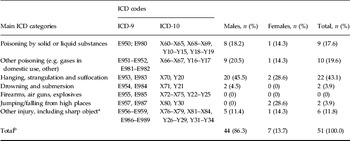
Of 16 470 participants in the birth survey in 1958 and who had not emigrated permanently, 1475 had died by 31 May 2009; of these, 51 (44 males, seven females) were suicides (including 13 of undetermined intent). The median age of suicide for males was 40 years (range 18–49 years); for females the median age was 39 years (range 21–49 years). Methods of suicide are shown in Table 1.
Methods of suicide (n = 51) in the 1958 British Birth Cohort

ICD, International Classification of Diseases.
a We excluded seven deaths coded 988.88 in ICD-9 and Y33.9 in ICD-10.
b Suicide/self-inflicted injury (n = 38) and undetermined intent (n = 13) were combined.
Risk factors for suicide in univariable analysis
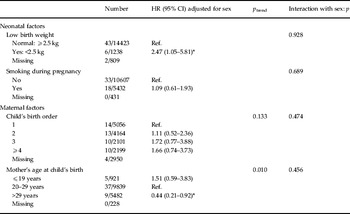
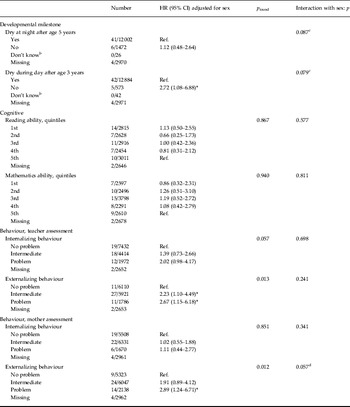
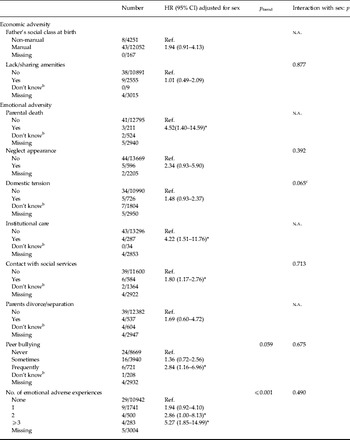
The strongest associations with prenatal factors were seen for birth weight and maternal age (Table 2); for developmental risk factors measured at age 7 years, the key factors were: being wet during the day after age 3 years, and externalizing behaviours (Table 3); and for indicators of adversity were: manual social class background, parental death, neglected appearance, domestic tension, institutional care, contact with social services, bullying and the overall number of emotional adversities (Table 4). Suicide risk was five times higher (HR = 5.27, 95% CI 1.85–14.99) amongst the 283 participants with ⩾3 adversities (n = 4 or 9% of all suicides) than those with none.
Univariable HRs for associations of prenatal factors recorded at birth with suicide a

HR, Hazard ratio; CI, confidence interval; Ref., reference.
a Based on all available data with 51 suicides.
* p < 0.05.
Univariable HRs for associations of developmental factors recorded at 7 years with suicide a

HR, Hazard ratio; CI, confidence interval; Ref., reference; n.a., not applicable (there was no event in females).
a Based on all available data with 51 suicides.
b The ‘don't know’ category was not associated with suicide mortality and was combined with ‘no’.
c The elevated suicide risk associated with not being dry at night and day was seen in females (HRs = 4.58, 95% CI 0.84–25.02 and 11.53, 95% CI 2.11–62.94, respectively), but not in males (HRs = 0.81, 95% CI 0.29–2.67 and 1.80, 95% CI 0.56–5.84, respectively). However, those analyses were based on a small number of females (n = 2) with both exposure and event.
d The elevated suicide risk associated with externalizing behaviour recorded by mothers was seen in males (HRs = 2.88, 95% CI 1.09–7.61 for intermediate and 4.59, 95% CI 1.65–12.74 for problems, p trend = 0.002), but not in females (HRs = 0.58, 95% CI 0.11–3.18 for intermediate and n.a. for problems, p trend = 0.281).
* p < 0.05.
Univariable HRs for associations of adversity factors recorded at 7 years with suicide a

HR, Hazard ratio; CI, confidence interval, Ref., reference; n.a., not applicable (there was no event in females).
a Based on all available data with 51 suicides.
b The ‘Don't know’ category was not associated with suicide mortality and was combined with ‘no’.
c The elevated suicide risk associated with domestic tension was seen in females (HR = 3.29, 95% CI 1.35–8.06), but not in males (HR = 1.20, 95% CI 0.66–2.16). However, this analysis was based on a small number of females (n = 2) with both exposure and event.
* p < 0.05.
Risk factors for suicide in multivariable analysis
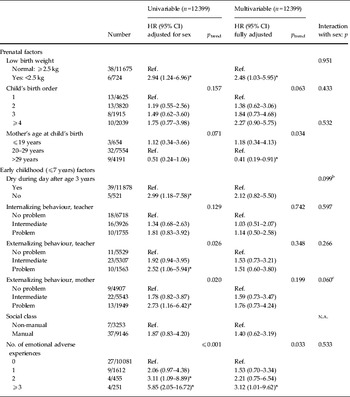
The 14 risk factors (p ⩽ 0.20) were included in multivariable analysis (n = 12 399 participants and 44 suicides; Table 5). Compared with suicides for which data were complete for all 14 risk factors (n = 44), those with missing information (one female and six males) had died at a younger age (31 v. 38 years, p = 0.073). However, estimates for suicide risk associated with prenatal and postnatal factors from univariable analyses were broadly comparable in both the maximum and complete case (multivariable) samples (Tables 2–4 v. Table 5). Table 5 shows that associations for separate prenatal factors were little changed in multivariable models controlling for other prenatal factors and there was little evidence of mediation by early childhood adversity or development measured at age 7 years. In multivariable analysis, low birth weight (<2.5 kg) was associated with a 2.48 (95% CI 1.03–5.95, PAF = 8%) times higher suicide risk. In additional analysis, based on the subset (n = 10 875 including 38 suicides) of participants with records of gestational age, the HR for low birth weight was 2.25 (95% CI 0.80–6.35) and this was somewhat attenuated (HR = 1.86, 95% CI 0.58–5.98) after controlling for gestational age. There was a trend of higher risk of suicide mortality with increasing birth order (p trend = 0.063), with the highest risk for fourth born or later births (HR = 2.27, 95% CI 0.90–5.75, PAF = 17%). For maternal age, a trend (p trend = 0.034) was observed from the highest suicide risk for younger mothers to the lowest risk for older mothers (HRs = 1.18 for ⩽19 years group to 0.41 for >29 years v. 20–29 years; PAF = 22% for maternal age categorized as below and above 23 years, i.e. the 25th percentile).
Univariable and multivariable HRs of prenatal and postnatal factors at 7 years with suicide a

HR, Hazard ratio; CI, confidence interval, Ref., reference; n.a., not applicable (there was no event in females).
a Based on 12 399 cohort members with complete data for multivariable analysis with 44 suicides.
b The elevated suicide risk associated with not being dry during the day was seen in females (HR fully adjusted = 21.31, 95% CI 3.07–147.52), but not in males (HR fully adjusted = 1.43, 95% CI 0.43–4.74). However, this analysis was based on a small number of females (n = 2) with both exposure and event.
c The elevated suicide risk associated with externalizing behaviour recorded by mothers was seen in males (HRs fully adjusted = 2.43, 95% CI 0.91–6.48 for intermediate and 2.96, 95% CI 1.03–8.47 for problems, p trend = 0.050), but not in females (HR fully adjusted = 0.47, 95% CI 0.80–2.75 for intermediate and n.a. for problems).
* p < 0.05.
For childhood adversity and development markers, there was a general observation of risk attenuation in multivariable analysis, suggesting that associations were due in part to prior or contemporaneous factors. For example, HRs for internalizing and externalizing behaviours reduced after controlling for prenatal and other early childhood factors. For externalizing behaviours rated by mothers an elevated suicide risk was seen in males, but not females (p for interaction with sex = 0.060). In univariable analyses in the reduced sample of 123 99 HRs were 2.65 (95% CI 0.99–7.05) and 4.31 (95% CI 1.54–12.09) for intermediate and problem externalizing behaviors in males (online Supplementary Table S1) and 0.58 (95% CI 0.11–3.18) for intermediate level externalizing behaviour in females; there were too few suicides to assess associations with problem behaviour in females). Although the risk for males was considerably attenuated in the multivariable model, the risk of suicide increased with severity of behaviour (p trend = 0.050) to almost threefold for those with problem behaviour (HR = 2.96, 95% CI 1.03–8.47, PAF = 28%); this finding held when teachers' assessments were excluded from the model (HR = 3.19, 95% CI 1.12–9.12). Separate items on the externalizing scale showed a graded association (p trend < 0.001) for suicide risk with the frequency of property destruction (for ‘frequently’ HR = 4.68, 95% CI 1.92–11.41) and for ‘frequently fighting other children’ HR = 3.90 (95% CI 1.13–13.48), but no association was observed for ‘irritable’ and ‘disobedient’. Similarly, the elevated suicide risk associated with number of adverse emotional experiences attenuated in multivariable analysis, but a trend remained (p trend = 0.033), with the highest HR (3.12, 95% CI 1.01–9.62) for persons with ⩾3 versus no adverse experiences (Table 5). The population prevalence of having at least one adverse emotional experience by 7 years was 18.7% (12.9% had 1, 3.7% had 2, and 2.1% had ⩾3); PAF for ⩾1 emotional adversity was 13%. Online Supplementary Table S2 presents univariable and multivariable analyses for each emotional adversity; parental death was associated with a 4.34 (95% CI 1.30–14.47) times higher suicide risk.
Discussion
Suicide is often considered to be caused by mental disorder and adverse events such as job loss and relationship difficulties around the time of death. Our analysis reveals associations with a series of risk factors recorded in the first 7 years of life, suggesting that trajectories leading to suicide in adulthood have roots in early life. The strongest associations were seen with low birth weight, younger maternal age, higher birth order, higher number of emotional adversities (particularly parental death and bullying by peers) and externalizing problems in males. Remarkably, some associations were undiminished in simultaneous analysis of prenatal and early childhood factors. Of particular note is our finding that none of the associations with prenatal factors was weakened greatly when we controlled for several factors measured at 7 years, indicating that they operate through other pathways. The increasing suicide risk with higher levels of emotional adversity is also notable, suggesting that such adversities influence risk outwith other early life influences. The PAFs varied greatly (8 to 28%) across risk factors; the largest PAF was attributed to externalizing problems in males.
Methodological considerations
Our study population is large and nationally representative of British residents born in 1958, and captures many key aspects of perinatal circumstances, family background, and behavioural and emotional development to age 7 years. Furthermore, the availability of birth data and detailed information on cohort members at 7 years allowed us to explore pathways linking birth-related risk factors to later suicide risk. The availability of prospectively recorded assessments from multiple informants, suicide mortality over five decades of life, low attrition rate and nationwide coverage are particular strengths of the study. The main limitation is study power (type II error), particularly when investigating sex differences in associations due to the small number of suicides, given the low incidence of suicide. In addition, type I error may also exist as we performed several comparisons. Owing to the rarity of suicide events, CIs for HRs were wide, particularly in multivariable analyses. Furthermore, the key assumption in the calculation of PAFs is that factors are causally associated with suicide; as our design is observational and so prone to confounding, the PAFs should be interpreted with caution. However, they do nevertheless enable us to quantify the potential public health importance of different risk factors.
There were some missing data; however, associations were replicated in the reduced sample available for multivariable analysis. We had no information on abuse in childhood – this is known to be strongly associated with self-reported suicidal attempts (Dube et al. Reference Dube, Anda, Felitti, Chapman, Williamson and Giles2001; Brezo et al. Reference Brezo, Paris, Vitaro, Hébert, Tremblay and Turecki2008). To the best of our knowledge, no prospective study has examined associations of abuse and suicide mortality. We have examined the possibility that prenatal and early childhood factors are operating through related pathways, but mediation or moderation through later, i.e. more proximal, factors remains a possibility. The strength of associations reported here for distal risk factors for suicide (HRs varied between 2.3 and 3.0) is similar to that reported in other epidemiological studies for proximal contextual risk factors such as unemployment and divorce/separation in adulthood (Kposowa, Reference Kposowa2000; Lundin et al. Reference Lundin, Lundberg, Allebeck and Hemmingsson2012), although mental health disorders preceding suicide remain one of the strongest predictors (Gunnell & Lewis, Reference Gunnell and Lewis2005). Finally, perinatal and childhood circumstances of the 1958 cohort may differ from those of today's generation, which may reduce the generalizability of our findings. However, similar findings reported for more recent cohorts (Mittendorfer-Rutz et al. Reference Mittendorfer-Rutz, Wasserman and Rasmussen2008; Sourander et al. Reference Sourander, Klomek, Niemelä, Haavisto, Gyllenberg, Helenius, Sillanmäki, Ristkari, Kumpulainen, Tamminen, Moilanen, Piha, Almqvist and Gould2009) suggest that our results remain relevant.
Comparison with other studies
Prenatal factors
Although there is a growing literature on perinatal circumstances and suicide (Mittendorfer-Rutz et al. Reference Mittendorfer-Rutz, Rasmussen and Wasserman2004; Riordan et al. Reference Riordan, Selvaraj, Stark and Gilbert2006, Reference Riordan, Morris, Hattie and Stark2012), our study was the first, as far as we are aware, to show that associations between perinatal circumstances and suicide were unexplained by a wide range of possible childhood intermediate factors, including emotional adversities and behavioural development by 7 years. HRs reported here for low birth weight, higher birth order and younger motherhood were broadly in agreement with previous studies on perinatal factors and suicide (Mittendorfer-Rutz et al. Reference Mittendorfer-Rutz, Rasmussen and Wasserman2004; Riordan et al. Reference Riordan, Selvaraj, Stark and Gilbert2006, Reference Riordan, Morris, Hattie and Stark2012). For instance, a Swedish record linkage study of over 700 000 young adults born 1973 to 1980, with 563 suicides, reported multivariable HRs of 2.2 for low birth weight and of 2.3 for teenage mothers (<19 years v. 20–29 years) (Mittendorfer-Rutz et al. Reference Mittendorfer-Rutz, Rasmussen and Wasserman2004). As reported in previous studies (Mittendorfer-Rutz et al. Reference Mittendorfer-Rutz, Rasmussen and Wasserman2004), the association of low birth weight and suicide was little changed after adjustment for gestational age. Some (Riordan et al. Reference Riordan, Selvaraj, Stark and Gilbert2006, Reference Riordan, Morris, Hattie and Stark2012) but not all (Mittendorfer-Rutz et al. Reference Mittendorfer-Rutz, Rasmussen and Wasserman2004) studies reported elevated suicide risk for higher multiparity or birth order, and as mentioned above, we show that such associations with suicide risk are independent of several childhood influences. It has been suggested that adversity may be linked to long-lasting changes in the expression of genes related to the biological stress response, possibly implicated in the development of mental disorders and suicidal behaviours via epigenetic modification (Turecki et al. Reference Turecki, Ernst, Jollant, Labonté and Mechawar2012). Hence, as higher birth order is correlated with decreased quality time with the mother (Jacobs & Moss, Reference Jacobs and Moss1976), associations between such distal prenatal risk factors (or other childhood adversity) and suicide mortality may operate via epigenetic mechanisms.
Postnatal factors
Our results yield important new insights into the connection of externalizing problems in early childhood with suicide mortality in later life. Males have a higher incidence of both suicide and externalizing problems than females in most countries (Clark et al. Reference Clark, Rodgers, Caldwell, Power and Stansfeld2007; Hawton & van Heeringen, Reference Hawton and van Heeringen2009). Our findings revealed that externalizing problems at 7 years were associated with three times the risk of completed suicide in males. Externalizing problems in childhood link, in turn, to problems around the time of the suicide, such as impulsive or disruptive behaviours and criminal convictions, that have been identified in both epidemiological (Björkenstam et al. Reference Björkenstam, Björkenstam, Vinnerljung, Hallqvist and Ljung2011) and psychological autopsy studies (Shaffer et al. Reference Shaffer, Gould, Fisher, Trautman, Moreau, Kleinman and Flory1996; Cheng et al. Reference Cheng, Chen, Chen and Jenkins2000). A recent Swedish register-based cohort study comprising about 1 million births from 1972 to 1981 showed that suicide rates up to the age of 25–34 years in males (n = 1086) and females (n = 396) increased with the number of criminal convictions, an indicator of externalizing behaviours, between 15 and 19 years, with a stronger association for males [crude incidence rate ratio (IRR) = 12.3 for males with five or more convictions] (Björkenstam et al. Reference Björkenstam, Björkenstam, Vinnerljung, Hallqvist and Ljung2011). Associations decreased substantially (IRR = 3.0), but were not entirely explained by social background, individual psychiatric history and substance abuse. Our study contributes to this literature in showing strong associations of problem behaviours in those as young as 7 years, as suggested by one epidemiological study combining suicide mortality and attempts (Sourander et al. Reference Sourander, Klomek, Niemelä, Haavisto, Gyllenberg, Helenius, Sillanmäki, Ristkari, Kumpulainen, Tamminen, Moilanen, Piha, Almqvist and Gould2009). Associations were strong for items assessing ‘destructive behaviour’ and ‘fighting’, but not ‘irritability’ or ‘disobedience’, suggesting that suicide is associated with severe disturbance only.
Our findings confirm previous findings from psychological autopsy studies (Séguin et al. Reference Séguin, Lesage, Turecki, Bouchard, Chawky, Tremblay, Daigle and Guy2007, Reference Séguin, Renaud, Lesage, Robert and Turecki2011) suggesting that, for most individuals, trajectories leading to suicide in adulthood have roots in early life. Indeed, we found a dose–response association between the number of emotional adversities and suicide, with highest suicide risks among those experiencing three or more adverse experiences, independently of other factors examined. In a large US study, retrospective reports of the number of adverse childhood experiences were associated with self-reported suicide attempts from childhood to young adulthood (Dube et al. Reference Dube, Anda, Felitti, Chapman, Williamson and Giles2001). Our study found that parental death was independently associated with considerably increased suicide risk. We were not able to determine whether parental deaths were due to suicides; hence genetic and other factors could be contributing to this association (Geulayov et al. Reference Geulayov, Gunnell, Holmen and Metcalfe2012).
However, we detected no association between markers of school performance and subsequent suicide, and this is discrepant with some studies (Gunnell et al. Reference Gunnell, Magnusson and Rasmussen2005, Reference Gunnell, Löfving, Gustafsson and Allebeck2011; Gravseth et al. Reference Gravseth, Mehlum, Bjerkedal and Kristensen2010), but agrees with others (Neeleman et al. Reference Neeleman, Wessely and Wadsworth1998; Sourander et al. Reference Sourander, Klomek, Niemelä, Haavisto, Gyllenberg, Helenius, Sillanmäki, Ristkari, Kumpulainen, Tamminen, Moilanen, Piha, Almqvist and Gould2009). These inconsistent findings may possibly reflect age differences in measurement, whereby cognitive abilities measured in adolescence or early adulthood (Gunnell et al. Reference Gunnell, Magnusson and Rasmussen2005, Reference Gunnell, Löfving, Gustafsson and Allebeck2011; Gravseth et al. Reference Gravseth, Mehlum, Bjerkedal and Kristensen2010), but not in early childhood (Neeleman et al. Reference Neeleman, Wessely and Wadsworth1998; Sourander et al. Reference Sourander, Klomek, Niemelä, Haavisto, Gyllenberg, Helenius, Sillanmäki, Ristkari, Kumpulainen, Tamminen, Moilanen, Piha, Almqvist and Gould2009), are associated with suicide mortality.
Mental illness as intermediary factor
Suicide usually occurs in the course of a mental disorder, especially depression with or without co-morbid substance misuse (Cavanagh et al. Reference Cavanagh, Carson, Sharpe and Lawrie2003). It is noteworthy that most early life factors associated with suicide mortality in the present study (e.g. low birth weight, high birth order, younger maternal age, emotional adversities) are predictors of depression (Cheung, Reference Cheung2002) or psychiatric admission (Riordan et al. Reference Riordan, Morris, Hattie and Stark2012) in adulthood. This may suggest that pathways from early life circumstances to suicide mortality in adulthood may involve mental health disorders at later stages of the life-course. Our findings indicate that externalizing problems at 7 years predict suicide mortality around 40 years more strongly than internalizing problems. Previous analysis of the 1958 cohort has shown the opposite in relation to depression, with a somewhat weaker association between externalizing behaviours at 7 years and major depressive disorder at age 45 years [odds ratio (OR) = 1.59, 95% CI 0.92–2.74] than for internalizing behaviours (OR = 2.12, 95% CI 1.34–3.36) (Clark et al. 2007).
Implications
Risk factors in place around the time of birth and during early childhood may have an influence on suicide mortality. Some of these factors, such as bullying, are amenable to intervention (Mann et al. Reference Mann, Apter, Bertolote, Beautrais, Currier, Haas, Hegerl, Lonnqvist, Malone, Marusic, Mehlum, Patton, Phillips, Rutz, Rihmer, Schmidtke, Shaffer, Silverman, Takahashi, Varnik, Wasserman, Yip and Hendin2005; Hawton et al. Reference Hawton, Saunders and O'Connor2012) but for others a better understanding of causal mechanisms may provide new insights for intervention to reduce suicide risk. Our results suggest that efforts to prevent externalizing problems in males beginning at an early age may translate into a reduction of suicide in adult life, if the relationship is causal. Early interventions to prevent aggression (e.g. family/parent training programmes or nurse home visits) have been proven to be effective (Olds et al. Reference Olds, Henderson, Cole, Eckenrode, Kitzman, Luckey, Pettitt, Sidora, Morris and Powers1998; Piquero et al. Reference Piquero, Farrington, Welsh, Tremblay and Jennings2009). More generally, the early risk factors identified here for increased risk of suicide mortality are associated with many other adverse outcomes. This suggests that interventions to mitigate these risk factors may have wide-ranging positive effects.
Supplementary material
For supplementary material accompanying this paper visit http://dx.doi.org/10.1017/S003329171300189X.
Acknowledgements
The Great Ormond Street Hospital/University College London Institute of Child Health was supported in part by the Department of Health's National Institute for Health Research (NIHR) Biomedical Research Centre. The Centre for Paediatric Epidemiology and Biostatistics was supported in part by the Medical Research Council (MRC) in its capacity as the MRC Centre of Epidemiology for Child Health. M.-C.G. was supported by a fellowship from the Canadian Institutes of Health Research. We thank the participants of the 1958 British Birth Cohort. D.G. is an NIHR Senior Investigator.
The study was funded by the Canadian Institutes of Health Research. The funder was not involved in the study design, data collection, data analysis and interpretation of data; in the writing of the report; and in the decision to submit the paper for publication.
Declaration of Interest
None.