1. INTRODUCTION
In architecture, few consistent mechanisms exist to record and explore the insights and arguments developed during design, let alone to extend their potential reach. Nevertheless, some recent initiatives suggest that there is a need for systematic documentation and exchange. A case in point is Building Stories, a methodology to capture and explore real-world design processes through storytelling (Martin et al., Reference Martin, Heylighen and Cavallin2005), or the Advanced Design Support Project, a decision support system for capturing histories of design processes for collaborative building design (Cerulli et al., Reference Cerulli, Peng, Lawson, de Vries, van Leeuwen and Achten2001). These initiatives, however, are little more than isolated pilot efforts, which sharply contrast with widespread mechanisms in other design domains (Gamma et al., Reference Gamma, Helm, Johnson and Vlissides1995; Bracewell & Wallace, Reference Bracewell and Wallace2006).
2. RESEARCH SETUP
This contrast motivated our attempt to capture and exchange the arguments and rationale architects develop while designing. The method developed to do so was inspired by experiments conducted in the context of a larger research project that investigates the use of design strategies, the application of design methods, and specific aspects of design thinking in architectural redesign. Building reuse represents a substantial and still growing portion of architectural practice. Several reasons for this tendency can be found, but in general, the added value of reusing instead of replacing buildings seems commonly accepted. Intuitively, redesigning an existing building looks different from designing a new one. But most architects are not specifically trained to redesign buildings. So what are the distinguishing aspects of redesign? And how do architects cope with them? In addressing these questions we chose a “mixed method” approach. By examining redesign in various ways and from multiple perspectives, we hope to establish a richer understanding than any one method could provide. To practically limit the scope of the study, the research focuses on the conceptual design phase of redesign. This is the phase where strategic decisions are made which have an important influence on the design outcome.
3. IDENTIFYING COMPONENTS OF DESIGN PROCESSES
Because we wanted to know what architects do and how they make design decisions when redesigning a building, we needed research methods that would provide insight in the notions that influence and steer their decisions. Through think-aloud protocol analysis, originally set up for other research purposes (Heylighen & Neuckermans, Reference Heylighen, Neuckermans and Jabi2001), we first observed in detail the design activity of three architectsFootnote 1 during a 2-h design session. All three were asked to develop a concept for the redesign and extension of an architecture school based in a 16th century castle.Footnote 2 The design task involved the reorganization and optimization of the west wing of the castle (design studios, lecture rooms, secretariat, and photocopy room) and the extension with a reception hall, material museum, and exhibition room.
The program brief for this assignment is very concise, given the experimental setup and the resulting time limitation. Apart from locating the spaces to be redesigned, the required program is described. Some of the current functions remain in the same wing, some move to another part of the building, and some new functions are added. The program lists the following functions and requirements: secretariat, not accessible by the students, containing three work places, storage space, copy room for students, info desk; reception hall with multifunctional character: waiting room, exhibitions, sitting areas, cafeteria (vending machines) and vertical circulation; lockable exhibition space that can be used also for meetings, seminars, and workshops; materials museum; archives. For each of these spaces an approximate surface is indicated.
The architects could go about the task as they preferred, except for some restrictions resulting from the observation method used. They were asked to “think aloud” during the whole session. By saying what they are thinking of, a large part of the design process can be externalized, which is exactly what we are after here.
The design session was limited to 2 h, to prevent both exhausting the designers and creating too large a dataset to examine in a reasonable time period. The design sessions were conducted in the university premises, which is not the natural working environment for the designers. This might prevent them from accessing acquainted materials (books, documents, references, and so forth) or using the tools they are familiar with (Cross, Reference Cross, Eastman, Mc Crachen and Newsletter2001). In addition, all actions of the designers were audio- and videotaped. The presence of the video camera can possibly cause stress for the designer (Lloyd et al., Reference Lloyd, Lawson and Scott1996) and consequently influence the design result.
After each design session, the architect's drawings and notes were collected and chronologically numbered, and the tapes were transcribed into full text protocols. When analyzing the protocols we observed that architects utter many ideas and observations. Sometimes these utterances form logical and continuously developed considerations in support of design decisions. The following example is taken from protocol A and shows how the architect finds arguments for determining the identity of the extension:
- 232 0:16:41
since the castle is a clear entity
- 233 0:16:44
composed of, evidently, of different wings and eh elements
- 234 0:16:49
but nevertheless … has a certain identity
- 235 0:16:51
it is important that the part that is added
- 236 0:16:54
gets an own identity
- 237 0:16:56
and definitely is not an appendix to the castle
- 238 0:16:59
it may definitely not merge with the castle
- 239 0:17:01
it needs [to have] an autonomy
- 240 0:17:02
… a certain contrast effect
- 241 0:17:05
anyway it needs to be a clear entity
- 242 0:17:07
that doesn't necessarily mean that it must be a contrast effect
- 243 0:17:08
it can still be in brick eh
- 244 0:17:13
it is after all also a space that has much to do with the functions of the castle …
- 245 0:17:19
it is not a radically separate program
- 246 0:17:22
it is a program that bears very close resemblance to the castle ….
- 247 0:17:26
and since the mill is also in eh … in brick …
- 248 0:17:30
eh … I see actually two possibilities for that building
- 249 0:17:33
in fact, I do think that for eh … . because all functions of mill as well as castle form one whole
- 250 0:17:40
… .intuitive tendency to say: look, we make it in a material that is already present in the mill and in the castle
- 251 0:17:47
ehm … bricks
- 252 0:17:49
brick and glass
- 253 0:17:50
brick, glass and lead
At other times the utterances seem very fragmented, but when considering the protocol as a whole, several fragments often form a common logic as well. In the following fragments from protocol B, the architect considers whether or not to create openings in the blind monumental wallFootnote 3 of the castle.
- 222 0:21:12
but there's something nice with this space which is very
- 223 0:21:15
the walls are very, this wall is very blind, very strong
- 224 0:21:22
so I'm thinking, if you' make an official entrance here
- 225 0:21:26
I'm thinking whether it's a good idea or whether it's a bad idea …
- 360 0:33:03
I don't think we do, because it's all like this formidable massive wall
- 361 0:33:13
yes, it's all … so there we don't have it
- 362 0:33:16
so there we just have a few piercings
- 363 0:33:19
small holes in the big wall … which keep the big wall as a …
- 364 0:33:24
thick element …
- 556 0:57:30
…
- 557 0:57:55
and I guess we would have at least one major opening
- 558 0:58:00
because we're gonna still empty part of the west wing … in this proposal
- 559 0:58:05
so we create a major opening
- 560 0:58:10
well we didn't want a major opening, cause we want to keep the massivity of the wall
- 561 0:58:15
so we create a small opening
- 562 0:58:20
one over here and another one there …
…
- 658 1:08:46
I haven't even looked at these things
- 659 1:08:49
I think I know the site, with the …
- 660 1:08:54
yeah! this is the wall … and the tower of course I could have used those
- 661 1:09:05
yeah … floor … the roof is …
- 662 1:09:17
it is really a beautiful blank wall
- 663 1:09:22
I mean, I had actually forgotten that there is also this part with windows …
- 664 1:09:26
which go all the way to the ground … here … ok
- 665 1:09:35
I thought it was all like … pure medieval stuff …
- 957 1:38:33
this wall also remains intact
- 958 1:38:36
so does this wall
- 959 1:38:38
here we have an opening, the new opening
- 960 1:38:41
and here we have another opening
- 961 1:38:43
in fact, this one is becoming a fairly important one
- 962 1:38:46
because this is also where we have the … bicycle
The separate utterances can be called chunks, after Suwa and Tversky's (Reference Suwa and Tversky1997) “dependency chunks”; the logic constructed with them, whether or not in a continuous way, can be called lines of thought, after Lawson's (Reference de Certeau and Rendall1993) “parallel lines of thought.” In the first example, for instance, the architect considers the identity of the historic building. He remarks that the building has a clear identity, composed by different wings and elements. This makes him decide to give the extension a clear identity as well; it should have autonomy rather than be an annex, and definitely not become one with the castle. Later on, he says that contrasts are unnecessary; he selects materials that match those of the existing building: brick, glass, and lead. A clear identity, he continues, can be established by the architectural elaboration: using a special structure, recognizable inside as well as outside; choosing a function that requires an open space. In the same 2-h protocol, we could discern many more lines of thought, covering topics as diverse as the location of the extension, the functionality, the volume, the character of the interventions, the structure, the materials.
The line of thought in the second example was not developed in a continuous way, but nevertheless forms an overall logic in the design. Starting from the observation that the blind wall of the castle is a very strong element, the architect questions whether or not making an official entrance here would be a good idea. Later he argues that making a few small piercings would preserve the wall as a thick massive element. However, then another consideration leads to the idea of creating a major opening in the wall. This is rejected based on the previous intention to keep the wall's massive character, and two small openings are opted for instead. Pictures not only confirm his observation about the beauty of the wall but also point to the presence of small windows on the upper floor. While reconsidering his proposal in the final part his choices are consolidated, because in terms of functionality the openings fit the design.
This line shows that other considerations and activities take place in between the fragments represented here. A functional concern first leads to creating one major opening, but another concern later on justifies the choice for two small openings. Browsing through the pictures confirms his initial appreciation of the beautiful blind wall, but also readjusts his assumption that it currently does not have any windows. In addition, many considerations are made that do not directly interfere with this line of thought. These include covering the courtyard, the symmetry of the castle, the proportions of the new courtyard, the size and location of the extension, creating an open passage in the west wing, the functionality of the whole, the character of the interventions, the state the current building is in, the size of the existing spaces.
Nevertheless, these lines of thought and their interaction do not tell the whole story. To some extent, lines of thought act in the design process as tactics do in warfare (de Certeau, 1984). They have a goal that immediate affects the building. Some considerations, however, do not directly affect the building, but steer or influence one or more lines of thought. In the military context, such considerations are henceforth called strategies.
To get a sense of the strategies used in redesign, let us return to protocol A. A historical restoration approach both substantiates the reconstruction of the original staircase very early in the session, and justifies opening up the arches toward the inner courtyard. No details are given about how the staircase will be reconstructed, only that the historic situation will be restored. Going back to the past can thus be considered a first strategy that is applied here. The arches will contain double glass doors, instead of gate doors as was the case for the stables. Viollet-Le-Duc's approachFootnote 4 is probably too rigid to compare this strategy with, but it comes very close to the principles of the Charter of Venice.Footnote 5
Of interest, the opposite strategy is used for the redesign of the back entrance at the end of the protocol. Here, the architect chooses to show clearly that a new element is inserted in the old structure. A contemporary opening is created “so that one easily notices that it was differently before.”
Two strategies influence the decision in the line of thought of our first example about the identity of the extension. First, distinguishing new parts from the old leads to the choice for an autonomous, contrasting volume. This is achieved by separating the extension, a uniform bar-shaped volume, two levels high, from the west wing of the castle, and connecting both by means of a small volume. In addition, the entity should be distinguished by means of the structure, the spatial configuration, the articulation of the façade and the windows. As illustrated above, the same strategy also influences other decisions. The second strategy, tuning new elements to characteristics of the existing building, is exemplified by the choice of materials (brick, glass, and lead), all materials that are used in the castle.
At first sight, capturing many of these think-aloud protocols seems an excellent way to provide students insights in architects' reasoning. However, the procedure poses several problems. First of all, because think-aloud sessions are necessarily limited in terms of the available time and resources, they rarely result in unambiguous design results. Few protocols end up with a real building design. Instead, for many aspects several thoughts and ideas are uttered without coming to conclusions (yet). Although the procedure allows tracing the development of the detailed design logic, the overall logic developed as the result of a full design process cannot be captured in these short sessions. Second, thinking aloud possibly causes extra stress and might obstruct the unhampered development of the design process (Cross et al., Reference Cross, Christiaans, Dorst, Cross, Christiaans and Dorst1996).
The important conclusion we can draw from analyzing the protocols, is that architects use three mechanisms in constructing arguments for design solutions:
1. Separate statements, without immediate underlying logic, called chunks, after Suwa and Tversky's (Reference Suwa and Tversky1997) “dependency chunks.”
2. A set of these statements, whether or not uttered continuously, forming a logical consideration and leading to a design decision, here called a line of thought, after Lawson's (Reference Lawson1993) “parallel lines of thought.”
3. Decisions of a higher order, guiding other decisions, not directly affecting the design, but steering or influencing one or more lines of thought, henceforth termed strategies (de Certeau, Reference de Certeau and Rendall1984).
4. A THREE-COMPONENT REPRESENTATION OF REAL-WORLD DESIGN PROCESSES
With these three mechanisms in mind, we tried to record real-world competition designsFootnote 6 in architectural practice. For each competition, a researcher started working in an architecture office several weeks before the deadline and took part in the design, being a design team member and researcher at the same time. He participated in all aspects of the design, and thus attended all (important) internal and external meetings and discussions. No extra effort was needed to avoid misinterpretation of the data, because the researcher was fully immersed in all aspects of the design. On a daily basis, reports were made of the project's progress, group meetings, and meetings with external consultants, to record the general aspects of the design process. At the end of each day, the researcher collected drawings, improvements of the model, and “postrationalizations”Footnote 7 of decisions made in a diary. Because our goal was not to collect raw data on a design project, but to try and reveal the design rationale underlying the corresponding design process, the diary was translated into a three-component representation, based on the mechanisms identified in the think aloud protocols.
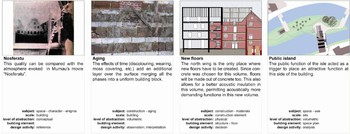
A large set of separate chunks constitute the smallest units of information. Although originally the term referred to the text fragments of the protocol only, we noticed that the understanding of the design process considerably increased when complementing the text fragments with visual material used by the architect. Therefore, “our” chunks include brief textual explanations complemented with visual material to fit the verbal and nonverbal thought characteristic to design. The visual material can comprise different sorts of information (drawings, sketches, pictures, diagrams, icons). The accompanying texts add meaning to the visual elements and vice versa. Figure 1 shows four characteristic examples of what information a chunk may contain. They are taken from a total of 101 chunks recorded while participating in a competition for the redesign of ‘s Hertogenmolens, a medieval watermill.Footnote 8
Examples of the information contained by chunks. [A color version of this figure can be viewed online at journals.cambridge.org/aie]

The redesign of ‘s Hertogenmolens was developed in response to a competition brief of the city of Aarschot, supervised by the Flemish Government. Given the context of a competition, there was no real client–architect relationship during the design process. Interaction with the client was limited to a few organized meetings between several representatives of the city and the selected architecture offices. During these sessions, several aspects of the design could be discussed. A delegate of the bench of aldermen represented the city and clarified its interests. The Flemish Government was represented by a delegate to support the city in considering the architectural aspects. The project was steered by two experts from the Heritage Conservation Committee: one monitoring the heritage aspects of the historic building, the other specialized in the industrial archaeological aspects. Other people could be involved to answer more specific questions as required.
At the same time, short presentations were given about the progress of the urban renewal project by another team of architects, which was running simultaneously, and in which the design of the watermill is incorporated. Because decisions taken at one level definitely influence decisions taken at the other level, having a general idea of the urban project was essential for situating the watermill in its context.
During these meetings, a lot of questions were not only related to the design brief, but also to specific elements of the design task. Because many of the representatives are experts in their fields, they were “used” as consultants in the disciplines of their expertise. In a similar way the urban project designers could clarify questions relating to the urban aspects of the design at this point. Given the cost and time restriction for the competition, most offices could not consult many experts themselves.
In this case, the “client brief” equals the competition brief set up in the context of an Open Oproep,Footnote 9 which specifies the main aspects to be considered in the design. A concept formulation is demanded, with a brief vision of the designer, describing how the design will address the goals and starting points as defined by the client in the project definition. This project definition is now summarized.
Inscribed in a larger urban context, ‘s Hertogenmolens should become a motor for the urban renewal as envisaged in the urban project. The building should contribute to the reconnection of the north and south of the city and also take up its function as bridge over the river again.
As demands for the building itself, the following topics are included: a proposal for a relevant new function for the building and an alternative function for the island, still, the design should leave alternative options open, and even already foresee future conversions; a viable function should be proposed, viable for the building itself and in terms of the economic consequences; a public character of the building is desirable. In the transformation of the building, the present decay should be counteracted; the relation with the water reestablished, possibly by generating energy from the water, without a connection with the water the building is not a watermill anymore; furthermore, it will help increase the legibility of the building as a watermill; the required changes should respect the monumental value of the building and its context; conservation of the lock mechanism and sluices is required; the relationship between new and old elements should be considered.
The following elements are listed as additional requirements:
1. Use a representative selection of the equipment of the mechanic mill in a museum arrangement, and assure a maximum conservation of the equipment belonging to other production processes.
2. Allow control of the water level in the river by making use of the existing mechanism. A modern control system is required to prevent flooding of upstream areas. Damming the water will have a positive ecologic effect for the river valley. Reinstalling vertical waterwheels should be considered. Because these measures hinder the fish migration to the upstream part of the river, additional measures will be needed to allow fish to pass the watermill in the future.
The first chunk in Figure 1 compares the quality of the existing building with the atmosphere in Murnau's movie Nosferatu. The second makes an observation about the beautifully aging materials of the existing building. Number 3 describes the decision to use concrete for the new floors in the north wing, and number four analyses the urban conditions of the island where the mill is located.
In general, the chunks cover a wide range of subjects that have influenced the redesign; they include questions and intentions, observations and analyses, references and associations, interpretations and evaluations, decisions and syntheses. They vary from small to large scale, from very abstract to concrete and tangible, and may relate to the complete range of possible building elements.
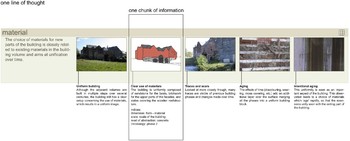
Rather than collecting singular facts, however, we wanted to reveal why the designers made certain choices and decisions, and what the qualities and shortcomings of the result are. To this end, several chunks are combined into lines of thought that represent the main arguments in the design. They show problems and opportunities of the design situation and capture the motives underlying the solution. Each individual line of thought covers one aspect considered during design, as if the designers explain in detail every consideration made. Together, the lines form a comprehensive story that can be investigated at different levels of detail. One can explore each individual design decision and discover how the combination of problem, argumentation, and decision affects the resulting project, or one can explore how these separate lines interact. Figure 2 illustrates a line of thought recorded during the redesign of ‘s Hertogenmolens. It describes how the new materials derive from characteristics of the original materials. The building results from different construction phases, spread over several centuries, and still looks like a coherent whole, possibly because all building parts have the same main setup (sandstone base, brickwork body, and slates roof). When looking more closely, however, traces and scars of former phases remain present throughout the building, yet the beautiful aging of the materials creates an additional layer that helps unifying old and new. This inspires the designers to choose rapidly aging materials for the new interventions, so that time will recreate a uniform building.
An example of a line of thought. [A color version of this figure can be viewed online at journals.cambridge.org/aie]

The line of thought describes not only separate fragments of information on the building and its design but also the relation between these different fragments and the overall logic applied. A separate title and concise description are added, on top of the information contained in the individual chunks that make up the respective line. Students or architects can explore each individual design decision and discover what consequences the combination of problem, argumentation, and decision has for the resulting project. Furthermore, they can explore how these separate lines of thought interact.
Besides chunks and lines of thought, our representation of real-world design processes also contains strategies, attitudes toward the design that influence or steer design actions, and that feature in one or more lines of thought. They often remain implicit during design, but can be made explicit afterward to capture the general logic behind the decisions. Depending on the dimensions considered, different strategies can occur, possibly acting across multiple scales and/or levels of abstraction.
The redesign of ‘s Hertogenmolens combines multiple approaches: where required, the building is healed (repairing where necessary, but changing as little as possible), and for more important reconstructions, the designers opt for noticeably contemporary interventions. A number of strategies are closely related to these general attitudes. For instance, the strategy underlying the abovementioned line of thought reads as: “Purposefully applying aging, patina, wear, erosion, weathering, oxidation as a means to catch up with time by the choice of materials. The aim is to integrate new additions with existing building parts.”
The new functions for the building are chosen such that all fit one of the equally sized spaces. This prevents breaking through walls and floors, which would destroy the basic spatial setup of this building. Only for the restaurant, where the ceiling height was too low to house any public function, the opportunity was seized to create a double high room by eliminating one floor. This strategy can be summarized as: “Matching the new functions to fit the characteristics of the existing spaces and the needs of the building, without requiring major interventions.”
The decision to reconstruct the volume of the burned down north wing according to its most recent construction phase was only made after several attempts to change the volumetric setup. Because the current form of the building evolved from a succession of building phases, the reconstruction was designed as a new building phase with contemporary materials, but adopting the original shape. Similarly, the windows in the new parts have a contemporary look, although they are very closely connected with the historical windows. Over time, the layout of the west façade was changed several times, resulting in an almost randomly organized façade. The ad hoc organization of the openings is copied from the old façade, but the size and proportions are completely novel, meeting the requirements of the building's new use. At the north wing, the opposite idea was used: size and proportions comply with the old windows, but the rigid industrial organization of the openings is replaced by a less rigid composition. The strategy guiding these decisions reads: “Adjusting to certain aspects of the original building by copying specific aspects, and reacting against the same building by contrasting other aspects.”
A more detailed application of the same strategy can be found in the choice of the building materials. The choice is based on the presence of “Diestiaan,” a red ferrous sandstone that is subject to aggravated erosion, in the stone basis of the building. The presence of ferrous elements in this stone led to choosing ferrous materials for the reconstruction: Cor-Ten steel for the west façade and ferrous concrete for the north extension. The presence of iron in the new materials will lead to similar, but superficial erosion. “By matching the molecular components of the new materials with the molecular components of the existing materials, to a certain extent old and new matches (e.g., color) and to a certain extent they can be distinguished (e.g., type of materials, general appearance).”
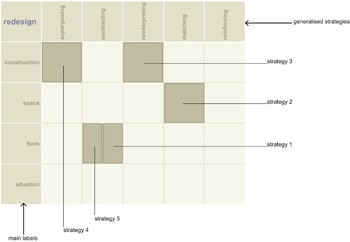
Because strategies are more abstract than both previous components, finding labels to describe them is far from trivial. Selecting labels to retrieve strategies is also hard because it is not always clear what one is looking for. Therefore, we have opted for ordering the strategies relative to one another instead of using labels. On the one hand, they all determine to some degree how the existing building will be affected. On the other hand, they cover a wide range of different design dimensions. Therefore, we have opted for a matrix because this allows visualizing both determining factors. Possible strategies range from reinforcing the characteristics of the existing building to contrasting these, currently divided in five classes that are placed on the horizontal axis. The four main dimensions can be placed vertically. To locate a strategy in the matrix, one first determines to what extent it affects the existing building by comparing it to the five possible classes. After that, the dimension of the strategy determines its location on the other axis.
At the strategic level, providing detailed descriptions of specific strategies used in a design project should enable designers to browse projects or separate lines of thought so as to understand the exact meaning of a strategy in a specific context. Ultimately, however, these strategies are meant for reuse in new design situations. Therefore, users should consider the generalizable and essential content of the strategy, a skill acquired through experience. To help novices practice this skill, strategies are generalized across multiple projects. Summarizing these generalizations in a matrix creates a provocative and interactive guide for new projects (Fig. 3). By organizing this summary according to the four dimensions, users can focus on just those strategies they consider most relevant. In the matrix, the vertical axis enumerates the generalized strategies; the horizontal axis can represent the different dimensions; the dark parts represent strategy–dimension combinations already available in the collection; the light parts highlight combinations to be explored in future projects. This way, the matrix maps the different sorts of rationale that are developed in this early design phase.
The matrix of redesign strategies. The horizontal axis enumerates the generalized strategies; the vertical axis can represent the subject, scale, or level of abstraction. The dark parts represent combinations of which examples have been recorded previously, and the light parts represent combinations that are not yet available. [A color version of this figure can be viewed online at journals.cambridge.org/aie]

5. PRELIMINARY EVALUATION
We can now assess to what extent this approach succeeds in passing on design rationale, by reporting on how the design processes captured and represented were appreciated by architects and students at different levels of expertise. The three-component representation of three real-world competition designs has been implemented in a Web-based online repository and, by way of exploratory evaluation, presented to assessors with different backgrounds: four architecture students, three practitioners and four academics. They first explored the repository and its contents during a short period of time, and were then given an evaluation form on which they could “mark” several aspects of it. After that, they answered some questions and were given the chance to make comments. The feedback reported here does not elaborate on the interface of the repository itself; it concentrates on how the representation was developed and how its components were received.
We first confronted the architects who had participated in the competition designs with our representation of their design process. Except from some elements they consider more important than shown in our representation, they generally value the accuracy and detail in which the content of their design process is represented. But, also, the students and architects who were not involved in the design process have supportive comments. Across the board, the mechanisms to structure the information are well received. One person likes the fine grain of the information (chunks, lines, and strategies): “with the chunks and lines already a lot of information is available in an easy way,” in contrast to an analysis described in a lengthy text. Another person is very positive about the transparency entailed by the system of chunks, lines of thought, and strategies. Several mark the lines of thought as the most powerful of the three; the fact that they address conceptual elements and not just physical or technical facts is particularly appreciated.Footnote 10
Most comments about the strategies were also positive. They are considered useful to compare different projects. One person says: “What I think is very strong—and from the beginning I thought this was a very good idea—is the matrix with strategies; that is something terrific.” The matrix provides an overview of all possible strategies and highlights that are used in the design processes recorded so far. Regarding the representation of the strategies, several assessors find it harder to understand what the abstract matrix represents though. One evaluator is more precise and explains: “The strategy search is more difficult to use than the process search, since it is more abstract than the concrete lines of thought. The main strategies ‘superposing,’ ‘matching,’ etc., are very useful though.” Another one agrees that “The concepts itself are interesting, and the individual strategies too, but the keywords [labels] are less meaningful in this case. The connection to the line of thought is very interesting again. (…) The strategies do not necessarily have to be related to the keywords, since one can find these through searching the line of thought.”
On the whole, the feedback from architects/designers in different contexts and at different levels of expertise supports the use of these components in explaining architectural (re)design processes. Which components will be used most and how will probably vary with personal preferences. The way of labeling the information was less well received, and clearly shows room for improvement. Across the board, however, our findings seem to suggest that recording and representing design processes in this way could help student, novice, and even experienced architects in building up a richer repository of design experiences to draw from during design.
6. RELATED AND FUTURE WORK
We described our three-component design process representation and reported on a first evaluation by various user groups, so this final section compares the approach to related work and outlines challenges for the future.
The relation to Suwa and Tversky's (Reference Suwa and Tversky1997) dependency chunks and Lawson's (Reference Lawson1997) lines of thought has already been pointed out above. More than 20 years earlier, Horst Rittel developed the issue-argument model, which decomposes problems into “issues,” phrased as questions, and arguments to support or contradict these issues (Kunz & Rittel, Reference Kunz and Rittel1970). Both elements are covered by the chunks in our representation. The “questions of fact” (solved by experts in or outside the design team) can also be represented in a chunk by means of an analysis or decision. In addition, a chunk can contain a question, intention, observation, analysis, reference, association, interpretation, evaluation, decision, or synthesis. The problem area or “topic” in Rittel's model, about which a discourse develops by means of issues and arguments, can be compared with the lines of thought. In our representation, one topic can be covered by several lines of thought though. The strategies for their part do not seem to have a counterpart in Rittel's model.
What does seem to have a counterpart, however, is the intention to use the model as a basis for design support. Rittel developed his model into the Issues Based Information System framework, which enables teams to decompose problems into questions, ideas, and arguments, to better deal with wicked problems. Similarly, our three-component representation ultimately aims at supporting student and professional designers in reusing design rationale from previous design processes.
Another approach worth mentioning here is Christopher Alexander's (Reference Alexander1977, Reference Alexander1979) Pattern Language, which is meant for use by the whole community to guide the design of regions and towns, neighborhoods, (clusters of) buildings, rooms and alcoves, and finally the details of construction. This language is composed of so-called patterns, which link a problem and a solution. Patterns cover large and small-scale considerations, treat several design topics, and are linked to patterns “above” (of larger scale) and “below” (of smaller scale) them as part of an extensive network.
Each pattern has a particular structure: concise problem statement, problem elaboration and illustration with examples, concise guideline on how to avoid the problem and to create a qualitative solution instead. The main structure of the patterns is similar to that of the lines of thought in our approach. Still, the patterns only show the way between a specific problem and its solution, whereas the lines of thought are broader in setup.
The most important difference between both approaches is that Alexander proposes his patterns as heuristics that apply in a large number of situations. Although Alexander gives plenty of examples the patterns are said to be usable in any context. The key of the language is that it presupposes a generic solution for each of the problems encountered. Our chunks and lines of thought only show one example where a certain consideration was decisive in a specific context. Other designers can reuse this consideration, but it is definitely not presented as being beatific. Moreover, the examples can only be brought to another context after being reinterpreted for the situation at hand.
The patterns are formulated such that they define how certain elements should be designed. It uses the imperative. This differs to a great extent from our approach: we only show how things can be done, and how the related decisions are argued upon, but always leave room for alternative approaches.
Alexander also envisages the use of the patterns in design practice. The language proposes to select a sequence of patterns in the book, following a prescribed procedure. These patterns are followed from large to small scale to create a design proposal. In doing so, the language structures the complete design process. Our approach does not try to guide the complete design process, but leaves room for the preferences and habits of individual designers.
By giving each of the patterns a “quote” for its significance, Alexander incites users to improve, adjust, or extend patterns. This idea of a growing collection overlaps with our approach. Moreover, the language was recently translated into a digital online version (Alexander, Reference Alexander2001), which shows similarities with our online design process repository.
To extend this repository into a genuine design rationale capturing tool to record decisions while they are taken, a considerable amount of development is required. This is currently not our main objective though. Although the workload involved in capturing design processes by the mechanisms described above is considerable, we also see advantages in explicitly deriving the rationale from the collected data. Doing so generates an awareness of the process that would be less available in an automatic capturing system. It stimulates reflection on both design content and process, thus (supporting) the process of reflection in action as advocated by Donald Schön (Reference Schön1983). Moreover, the post hoc capturing mechanism allows filtering the masses of information that are being produced during the design process.
If we want the repository of design processes to grow substantially, a possible strategy, therefore, would be to involve architecture students and architectural interns in the capturing activities. In many architecture schools, analyzing exemplary buildings is a common assignment before starting a design assignment. Confronting students with experts in the field during the design process would enable them to collect much more information than in retrospective analyses. The workload involved in the process can be divided: the architects can concentrate on the design and regularly report progress to the students; the students concentrate on collecting and translating the information in the format of the repository. Conducting the analysis post hoc also implies that capturing the rationale does not interfere with the creative design activity. This interference, as for example shown in the discussion on the protocol analysis, can be problematic in the architectural design process. At the end of the process, the architects can give feedback and make adjustments where necessary, which should prevent misinterpretation of the collected data.
A repository of design cases is only as valuable as the cases it contains. The approach described here can only be used in a design context when the repository contains enough cases for users to make it worth a visit. A first task is thus to start up the procedures for collecting more redesign data. As mentioned above, this includes student involvement as well as involvement from practice. Eventually, it will allow using the tool in a design context, which will result in a more extensive evaluation, which in turn, will engender more research.
To further develop this approach, however, a more comprehensive evaluation is needed first. Such evaluation should allow revealing the assets and shortcomings of our components when used more intensively. A second challenge is convincing both architectural practice and education to participate in this endeavor. However, the experiences with Building Stories, which also relies on the participation of students, interns, and practitioners, are very promising in this respect (Heylighen & Martin, Reference Heylighen and Martin2005).
Jonas Lindekens received his MSc (1998) and PhD (2006) degrees in architecture and engineering from Vrije Universiteit Brussel (Belgium) and his MArch (1999) degree in architectural design from The Bartlett School of Architecture at University College London. He is currently a parttime Guest Professor at the Vrije Universiteit Brussel where he is tutoring the studio work and research of the final year students. Dr. Lindekens' research studies design methods used for the redesign of buildings. He has recently founded his own design office ONO architectuur (in collaboration with Gert Somers), which will engage in both design and research projects in architecture.
Ann Heylighen studied architecture and engineering at K.U. Leuven and ETH Zürich. After obtaining her MSc (1996) and PhD (2000) degrees, she conducted research at K.U. Leuven, Harvard University, and the University of California, Berkeley. Since 2006 she has been an Associate Professor in the Department of Architecture, Urbanism, and Planning in Leuven. Currently, her research and teaching focuses on fostering more knowledgable ways of designing, especially in the context of inclusive design.