During recent decades, sociologists of science have paid attention to the study of scientific controversies, particularly those with strong political and ethical overlays. The main reason for this attention is that both public policymakers and the general public need properly to understand how scientific reasoning works in controversies in order to have a common social understanding of the consequences of some scientific applications.Footnote 1
Despite this interest in the study of unresolved scientific controversies, which are particularly useful for historians of science as case studies to explore and learn about the making of science, there has been one form of conflict that has been less explored: conflict over the priority of scientific discoveries.Footnote 2 The main reason for not paying attention to priority conflicts is that such arguments have been generally recognized as a natural and inevitable part of social relations between scientists. Indeed, priority disputes were the only area of controversy which effectively fitted with Merton's norm of universalism, one of the central characteristics that Merton employed to describe scientific activity.Footnote 3
As Merton pointed out, scientists not only know but fear that discoveries are often made independently, and this knowledge activates a rush to ensure priority. However, he understood these conflicts largely to be a consequence of the institutional values, norms and organization of science, as they would exert pressure on scientists to assert their claims. In other words, recognition for originality was, for a scientist, a symbol and reward for having done his or her job well, for it would be originality that did most to advance science.
But disputes over priority may also be understood to be strategies to gain prestige, legitimacy and power at critical moments. In order to demonstrate this feature of priority disputes, this paper focuses on the public confrontation between Josep Comas i Solà (1868–1937) and Eugène Michel Antoniadi (1870–1944) regarding some of their astronomical observations and theoretical conclusions about Mars and Jupiter. As this case study will suggest, such disputes took different forms and gained notoriety depending on several aspects such as the specific practices of the field, the constitution of local communities, the rhetoric employed, the material culture involved in the debate, and the expected behaviour of scientists.Footnote 4 Overall, in this case, successful priority claims were particularly important to acquiring authority over specific astronomical fields and to joining the international astronomical community that was being reorganized at the time, mainly as a consequence of the rise of astrophysics.
Astrophysics and the reorganization of the astronomical community
The development of astronomy during the late nineteenth and early twentieth centuries was mainly governed by the emergence of the new field of astrophysics, which materialized as a discipline during the second half of the nineteenth century as a result of the application of new techniques such as spectroscopy and photography to astronomical observations.Footnote 5 These innovative applications to astronomy, which opened the doors to a new understanding of the heavens, owed much to amateur astronomers.Footnote 6 In fact, the new astrophysical techniques were first developed outside the universities. Originally the techniques were not associated with theoretical investigations, but with the design, construction and use of new specialist equipment.
The freedom that amateur astronomers of a comfortable financial status had to take risks in speculative and experimental research provided a major boost to the development of these new astrophysical techniques, particularly in Great Britain and the United States of America.Footnote 7 Indeed, it was wealthy amateurs such as Warren de la Rue, Isaac Roberts, Henry Draper and Andrew Ainslie Common who from the 1860s developed the research technology for the study of the physical and chemical nature of stars and planets.
These elite amateurs regarded the work of institutional astronomers at national state-funded observatories, which was mainly confined to the observational confirmation of celestial mechanics, as too tedious to undertake. For example, writing about the construction of his private observatory in 1856 at Tulse Hill in South London, William Huggins recognized his dissatisfaction with the routine nature of ordinary astronomical work. For amateurs, the possibility of research by new methods meant an exciting opportunity to discover the nature and chemical constitution of heavenly bodies. Indeed, wrote Huggins, amateur astronomers felt as if they had the possibility in their hands ‘to lift a veil which had never before been lifted’, a key to ‘unlock a door which had been regarded as forever closed to man – the veil and door behind which lay the unknown mystery of the true nature of the heavenly bodies’.Footnote 8 So wealthy and motivated amateur astronomers began directing spectroscopes, spectrographs and photographic telescopes to the heavens to learn about the physical and chemical nature of celestial bodies. This meant amateurs taking major initiatives in the study of double-star astronomy; the nature of nebulae; and lunar, solar and planetary surfaces.Footnote 9
A good example of how astronomy was gradually changing is the crisis of the world's few existing university astronomical observatories in the 1870s, as a result of the lack of adaptation to astrophysics. New facilities, staff and training were required to engage in this new field of astronomical research that had been opened by amateur astronomers. In Great Britain and the United States of America in the 1880s, most of these amateurs were to play a crucial role in revitalizing astronomy not only as practitioners, but also as benefactors, boosting a shift of fundamental research and instruments from amateurs to different institutions, particularly universities.Footnote 10 The strength and initiatives of amateurs, together with the stimulus of the instrument industry, favoured the application of new techniques and methods to university observatories in these countries, as opposed to the very slow and limited response to astrophysics in countries such as France.
French amateur astronomers, however, were also to play a crucial role in the revitalization of astronomy, particularly as a result of the dramatic consequences of the political instabilities of the first half of the nineteenth century, which had meant a reduction in the number of French astronomical observatories that were active during the late eighteenth century from thirty to only two: those of Paris and Marseille.Footnote 11 In particular, the ambitious popular astronomy programme set up by the acclaimed astronomer and popularizer Camille Flammarion, which promoted the ideas both of cooperation between amateur and professional scientists and of the significance of amateur contributions to the progress of science, proved highly successful.Footnote 12
Consequently, the late nineteenth century saw the doors of scientific expertise and authority opened to a new and highly heterogeneous group of astronomy scholars, including not only physicists and chemists, who played an important role in the progress of astrophysical research,Footnote 13 but also amateurs with no formal academic training at all. Indeed, while the turn of the century witnessed a gradual professionalization of astrophysics – mainly through the foundation of new astrophysical observatories and the rise of specialized astrophysical literatureFootnote 14 – astronomy became involved in a process of reconfiguration that affected not only its institutions, but also the international community of astronomers.Footnote 15
In fact, while the influence of amateurs grew rapidly and amateur astronomers gained authority and prestige, a tension arose between professional and amateur astronomers. This tension was ultimately related to such issues as which individuals should be credited as being the utmost authorities in astronomical knowledge, whom the public should rely on, what research projects should be developed fruitfully under government funding, and so on.
Therefore the rise of astrophysics and the subsequent reconfiguration of astronomical research opened the doors for select scientists to join the new international community of astronomers that was taking form. In this sense, priority claims and other public disputes have to be understood as exceptional opportunities for scientists, particularly those from scientifically and technologically marginal countries, to achieve a relevant position, gain scientific authority and secure an influential position within the new international community being reorganized.Footnote 16 At the same time, gaining recognition among the international community helped these scholars to reinforce their position in their local contexts. Such recognitions of originality were socially validated testimonies that verified that one had accomplished the expected requirements of a scientist, particularly relevant to these scholars in countries away from the centres of production of knowledge.
These arguments are perfectly illustrated in the case of the Spanish astronomer Josep Comas i Solà, who in the 1910s publicly argued with Eugène Michel Antoniadi about the veracity of several observations of Mars and some other theoretical considerations about the nature of its canals.Footnote 17
Comas i Solà versus Antoniadi
Comas i Solà (Figure 1) achieved great popularity as an astronomer in Spanish society during the early 1890s, both for his regular popular astronomy contributions which appeared from 1893 in the Catalan newspaper La Vanguardia and for his various original contributions to astronomical knowledge, which were recorded and published in such scientific periodicals as L'astronomie.Footnote 18 He was publishing on solar, lunar and planetary observations, as well as some observations of stars and nebulae, in this journal in his late teens, when he also began his university degree in physical and mathematical sciences at the University of Barcelona.
Josep Comas i Solà.

From 1897 to 1899, Comas i Solà worked on a regular basis at the Catalan Observatory, a private observatory founded in 1894 by Rafael Patxot Jubert at San Feliu de Guíxols. Here he made several planetary observations, mainly of Mars, Jupiter and Saturn, and a catalogue of 156 double stars, with the 22 cm aperture refractor made by Mailhat and a spectrograph and a micrometer attached to the visual and photographic equatorial. After this period, he established his own private observatory at his home in Barcelona. Comas i Solà’s astronomical work over these years transformed him into one of the most promising figures in astronomy not only in Spain, but also in the international context, as one of the protégés of the renowned Flammarion.Footnote 19
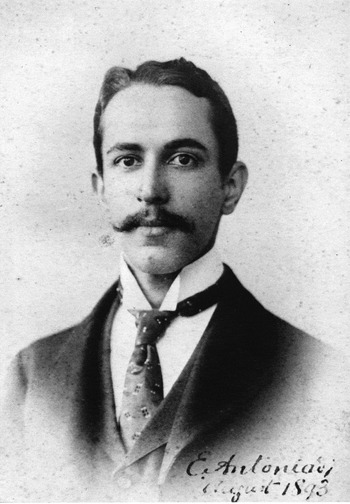
Born in Constantinople and trained as an architect, Eugène Michel Antoniadi (Figure 2) had also already gained a high standard of astronomical knowledge by his late teens.Footnote 20 In his early days, he also established a significant network of contacts, including Flammarion, and published some papers in the Journal of the Liverpool Astronomical Society.Footnote 21 In 1890 Antoniadi became one of the founder members of the British Astronomical Association (BAA). One year later, he became member of the Société astronomique de France and in 1892 he participated actively in the creation of the BAA Mars Section – becoming its director in 1896.
Eugène Michel Antoniadi (Royal Astronomical Society Library).

Camille Flammarion soon realized what a talented astronomer Antoniadi was and offered him a position as assistant astronomer in his private observatory in Juvisy. In 1893 Antoniadi accepted the offer and emigrated to France, signing a contract stating that his astronomical observations had to be programmed and published by Flammarion, although he could still publish a few of his own articles on his work. This contract, as will be shown, may have become a significant obstacle to Antoniadi's aspirations during later years.
Both Antoniadi and Comas i Solà were highly ambitious astronomers, extremely interested in raising their status and achieving scientific authority and social prestige. Their personal interests soon clashed, as the public discussion they had in the early 1910s proves. The controversy unfolded on the pages of BAA public reports and publications. The BAA had been founded in 1890 as an alternative to the Royal Astronomical Society to cater for those who found the subscription to the Royal Astronomical Society too high, or the papers excessively technical, or who, like women, were excluded.Footnote 22 However, it soon became not only the voice of amateur astronomers in Great Britain, but also a prestigious institution for astronomical research that was well considered by many professional astronomers elsewhere in the world.
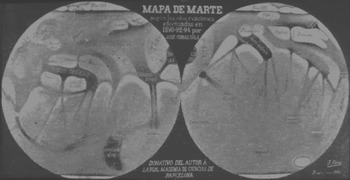
It was in an official report by the BAA Mars Section that Antoniadi criticized the observations of Mars made by Comas i Solà in 1894. After reading such accusations, the Spanish astronomer felt obliged to reply immediately to the Journal of the British Astronomical Association. Antoniadi's allegation rested on the work by William Rutter Dawes, whose observations with an eight-inch-aperture telescope had shown no evidence of the Martian Phoenix Lake. Dawes had a reputation for the acuity of his observations. Therefore Antoniadi believed that it had been impossible for Comas i Solà to observe such a well-defined lake in 1894, as the Spanish astronomer had claimed, using his telescope of four and a half inches' aperture (see Figure 3).Footnote 23
Map of Mars, from observations made in 1890, 1892 and 1894 by Comas i Solà (Royal Academy of Science and Arts of Barcelona).

When Comas i Solà replied, he defended his observations by claiming that other authors such as Arthur Stanley Williams had made similar observations in 1894,Footnote 24 and pointed out his ‘scientific sincerity, never proved worthless’ and his ‘recognised experience as an observer’.Footnote 25 In other words, it was his scientific prestige and authority that were at stake and he had to fight tooth and nail to protect them. It was crucial for any scholar seeking the respect of the astronomical community of the late nineteenth and early twentieth centuries to safeguard such values.
Why did Antoniadi become involved in such a sudden attack on Comas i Solà, about fifteen years after these observations had been reported? Antoniadi's correspondence suggests that this public argument had its roots in professional jealousy and personal resentment. Moreover, there were other aspects involved, such as the violation of specific protocols and the codes of behaviour that were expected to rule scientific practice.
The origin of the rivalry between these two authors may be found in the following words of Comas i Solà about the discovery in 1901 of the aureole around Nova Persei:
Flammarion attempted to photograph the Nova in August 1901, and obtained a special image, consisting of a small bright circle like other stars have, but surrounded by a luminous fog. Analysing the origins of this fog, it turned out to be untrue, but derived from the lack of achromatism of the lens; but even though the cloud that appeared in the negative was not real, it indicated that the Nova emitted a particular genre of radiation, in other words, that the Nova was a different star from the others.Footnote 26
Antoniadi felt highly offended after reading these words. Such a finding had been one of the most important and interesting astronomical discoveries made at the turn of the century and he had been the person who had observed and photographed it. But Comas i Solà had not mentioned his name, even though Flammarion had published the paper on the discovery together with him and therefore recognized the important role that he had played in it.Footnote 27 As Antoniadi wrote to the Spanish musician and amateur astronomer Salvador Raurich i Ferriol in 1909,
It has been for a long time that I have noticed from Mr Comas Solà a feeling of jealousy towards me. Thus, although I discovered the optic aureole surrounding Nova Persei in 1901, a discovery that was published under the names of Flammarion and Antoniadi, as it was made at Flammarion's Observatory, Mr Comas Solà said, in his book on astronomy, that it was Mr Flammarion who discovered such a fact, without mentioning my name … Eliminating my name, Mr Comas Solà alters the truth.Footnote 28
Indeed, this incident between Flammarion and Antoniadi on the discovery of Nova Persei's aureole might have been decisive in the conflicts in which both astronomers were constantly immersed, as pointed out by McKim, who suggests that it may have led Antoniadi to resign from his position at Juvisy in 1902. However, Antoniadi confessed his resentment towards Flammarion for signing the article on the photographic aureole surrounding Nova Persei, the latter having almost no knowledge of photography and being convinced by Antoniadi that the nebulosity photographed around the star was not real.Footnote 29
All in all, it is very difficult to know the reasons why Comas i Solà omitted Antoniadi's name in his account of the discovery of Nova Persei's aureole. However, as the following lines suggest, one may identify direct competition between two astronomers who had been among the most promising figures in astronomy, both protégés of Flammarion. Now in their late thirties and early forties, they wanted to consolidate their status as recognized scientists and become the sole successor to Flammarion's scientific authority.
The Martian canals
By the time Salvador Raurich received Antoniadi's letter in December 1909 complaining about how the discovery of Nova Persei's aureole had been presented in Spain, Antoniadi was fully immersed in an international controversy regarding the illusory character of the canals of Mars. During the late nineteenth century, highly influenced by the work of the Italian astronomer Giovanni Virginio Schiaparelli and the American astronomer Percival Lowell, many observers adopted a conventional mode of drawing Mars that was characterized by the use of straight narrow lines. Although this influence was present in most drawings, some astronomers questioned the form and nature of the canals, mainly due to their broad and diffused appearance.Footnote 30 A good example is found in the sarcastic words of the prestigious American astronomer Edward Emerson Barnard when receiving the Gold Medal of the Royal Astronomical Society in 1897:
I have carefully observed, drawn, and measured the surface markings of this planet [Mars] with the thirty-six-inch [telescope] during the past two oppositions. I have also examined a great many drawings made of it with all kinds of telescopes, and must confess that I have been amazed at some of the details shown on many of these drawings. I must confess also that in many respects it seems proved, if we are to take the testimony of the drawings themselves, that the smaller the telescope the more peculiar and abundant are the Martian details.Footnote 31
Barnard was indeed well known for how humorously he dealt with reports speculating about the real nature of Martian canals and the possibility of intelligent life on Mars.Footnote 32 The controversy over Martian canals had originated in 1877, after Schiaparelli had reported the discovery of an extensive system of canali on Mars with an eight-inch-aperture refractor. During the following years, an increasing number of observers reported canals and new theories on their nature were developed. The astronomical community would become divided into those who enthusiastically endorsed and provided some support for Schiaparelli's canals and those who rejected and objected to these observations.Footnote 33
The 1890s saw a few astronomers, such as Antoniadi, emerging as fierce opponents of Schiaparelli's Mars, explaining the observations of canals in terms of optic illusions arising from erroneous telescopic focusing and misleading perceptions of the eye. For example, Vincenzo Cerulli argued for an optic origin of the canals, which received the support of astronomers from several countries, including Comas i Solà in Spain.Footnote 34 But even when, by the turn of the century, the observations and theories concerning the origin and structure of the canals were being challenged by the astronomical community, the observations and ideas developed by Lowell and his allies would survive such attacks.Footnote 35
The debate on the nature of Martian canals heightened further with the Mars opposition of 1909, particularly after Antoniadi published his observations of the surface of this planet with the Meudon Observatory's thirty-three-inch refractor. Antoniadi's observations established that the geometrical nature of the network of canals described by Lowell was an illusion – only later would he argue that it was the result of the eye straining to see myriads of unresolved details, or giving illusory hard edges to the intersections of half-tones of different intensity.Footnote 36
While some astronomers quickly praised his work, others attacked Antoniadi on the basis of his lack of ability to pursue high-quality astronomical observations. Was he a reliable observer? At the same time, as no trace of canals had been detected using a large telescope, did this really mean that they did not exist? Was there a limit to aperture efficiency which, once surpassed, reduced the power of the lens, meaning that large telescopes were not appropriate for planetary observations? There were several aspects Antoniadi had to deal with before he could be seen as the individual who had brought an end to this long-lasting controversy. And he soon had to add another front to his battle: Comas i Solà’s claims of priority about the discovery of the illusory nature of Martian canals.
In private, Antoniadi would bitterly complain about how the feelings against him had moved the Spanish astronomer to raise such claims. In fact, Antoniadi argued that the article published on 4 November 1909 by Comas i Solà in the Catalan newspaper La Vanguardia, one of the articles that the Spanish astronomer used to claim priority and in which he dismantled the theory of the Martian canals, had been printed forty days after he had published the first of his articles on the same issue in the Greek journal Athenae.Footnote 37
The publication of such articles in general newspapers was fairly common; Mars and the nature of its canals attracted the attention not only of scientists, but also of the lay public. In fact, the second half of the nineteenth century witnessed Martian canals becoming a widely discussed topic in popular lectures, often at the request of a curious audience who wanted to know whether there was life on Mars. This possibility, supported by many scholars and explained to the lay public by popularizers of science, largely aroused and enraptured the public imagination.Footnote 38 As the Irish astronomer and popularizer of science Robert Stawell Ball stated in one of his 1898–1899 Royal Institution Christmas Lectures on the canals and the possibility of intelligent life on Mars,
We really know nothing of them [the inhabitants of Mars]. They may be five feet high, or five inches high, or fifty feet high … The inhabitants on Mars may be more like birds or fishes than like men or women … I never expect to know anything beyond just this – that Mr. Lowell's observations appear to show that work conducted by intelligent agents is at present in progress on Mars.Footnote 39
Thus the discovery of the illusory character of the Mars canals was destined to have a major impact not only on scientists, but also on the general public. Before Antoniadi's observations, Comas i Solà had presented Martian canals as mere fictions in his popular works. As he pointed out in an article published in La Vanguardia on 16 August 1903, he was certain that Martian canals did not exist; they were false and subjective visions created by the imagination of observers or by optic illusions.Footnote 40 Such a conclusion had been presented to the international astronomical community two years earlier, being published in the Bulletin de la Société astronomique de France. Having reported a plausible scientific explanation for these illusory visions, why should he not be recognized as the person who had provided definitive evidence that Martian canals were not real?
Both Comas i Solà and Antoniadi knew that whoever's priority claim was recognized would secure his scientific authority and social prestige. Antoniadi himself acknowledged this when he ascertained that among his opponents in the controversy over the nature of Mars canals was his former master Camille Flammarion. In Antoniadi's words, Flammarion's reluctance to accept the results of his observations was due to Flammarion's wishes ‘to remain the great Martian authority’, avoiding a ‘dangerous invasion of his prerogative’.Footnote 41 If the canals were not real, as many astronomers believed, scientists and the general public had to honour a new authority in this field. Without a doubt, such a renowned position was very tempting for any astronomer – particularly if, like Antoniadi, they had no academic degree and wanted to secure their position and career in astronomy.Footnote 42
As soon as he made his observations from Meudon, Antoniadi published his results and began exchanging correspondence with some of the most prestigious astronomers, such as Barnard, Lowell, Schiaparelli and Williams. He thought such an exchange of information was crucial to support his ideas and to dispel any resistance. Antoniadi was also convinced that this network of contacts would help him in his conflict with Comas i Solà, a conflict that he wanted to elucidate in England,Footnote 43 one of the main centres of production of astronomical and astrophysical knowledge at the time and where he had made a name for himself among amateur astronomers.
Indeed, the public dispute between Antoniadi and Comas i Solà in the Journal of the British Astronomical Association described earlier in this paper should be understood in this context. When Antoniadi suggested that Comas i Solà’s lack of reliability as an astronomer had been indicated by the reporting of fraudulent observations, his main objective was to discredit the Spanish astronomer before the international astronomical community.Footnote 44 This strategy was seen as crucial in order to be recognized as the discoverer of the illusory character of Martian canals and secure his designation as the most competent authority in the field.
Antoniadi refrained from introducing other aspects to the debate, such as the quality of the telescope employed by Comas i Solà to pursue his observations, even though he believed that such an argument was strong enough to attack his opponent. Antoniadi certainly commented confidentially in his private letters how most French glasses, like the one employed by Comas i Solà to observe Mars, were seldom of good quality. Nevertheless, his public statements mainly relied on the skills and abilities of a previous generation of prestigious observers such as Wilhelm Wolff Beer, Johann Heinrich von Maedler and William Rutter Dawes, who saw no evidence of canals on Mars with similar or larger-aperture telescopes, to discredit Comas i Solà’s observations.Footnote 45
Salvador Raurich and the controversy in Spain
Scholars involved in controversies pursued their cases not only within the scientific community but also in the public sphere, in relation to strategies of the popularization of science, the engagement of political ideas and so on. To battle in all these fields, scholars consolidated networks of support – formed by both professionals and amateurs – that campaigned in their favour and against enemies. In the case of the dispute between Comas i Solà and Antoniadi, the latter relied on some of his most devoted and enthusiastic colleagues to keep battling in these different arenas.
In Spain, it was the amateur astronomer Salvador Raurich who defended Antoniadi's ideas and publicly argued against Comas i Solà. Raurich had, indeed, a significant presence in the Spanish public sphere through his articles published in such periodicals as Por esos mundos and Nuevo mundo. Moreover, the early years of the twentieth century had seen the division of the Catalan community of astronomers into two groups centred around the figures of Comas i Solà and Eduard Fontserè.Footnote 46 Raurich, who belonged to the latter faction, was the secretary of the Astronomical Society of Barcelona – an association founded in January 1910 that Comas i Solà unsuccessfully attempted to control.Footnote 47
The foundation of this society was the excuse for tensions to come to a head and conflicts to crystallize. A few months after the foundation of the Astronomical Society of Barcelona, Comas i Solà accused Raurich of campaigning against him and his observations of Mars in the society's journal. As the references were not explicit, the Governing Body of the Astronomical Society (to whom Raurich belonged) requested Comas i Solà not to feel affronted by Raurich's comments. However, Comas i Solà did not accept this advice and announced his rupture from the society, which he thought had been set up specifically to antagonize him.Footnote 48 One year later, the Astronomical Society of Spain was founded, promoted and presided over by Comas i Solà.
Antoniadi instructed and carefully gave details to Raurich about the main points in his dispute with Comas i Solà on the nature of Martian canals. He explained how, even though Comas i Solà may have had the original idea in 1901 of identifying the duplication of canals on the Martian surface with contrast phenomena, nothing else he said added to what had already been proposed in the 1890s by authors such as Edward Walter Maunder and Vincenzo Cerulli, who argued that Martian canals were formed by the combination and integration of stains.Footnote 49
Antoniadi claimed that his observations not only proved that the canals were combinations of irregular stains arranged in different ways, but also both confirmed the illusory nature of the geometric network of canals described by Lowell on the surface of Mars and established the absence of canals on Mars. He also complained in a private letter to Raurich about Comas i Solà publishing an article in 1909 on the evolution of Bathys, one of the canals represented by Lowell, which he dealt with as if it had been real.Footnote 50 Antoniadi was convinced that it had been only when Comas i Solà found out about the unsuccessful attempt to observe the Martian canals at Yerkes Observatory, and after reading the results of Antoniadi's observations, that he claimed priority in the non-existence of canals on Mars, with an attitude which may have resembled, as he pointed out, ‘that of the jackal walking behind the lion, in the hope of licking some bone’.Footnote 51
For Antoniadi, the dispute was not only about who had first stated that the canals on Mars were not real, but also about how this could be demonstrated and what experimental method of discovery would be accepted by the scientific community. Here, one is tempted to identify Raurich's arguments supporting Antoniadi's claims with a wider controversy involving the importance of small-aperture telescopes and the hypothetical weaknesses of large telescopes for planetary observations: the failure of large telescopes to observe specific planetary marks was said to be a consequence of the reduction of the power of lenses exceeding an existing limit to aperture efficiency.Footnote 52
Such a debate, which took place during the final decades of the nineteenth century and the early years of the twentieth, had brought some amateur astronomers such as the British William Frederick Denning into confrontation with professional astronomers who had gradually become involved in work with large refractors, such as the American Charles Augustus Young.Footnote 53 Antoniadi, who already had an extensive network of supporters among amateur astronomers, might have attempted to convince professional astronomers from the international astronomical community that his observations, made with a large-aperture refractor, were the only ones that were valid to demonstrate the illusory nature of the Martian canals, dismissing the same conclusion achieved by Comas i Solà, as it was obtained using a small-aperture telescope.
Furthermore, Antoniadi encouraged Raurich to attack Comas i Solà’s reputation as an observer, in similar terms to what he had done at the BAA. He insisted that it was impossible for Comas i Solà to have seen the Martian feature Nix Atlantica from 1890 to 1894 while observing Mars with a telescope of four and a half inches’ aperture , as the Spanish astronomer claimed, at a time when no telescope, including that with a thirty-six-inch aperture at Lick, could show any trace of it.Footnote 54 On the other hand, Comas i Solà not only defended his prestige and the validity of his observational work in different publications and lectures, but also argued that it had been his observations of Mars and his theoretical lucubration that had greatly contributed to clarifying the issue on the false nature of the Martian canals.Footnote 55
So who deserved the right to be acknowledged as the discoverer of the illusory nature of the canals? Both astronomers felt that it was something to be decided mostly by the international community of astronomers. In order to obtain as much support as possible, both Antoniadi and Comas i Solà developed and mobilized their own networks of contacts. For example, Antoniadi's campaign had the approval of astronomers such as Denning,Footnote 56 while others like Schiaparelli and Williams were kinder to Comas i Solà.Footnote 57 In fact, Comas i Solà was fully aware that Raurich's intervention in the Spanish public sphere to support Antoniadi's observations was supported by Antoniadi himself. This is clear from the following lines that Antoniadi wrote to Raurich: ‘Today I got your second letter; also a pamphlet from Comas Solá, attempting to reply to your attack. Possibly he sent me this with the idea of intimidating me. I have only smiled on reading it.’Footnote 58
Moreover, Raurich's opposition to Comas i Solà was deliberately presented by the latter as an attack on the interests of the country. At least this is what he attempted to show to Spanish society. Indeed, science was seen in early twentieth-century Spain as a way to recover national prestige and reputation in an international context. Spanish governments aimed to project a new image of the country abroad, mainly in pursuit of capital for the modernization of the country, which affected science.Footnote 59 Therefore the early twentieth century saw an increasingly favourable attitude towards science in Spanish society. Science was seen as the tool to modernize the country and to recover its prestige and significant role in the world.
This idea was so widespread among Spanish society that Comas i Solà soon tried to incorporate it in his public dispute with Raurich. What could be better for the country than having an internationally acclaimed astronomer among its community of scholars? Comas i Solà publicly complained that Raurich had adopted such an unpatriotic attitude towards a compatriot. Antoniadi, aware as he was that this was an important point not to be overlooked in the battle, encouraged Raurich to turn it in favour of his arguments and against Comas i Solà:
I laughed at Comas Solá’s reproach that you have no ‘amor patrio’. Does it mean love of your country, of Spain? If so, what can be said of the enclosed sentence of your opponent, where it is stated: - «De moi [i.e. de Comas Solá], de un astronome qui, quoique espagnol, a la conviction de son autorité scientifique et de sa dignité jamais dementie’? Does not Comas Solá proclaim thereby that Spanish astronomers do not have conviction in their authority, and that their dignity is always false? It is difficult to imagine any more unkind deprecation of his countrymen. His ‘amor patrio’ is simply admirable … Do not hasten to attack; rest on my arguments, which you are welcome to use as yours; and submit me your reply that I might check the weight of every word … Also, do not forget to take a patriotic attitude in the matter, so as to have all Spain with you.Footnote 60
As these words prove, neither astronomer hesitated to employ demagogical rhetoric in order to support their views and achieve their goals, if necessary. Every single word employed in their publications was carefully thought through, so as not to overstep the limits of gentlemanly conduct but with the clear intention of obtaining further support and damaging opposing ideas, even from points of view far from what had traditionally been considered purely scientific. But perhaps more importantly, these lines show how the active role of the general public in legitimating and conferring authority on scientists and their arguments was seen to be crucial by scholars in order to succeed in their scientific enterprise.
Even though most astronomers became convinced at that time that the red planet could not support any kind of intelligent life, the controversy surrounding the existence of the Martian canals remained open for the first half of the twentieth century. However, the deaths of Schiaparelli and Lowell in 1910 and 1916, respectively, helped the formation of a consensus among astronomers of the non-existence of the canals. But no ultimate recognition from the international astronomical community was achieved by Comas i Solà or by Antoniadi on their priority claims. Indeed, the definitive closure of the debate had to wait until 1971, when the photographs taken by the spacecraft Mariner 9 proved that the vast majority of canals observed by late nineteenth- and early twentieth-century astronomers had no actual relation to the surface of Mars.Footnote 61
Jupiter's Great Red Spot
Comas i Solà's rivalry with Antoniadi was long-lasting and related to other issues, such as the observations of the acceleration of Jupiter's Great Red Spot. Jupiter's Great Red Spot is currently thought to be a huge high-pressure storm, similar to a hurricane on Earth, which may have persisted for hundreds of years, changing in appearance, colour, size, intensity and rotation period. Presumably, it is driven by Jupiter's internal heat source. The large size of the Great Red Spot (about three Earths would fit within its boundaries) on Jupiter is explained by weak disturbances being absorbed by this stronger one.
Perhaps one of the main interests of Jupiter's Great Red Spot for astronomers nowadays is that it has been used to determine properties of the Jovian atmosphere that may not otherwise be established. But even today, when scientists believe that they comprehend the broad properties of the phenomenon, some features are still not understood and remain somewhat speculative – like the reddish-brown colouring of the spot, which, it has been suggested, may have something to do with certain phosphorous compounds.
This interest was also present during the second half of the nineteenth century and the early years of the twentieth, when astronomers paid remarkably close attention to the varying period of the spot's rotation.Footnote 62 In fact, some remarkable fluctuations in the motion of Jupiter's Red Spot had been detected in the first decades of the twentieth century, the rate of the spot's motion being accelerated from 9 h 55′ 41.6″ in 1901 to 9 h 55′ 33.6″ in 1914. As Denning wrote,
The visible behaviour of this marking has been greatly affected by a mass of dark material situated on the planet's south tropical bright zone and first seen in 1901. M. Eugene Antoniadi was the first to point the effect out. The tropical spot or disturbance moves with greater celerity than the red-spot (its rotation period being about 9 h 55 m 20 s) and is situated in similar latitude. As its swifter motion enables it to overtake the red-spot, the latter displays an increased speed and this continued until the tropical disturbance has passed to the westward.Footnote 63
In fact, two years before the publication of these lines, Antoniadi had claimed to be the first astronomer to draw attention to such a possibility. Such a claim was based on a letter sent to the British astronomer Andrew Claude de la Cherois Crommelin on 1 October 1902, in which Antoniadi stated how, due to the higher angular speed of this disturbance, it may ‘have communicated part of its vis viva to the Red Spot’, reducing the period of rotation of the Red Spot and therefore accounting for its acceleration.Footnote 64 This hypothesis, independently suggested by Denning that same year,Footnote 65 would have been confirmed in subsequent conjunctions by different observers.
Comas i Solà soon wrote a note to this same journal claiming that he had already published in September 1902 in the Bulletin de la Société astronomique de France the hypothesis of a ‘push’ of the disturbance on Jupiter's Great Red Spot.Footnote 66 War over who had first explained the change in the Red Spot's motion was declared. Antoniadi replied, arguing that his theory had nothing to do with a ‘push’, as Comas i Solà seemed to suggest in his note. In his response, he pointed out that his theory was completely different from that of Comas i Solà, as the acceleration of Jupiter's Red Spot was explained by real contact with a disturbance which was found on the same level as the spot. In fact, this was not what Comas i Solà had published in 1902. Antoniadi emphasized in his response the dogmatism of Comas i Solà’s assertions on the Red Spot being a solid body which floats in the atmosphere of Jupiter and, therefore, was located on a higher level than the disturbance. But if the austral disturbance passed behind the Red Spot, how were the contact and the ‘push’ produced?Footnote 67
Comas i Solà then realized that his and Antoniadi's explanations for the acceleration of Jupiter's Red Spot during its conjunction with the disturbance were, indeed, different. However, he argued that in his theory, when the austral disturbance passed behind the Red Spot, it rubbed the spot's lower part and therefore boosted it in terms of transmitting vis viva, which would produce the acceleration of the spot during conjunctions. In his opinion, and in a similar fashion to what Antoniadi claimed, later observations made by different astronomers had proved his theory. Nevertheless, his dialectical efforts were directed at making it clear that his priority claims had been in the interest of the progress of science, and therefore he concluded his note by underlining his satisfaction that such a question of priority had been able to stress a point on the physics of Jupiter which, he thought, was one of the most important related to this planet.Footnote 68
This rhetoric did not come for free. In fact, even when claiming priority was seen to be crucial for gaining prestige and authority, it could not be at any price. Persisting any further with such a controversy, particularly after Comas i Solà’s claims had been so strongly dismissed, would have led to the risk of the Spanish astronomer being identified as a problematic individual and distrustful scholar. This was particularly important in the case of astronomy, a discipline which had proven to be a remarkably versatile cultural resource and a field mainly ruled by gentlemen on both the professional and amateur levels.
Moreover, in scientifically and technologically peripheral countries like Spain, the integration of scientists in the international community was based on the establishment of personal networks of trust and credit among foreign scholars identified as relevant members of such a community.Footnote 69 Indeed, from the mid-nineteenth century onwards, Spanish scientists attempted to build appropriate networks by means of which they could establish personal relationships with prestigious foreign scholars. Such a slow process of constructing and establishing networks of trust and credit, particularly in the field of astronomy, proved crucial for the development of science in the country, as it favoured the visibility and integration of Spanish scientists and their research in the international community.Footnote 70
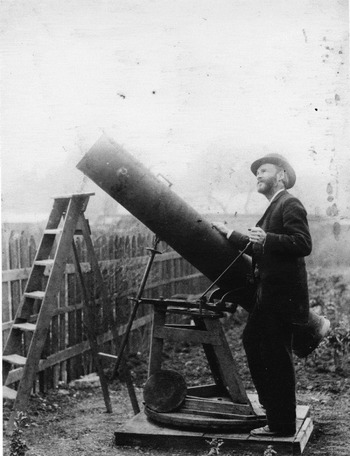
In this sense, Comas i Solà was highly concerned about the perception of his image as a reliable scientist, as an authority in his field of research whose results could be trusted by any scientist. Furthermore, he did not want to appear in the eyes of the international community as someone difficult, but rather as being concerned about the progress of science. This strategy was also pursued by Antoniadi, who, in his last note on this controversy, after explaining how the observations of prominent astronomers such as Williams, Barnard and Denning clearly supported his theory rather than Comas i Solà’s, acknowledged that, Denning (Figure 4) having been first to publish the theory he had also enunciated, Denning had to be granted the priority honours.Footnote 71
William Frederick Denning (Royal Astronomical Society Library).

Conclusion
Scientific controversies are closely related to social and cultural values that influence the practice of science. For instance, they involve issues such as scientific authority and social prestige, and in some cases may be affected not only by epistemological but also by personal and ideological disputes.Footnote 72 Thus one may argue that scientists deal with priority using a set of socio-pragmatic rules to define not only what counts as a discovery and as a discoverer, but also what conferring priority means in terms of authority, power, entitlement to celebration and so on. In this sense, the public disputes between Comas i Solà and Antoniadi may be understood in terms of their personal projects for gaining both national and international prestige, legitimacy and authority. In other words, the goal of such arguments was the development of their own scientific careers and their consolidation as relevant members of the international community.
Indeed, the personal situation of both astronomers was crucial in their decision to get involved in such public disputes. They both needed to promote their careers and reinsure their positions. For example, Antoniadi had no academic scientific training or university degree. This lack of an academic qualification had prevented him from holding a position such as the directorship of the Observatory of Athens, which he had been offered if he could provide evidence of having a degree (even honorary) from a European university. On the other hand, Comas i Solà’s pre-eminence and authority in astronomy was being challenged in Spain (in particular in his home town of Barcelona) by a heterogeneous group of professional scientists and amateur astronomers who had created the Astronomical Society of Barcelona.
They had both established an international network of contacts which allowed them not only to advertise their research and results, but also to credit and integrate them among a broader international community of scientists. Such a strategy proved highly successful for scientists from scientifically and technologically marginal countries, persuading governments such as that of Spain, by appeals to national pride and obligation, to develop policies that promoted astronomical research and the institutionalization of the field.Footnote 73 But, more importantly, these networks were also mobilized at critical moments, such as scientific controversies, to obtain support and attack opponents’ ideas.
The public nature of these disputes shaped and transformed them into social phenomena.Footnote 74 Attempts to persuade the general public were made through the use of discursive arguments, conducted in terms of dialectics and rhetoric, in order to show authority on the subject. Far from being merely ornamental, the exposition of arguments and writing style are crucial aspects both in scientific controversies and in the practice of science.Footnote 75 As this paper has shown, the rhetoric employed by scientists during public debates played an important role not only in attempting to settle controversies, but also in obtaining support from the members of the local and international scientific community.
Moreover, rhetoric was central for persuading the lay public. Scientists were fully aware of the importance of the latter in establishing social authority and fiercely fought for such public recognition. But the favour of the public could not be gained at just any cost, at least if one wanted to be seen both by experts and by the lay public as the main authority in the field. Specific codes of behaviour were expected of the scientific community, particularly in astronomy, a field that was thought to transmit great intellectual, cultural and moral values to different audiences.
Therefore, despite their open disputes and personal attacks, scientists also carefully shaped their discourses to serve the purposes of official records, appearing in such controversies as merely being concerned about the progress of science and far from their personal ambitions. In other words, the study of these public controversies and priority claims allows us not only to analyse how some uncertain issues of scientific theories are critically stressed and discussed, but also to challenge official scientific accounts of the progress of science, revealing the fragility of scientific enterprises from a scientific and technical point of view, but also influenced by social conventions and cultural values.