Agreement variation in existential there constructions is a widely attested phenomenon in many varieties of English. In these constructions, the verb can agree in number with the pivot, the noun phrase that follows it, as in (1). However, in many dialects of English, the verb may also appear with singular agreement inflection, even when the pivot is plural, as in (2). The sentence in (2a) has a plural pivot and a full, uncontracted form of the verb bearing singular agreement, in this case is. The sentence in (2b) shows that the verb may also appear as a clitic -'s, usually analyzed straightforwardly as a contraction of is.
-
(1) Agreement: There are more new subdivisions in the south side of town.
-
(2)
-
a. Nonagreement with full verb: There is basically no jobs in the industry.
-
b. Nonagreement with there's: There's only two thrift shops down there.
-
Because the verb's inflection in (2) does not correspond to the grammatical number of the pivot, we refer to this phenomenon as nonagreement.
Sentences such as those in (2), where the verb does not agree with the pivot, appear to violate prescriptive norms. However, previous studies find that nonagreeing variants account for 13% to 71% of utterances with plural pivots, often on the higher end of that range (Riordan, Reference Riordan2007). This fact contradicts our usual understanding of nonstandard variants, which tend to appear less frequently than standard variants, especially in the speech of educated, middle class speakers (Trudgill, Reference Trudgill, Bex and Watts1999). Why should the nonstandard variant predominate here? Our answer to this question involves a closer look at the different ways that nonagreement may be realized. We show, in alignment with previous work, that the predominant form used by speakers is there's, and we argue that nonagreement with the variant there's crucially differs from nonagreement with there is/was in its social and linguistic distribution.
Although there has been a great deal of work on agreement variation in existential there constructions, most production studies of this phenomenon have treated it as a binary variable, with a distinction between agreeing and nonagreeing variants. However, there is reason to believe that there's behaves differently from there is/was. First, researchers observe that the use of there's with plural pivots is lacking in social stigma (Crawford, Reference Crawford2005; Kortmann, Reference Kortmann, Aarts and McMahon2006; Squires, Reference Squires2011). Additionally, Walker (Reference Walker2007) found that although there's and there is/was are conditioned by the same linguistic factors compared to there are, the relative effect sizes of these factors differ. On this basis, Walker concluded that there's must be treated as a different variant from there is/was; the present study provides further evidence in support of the same conclusion.
We analyze new data from a corpus of English spoken in California to make the case for a three-way distinction between agreement using there are/were, nonagreement using there is/was, and nonagreement using there's. We motivate this three-way distinction by showing that the two nonagreeing variants are conditioned by different social and linguistic factors. We show that nonagreeing there is/was is more likely than either of the other variants to be used by speakers with less formal education, which is in line with interpreting this variant as nonstandard. In contrast, nonagreeing there's, while very widespread, is more likely to be found in the speech of younger people. Because younger speakers favor there's followed by a plural pivot, but not nonagreement more generally, we argue that a change in progress is underway, and that the two nonagreeing variants are on two different longitudinal trajectories. Furthermore, following Squires (Reference Squires2011:48), we suggest that there's is “moving into the standard dialect,” and that only nonagreement with there is/was constitutes the nonstandard variant.
EXISTENTIAL THERE
Variable number agreement in existential there constructions has been present in English since at least AD 1000 (Quirk & Wrenn, Reference Quirk and Wrenn1957:76) and continues to thrive in Modern English, as noted by both sociolinguists and traditional grammarians (Jespersen, Reference Jespersen1954:181–183; Quirk & Greenbaum, Reference Quirk and Greenbaum1973:419). Unlike other nonstandard grammatical features, agreement variation in existential there constructions is widespread across most varieties of English, including those considered standard. Nonagreement occurs in 13% to 71% of utterances with plural pivots, depending on a variety of factors such as the speaker's level of education and the type of determiner in the pivot (Riordan, Reference Riordan2007).
Social factors conditioning nonagreement
With regard to social factors, nonagreement in existential there constructions follows the expected patterns of a nonstandard grammatical feature in some but not all respects. On the one hand, nonagreeing forms in existential constructions are used more frequently by speakers with lower levels of education (Britain & Sudbury, Reference Britain, Sudbury, Jones and Esch2002; Meechan & Foley, Reference Meechan and Foley1994; Tagliamonte, Reference Tagliamonte1998). On the other hand, nonagreement in existential constructions also occurs frequently in formal speaking contexts, such as academic lectures (Crawford, Reference Crawford2005). With respect to sex, we might expect nonstandard features to be used more frequently by men than by women (Labov, Reference Labov1990); however, nonagreement in existential constructions does not clearly follow this pattern. While Britain and Sudbury (Reference Britain, Sudbury, Jones and Esch2002) found that men are more likely than women to use nonagreeing forms, Hay and Schreier (Reference Hay and Schreier2004) and Tagliamonte (Reference Tagliamonte1998) found the opposite pattern.
Several researchers have shown age to be a relevant factor conditioning nonagreement; they suggest that the use of nonstandard agreement in existential constructions, especially with there's, is becoming increasingly more frequent and accepted over time (Britain & Sudbury, Reference Britain, Sudbury, Jones and Esch2002; Cheshire, Reference Cheshire, Bex and Watts1999; Crawford, Reference Crawford2005; Walker, Reference Walker2007). Britain and Sudbury (Reference Britain, Sudbury, Jones and Esch2002) examined this variable in New Zealand English and Falkland Island English and found that both of these varieties, despite being isolated from each other, seem to be undergoing a change in progress toward the more frequent use of singular verb forms before plural pivots, and furthermore, that the variation in both of these varieties is conditioned by the same linguistic constraints. Based on these findings, they suggested that a shift toward singular forms in existential there constructions is common across most, if not all, dialects of English, including standard varieties. However, they did not distinguish between use of there's and there is/was, so it is unclear whether nonagreement in general is becoming more frequent in these constructions, or, as we argue here, only the use of nonagreement with there's is becoming more frequent.
Linguistic factors conditioning nonagreement
One of the most well-represented linguistic factors in previous work is the type of determiner that introduces the pivot (e.g., there's the old timers). Meechan and Foley (Reference Meechan and Foley1994) hypothesized that “strong” determiners in the sense of Milsark (Reference Milsark1977), such as definite determiners (the, these) and universals (any, all), would positively condition agreement. While this hypothesis was not supported by their study, determiner type has since been shown to have an effect on agreement patterns. Studies vary as to how determiners are classified, which determiners turn out to influence agreement patterns, and how strong the effect is. Tentatively, it seems that the form no and numeric quantifiers tend to condition nonagreement (Britain & Sudbury, Reference Britain, Sudbury, Jones and Esch2002; Hay & Schreier, Reference Hay and Schreier2004; Tagliamonte, Reference Tagliamonte1998).
Second, the polarity of the clause has been shown to affect agreement realization in copular and existential constructions. Tagliamonte (Reference Tagliamonte1998) found that, in existential constructions with plural pivots, nonagreement occurs more frequently in affirmative clauses. For example, sentences such as ‘there was many people’ were more common in her data than sentences such as ‘there wasn't many people’. In contrast, Claes and Johnson (Reference Claes and Johnson2016) found the opposite pattern. Other researchers did not find polarity to have a significant effect on agreement (Britain & Sudbury, Reference Britain, Sudbury, Jones and Esch2002; Hay & Schreier, Reference Hay and Schreier2004; Martínez Insua & Palacios Martínez, Reference Martínez Insua and Palacios Martínez2003).
Three other linguistic factors are also often included in studies on existential agreement, but they are incompatible with an analysis that treats there's as a distinct variant. First, cliticization has been treated as a factor conditioning nonagreement (Hay & Schreier, Reference Hay and Schreier2004; Meechan & Foley, Reference Meechan and Foley1994). These studies show that nonagreement is more frequent when the verb of the existential construction has undergone cliticization, that is, if there is is reduced to there's and there are is reduced to there're. However, given the design of the previous studies, it is not possible to determine whether nonagreement with there's has different conditions on its use than does nonagreement with there is/was.
A related problem arises when tense is included as a factor conditioning agreement. Several studies find that nonagreement is more likely to appear in the present tense than in the past (Britain & Sudbury, Reference Britain, Sudbury, Jones and Esch2002; Hay & Schreier, Reference Hay and Schreier2004; Meechan & Foley, Reference Meechan and Foley1994). However, as Walker (Reference Walker2007) noted, this observation reflects the fact that use of there's with plural pivots is very frequent. There's occurs categorically in the present tense, so proposing that present tense conditions nonagreement can be misleading.
Finally, Tagliamonte (Reference Tagliamonte1998) and Britain and Sudbury (Reference Britain, Sudbury, Jones and Esch2002) included subject-auxiliary inversion as a linguistic factor in their studies. However, just as there's never appears in the past tense, it also never appears in a question involving inversion (e.g., ‘ ′S there any cookies?’). Therefore, inversion cannot be included as a factor.
DATA AND METHODS
The data for the present study come from 145 sociolinguistic interviews collected between 2010 and 2012 in the cities of Bakersfield, Merced, and Redding in the Central Valley of California by graduate student and faculty researchers as part of Stanford University's Voices of California Project. The interviewees were women and men aged 18 to 93, including speakers from several different ethnic and class backgrounds. They were all native English speakers who had lived in their respective cities for the majority of their lives.
The one-on-one, audiorecorded interviews lasted about an hour and covered the same range of topics, from the speaker's experiences growing up in the city, their current day-to-day life in the city, their opinions of the city as compared to other areas of the state, and commentary on language in their city and in the rest of California. The audio recordings were then transcribed, and the resulting text transcripts searched for uses of the word there.
We collected only existential uses of there. About half of all instances of there were not existential uses, but instead locative uses where there is a place adverb, as in ‘I remember going out there and playing as a kid’. We also excluded deictic uses of there, as in ‘Here's my house, and there's Jan's house’. Excluding false starts and repetitions, we found 5865 instances of existential there constructions across all interviews. Of these 5865, we excluded tokens in which the main verb does not inflect for number, such as ain't or modals such as will or would; the remaining tokens totaled 5651. Of those tokens where agreement variation is possible, 2614 have plural pivots, the context in which almost all agreement variation occurs.Footnote 1 Finally, we excluded 70 tokens in which the verb inflecting for agreement was not copular, such as “there has been a lot of changes,” for a total of 2544 tokens.Footnote 2
In addition to coding for the agreement inflection on the verb, each utterance was also coded for the linguistic factors of polarity and determiner type. Clauses in which the verb was negated by not, -n't, never, or no longer were coded as negative; tokens with no as the determiner, as in ‘there are no jobs’, were also coded as negative. All other tokens were coded as affirmative. Determiners were classified as strong or weak: strong determiners include definite determiners (the, these, those), universals (all, any), and proper names; all other determiners were classified as weak. This includes some, many, no, a lot of, and numerical quantifiers. Bare noun phrases and noun phrases introduced by an adjective rather than a determiner were also classified as weak.
Next, each utterance was coded for social factors, including speaker age, sex, education level, and field site. Speaker education was divided into five categories: some high school, completed high school (including GED), some college (including a two-year degree or currently attending college), completed four-year college, and beyond college (including both attempted and completed graduate degrees).
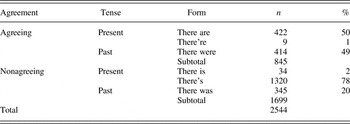
Of the 2544 tokens, 1699, or 67%, show nonagreement of some kind, and 1320 of them, or 52%, show nonagreement with the form there's. This means that the majority of nonagreement, 78%, occurs with the form there's rather than is or was. Table 1 shows how agreement varies across the present and past tenses.Footnote 3 , Footnote 4
Distribution of agreeing and nonagreeing forms in present and past tense

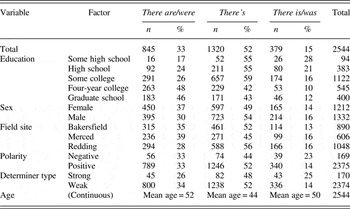
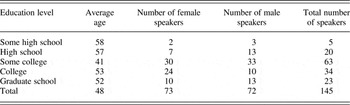
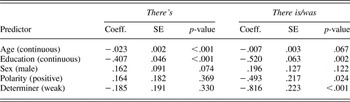
We conducted two multinomial logistic regressions in R to test the relative effects of the social factors (age, education, sex, and field site) and linguistic factors (polarity and determiner type) on the realization of the verb as agreeing, nonagreeing with there's, and nonagreeing with there is/was (Multinominal Logistic Regression, 2014). We treated level of education and age as continuous factors and all other social and linguistic factors as categorical. Table 3 in the Appendix lists the rates of all three variants across each of the social and linguistic factors, and Table 4 provides the number of female and male speakers across each education level, as well as average ages for each education level.
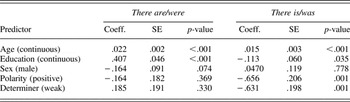
The realization of the verb served as the dependent variable, with three different outcomes. To determine how all three variants behave with respect to one another, we ran two separate regressions, one where the variant there's served as the reference level and another where there are/were served as the reference level. The first regression allows us to compare the distribution of there's with the other two variants. The second regression, where there are/were serves as the reference level, allows us to compare the distribution of nonagreeing there is/was to that of agreeing there are/were. If there's and there is/was are sociolinguistically equivalent, then we expect the same linguistic and social factors to condition their use and for them to deviate from plural agreement in similar ways. The results, presented in the next section, indicate that this is not the case.
RESULTS
The results of the first multinomial logistic regression, in which there's serves as the reference level, reveal significant distinctions between nonagreeing there's and nonagreeing there is/was. Complete results of this regression are provided in Table 5 in the Appendix. The two nonagreeing variants are used at different rates by different social groups and are conditioned by different linguistic factors. Compared to there's, the nonagreeing forms there is/was are significantly more likely to be used by older speakers and by speakers with less formal education. As for linguistic factors, there is/was is also significantly more likely than there's to occur in sentences with negative polarity and when the pivot contains a strong determiner.
The first multinomial regression also allows us to compare the distributions of there's with the agreeing forms there are/were. Neither of the two linguistic factors, polarity or determiner strength, have a significant effect. However, compared to there's, there are/were is more likely to be used by older speakers and by speakers with higher levels of education.
The direct comparison of the two uncontracted variants there are/were and there is/was is possible in the second regression model, in which there are/were serves as the reference level. Complete results of this regression are provided in Table 6 in the Appendix. The two linguistic constraints have a significant effect on the use of these two uncontracted variants. Compared to there are/were, nonagreeing there is/was is more likely to occur in sentences with negative polarity and when the pivot contains a strong determiner. Of the social factors, only the speaker's level of education has a significant effect, with there is/was being used at higher rates by speakers with less formal education. Age, however, has no significant effect. Across both statistical models, neither speaker sex nor field site shows any significant effects.
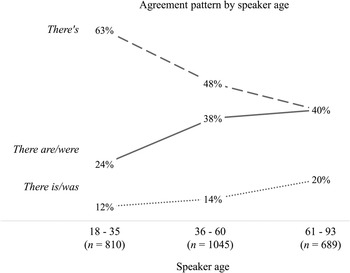
Overall, these findings indicate that the three variants are used at different rates by different social groups. Younger speakers are more likely than older speakers to use there's over either of the full form variants, whether agreeing or nonagreeing. However, in our data, age has no effect on the use of nonagreeing there is/was when compared with agreeing there are/were. In other words, younger speakers are not more likely to use all nonagreeing forms more than older speakers, only the specific nonagreeing form there's. These age patterns are illustrated in Figure 1. Although speaker age was treated as a continuous variable in the statistical analysis, in Figure 1 it is divided into three categories, roughly corresponding to generational groups, to illustrate the overall pattern.
Rate at which speakers use the three variants across three age groups.

Figure 1 illustrates that the nonagreeing form there's is the preferred variant for speakers age 35 and under, accounting for 63% of all of their tokens. For these youngest speakers, nonagreeing there is/was makes up only 12% of their tokens. In other words, the youngest speakers are five times as likely to use nonagreeing there's as they are to use the full verb nonagreeing form there is/was. Speakers over the age of 60, however, use nonagreeing there's only 40% of the time and there is/was 20% of the time, meaning that they are only twice as likely to use there's over the full form nonagreeing variant.
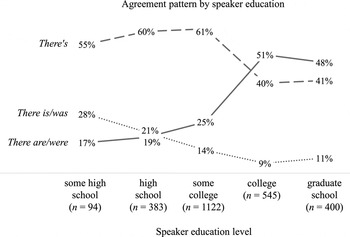
Compared to agreement with there are/were, the two nonagreeing variants there's and there is/was are both more likely to be used by speakers with less formal education. However, the two nonagreeing variants differ significantly from each other in their correlations with education—nonagreement with there is/was exhibits a stronger correlation with lower levels of education. Figure 2 illustrates the distribution of each variant across the five education levels.
Rate at which speakers use the three variants across five education levels.

The use of nonagreement with there is/was is concentrated among speakers with only a high school education (21% to 28% of their tokens), and it occurs relatively infrequently in the speech of college graduates (9% to 11% of their tokens). In contrast, the agreeing variant there are/were exhibits the opposite trend. Speakers who do not have a college degree use plural agreement somewhat infrequently, with there are/were accounting for only 17% to 25% of these speakers' tokens. Among those who have completed college, though, plural agreement accounts for 48% to 51% of their tokens, making it the most commonly used variant for this group of speakers. Although both the use of there's and the use of there is/was show an inverse correlation with education, the slope of the correlation is less steep for there's.
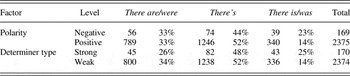
The results also demonstrate that the choice of variant is affected by both of the two linguistic factors we investigated. The agreeing variant there are/were and the nonagreeing variant there's pattern together and are conditioned by the same linguistic factors in the same direction. Both are significantly more likely to occur in sentences with affirmative polarity and when the pivot contains a weak determiner. Nonagreeing there is/was shows the opposite correlation; it is more likely to occur in sentences with negative polarity and when the pivot contains a strong determiner. Table 2 provides the rates at which each variant co-occurs with each linguistic factor.
Rate at which speakers use the three variants across different linguistic contexts

DISCUSSION
The majority of nonagreement in our data, 78%, occurs with the form there's rather than there is/was. Examining only a single category containing there's, there is, and there was would conflate these forms without determining whether they have separate properties. We have shown that the variants do in fact exhibit distinct distributions—they are used at different rates by different social groups, and they are conditioned by different linguistic factors—and therefore merit distinct sociolinguistic analyses.
Education and standardness
The social distribution of nonagreeing there is/was appears similar to other stable stigmatized features, such as alveolar ING (Trudgill, Reference Trudgill1972), negative concord (Eckert, Reference Eckert2000:109–110; Shuy, Reference Shuy1969), ain't, and invariant don't (Feagin, Reference Feagin1979:186–243); compared to the other two variants, there is/was shows a strong negative correlation with speaker education level. Speakers with only a high school education are the most likely to use nonagreeing there is/was, and they use this form more frequently than the agreeing variant there are/were. For speakers with a four-year college degree, the pattern is reversed. These speakers use the agreeing variant there are/were five times more frequently than nonagreeing there is/was. While these two variants differ starkly in their correlations with education level, age does not predict whether speakers use there is/was or there are/were. These patterns suggest that nonagreement with there is/was is an example of a stable stigmatized feature.
In contrast, the other nonagreeing variant, there's, does not quite match the typical distribution of a stable stigmatized feature. It does show a negative correlation with speaker education, but the slope of this trend is significantly less steep than it is for there is/was. Speakers with a two-year college degree or some college experience are half as likely to use there is/was compared to those without a high school degree, but they are just as or more likely than speakers without a high school degree to use there's. Also, although speakers with a four-year college degree are slightly more likely to use there are/were than there's, they still use there's relatively frequently and at a much higher rate than they use there is/was. This suggests that the two nonagreeing variants, there's and there is/was, differ in the level of standardness they convey.
Other researchers have called attention to the relative social unmarkedness of nonagreeing there's. For example, Squires (Reference Squires2011, Reference Squires2013) showed that nonagreeing there's and invariant don't differ in their perceived standardness. She noted that nonagreeing there's has “broad social acceptance, at least in informal, spontaneous spoken English” (2011:55), an impression that echoes throughout much of the literature on nonagreement in existential constructions. Hilton (Reference Hilton2016) specifically investigated the standardness of there's relative to there is. She found that the use of there is followed by a plural pivot negatively affects perceptions of the speaker's intelligence, education, articulateness, and wealth, while the use of there's followed by a plural pivot does not demonstrate an effect, relative to plural agreement. This suggests, then, that there is/was followed by a plural pivot is a true nonstandard variant, but that nonagreement with there's is different. Instead, this variant appears to be a relatively standard form in spoken English.
Age
Our second major finding is that younger speakers favor nonagreement with there's, but that they do not favor nonagreement with there is/was. This suggests that the two variants are on different longitudinal trajectories. We propose that a change in progress is taking place, whereby nonagreeing there's is becoming more frequent over time but nonagreeing there is/was is not.
An alternative interpretation of our finding, however, is that perhaps younger speakers are more likely than older speakers to use contractions more generally. Under this interpretation, younger speakers are actually quite likely to use there is, and further, they are likely to reduce there is to there's. This means that higher rates of the use of there's by younger speakers would be due to a high rate of contraction. If younger speakers are in fact more likely to use contractions, this would mean that younger speakers use there's more than older speakers do because contraction is age graded, and not, as we argue, that a change in progress specific to the variant there's is taking place.
To investigate the hypothesis that younger speakers use more contractions in general, we searched a sample of the interviews for a small set of contractions, each in some way similar to there's. The sample included all of the white speakers from our data set who had some college experience but had not graduated from a four-year university. This kept both ethnicity and education level constant across all speakers in the sample. These 46 speakers represented a range of ages from 18 to 90.
We searched the text transcripts of the sample interviews for contractions and their uncontracted counterparts. We searched for three different types of contractions based on their similarity to there's. First, we looked for instances of here's/here is and where's/where is; here and where are phonologically similar to there, and they are arguably in the same syntactic position in the clause, preceding a form of to be and a pivot. Second, we searched for instances of he's/he is and she's/she is because, like existential constructions, they involve the copula to be. Finally, we searched for instances of don't/do not, won't/will not, and can't/cannot/can not. Zwicky and Pullum (Reference Zwicky and Pullum1983) argued that -n't is an inflectional morpheme rather than a clitic, a property potentially shared by the -'s in there's (Kiparsky, personal communication). We excluded instances of the uncontracted forms when they were used in contexts that would not allow contraction, such as in questions and contrastively focused environments. Speakers in the sample produced an average of 100 utterances over the course of their interviews in which this variation was possible.
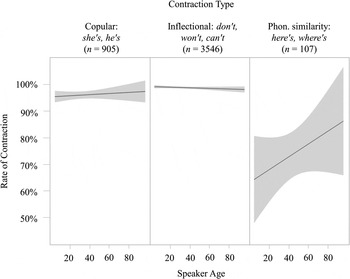
We ran a mixed-effects logistic regression to test the effects of speaker age and contraction type on the use of contractions. This model included speaker age as a continuous variable, type of contraction as a nominal variable (inflectional, copular, phonologically and syntactically similar to there), and the interaction between age and contraction type, as well as speaker as a random effect. The results of this regression show that age does have a significant effect on use of contracted forms, but in the opposite direction from what the age-grading hypothesis predicts. Older speakers are significantly more likely than younger speakers are to use contracted forms (p < .0001). The interaction between age and contraction type reveals that this overall trend is driven by older speakers' tendency to use the contractions here's and where's at higher rates than younger speakers do (p < .0001). Figure 3 illustrates the results.
Rate of contraction by speaker age and contraction type.

Because we know that younger speakers are not more likely to use contractions generally, we can conclude that their frequent use of there's is not part of a more general trend toward contraction. Instead, it appears that a change in progress is taking place, with younger speakers being more likely to use the form there's to introduce plural pivots. In contrast, the use of nonagreeing there is/was does not appear to be increasing over time. This provides further support for our claim that there's exhibits distinctive behavior from existential constructions with full form nonagreement.
Linguistic factors
The effects of linguistic factors on agreement variation further highlight the need to analyze there's separately from other nonagreeing variants. Speakers in our data set were significantly more likely to use there is/was in clauses with negative polarity and strong determiners. Use of there's showed the opposite correlation, patterning together with there are/were.Footnote 5 Claes and Johnson (Reference Claes and Johnson2016), who found as we do that negative polarity conditions nonagreement with there is/was, offered a possible explanation for the pattern. Underlying their cognitive linguistic analysis of agreement variation in existential constructions is the idea that, when referents denoted by the pivot are more conceptually prominent, they are more likely to be treated as subjects, and, as a result, are more likely to occasion agreement. When noun phrases occur in constructions with negative polarity, their reference is said to be “suspended” (Keenan, Reference Keenan and Li1976:318), and they are therefore less conceptually prominent. If negative polarity corresponds to less prominent pivots, then these pivots will be less likely to occur with agreement.
The polarity patterns we find align with Claes and Johnson's (Reference Claes and Johnson2016) analysis; however, the correlations we find between determiner type and nonagreement run counter to what we might predict from their analysis. Strong determiners, such as the and these, point to specific, prominent referents. Their analysis might predict that existential constructions with strong determiners would be more likely to display agreement than constructions with weak determiners would. Instead, our data show the opposite correlation, with strong determiners conditioning the use of nonagreeing there is/was.
Implications of treating there's as a separate variant
Our main proposal, that there's should be treated as a separate variant from nonagreeing there is/was, has implications beyond existential constructions. The way researchers choose to classify individual linguistic forms affects which factors are determined to be conditioning linguistic variation, which then affects the social analyses that researchers propose to make sense of the data. Agreement variation in existential constructions is a fitting case study of a broader issue: it is not always obvious how to conceptualize and therefore categorize variants, but these decisions have important consequences for our sociolinguistic analyses.
While many of the researchers of agreement variation give serious thought to the idea that there's is different from other forms of nonagreement, to our knowledge only Walker (Reference Walker2007) considered it to be a distinct variant for analytical purposes. The choice to group there's with there is/was can lead to generalizations that are inaccurate or incomplete. For example, Britain and Sudbury (Reference Britain, Sudbury, Jones and Esch2002) found that nonagreement is positively conditioned by present tense. This finding would also be supported by our data if we had grouped constructions with there's in the same category as there is/was. However, if we consider only full forms of the verb, ignoring there's, nonagreement occurs more frequently in the past tense than in the present. In Claes and Johnson's (Reference Claes and Johnson2016) and Walker's (Reference Walker2007) studies, the same pattern is observed among full form variants. In this case, when there's is analyzed separately from the other nonagreeing forms, we find that present tense, a factor proposed to positively condition nonagreement in previous studies, is instead best described as negatively conditioning full form nonagreement.
In a similar case, as a part of a larger study on agreement variation in existential constructions, Rupp (Reference Rupp2005) examined negated clauses. She observes that nonagreement with there's/there is in a negated present tense clause is more likely to occur when the form of the negation is not rather than -n't. However, there are linguistic constraints on which form of negation may co-occur with which form of the verb. Not appears overwhelmingly in clauses containing there's, and the contracted form -n't appears exclusively with is (there are no tokens of there'sn't). Rupp's observed correlation between the form of negation and agreement rates is reducible to the finding presented here that nonagreement with there's occurs at much higher rates than does nonagreement with there is. This case illustrates how grouping together two variants that behave differently can obscure patterns in the data.
How we classify variants can also influence our understanding of the social distribution of variation; we can illustrate this using our own data. For example, if we group together instances of there's and nonagreeing there is/was into a single “catch-all” nonagreeing category, both age and education level significantly condition nonagreement. We ran a logistic regression with the same factors as described in the Data and Methods section, but with a binary classification of the variants. The results of this regression show that younger speakers (p < .0001) and less educated speakers (p < .0001) use “catch-all” nonagreement more frequently than their older and more educated counterparts. Furthermore, neither polarity nor determiner type had a significant effect. Had we grouped the variants in this way, we might have come to a different interpretation of this variable. We might have suspected that this is an example of a nonstandard variant becoming more frequent over time, or that it is an example of age grading in which people of working age use a nonstandard variant more frequently than speakers of retirement age do.
The larger issue here is not about which factors turn out to be significant in the statistical model. Instead, the issue is how a sociolinguistic analysis would proceed based on the results obtained.
CONCLUSIONS
The results of this study support the proposal that there's is sociolinguistically distinct from the nonagreeing forms there is/was. The use of there is/was is largely restricted to speakers with lower levels of education. However, nearly all speakers in our data set, regardless of their educational background, use the form there's at least once to introduce a plural pivot, and younger speakers are significantly more likely to use there's over the other forms.
Moreover, there's accounts for 74% of all present tense tokens in this study, suggesting that it is the unmarked form for introducing plural pivots in the present tense. This finding may challenge the reasonable assumption that there's is a straightforward contraction of there and is. If there's is merely a contracted form of there and is, it would suggest either that the unmarked form of this construction in the present tense violates normative grammar rules of English, or that the typical agreement rule we see elsewhere in English does not apply in the same way to existential constructions. This second idea would predict that there is should also be an unmarked way of introducing plural pivots, but this is not what we find. Alternatively, perhaps there's is not a straightforward contraction of there and is. This raises the possibility that there's and there is are morphosyntactically distinct.
Several researchers have explored this possibility, accounting for the differences between there's and there is by suggesting that there's is a “frozen form” or a single lexical unit (Cheshire, Reference Cheshire, Bex and Watts1999; Chomsky, Reference Chomsky1995:384; Crawford, Reference Crawford2005; Walker, Reference Walker2007). Under this analysis, there's is not syntactically decomposable into there and the copula. Although the findings of this study are consistent with the idea that there's is a single lexical unit, there are other potential analyses that are also compatible with our results. For example, it is possible that there's is decomposable: its component parts may be there and -'s, with -'s being a distinct lexical item from is. Under this analysis, we would say the proposed change in progress actually concerns the lexical item -'s. The two analyses differ in their predictions about productivity: under the second analysis, we would expect -'s to productively attach to other words, such as here and where, and we would expect here's and where's to behave similarly to there's with respect to agreement patterns.Footnote 6
Regardless of whether these particular analyses are on the right track, studies on agreement variation in existential constructions suggest the possibility of using the sociolinguistic distribution of a variable to extend morphosyntactic research; that is, we may point to distributional differences to argue that what has been thought of as a single syntactic phenomenon is nonuniform. Just as variationist work integrates proposals about sentence structure to provide explanations for the distributional patterns that are uncovered, there is much room for sociolinguistic research to be brought to bear on morphosyntactic puzzles. Through this process of mutual engagement, we can gain insight that is fruitful for both fields.
APPENDIX
Use of each variant across all social and linguistic factors

Average age and total number of female and male speakers across the five education levels

Results of the multinomial regression where there's served as the reference level

Results of the multinomial regression where there are/were served as the reference level