1 Introduction
The ‘voice quality symbols’ (VoQS) system for the transcription of voice quality was introduced over 20 years ago (Ball, Esling & Dickson Reference Ball, Esling and Craig Dickson1995), and since that time there have been no major revisions to the symbol set, or to the chart on which they are displayed.Footnote 1 At the Oslo conference of the International Clinical Phonetics and Linguistics Association (ICPLA) in 2012, a special panel on the transcription of disordered speech set in motion a major survey of the extIPA symbols (Duckworth et al. Reference Duckworth, Allen, Hardcastle and Ball1990) and the chart that displays them, and the results of this survey together with the suggested changes were reported in June 2016 at the ICPLA conference in Halifax, Nova Scotia, and approved by the membership (see Ball, Howard & Miller, published online 13 April 2017). The current authors deemed that this was also an opportune time to consider revisions to the VoQS system, and these revisions are reported here.
2 The 1994 VoQS chart
The original VoQS chart was divided into three sections (see Figure 1). The top section was intended for voice qualities derived from the airstream used, the middle section was for voice qualities derived from phonatory activity, and the third section for voice qualities derived from supralaryngeal settings. At the foot of the chart is a brief example of how the voice quality symbols can be integrated into a segmental transcription, and how to mark differing degrees of a specific parameter. The remainder of the present section discusses the chart's elements in some detail.
The 1994 VoQS chart.

2.1 Airstream type
This section of the chart had four symbols, marking œsophageal and tracheo-œsophageal speech, speech assisted by an electro-larynx, and pulmonic ingressive speech. The symbols were decided upon by the current authors, with the œsophageal symbol derived from the ligature œ used in some forms of British English spelling, and the tracheo-œsophageal symbol being an iconic representation of the dual route involved here. The electrolarynx symbol echoes the electrical warning ‘flash’ often seen on electrical equipment. The ingressive arrow comes from the extIPA symbols (see Duckworth et al. Reference Duckworth, Allen, Hardcastle and Ball1990, Ball et al., published online 13 April 2017).
2.2 Phonation types
Most of the symbols in this section of the chart were based on suggestions by John Laver (Laver Reference Laver1980). The four main phonation types – (modal) voice, falsetto, whisper, and creak – were denoted by capital letters: V, F, W, and C respectively. Possible combined types were illustrated for whispery voice (or murmur), creaky voice, and whispery creak, where a relevant diacritic was attached to the appropriate capital letter symbol. As was discussed in Ball, Esling & Dickson (Reference Ball, Esling and Craig Dickson1995, Reference Ball, Esling, Craig Dickson, Raymond and Ball2000), the VoQS system distinguished between whispery voice (or murmur), and breathy voice. Breathy voice is commonly encountered clinically as a disordered voice quality. Both whispery voice and breathy voice, and various gradations, can be found contrastively in the languages of the world, although we know of no language that contrasts whispery voice with breathy voice. Following popular usage, the general phonetics literature often uses ‘breathy voice’ as a synonym for ‘murmur’ (e.g. Ladefoged & Johnson Reference Ladefoged and Johnson2015), but the authors of the original VoQS chart decided to adhere to Laver's descriptors in this regard. Whispery voice was symbolized by adding Laver's murmur diacritic to the V symbol, whereas breathy voice had the IPA breathy voice diacritic added although this was almost certainly designed to represent the typical murmur phonation type. This confusion was addressed in a minor revision in 2004 whereby the IPA breathy voice diacritic was transferred to the VoQS whispery voice symbol, and the IPA aspiration diacritic was used to signal atypical breathy voice, even though it implies voicelessness.
Laver's (Reference Laver1980) convention of using an exclamation mark to signal harsh voice was extended to allow the distinction between harsh voice, harsh voice derived from ventricular phonation, and diplophonia (i.e. the perception of two simultaneous pitches due to scarring on the vocal folds causing them to vibrate at different frequencies; but sometimes also used for ventricular recruitment: simultaneous ventricular and normal phonation). Finally in this section, the chart illustrated the use of advanced and retracted diacritics to denote which part of the glottis is involved in phonation following Catford (Reference Catford, Abercrombie, Fry, MacCarthy, Scott and Trim1964), in this case marking anterior or pressed phonation, and posterior whisper.
2.3 Supralaryngeal settings
The largest group of symbols covered the possible supralaryngeal settings that can influence voice quality. The symbols for these mostly came from IPA and extIPA conventions, whose diacritics were attached to a capital-V. These cover a range of typical and nonnormal places of articulation from labialized voice to faucalized (see Figure 1). Nasalized and denasalized voice qualities were also shown by adding relevant diacritics to a capital-V.
The exceptions to this included raised and lowered larynx (using a capital-L symbol), various types of jaw displacement (using a capital-J symbol), and tongue protrusion (using a capital-theta). More details of these are given in Ball et al. (Reference Ball, Esling and Craig Dickson1995).
2.4 Exemplification section
At the foot of the chart there was a brief exemplification of how to integrate these suprasegmental symbols with an otherwise segmental transcription. This is described in more detail in Müller (Reference Müller2006), but the chart illustrated how curly braces (suitably annotated with the desired VoQS symbol or symbols) could enclose the stretch of speech over which a particular voice quality or combination of qualities was operating. Further, this example also demonstrated how numbers (from 1 to 3) could be used to denote how strong a particular quality was (this usage also derived from Laver Reference Laver1980).
3 The 2016 revised VoQS chart
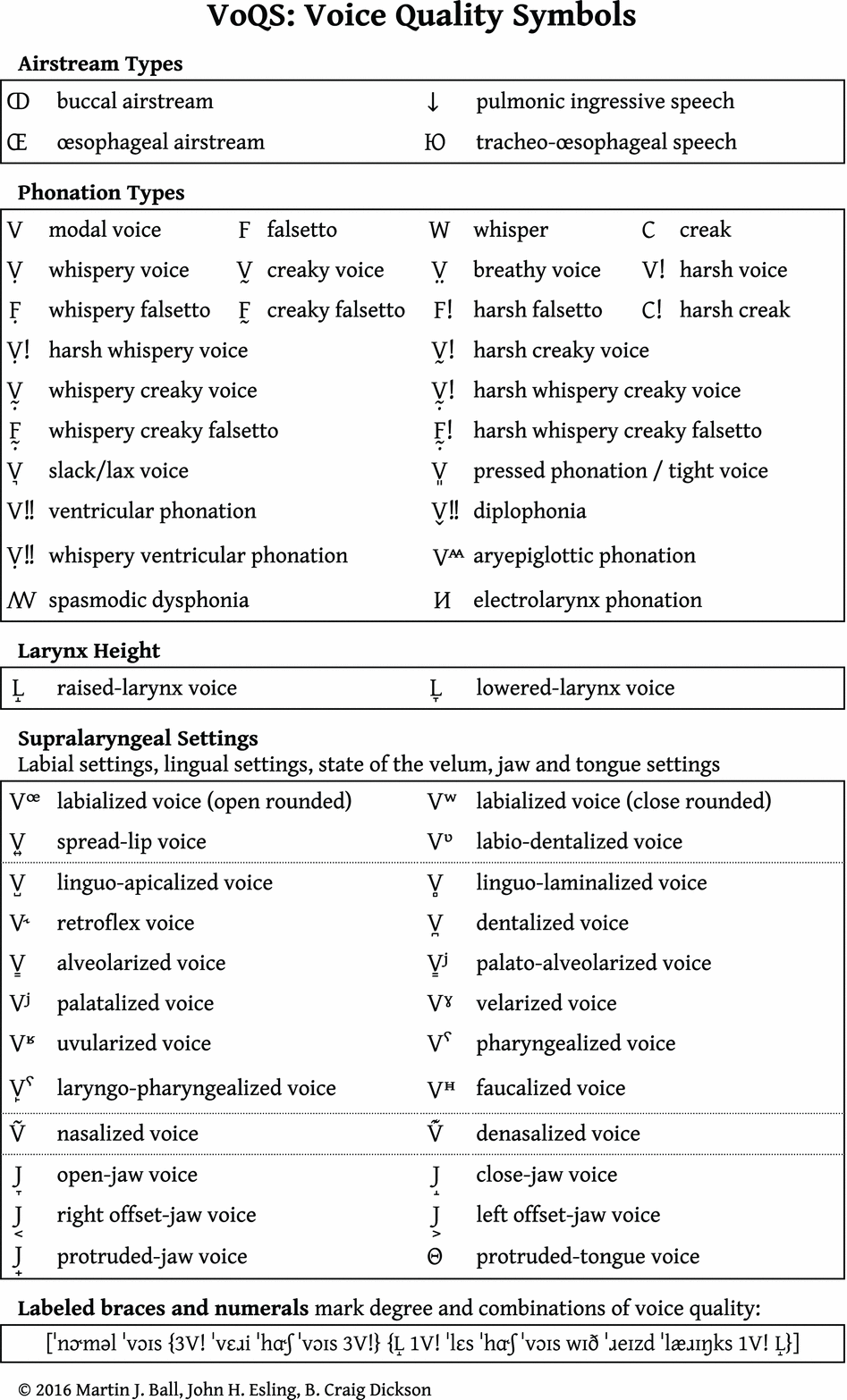
All sections of the original chart were revised (see Figure 2), and these changes are described in the following subsections.
The 2016 revised VoQS chart.

3.1 Airstream type
The symbol for electrolarynx speech was moved from this section of the chart to the phonation section, as it was deemed that the use of the electrolarynx can more properly be considered a type of phonation rather than an airstream. In its place is added a symbol for buccal airstream. Sounds produced on a buccal airstream are often encountered in child speech (for example, the ‘raspberry’) and, while these are usually single sounds within an otherwise pulmonic egressive airstream, short stretches of speech can be made on this airstream. The symbol chosen was intended to suggest the source of the airstream through compression of the cheeks.
3.2 Phonation types
This section has undergone major re-arrangement, with four main phonation types (modal voice, falsetto, whisper and creak) set across the top of the section followed by a range of combinations, including those with added harshness. While there is not room for every possible combination, the examples indicate how symbols for such combinations as harsh creaky falsetto can be constructed.
As noted earlier, the electrolarynx symbol was transferred to this section of the chart. One change from the 1994 chart noted earlier was the 2004 alteration to the symbols for whispery voice and breathy voice. We now feel that this change was not well motivated, and indeed the Vh symbol might well be construed as breath (i.e. voicelessness), rather than breathy voice. Therefore, we have reverted to the original symbols of the 1994 chart. This brings the symbol for breathy voice in line with IPA usage, albeit that Laver's (Reference Laver1980) understanding of murmur was that it was a combination of whisper and voice.
Other than these examples, one symbol has been removed from this section of the chart; the symbol for ‘posterior whisper’. As whisper requires epilaryngeal tube constriction so that glottal opening is necessarily posterior (Esling Reference Esling2005, Esling & Harris Reference Esling, Harris, Hardcastle and Beck2005), this was deemed redundant if not misleading. The removal of both the advanced and retracted diacritics from VoQS was also undertaken, and the description ‘anterior or pressed phonation’ was replaced by ‘pressed phonation/tight voice’. The latter is now symbolized by the use of the extIPA diacritic for fortis or strong articulations. The counterpart to the fortis or strong diacritic is the extIPA lenis or weak one. This is used on another new symbol, for ‘slack’ or ‘lax voice’.
Recent research (for example, Moisik, Esling & Crevier-Buchman Reference Moisik, Esling and Crevier-Buchman2010) has demonstrated that vibrations of the aryepiglottic folds can, as with the use of the ventricular folds, be considered a sound source (see also Esling Reference Esling2005, Esling & Harris Reference Esling, Harris, Hardcastle and Beck2005). Therefore another of the new VoQS symbols is designed to denote aryepiglottic phonation, the symbol itself being a combination of two capital-A letters.
The final new symbol was introduced to denote spasmodic dysphonia (Warner & Bressman Reference Warner and Bressman2007). If so wished, this symbol can be combined with other VoQS symbols to show at which points in a transcription varying voice qualities start and finish. Alternatively, the symbol can be used alone to denote a generally fluctuating voice quality due to irregular spasms during speech. The symbol itself was chosen to suggest an alternating state. The symbol by itself does not indicate types of spasmodic dysphonia (i.e. adductor, abductor, or both). Nor does it indicate whether there is accompanying tremor. To avoid the creation of too many specialist symbols, we would recommend that, in the same way that VoQS symbols can be annotated with numerals to show strength, and that the extIPA system annotates stretches of speech with terms such as allegro, the spasmodic dysphonia symbol could be annotated to show these extra features if needed.
3.3 Supralaryngeal settings
The revised chart has divided larynx height from the other supralaryngeal settings. There are two main reasons for this. First, larynx height is clearly not supralaryngeal. Second, we wished to demonstrate that larynx height can combine with other parameters. Thus, the sections of the chart can now be understood to show more clearly that parameters across sections are likely to combine, while combinations within sections are limited. Combined phonation types are possible (and many of these are now shown on the chart), and some of the supralaryngeal settings can combine. This latter is dealt with by separating the supralaryngeal section into four subsections: lingual and labial articulatory settings, state of the velum, and jaw and protruded tongue settings.
Not all combinations of larynx height with supralaryngeal settings are possible, just as not all airstream types can combine with all the phonation types. For example, current models show that pharyngealized and laryngo-pharyngealized voice are gradations of aryepiglottic sphincter constriction, and that they interact with larynx raising. We assume that transcribers will use these symbols to denote degrees of tightness, combined with degrees of larynx raising. The chart cannot explicitly show which supralaryngeal settings combine more naturally with raised (as opposed to lowered) larynx, but this is true of other combinations across the different sections of the chart. As with any form of phonetic transcription, one has to rely on transcribers’ knowledge of the speech production process to inform their choice of possible as opposed to impossible combinations of symbols.
3.4 Exemplification section
The example at the foot of the chart has been altered slightly, to show a combination of harsh voice and raised larynx, rather than lowered larynx. As described in the previous section, certain voice types combine more naturally with different degress of larynx height, and the original example would be a less likely combination than the replacement. The example has also been simplified somewhat.
4 Conclusion
The purpose of this revision is to bring the VoQS symbols up-to-date in terms of current research on voice quality, to increase provision for transcribers of voice disorders, and to produce a more clearly organized VoQS chart.
Acknowledgements
The authors would like to thank Kirk Miller for his help with designing the new chart, and the anonymous reviewers for their comments.
From August 2017, Martin Ball's affiliation is Bangor University, Wales.